
Home Blog Page 337

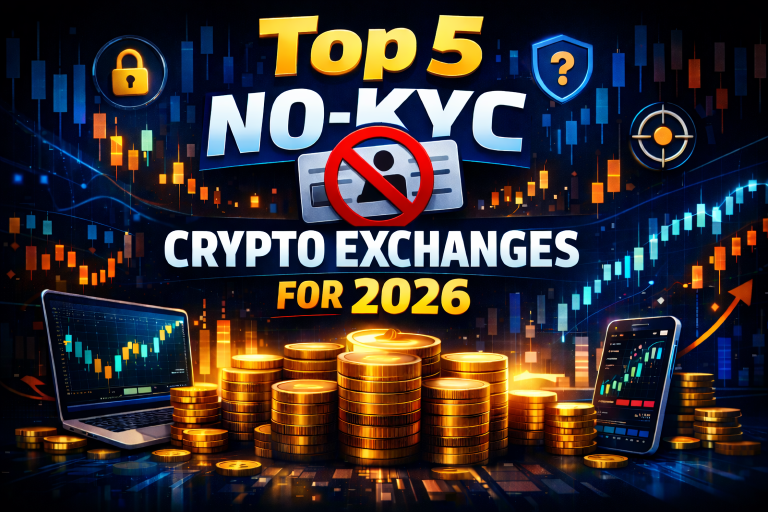
Top 5 No-KYC Crypto Exchanges For 2026

0

Want to trade crypto privately in 2026? That’s actually something any serious cryptocurrency trader should consider. Nowadays it feels like every platform wants your government ID, a selfie, or a utility bill. 

The hunt for a private, no KYC exchange that doesn’t ask for your info can feel endless and tough, but that doesn’t mean they are non-existent. The cool thing is, some exchanges still care about privacy. 

Here are the top five no KYC crypto exchanges where you can trade in 2026 without giving up your personal info.

Our Top Picks for 2026: A Quick Look

Exchange Type Key Privacy Feature Best For Geo-Restrictions?
Bitania Non-Custodial P2P IP protection via Tor Overall best for pure privacy Worldwide
Bisq Decentralized P2P No account, runs over Tor Bitcoin purists & decentralization Worldwide
MEXC Centralized (CEX) 10 BTC daily withdrawal no KYC Massive altcoin selection Yes (unavailable US)
Changelly Non-Custodial Swap Swaps with just an email Fast crypto-to-crypto swaps Yes (No US)
dYdX Decentralized (DEX) Connect wallet & trade Anonymous derivatives trading Yes (No US/Canada)

1. Bitania: Overall Best No-KYC Exchange 

After looking at a bunch of options, Bitania looks like the best no-KYC exchange for 2026. It’s peer-to-peer and really focuses on privacy. If you care about keeping your info private while trading, you should check it out.

This P2P exchange that cares about privacy is building a really solid reputation by putting user anonymity first.

  • How It Works: It’s truly P2P —you deal directly with other people. The site helps by giving you a secure escrow system, but it never actually controls your money. 
  • The coolest thing is that it hides your IP address with its built-in Tor. You don’t even need an email to sign up – just pick a username and you’re good to go.
  • What You Can Trade: They have over 200 crypto tokens, like Monero (XMR), Bitcoin, and some other important coins.
  • A couple things to keep in mind: you’ll need to wait for someone else to trade with you, so it’s not always instant. Plus, Bitania’s still pretty new—it’s still proving itself over time.

Bottom line? If you care about privacy and want an easy peer-to-peer setup, Bitania’s your best bet.

2. Bisq: For Those Serious About Decentralization

Now, when people talk about real decentralized exchanges, Bisq pretty much sets the standard. It’s open source and runs on a decentralized network. 

  • How does it work? All you need do is download their software onto your computer and you’re ready to go. It hooks you up with other users through Tor. Each trade is a deal made directly between you and another person. 
  • No accounts are needed, and you don’t have to give an email. There aren’t any central servers involved. Tor hides your IP address, and you can check out the code yourself because it’s open source.
  • What you can trade: Mostly Bitcoin, but it works with a bunch of other coins too.
  • The trade-offs: Bisq isn’t the easiest thing to pick up. The interface feels clunky, and if you’re just starting out, you’ll notice some trading limits.

Our Verdict? If your main goal is total decentralization and staying out of anyone’s control, Bisq really stands out.

3. MEXC: The Liquidity Powerhouse  

If you’re after a huge selection of altcoins and don’t want to jump through verification hoops right away, MEXC is tough to beat. 

  • How does it work? It works like most big exchanges — just create an account and you’re good to trade, no KYC needed, up to a daily withdrawal of 10 BTC. 
  • Their tier system lets you do quite a bit before you hit any verification roadblocks, though they’ll ask for your info if your activity sets off any alarms.  
  • Now, what can you trade? Large number of coins – over 1,600 cryptocurrencies, which makes it one of the biggest altcoin markets out there. 
  • Just a heads up: If you’re in the US, you’re out of luck with MEXC, and don’t try sneaking in with a USA VPN — that’s against their rules.  

Bottom line: for altcoins hunters outside the US, MEXC is a treasure trove you can access without handing over your passport. 

4. Changelly: For Fast, Simple Swaps  

Sometimes you don’t want to fuss with opening yet another exchange account. You just want to swap one coin for another, fast – that’s where Changelly shines. 

  • How it works: Head to Changelly site, pick your crypto pair, type in the amount and your wallet, send your coins — done. The swap happens automatically, an email is your only point of contact.  
  • No ID checks for crypto-to-crypto trades, but you will need to verify if you’re buying with fiat. The selection’s solid too, with support for over 200 coins.  
  • The Catch? Like MEXC, Changelly locks out US users. Also, the speed and convenience comes at a cost –their rates can take a noticeable bite compared to when you’re using a standard exchange, so for large sums, it’s not the best choice.  

Final Word: Consider Changelly your crypto quick stop – ideal for rebalancing your portfolio without all the login drama.

5. dYdX: Trade Derivatives Without Giving Up Your Privacy

If you’re looking to trade with leverage or short the market, and you don’t want to hand over your personal info, dYdX is where a lot of serious traders go. 

  • How It Works? Here, you’re not a user on a platform; you’re just a trader on a protocol. No one’s holding your coins for you; just connect a Web3 Wallet like MetaMask – no sign-up form in sight, no KYC, and you’re in. Your keys, your coins, your risks.
  • Privacy is absolute here because the protocol interacts only with your public wallet address; it has no idea who you are.
  • Coins You Can Trade – You’ll be trading perpetual contracts (‘perps’ as some call it) on over 35 major tokens, with the ability to use significant leverage, which is power but a dangerous tool. 
  • A Word of Caution: this is expert-level stuff. Leverage multiplies losses as fast as gains, and it’s a quick way to get wrecked. Also, traders in the US and Canada are officially barred from using the platform.

Bottom line? In the realm of anonymous, high stakes derivatives, dYdX is a reigning champion; but just know the arena is brutal.

How to Choose the Best No-KYC Crypto Exchange

Picking the best no KYC exchange isn’t about which one’s the overall best for everyone; choose what fits you best, must-have features over features you can skip. Also think about what features you’re giving up:

Privacy vs Ease of Use

  • For Top Privacy: Try platforms like Bisq. No account or email. Uses Tor. Steeper learning curve, slower trades.
  • Balanced Privacy: Platforms like Bitania.com. Privacy features in a familiar P2P interface. Better liquidity and speed.

Supported Assets & Payment Methods

  • Cryptocurrency Diversity: From Bitcoin-only (Bisq) to broad selections (Bitania, MEXC).
  • Payment Methods: Essential for P2P success. Look for global options (bank transfer, Wise) and local methods for your region.

Security Model

  • Non-Custodial (You Control): Your funds stay in your wallet. Platforms: Bisq, DEXs. You are your own bank.
  • Escrow-Based: The platform holds crypto in escrow during the trade. Platforms: Bitania.com, other P2P marketplaces. You must trust their system.

Before you put money in:

  1. Look closely at all the fees (withdrawal, trading fees, even check the escrow).
  2. To figure out if customer support’s actually real people, respond on time, and are helpful, try contacting them to see how they respond.
  3. Check independent reviews on forums like Reddit (not the reviews on the platform) to know what real users think about the exchange. Search for “problem” or “withdrawal stuck.”

P2P vs. OTC: A Quick Comparison

You are almost certainly looking for a P2P exchange if you want to trade privately without giving out KYC. OTC desks are not a realistic option for no KYC trading due to high minimums and mandatory KYC.

Feature P2P Exchanges (For You) OTC Desks (For Institutions)
Who It’s For Individual traders, privacy advocates. Hedge funds, whales, corporations.
Transaction Size Flexible, often small. Least amount often from $100,000 up.
Access & KYC Accessible, often no KYC. Heavily gated. Requires extensive KYC.
Privacy Type Identity privacy (no KYC). Trade privacy (hides large orders).

Staying Safe: 3 Non-Negotiable Rules

  1. You Are Your Own Bank: On non-custodial platforms, you hold your keys. Lose them, lose your funds so you have to guard your passkeys jealously.
  2. Do Your Own Research (DYOR): Policies change. An exchange that doesn’t require KYC today might ask for it later.
  3. Watch out for deals that seem too good; stick with platforms that have good reviews. Try a small transaction first.

FAQs

Are no-KYC crypto exchanges legal?

In most jurisdictions, using them is legal. However, exchanges often restrict access from certain countries (like the US) to avoid regulatory conflicts. Your local laws always apply.

What’s the main risk of No KYC crypto exchanges?

The primary risk is the lack of recourse. If the platform is hacked or freezes your funds, you have no verified identity to claim your assets. Non-custodial platforms can help with this.

Should you use a VPN to get to an exchange that’s blocked?

We really don’t recommend it. Exchanges like MEXC prohibit VPN use. If detected, your account can be suspended and funds locked. Use a platform that officially accepts users from your region.


YouTuber Says Why Focus on XRP to $100 When $2 Is Real

0

Mason Versluis, a prominent crypto YouTuber, remains big on common sense and a focus on the “real things” after Jake Claver’s $100 call for XRP in 2025 fails.

For context, DAG CEO Jake Claver insisted early in December that he is 99.99% certain XRP will soar to $100 per coin before the end of 2025, despite the odds heavily stacking against the prediction. XRP was below $2, and the broader market mood was bearish, yet he remained steadfast in his extremely bullish outlook.

While Claver has come out to acknowledge his failed outlook, Versluis shared a “common sense” theory that XRP enthusiasts should bear in mind.

No Under $2 XRP Predictions

The pundit noted that instead of focusing on the failed three-digit price predictions, enthusiasts should look at the current price just under $2. XRP started January 2025 around $2.08 but quickly moved to $3.40 before the end of the month. Meanwhile, after reaching its yearly high of $3.66 in July, it corrected extensively to close 2025 at $1.84, representing an 11.5% YTD decline.

Notably, he highlighted that community members and analysts alike were calling for higher prices for XRP, but none foresaw the drop below $2 by December 2025. According to him, that is why he does not call prices.

“We just look at the fundamentals,” he stated, adding that those incessantly projecting outrageous price targets and timelines for XRP would always end up being wrong.

Focus on the Real Things

Furthermore, he added that instead of focusing on XRP’s price, enthusiasts should turn their attention to what matters, some of which are XRP DeFi and ETFs. He insisted that this is what actually influences demand for the coin.

Additionally, he urged holders to shift their expectations from ambitious targets to little but crucial steps for continued growth. Price targets like $4, which would see XRP finally defy its all-time high of $3.84 in 2018, should be the primary focus.

He also addressed the NDA topic, which some have misunderstood. According to him, Ripple has some NDAs with some major institutions. However, he noted that no random person making content online has a non-disclosure agreement with Ripple regarding the price of XRP.

When Can XRP Hit $100?

Meanwhile, Versluis went further to highlight when XRP could reach $100 per coin. In the video, he identified three barriers preventing the coin from rallying to the three-digit value.

One hindrance to this is the “company problem.” The pundit stated that if XRP surges to $100 overnight, multiple addresses in the XRP Rich List would be worth trillions of dollars. This means that firms like Binance and Ripple, as well as whales holding large amounts of XRP, would attain staggering valuations.

He also noted that the world is not ready for the innovation that XRP brings. Versluis called XRP the “plumbing of the new financial system,” but said we are still early and that adoption is in its infancy.

Finally, he identified the reputation problem as the final hindrance to XRP reaching $100. The asset gained negative sentiment because it is attacking the roots of the problems in the traditional financial system.

On the timeline, he did not mention any. According to him, it would be “foolish” of him to predict when XRP would reach $100. He added that it would happen when the problems he mentioned are resolved, and the asset receives the required demand to bring the price into reality.

Where Could XRP Go in 2026, Pundit Shares Insights from Bitwise CIO and Inversion CEO

0

Where could XRP and the broader crypto market go in 2026? Brad Kimes from Digital Perspectives presents suggestions from Bitwise CIO and Inversion CEO.

Notably, the crypto market faced a difficult year in 2025 despite a strong start. Specifically, heavy losses in the final quarter erased earlier gains and dragged down overall performance. 

Crypto Underperformed in 2025

The market reached a high of $4.27 trillion in early October 2025 but ended the year at $2.93 trillion, marking a $1.34 trillion decline from its peak. Over the full year, the market lost $250 billion. This represented a 7.85% drop overall. Expectedly, XRP followed the broader market trend, declining 11.51% in 2025. 

However, as 2026 begins, sentiment has started to improve. Several analysts and industry leaders now believe the market could recover, with XRP in a proper position to take part in the expected rebound.

Most recently, Brad Kimes, founder of Digital Perspectives, shared two important commentaries in this regard, specifically spotlighting views from Bitwise Chief Investment Officer Matt Hougan and Inversion CEO Santiago Roel Santos.

Bitwise CIO Says 4-Year Cycle Over, Expects Bullish 2026

Kimes first presented a clip of Hougan, who claimed that the traditional four-year crypto cycle may be over. This aligns with views shared by Strategy’s Michael Saylor and CryptoQuant’s Ki Young Ju. Hougan said the market has entered a longer phase that resembles a 10-year upward trend. According to him, new forces now influence crypto more than past cycles.

Hougan called attention to several major developments responsible for this change. Specifically, he highlighted the launch of spot Bitcoin ETFs in January 2024, followed by regulatory progress in January 2025. 

He also mentioned the growing role of stablecoins and tokenization, which he described as strong and lasting growth drivers. According to Hougan, these factors now overshadow the forces that once defined the four-year cycle.

Although Hougan said the four-year cycle still influences investor thinking, he clarified that it no longer controls market direction. To him, the belief in the cycle helped hold prices down in 2025. However, Hougan expects the crypto market to rise in 2026, but with steady gains rather than sharp rallies, lower volatility, and normal price swings.

Hougan also discussed institutional adoption. He explained that large financial firms move much more slowly than retail investors. He noted that Morgan Stanley, Merrill Lynch, Wells Fargo, and UBS only recently approved Bitcoin investment products, even though ETFs launched nearly a year earlier. 

From Bitwise’s experience, institutional clients usually commit funds after eight meetings, often held quarterly. Many firms that began talks when ETFs launched are only now reaching that stage. Hougan said this slow institutional pace, alongside fast retail trading, explains much of the market’s uneven movement.

Inversion CEO More Bullish on XRP Than Ethereum

After presenting Hougan’s comments, Kimes shared remarks from a recent Empire podcast episode. He pointed out that the show’s hosts and guests have long supported Ethereum, Solana, and Bitcoin, while criticizing Ripple and XRP. Kimes said that attitude has begun to change.

Specifically, during the Empire podcast episode, Inversion CEO Santiago Roel Santos said XRP has a stronger chance than most top-10 crypto networks to return to its all-time high, even if the broader market weakens. 

He contrasted this view with his bearish stance on Ethereum, saying he sees little chance of ETH reaching its previous peak. Santos criticized Ethereum’s product approach and argued that centralized product decisions work better than fully decentralized strategies.

He also questioned Ethereum’s valuation, saying the market value of around $350 billion lacks strong support. By comparison, he highlighted XRP’s lower valuation and compared its scale to Visa. Santos said Ripple has more room to use its currency to acquire businesses, grow distribution, and strengthen its products.

Solana Forecast for Jan 2: Here are Zones SOL Needs to Hold

Solana shows early-year strength with rising price action, while heavy short liquidations highlight growing pressure on bearish traders.

Solana (SOL) starts the new year with strong upward momentum, currently trading at $128 after a 3.0% gain in the past 24 hours.

Over this period, SOL fluctuated between a low of $124.22 and a high of $128.47, closing near the peak of its intraday range, signaling bullish sentiment and active buying interest among traders. This upward movement reflects SOL’s ability to recover and capitalize on market optimism early in 2026.

Notably, over the past week, SOL has climbed 4.9%, while the 14-day performance shows a more modest 2.6% gain, indicating that the recent rally is part of a continuing recovery after a prior downtrend.

Key levels to watch include the 24-hour floor at $124.22, which serves as immediate support, while the intraday high of $128.47 acts as resistance. Maintaining above this support is crucial for sustaining the bullish trend. Can SOL hold on to support?

Can SOL Defend Support?

Solana is attempting to stabilize after a steep corrective phase, but technical signals suggest the recovery remains fragile. The Supertrend indicator is still firmly bearish, with overhead resistance near $141.5, highlighting where sellers continue to regain control. Price action shows SOL reclaiming ground from recent lows, yet it remains capped below a cluster of Fibonacci retracement levels.

Solana Prediction
Solana Prediction

On the downside, the $124–$127 zone stands out as immediate support, aligning with key retracement levels. A failure to hold this area could expose Solana to a deeper pullback toward the $116 region, which marks a major swing low.

On the upside, resistance rests near $131, then higher around $141.5 and $146. A decisive break above these zones would be necessary to confirm a broader bullish reversal, while rejection keeps SOL range-bound with downside risks still in play.

Solana Liquidation Data

Elsewhere, Solana’s liquidation data reinforces the idea that recent price action has put significant pressure on short sellers, especially on higher timeframes. In the past hour, total liquidations reached $93.42K, with shorts accounting for $68.57K, compared to $24.85K in long liquidations.

Solana Liquidation
Solana Liquidation

The trend becomes more pronounced over longer periods. The 4-hour window recorded $7.40M in liquidations, almost entirely from shorts. Over 12 hours, short liquidations hit $9.44M versus $823K in longs, while the 24-hour data shows $10.02M in shorts liquidated compared to $1.86M in longs.

Pundit Explains How to Turn $1 Million in XRP into Real Cash Flow

0

A market commentator has explained how XRP investors could turn $1 million in XRP into real cash flow for possible retirement.

Notably, speculation about XRP reaching $100 has led many investors to believe that such a price could lead to early retirement. Some believe holding around 20,000 XRP would be enough to secure long-term comfort. However, not everyone in the community agrees with this.

As recently reported by The Crypto Basic, one community pundit argued that holding 20,000 tokens at a $100 XRP price does not automatically mean financial freedom. According to him, taxes, regular bills, and daily living costs can quickly reduce such wealth. He also pointed out that inflation steadily lowers the value of money over time. 

As a result, he believes most people need between $5 million and $7 million to live without financial stress. The pundit added that age should also come into consideration, since younger investors need their money to last much longer. 

Borrowing Against The $1M in XRP

In response, Cypress Demanincor suggested that it is less about price and more about income. He said investors often focus too much on XRP’s price and ignore how assets can generate steady cash flow. 

According to him, holding $1 million worth of XRP does not mean selling it for fiat. Instead, he suggests investors should use their XRP to earn income while keeping their holdings intact. Demanincor explained that XRP holders can lend their tokens on decentralized lending platforms to earn yield. 

He advised that investors should not borrow the maximum amount possible. Instead, they could borrow about 65% of the XRP’s value, rather than pushing closer to 75%, to reduce liquidation risk. With this, an investor with $1 million in XRP could borrow around $650,000 in stablecoins, such as USDC.

He also stressed that it is important to spread risk by using more than one stablecoin by diversifying to other options like USDT. Now, from the $650,000 borrowed, Demanincor shared how investors could create different income streams.

How to Generate Cash Flow with the $650K

He said an investor could use about $300,000 to buy a property. After the purchase, the owner could tokenize the property through a platform like Lofti. This could generate yearly returns of about 4% to 8%. 

On top of this, short-term rentals tied to the property, such as Airbnb-style stays, could bring in more than $1,000 per month in additional income. He called this a mixture of traditional real estate and newer DeFi tools.

For the remaining $350,000, Demanincor recommended stablecoin liquidity pool strategies that use looping. Specifically, he said a 10% annual return for this leftover capital remains realistic on well-established decentralized exchanges. 

At that rate, $350,000 could generate around $35,000 per year. He added that this income could move into other assets or support staking or running a node, which may offer returns between 4% and 12% per year.

Conclusively, Demanincor explained that investors can use the yield from these strategies to repay the loan taken against their XRP. This helps manage risk, reduces debt, and keeps the XRP holdings untouched. To him, price movements distract investors from the real objective. However, it is important to note that these lending protocols do feature some elements of risk, so investors should carry out proper research before utilizing any of them.

Legendary Trader James Wynn Predicts PEPE to Hit $69B Market Cap: Here’s the Corresponding Price

0

James Wynn, a prominent legendary crypto trader, believes leading meme coin PEPE has the potential to hit a $69 billion market cap.

Notably, the global crypto market has remained under pressure for the past three months, losing $870 billion since October 2025. Despite short-lived rebounds across some assets, the total market cap now stands at $2.98 trillion. During this period, meme coins have suffered some of the biggest losses as investors avoid speculative trading.

In early October, the meme coin market held a combined value of $76.25 billion. Today, the figure has dropped to $39.63 billion, resulting in a $36.62 billion loss in three months. 

Expectedly, PEPE accounts for a notable portion of that decline. The token’s market cap fell from $4.12 billion in early October to $2.13 billion at press time, wiping out about $2 billion.

James Wynn Expects PEPE to Hit $69B Market Cap

Despite this decline, veteran trader James Wynn believes PEPE could launch a comeback if the broader bull market continues. Wynn shared this sentiment on X, stating that he does not believe the bull cycle has ended. Based on this belief, he expects money to flow back into leading meme coins and solid altcoins, with PEPE possibly benefiting.

Wynn compared PEPE’s current position to Shiba Inu’s performance during the last bull market. He noted that SHIB reached a $41 billion market cap in the previous cycle and argued that PEPE could move beyond that level. 

Wynn also highlighted how quickly SHIB climbed, rising from a $3.5 billion valuation to $41 billion in less than one month. This represented a gain of 11.7x. The legendary trader sees this historical move as evidence that PEPE could achieve a much higher valuation.

According to Wynn, social engagement also gives PEPE an advantage. Notably, he stressed that social activity plays an important role in meme coin performance and pointed out that several exchanges use PEPE in their branding and promotional posts to boost engagement and attract users. 

Wynn also referenced Dogecoin’s previous peak market cap of $88 billion to support his prediction. Considering these factors, he set a $69 billion market cap target for PEPE.

At its current valuation of $2.13 billion, PEPE would need to add $66.87 billion in market value to reach that target. That move would represent a 3,139% increase. 

PEPE Price at $69B Market Cap

Reaching a $69 billion market cap would place PEPE as the eighth-largest crypto by market value, allowing it to surpass top-10 assets such as Dogecoin, Cardano, and Tron if their valuations stay the same. At present, PEPE ranks 38th among the largest crypto assets.

With a circulating supply of 420.68 trillion tokens, PEPE’s $2.13 billion market cap places its price at $0.00000506 per token. If the market cap climbs to $69 billion with the same supply, PEPE’s price would rise to about $0.0001640 per token. 

To put things into perspective, a $10,000 investment at today’s price would grow to roughly $3.24 million. However, Wynn’s prediction remains highly speculative, and investors should not regard it as investment advice.

Iran Considers Using Cryptocurrencies for Overseas Weapons Sales: Report

0

Iran is exploring the use of cryptocurrencies as a payment method for overseas weapons sales, according to an FT report.

Specifically, the proposal would apply to exports of advanced military hardware, including ballistic missiles, naval vessels, and other sophisticated defense equipment.

Defense Export Agency Outlines Payment Options

The initiative originates from Iran’s Ministry of Defence Export Center, known as Mindex, the state agency responsible for managing the country’s official arms exports.

According to the report, Mindex has indicated its willingness to negotiate contracts settled in digital currencies. In addition to crypto payments, the agency is open to barter arrangements and transactions in Iranian rials, signaling an effort to expand beyond conventional financial systems.

This payment framework was first introduced in 2025, according to the Financial Times. While digital assets are widely used in commercial trade, their proposed role in weapons exports remains uncommon.

As a result, analysts view the policy as a rare public signal from a government willing to link cryptocurrency directly to arms sales.

Scope of Mindex’s Global Operations

Mindex operates as a state-run defense exporter with a broad international footprint. The agency reportedly maintains commercial relationships with buyers in 35 countries.

Information published on its official website highlights an extensive product portfolio that includes missiles, rockets, ammunition, and specialized military vessels. Taken together, this catalog underscores the scale of Iran’s defense export ambitions.

Sanctions Shape Iran’s Trade Strategy

The move comes amid long-standing sanctions imposed by the United States, the United Kingdom, and the European Union. These restrictions target Iran’s missile program, oil exports, and access to global banking networks.

Consequently, with traditional financial channels constrained, Tehran has increasingly relied on alternative trade mechanisms, including barter systems and digital assets such as Bitcoin.

At the same time, sanctions enforcement has intensified. Last month, U.S. authorities announced penalties against 29 vessels accused of facilitating covert Iranian oil shipments. 

According to U.S. officials, the vessels were part of a so-called shadow fleet to bypass restrictions on petroleum exports.

Mindex Downplays Sanctions Impact

Despite the expanding sanctions regime, Mindex has publicly downplayed its impact on arms contracts. 

In particular, statements published on the agency’s website claim that agreements can still be executed without disruption, suggesting that Iran’s policy framework allows deliveries to proceed despite international constraints.

Cryptocurrencies and Iran’s “Shadow Network”

Interestingly, Iran’s reliance on digital currencies predates the current proposal. For several years, the country has used cryptocurrencies to reduce dependence on traditional financial systems.

For context, in September, the U.S. Treasury identified two Iranian nationals linked to more than $100 million in cryptocurrency transactions tied to oil sales conducted between 2023 and 2025. U.S. officials characterized the activity as part of a broader financial “shadow network” supporting the Iranian state.

Taken together, these developments illustrate how Tehran continues to adjust its economic and trade strategies. As sanctions persist, digital assets appear to be playing an increasingly central role in sustaining Iran’s international transactions.

Bitcoin Analysis for Jan 2: Where’s BTC Headed as Futures Outflows Flood Market

Bitcoin momentum is positive, but negative futures outflows over multiple periods suggest caution for short-term traders.

Bitcoin (BTC) has seen a measured gain of 1.4%, trading around $88,761. Over the last 24 hours, BTC moved between a low of $87,489.65 and a high of $88,979.05, with the price trading at the upper end of its range.

Zooming out, Bitcoin has shown modest gains of 1.6% over the past 14 days. These figures indicate that the crypto firstborn is potentially preparing for a breakout. Despite short-term stability, the longer-term trend still shows a cautious market, with 30-day and 1-year declines of 5.2% and 7.0%, respectively.

Key levels to watch are the 24-hour low at $87,489.65 as immediate support and the intraday high at $88,979.05 as short-term resistance. If buyers can push BTC above this range with conviction, a stronger bullish phase could unfold.

Bitcoin Price Analysis

On the technical end, the 9-day SMA at $87,891 is providing near-term support, while resistance at the daily high of $89,011 is a key level BTC must surpass for a potential continuation of the bullish trend. Trading activity is steady, with momentum indicators showing mixed signals as buyers and sellers weigh in.

Bitcoin Analysis
Bitcoin Analysis

The MACD indicates weakening bearish momentum. Ultimately, a break above $89,011 could open the path toward $90K, while a drop below the SMA support may test $87K and further downside levels.

Traders should watch these key zones closely, as short-term direction will likely hinge on BTC maintaining support or breaching resistance in the coming sessions.

Bitcoin Liquidation Data

Meanwhile, the recent futures flow data for Bitcoin highlights mixed short-term sentiment and some profit-taking pressure over longer periods. In the last 30 minutes and 1 hour, there were modest net inflows of $22.11M and $3.37M, respectively.

Bitcoin Futures Flows

However, over the 4-hour to 3-day horizons, net outflows dominate. Specifically, the 4-hour period saw a net outflow of $174.32M, the 8-hour period $258.14M, and the 12-hour period $373.61M. Meanwhile, the 24-hour and 3-day periods showed net outflows of $206.04M and $279.76M, respectively.

Finance Coach Says XRP Under $2 Is One of the Greatest Blessings of Our Lifetime

0

A widely followed finance coach in the XRP community has described XRP’s current price below $2 as a rare long-term opportunity.

The comment aligns with a popular mindset among some investors who see the present market phase as a time for accumulation rather than a moment for anxiety.

XRP Below $2 Seen as a Long-Term Opportunity

In a tweet, Coach JV, a well-known commentator within the XRP community, said XRP trading under $2 is “one of the greatest blessings of our lifetime”. Accordingly, he disclosed that he is still accumulating, capitalizing on the supposedly low price.

His view suggests the market has yet to fully price in XRP’s potential role in global payments and financial infrastructure. Rather than focusing on short-term price swings, which have frustrated many, his message emphasizes patience and positioning ahead of adoption cycles.

Portfolio Built Around Core Convictions

Alongside his XRP outlook, Coach JV shared his crypto asset allocation. His top crypto holdings include XRP, Bitcoin, WLFI, Solana, XLM, HBAR, and VET. This highlights a mix of large-cap assets and infrastructure-focused projects.

On the equities side, he highlighted American Bitcoin Corp (ABTC) and Twenty One Capital (XXI) as his top stock positions. Notably, both are leading crypto treasury firms.

The takeaway from this disclosure is the importance of building exposure to assets that fit into a long-term strategy.

Systems Over Speculation

Meanwhile, a key theme in Coach JV’s commentary is structure. He says it’s not about chasing the next big crypto, but about creating systems that encourage discipline. Discipline, in turn, leads to steady cash flow, which ultimately brings freedom.

He uses cash-value life insurance as a cornerstone of his family’s long-term wealth, keeps very low personal debt, and evaluates investments carefully to stay ahead of inflation.

In an emotional market, this approach resonates with XRP holders who see today’s prices as part of a long-term journey.

As XRP trades under $2, Coach JV’s message reminds the community that the key is not perfect market timing but building a disciplined system that can endure multiple market cycles.

Bullish Factors for XRP

Notably, his view that XRP’s current price is a “great blessing” to humanity is widely shared among other market commentators. In December, XRP influencer Alex Cobb said buying XRP below $2 is synonymous with “stealing it,” suggesting the price is extremely low compared to its potential.

Cobb cited multiple catalysts for an XRP price surge, including confirmation from the White House that the CLARITY Act markup is scheduled for January 2026. Proponents see the Act as a turning point, creating crypto regulations and boosting institutional participation.

Other factors supporting Cobb’s bullish view include growing demand for XRP spot ETFs, which now hold around $1.16 billion in assets, and rising interest in XRP treasuries from companies like VivoPower and Wellgistics Health. These developments could limit XRP supply and support price growth, according to XRP pundits.

Bitwise Snubs Cardano In New Crypto ETFTracking Tron, ZEC, and 9 Others

0

Prominent asset manager Bitwise filed for a new crypto ETF for 11 separate major altcoins like Zcash and Tron but omits Cardano.

Notably, Bitwise filed the N-1A form with the US Securities and Exchange Commission (SEC) on Tuesday, seeking to add to its ever-expanding collection of crypto ETFs. Having already launched funds tracking the largest cryptocurrencies, such as Bitcoin and XRP, the asset manager has turned its attention to several altcoins.

No Cardano in New Filing

The new application was for 11 altcoins, providing investors with diverse options. Specifically, the filing covered cryptocurrencies like Tron (TRX), Ethena (ENA), Zcash (ZEC), AAVE, Hyperliquid (HYPE), and SUI. Others include Bittensor (TAO), Uniswap (UNI), NEAR, Canton (CC), and Starknet (STRK).

However, a major crypto asset, Cardano, was not on the list. Top Cardano-focused trading platform TapTools first highlighted this omission in a recent X post, eliciting reactions from the broader cryptocurrency community.

Notably, this is worth highlighting because sentiments are emerging that Bitwise seems to be snubbing Cardano for even lower-ranked assets. The asset manager offers products tracking Bitcoin, Ethereum, XRP, and Solana, but has skipped the 10th largest digital asset by market cap in favor of less valuable cryptocurrencies.

The only funds that offer Bitwise clients exposure to Cardano are the Bitwise 10 Crypto Index ETF (BITW) and the Bitwise physical Cardano ETP in Europe. The former is an NYSE Arca-traded investment product that tracks the top 10 cryptocurrencies by market cap. However, ADA only has a meager 0.52% weight in the fund, largely centered around Bitcoin (75%) and Ethereum (15%).

Community Reactions

“The Crypto Cartel doesn’t want Cardano to win because it’s actually decentralized,” a reaction claimed. The user also noted that this was why USDC and Chainlink are staying away, and that the top exchange, Coinbase, did not list the Cardano-native Midnight (NIGHT) token.

Some others supported this sentiment, stating that Cardano was a threat. Meanwhile, another reaction insisted this was not important, as ADA would ultimately see more ETF applications focused on giving investors access to the asset.

However, some pointed out that the omission was due to Cardano’s lack of demand. Others called the move “smart,” expressing concerns over the token’s use case and high fees.

Bitwise “Strategy” ETF Details

Meanwhile, Bitwise disclosed that the funds will trade in the NYSE Arca, offering both direct and indirect exposure to the aforementioned coins. The asset manager will allocate 60% of the product’s assets under management to buying the underlying coins, with 40% assigned to other ETFs and derivative products.

The incessant launch of crypto-related products aligns with Bitwise’s bullish stance on the sector’s progression. Recently, Biwise CIO Matt Hougan predicted that Bitcoin would reach new all-time highs in 2026, defying its historical four-year cycle.