Home Blog Page 35

XRP Whales Scoop Up 300 Million XRP, Driving Its Valuation by $24B

0

XRP whales are making a major return to the market, with more than 300 million XRP accumulated as the coin stages one of its strongest price rallies of the year.

Analyst Ali Martinez highlighted the whale activity in a post on X, saying whales are going crazy. Citing data from Santiment, he revealed whales had scooped up more than 300 million XRP in just four days.

The accumulation comes as the coin has delivered a massive breakout this week. The token is up roughly 20% over the past 24 hours and has climbed about 39% over the past seven days. It briefly reached $1.40 today after trading at $0.989 earlier in the week.

Ali Martinez Sees XRP Reaching $1.6

Notably, Martinez turned bullish on XRP earlier this month, arguing that on-chain data suggested the token was preparing for a potential bull run.

On August 9, the analyst pointed out that nearly 3 billion XRP had been transacted around XRP’s then-current price level. He argued that a monthly close above that zone could open the door toward $1.35, followed potentially by $1.64.

After XRP’s latest surge, one user asked Martinez how high the token could rise before retracing. In response, he suggested $1.35 as a possible level. “I believe $1.25 to $1.35 based on on-chain data,” he said.

His projected range now comes as XRP has already pushed through the $1.20 level and reclaimed prices not seen since mid-May.

Among Biggest Gainers

The latest whale accumulation coincides with the overall crypto market recovery that has lifted the total market capitalization by roughly $440 billion since August 17.

XRP has been among the biggest beneficiaries. Its market capitalization has surged by nearly $24 billion in just three days to approximately $86.82 billion.

The rally has also put XRP among the top weekly gainers, with the token up around 39% over seven days and more than 20% over the past day.

XRP’s move above $1.40 marks a significant technical recovery, as it had not traded at that level for roughly three months.

With whales now accumulating hundreds of millions of XRP and the price reclaiming key technical levels, traders are eyeing the psychological levels at $1.5, $1.8, and $2 as next potential targets, especially as ETFs are now seeing massive inflows.

Nvidia Loses $204 Billion in Five Days as Sixth Straight Drop Looms Before Earnings

Nvidia stock was heading toward a sixth consecutive decline Friday, potentially giving the artificial intelligence chipmaker its longest losing streak since January 2022 just days before a closely watched earnings report.

NVDA traded at approximately $216.30 at 10:06 a.m. Eastern Time, down 0.25% from Thursday’s $216.85 close.

The stock had already completed five consecutive losing sessions, falling from $225.30 on August 13 to $216.85 on August 20.

A Friday close below $216.85 would officially extend the streak to six sessions. Nvidia previously recorded a six session losing streak in January 2022, meaning the current decline would be its longest in more than four years.

Five Completed Losses Erased $204 Billion

Using Nvidia’s approximately 24.20 billion outstanding shares, the decline from $225.30 to Thursday’s $216.85 close removed an estimated $204.5 billion from the company’s market capitalization.

With Nvidia trading at $216.30 on Friday morning, the total intraday reduction from the August 13 close had increased to approximately $217.8 billion.

The calculation is:

($225.30 minus $216.30) multiplied by 24.20 billion shares equals approximately $217.8 billion

The exact figure will continue changing during Friday’s session.

Despite the decline, Nvidia remained valued at approximately $5.23 trillion and had gained about 16% since the beginning of 2026. The stock was approximately 8.6% below its May record of $236.54, according to current market data.

The selloff has not followed a profit warning or a reduction in Nvidia’s financial guidance. Instead, it has occurred alongside broader weakness in semiconductor and AI related stocks.

Rising Treasury yields have pressured technology valuations while investors reassess the enormous amounts being committed to AI infrastructure. The Philadelphia Semiconductor Index was down approximately 5% for the week as long term borrowing costs increased.

Nvidia Earnings Could Move More Than $300 Billion

Nvidia will publish its fiscal second quarter 2027 results after the market closes on Wednesday, August 26.

Options prices imply that traders expect NVDA to move approximately 6% in either direction following the announcement.

Based on Nvidia’s current market capitalization of approximately $5.23 trillion, a 6% move would add or remove roughly $314 billion in shareholder value.

That would be larger than the entire market capitalization of most publicly traded companies.

Wall Street expects Nvidia to report:

  • Revenue of approximately $92.16 billion
  • Adjusted earnings of $2.09 per share
  • Data center revenue of approximately $85.67 billion
  • Data center growth of about 108% from the previous year

Those estimates would place Nvidia’s quarterly revenue and adjusted earnings at roughly twice their levels from one year earlier.

Visible Alpha estimates reported by Investopedia show that 12 of the 13 analysts it tracks recommend buying Nvidia shares.

What Investors Will Watch

The upcoming results will show whether spending by cloud providers and other major technology companies continues translating into rapidly growing demand for Nvidia’s processors and networking products.

Investors will focus on data center sales, Blackwell demand, Vera Rubin deployment plans, product availability, gross margins and management’s revenue forecast for the following quarter.

They will also examine Nvidia’s comments about competition from custom AI chips and the financing arrangements supporting the rapid construction of AI data centers.

These are established areas of investor attention. However, they do not prove that Nvidia’s current decline reflects deterioration in its operating business.

The latest selloff appears to represent a broader valuation adjustment across semiconductor stocks ahead of a financial report carrying unusually high expectations.

NVDAB Reflects the Earnings Pressure

Nvidia Tokenized bStock, trading as NVDAB, was quoted near $217.15 against USDT on Binance.

NVDAB provides tokenized economic exposure linked to Nvidia shares. A major movement in NVDA following Wednesday’s earnings report could therefore produce similar volatility in the tokenized market.

Temporary differences between NVDAB and NVDA can occur because the assets trade through separate venues with different liquidity, spreads and trading hours.

For now, Nvidia’s five completed declines represent a pre earnings valuation pullback rather than evidence of a confirmed slowdown in its AI business.

The six session losing streak will only become official if NVDA closes Friday below $216.85. Wednesday’s results and forward guidance will provide the next measurable test for both NVDA and NVDAB.

Robinhood Adds Nearly $14 Billion in Three Days as Bernstein Repeats $160 Target

Robinhood Markets added approximately $13.9 billion to its market capitalization between Tuesday’s close and early Friday trading as its shares rallied alongside Bitcoin and other cryptocurrency linked stocks.

HOOD closed at $91.53 on Tuesday before rising 4.63% to $95.77 on Wednesday. The stock finished Thursday at $95.10 and accelerated to $106.98 by 9:51 a.m. Eastern Time on Friday, gaining 12.49% for the session.

Using Robinhood’s approximately 899 million outstanding Class A and Class B shares, the increase from $91.53 to $106.98 lifted its estimated market value from $82.3 billion to approximately $96.2 billion.

That represents an increase of about $13.9 billion across three trading sessions. Friday’s move alone, measured from Thursday’s $95.10 close, added approximately $10.7 billion.

These figures are intraday estimates and will change as Robinhood’s share price moves.

Bernstein Maintains Its $160 Robinhood Target

Bernstein reiterated its bullish view of Robinhood on Friday, maintaining a $160 price target and an Outperform rating.

The firm formally uses the term Outperform, although some market data platforms classify the recommendation as Buy. The latest action is a reiteration rather than a new upgrade or price target increase.

Bernstein analyst Gautam Chhugani originally raised the Robinhood target from $130 to $160 on July 20 while maintaining the Outperform rating.

At $106.98, the target represents approximately 49.6% potential upside. Current analyst data compiled by Google Finance places the average target near $123.58, with Bernstein’s $160 forecast remaining the highest listed estimate.

Bernstein’s bullish thesis extends beyond cryptocurrency trading. The firm views prediction markets, tokenized equities, perpetual futures and other emerging financial products as important growth opportunities for Robinhood.

Chhugani projected that Robinhood’s prediction market revenue could reach approximately $1.7 billion by 2028.

HOODB Tracks Robinhood’s Rally

Robinhood Tokenized bStock, HOODB, followed the underlying equity higher.

Binance showed HOODB near $101.15 at the latest available indexed snapshot. That figure preceded HOOD’s later move to $106.98 after the Nasdaq opened.

Each HOODB token provides economic exposure linked to one Robinhood share, subject to the issuer’s terms and applicable restrictions. Its value should therefore follow HOOD rather than develop an independent cryptocurrency valuation.

Temporary differences can occur because HOODB trades through a separate order book and outside conventional Nasdaq hours. Liquidity, spreads and differences in price update timing can also produce short lived premiums or discounts.

Bitcoin Rally Lifts Cryptocurrency Stocks

Robinhood’s rebound occurred as Bitcoin surged from below $63,000 one week earlier to above $76,000 on Friday.

Several confirmed developments supported the cryptocurrency rally.

The US Treasury announced an expansion of its purchases of longer duration government bonds. The decision reduced pressure on bond yields and weakened the dollar, improving demand for assets such as Bitcoin and gold.

President Donald Trump also urged lawmakers to advance the Clarity Act, proposed legislation intended to establish a clearer federal regulatory framework for digital assets.

The rapid Bitcoin advance forced traders to close approximately $2.7 billion in bearish cryptocurrency positions, accelerating the rally. US spot Bitcoin exchange traded funds also recorded approximately $517.2 million in net inflows on Wednesday, their largest daily total since May 4.

The sector wide reaction supports the conclusion that Robinhood’s rebound is partly connected to improving cryptocurrency market sentiment. Coinbase, Circle and Strategy also advanced during Friday trading.

Robinhood Is No Longer Dependent on Crypto Alone

Robinhood benefits from higher cryptocurrency trading because it generates transaction revenue from trades completed through its platform. However, crypto represented only part of its latest quarterly business.

Robinhood reported record second quarter revenue of $1.31 billion, representing 32% annual growth. Diluted earnings reached $0.62 per share, while adjusted EBITDA increased 35% to $741 million.

Crypto transaction revenue declined 38% from the previous year to $100 million. In contrast, event contract revenue reached $156 million, options revenue increased to $342 million and equities revenue climbed to $129 million.

The company had 790 million Class A shares and 109 million Class B shares outstanding as of June 30, producing a combined total of approximately 899 million shares. This reported total forms the basis of the market capitalization calculations as per Robinhood’s quarterly results.

What This Means for HOOD and HOODB

Robinhood’s nearly $14 billion rebound is supported by a broad recovery in cryptocurrency markets and renewed regulatory optimism.

Bernstein’s reiteration adds institutional support, but investors should not interpret it as a fresh upgrade or a newly increased target. The $160 forecast has been in place since July 20.

For HOOD and HOODB, the immediate catalyst remains the strength of Bitcoin and cryptocurrency trading activity. The longer term investment case increasingly depends on whether Robinhood can turn prediction markets, tokenized assets and its expanding financial platform into durable revenue sources.

Micron CEO Says AI Rewrote Memory’s Boom and Bust Cycle as MUB Gains 5.6%

Micron Technology CEO Sanjay Mehrotra says artificial intelligence is fundamentally changing the economics of the memory industry, turning memory from a frequently oversupplied component into strategic computing infrastructure.

His comments coincided with a strong session for Micron, although there is insufficient evidence to attribute the rally entirely to the interview.

MU gained 3.97% Thursday to close at $974.33, giving Micron a market capitalization of approximately $1.1 trillion. The stock was indicated near $987.81 in Friday premarket trading, according to Google Finance.

Micron’s tokenized stock also advanced. MUB traded at $984.02 on Binance, rising 5.57% over a rolling 24 hour period. The token generated approximately $27.4 million in trading volume.

MUB’s reported market capitalization of $55.3 million represents the value of its circulating token supply. It should not be confused with Micron’s corporate market value.

Micron CEO Says Memory’s Value Equation Has Changed

Speaking with CNBC’s Jim Cramer, Mehrotra argued that AI has changed how customers use and value memory.

“Today there is no AI without memory,” Mehrotra said, explaining that AI systems require greater capacity, faster performance and lower power consumption.

“The value of memory, that equation has totally changed,” he added.

The memory industry has historically moved through severe boom and bust cycles. Rising prices encouraged Micron, Samsung and SK Hynix to expand production. Once new supply exceeded demand, memory prices collapsed, forcing manufacturers to reduce output and capital spending.

Mehrotra’s argument is not that oversupply has become impossible. It is that memory now plays a more important role in overall system performance, particularly as AI models require increasingly large quantities of data.

Modern accelerators cannot operate efficiently without fast access to high bandwidth memory. Demand is also expanding beyond data centers into autonomous vehicles, robotics and AI powered consumer devices.

Mehrotra consequently described memory as strategic infrastructure for the AI era rather than a basic component selected primarily according to price.

Five Year Contracts Could Make Earnings More Durable

The strongest evidence supporting Mehrotra’s argument may be the way customers are securing future supply.

According to the CEO, Micron’s data center customers want approximately 50% more memory than the company can currently commit to delivering. He also said customers across Micron’s end markets are prepared to purchase everything the company can produce.

Micron disclosed 16 Strategic Customer Agreements during its latest earnings call and has signed additional agreements since then.

Most of the committed volume runs through 2030 under five year terms, while smaller automotive agreements can run for three years. The contracts contain binding purchase commitments and are expected to eventually cover approximately 50% of Micron’s revenue, according to details presented during a recent technology leadership forum.

The agreements also contain pricing floors and ceilings. Those provisions could protect profitability if spot market prices weaken while giving customers greater certainty about future costs.

This structure does not eliminate the memory cycle. However, it could reduce the severity of future downturns by lowering the risk that Micron builds capacity without customers committed to purchasing the resulting output.

AI Is Making Memory a Performance Constraint

Micron executives recently said processors can spend approximately half their operating time waiting for data. This makes memory capacity and bandwidth increasingly important to overall AI system performance.

High bandwidth memory addresses part of this problem by moving information to AI processors considerably faster than conventional memory. However, HBM is more complicated to manufacture and consumes more wafer capacity, limiting how quickly producers can increase supply.

Micron began high volume production of HBM4 during the first quarter of 2026. The product was designed for Nvidia’s Vera Rubin platform and provides more than 2.8 terabytes per second of bandwidth, according to Micron’s announcement.

Customized HBM4E products are also under development. Micron expects memory market conditions to remain tight beyond 2027 as structural supply constraints struggle to keep pace with AI demand.

The shift is already visible in Micron’s financial results. Fiscal third quarter revenue reached a record $41.46 billion, compared with $9.3 billion one year earlier. Non GAAP gross margin expanded to 84.9%, while adjusted earnings reached $25.11 per share, according to the company’s official earnings release.

Micron Expands Its Long Term US Investment

Micron is supporting its outlook with one of the semiconductor industry’s largest expansion programs.

The company plans to invest more than $250 billion in US manufacturing and research through 2035. Its Idaho development will eventually contain two major fabrication facilities, with the first expected to begin wafer production during the middle of 2027 and the second targeted for late 2028.

Micron also unveiled Micron Research Labs, a Boise based research institution backed by a planned $10 billion investment over the next decade.

The company expects to begin construction in 2027. The institution will focus on memory technology, advanced computing architectures, packaging and future semiconductor manufacturing.

This investment is separate from Micron’s previously announced commitment of more than $250 billion.

What the Comments Mean for MU and MUB

Mehrotra’s comments strengthen the long term bullish case for Micron because they are supported by record revenue, constrained supply and binding customer commitments.

However, saying AI has changed the memory cycle is not the same as proving that the cycle has disappeared.

Micron shares fell more than 7% earlier this week before recovering, demonstrating how quickly investors can reduce exposure when interest rates, semiconductor valuations or AI spending become concerns.

New factories will eventually increase supply. Samsung, SK Hynix and Chinese memory manufacturers are also expanding their capabilities. Meanwhile, Micron stock has risen approximately 700% during the past year, leaving limited room for weaker demand or execution problems.

For MUB holders, the primary catalyst remains the underlying Micron stock rather than an independent cryptocurrency development.

If AI memory demand continues exceeding supply and Micron’s customer agreements protect pricing, both MU and MUB could remain supported. The decisive test will be whether those contracts make the next memory downturn meaningfully less severe or merely postpone it.

XRP Shorts Suffer $33,000,000 Wipeout Amid Price Rebound

0

XRP shorts have suffered over $33 million worth of liquidations over the past 24 hours amid the recent XRP price resurgence above $1.30.

As the crypto market rebounds on the back of favorable macroeconomic developments and proposed liquidity injections, XRP has leveraged the upward trend to stage its most impressive rally of the year, securing its spot among the top gainers.

Interestingly, data from Coinglass, a leading market analytics platform, confirms that this recovery push has resulted in increased liquidations for XRP shorts, as investors betting on sustained price declines continue to witness losses in the futures market.

XRP Reclaims $1.30

For context, XRP’s resurgence came later than the rest of the market. While the broader crypto market started seeing gains at the start of the week, XRP only began recovering on Wednesday, Aug. 19, when it posted a massive 10.40% gain.

So far, XRP has recorded some of the largest gains in the market, outperforming Bitcoin (BTC) and nearly every altcoin in the top 100 over the daily and weekly timeframes.

As the upsurge continued, XRP eventually reclaimed the $1.30 price level on Aug. 20 for the first time since early June. The asset has since maintained the rally, hitting a 3-month peak of $1.43 today before pulling back to settle at $1.35 as of press time.

XRP Shorts Record $33M Loss

While bullish investors have benefited from this rally, the upsurge has dealt a blow to XRP shorts. Notably, XRP’s initial upsurge led to increased interest among traders in the derivatives market, with most market participants anticipating a sudden drop and opening short positions.

However, XRP maintained its rally, resulting in massive losses for these short positions. According to Coinglass, XRP shorts have suffered nearly in liquidations over the last four hours. Notably, shorts accounted for over 68% of the total liquidations within this period.

In the 12-hour timeframe, total liquidations amounted to $23.39 million, with shorts recording $15.68 million or 67%. Meanwhile, over the past 24 hours, XRP shorts made up $33.25 million in liquidated value, representing a 60% share of the total $55.2 million.

XRP Shorts Suffer Liquidations Coinglass
XRP Shorts Suffer Liquidations | Source: Coinglass

However, longs have accounted for the greater share in the last hour, amounting to $824,560, a 71% share of the $1.16 million total. This turnaround is due to XRP’s resistance at the $1.43 level today and the recent pullback toward $1.35.

A Spike in Futures Interest

Further data from Coinglass also confirms the latest spike in futures interest. Notably, XRP’s futures volume has surged more than 130% to $14.40 billion at press time, marking a 6-month peak. The last time daily futures volume crossed the $10 billion mark was in February 2026.

In addition to this, open interest has also risen 15.8% to $3.42 billion. Data shows that Binance continues to lead in futures volume, with $4.35 billion. Meanwhile, Bybit comes second with $1.87 billion, while MEXC holds the third spot, having processed $1.81 billion worth of XRP futures volume in the last 24 hours.

XRP Futures Volume Heatmap Coinglass
XRP Futures Volume Heatmap | Source: Coinglass

Shiba Inu Community Celebrates Top-50 Whale Holding 5,000,000,058,418 SHIB for 4+ Years Without Selling

0

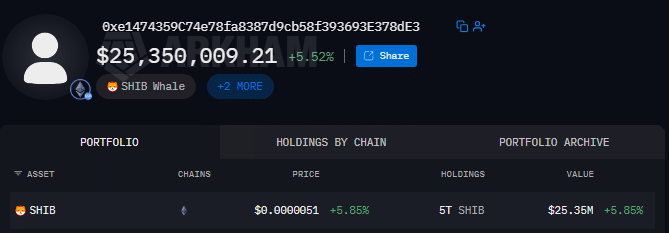
The Shiba Inu community is highlighting the long-term conviction of a top-50 whale who has held 5 trillion SHIB tokens for over 4 years without a single outflow.

According to data from Arkham, the whale received 5,000,000,058,418 (5 trillion) SHIB from an unlabeled address on November 4, 2021. The transaction came only days after Shiba Inu reached its all-time high of $0.00008845 on October 28, 2021.

At the time, the whale’s SHIB holdings were worth $281.98 million. Today, however, the same holdings are valued at roughly $25.35 million, reflecting a staggering 91.01% decline in dollar value. Despite that dramatic reduction, the whale has apparently refused to sell. 

Shiba Inu Top 50 Whale Shows Resilience in SHIB

No SHIB Outflows Since 2021 

The whale’s transaction history shows no SHIB outflows since the tokens entered its wallet in November 2021. The address has held through multiple market cycles, including SHIB’s sharp declines from its 2021 peak.

This behavior has sparked a wave of admiration among members of the Shiba Inu community. Some observers describe the whale as an example of “diamond hands,” emphasizing that it has neither dumped its holdings nor transferred them to centralized exchanges.

The sentiment is essentially that the whale has remained committed through both major rallies and severe market crashes, reinforcing the perception that long-term holders can withstand significant volatility without panic selling.

Interestingly, SHIB remains the largest token in the whale’s portfolio by dollar value. That further underscores the significance of the position, considering how dramatically the token’s market value has changed since the whale acquired the tokens. 

Shiba Inu Reclaims the $0.000005 Level

Meanwhile, SHIB has recently benefited from renewed strength across the broader cryptocurrency market.

At press time, Shiba Inu was trading around $0.000005133, while its market cap stands at $3.03 billion. The token has also moved back above the $0.000005 psychological threshold and currently ranks as the 28th-largest cryptocurrency globally by market capitalization.

Although SHIB remains 94.23% below its 2021 all-time high, the whale’s four-year holding period has become a talking point within the community as the token attempts to regain momentum.

XRP Spikes 39%, Sits Among Top Gainers as Price Reclaims 3-Month Peak Above $1.4

0

XRP has spiked 39% over the past seven days, securing a spot among the top 5 gainers as its price reclaims a 3-month peak.

The broader crypto market has maintained the recovery push that began at the start of this week, and XRP appears to be taking advantage of the rally more than most. For context, the global crypto market cap (TOTAL) has added $440 billion since Monday, Aug. 17.

Amid the upsurge, XRP delivered its best performance so far this year, as its market cap spiked by nearly $24 billion to $86.82 billion within just three days. This comes as XRP’s price rallies by more than 33% on the weekly timeframe.

XRP Ranks Among Top 5 Gainers

Notably, this places XRP among the top 5 gainers over the past week, according to data provided by CoinMarketCap. Specifically, Ethena (ENA) tops this exclusive list with nearly 64% gains on the weekly timeframe. 

XRP Among Top Gainers
XRP Among Top Gainers | Source: CoinMarketCap

Meanwhile, SPX6900 (SPX) sits second on the list, with weekly gains exceeding 41%. The third position is secured by XRP, which has recorded a 39.70% rise over the past week. Pump.fun (PUMP), the native token of the DeFi project of the same name, follows closely with a 37% increase.

Interestingly, on the daily timeframe, XRP also sits among the top 5 gainers, securing third after rising 20.49%. Further data from CoinMarketCap confirms that XRP remains the largest gainer on both the daily and weekly timeframes among the top 50 tokens.

XRP Reclaims 3-Month Peak of $1.4

This rally has since helped XRP reclaim the $1.40 level for the first time in three months. The last time XRP saw this price region was in mid-May, when its price collapsed from the $1.54 peak and slipped into a free-fall phase toward the $1.05 low in early June.

With the price currently trading at $1.41, XRP has also reclaimed its 20-week exponential moving average (EMA), one of two key moving averages that could dictate XRP’s next price direction from here.

XRP Breaches Key EMAs
XRP Breaches Key EMA

A previous report from The Crypto Basic identified the 20-week EMA and the 50-week EMA as the two important MAs that XRP must breach to flip its momentum bullish. XRP has now recovered above the 20-week EMA, with its eyes now set on the 50-week moving average at $1.5417.

At the current price of $1.4140, XRP needs to only rally by an additional 9% to breach the 50-week EMA. However, on the daily chart, the crypto asset could face strict resistance at the Pivot Point’s R3 area, which stands around $1.4895, on the way to the 50-week EMA. 

XRP Pivot Points
XRP Pivot Points

XRP’s daily RSI has spiked to 84. While this shows that bulls have reclaimed control of the market in the short term, it also indicates that the rally could be getting overstretched. If XRP faces exhaustion and a pullback from here, it could attempt to find immediate support around the R3 mark at $1.39.

Institutional Lending Comes to XRP Ledger as Ripple, Clearpool, and Cicada Join Forces

0

Institutional lending is coming to the XRP Ledger (XRPL), with a new partnership between Clearpool, Cicada Partners, and Ripple bringing real-world lending activity onchain.

XRPL developer Vet (Hussein Zangana) highlighted the development on X, saying, “Now it gets really serious on the XRPL.”

He described the move as a clear institutional commitment to borrowing and lending on the ledger. The planned structure brings together three players with distinct roles.

Notably, Clearpool will provide the lending infrastructure, and Cicada Partners will handle credit origination and credit checks. Meanwhile, Ripple will provide capital

The borrowers will be fintech and payment companies that use stablecoins to fund their day-to-day business needs.

XRPL Lending Protocol at the Center with Ripple Backing

Notably, the project will use XRPL’s proposed XLS-66 Lending Protocol and XLS-65 Single Asset Vaults. For context, the XRPL community is still voting on it.

The model allows institutions to put money into managed lending pools, while credit managers choose borrowers, set loan terms, and manage risk.

Cicada has experience with more than $860 million in credit, while Clearpool has helped facilitate over $930 million in institutional loans since 2021.

Ripple will invest in the credit fund alongside other institutional investors rather than guarantee the loans.

Image

Ripple RLUSD and XRP Could Power the Lending Flywheel

The proposed system seeks to create an activity loop across the XRPL ecosystem.

Borrowers would use RLUSD for everyday business needs, which could increase its use for payments and settlements. XRP would continue to be used for transaction fees and network reserves.

Vet described this as a potential cycle: investors provide capital, earn returns, and then provide more capital, while increased lending brings more activity to the XRPL.

The main idea is that investors would earn returns from loans to real businesses rather than mainly from DeFi strategies such as liquidity mining, arbitrage, or leverage.

Technical Demo Coming Next

Clearpool is building and testing the system on the XRPL Devnet. A demo is expected to show the full lending process, from creating a lending pool to issuing and repaying loans.

The Lending Protocol and Single Asset Vault features still need to pass the XRPL voting process before they can launch on the mainnet.

If activated, this could expand XRPL beyond payments and make it a platform for institutional lending.

XRP Price Surges 18.5%

Meanwhile, the development comes as XRP stages a sharp price recovery. XRP is trading at $1.31, up 18.5% over the past 24 hours and 31% over the past week. The cryptocurrency traded as low as $0.98 earlier this week before staging its latest rally.

The rising XRP price, along with the planned institutional lending system, could bring more attention to XRP and the XRPL as part of the growing onchain financial market.

Shiba Inu Team Member Teases Major Announcement From Shytoshi Kusama, Gives Timeline

0

Shiba Inu ecosystem team member Vet Kusama has sparked fresh speculation in the SHIB community after hinting that August could bring a major announcement from two prominent figures in the ecosystem.

In a post on X today, Vet Kusama urged the community to stay alert, suggesting that Shytoshi Kusama and Kaal Dhairya could make an announcement before the month ends. He also encouraged Shiba Inu supporters to turn on their notifications so they do not miss the potential development, which he described as “Big News.” 

Vet Kusama Says Shiba Inu Lead Will Make Major Announcement This Month

Shytoshi Kusama and Kaal Dhairya Remain Relatively Quiet

Notably, both Shytoshi Kusama and Kaal Dhairya have maintained relatively low profiles on social media throughout much of 2026.

Shytoshi Kusama, the pseudonymous visionary leader associated with the Shiba Inu ecosystem, has largely remained silent on X. His most recent post came on May 13, when he expressed admiration for Dhairya.

Meanwhile, Dhairya has also maintained limited social media activity. His latest referenced X post came on July 25, when he highlighted SHIB’s price surge.

As a result, Vet Kusama’s suggestion that the two developers could soon make an announcement has renewed curiosity among SHIB holders.

R.OS Could Influence Shytoshi’s Next Move

One factor fueling the speculation is Shytoshi Kusama’s apparent shift in focus this year. Rather than remaining highly active in Shiba Inu-related discussions, Kusama has indicated that he has been concentrating on completing R.OS, an independent artificial intelligence project. 

His reduced social media presence has consequently raised questions about whether he plans to return to a more prominent role in SHIB development.

However, there is currently no confirmation that the teased announcement will involve R.OS, Shibarium, SHIB, or any other component of the broader ecosystem.

Only 10 Days Remain for the Potential Announcement

Vet Kusama’s comments have also created a sense of urgency as August draws to a close. With just 10 days remaining in the month, members of the SHIB community are increasingly wondering what Kusama and Dhairya might reveal.

However, the nature of the potential announcement remains unclear. Vet Kusama did not provide specific details, while neither Shytoshi Kusama nor Kaal Dhairya has publicly confirmed what they may announce.

Therefore, this speculation should be treated cautiously until the developers provide additional information. For now, Vet Kusama’s comments represent a teaser rather than an official announcement. 

$11B Manager 21Shares Identifies 4 Key Structural Shifts in XRP as Price Surges 35%

0

XRP price surged sharply this week as the coin underwent notable structural changes, with institutional investment products expanding.

Moreover, activity on the XRP Ledger is growing, while stablecoin liquidity continues to build, according to $11 billion asset manager 21Shares.

In a recent post on X, 21Shares said the XRP ecosystem is experiencing shifts that were not present at the same scale a year ago. It pointed to settlement volumes, an expanding stablecoin base, and the development of regulated investment products providing exposure to XRP.

The asset manager highlighted four key structural shifts identified by its research team.

XRP ETPs Absorb Large Share of New Supply

According to 21Shares, U.S. spot XRP exchange-traded products (ETPs) absorbed 14.8% of net new XRP supply during the first half of 2026.

The share peaked above 50% in May, highlighting the role of regulated investment products in XRP’s supply-and-demand dynamics.

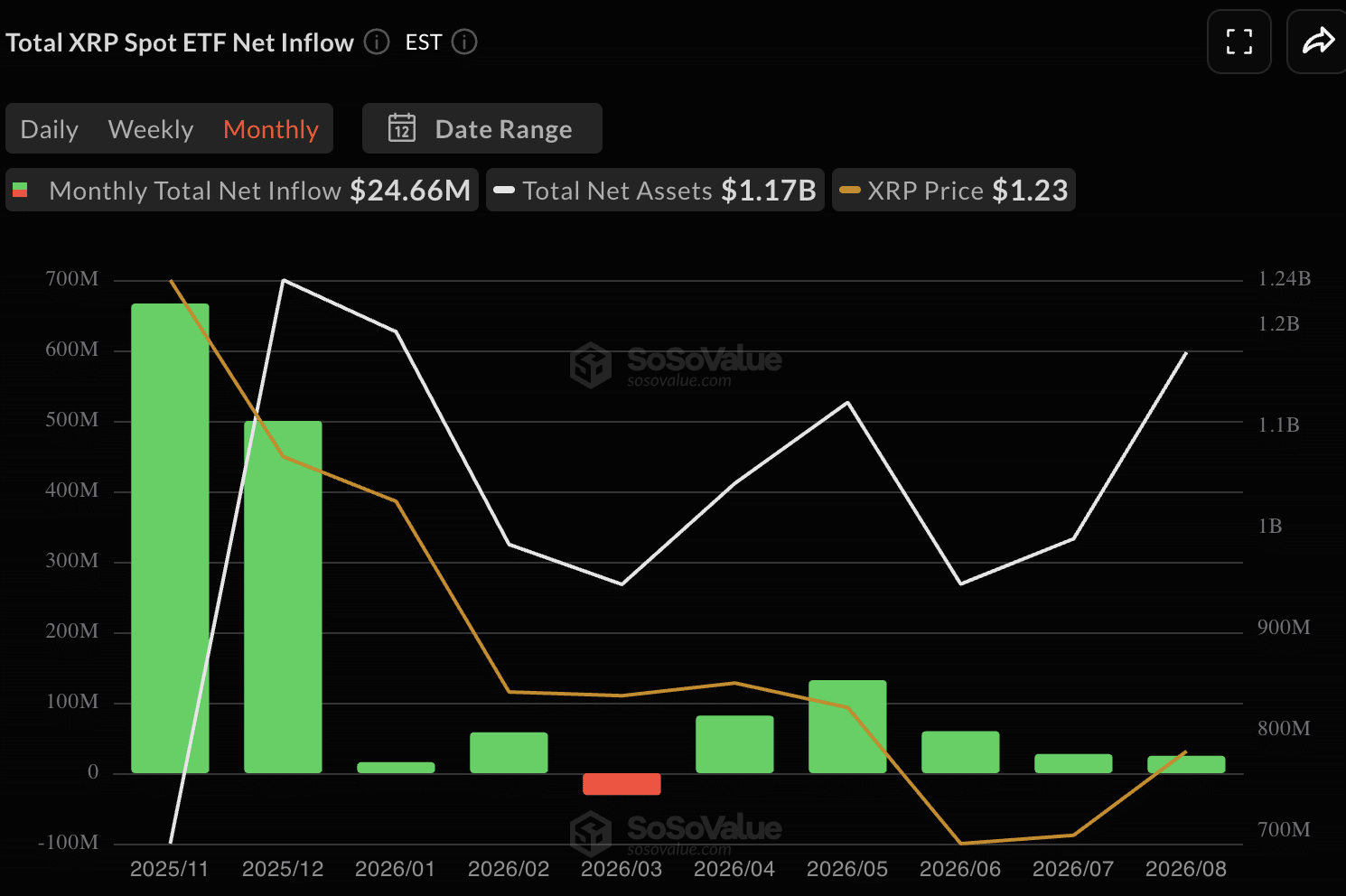
For context, since the start of the year, XRP ETFs in the U.S. have attracted $367 million in inflows. They now boast $1.17 billion in total assets and $1.53 billion in cumulative inflows.

XRP ETF Records | SoSoValue

XRP Supply Dilution Remains Lower Than Some Rivals

Meanwhile, 21Shares also pointed to XRP’s relatively modest annual supply dilution. The asset manager estimates XRP’s annual supply dilution at approximately 5.5%, compared with 8.8% for Stellar’s XLM and 9.6% for Toncoin (TON).

A lower rate of supply expansion means less new XRP enters the market, which could be bullish.

RLUSD Expands XRP Ledger Liquidity

Stablecoin liquidity represents another major structural shift. 21Shares said RLUSD’s supply expanded by 1,131% through June 30, 2026, with more than half of the stablecoin’s supply residing on the XRP Ledger.

RLUSD’s rapid growth strengthens liquidity and supports activity across the XRPL ecosystem as stablecoin transactions and applications expand.

Settlement Volume Rises While Fee Revenue Falls

The fourth shift identified by 21Shares concerns the relationship between XRP Ledger activity and revenue. The asset manager noted that settlement volume has expanded even as fee revenue has contracted.

21Shares ultimately raised a question for the XRP market: Could greater use of XRP as collateral materially change these supply-and-demand dynamics?

XRP Price

At press time, XRP was trading at $1.36, according to CoinMarketCap data. The token had surged approximately 20% over the previous 24 hours, briefly touching $1.40. XRP was up around 38% over the past week after trading near $0.988 earlier in the week.

The latest move adds to a sharp recovery in XRP, while 21Shares’ analysis points to structural developments beyond price action that could influence the asset’s longer-term supply, demand, and utility dynamics.