
Home Blog Page 356

Hoskinson Says It’s Time to Go Long on Cardano DEXes, “They Will 100X”

0

Charles Hoskinson has emphasized how undervalued Cardano’s DeFi ecosystem remains, urging market participants to go long on Cardano-based decentralized exchanges (DEXes).

Hoskinson, the founder of Cardano, made this recommendation in response to a post by Cardano stake pool operator (SPO) YODA, who highlighted the recent performance of NIGHT, the native token of privacy-focused sidechain, Midnight.

NIGHT Impressive Trading Activity

In the post, YODA pointed to NIGHT’s explosive momentum, noting that the token had reached a new all-time high while generating an impressive $4.2 billion in daily trading volume across centralized exchanges.

At the same time, YODA highlighted NIGHT’s trading activity on Cardano’s decentralized platforms. Citing data from DEX Screener, the SPO revealed that Cardano DEXes collectively recorded just $4.3 million in NIGHT trading volume.

While the figure appears modest when compared with centralized exchange volumes, YODA framed the performance as a relative success.

Notably, the attached screenshot shows that NIGHT significantly outperformed the second-ranked token, SNEK, which posted only $306,560 in DEX trading volume. As a result, YODA expressed optimism that the increase in NIGHT’s activity could serve as a fresh catalyst for Cardano’s DeFi ecosystem.

NIGHT volume on Cardano DEX

Hoskinson Highlights Infrastructure Required to Boost Cardano DEX Activity

YODA’s update underscored how far Cardano’s DeFi trails other ecosystems, despite the network’s strong technical foundations. In response, Hoskinson acknowledged the recent surge in NIGHT’s DEX volume but stressed that Cardano’s DeFi ecosystem still requires robust stablecoins and cross-chain bridges to meaningfully accelerate trading activity across its decentralized exchanges.

The Cardano founder has consistently highlighted the importance of these missing infrastructure components, particularly stablecoins, as catalysts for DeFi growth.

While Cardano already hosts a small number of stablecoins, Hoskinson has repeatedly pushed for the launch of a tier-1 stablecoin on the network and has disclosed ongoing discussions with key entities to make this a reality.

As previously reported, the lack of a reliable stablecoin on Cardano led to a costly incident in which a user operating a five-year dormant account lost an estimated $6.05 million after swapping ADA for the low-liquidity stablecoin USDA.

This incident highlights a bigger problem: without reliable stablecoins, traders cannot safely store funds, manage risk, or use more advanced trading strategies.

In addition, the lack of strong cross-chain bridges limits capital coming in from major networks like Ethereum and Solana, keeping Cardano’s DeFi ecosystem relatively isolated.

Cardano DEX Volume to Soar by 100x

Against this backdrop, he suggested that once reliable stablecoins and effective bridges are in place, the current low volumes on Cardano DEXes could expand dramatically, potentially surging by as much as 100x.

In the meantime, he framed the current environment as an attractive entry point, encouraging investors to “go long” or accumulate low-cap tokens on Cardano’s decentralized exchanges in anticipation of this spike.

In Hoskinson’s view, Cardano DeFi is now in an accumulation phase, where activity and valuations remain subdued even as foundational upgrades progress.

Expert Says XRP to $100 is Not a Bold Call, Shares Expected Timeline

0

A well-known market commentator has insisted that an XRP to $100 price prediction is not an ambitious call, while predicting the timeline.

Notably, XRP has struggled to perform strongly in 2025 amid a broader market downtrend. With XRP losing the $2 mark going into 2026, critics have begun questioning high-end price targets, especially predictions that place XRP at $100. 

However, despite the growing widespread skepticism, market commentator 24HrsCrypto has maintained his stance, arguing that an XRP to $100 call is not an extreme or unrealistic forecast.

“XRP to $100” is not a Bold Call

Interestingly, 24HrsCrypto is one of the market commentators who believe XRP remains largely undervalued. In a post days back, he questioned why “a $100 asset” could be trading under $2 and people would still ignore it. Earlier this month, he argued that tokenization could help push XRP to the $100 mark.

In a recent commentary on X, 24HrsCrypto explained that he builds his outlook on probability and data, not on hype or emotional trading. The market pundit reassured his audience that he does not make careless price calls. 

24HrsCrypto on X
24HrsCrypto on X

Instead, he focuses on how money moves through financial systems, how liquidity forms, and how settlement demand shapes value. To him, many critics fail to consider these factors when judging XRP’s long-term potential.

According to him, an XRP price of $100 by 2030 follows basic economic logic. He called it a natural outcome of liquidity math, rising settlement demand, and changes in market structure. The pundit believes that anyone who understands capital flows can see how XRP could reach that level as usage grows.

Meanwhile, he also shared expectations for the medium term. Looking at 2026, 24HrsCrypto said an XRP price of $20 fits realistic market conditions. He added that he would find it surprising if XRP does not reach that level. He made it clear that speculation would not drive this move, but real usage and trading activity would.

Importance of Trading Volume

24HrsCrypto also emphasized the importance of trading volume. He pointed to XRP’s 24-hour trading volume as the important measure to watch. 

According to him, the real goal is for XRP to exceed $200 billion in daily volume, as this would signal strong utility and demand. To put this into context, Bitcoin currently records an average of $32 billion in daily trading volume. Also, XRP’s largest-ever recorded volume was $37 billion on April 6, 2021.

24HrsCrypto acknowledged that many people will dismiss the idea of XRP reaching $200 billion in daily volume. However, he argued that this disbelief comes from viewing the future through today’s speculative market lens. In his opinion, this mindset no longer reflects where the crypto market is heading.

24HrsCrypto said the crypto industry spent the last decade focused mainly on speculation. Specifically, traders chased price moves rather than real economic use. He believes this phase is ending. According to him, real economic activity will soon move on-chain at scale.

Pundit Says Never Sell Your XRP as Ripple Now Eyeing Institutional Native Lending on XRPL

0

Disclosures within the XRP community show Ripple developers working to bring institutional-grade native lending to the XRP Ledger. 

Notably, for more than a decade, the XRP Ledger has focused almost entirely on payments, as its original architects deliberately excluded native lending tools and broad smart contract functionality.

While this design helped the XRPL gain traction in payments and cross-border transfers, it also limited growth in decentralized finance. As newer blockchains launched with lending and DeFi features built in, XRPL’s DeFi ecosystem has lagged despite the network’s age and stability.

Ripple Eyeing Institutional Native Lending

Now, the demand for compliant and capital-efficient onchain credit has seen a rapid surge, especially among institutions. In response, Ripple and other ecosystem developers have begun exploring protocol-level lending on XRPL. 

Ed Hennis, a staff software engineer at Ripple, recently called attention to a proposed XRPL Lending Protocol. Hennis explained that the planned upgrade would introduce fixed-term, fixed-rate, underwritten lending directly into the XRP Ledger itself. 

Also, rather than relying on external smart contracts, the protocol would handle borrowing rules, repayment schedules, interest calculations, and permissions at the core ledger level. This would allow enterprises to access onchain credit with the same predictability and discipline they expect from traditional institutional lending.

With this change, XRPL would move beyond its payments-only identity and develop into a broader institutional finance platform. 

Notably, the lending structure would support more efficient use of capital, stronger risk controls, and new productive roles for both XRP and Ripple’s stablecoin, RLUSD. Large XRP holders, exchanges, and custodians could lend XRP into isolated credit facilities and create a scalable yield market tied to XRP’s over $115 billion value.

Practical Use Cases

Hennis also highlighted practical use cases. Specifically, payment service providers could borrow RLUSD for short periods to bridge slow bank and card settlement cycles, enabling instant merchant payouts while lowering idle capital requirements. 

In addition, market makers could borrow XRP or RLUSD to finance inventory, support arbitrage strategies, and provide liquidity across venues without straining their balance sheets. 

Also, fintech lenders could access on-ledger credit to fund invoice financing, seasonal demand, and short-term working capital for small and medium-sized businesses.

The XRPL Lending Protocol Addresses Known Weaknesses

Per the report, the proposal directly addresses weaknesses in today’s crypto lending market. For instance, most DeFi lending platforms depend on heavy overcollateralization, demanding far more collateral than real businesses can afford. 

Interest rates also fluctuate sharply because retail supply and demand drive them, not borrower quality or credit fundamentals. On top of that, institutions face significant risk from custom smart contracts, complex integrations, and limited auditability.

XRPL’s approach seeks to remove these barriers by embedding lending directly into the protocol through the proposed XLS-66d amendment. The design relies on Single Asset Vaults, with each vault holding only one asset, such as XRP or RLUSD. 

This will keep liquidity clean and prevent risk from spreading across assets. Moreover, pool administrators would manage underwriting, servicing, fees, and repayments, closely mirroring how traditional loan managers operate in real-world credit markets.

Risk Control Measures

Importantly, the model also employs risk controls. Notably, experienced underwriters would evaluate borrowers off-chain using established financial data and compliance checks. Further, pool administrators or underwriters would provide first-loss capital to absorb potential defaults. 

Moreover, each loan could exist in its own isolated vault, ensuring that one borrower’s failure never affects others. Also, every transaction and repayment would remain permanently recorded onchain, delivering full transparency and auditability.

Hennis stressed that this supports a wide range of institutional users, including market makers, payment firms, trading desks, and fintech lenders. Meanwhile, when more assets gain support, the lending system could expand well beyond XRP and RLUSD.

Looking ahead, Ripple expects the relevant lending amendments to enter validator voting in late January. Reacting to the disclosure, Brad Kimes from Digital Perspectives urged investors not to sell their XRP, echoing previous calls from other market commentators, who insist that borrowing against one’s holdings is a better option.

WhiteBIT Introduces Trading Fee Cashback Program for TradingView Users In Collaboration With Tether

0

WhiteBIT, a European cryptocurrency exchange by trading volume and user activity, has introduced a global trading campaign in cooperation with TradingView and Tether. The initiative allows eligible participants to receive up to 30% cashback on trading fees, distributed in WhiteBIT’s internal bonus asset, USDTB.

The campaign reflects a broader industry shift toward integrated trading environments, where execution, charting, and liquidity tools are combined within a single workflow. TradingView has become a primary interface for many traders, while USD₮ issued by Tether continues to serve as a widely used settlement asset. The promotion is scheduled during December, a period that historically sees elevated market participation.

The campaign is active from December 8, 2025, 12:00 UTC to January 8, 2026, 12:00 UTC, and is open to verified users from eligible jurisdictions.

Cashback Structure and Participant Allocation

During the promotional period, users trading USDT spot pairs or futures through TradingView may qualify for one of two cashback tiers:

Main Prize Pool – 20% Cashback

The first 600 qualifying participants who reach a trading volume between 5,000 and 20,000 USDT will receive cashback equal to 20% of trading fees paid, credited in USDTB.

Special Prize Pool – 30% Cashback

An additional 600 participants who record trading volumes between 20,000 and 50,000 USDT will be eligible for 30% cashback, also issued in USDTB.

To be considered, participants must reach a minimum trading volume of 5,000 USD₮. In total, up to 1,200 users may receive rewards, subject to compliance with campaign rules.

Eligibility and Participation Criteria

To take part in the campaign, users are required to:

  • Hold a verified WhiteBIT account
  • Connect their WhiteBIT account to TradingView
  • Submit a broker review for WhiteBIT on TradingView
  • Execute trades exclusively through the TradingView interface during the campaign
  • Reach one of the specified trading volume thresholds

Trading volume from all USDT spot pairs and all futures instruments available on WhiteBIT is counted, provided the trades are executed via TradingView.

Qualifying Markets and Reward Timeline

Both spot USD₮ trading pairs and all supported futures contracts on WhiteBIT are included in the volume calculation.

The list of winners is scheduled to be published on January 16, 2026, with rewards credited within 10 business days following the announcement.

The campaign aligns with an ongoing industry trend in which exchanges increasingly support direct trade execution from charting platforms such as TradingView.

USDTB as a Futures Trading Credit

Cashback rewards are distributed in USDTB, an internal bonus asset used for futures trading on WhiteBIT.

USDTB is available only in jurisdictions where futures trading is permitted. If a participant is located in a restricted jurisdiction at the time of reward validation, eligibility may be transferred to the next qualifying participant.

Compliance and Fair Trading Rules

WhiteBIT applies standard compliance requirements to the campaign. Activities such as multi-accounting, wash trading, bot usage, or other violations of the platform’s User Agreement and AML policies are prohibited. Corporate accounts are excluded from participation.

Users are responsible for ensuring that participation complies with applicable local regulations. The campaign is not available in certain jurisdictions, as outlined in the official Terms & Conditions published on WhiteBIT’s website.

Industry Background and Trading Trends

The campaign reflects two broader developments in digital asset trading. First, TradingView continues to grow as a primary trading interface, with an increasing number of users executing trades directly from charting platforms while relying on USD₮ as a commonly used settlement asset.

Second, interest in futures trading remains steady, with bonus-based incentives providing traders an opportunity to engage in derivatives markets without committing additional upfront capital.

For participants, the campaign structure offers reduced effective trading fees during a period of heightened market activity, centralized trade management through TradingView, cashback tied to trading volume, and access to futures trading through bonus credits.

About WhiteBIT

WhiteBIT is a European cryptocurrency exchange offering more than 900 trading pairs and 350+ digital assets, with support for multiple fiat currencies. Established in 2018, the platform operates as part of W Group and reports a global user base exceeding 35 million.

WhiteBIT has partnered with organizations such as Visa, Fireblocks, Juventus Football Club, and the Ukrainian national football team. The company focuses on developing secure infrastructure and expanding access to blockchain-based financial tools.

Pundit Says ChatGPT Updates XRP Price Prediction to $500-$3,000 for 2030: Here’s Why

0

After factoring in Ripple’s recent developments, an XRP community member says ChatGPT now projects XRP could climb to as high as $3,000 by 2030.

Throughout 2025, Ripple announced a steady stream of high-profile deals, partnerships, and regulatory breakthroughs, and the XRP ecosystem also witnessed some impressive progress. Yet the XRP price has continued to trade without showing a response to those events, down 7.34% this year as it changes hands at $1.92. 

ChatGPT Projects XRP to $500-$3,000 by 2030

Notably, some commentators believe this gap between ecosystem progress and price does not actually weaken the bullish case for XRP. Instead, they suggest that the market has yet to fully absorb the long-term impact of XRP’s progress and what Ripple has built.

Amid these discussions, an XRP community member shared his experience with the AI chatbot ChatGPT. According to him, earlier prompts he made on ChatGPT produced a conservative projection of about $5 for XRP by 2030. 

However, after he supplied the chatbot with details about Ripple’s partnerships, acquisitions, and the launch of XRP ETFs, the projected range reportedly changed. Based on the expanded input, ChatGPT generated a much higher prediction, placing XRP between $500 and $3,000 by the end of the decade. 

Nonetheless, despite this update target from the AI chatbot, the community member still argued that XRP would still be undervalued at such prices when you compare it with the developments surrounding the ecosystem.

Ripple Pushed Further from April to August 2025

Notably, this comes as 2025 brings major milestones for Ripple and XRP. Specifically, in April 2025, the company acquired prime brokerage firm Hidden Road for $1.25 billion and rebranded it as Ripple Prime. Ripple set up the business to connect traditional finance with digital assets, using the XRPL and its U.S. dollar stablecoin, RLUSD, as part of the underlying infrastructure.

Ripple followed up in July 2025 by appointing BNY Mellon as the primary custodian for RLUSD. During the same month, Ripple partnered with the Dubai Land Department and Ctrl Alt to support real estate tokenization on the XRP Ledger.

Meanwhile, August 2025 brought two important developments. First, Ripple acquired stablecoin payments platform Rail for $200 million to strengthen its cross-border payments offering. 

In the same period, Ripple and the U.S. SEC withdrew their appeals in the long-running legal dispute that began in December 2020. This decision effectively closed the case and removed a regulatory overhang that had weighed on XRP for years.

Late 2025 Brings Bullish Developments for XRP and Ripple

Ripple continued its expansion in October 2025 with the $1 billion acquisition of treasury management firm GTreasury, marking its entry into the multi-trillion-dollar corporate treasury market. Also in October, Evernorth emerged with plans to raise $1 billion to build what it described as the world’s largest XRP treasury reserve.

Interestingly, investor confidence increased further in November 2025 when Ripple raised $500 million at a $40 billion valuation, with participation from firms such as Citadel Securities and Fortress Investment Group. 

October also delivered a milestone for XRP in U.S. markets, as Canary Capital’s spot XRP ETF, trading under the ticker XRPC, secured regulatory approval and began trading on Nasdaq. Four additional XRP ETFs launched shortly afterward, and together they attracted more than $1 billion in inflows within 21 trading days.

The year closed with another notable move in December 2025, when VivoPower partnered with Lean Ventures to pursue the purchase of up to $300 million worth of Ripple Labs shares. The transaction offered indirect exposure to nearly $1 billion in XRP holdings and added to the list of institutional-linked activity around Ripple.

Despite these developments, it is important not to treat AI-generated price projections as reliable forecasts. ChatGPT and similar tools often reflect the tone, assumptions, and information supplied by users. In fact, separate prompts to the same model have produced much lower XRP estimates, including targets near $15 for 2030, even after considering the events of 2025.

JPMorgan Considers Bitcoin and Crypto Trading for Wall Street Investors

0

JPMorgan Chase is assessing whether to offer Bitcoin and crypto trading services to its institutional clients. 

The move would mark another major step by a top U.S. bank toward deeper participation in the crypto asset market. This comes as demand from hedge funds, asset managers, and pensions continues to grow.

Spot and Derivatives Trading Under Review

Bloomberg says JPMorgan’s markets team is exploring which crypto products it could offer, focusing on spot and derivatives trading. Notably, they’re still in the early stages, and no decisions have been made yet. Meanwhile, any launch would depend on client interest, risk, and whether it’s profitable long-term.

Indeed, if JPMorgan, the largest U.S. bank, offers crypto trading to its clients, it would become one of the most prominent financial institutions to provide direct crypto services.

Institutions Seek Regulated Crypto Access

As Bitcoin’s popularity expands, large investors seek regulated avenues to trade crypto assets. However, many institutional players are unable or unwilling to rely on retail exchanges such as Coinbase or Binance due to compliance and custody requirements. 

Instead, they prefer bank-backed or institution-grade platforms that can handle large orders and meet strict regulatory standards.

Platforms like Coinbase Prime, Kraken Institutional, Bullish, Galaxy Digital, and Fidelity Digital Assets already serve this market. Accordingly, JPMorgan’s potential entry would intensify competition in the institutional crypto trading space.

Meanwhile, the timing of JPMorgan’s review coincides with improving regulatory clarity in the U.S. A major crypto bill is on track to pass in the first half of 2026, giving institutions more confidence that digital asset markets are maturing under clearer rules. 

This clearer regulatory picture is prompting traditional financial firms to rethink their crypto plans, even though prices are still volatile. The shift also reflects a more crypto-friendly approach from President Trump, who wants the U.S. to be a global leader in digital assets.

JPMorgan’s Growing Blockchain Footprint

Even though CEO Jamie Dimon has remained skeptical about Bitcoin and crypto, JPMorgan has been expanding its blockchain initiatives. 

Recently, it arranged a short-term bond for Galaxy Digital on the Solana blockchain. The bank has also tokenized assets, like a money market fund on Ethereum, and applied to offer Bitcoin-backed notes tied to BlackRock’s Bitcoin ETF.

JPMorgan also allows some clients to use Ethereum and Bitcoin as loan collateral and previously partnered with Coinbase, allowing customers to link their bank accounts to crypto wallets.

Wall Street Momentum Builds

Meanwhile, JPMorgan is not the only big bank exploring crypto trading. Morgan Stanley plans to offer it on E*Trade in early 2026, and banks like PNC have teamed up with Coinbase to give clients more access to crypto.

In sum, with the global crypto market around $3.1 trillion, and Bitcoin alone at $1.8 trillion, traditional banks don’t want to be left out.

Here are Bullish Bitcoin Price Predictions for 2025 That Failed to Play Out

0

With ten days left in the year, Bitcoin has failed to live up to the high expectations that dictated market sentiment at the start of 2025. 

The flagship crypto opened the year strong, rising nearly 10% in January and bolstering optimism. Analysts highlighted clearer U.S. regulations, growing institutional treasury adoption, and steady ETF inflows as reasons to expect a powerful bull run. 

Bitcoin Fails to Hit Most Bullish Targets

These factors led to ambitious price targets, with most projections clustering between $200,000 and $250,000. However, momentum weakened sharply from October. Over the past three months, Bitcoin has fallen more than 21%, now down about 3.6% for the year, and trades near $90,130. 

If the current momentum holds, Bitcoin will secure a yearly close in the red for the first time since the 2022 bear market, leaving many bullish forecasts unfulfilled.

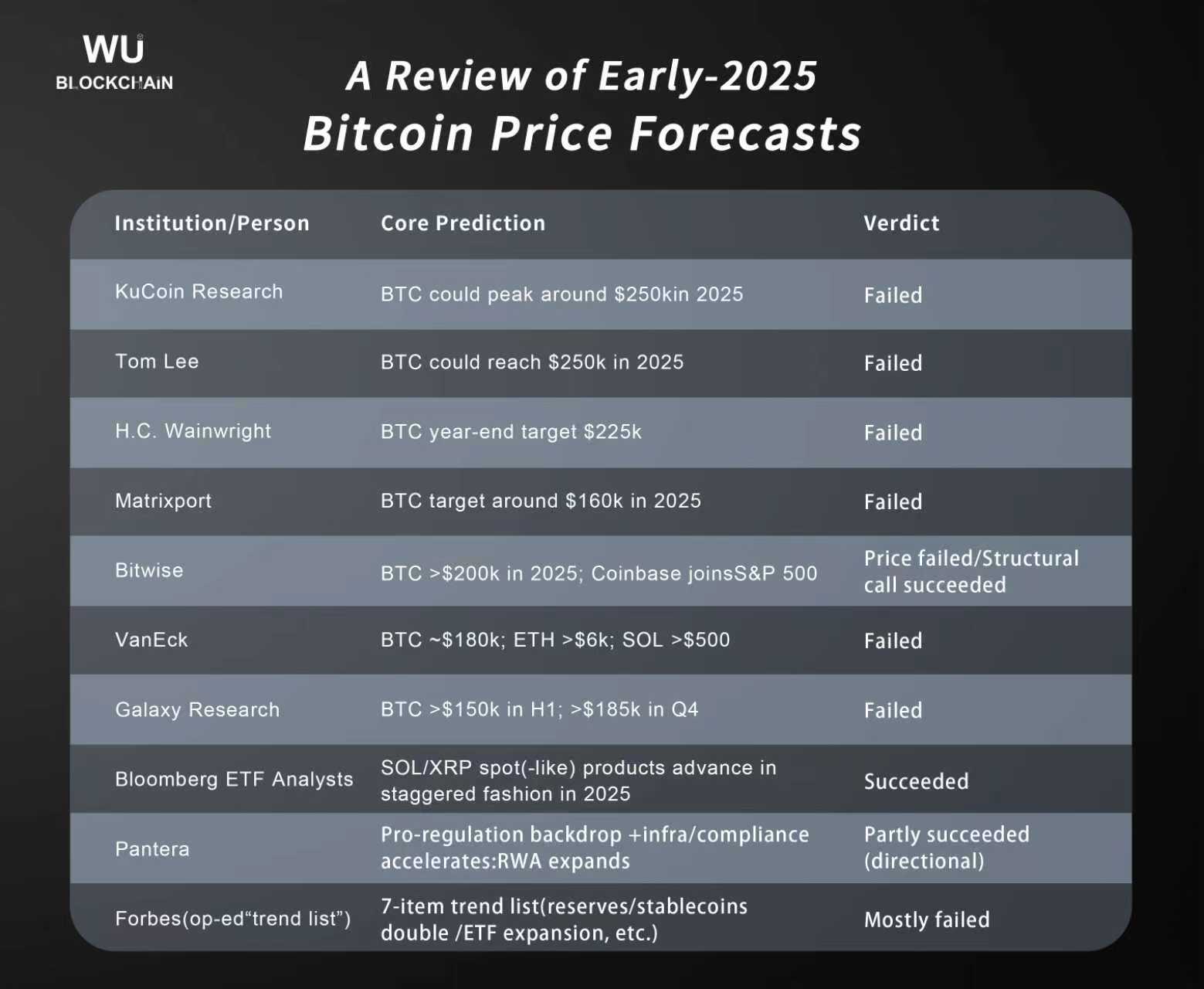
Crypto journalist Colin Wu recently highlighted how far these predictions missed their targets. In a Substack article, he explained that from late 2024 into early 2025, the market rallied around a shared narrative around post-halving strength, ETF expansion, institutional adoption, and friendlier regulation. 

This outlook encouraged institutions and prominent commentators to publish aggressive price targets. Wu noted that while expectations around regulation, compliance, and industry structure mostly moved in the right direction, most price forecasts overstated Bitcoin’s rally throughout 2025.

Bitcoin Price Predictions for 2025 Colin Wu
Bitcoin Price Predictions for 2025 | Colin Wu

KuCoin Research

KuCoin Research entered 2025 with one of the most ambitious outlooks in the market. The firm combined historical post-halving trends with expectations of strong institutional and ETF-driven demand to argue that Bitcoin could peak near $250,000 during the year. 

KuCoin also projected that the crypto market, excluding Bitcoin, could reach about $3.4 trillion, which could be due to a massive altcoin season. 

While the firm correctly anticipated progress in compliant products, including Solana and XRP ETFs, Bitcoin’s price action moved in a different direction. The asset peaked just above $126,000 before sliding back to the current price of around $90,000, leaving the price forecast far out of reach.

Tom Lee

Meanwhile, in January 2025, Fundstrat’s Tom Lee publicly shared a $250,000 Bitcoin target. He based his view on improving liquidity conditions, regulatory tailwinds, and what he described as growing market resilience. 

As the year unfolded, repeated drawdowns and elevated volatility prevented Bitcoin from sustaining upward momentum. Despite several rallies, the price never came close to Lee’s projected level.

H.C. Wainwright

Investment bank H.C. Wainwright also presented a highly bullish stance at the start of the year, lifting its year-end Bitcoin target to $225,000. The firm relied on historical cycle behavior, expectations of regulatory improvement, and rising institutional participation. Like other forecasts above $200,000, this projection failed to materialize. 

Matrixport

Matrixport had a more restrained outlook compared to its peers, calling 2025 a breakout year but setting a $160,000 target for Bitcoin. However, even with this lower ceiling, the forecast failed to play out. While sentiment improved at times, Bitcoin’s final price remained below the projected mark.

Bitwise

Asset manager Bitwise opened its December 2024 “Top 10 Predictions for 2025” with an ambitious call that Bitcoin would trade above $200,000 during the year.

The firm linked the price target to expectations around industry growth, including Coinbase joining the S&P 500 and continued expansion in stablecoins and tokenized assets. Some of the structural developments did occur, but Bitcoin ended the year far below the forecasted price level.

VanEck

VanEck also presented a roadmap for the 2025 cycle. The firm expected an early-year peak, followed by a sharp correction and renewed momentum later in the year. 

Notably, it placed Bitcoin’s cycle-top target near $180,000. As of August 2025, VanEck maintained this target. While the market did experience large swings and notable drawdowns, Bitcoin never reached the projected highs.

Galaxy Research

Meanwhile, Galaxy Research argued that adoption by institutions, corporations, and even governments would push Bitcoin above $150,000 in the first half of 2025 and toward $185,000 by year-end. 

However, in practice, adoption moved too slowly to offset faster forces such as macro shocks, risk-off sentiment, and leverage-driven liquidations.

Pantera and Forbes Outlooks

Investment firm Pantera focused on improving policy conditions and infrastructure growth, later acknowledging that price performance lagged expectations. 

Meanwhile, Forbes trend forecasts also leaned bullish, expecting developments such as strategic Bitcoin reserves and stablecoins doubling toward $400 billion. While some directional progress emerged, the combined assumptions were too ambitious for a single year.

Ghana Legalizes Bitcoin and Crypto Trading with New VASP Law

0

Ghana has officially legalized Bitcoin and cryptocurrency trading, marking a decisive shift in the country’s approach to digital finance.

The move follows parliamentary approval of the Virtual Asset Service Providers (VASP) Bill, 2025. It establishes a formal legal framework for cryptocurrency and related digital asset activities. 

The legislation brings long-anticipated regulatory clarity to a sector that had previously operated in a legal grey area.

Central Bank Confirms Policy Shift

The Bank of Ghana (BoG) formally confirmed the new legal status during its annual thanksgiving service on December 19, 2025. 

Speaking at the event, Governor Dr. Johnson Pandit Asiama described the legislation as a turning point in the country’s financial governance. He noted that the law provides a structured foundation for supervising digital asset activities, enabling regulators to monitor the sector more effectively while allowing innovation to develop within clearly defined boundaries.

Under the new framework, all crypto service providers must obtain licenses before operating. This applies to exchanges, wallet providers, and custody services. Regulatory oversight will be jointly managed by the Bank of Ghana and the Securities and Exchange Commission (SEC).

Officials say this coordinated approach will bring consistency to the market. It also ensures that only compliant entities will serve the public.

Enhanced Consumer Protections

The legislation also introduces stronger protections for crypto users. Specifically, regulators are now empowered to take action against fraud, misconduct, and other abusive practices. Service providers must implement internal controls and demonstrate financial stability as part of their licensing requirements.

Officials say these measures are intended to reduce risks for individual users while boosting public confidence in digital financial services, particularly among traders and small businesses.

The law further integrates Ghana’s crypto sector into the global regulatory system. Service providers are required to comply with anti-money laundering and counter-terrorist financing rules. These measures align with standards set by international financial watchdogs.

Moreover, platforms must adhere to the “Travel Rule,” which governs the sharing of transaction data when required. Regulators say this will increase transparency and strengthen cross-border cooperation in digital finance.

The Bank of Ghana has also clarified the legal position of current crypto users. Governor Asiama confirmed that legitimate cryptocurrency trading is protected under the new law, offering reassurance to the millions of Ghanaians already participating in the market.

While the clarification removes uncertainty surrounding lawful crypto activity, authorities emphasized that legal protections apply only to compliant and regulated transactions.

Rapid Adoption Prompted Regulatory Action

The policy shift comes after years of cautionary statements from the central bank regarding unregulated cryptocurrencies. Nevertheless, adoption continued to grow rapidly. Between 2023 and 2024, more than three million Ghanaians traded digital assets.

Crypto transactions during that period exceeded $3 billion. Authorities acknowledged that the scale of activity made regulation unavoidable.

Ghana Joins Regional Crypto Regulators

By legalizing and regulating crypto trading, Ghana joins regional peers such as Nigeria and South Africa, both of which have introduced structured oversight frameworks for digital assets.

The objective is to attract fintech investment while reducing the risks associated with informal and underground markets. Ultimately, they expect the new framework to support innovation while maintaining financial discipline over the long term.

Michael Saylor Says Bitcoin Goes to $1M if Strategy Buys 5% of BTC Supply and $10M at 7%

0

Michael Saylor has highlighted the exponential growth trajectory of Bitcoin, highlighting how the firm spends more fiat for fewer BTC.

Saylor, who is the executive chairman of Strategy, shared this sentiment in his appearance on episode 641 of the Breakdown podcast, hosted by David Gokhshtein. The Bitcoin evangelist discussed Bitcoin’s price trajectory and how it has become increasingly expensive over time.

More Fiat for Less Bitcoin

Notably, Strategy (formerly MicroStrategy) started its Bitcoin HODL strategy in August 2020, acquiring 21,454 BTC for $250 million at an average price of $11,654 per coin. Interestingly, the asset’s price has since surged 7.7x to its current market price above $90,000. Meanwhile, it would have been a staggering 10.8x from its all-time high of $126,200 in October.

Led by Saylor, Strategy has now acquired 671,268 BTC at an average price of $74,972 per coin. The self-acclaimed Bitcoin development firm did this with $50.3 billion, which would have cost about $7.8 billion had they bought it all in their first purchase over five years ago.

Saylor highlighted this exponential capacity in his recent podcast with Gokhstein. He noted that Strategy spent $50 billion to acquire approximately 3.2% of Bitcoin’s total supply. However, the same $50 billion would not get them another 3.2%; it would get the firm far less.

Saylor says probably less than 1%. However, math shows it could be far more. At $90,000, $50 billion would buy 555,555 BTC, about 2.64% of the asset’s total supply. Nonetheless, the bottom line is that when they realize such capital again, Bitcoin may have grown beyond its current price level.

Additionally, it means that Bitcoin has a proven record of price spikes, consequently requiring more and more fiat to buy.

“I am buying something getting exponentially more expensive using exponentially more money,” he stated.

Bitcoin to $1M at 5% Supply

Meanwhile, Saylor plans to keep buying more despite Bitcoin’s rising price. He added that Strategy plans to buy between 5% and 7.5% of the total supply and then “exponentially slow down” thereafter.

However, he believes BTC might have exploded to higher valuations by then. Per his predictions, the cryptocurrency would reach $1 million per coin when Strategy buys up to 5% of its supply, and $10 million per coin when it buys up to 7% of its supply. Notably, several industry leaders have predicted that these prices would one day become realistic for BTC.

Interestingly, Saylor sees Bitcoin getting more concentrated among the OGs. He added that with $100 billion in inflows from BlackRock’s iShares Bitcoin Trust (IBIT) and $50 billion from Strategy, about 85% of its supply is held by OGs.

When the next $1 trillion from institutional adoption comes in, this number may reduce to 75%. Furthermore, he sees Strategy as powering the Bitcoin network up and pushing against an exponentially hardening asset.

XRP Steals the Show, Pulls in $63M as Bitcoin and Ethereum Shed Over $1B

0

Despite widespread outflows across digital investment products, XRP still attracted notable inflows, allowing it to outperform both Bitcoin and Ethereum. 

Over the past week, several crypto investment products underperformed. Funds tied to Bitcoin, Ethereum, and other assets recorded nearly $1 billion in withdrawals.

According to CoinShares, digital investment products saw total outflows of $952 million, marking the first weekly outflow in four weeks. 

The report attributed this pullback to investor disappointment following delays in the passage of the CLARITY Act. While many initially expected the legislation to pass and be signed into law this year, recent reports indicate that the markup process will begin next month. 

Ethereum and Bitcoin Funds Bleed But XRP Shines 

Consequently, investors pulled $952 million from various crypto investment products during the week. Ethereum suffered the largest outflows, totaling $555.1 million. This reduced its total assets under management (AUM) to $24.56 billion.

Bitcoin followed with $460 million in outflows. Meanwhile, multi-asset products and Sui also recorded withdrawals of $55.7 million and $400,000, respectively.

However, investment products tied to XRP bucked the trend by recording strong inflows. According to the report, XRP products attracted $62.9 million in inflows over the past week, lifting month-to-date flows to $354.6 million and pushing cumulative AUM to $2.94 billion.

XRP’s standout performance has sparked celebration across its community. Reacting to the data, popular community figure Xaif noted that XRP “stole the show,” drawing in $62.9 million in inflows while both Bitcoin and Ethereum suffered heavy outflows. 

inflows into crypto funds last week
Inflows into crypto funds last week

Growing Demand for XRP  

Since November, spot XRP ETFs have maintained a steady inflow streak, collectively attracting $1.07 billion. Notably, inflows into these ETFs were a key driver of XRP’s strong performance over the past week. 

Meanwhile, XRP was not the only asset to see positive flows. Investment products linked to Solana, Short Bitcoin, and Chainlink also recorded inflows of $48.95 million, $4.6 million, and $3.3 million, respectively. 

Flows Per Region

Notably, the bulk of last week’s outflows originated in the United States, totaling $990 million. Sweden, Switzerland, and Hong Kong followed, recording outflows of $18.7 million, $5.4 million, and $1.7 million, respectively.

In contrast, Germany, Canada, and Brazil boasted inflows of $46.2 million, $15.6 million, and $1.8 million, respectively. 

Flows by country
Flows by country