Historical context supports an analysis suggesting that Shiba Inu could explode from here as it retests a crucial support area.
Notably, the analysis came from Crypto Patel, who forecasts that Shiba Inu could reverse recent price underperformance. Notably, SHIB continues to struggle to sustain an uptrend amid broader market uncertainty.
Shiba Inu Back at Support
After rallying to a high of $0.00000952 last week, Shiba Inu again caved to a Bitcoin-inspired higher price rejection. The momentum shift saw it retrace 12.3% to close the week at $0.00000834. Essentially, Shiba Inu could not build on its 6.6% gain two weeks ago, which was its first green weekly candle in five weeks.
Top analyst Crypto Patel highlighted that the close pushed the token back to the “mega support” between $0.0000080 and $0.0000060. Interestingly, he suggested that this could be a bullish development for SHIB, citing historical context. He specifically noted that the meme coin has pumped from the zone at each retest, suggesting a similar outcome could emanate from this retest.
Bounce in Three Retests
An accompanying chart further provided a perspective on the importance of this level to SHIB’s trend. The token retested the $0.0000080 to $0.0000060 support in July 2021 and consolidated around the area for months. However, it eventually broke out in early October 2021, rallying over 1,237% to its all-time high of $0.0000885.
Shiba Inu Analysis/Crypto Patel
A similar event occurred in June 2022, when SHIB dropped back to the support, hitting a low of $0.00000714. Bulls again stepped in to drive the token to its August 2022’s high of $0.0000180, representing a 152% increase.
Additionally, Shiba Inu retested the area again in June 2023. Specifically, after a slight push towards $0.0000113 in August 2023, it fell back to the support in October 2023. What followed was a breakout and a subsequent 575% increase to March 2024’s peak price of $0.0000456.
Possible Targets if Bullish Scenario Repeats
Citing these previous instances, Crypto Patel provided four possible price scenarios for Shiba Inu if it holds the $0.0000060 and $0.0000080 support levels this time. The first is a rally from the lower support boundary ($0.0000060) to December 2024’s high of $0.0000334, culminating in a 456% growth.
The second target is a rebound from $0.0000060 to its 2021 peak of $0.0000885. The move represents a 1,375% surge from $0.0000060 and a 943% increase from the current market price of $0.00000848.
Notably, the third and fourth scenarios will play out if SHIB rallies from the upper support boundary of $0.0000080 to the March 2024 and October 2021 peak prices. A rally to $0.0000456 from here would mark a 470% increase, while an uptrend to its all-time high of $0.0000885 represents a 1,006% growth. Remarkably, Crypto Patel suggested this rally could happen in the next six months.
Professional investors can now trade XRP directly against the Hong Kong Dollar (HKD) after its listing on a licensed crypto exchange in the region.
In a recent announcement, OSL, a regulated digital asset trading platform in Hong Kong, expanded its trading offerings by listing XRP for professional investors on its Flash Trade platform.
The exchange confirmed that XRP’s withdrawals and deposits are now open via the XRP Ledger (XRPL). Accordingly, trading is live across three key pairs: XRP/USDT, XRP/USD, and XRP/HKD.
However, OSL noted that the new offering is currently restricted to Professional Investors, in line with Hong Kong’s regulatory requirements.
XRP is now available at OSL HK — secure, compliant access to one of the world’s most established digital assets. 🚀 Renowned for its speed and efficiency in cross-border transactions, XRP expands OSL HK’s token lineup.
This development marks a significant milestone for XRP enthusiasts in Hong Kong. It provides one of the few opportunities in the region to trade the asset directly against the HKD.
Notably, Hong Kong is one of the world’s most crypto-friendly jurisdictions. The government has implemented clear rules to attract digital asset companies, creating a regulated environment that encourages innovation.
Although several exchanges licensed in the region support XRP, only a few provide an HKD trading pair. For instance, HashKey offers XRP trading but only through the XRP/USDT pair.
Meanwhile, OSL now enables users to trade XRP for HKD, giving investors a more convenient entry point to the asset and boosting its adoption. Notably, HKD-based trading eliminates currency conversion friction and strengthens XRP’s presence within Hong Kong’s growing regulated crypto market.
OSL Highlights XRP Core Features
OSL’s announcement also highlighted XRP’s core fundamentals, offering users a clearer understanding of the asset’s value. The post highlighted XRP’s primary utility in cross-border payments and microtransactions, supported by the XRP Ledger’s 3–5 second settlement time.
It also noted other key features, including its ability to move value without a central intermediary and its decentralized network of validators.
The move coincides with XRP’s relief rally in the crypto market. It has soared 2.91% over the past 24 hours to reach $2.09.
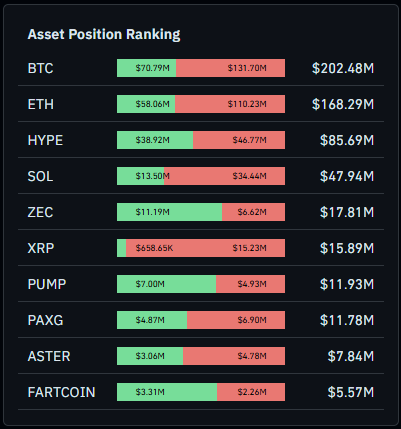
Recent data from Coinglass reveals that traders are piling into short positions on XRP at a far more aggressive pace than any other major asset.
Despite this pressure, the asset has held surprisingly firm, posting gains over the past day.
Aggressive Shorts on XRP
According to figures shared by Coin Bureau, traders are heavily tilted toward shorting top cryptocurrencies, but the imbalance is most extreme for XRP. The breakdown shows that Bitcoin holds $131 million in shorts versus $70 million in longs.
Meanwhile, Ethereum has $110 million shorts, compared to $58 million in longs. SOL registers $34 million in shorts and $13 million in longs.
But XRP stands out with $15 million in shorts compared to just $0.6 million in longs. This translates to a nearly 96% short allocation, with longs making up barely 4% of total positioning. It is one of the most lopsided ratios in the market, with shorts outweighing longs by roughly 25 to 1.
This data highlights how strongly traders are betting against XRP as the coin attempts to recover.
XRP Price Holds Steady Despite the Pressure
Despite being heavily shorted, XRP’s price has not reacted as many had hoped. The token is currently trading at $2.08, up 1.79% over the past 24 hours. Its weekly candle shows a 1.88% gain.
This mild upward movement suggests that underlying spot demand remains resilient, preventing bears from gaining full control. Market observers attribute this strength to inflows from XRP spot ETFs.
As of the close of business last week, XRP ETFs have attracted $897 million in inflows over 15 consecutive trading days. Major contributions came from Canary Capital with $363.89 million and Grayscale’s GXRP with $211.85 million. Others, including Bitwise and Franklin, have also purchased XRP worth $187.14 million and $134.5 million, respectively.
XRP ETF data
Many XRP analysts continue to project a supply shock as ETFs keep buying XRP, expecting a major uptrend that could catch many by surprise. However, traders appear to be largely betting against this outlook, given the heavy skew toward bearish positions in the futures market.
Crypto AI founder Leo Simpson argued that the crowd is leaning heavily in the wrong direction on XRP. He noted that such one-sided positioning often fuels sharp moves: “When longs are nearly absent, even a small catalyst can trigger a real squeeze.”
He warned traders to stay alert and avoid letting market consensus push them out of potential upside.
Others commenting on the data echoed this view, noting that such a heavily bearish stance could easily backfire, as the markets often move against the dominant position.
I am sitting here waiting to pounce in case my buy orders are missed.
Coinglass liquidation records over the past 24 hours show $9.71 million in total liquidated positions across XRP. Long positions accounted for $7.05 million, while short positions totaled $2.66 million.
This ratio shows that both sides of the market are taking hits, though longs have absorbed more liquidations. Still, the rapid buildup of short exposure remains the standout trend.
All eyes are now on whether the bears will finally force a breakdown, or whether XRP’s quiet strength will trigger a squeeze that catches the market off guard.
A crypto market analyst and trader has projected how much lower XRP could still drop from here, identifying what he believes is behind the current market struggles.
The crypto market tried to rebound earlier this month, but that momentum faded prematurely. Notably, prices slipped again, and XRP, which was one of the victims of this drop, now trades around $2.07, extending a losing streak that has lasted since October.
Crypto Market Still Following Normal Risk Cycles
Amid the struggles, Cypress Demanincor, CEO of CYPRX Superior Trading, highlighted what he believes are the reasons behind the continued weakness and explained how far XRP might still fall before conditions turn around.
In a post on X, Demanincor said crypto still follows normal risk cycles. Specifically, traders rush in when markets lean risk-on, but they retreat the moment conditions shift toward risk-off.
However, despite the current downturn, he said he feels more optimistic heading into 2026 than he has in years, especially now that the United States finally offers regulatory clarity. He argued that many investors still underestimate how important that change is.
XRP and Crypto Under Pressure
Demanincor called attention to the broader market to show how pressure has been building. At the time of his analysis, the total crypto market had lost more than $90 billion, and he said XRP’s weakness comes from obvious macro issues rather than anything happening inside the XRP ecosystem.
He added that altcoins across the market have been sliding for months, something he and his community expected long before retail traders caught on.
Demanincor reminded his audience that he called out early signs of a yen carry trade unwind on Sept. 28. He said many people dismissed him, and he saw the same reaction when he released a 45-minute breakdown on Nov. 23 outlining the same problem.
However, by Dec. 5, outlets like Yahoo Finance had begun discussing how the yen carry trade and the Bank of Japan’s sudden policy shift, could hit Bitcoin and the broader crypto space.
How the Yen Carry Trade Is Impacting the Market
He explained that the latest round of selling came after new signals from the Bank of Japan’s leadership. Hawkish remarks from Governor Kazuo Ueda pushed traders to expect faster rate hikes.
Demanincor highlighted a Bloomberg report indicating that BOJ officials were preparing to raise rates at their upcoming meeting. Notably, the markets now expect a 25-basis-point hike on Dec. 14, with more increases in 2026.
Specifically, analysts at MUFG even project that BOJ may take rates to 1.25% by the end of 2026. Demanincor also pointed out that Japan’s household spending just saw its steepest drop in nearly two years, Japanese yields keep climbing, and the 2-year JGB now sits above 1% for the first time since the 2008 crisis.
He said all of this matters because the yen carry trade has fueled global liquidity for almost thirty years. For context, investors borrow cheap yen, convert it to dollars, and push that money into higher-yield assets, including leveraged crypto positions, especially in Asia.
When Japan raises rates or the yen strengthens, the unwind can hit markets hard. He reminded traders that a BOJ hike in August 2024 erased more than $600 billion from the crypto market in one day and over $700 billion that week, along with more than $1 billion in forced liquidations.
Two Possible Paths for the BOJ
Considering these, Demanincor presented two possible outcomes for the upcoming BOJ decision. First, if the rate hike lands in line with expectations, markets may already have priced in the damage, which could lead to a “sell the rumor, buy the news” bounce.
However, if the BOJ takes a more aggressive stance or signals steeper hikes heading into 2026, the carry trade unwind could intensify and trigger another sharp drop, especially in crypto, which he described as the highest-beta risk asset.
Another Factor Contributing to Market Pressure
Meanwhile, Demanincor also highlighted a second factor contributing to the crypto market’s downturn besides Japan’s economic situation. Specifically, he called attention to geopolitical developments.
Notably, markets responded positively earlier in the week when reports hinted at progress in Russia–Ukraine peace talks. However, the optimism collapsed when Russian President Vladimir Putin delivered new warnings and insisted that Moscow would seize territory.
Demanincor said official statements from U.S. and global officials clearly showed that negotiations remained difficult, despite upbeat headlines circulating on social media.
He told traders to watch for surprise comments from Japanese officials, tariff-related news tied to U.S. political negotiations, and the run-up to next week’s FOMC meeting.
Markets currently expect a third straight 25-basis-point cut, and traders assign an 87% chance to that outcome. They also project two or three cuts in 2026. Demanincor said Jerome Powell’s guidance will determine whether markets keep pricing in early-2026 easing or start pulling back those expectations.
He argued that even if the Fed cuts rates next week, weaker data could erase hopes for early-2026 cuts and keep pressure on risk assets into the end of the year.
How Low Could XRP Go?
The market pundit then shared the XRP levels he plans to monitor. Specifically, if XRP drops below $1.90, he noted that he may consider adding to his position, depending on whether buyers show interest on order-flow charts. However, if XRP loses that support, investors should watch $1.56 as the next accumulation zone.
On the upside, Demanincor noted that he would not expect a recovery until XRP flips $2.33 into support because he identifies a strong seller at that level. If XRP breaks through $2.33, he plans to turn bullish again and watch for a move toward $2.63.
XRP 1D Chart | Demanincor
He also noted a lower delta zone between $0.73 and $0.81, which would only come into play under extreme selling pressure, and he highlighted $3.28 as the next major sell zone above.
Despite Shiba Inu bearish performance, early community member Zach Humphries argues that SHIB still has a realistic path back to its explosive 2021 momentum.
In a nine-minute video shared on X, Humphries outlined critical changes he believes the team must implement for SHIB to break out of its prolonged stagnation and regain the 2021 price levels that defined its legendary rise.
For context, SHIB reached an all-time high of $0.00008845 in October 2021 but now trades 90.48% below that level. At its current price of $0.000008419, SHIB has fallen 17.3% over the past 30 days, 34.6% over the past 3 months, and 60.2% year-to-date.
Humphries emphasized that he has covered SHIB since early 2021 and has remained active through both its highs and decline. He acknowledged the community’s growing frustration, citing an expanding ecosystem that often feels disconnected from SHIB, along with the token’s steadily fading momentum.
How Shiba Inu Can Reclaim Its 2021 Glory
Nonetheless, Humphries insisted that SHIB is far from dead. He highlighted that SHIB remains a top-25 crypto asset with one of the strongest brands in the industry. Accordingly, he argued that the token still has a path to recovery if developers address three major issues.
A Full Refocus on SHIB as the Core Asset
Humphries’ strongest argument centers on realignment. He believes the Shiba Inu ecosystem has expanded in too many directions, ultimately diluting the focus on SHIB.
Since launching SHIB in August 2020, the team has rolled out several additional projects and tokens, including Shibarium, Shib: The Metaverse, ShibaSwap, BONE, LEASH, TREAT, and NFTs. Humphries believes these additions have drawn attention and value away from the ecosystem’s flagship token.
According to him, this broad expansion has created confusion rather than confidence within the community. He stressed that SHIB’s 2021 rally was not due to its complex utility but to its massive, unified community, strong identity, and viral momentum. Today, he argues, the ecosystem feels scattered, unfocused, and disconnected from SHIB.
In parallel, Humphries recommends a full ecosystem realignment, one in which every major development directly benefits SHIB rather than side tokens or separate projects.
Capturing the Next Wave of Retail Momentum
Humphries’ second condition centers on market psychology. He emphasized that meme coins like Shiba Inu thrive when retail participation is high. Institutional investors do not drive meme coin rallies. Instead, they surge when everyday traders enter the market, motivated by emotion, social virality, and the appeal of low-cost tokens with high perceived upside.
Humphrie noted that when retail returns to crypto, these investors rarely start with Bitcoin. Instead, they lean toward high-energy, narrative-driven assets like SHIB.
In his view, SHIB can still position itself as one of the strongest meme-based tokens. If the team aligns the project correctly, SHIB could once again become a retail magnet, sparking a new phase of price discovery as fresh buyers enter the ecosystem.
Need for a Simple, Transparent, and Executable Roadmap
Humphries also pointed to the project’s overly complex roadmap. He noted that Shibarium, the DEX, NFTs, multiple tokens, and metaverse development have stretched the project’s vision so broadly that it now lacks clarity.
Crypto investors do not need ten ambitious initiatives, he said — they need one clear, well-executed mission. Accordingly, Humphries urged the team to create a roadmap that is simple, transparent, achievable, and directly tied to SHIB’s value.
Specifically, he called for SHIB-linked revenue distribution, incentives, or mechanics that give the token real economic purpose within the broader ecosystem. The goal is not to build the most features but to build the right ones that align with SHIB holders and are easy for newcomers to understand.
Humphries concluded that if the team embraces these recommendations, SHIB can still recover. He asserted that the token has the brand power, community size, and cultural recognition needed for a rebound.
Meanwhile, he stressed that SHIB’s success ultimately depends on leadership’s willingness to refocus, simplify, and reconnect the ecosystem with its original identity.
Coinbase has reinstated new user registrations in India after more than two years of suspension.
This initiative represents its most concerted effort to reestablish a significant presence in one of the world’s most active cryptocurrency markets.
With sign-ups restored, Indian customers can once again trade digital assets through crypto-to-crypto pairs.
Coinbase’s director for Asia-Pacific, John O’Loghlen, shared this update during India Blockchain Week, highlighting the firm’s cautious approach. He explained that this first phase allows the company to return in a controlled manner while navigating India’s complex regulatory landscape.
By focusing on crypto-only transfers for now, the company aims to rebuild trust and operational stability before expanding features.
Fiat Services Targeted for 2026
Building on this initial reopening, Coinbase plans to reintroduce fiat support in 2026. According to TechCrunch, the company intends to allow users to load rupees directly into the app and to make seamless purchases of digital tokens.
This capability was discontinued shortly after its 2022 launch when the operator behind India’s Unified Payments Interface withdrew its support for the platform.
Regulatory Reset and Formal Engagement
The renewed push follows a complete withdrawal from the Indian market in 2023. At the time, Coinbase offboarded millions of users as part of what O’Loghlen described as a “regulatory reset.”
Since then, the exchange has strengthened its compliance framework and has initiated direct engagement with the Financial Intelligence Unit, India’s authority responsible for overseeing financial integrity and anti-fraud standards.
Coinbase secured official registration earlier this year, laying the groundwork for a structured return.
Gradual Testing Ahead of Broad Launch
Before opening registration to the general public, Coinbase quietly tested the waters through an early-access program launched in October. This limited release allowed the company to refine its onboarding systems and ensure alignment with domestic requirements.
The broader rollout that followed represents the next step in restoring full operational capability.
Operating Under India’s Strict Tax Rules
Coinbase’s comeback occurs at a time when the crypto sector continues to adjust to India’s demanding tax regime. Current rules impose a 30% tax on digital-asset profits and mandate a 1% tax deduction at source on every trade, without allowing loss offsets.
Government data indicate that these policies have generated approximately $818 million (₹700 crore) since their implementation in 2022/23. The structure has reshaped trading patterns nationwide, forcing exchanges and investors to re-evaluate their strategies.
Industry participants indicate that these tax requirements have significantly curtailed domestic trading activity. They have further complicated operations, particularly for global firms seeking to expand in India.
Even so, Coinbase’s renewed push suggests the company sees long-term potential in the region despite short-term headwinds.
Expansion Plans and Regional Strategy
Alongside reopening its platform, Coinbase is increasing its investment in CoinDCX, India’s largest crypto exchange, which holds a valuation of $2.45 billion.
The company also plans to expand its local workforce, which currently numbers over 500 employees.
O’Loghlen emphasized that India will serve not only as a core market but also as a strategic base for supporting operations across South Asia and the Middle East, highlighting the region’s broader importance to the company’s global roadmap.
Investors holding 1,000, 5,000, and 10,000 XRP tokens could see massive profit if the XRP price rallies in a scenario where XRP powers the global payroll industry.
XRP trades at $2.18 today with a market value of about $131.8 billion. However, analysts who have tracked the token’s long-term potential argue that XRP still trades below its real worth despite having increased by over 37,000% since launch.
They believe XRP could rise higher if it secures broad utility in payments. One major sector where XRP could make a noticeable impact is the global payroll industry, a market that depends on fast, low-cost, and dependable settlement technology.
Size of the Global Payroll Industry
Interestingly, Mordor Intelligence expects global payroll services revenue to reach $27.81 billion in 2025 and grow to $34.76 billion by 2030, with a compound annual growth rate of 4.56%. Notably, these figures represent the cost of payroll software and services, not the total wages companies pay.
Data also shows that payroll processing made up 46.4% of the entire market in 2024. Meanwhile, employer-of-record services held 15.7% and continue to grow quickly. Large companies controlled 56.2% of the market share, while small businesses are expanding at a strong 13.5% rate through 2030.
According to Mordor Intelligence, regionally, North America held 38.5% of global payroll services revenue in 2024, while Asia-Pacific continues to grow at 11.9% and should remain the fastest-expanding region between 2025 and 2030.
Meanwhile, the real payroll force sits in total wages paid worldwide each year. Estimates place the world’s annual payroll volume between $40 trillion and $50 trillion. This estimate comes from the global GDP of roughly $105 trillion and the fact that employee compensation usually accounts for 50% to 60% of worldwide economic output.
XRP Price if It Powers the Global Payroll Industry
If XRP wins even a portion of this enormous flow of payments, its valuation could rise sharply. To explore how much this could impact XRP price, we asked Grok AI to build a hypothetical model based on payroll settlement.
In the model, XRP acts as a mainsettlement asset for a meaningful portion of global payroll, especially cross-border and instant wage payments.Grok first examined what happens if XRP handles 25% of global payroll volume by 2030.
XRP Price Prediction | Grok AI
Notably, this share would equal $10 trillion to $12.5 trillion in annual payment flow. If the network uses each XRP token 50 times per year, a reasonable rate for a high-speed payment asset, the system will need a market value between $250 billion in a moderate scenario and $500 billion in a stronger one.
Grok then explored a more bullish scenario. In this case, XRP captures 30% to 40% of global payroll, or $15 trillion to $20 trillion per year.
With token velocity between 50 and 70, and with support from institutional demand, ETFs, and broader network adoption, Grok sees a possible value range between $2 trillion and $14 trillion. A $14 trillion market cap would put XRP at roughly $248 per token. Based on this model, Grok set its final hypothetical target at $250 by 2030.
Worth of 1,000, 5,000, and 10,000 XRP if XRP Hits $250
If XRP ever climbs to $250, the impact on individual investors would be massive. Specifically, on-chain data shows that 773,595 wallets hold between 1,000 and 10,000 XRP. Of this number, 596,029 wallets contain 1,000 to 5,000 XRP, while 177,566 wallets hold 5,000 to 10,000 XRP.
An investor with 1,000 XRP owns roughly $2,200 today. This same amount would rise to $250,000 at a $250 price, producing a gain of $247,800. Someone with 5,000 XRP owns about $11,000 today, and that position would grow to $1.25 million, an increase of $1.239 million.
Meanwhile, a wallet with 10,000 XRP holds around $22,000 at current prices, but that balance would reach $2.5 million at $250 per token, creating a gain of roughly $2.478 million.
Market participants have continued to anticipate a scenario where an XRP price spike pushes their holdings to $1 million.
XRP has struggled over the past few months. Still, most analysts have maintained a bullish stance, often suggesting that current market uncertainty offers investors an opportunity to acquire more XRP at discounted prices.
An Opportunity to Buy at a Discount
For context, after recovering 8% to the $2.2 resistance on Dec. 3, the XRP price collapsed 7.53% in the following two days, bringing XRP back to its starting point. Despite a mild rebound push since Saturday, Dec. 6, XRP continues to trade at the lower end of the $2 mark, currently changing hands at $2.07.
However, there may be a silver lining to this, analysts argue. For instance, as market conditions turned sour last month, market pundit Income Sharks suggested that any XRP crash below $2 would only be another opportunity for investors to be able to load up on their bag at lower prices.
Notably, data from the XRP Rich List confirms that there are 598,607 wallets holding 1,000 to 5,000 XRP tokens, making this tier the third-largest cohort of addresses on the XRPL. Today, 5,000 XRP remains within retail reach, costing about $10,350, as the XRP price continues to trade at lower levels.
How 5,000 XRP Could Yield $1M
Meanwhile, many XRP investors have envisioned a future where their holdings push them to millionaire status, including a balance of just 5,000 tokens. Earlier this year, XRP community figure Edoardo Farina projected that multiple XRP holders could become millionaires and testify to how they took the risk and loaded up on XRP.
However, at what point would a balance of 5,000 XRP lead to $1 million? Today, these tokens hold a worth of $10,350.For their value to rise to $1 million, the XRP price would need to surge from $2.07 to $200. For perspective, this would represent an ambitious 9,561% increase in XRP price.
Interestingly, while the $200 price remains an audacious target, some experts have not shied away from highlighting it. For instance, last month, Chad Steingraber, a professional game designer, presented an analysis that suggested that XRP ETFs alone could push XRP price to $220. His commentary came on the back ofthe success of these financial products.
In addition, market analyst Javon Marks pointed out that XRP had broken above a 6-year pennant formation as of September 2024, predicting a possible rally to $200.Meanwhile, analysts at crypto platform Changelly presented a possible timeline for the $200 forecast to play out, projecting XRP to hit a minimum price of $246 in February 2040.
How could the XRP price react if the top 10 Fortune 500 companies decide to add XRP to their balance sheets?
Notably, as U.S. regulators provide greater clarity on crypto laws, more firms are showing interest in holding XRP as part of their corporate treasuries. Interestingly, multiple companies have already created or announced plans to create XRP treasuries.
Specifically, VivoPower committed millions in May 2025. Webus International followed with a $300 million plan in June, and Trident Digital Tech Holdings announced a $500 million purchase. Wellgistics Health added $50 million, and Evernorth made the biggest move yet with a $1 billion announcement last month.
The Fortune 500 Firms
While no large U.S.-based company has shown any interest in adopting XRP as a treasury asset, we recently analyzed what might happen to XRP’s price if the top ten firms on the Fortune 500 list decide to buy in.
For the uninitiated, the Fortune 500, published yearly by Fortune magazine, ranks America’s largest companies by total revenue.
In the 2024 edition, Walmart led with $648.1 billion in revenue. Amazon followed with $574.8 billion, while Apple took third place with $383.3 billion. UnitedHealth Group came next with $371.6 billion, and Berkshire Hathaway reported $364.5 billion.
Meanwhile, CVS Health earned $357.8 billion, ExxonMobil brought in $344.6 billion, Alphabet generated $307.4 billion, McKesson made $276.7 billion, and Cencora rounded out the top ten with $262.2 billion.
Notably, when companies invest, they typically use their profits rather than their total revenue. For context, revenue represents total sales, but firms must first cover costs like salaries, operations, and taxes.
What’s left as profit can either go back into the business, fund new investments, or be paid to shareholders through dividends. Some companies also borrow money or issue new shares to raise funds for investments.
XRP Price if Top 10 Fortune 500 Firms Invest 5% of Revenue
However, for this analysis, we presented a scenario where each of the top ten Fortune 500 firms decides to use 5% of their total revenue to buy XRP.
This would mean Walmart investing about $32.405 billion, Amazon putting in $28.74 billion, and Apple committing $19.165 billion. UnitedHealth Group would add $18.58 billion, and Berkshire Hathaway would contribute $18.225 billion. Including the others, the total investment would reach roughly $194.55 billion.
Notably, if these ten firms put $194.55 billion intoXRP, the effect on the market would be massive. However, inflows like this don’t translate directly into a one-to-one increase in market value.
The crypto market usually reacts with a multiplier effect, where each dollar entering the market lifts the overall valuation by several times. In some past cases, XRP has seen multipliers as high as 272x the amount invested.
However, to stay realistic, we applied a conservative 10x multiplier. Under this assumption, a $194.55 billion inflow could boost XRP’s market cap by about $1.945 trillion. With XRP’s current market cap near $139 billion, this increase would push its total valuation to roughly $2.084 trillion.
Given XRP’s total supply of about 99.9 billion tokens, this $2.084 trillion valuation would put the XRP price at around $21 per token.
A famous member of the XRP community shared a list of macro and crypto-related catalysts that motivated him to increase his XRP position today.
The broader crypto market continued its downturn yesterday, plummeting 2.87% over the past 24 hours to $3.05 trillion. XRP was not spared in the bloodbath, as the fourth-largest cryptocurrency also lost 2.18% of its value, dropping to $2.03.
The token has remained pinned to the $2 range, trading between $2 and $2.2 over the past week under persistent macroeconomic pressure. This lackluster performance has fueled investor skepticism, as evident in the Fear and Greed Index (FGI), which sits at 21, signaling fear.
While many investors shift their crypto holdings into stablecoins to avoid further losses, others view the market dip as an opportunity to accumulate. Notably, Digital Asset Investor (DAI), a well-known figure in the XRP community, falls into the latter group.
Expert Reveals Why He Bought More XRP
He revealed on X that he purchased additional XRP tokens yesterday and outlined several key factors that drove his latest accumulation. His commentary connects monetary-policy shifts, geopolitical developments, and emerging digital-asset regulation, ultimately portraying a rapidly improving environment for risk assets such as XRP.
Just some of the reasons I bought XRP today:
$8 Trillion Sitting in money markets Interest Rate Decreases coming $2,000 Tariff Checks coming Clarity Act Passage Coming Tokenization coming Billions flowing into XRP ETFs Ukraine War could end any day now China Trade deal…
DAI begins by highlighting the massive pool of capital sitting idle. He points out that $8 trillion remains parked in U.S. money-market funds, which he considers one of the strongest bullish setups for assets like XRP.
While these funds serve as traditional safe havens, falling yields could push some of this capital into riskier markets—potentially flowing directly into crypto, with XRP well positioned to benefit.
Incoming Economic Stimulus
Next, he cites the $2,000 tariff checks expected to be distributed to U.S. taxpayers. In his view, this injection of consumer liquidity could increase market participation, as some recipients may direct a portion of those funds toward speculative assets such as cryptocurrencies.
Expected Interest-Rate Cuts
DAI also stresses that the Federal Reserve is poised to slash interest rates soon. Analysts, including those at Bank of America, anticipate a 25-basis-point cut later this month. As a result, investors expect cheaper borrowing costs and broader liquidity expansion. Since rate-cut cycles historically support rallies in risk assets, DAI sees this shift as a significant tailwind for XRP.
Upcoming Regulatory Clarity via the CLARITY Act
He also points to the anticipated passage of the Clarity Act, a regulatory framework intended to clarify the classification of digital assets. Sources suggest the legislation could take effect next year and drive stronger institutional adoption. For DAI, this incoming clarity strengthens the long-term investment case for XRP.
Growing Inflows Into XRP ETFs
Furthermore, he emphasizes the rising inflows into XRP-linked ETFs, which have already attracted $897.35 million in under a month. As institutional capital continues to flow in, market stability and liquidity improve—conditions that often precede broader adoption and price growth.
Tokenization Wave Expected to Accelerate
DAI also highlights the rapid approach of real-world asset tokenization. Since XRP offers fast settlement and high efficiency, it frequently appears in industry discussions about tokenized assets. He believes this trend could significantly elevate XRP’s utility and demand.
Easing Geopolitical Tensions
In addition, he notes that the Ukraine conflict could end at any moment, potentially triggering a global rally in risk assets. It is worth noting that reduced geopolitical tensions typically boost investor confidence and support a recovery in speculative markets, including crypto.
Quantitative Tightening Ending
DAI further stresses that the end of quantitative tightening (QT) influenced his latest purchase. The Federal Reserve halted QT earlier this month, signaling a shift toward more accommodative financial conditions, which is historically a powerful catalyst for asset appreciation.
Other Contributing Factors
He also mentions several additional factors: a possible U.S.–China trade deal, a revival in U.S. manufacturing, and the clearing out of excessive crypto leverage, which reduces downside risk and sets the stage for healthier price action.
Based on DAI’s analysis, XRP stands at the center of a rare alignment of macroeconomic catalysts, incoming regulation, institutional inflows, and shifting geopolitical conditions. In his view, these combined factors justify increasing exposure to XRP now, as they may signal the early phase of a significant market cycle.