Home Blog Page 39

XRP Adds $10B Market Value in One Day as Price Spikes 15%

0

XRP recently added $10 billion to its market value in a single day as its price jumped 15% amid a broader recovery across the crypto market. 

Several positive developments have helped lift market sentiment and bring buyers back into risk assets. The crypto market gained $161 billion yesterday and has added another $58 billion so far today, taking its total value to a three-month high of $2.41 trillion.

This recovery came as the US Treasury announced plans to double its liquidity-support operations, with President Trump also meeting with crypto executives at the White House. Notably, Bitcoin has moved above $72,000 for the first time since early June.

XRP Adds $10 Billion to Its Market Value

XRP has leveraged the recovery to push above $1. The token reached $1.16 earlier today before falling back to around $1.15. Over the past 24 hours, XRP has added $10.14 billion to its market value. Notably, it gained $6.53 billion yesterday alone and has added more than $3.6 billion today.

With the recent rally, XRP’s market capitalization has surged to $72.77 billion, its highest level since July 4. XRP has also gained 15.46% over the past 24 hours, making it the third-biggest gainer among the top 10 crypto assets by market value.
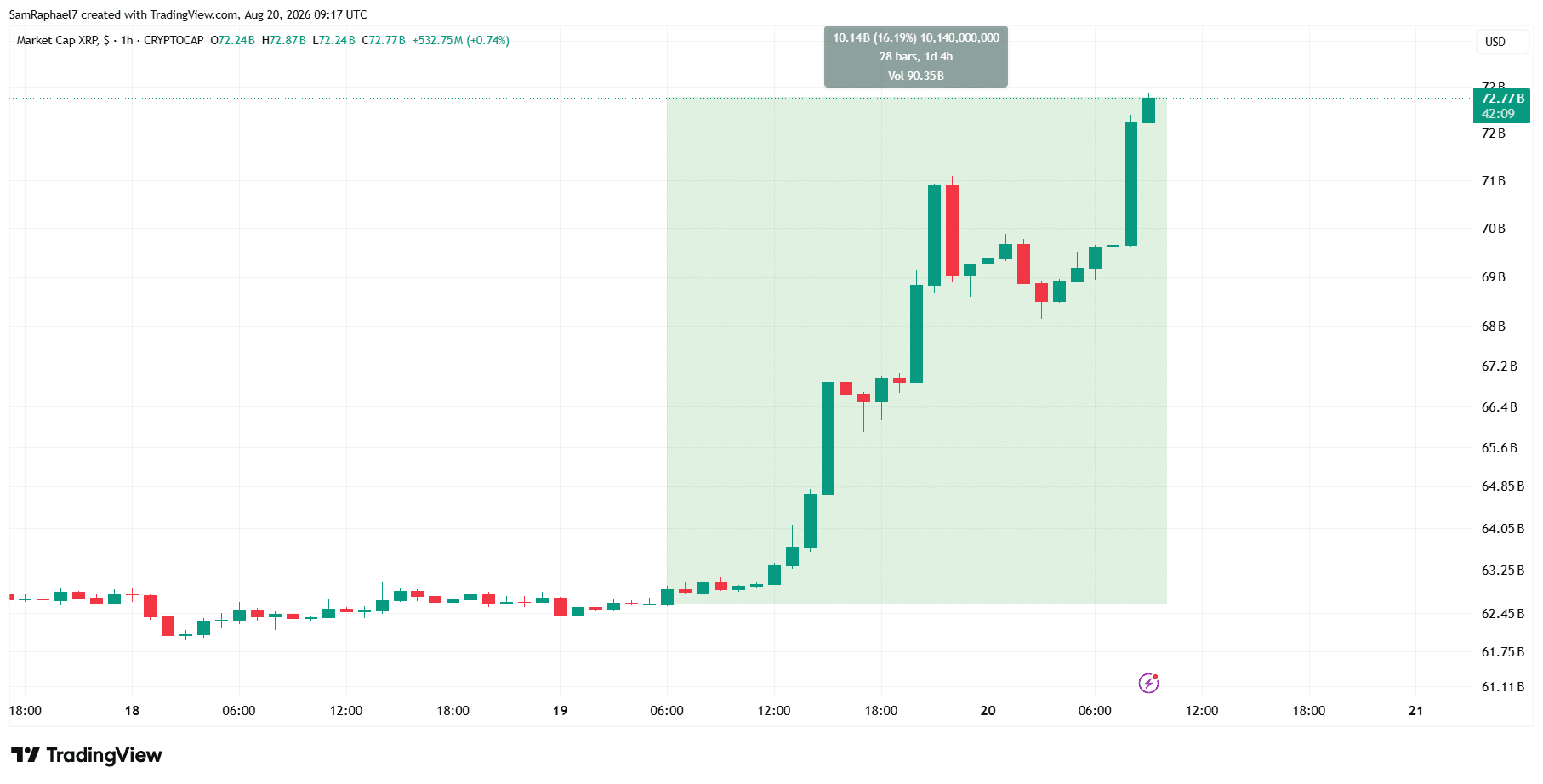
XRP Adds $10B to Its Market Value

The latest rally has pushed XRP into fifth place among the top 10 crypto assets, putting it ahead of USDC. However, CoinMarketCap had not updated its rankings at press time.

XRP has also performed better than BNB during the recent market recovery. Still, the gap between the two assets remains wide. BNB currently has a market value of $85.5 billion, compared with XRP’s $72.77 billion.

XRP would therefore need to add about $12.73 billion to its market value to match BNB. Based on the current figures, the token would need to gain another 18%, taking its price to about $1.36, to reach BNB’s current market value.
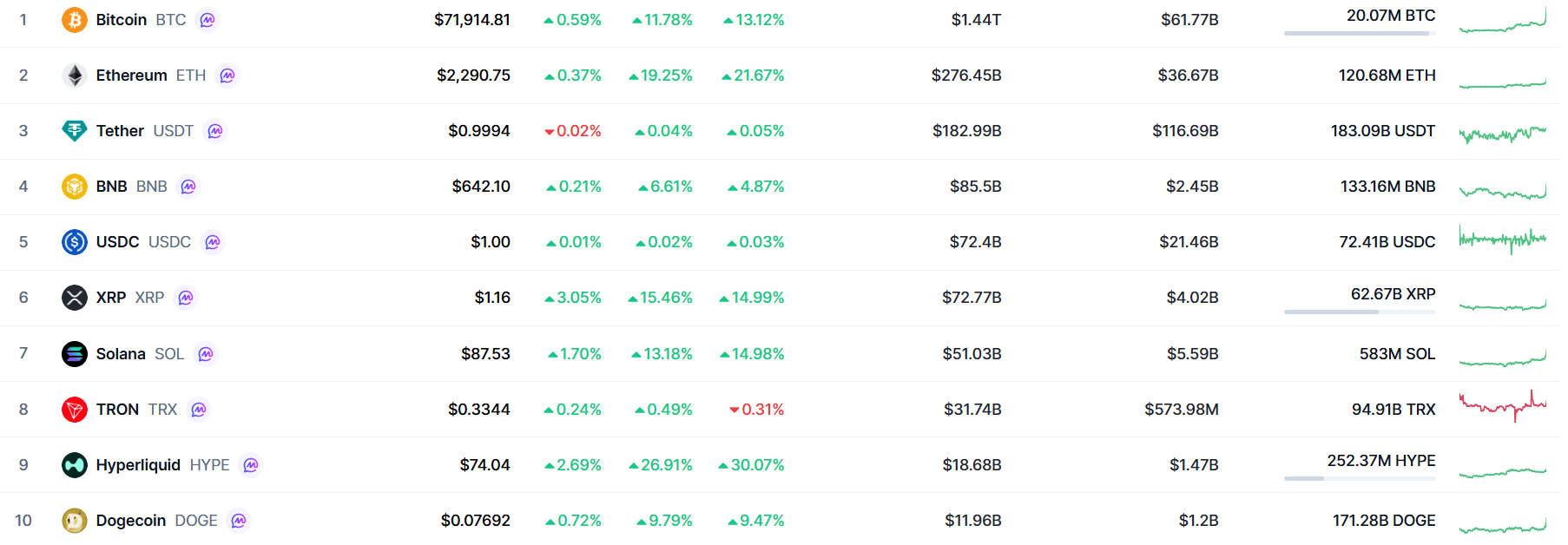
XRP Ranks Fifth Among Top 10 Crypto Assets

Catalysts Behind the Rally

The recent recovery has several key drivers. For one, under Secretary Scott Bessent, the Treasury announced plans to at least double its liquidity-support operations for longer-dated Treasuries, increasing each operation from roughly $2 billion to at least $4 billion.

The Treasury plans to start the larger operations around Sept. 9 and continue them into early November. The announcement came after the 30-year Treasury yield climbed to a multi-year high near 5.34%. The yield later fell toward roughly 5.2%, while bond prices rose and market liquidity improved.

Meanwhile, the initial price gains triggered a large wave of forced buying as traders holding short positions faced liquidations. Around $2.7 billion to $3 billion in crypto short positions were liquidated across the market within roughly 24 hours. 

When exchanges closed these losing short positions, traders had to buy back the assets they had sold. This forced buying added more upward pressure and helped push the wider market higher.

White House Meeting Adds to Crypto Optimism

Political and regulatory developments have also helped improve sentiment. President Trump recently met with crypto executives, including representatives connected to Coinbase, Gemini, Ripple, Chainlink Labs, and other companies, during a White House event.

Trump also urged Congress to move forward with a fair version of the Digital Asset Market Clarity Act, an important piece of proposed crypto market-structure legislation. 

The meeting added to other recent signs of a more supportive US policy approach toward digital assets. Recent SEC proposals have also focused on easing some rules around digital-asset fundraising and exemptions.

Crypto Founder Says Cardano to $3 is a Question of When, Not If

0

Jure Karamarko, founder of Cardano-based token SongMarketCap, believes ADA will eventually reclaim the $3 level.

In a recent tweet, Karamarko said the possibility of Cardano surpassing $3 is a question of when, not if, highlighting his strongly bullish outlook for the coin. In his view, Cardano has the potential to reclaim and eventually exceed the key price level.

Cardano Rebounds as Crypto Market Recovers

Karamarko’s comment comes as Cardano attempts to recover from a prolonged period of weakness and return to levels last seen during the 2021 crypto bull market. Yesterday, ADA surged more than 10% and briefly moved above $0.19 as momentum returned to the broader crypto market.

Meanwhile, the wider market also staged a sharp recovery, with total crypto market capitalization rising 8.7% to $2.37 trillion. Bitcoin reclaimed $70,000 before pulling back slightly, while Ethereum moved above $2,000 and traded around $2,252.

Consequently, Cardano’s rally did not occur in isolation. The broader market recovery provided additional momentum for ADA and encouraged investors to reconsider the possibility of a much larger rebound.

ADA Faces a 1,530% Rally to Reach $3.10

Notably, the $3 level is not new territory for Cardano. ADA reached an all-time high of $3.10 in September 2021 during the previous crypto bull market. However, the token now trades far below that peak, at $0.1840. From this level, ADA would need to rally roughly 1,530% to reclaim its previous all-time high.

Karamarko is not alone in identifying $3 as a potential target for Cardano. Technical analysts and long-term forecasts have also pointed to the possibility.

For instance, TradingView analyst OceanStaker previously identified a Power of Three (PO3) pattern that could potentially support a move toward $3. Similarly, Telegaon has projected that ADA could cross $3 and potentially reach $3.24 by 2028. 

What Could Drive Cardano Toward $3?

Several factors could support a sustained Cardano recovery. First, another broad crypto bull market could increase demand for ADA. Historically, the token has benefited from stronger market-wide risk appetite and increased capital flows into altcoins.

Additionally, Cardano founder Charles Hoskinson has maintained his confidence in ADA’s long-term potential. While discussing ADA’s previous performance, Hoskinson recalled how ADA climbed from $0.025 to $3.10 in 2021.

Furthermore, Hoskinson has suggested that the crypto industry could enter another major bull market driven by a new market narrative. If that scenario materializes, ADA could benefit from renewed investor interest and stronger market momentum. Moreover, Cardano is strengthening its DeFi ecosystem and attracting more users through initiatives such as RealFi and the AlphaGrowth PRIME proposal. 

Although Karamarko considers $3 “a matter of when rather than if,” investors should treat long-term crypto forecasts cautiously because market conditions, regulation, adoption and sentiment can change significantly.

XRP ETF Takes A 6% Share As Bitwise Products Record $300M Volume

0

Bitwise crypto investment products recorded about $300 million in combined trading volume on Aug. 19, with the Bitwise XRP ETF making up roughly 6% of the total. 

This comes as the broader crypto market remains under pressure, with the market losing about $580 billion in value this year. Despite the consistent decline, crypto investment products have continued to draw renewed investor attention.

Bitwise ETFs Post $300 Million in Volume

Hunter Horsley, CEO of Bitwise, revealed the figures in a recent disclosure on X and highlighted the top five contributors to the company’s total ETF volume. 

Specifically, the Bitwise Bitcoin ETF (BITB) led the group with $156 million in trading volume, followed by the Bitwise Solana ETF (BSOL) with $58 million.

Meanwhile, the company’s Hyperliquid ETF (BHYP) ranked third with $45 million, while the Ethereum ETF (ETHW) followed with $35 million. 

The Bitwise XRP ETF (XRP) ranked fifth, recording about $20 million in trading volume on Aug. 19. Based on Bitwise’s figures, the XRP product accounted for 6.6% of the total trading volume across all Bitwise ETFs.

XRP ETF Volume Reaches Highest Level Since May

Data from Sosovalue, a crypto analytics platform, put the Bitwise XRP ETF’s trading volume slightly higher at $22.77 million on Aug. 19. This marked the product’s highest single-day trading volume since May 14, when XRP traded at around $1.54.

Trading activity also picked up across the broader XRP ETF market. Notably, the five XRP ETF products together recorded $31.66 million in trading volume on Aug. 19, marking the highest daily figure since mid-June.

Bitwise Leads the XRP ETF Market Source Sosovalue
Bitwise Leads the XRP ETF Market | Source: Sosovalue

However, the jump in trading volume did not lead to a similar increase in new capital entering the Bitwise XRP ETF. The product recorded just $1.19 million in inflows on Aug. 19. This figure is well below the $7 million in inflows recorded on May 14, when the ETF posted a similar level of trading activity.

Bitwise XRP ETF Maintains Lead

Despite the relatively small inflow, the Bitwise XRP ETF still recorded the largest single-day inflow among all XRP ETFs on Aug. 19. The Franklin Templeton XRP ETF (XRPZ) followed with $1.16 million, while the other three XRP ETF products recorded no inflows.

The latest figures also bolster Bitwise’s position as the largest XRP ETF by both cumulative net inflows and net assets. Notably, the Bitwise product recently moved ahead of the Canary Capital XRP ETF (XRPC) and has continued to widen its lead.

For context, the Bitwise XRP ETF now has $515.9 million in cumulative net inflows, compared with $468 million for XRPC. This gives Bitwise nearly 34% of the total cumulative net inflows across all XRP ETFs.

The gap also extends to assets under management. The Bitwise XRP ETF holds approximately $322.71 million in net assets, compared with $247.73 million for XRPC. While the latest trading figures show renewed activity around XRP ETFs, Bitwise remains the leader in both investor inflows and total assets among XRP ETF products.

XRP News: President Trump Welcomes Ripple CEO at White House

0

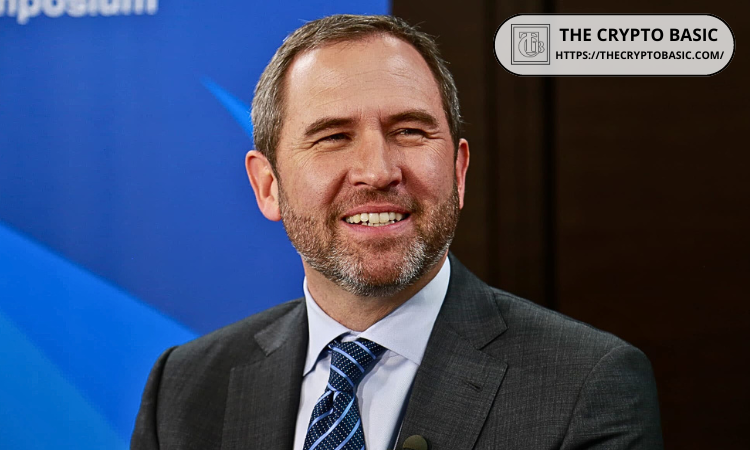
U.S. President Donald Trump welcomed Ripple CEO Brad Garlinghouse to the White House on Wednesday.

This was during Trump’s gathering with crypto industry leaders to discuss the future of digital assets and financial markets. Garlinghouse was among the executives Trump specifically acknowledged in remarks.

Trump Highlights Crypto Leadership

Trump described the gathering as a meeting of a “who’s who” in finance, crypto and technology. He stressed his administration’s efforts to position the United States as a global leader in crypto and blockchain-based financial markets.

Alongside Ripple CEO, the meeting included Coinbase CEO Brian Armstrong, Chainlink co-founder Sergey Nazarov, and Kraken CEO Arjun Sethi. BitGo executives, Robinhood CEO Vlad Tenev, Nasdaq CEO Adena Friedman, and other major industry figures were also present.

Trump used the event to reiterate his administration’s support for crypto. Specifically, he said the United States had “ended the war on crypto” and was working to modernize financial rules so markets could incorporate blockchain technology.

He also pointed to the administration’s Strategic Bitcoin Reserve, Digital Asset Stockpile and stablecoin legislation as key components of its digital-asset agenda.

Garlinghouse: Crypto Is No Longer a Fringe Industry

After the meeting, Garlinghouse took to X to highlight the gathering’s significance. “Great to be back at the White House today,” he wrote, while also citing SEC Chairman Paul Atkins and CFTC Chairman Michael Selig.

Garlinghouse pointed to the increasing number of Americans holding digital assets, saying 67 million Americans now own crypto, representing nearly one in four people in the country.

“Crypto isn’t a fringe industry. And Washington, D.C., knows the crypto voter is alive and well,” Garlinghouse added.

He also praised Trump’s approach to the industry, saying the president’s “commitment to innovation and leadership around digital assets in the US has been profound.”

Ripple and Trump Have Met Before

Wednesday’s meeting is not the first time Garlinghouse has met Trump at the White House. In January 2025, shortly before Trump’s inauguration, Garlinghouse and Ripple Chief Legal Officer Stuart Alderoty met with Trump at the White House.

A few days later, Garlinghouse also met with Vice President JD Vance during events around Trump’s inauguration. He attended the first Crypto Ball, dinners with Trump and Vance, and a session at the Capitol.

Garlinghouse said these events showed growing optimism about crypto and blockchain in the U.S., especially after years of regulatory uncertainty.

The latest meeting further highlights Ripple’s presence among major crypto companies engaging directly with the U.S. administration as Washington continues developing its regulatory framework for digital assets.

For XRP holders, Garlinghouse’s participation is notable as Ripple continues expanding its payments and digital asset infrastructure while seeking a clearer regulatory environment for the crypto industry in the United States.

Cardano Finally Joins T. Rowe Price’s Active Crypto ETF After Initial Snub

0

Asset manager T. Rowe Price has quietly added Cardano to its Active Crypto ETF, placing the cryptocurrency alongside major assets such as Bitcoin and Ethereum.

The move follows the fund’s initial launch without Cardano, despite earlier filings indicating that T. Rowe Price could support the asset. TKNZ began trading on NYSE Arca in mid-July after the U.S. SEC approved the fund in June.

At launch, TKNZ held Bitcoin, Ethereum, BNB, Solana, XRP, Hyperliquid, Stellar, Dogecoin, USD Coin, and cash equivalents. Although T. Rowe Price had previously indicated that Cardano could qualify for inclusion, ADA was absent from the fund’s initial holdings.

However, the asset manager has now followed through by adding ADA to the portfolio.

Cardano Meets TKNZ’s Eligibility Requirements

Cardano’s inclusion is notable because TKNZ cannot invest in every cryptocurrency. Instead, the fund applies eligibility criteria covering regulatory classification, liquidity, custody, valuation, and an asset’s ability to be held and traded within a regulated investment product.

In addition, the fund’s prospectus excludes assets considered securities under U.S. federal law. Therefore, ADA’s inclusion indicates that T. Rowe Price considers Cardano eligible under the fund’s investment framework.

ADA Holds a Small Allocation

Despite its addition, Cardano currently accounts for only a small portion of TKNZ.

ADA ranks as the fund’s 10th-largest asset, with a 0.44% portfolio weighting, according to data from the fund’s website. Based on TKNZ’s reported $16.47 million in net assets, the allocation represents approximately $72,500 in Cardano.

Nevertheless, the significance of the move extends beyond the size of the investment. By including ADA in an actively managed product from a major asset manager, TKNZ provides traditional investors with another avenue to gain Cardano exposure through a regulated fund structure. 

Active Crypto ETF Holdings

Cardano’s Institutional Presence Expands

Meanwhile, T. Rowe Price’s move adds to Cardano’s growing presence in U.S.-based crypto investment products.

ADA has already appeared in several diversified crypto funds and index products, including the Bitwise 10 Crypto Index Fund (BITW), Grayscale Smart Contract Fund, and Hashdex Nasdaq CME Crypto Index ETF. Consequently, TKNZ’s addition further strengthens Cardano’s position within the institutional crypto-investment landscape.

In the meantime, ADA posted a strong performance yesterday, rallying more than 10% and briefly surpassing $0.19. However, the token has since surrendered some of those gains and currently trades at around $0.1838.

Despite the pullback, Cardano remains up 4.9% over the past 24 hours. Its trading volume has also surged 212% during the same period to $528.26 million, highlighting increased market activity around the asset. 

Binance, Upbit, Coinbase See Surging XRP Outflows, as Investors Pull $2B From Futures Market

0

XRP outflows have dominated major exchanges such as Binance, Upbit, and Coinbase, despite the persistent bearish pressure.

XRP continues to struggle, trading more than 72% below its all-time high of $3.66. However, despite the downtrend, investors have continued moving XRP off exchanges. This could reduce the amount of XRP available for immediate selling and, in turn, ease some of the selling pressure.

Binance, Upbit and Coinbase See XRP Outflows

Recent CoinGlass data confirms this trend. Over the past seven days, all major exchanges except Bitstamp and Gemini recorded net XRP outflows. 

Binance led the withdrawals, with investors moving $32.32 million worth of XRP off the exchange. Upbit followed with $23.94 million, while Coinbase recorded $8.12 million in outflows. Bybit ranked next with $6.91 million in withdrawals.

XRP Exchange Flows Coinglass
XRP Exchange Outflows | Source: Coinglass

Essentially, Binance, Upbit, and Coinbase alone accounted for $63.17 million in XRP outflows during the week. 

Other major exchanges also recorded withdrawals. Gate saw $1.25 million leave its platform, while OKX and Kraken recorded outflows of $1.20 million and $1.01 million, respectively. 

Bitstamp and Gemini were the only major exchanges to record inflows, but their figures remained small at $1.21 million and $230,000, respectively.

XRP Futures Flows Turn Negative

The XRP futures market has shown a different trend over the very short term, although its broader weekly figures also point to more money leaving than entering. 

Over the past eight hours, futures inflows jumped 352% to $3.27 million. The increase suggests that traders have recently taken greater interest in derivatives trading despite the weakness in XRP’s spot market.

XRP Futures Flows Coinglass
XRP Futures Flows | Source: Coinglass

However, the seven-day figure remains negative. Specifically, XRP futures recorded $2.01 billion in outflows over the past week, compared with $1.86 billion in inflows. 

This left the market with a net outflow of $149.42 million. In other words, despite the recent rise in short-term futures activity, more money has left the market than entered it over the past week.

XRP Clings to $1

The exchange outflows have come as XRP continues to struggle around the important $1 level. XRP currently trades at $1.0054 after moving between $0.9937 and $1.0083 during the latest daily session. Bears remain in control as the token continues its 30-day decline. XRP has also fallen 67.62% over the past 12 months.

Several technical levels now stand above the current price. The 20-day EMA at $1.0266 is the first major resistance XRP needs to clear. A move above it would bring the 50-day EMA at $1.0708 into focus, followed by the 100-day EMA at $1.1516. 

These levels could make a sustained recovery more difficult if XRP fails to break through them. On the downside, the $0.9877 cycle low remains the main near-term support level for traders.

XRP Below Key EMAs
XRP Below Key EMAs

XRP also continues to trail the wider crypto market. Over the past seven days, the price has declined 1.30%, while the broader market has gained 1.20%. 

The Federal Reserve’s July meeting minutes, due today, could contribute to the short-term outlook. The release may reveal the central bank’s approach to interest rates. Any signs that could support future rate cuts may provide some relief for risk assets, including cryptocurrencies.

Circle Stock Jumps 12%, Adds $2.2 Billion as U.S. Crypto Policy Optimism Returns

Circle Internet Group stock surged more than 12% Wednesday as investors returned to crypto-linked equities amid renewed regulatory activity in Washington and a broader rebound across cryptocurrency markets.

CRCL traded at approximately $80.59 as of 12:18 p.m. ET, gaining $8.86 from Tuesday’s closing price. Using Circle’s approximately 253.9 million total shares outstanding, the advance added an estimated $2.25 billion to the company’s market value.

Circle’s implied capitalization increased from roughly $18.2 billion to approximately $20.5 billion. The calculation is based on an intraday price and will change as the stock moves.

Circle’s tokenized stock also followed the rally. CRCLB traded near $80.10, gaining 10.31% over 24 hours, with approximately $27 million in trading volume. The token remained around 0.6% below the underlying CRCL share price at the time of comparison.

Why Is Circle Stock Pumping?

The rally appears to reflect a combination of improving cryptocurrency prices and renewed optimism about US digital-asset regulation.

Senator Cynthia Lummis reportedly said she expects the Senate to vote on the CLARITY Act on September 15. The legislation would establish a broader federal market structure for digital assets and clarify how regulatory authority is divided between the Securities and Exchange Commission and the Commodity Futures Trading Commission.

However, passage is not guaranteed. The legislation has already faced delays and unresolved negotiations, while Reuters described the broader congressional effort as stalled.

The SEC also proposed rules Tuesday that would exempt certain token offerings from existing securities requirements, potentially making it easier for cryptocurrency companies to issue tokens and raise capital.

President Donald Trump was also scheduled to address cryptocurrency and technology executives at the White House on Wednesday. SEC Chair Paul Atkins, CFTC Chair Mike Selig, crypto adviser Patrick Witt and representatives from major industry companies were expected to attend.

These developments placed digital-asset regulation back at the center of the market’s attention.

Broader Crypto Rally Also Supports CRCL

Circle’s advance should not be attributed exclusively to Washington.

Coinbase shares gained approximately 12.6%, while Strategy and Robinhood also rose sharply. Bitcoin traded near $66,470 during the session, representing an increase of approximately 2.8%.

The simultaneous gains across Bitcoin and crypto-linked equities indicate that investors were broadly increasing exposure to the sector.

Circle remains particularly sensitive to regulatory developments because its main business revolves around USDC, a dollar-backed stablecoin. Clearer federal rules could encourage banks, payment companies and other institutions to expand their use of stablecoins and blockchain-based settlement systems.

However, the CLARITY Act addresses the wider digital-asset market rather than functioning solely as stablecoin legislation. Its direct financial effect on Circle will depend on the final text and whether it receives enough support to pass the Senate.

Arc Mainnet Adds Company-Specific Momentum

Investors are also looking toward the September 16 public launch of Arc, Circle’s blockchain network for payments and institutional financial applications.

Circle recently named BlackRock, DTCC, Galaxy, Global Payments, ICE, Mastercard, MoneyGram, SBI Group, Standard Chartered, Sumitomo Corporation and Visa as Arc’s founding validators.

More than 100 institutional and ecosystem participants are already working on Arc’s private mainnet, according to Circle.

BlackRock expects to deploy its BUIDL institutional liquidity fund on Arc. Circle is also working with DTCC to support the tokenization of DTC-custodied assets on the network beginning in the second half of 2027.

Arc could eventually help Circle expand beyond its reliance on interest earned from USDC reserves by supporting payment services, asset tokenization and other potentially fee-generating products.

Nevertheless, Circle has not yet quantified how much revenue Arc could generate. The network remains a future commercial opportunity rather than a proven source of earnings.

Circle also did not announce a new partnership, acquisition or financial update Wednesday. The stock’s surge therefore appears to reflect regulatory optimism, the broader crypto rally and investor positioning ahead of Arc’s launch rather than one new company-specific announcement.

What CRCLB Traders Should Know

CRCLB provides tokenized economic exposure to Circle shares but is not identical to holding CRCL through a conventional brokerage account.

According to the product description, each CRCLB token is backed by corresponding underlying equity held through a US-regulated broker-dealer. Eligible users may also have conversion rights, subject to platform rules and applicable laws.

Because CRCLB trades outside regular US stock-market hours, its rolling 24-hour percentage change will not always match CRCL’s regular-session performance. Liquidity, spreads and different measurement periods can also produce temporary premiums or discounts.

The token’s approximately $74.5 million market capitalization represents the value of circulating CRCLB tokens—not Circle Internet Group’s corporate market value.

Outlook for CRCL and CRCLB

The near-term setup for Circle remains constructive, supported by rising cryptocurrency prices, renewed regulatory momentum and the approaching Arc launch.

However, Wednesday’s advance is largely event-driven. The rally could reverse if the CLARITY Act is delayed again, regulatory proposals become less favorable or investors take profits following the double-digit move.

For both CRCL and CRCLB, the next important tests will be whether Washington converts its proposals into enforceable rules and whether Arc’s institutional participation develops into measurable USDC adoption and additional revenue.

XRP Exchange Reserves Decline as Upbit Holds 6.4 Billion XRP Near Early-Summer Highs

0

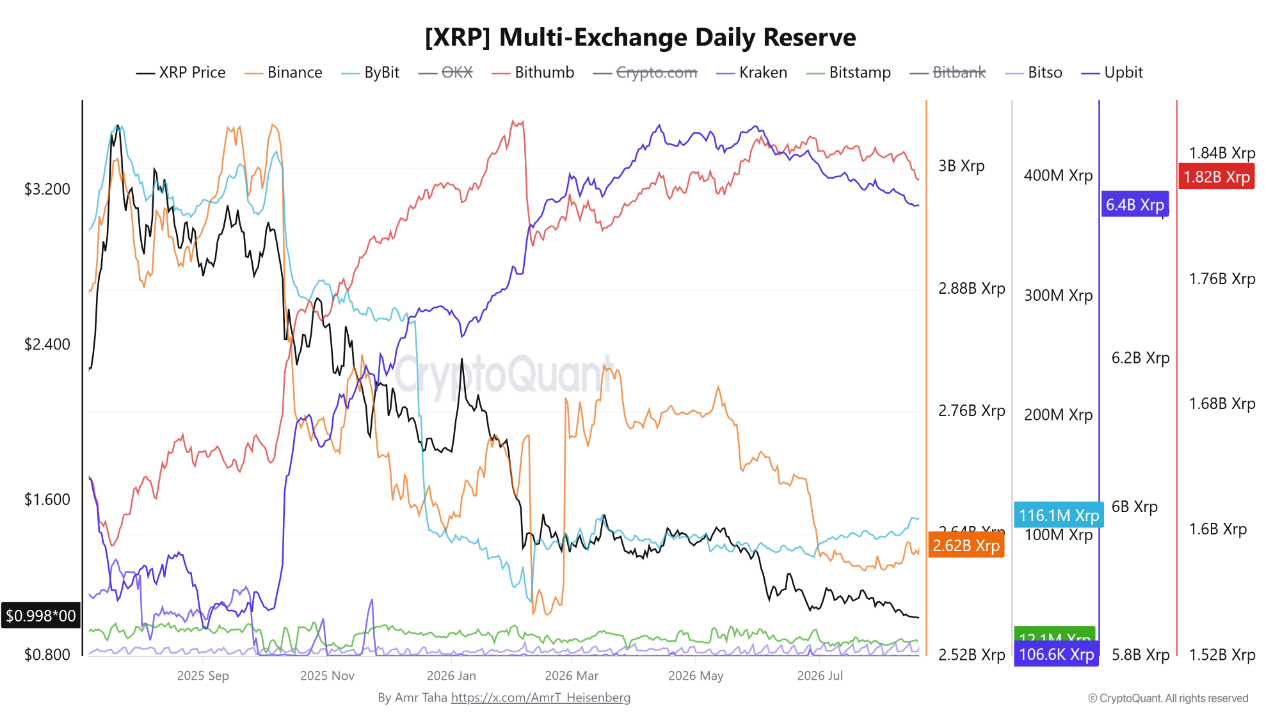
XRP reserves across three top crypto exchanges have declined by roughly 240 million XRP since late May and early June, according to CryptoQuant author Amr Taha.

Despite the decline, South Korean exchanges continue to account for the overwhelming majority of XRP held across the tracked platforms. Upbit is maintaining a dominant position.

Binance XRP Reserves Fall 3.7%

As of August 19, Upbit held approximately 6.40 billion XRP, down from 6.51 billion XRP on May 30. That represents a decline of roughly 110 million XRP, or 1.7%.

Bithumb’s XRP reserves also edged lower, falling from 1.85 billion XRP on June 2 to approximately 1.82 billion XRP. The decline amounts to around 30 million XRP, or 1.6%.

Meanwhile, Binance recorded the largest percentage decline among the three exchanges. Its XRP reserves fell from 2.72 billion XRP on June 2 to 2.62 billion XRP on August 19, a reduction of about 100 million XRP, or 3.7%.

quicktake-image

Upbit and Bithumb Hold Nearly 76%

Combined XRP reserves across Upbit, Binance and Bithumb currently stand at approximately 10.84 billion XRP, down from about 11.08 billion XRP in late May and early June.

That represents a decline of roughly 240 million XRP, or 2.2%.

Upbit remains by far the largest XRP holder among the three exchanges, with 6.40 billion XRP in reserves. Together, Upbit and Bithumb hold approximately 8.22 billion XRP, accounting for nearly 76% of the XRP reserves tracked across the three platforms.

What the Decline Means for XRP

The gradual reduction in exchange-held XRP reserves points to a shift in how much XRP sits on centralized trading platforms.

While the decline alone does not show whether investors are accumulating XRP or simply moving funds between venues and wallets, lower exchange balances reduce the immediately available supply on trading platforms.

The concentration of XRP reserves on South Korean exchanges is also notable, with Upbit and Bithumb continuing to represent the largest share of tracked exchange-held supply.

XRP Whales Are Back

Meanwhile, XRP whale activity has surged as the token trades about 73% below its July 2025 all-time high. According to Santiment data, XRP transactions worth more than $1 million jumped 280% this week, rising from 9.9 to more than 38 transactions.

XRP is currently around $1, down 9.22% over the past month. The coin is down roughly 47% year-to-date, suggesting its steep decline from the $3.66 peak may be attracting large investors.

The combination of rising whale transactions and stronger network activity, despite weak price performance, could signal that large investors are accumulating XRP at lower prices.

Broadcom Loses $87 Billion as Google Gives Marvell Bigger AI Chip Role

Broadcom shares fell nearly 5% on Wednesday after Google expanded its custom-silicon partnership with Marvell Technology, raising concerns that Broadcom could face greater competition for the technology giant’s future artificial intelligence chip spending.

AVGO traded at approximately $361.45 as of 9:53 a.m. ET, down 4.84% from Tuesday’s $379.83 close. Based on Broadcom’s approximately 4.76 billion outstanding shares, the decline erased an estimated $87.5 billion from its market capitalization.

Broadcom’s implied market value fell from roughly $1.81 trillion to approximately $1.72 trillion. These estimates will change as the stock moves during the session.

Meanwhile, Marvell shares climbed approximately 8% after gaining more than 11% in premarket trading.

Why Is Broadcom Stock Down Today?

The market is reacting to Google’s decision to give Marvell a substantially larger role across its custom AI infrastructure.

According to Marvell’s regulatory filing, the expanded partnership covers multiple semiconductor programs connected to Google’s Tensor Processing Unit ecosystem, including:

  • AI inference accelerators
  • Storage controllers
  • Network interface controllers
  • Memory interface controllers
  • Near-memory computing technology

This is broader than an isolated chip-design contract. It positions Marvell across several components responsible for processing, storing and transferring data inside Google’s AI infrastructure.

Google appears to be building a multi-supplier custom-chip ecosystem rather than depending primarily on one semiconductor partner. That could reduce Broadcom’s share of future orders and give Google greater leverage when negotiating prices and contract terms.

The broader US market was trading higher Wednesday, making Broadcom’s decline appear primarily company-specific rather than part of another widespread technology selloff.

Google’s Warrant Is Tied to $120 Billion in Purchases

Marvell issued Google a warrant to purchase as many as 58,970,907 shares at an exercise price of $206.58 each.

Exercising the entire warrant for cash would cost Google approximately $12.18 billion. However, that figure should not be described as the guaranteed value of Google’s potential stake. The shares’ actual market value would depend on Marvell’s stock price when the warrant is exercised.

Google also does not immediately receive the right to purchase all 58.97 million shares.

Approximately 1.36 million shares are subject to time based vesting during the first year. Most of the remaining warrant shares vest only when Google meets specified purchasing thresholds through Marvell’s fiscal 2033.

The performance-based portion is divided into 240 tranches, with each tranche linked to $500 million in qualifying custom product revenue. Consequently, fully vesting every performance tranche could require as much as $120 billion in cumulative purchases from Marvell.

That purchasing framework is more significant than the headline warrant value. It gives Marvell a potential path to capture a meaningful portion of Google’s long-term AI hardware budget rather than simply participating in a limited development project.

Reuters reported that a fully exercised warrant could make Google one of Marvell’s five largest shareholders.

Google Has Not Abandoned Broadcom

Wednesday’s decline does not mean Broadcom has lost Google as a customer.

Broadcom signed a separate long-term agreement in April to develop and supply future generations of Google’s custom AI processors and other components for next-generation AI racks through 2031. That agreement remains in place.

The immediate risk is therefore not the cancellation of Broadcom’s existing business. It is the possibility that Marvell captures a larger portion of Google’s future spending and weakens Broadcom’s pricing power.

Broadcom also has major custom silicon relationships outside Google.

Its expanded partnership with Meta covers several generations of Meta Training and Inference Accelerator chips through 2029, beginning with more than one gigawatt of computing capacity.

Broadcom is also working with OpenAI to develop and deploy 10 gigawatts of OpenAI-designed AI accelerators. Deployment is expected to begin during the second half of 2026 and continue through 2029.

These agreements reduce Broadcom’s dependence on any single customer, although Google remains strategically important to its custom-chip business.

Broadcom Stock Is Down Over the Past 90 Days

Wednesday’s decline extends Broadcom’s net loss over the past 90 calendar days.

AVGO closed at $414.57 on May 21. Compared with Wednesday’s early price of $361.45, the stock has declined approximately 12.8% over that period.

The performance has not been a continuous decline. Broadcom reached a record intraday high of $495 on June 3 before falling sharply following its quarterly results. The stock later recovered above $427 in early August before turning lower again.

AVGO is now approximately 27% below its June record. Historical prices therefore confirm a negative 90-day return, but the stock’s path has included several substantial rebounds rather than a consistent straight-line downtrend.

Broadcom Tokenized Stock Follows AVGO Lower

Broadcom Tokenized bStock, trading under AVGOB, followed the Nasdaq-listed shares lower.

At the time of reporting, CoinMarketCap showed AVGOB near $370.86, down approximately 3.66% over 24 hours. Reported trading volume reached about $1.54 million.

AVGOB provides tokenized economic exposure to Broadcom but is not identical to holding AVGO through a conventional brokerage account. Its price can temporarily differ from the underlying shares because of extended trading hours, liquidity, spreads and price-feed timing.

The token’s approximately $1.9 million market capitalization represents only the value of circulating AVGOB tokens. It should not be confused with Broadcom’s corporate market value of approximately $1.72 trillion.

What This Means for Broadcom Stock

Broadcom’s selloff reflects a reassessment of its competitive advantage in custom AI chips—not evidence that Google has terminated their existing relationship.

Marvell’s expanded role shows that Google wants additional suppliers, broader technical capabilities and potentially greater negotiating leverage as its AI infrastructure spending accelerates. That creates a genuine long-term competitive risk for Broadcom.

However, Broadcom remains connected to Google through 2031 and maintains substantial AI agreements with OpenAI, Meta and other customers.

The central question is not whether Broadcom will remain part of the AI infrastructure boom. It is how much of the expanding custom chip market the company can retain as Marvell becomes a stronger competitor.

Nebius Loses $4.3 Billion in Market Value as Convertible Offering Fuels Dilution Fears

Nebius Group shares fell sharply Wednesday after the AI infrastructure company proposed another multibillion dollar convertible note offering, raising concerns about future dilution, additional debt and hedge related selling.

NBIS dropped 6.35% to approximately $232.66 shortly after the Nasdaq opened, down from Tuesday’s $248.43 close. Using Nebius’s total reported Class A and Class B shares outstanding, the decline erased an estimated $4.29 billion from the company’s market value.

The company plans to offer $4.5 billion of convertible senior notes, subject to market and other conditions. The proposed sale includes $2.75 billion of notes due in 2030 and $1.75 billion due in 2034.

Initial purchasers would also receive options to acquire another $675 million of notes, potentially increasing the total principal amount to $5.175 billion. Nebius intends to use the proceeds to expand its data centers, computing capacity and broader AI infrastructure platform, according to Reuters.

Why Is Nebius Stock Down Today?

The immediate concern is not confirmed dilution but the possibility of dilution in the future.

Convertible notes begin as debt and may later be converted into shares if specified conditions are met. The eventual effect on shareholders will depend on the conversion price, conversion premium, settlement method and other terms established when the offering is priced.

The financing can also create immediate technical pressure. Convertible-bond investors frequently short the underlying stock to hedge their exposure while purchasing the notes a strategy known as convertible arbitrage. That activity can increase selling while an offering is marketed.

The notes would also add interest and repayment obligations if they are not converted. Final coupons and conversion prices had not been announced at the time of writing.

March Financing Makes Investors More Sensitive

The proposed offering comes only five months after Nebius completed another major convertible note sale.

In March, the company raised approximately $4.34 billion through 1.25% notes due in 2031 and 2.625% notes due in 2033.

Those notes carried initial conversion prices of approximately $183.22 and $180.31 per share, respectively both below Wednesday’s early trading price. That does not mean conversion is immediate or guaranteed because conversion rights remain subject to contractual conditions. However, it makes the potential share-count impact of Nebius’s previous financing more relevant to investors.

Nebius said the March proceeds would fund data-center construction, GPU purchases and expansion of its full-stack AI cloud.

Nebius Loses Approximately $4.3 Billion in Market Value

Nebius closed Tuesday at $248.43 and traded near $232.66 at approximately 9:32 a.m. ET Wednesday.

The company reported 238,400,165 Class A shares and 33,455,053 Class B shares outstanding as of June 30, for a combined total of 271,855,218 shares.

Using that total:

($248.43 − $232.66) × 271,855,218 = approximately $4.29 billion

That calculation reduces Nebius’s implied equity value from roughly $67.54 billion to $63.25 billion.

At Wednesday’s early intraday low of $229.70, the estimated market-value decline temporarily reached approximately $5.09 billion. These figures are estimates and will fluctuate with the share price.

The Decline Is Not a New Earnings Warning

Nebius did not announce an earnings deterioration or guidance reduction alongside the proposed financing.

The company recently reported second-quarter revenue of $582.3 million, representing 454% year-over-year growth. Adjusted EBITDA improved to a positive $236.2 million, compared with a $21 million loss one year earlier.

However, that growth requires substantial investment. Nebius reported approximately $5.66 billion in purchases of property, equipment and intangible assets during the quarter.

The new financing could accelerate the company’s capacity expansion, but it also highlights how much outside capital is required to compete in AI cloud infrastructure.

Nebius Tokenized Stock Also Falls

Nebius’s tokenized bStock, NBISB, followed the underlying shares lower.

At the time of review, CoinGecko showed NBISB near $238.39, down approximately 11.9% over 24 hours. Its circulating token market capitalization was approximately $8.8 million, with about $4.6 million in reported 24-hour trading volume.

The token’s market capitalization represents only the value of circulating NBISB tokens. It should not be confused with Nebius Group’s corporate equity value.

NBISB can also temporarily trade above or below Nasdaq-listed NBIS because cryptocurrency venues operate different order books and use rolling 24-hour performance calculations.

What Comes Next for NBIS?

The immediate pressure on Nebius stock is tied primarily to financing risk rather than evidence of weakening AI demand.

Investors will now focus on the notes’ final interest rates, conversion prices, conversion premiums and settlement provisions. A high conversion premium could reduce perceived dilution risk, while unfavorable pricing or additional capital raises could keep the shares volatile.

Nebius is raising money to support rapid expansion. Wednesday’s reaction shows that investors are increasingly scrutinizing not only how quickly the company can grow, but also how much that growth could cost existing shareholders.