
Home Blog Page 395

Analyst Says XRP Will Target $33 — But You Must Be Patient for It to Happen

0

In a passionate message to the XRP community, prominent analyst Egrag has reaffirmed his long-term bullish forecast for XRP.

He insists that double-digit price targets up to $33 remain realistic expectations, despite growing dull sentiment amid previously unrealized forecasts. His message mixed technical analysis with personal conviction, calling for patience, faith, and resilience from XRP holders.

Notably, what sets Egrag’s analysis apart this time is not just the charts but also a spiritual message he shared to his audience.

He referred to XRP as a “way to spread wealth to everyone who is patient and willing to wait”. In parallel, he drew on teachings from the Bible, Torah, and Quran to reinforce his message of endurance and faith.

Citing scriptures like Hebrews 10:36 (“You have need of endurance…”) and Quran 2:155 (“We will surely test you…”), he reminded his followers that, in life and in markets, rewards come only after trials.

To him, holding XRP is not merely an investment strategy but a test of personal resolve and belief in a greater purpose.

Pattern Hidden in XRP Charts

Meanwhile, on the technical side, Egrag based his latest prediction on XRP’s historical movements. He noted that on the 2-week chart, XRP typically drops back to the 21-period Exponential Moving Average (EMA) before making a significant upward move. This EMA often acts as a support level or launchpad for strong rallies.

In 2017, after touching the 21 EMA, XRP surged by 1,250%. If XRP mirrors this path, it could reach $33. Meanwhile, a similar move in 2021 yielded a 560% gain. If this run repeats, XRP could rise to $17.

Egrag calculates an average potential upside of 905% if history repeats — or even just rhymes — which would place XRP around $27. In other words, considering various scenarios, he believes price targets between $17 and $33 are within reach in the next explosive leg upward.

Egrag's 2 weeks XRP chart
Egrag’s 2 weeks XRP chart

Given that he has made several similar analyses in the past to forecast XRP’s price, many are increasingly skeptical of the outlook. He admitted to receiving direct messages from market participants asking whether he ever grows tired of continuously projecting bullish scenarios for XRP.

He reiterated the importance of patience, saying that the information on the chart remains promising.

Charts Don’t Lie, But Emotions Might

Reiterating a popular phrase among technical analysts, Egrag notes, “Men lie, women lie, but charts and numbers do not lie.”

While acknowledging that the market will continue to test its participants with volatility, fear, and uncertainty, he insists that patience is the most profitable strategy for those truly invested in XRP’s long-term vision.

He ends his message by encouraging the XRP community to stay strong and united, declaring that together they’ll rise — and soon, “we shall fly so much higher.”

XRP Becomes Second-Fastest Crypto to Cross $800M ETF Inflows

0

The spot XRP ETFs became the second-fastest to cross the $800 million milestone, beating the products from Ethereum and Solana.

After the debut of Bitcoin ETFs in January 2024, which opened the path for other crypto ETFs, Ethereum ETFs emerged in July 2024, and Solana products were the next to begin trading en masse in October 2025. 

Although XRP and SOL ETFs filings came up around the same time, the Solana funds launched first because issuers such as Bitwise amended their S-1 filings more quickly during the government shutdown.

XRP Becomes Second-Fastest to Cross $800M in ETF Flows

However, despite XRP ETFs entering the market roughly two weeks later, they have now comfortably surpassed their Solana counterparts in terms of capital inflows. Notably, XRP recently became only the third crypto asset to cross $800 million in ETF inflows, hitting this milestone in just two weeks.

For context, XRP ETFs now boast $824 million in cumulative net inflow after 13 trading days, outpacing the $650.81 million recorded by Solana ETFs after 25 days. This makes XRP only the third crypto asset to cross $800 million in ETF inflows, after Bitcoin and Ethereum. 

XRP ETfs Cross $800M Inflows
XRP ETFs Cross $800M Inflows | Sosovalue

Also, XRP holds the record for the second-fastest climb to this milestone, achieving it in just 13 days. For comparison, Bitcoin ETFs crossed $800 million in only two days, while Ethereum ETFs reached this level on Dec. 4, 2024, after 95 trading days, or roughly three months.

How XRP ETFs Compare to Solana ETFs

The Canary Capital XRP ETF (XRPC) set the stage for XRP’s impressive performance when it launched with an impressive $243 million worth of inflows on Nov. 13, per data from Sosovalue. Bitwise followed with $105.36 million in inflows for its XRP product on Nov. 20. Four days later, Grayscale and Franklin debuted their own funds.

These four XRP ETFs have since continued to witness rapid inflows, with their latest $67.64 million capital flow pushing the cumulative total net inflow figure from $756.26 million on Dec. 1 to $824 million at press time. The four products reached this $800 million milestone after just 13 trading days.

Meanwhile, the six Solana ETFs, which launched two weeks earlier, have failed to cross the $700 million mark despite trading for 25 days. The SOL products also saw an impressive run from Oct. 28 to Nov. 25, recording a commendable 21-day inflow streak within this period.

However, while the funds witnessed no outflows, their inflow values were not substantial enough to push them above $700 million during this period. The funds witnessed a setback on Nov. 26, when they saw their first outflow worth $8.10 million. Nonetheless, they seem to have bounced back with $45.77 million in inflow, taking their cumulative netflow to $650.81 million at press time.

It’s important to note that XRP’s rapid progress reflects its own strong performance rather than any weakness from Solana. Notably, Solana’s recent pace has also been nothing short of extraordinary, having performed much better than Ethereum ETFs did in their first month of trading.

XRP Price if Bitcoin Hits $1,000,000,000 as Predicted by Fidelity Executive

0

Grok, xAI’s LLM chatbot, predicts XRP price if Bitcoin ever reaches the audacious $1 billion projection from a Fidelity executive.

Notably, three years ago, Fidelity’s Director of Global Macro, Jurrien Timmer, made one of the boldest Bitcoin price forecasts ever. He believed Bitcoin could reach $1 million by 2030 and potentially soar to $1 billion by 2038. 

Logic Behind the Bitcoin to $1B Prediction

Timmer cited models like Stock-to-Flow and his own demand framework built on Metcalfe’s Law to make his case. For the uninitiated, the law argues that as more people join a network, its value grows at a much faster pace. To Timmer, Bitcoin’s future value depends on scarcity and also on adoption.

Bitcoin to $1B New111
Bitcoin to $1B

Interestingly, a lot has changed since he first presented this prediction. At the time, Bitcoin traded around $48,000. Today, it sits close to $92,500, having increased by more than 1x since then.

If the asset continues to climb anywhere near Timmer’s projections, the rest of the crypto market would almost certainly follow. XRP is one example of this trend. 

When Timmer made his call, XRP was worth about $1.24. Today, it trades around $2.18, which is a 98% increase and slightly higher than Bitcoin’s gain over the same stretch. The question now is what XRP might look like if Bitcoin really did reach $1 billion one day.

This question recently came up when Digital Asset Investor (DAI), a well-known XRP community figure, asked Grok AI to present such a scenario.

Possible XRP Price if Bitcoin Hits $1B

Responding, Grok estimated that XRP could climb to roughly $25,000 if Bitcoin ever hit $1 billion. The AI chatbot explained that Bitcoin would need to grow about 8,868x to reach $1B. If XRP matched the same growth factor, its price would land around $26,400.

However, Grok presented another outlook. Specifically, it noted that simple multiplication does not really account for the broader picture, so it decided to focus more on total market cap projections. 

Grok Predicts XRP Price DAI
Grok Predicts XRP Price | DAI

Notably, if Bitcoin traded at $1 billion per coin, its market value would sit around $21 quadrillion. Assuming Bitcoin made up half the market, the entire crypto space could expand to $42 quadrillion. Now, if XRP kept about 5.5% of that share while its full supply of 100 billion coins circulated, it could reach around $23,000.

It then weighed both methods and factored in XRP’s real-world role in powering cross-border payments through RippleNet. With this approach, the chatbot came up with an average of $25,000 per token. 

According to Grok, the difference between XRP and Bitcoin is in their use cases. Particularly, while Bitcoin mainly acts as a store of value, XRP benefits from utility-driven demand, which could support its growth in a maturing market. 

Meanwhile, Grok also pointed out that shorter-term models, like those projecting XRP above $20 if Bitcoin reaches $1 million, already align with this long-term framework. However, it is important to note that these predictions are extremely audacious and less likely to materialize.

Analyst Explains Why XRP Can Still Surge 550% Despite Short-Term Weakness

0

XRP recent pullback continues to stir fears across short-term charts, but analyst EGRAG says the macro trend remains intact.

In his latest analysis, he argued that the macro trend still points toward a move into the double-digit range for XRP, with prices potentially reaching as high as $13. Notably, he used a multi-timeframe analysis to show that the long-term structure is unaffected despite near-term weakness.

Six Timeframes Flash Bearish, but One ‘King’ Signal Holds

Specifically, EGRAG reviewed seven key timeframes, and six of them are currently trading below the 21-day Exponential Moving Average (EMA). These are the 4-hour, 1-day, 3-day, 5-day, 1-week, and 2-week charts.

These lower and mid-range timeframes show bearish pressure, which explains the current market sentiment around XRP. For context, XRP is trading at $2.03, representing a notable loss of 8% over the past week. Moreover, on the four-week chart, XRP is down over 20%.

Meanwhile, one timeframe overrides all the others: the monthly chart. According to EGRAG, XRP remains bullish on the 1-month timeframe. On this chart, the price stays above the 21-EMA, which he calls the most important signal in the entire structure.

“In technical analysis, the higher the timeframe, the stronger the truth,” he noted, adding that short-term fear is mostly “noise.”

XRP Macro Structure Still Targets $9 to $13

Indeed, the analyst’s long-term “Chasm” model on the monthly chart continues to project XRP upward. Despite the disappointing price performance since July, when XRP touched $3.66, the overall structure remains upward.

In particular, according to EGRAG, it points toward the $9–$13 zone, as long as the monthly candle holds above its support structure, which is currently intact. The macro chart places XRP inside a long-standing upward channel, with the upper boundary near $13.

Image

EGRAG assigns a 55–65% probability that XRP’s price will reach this level within the next 3–6 months, arguing that higher-timeframe momentum often triggers fast, decisive moves:

“When it kicks in, it won’t give second chances.”

For context, XRP’s price would need to surge 4.5x from its current position to hit $9, while reaching the higher target would require a more aggressive increase of 6.5x.

While ambitious, EGRAG stressed that the macro trend has not changed, even if lower timeframes appear weak. As such, holders must remain patient during the ongoing underperformance.

Other Analysts’ Views for XRP in 2026

Other market analysts share a similarly optimistic outlook for XRP over the next few months. For instance, Dr. Whale recently projected that XRP could reach up to $4 within four months.

Separately, a 24/7 Wall St analyst argued that XRP could reach $4.50 by the end of 2026, citing Ripple’s plans to launch RLUSD in Japan by Q1 2026.

Other factors analysts believe could push XRP beyond the $4 range include spot XRP ETFs. Interestingly, these products have now bought over $756 million XRP just weeks after launch, despite the largely bearish market.

Bitcoin Pumps 7% as Fed Ends QT: All-Time High Coming Soon?

0

The U.S. Federal Reserve has officially ended its Quantitative Tightening (QT) program. This pivotal move could reshape the trajectory of assets like Bitcoin. 

Notably, the decision signals the start of a new liquidity-expansion phase, a shift that has historically fueled stronger rallies in equities and cryptocurrencies.

As part of this transition, the Fed added more than $13 billion to the banking system using overnight repo deals, marking the second-biggest liquidity move by the U.S. apex bank since the 2019 coronavirus pandemic.

Potential Impact on Bitcoin

As the news spread across the financial community, several prominent crypto figures, including Binance co-founder Changpeng Zhao (CZ), have weighed in on the implications for the crypto market.

Industry leaders suggest that the Fed’s decision typically translates into greater market participation, easier access to capital, and stronger upside momentum for Bitcoin. Analysts note that conditions are beginning to resemble past cycles in which expanded liquidity preceded major crypto rallies.

Imminent Rally?

BitMine Chairman Tom Lee told CNBC’s Squawk Box that Bitcoin jumped nearly 20% in the weeks following the Fed’s previous end to Quantitative Tightening. He said BTC could rally similarly this time, potentially gaining strength before the new year.

Bull Theory also weighed in on the Fed’s latest decision, stressing that the recent move resembles the pattern observed in late 2019, when a series of repo spikes preceded tighter liquidity long before the pandemic.

If repo spikes continue, according to Bull Theory, the Fed may be pushed toward some form of monetary easing by early 2026.

While this would not mirror the massive Quantitative Easing launched in 2020, it would still represent meaningful liquidity support for financial markets.

Amid anticipation for a rally, market analyst Sykodelic urged crypto enthusiasts to stay calm following the Fed’s decision. While the move is bullish for Bitcoin, he cautioned against expecting an immediate surge.

Bitcoin Could Plunge Heavily in Mid-December

Amid growing anticipation of a potential Bitcoin price surge, Into The CryptoVerse founder Benjamin Cowen urged investors to remain cautious.

He warned that the market could see the Federal Reserve cut rates while the Bank of Japan raises interest rates later this month. Cowen noted that a similar setup occurred in July 2024, triggering sharp volatility in Bitcoin and a heavy sell-off, with the market bottoming roughly one week later

With similar conditions potentially aligning on December 10—expected Fed rate cuts paired with a possible BOJ hike—he cautioned that Bitcoin may face comparable pressure. If the pattern repeats, the market could experience another short-term capitulation followed by a rebound, setting up a potential Bitcoin bottom in mid-December.

Chart by Benjamin Cowen

BTC Price Reacts

At press time, Bitcoin is rallying on the news of the latest Fed announcement. BTC is now up 7.33% over the past day, after briefly trading at $84,000 yesterday.

Screenshot 2025 12 02 at 45423 pm
Bitcoin price chart CoinMarketCap

Dogecoin Rebounds from Swing Lows: Here are Upside Fib Targets to Watch

Dogecoin tests key resistance as intraday rebound meets Fib ceilings while MACD bullish cross setup forms.

Notably, Dogecoin (DOGE) is posting modest gains today, trading around $0.138, up roughly 1.79 over the past 24 hours. Price action has unfolded inside a relatively tight $0.132–$0.138 daily range, with DOGE dipping toward the lower end early in the session before grinding higher into the current intraday peak.

Even with this short-term bounce, DOGE remains under pressure on higher timeframes, sitting about 7.3% lower over the past week and 12.3% down in the last 14 days. This suggests that today’s move is more of a relief rally within a broader cooling-off phase. The next moves on the technical charts will be crucial in showing whether bulls can build on this rebound or if sellers quickly regain control. 

Dogecoin Technical Analysis

On the 4-hour chart, Dogecoin is trying to stabilize after the drop from yesterday, with price rebounding from the recent swing low around $0.132 (0 Fib). That area now marks major support, as it aligns with the base of the current Fibonacci retracement structure. 

Dogecoin 4-Hour Chart

Above, DOGE is pressing into the 0.236 Fib level near $0.1378, which acts as immediate resistance and currently caps the recovery. A clean break and hold above this zone would open the door toward the next resistance band at $0.141–$0.144 (the 0.382–0.5 Fib region), followed by a stronger supply area at $0.147–$0.151 (the 0.618–0.786 Fib cluster).

If buyers fail to conquer the 0.236 level, support to watch on pullbacks sits first around $0.135, then back at the $0.132 floor; a loss of that base would risk extending the downtrend. 

Meanwhile, the RSI (14) has bounced from oversold territory below 30 and now sits near 38, signaling that downside momentum is easing but not yet flipped decisively bullish. This combination of a rebound off key support and a recovering RSI hints at an early attempt to build a short-term bottom as long as the $0.132 support area continues to hold.

MACD Bullish Cross Incoming?

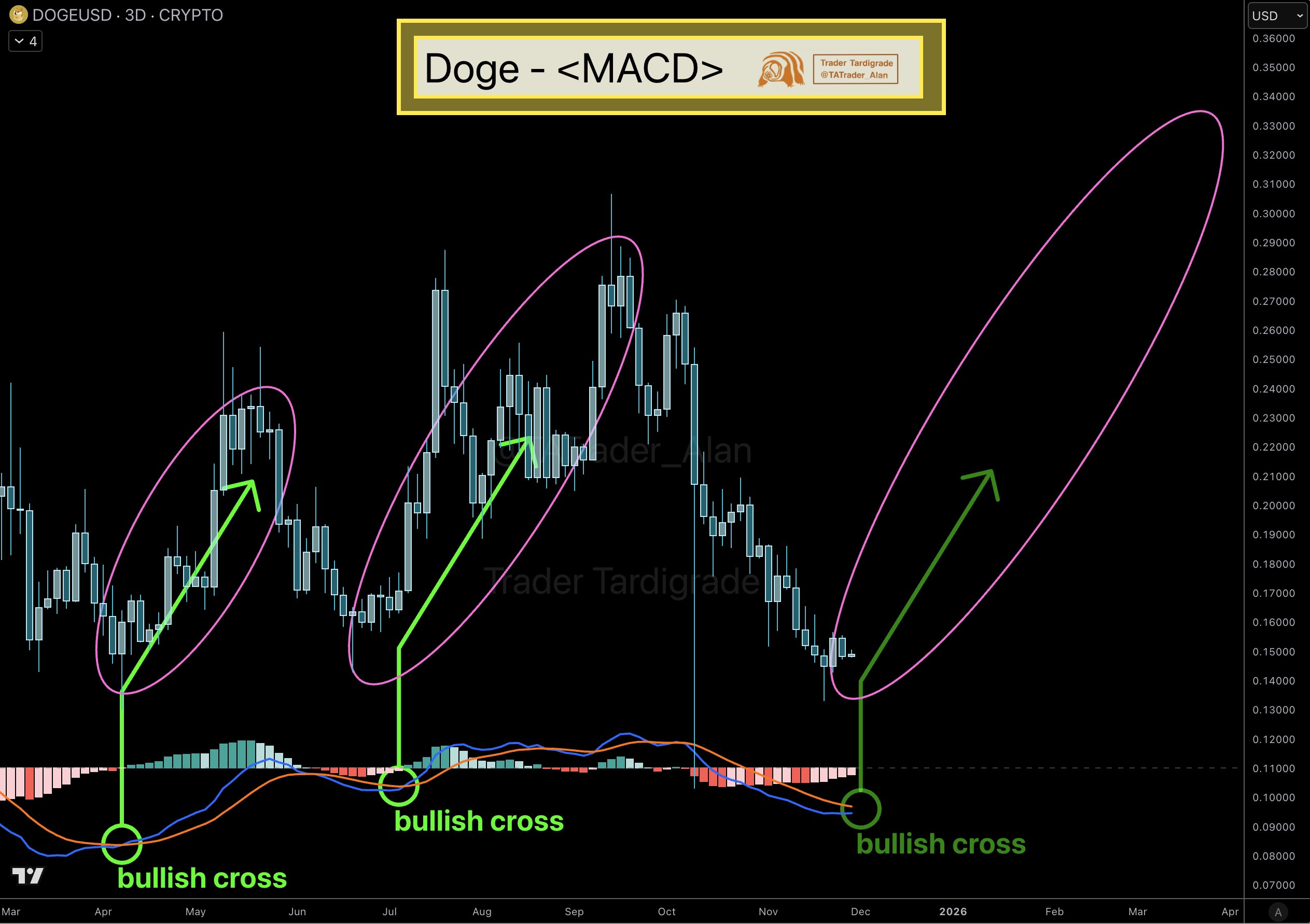
On the commentary side, Trader Tardigrade’s 3-day Dogecoin chart focuses on the MACD indicator. The analyst highlights previous points where the MACD line (blue) crossed above the signal line (orange) from below, so-called bullish crosses. 

DOGEUSD 3-Day Chart
DOGEUSD 3Day Chart

In the past two instances marked on the chart, these crosses were followed by strong multi-week upswings for DOGE, with prices moving from local lows into sizable rallies. Each prior signal occurred after a prolonged downtrend and while the MACD histogram was deeply negative, hinting at a shift from bearish to improving momentum.

The latest setup shows a very similar structure: price has pulled back toward the $0.13–$0.15 zone while the MACD lines compress and look close to crossing again in negative territory. 

Where’s Ethereum Headed as Price Stalls at Middle Bollinger Band?

Ethereum hovers at the middle Bollinger Band as support holds, and fresh liquidations hint at a fragile rebound.

Ethereum spent the past 24 hours testing market nerves around the $2,800 mark. After holding steady near the upper end of its range for most of the day, the price saw a sharp intraday drop from just below $2,845 to a low near $2,725, wiping out earlier gains. That flush was followed by a steady rebound, with ETH clawing back toward $2,800, though it still sits about 0.8% lower on the day at roughly $2,809.

Over a longer lens, Ethereum’s chart shows a slow, grinding pullback rather than a sudden collapse. In the last seven days, ETH has slipped around 4.3%. Stretch the view to 14 days and the picture looks similar, with losses deepening to roughly 6.6% as each attempt to push above $2,900 has been met with renewed supply.

Despite the pullback, Ethereum’s market cap remains above $338 billion, supported by almost $30 billion in 24-hour volume. Meanwhile, the pattern on the chart, a sudden sell-off, consolidation at the lows and a partial recovery, sets the stage for a decisive next move. 

What is Ethereum’s Next Move?

Specifically, on the daily chart, Ethereum remains locked in a clear downtrend, trading below the 20-day Bollinger Band simple moving average (around $2,976) and spending most of the past month in the lower half of the volatility envelope. The latest attempt to push higher stalled almost exactly at this mid-band, and the current candle has been knocked back toward the lower band near $2,705. 

Ethereum 1-Day Chart

This keeps immediate resistance clustered in the $2,950–$3,000 zone, followed by the upper Bollinger Band and recent swing area around $3,200–$3,250. As long as price holds beneath the 20-day SMA, the bears retain the technical advantage.

The lower Bollinger Band near $2,700 now doubles as short-term support, with the furthest wick low around $2,623 and then the psychological $2,500 zone acting as deeper downside levels to watch if selling resumes. 

Meanwhile, the 14-day RSI sits around 34, well below the neutral 50 line but still just above classical oversold territory at 30.

That reading confirms that bearish momentum is dominant yet also hints that the market is nearing a zone where previous selloffs have started to exhaust. For a more constructive picture to emerge, traders will want to see RSI climb back above 40 and, crucially, a daily close back over the 20-day SMA, which would open the door for a retest of $3,000 and the $3,200 resistance band.

Ethereum Liquidation Data

Further, liquidation data shows how violently leverage has been reset around Ethereum’s latest move. Over the past 24 hours, roughly $105.18 million in positions have been wiped out, with about $78.97 million in longs liquidated versus $26.21 million in shorts. That skew toward long liquidations confirms that the first leg of the move was driven by aggressive selling, forcing over-leveraged bullish traders out of the market.

Ethereum Liquidation

However, the intraday picture has started to flip. In the last 12 hours, liquidations total about $20.38 million, with shorts ($14.69 million) notably higher than longs ($5.69 million). Also, the latest 1-hour window shows the same pattern: around $89.92K in liquidations, of which $85.59K are shorts. Even on the 4-hour view, shorts at $2.73 million exceed longs at $1.01 million. 

This shift suggests that, after the initial long flush, the subsequent bounce toward $2,800 has started to squeeze late bearish positions, hinting at a short-term attempt to stabilize price above key support while the broader downtrend and heavy 24-hour long liquidations still cap upside momentum.

Ripple’s Latest Partnership Brings XRP Payments to Africa’s Largest Market

0

Ripple has secured another key foothold in global remittances via XRP, this time in Africa’s largest market. 

Specifically, RedotPay, a stablecoin payment fintech, has integrated Ripple Payments to power instant digital-asset-to-Naira settlements.  The partnership introduces a new feature called “Send Crypto, Receive NGN”. It allows users to convert crypto to Nigerian naira and receive funds in local bank accounts within minutes.

The launch positions Ripple and RedotPay at the center of one of the world’s most active crypto markets. Nigeria consistently ranks among the top countries for global adoption and search interest.

Instant NGN Payouts Through Ripple Payments

RedotPay’s integration with Ripple Payments aims to solve long-standing issues in cross-border transfers. Global remittances still carry average fees above 6% and often take several days to settle. By contrast, RedotPay’s new feature offers near-instant payout and transparent pricing.

The service supports a wide list of major assets at launch. They include USDT, USDC, BTC, XRP, ETH, SOL, TRX, TON, and BNB. Meanwhile, there is an ongoing plan to introduce Ripple’s stablecoin RLUSD later. 

Verified users simply send XRP or any supported crypto from RedotPay, and NGN is deposited directly into a local bank account.

RedotPay CEO Michael Gao called the milestone a significant step toward making stablecoin payments “as easy to use as local currency”. Gao stressed that with the integration, users can now move value quickly, securely, and affordably.

Ripple says the partnership reflects the real-world utility of its enterprise payment stack. Jack Cullinane, Head of Commercial for APAC, noted that Ripple Payments removes friction from global transfers, making cross-border transactions faster and more reliable.

Nigeria’s Crypto Landscape

Nigeria remains a global crypto hotspot, ranking sixth in Chainalysis’ 2025 Global Adoption Index. But the regulatory environment has been volatile.

Over the past year, the Nigerian SEC overhauled marketing and advertising rules for crypto firms. The government previously filed a lawsuit against Binance, accusing the exchange of harming the naira and owing back taxes. 

Meanwhile, officials later clarified that many crypto businesses continue to operate without prosecution, and the SEC signaled openness to compliant stablecoin services.

The environment has created a strong demand for regulated, fast, affordable digital payment infrastructure.

Expanding Into More Emerging Markets

The NGN service builds on RedotPay’s growing multi-market payout network, which already includes “Send Crypto, Receive MXN” in Mexico and “Send Crypto, Receive BRL” in Brazil. The product targets freelancers, digital nomads, small businesses, and expatriates who need efficient ways to move funds across borders.

Meanwhile, RedotPay has expanded rapidly in recent times. In September, the firm announced that it reached unicorn status following a $47 million strategic investment round backed by Coinbase, Galaxy, Vertex Ventures, and others.

Ripple is also expanding internationally. This week, it got approval from Singapore’s central bank to grow its payment operations. Its RLUSD stablecoin was also cleared for institutional use in Abu Dhabi.

Through its partnership with RedotPay, Ripple Payments is now entering Africa’s largest market, making XRP and Ripple’s stablecoin network a key part of cross-border payments in emerging markets.

SEC Chair Sets New Timeline to Pass Innovation Exemption for Crypto Firms After Gov Shutdown

0

U.S. SEC Chair Paul Atkins has given his clearest update yet on the agency’s upcoming innovation exemption for crypto firms. 

In a discussion on CNBC’s Squawk Box, Atkins said the SEC plans to publish the framework within the next month, even though the recent government shutdown slowed the process. 

SEC Chair Speaks on Innovation Exemption Timeline

Notably, during the interview, host Joe Kernen questioned whether the SEC can make real progress on crypto regulation without new legislation and if that progress can happen before the end of the year. 

In response, Atkins explained that the SEC continues to work with Congress and gives lawmakers technical guidance on upcoming bills, so they stay aligned with existing rules. 

He emphasized that this cooperation matters but also stated that the SEC already holds enough authority to move forward. While Atkins failed to provide a timeline on when Congress might act, he made it clear that the SEC does not plan to wait for new laws before taking action.

The SEC Chair then turned to the innovation exemption, which he described as one of the agency’s main priorities. He said he expects the SEC to release the exemption “in a month or so,” aligning with earlier projections.

For context, the government shutdown temporarily stopped the team from working on it, since staff could not continue during that period. Now that the shutdown has ended, Atkins says the agency has returned to its schedule and continues to move ahead. 

He stressed that the exemption seeks to open the door for crypto developers to build and test new products inside a clear and supportive regulatory setup. According to him, the United States spent too many years pushing away blockchain innovation, and he wants rules that help the sector grow instead of holding it back.

What is the Innovation Exemption for Crypto Firms?

For the uninitiated, the innovation exemption is a proposal that gives temporary relief from full securities registration and certain compliance rules for crypto companies, blockchain projects, fintech startups, and other firms that offer on-chain services. 

It creates a supervised testing environment where eligible firms can experiment with tokenized assets, DeFi services, staking programs, token launches, and other blockchain-based tools. 

In return, these companies must follow strict disclosure standards, protect investors, and operate under SEC oversight. The goal is to reduce legal uncertainty for developers while the SEC works on long-term rules designed specifically for digital assets.

The idea started after the leadership transition earlier this year. Notably, former Chair Gary Gensler focused instead on strict enforcement, arguing that existing laws already covered most crypto assets. 

A Refreshing Outlook for the Industry 

Atkins, who took office in April 2025 and has long supported crypto-friendly modernization, has treated the exemption as a way to undo four years of strict rules that pushed developers overseas.

Throughout the year, he linked the exemption to several larger SEC initiatives. In June, he told staff at the SEC’s Crypto Task Force Roundtable to explore a conditional relief system for on-chain products. 

Meanwhile, he later connected the exemption to Project Crypto, the SEC’s broader effort to update market rules for blockchain-based systems. Atkins had also stated in October that the agency expects to start the formal rulemaking process by late 2025 or early 2026. 

Notably, industry leaders have welcomed his push, although groups like SIFMA recently warned that the exemption must be properly designed to avoid harming market stability.

Russian Central Bank In Showdown Talks to Ease Bitcoin and Crypto Regulations

0

The chances of lighter Bitcoin regulations in Russia grow increasingly likely as its central bank enters talks with the finance ministry.

Bank of Russia’s First Deputy Chairman Vladimir Chistyukhin confirmed this development, as Russia joins a global trend of Bitcoin and crypto adoption. He noted that talks remain ongoing between key policy stakeholders in the country to relax the tough handling of digital assets.

Crypto Regulatory Win Imminent in Russia

Deputy Finance Minister Ivan Chebeskov first reported this ongoing discussion between the Ministry of Finance (MinFin) and the prominent officials of the Bank of Russia last week. Notably, the conversation centers on expanding nationwide access to and distribution of Bitcoin.

Meanwhile, Chistyukhin told media outlets that the Bank of Russia is, in truth, in contact with the MinFin on the matter. He also confirmed that it’s now “quite possible” that crypto proponents in the country will see regulatory oversight of cryptocurrencies ease.

According to him, the rules for crypto asset ownership and circulation should extend beyond the current purview of an exclusive brand of investors. Notably, Russia has a strong stance that only “highly qualified” entities should hold Bitcoin and other digital assets.

To fall under this category, investors must meet strict criteria, including holding a minimum of 100 million rubles ($1.3 million) in assets—bank deposits and securities—and earning 50 million rubles ($650,000) in income over one year. However, Russian regulators are looking to scrap these stringent requirements and make Bitcoin a regular financial asset accessible to all.

Russia Turns to Bitcoin Amid Western Sanctions

Another propellant for this softer crypto tone is the current ban on Russia. Its invasion of Ukraine led to a series of severances in trade ties from several Western states, limiting its energy exports and international settlement channels.

However, Russia has seen cryptocurrencies as a means to evade these sanctions, aligning with President Vladimir Putin’s statement that no one can ban Bitcoin. The nation has been using this approach in its oil trades with China and India since early March and now wishes to fully embrace the asset locally.

Remarkably, Russian has steadily progressed in this course. In October, it began allowing banks to use crypto, but on a limited scale. This also comes after Putin signed a bill recognizing the asset as property and exempting it from value-added tax.

Meanwhile, Deputy Chairman Chistyukhin projected that Russia could implement the softer crypto regulation by the end of the year.