
Home Blog Page 404

NOW Wallet Launches GasFree USDT Transfers On Tron. Here’s How It Works

0

Gas fees have consistently ranked among the most significant pain points in cryptocurrency transactions. For traders, businesses, and everyday users alike, the necessity to hold native tokens like TRX simply to send stablecoins has long been an inconvenient extra step that complicates the user experience and adds unnecessary complexity to digital asset management.

The cryptocurrency landscape in 2025 continues to evolve rapidly, with user experience becoming the primary battleground for wallet providers. While innovation in blockchain technology has accelerated, fundamental issues like gas fee management have remained largely unchanged – until now. NOW Wallet’s groundbreaking GasFree feature represents a paradigm shift in how users interact with the TRON network, specifically for USDT transactions.

This comprehensive guide explores NOW Wallet’s permanent GasFree feature for USDT (TRC20), which enables users to send stablecoins on the Tron network without maintaining a TRX balance. Instead of requiring TRX for gas, the transaction fee is directly deducted from your USDT balance at a flat rate of 1 USDT per transfer, creating a seamless and predictable transaction experience.

Understanding the TRX Gas Fee Problem

The Traditional TRON Transaction Model

For years, TRON network users have faced the persistent challenge of managing TRX balances specifically for transaction fees. This created several significant pain points:

  • Asset Fragmentation: Users must maintain separate token balances for different purposes
  • Cost Uncertainty: Fluctuating TRX prices and network congestion make fee prediction difficult
  • Transaction Failures: Insufficient TRX balances lead to failed transfers and user frustration
  • Barriers to Entry: New users find the concept of gas tokens confusing and intimidating

The Impact on Different User Types

  • Retail Users: Struggle with the complexity of managing multiple tokens
  • Traders: Face unpredictable costs that affect profit margins
  • Businesses: Deal with accounting complexity and treasury management challenges
  • New Crypto Adopters: Encounter steep learning curves that hinder adoption

NOW Wallet’s GasFree Solution: A Technical Breakdown

How GasFree Technology Works

NOW Wallet’s GasFree implementation utilizes advanced smart contract technology combined with TRON’s native capabilities to create a seamless user experience:

  • Dedicated Wallet Architecture: Uses separate USDT TRC20 addresses specifically for gasfree transactions
  • Smart Contract Integration: Handles fee processing and transaction validation
  • Off-Chain Authorization: Maintains security while simplifying the user experience
  • Native TRON Compliance: Works within existing network specifications

Fee Structure and Activation Process

The GasFree system operates on a straightforward, transparent fee model:

  • Initial Activation: First transaction costs 2 USDT (includes 1 USDT activation fee + 1 USDT transaction fee)
  • Standard Transfers: All subsequent transactions cost exactly 1 USDT each
  • No Hidden Costs: Complete fee transparency with no surprise charges
  • Predictable Pricing: Same fee regardless of network conditions or TRX price movements

Why GasFree USDT Transfers Matter in 2025

The Evolution of User Experience in Crypto

In the competitive crypto landscape of 2025, user experience and cost efficiency have become crucial differentiators. While most wallets still rely on the traditional model of native tokens for transaction processing, NOW Wallet’s GasFree approach represents a significant leap forward.

Key Benefits for Various User Types

  • For Everyday Users: Simplified transactions without technical complexity
  • For Active Traders: Predictable costs and eliminated failed transactions
  • For Businesses: Streamlined treasury management and accounting
  • For Crypto Newcomers: Lowered barriers to entry and reduced learning curve

Industry Impact and Future Implications

The permanent implementation of GasFree transfers signals a shift toward user-centric design in blockchain technology. This innovation demonstrates that:

  • Complex blockchain interactions can be simplified without sacrificing security
  • User experience improvements can drive broader crypto adoption
  • Traditional pain points can be solved through thoughtful technical implementation

Complete Guide: How to Use NOW Wallet for GasFree USDT Transfers

Step 1: Download and Install NOW Wallet

Begin by downloading the official NOW Wallet application from either the App Store (iOS) or Google Play (Android) for mobile or desktop applications on Windows/macOS/Linux. The installation process takes less than a minute and provides immediate access to a comprehensive cryptocurrency management platform.

Step 2: Create or Restore Your Wallet

Users can either generate a new wallet or import an existing one using their recovery phrase. The wallet creation process emphasizes security while maintaining user-friendliness, with clear instructions and backup reminders.

Step 3: Access GasFree Mode

Navigate to the USDT TRC20 section within NOW Wallet and tap “Create GasFree Wallet” to generate your dedicated GasFree address. This specialized address operates alongside your standard USDT wallet, allowing seamless switching between transaction modes.

Step 4: Fund Your GasFree Wallet

Transfer USDT to your new GasFree address through various methods:

  • Direct transfer from another wallet
  • In-app purchase using fiat currency
  • Token swap from other cryptocurrencies
  • Receiving funds from other users or exchanges

Step 5: Execute GasFree Transactions

Send USDT using the GasFree mode with these key features:

  • First transaction: 2 USDT total (includes activation)
  • All future transfers: 1 USDT flat fee
  • No TRX balance required
  • Instant transaction processing
  • Full compatibility with all TRC20 addresses

Security Architecture of the GasFree Feature

Non-Custodial Security Foundation

NOW Wallet’s GasFree feature maintains the same security standards as its core wallet functionality:

  • Private Key Control: All keys remain encrypted on the user’s device
  • No Third-Party Access: NOW Wallet cannot access, freeze, or control user funds
  • User Sovereignty: Complete ownership and control maintained by the user
  • Biometric Protection: Optional biometric authentication for added security

Network-Level Security Measures

  • TRON Native Compliance: Uses official TRC20 standards without modifications
  • Smart Contract Audits: Regular security reviews and vulnerability assessments
  • Transaction Validation: Full blockchain validation for all transactions
  • Transparent Operations: Clear visibility into all transaction processes

Comparative Analysis: GasFree vs Traditional TRON Wallets

Feature Comparison Table

Feature Traditional TRON Wallets NOW Wallet GasFree
TRX Requirement Required for all transactions Not required
Fee Structure Variable TRX costs Fixed 1 USDT
Fee Predictability Low (market-dependent) High (always 1 USDT)
User Experience Complex token management Simplified single-asset
Transaction Reliability Subject to TRX availability Guaranteed with USDT balance
Cost Efficiency Varies with network conditions Consistent and predictable

Real-World Cost Scenarios

  • Individual User (10 transactions/month): Save approximately 2-5 USD monthly
  • Active Trader (100 transactions/month): Save 20-50 USD monthly
  • Business Account (500+ transactions/month): Save 100-250+ USD monthly

Beyond GasFree: NOW Wallet’s Comprehensive Feature Set

Multi-Chain Asset Support

NOW Wallet supports an impressive array of digital assets:

  • 1,500+ cryptocurrencies across all major blockchains
  • 40+ supported networks including Bitcoin, Ethereum, Solana, and Polygon
  • Privacy coin integration with Monero (XMR), Zcash (ZEC) and many others
  • Stablecoin variety including USDT, USDC, DAI, and others

Advanced Financial Tools

  • Built-in Exchange: Instant token swaps with competitive rates
  • Staking Services: Earn passive income on supported assets
  • NFT Management: Complete NFT storage and viewing capabilities
  • DApp Connectivity: WalletConnect integration for DeFi applications

Cross-Platform Accessibility

  • Mobile Applications: Full-featured iOS and Android apps
  • Desktop Support: Native applications for Windows and macOS
  • Seamless Synchronization: Consistent experience across all devices
  • Enterprise Features: Business-focused tools and reporting

Industry Impact and Future Developments

Setting New Standards in Wallet Technology

NOW Wallet’s GasFree implementation challenges industry conventions and pushes competitors to prioritize user experience. This innovation represents the next evolution in wallet functionality, demonstrating that blockchain accessibility doesn’t require sacrificing security or decentralization principles.

Potential Expansion Areas

  • Cross-Chain Implementation: GasFree features for other major networks
  • Additional Asset Support: Expanded stablecoin and token compatibility
  • Enterprise Solutions: Custom implementations for business needs
  • Advanced Features: Enhanced functionality based on user feedback

Conclusion: The Future of Frictionless Crypto Transactions

NOW Wallet’s permanent GasFree feature represents a significant advancement in cryptocurrency usability and accessibility. By eliminating the TRX requirement while maintaining full blockchain security and compatibility, NOW Wallet demonstrates that user experience and technological innovation can coexist seamlessly.

This solution addresses fundamental pain points that have persisted since the early days of cryptocurrency, providing tangible benefits for users across all experience levels. The fixed 1 USDT fee structure brings unprecedented predictability to TRON network transactions, while the simplified user experience lowers barriers to entry for new adopters.

The implementation reflects NOW Wallet’s commitment to user-centric design and continuous innovation. Rather than following temporary trends, the platform focuses on solving genuine user problems with permanent, reliable solutions.

Ready to experience the future of GasFree USDT transfers?
Download NOW Wallet today and activate your GasFree wallet in minutes!
Try GasFree Today 🚀


Here’s Roadmap to Turn $10,000 in XRP Into $500K or $1 Million

0

Turning a $10,000 investment in XRP into $500,000 or $1 million is an ambitious goal, but it’s not entirely out of the realm of possibility.

Achieving it requires a well-planned strategy, precise timing, and an appropriate risk tolerance.

How Much XRP Does $10,000 Buy Today?

At an XRP price of $2.21, a $10,000 investment buys 4,347 XRP. Interestingly, just a year ago, you could have purchased as many as 20,000 tokens when XRP traded at $0.50.

With fewer tokens available for $10,000 compared to before, reaching $500K or $1 million requires much higher price milestones.

Specifically, to reach $500,000, XRP would need to hit about $115 per token. To reach $1 million, XRP would need to surge to around $230 per token.

These targets may sound extreme, but they reflect projections from some analysts in the XRP community. For instance, in September, analyst 24hrscrypto1 argued that XRP could reach $100 before 2030. Similarly, crypto founder Matthew Brienen suggested XRP could reach $100–$1,000 by 2035.

Notably, several factors underpin these optimistic outlooks. First, XRP’s main purpose is fast, low-cost global payments. Its real-world utility comes from Ripple’s partnerships, technology upgrades, and banking integrations.

In other words, many attribute XRP’s long-term value to institutional adoption and ongoing improvements to the XRP Ledger.

Strategies for Growing a $10,000 XRP Investment

To benefit from XRP’s future potential, investors must maintain a disciplined strategy, especially in a volatile market where emotions can lead to poor decisions.

Buy and Hold (HODL)
Accumulate XRP and hold through market cycles. This strategy relies on patience and confidence in XRP’s long-term success. The main challenge is weathering volatility without selling prematurely.

Active Trading
Buying at support levels and selling at resistance can accelerate growth. Returns can be higher, but mistakes can quickly erase gains.

Staking and Yield Options
Some platforms, like Flare, offer modest yields on XRP. These provide steady passive income while waiting for larger price moves.

Dollar-Cost Averaging (DCA)
Investing fixed amounts regularly smooths out volatility and reduces timing risk, creating a balanced entry price that often outperforms emotionally-driven decisions.

For example, The Crypto Basic recently highlighted an Australian investor who has been buying 3 XRP every week for the past eight years. Today, the investor’s holdings have grown substantially, and he believes his portfolio could one day be worth over $1.2 million.

Preparing for Wealth Before the Windfall

Industry leaders warn that investors often celebrate potential price targets without preparing for the consequences of success. Digital Ascension Group CEO Jake Claver emphasizes that even if XRP reaches $100, many holders may mishandle their newfound wealth without a solid plan.

He stresses the importance of:

  • Documenting financial goals
  • Setting profit-taking targets
  • Establishing legal and tax structures
  • Ensuring secure and compliant crypto custody

Without preparation, sudden wealth can vanish quickly. Analysts like Armando Pantoja note that many investors lose their gains within 18 months due to a lack of wealth-management strategies.

The Importance of an Exit Strategy

One of the most overlooked aspects of crypto investing is knowing when to sell. An exit plan helps avoid emotional decisions during parabolic rallies. This may include:

  • Gradually offloading XRP at psychological price levels
  • Diversifying into real estate, Bitcoin, or traditional assets
  • Securing long-term wealth through trusts or LLCs

Essentially, having a plan in place before prices surge can mean the difference between life-changing gains and missed opportunities.

In Sum

Turning $10,000 in XRP into $500,000 or $1 million is possible, but it is far from guaranteed. It requires significant price appreciation, disciplined strategy, favorable market conditions, and careful risk management.

Success depends on combining long-term holding, smart accumulation, and foresight to manage wealth responsibly if XRP fulfills its potential.

For investors with a clear plan, patience, and preparation, the journey can be just as meaningful as the outcome.

Solana Bounce Breaches First Resistance, Eyes Now on $153

Solana rebounds from a month-long slide, breaking the first Fibonacci resistance as traders watch for the next leg up.

Solana is trying to rebuild momentum after a bruising month-long slide, currently changing hands at $141.87. Over the last 24 hours, SOL has gained about 3.6%, as buyers push price back toward the upper end of its recent $135–$144 range. On a 7-day view, performance is roughly flat with a mild 0.9% pullback that masks a clear dip-and-rebound pattern.

Meanwhile, the 14-day return shows a deeper 8.3% decline, while the 30-day picture is still harsh at around 30.3% in the red. With a market cap near $79 billion and daily volume above $5.8 billion, Solana remains highly liquid, setting the stage for a closer look at whether this rebound can evolve into a sustained recovery.

Can Solana Price Fully Recover?

On the technical end, the daily chart shows Solana is attempting a structured recovery from November’s sell-off. The auto Fibonacci retracement drawn from the recent swing high just above $205 to the low around $121.65 shows SOL now pressing against the 0.236 level around the $141–$142 area. This marks the first meaningful resistance breach of the current bounce.

Solana
Solana

A confirmed move above this band would open the door toward the next Fibonacci levels at the 0.382 retracement at $153.60, where sellers are likely to re-emerge. If price fails to hold above the 0.236 band, downside focus returns to the recent base at $121, acting as major support.

Further, the Directional Movement Index (DMI) points to weakening bearish conditions. The +DI line at 13.26 sits well below the –DI line at 22.76, indicating that sellers are still present. The ADX above 45 suggests a strong trend, yet the narrowing distance between the two lines signals that bearish momentum may be losing strength. If the +DI line can flip the –DI line, it would signal a clear shift in momentum toward the bulls and strengthen the case for Solana extending its recovery.

Can Solana Outperform Bitcoin?

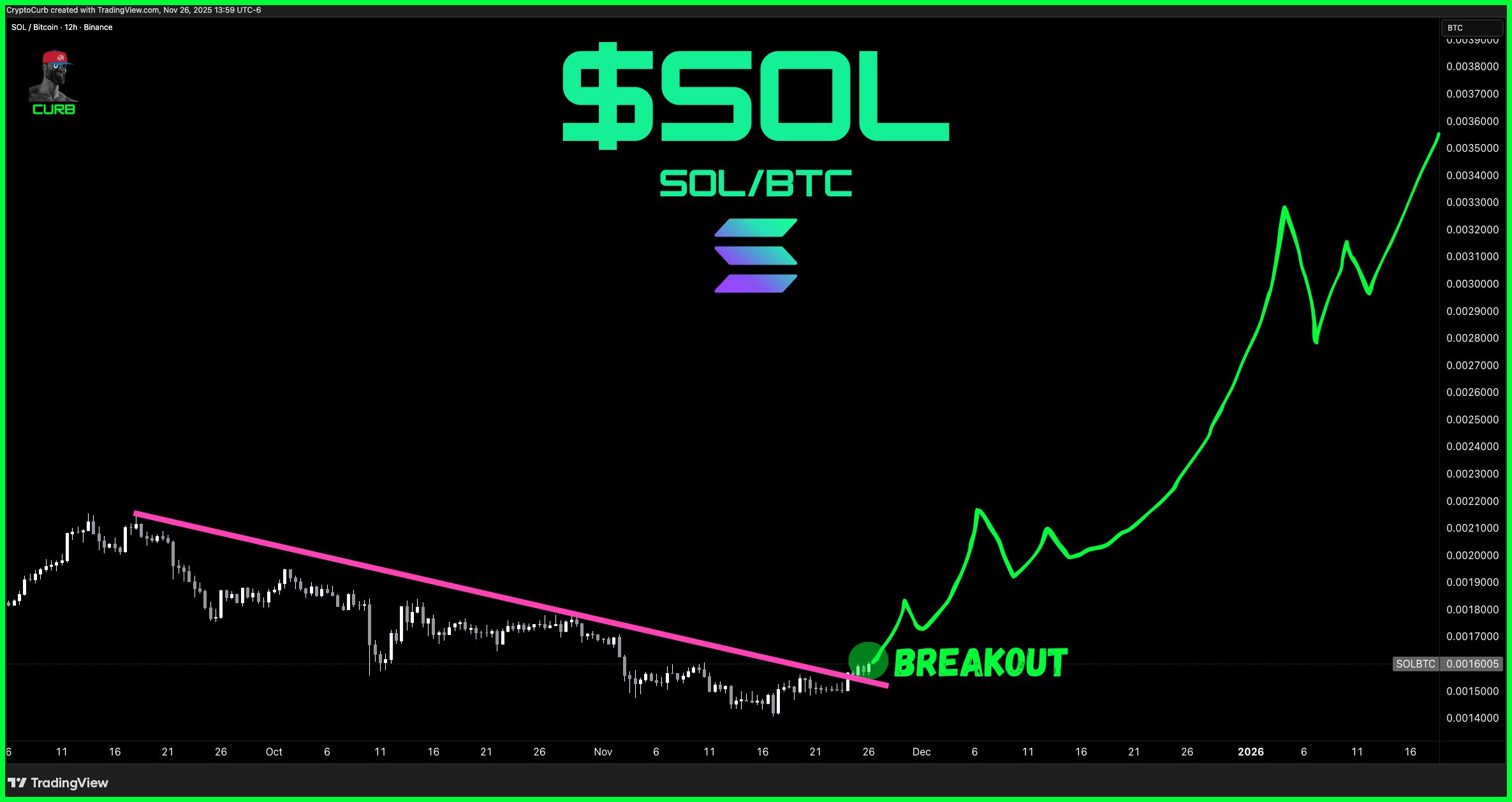
Elsewhere, with Solana finally recovering, a market watcher account, curb.sol, points to a breakout on the SOL/BTC pair. His chart on X shows the ratio pushing above a multi-month descending trendline, suggesting that Solana may be starting to outperform Bitcoin after an extended period of relative weakness. The chart points to a potential pump in the SOL/BTC pair toward roughly the 0.0035 to 0.0036 BTC per SOL area.

Image

In his post, the market watcher calls the move “probably something” and even suggests that traders holding only BTC should consider pivoting to SOL. While the comment is speculative and not guaranteed, it underlines growing sentiment that Solana could lead the next leg higher if this breakout on the SOL/BTC chart holds.

XRP Reserve On Binance Is Plummeting, Suggesting Accumulation: CryptoQuant

0

The amount of XRP tokens on the leading cryptocurrency exchange Binance has dropped substantially in recent times, suggesting user accumulation.

CryptoQuant highlighted this bullish event for XRP in an X post on Thursday, citing recent on-chain activities. It also buttressed what this event suggests, using a piece from a verified author, Darkfost.

XRP Disappearing from Binance

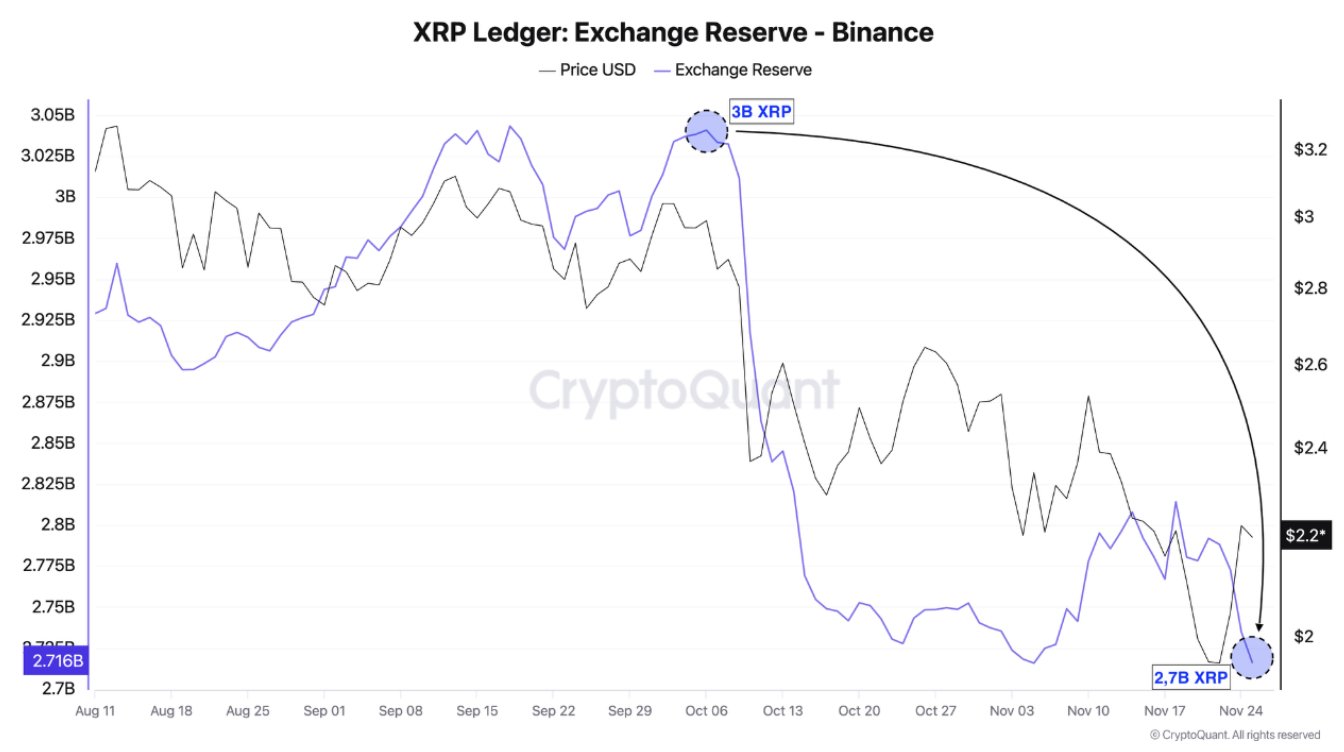
Notably, Darkfost identified that this activity has intensified since October, indicating a persistent trend of XRP accumulation. Over 300 million XRP, valued at $651 million at the current price, has been withdrawn from Binance since October 6, the analysis highlighted.

As a result, XRP’s reserve on Binance has now dropped to 2.7 billion tokens, one of its lowest recorded amounts on the exchange. Darkfost stated that, while not all may represent whale accumulation, the trend is far too consistent to go unnoticed.

XRP Reserve Drops on Binance/CryptoQuant

He stated that a “tiny” portion of these movements may be wallet redistribution among holders or the exchange. However, others are actual withdrawals from Binance, suggesting a shift towards long-term holding. This is bullish for XRP, as it reduces short-term selling pressure.

ETF Launch Alignment Adds Volume

Notably, this withdrawal closely aligns with the launch of the US spot XRP ETFs. The Canary Capital XRP ETF debuted on November 13, followed by the products from Bitwise, Grayscale, and Franklin Templeton.

Darkfost stated that these changes things for XRP, shifting the asset from a standard cryptocurrency to a product accessible to institutions through several traditional wrappers. Furthermore, its coincidence with the accumulation further strengthens the significance of these withdrawals on XRP.

Remarkably, the XRP ETFs have made a fast start to their trading days on Wall Street and could be on track to meet hefty inflow projections from industry leaders. With XRP increasingly scarce on exchanges, additional demand from institutions would create a supply shock.

The analyst said that if the trend kept building, XRP could shift into a more orderly phase and attract greater attention from institutions.

Supply Shock Impact on XRP Price

Meanwhile, analysts are already putting the possible impact of this bullish development into a price context. Should this dual accumulation persist, and a supply shock kick in for XRP, analyst Chad Steingraber has highlighted possible price scenarios for XRP.

He calculated the price impact using a conservative $33.6 billion annual inflow and an XRP price factor, which determines how quickly asset managers accumulate. He outlined a 5x-100x model, culminating in an XRP price range of $11.25 to $225 per coin.

Bhutan Moves 320 Ethereum To Staking

0

The Royal Government of Bhutan has strengthened its crypto infrastructure by staking 320 Ethereum tokens through Figment.io.

This move represents its most significant Ethereum-related activity in several months.

Government Allocates $970K in ETH to Validator Network

According to Onchain Lens, Bhutan transferred 320 ETH, worth approximately $970,820, to the Ethereum staking contract via the institutional provider Figment.io.

Data from Arkham Intelligence corroborates the transaction and links it to wallet addresses belonging to Druk Holding and Investments, the government’s investment arm.

Arkham records show the transaction occurred precisely at 10:30:35 UTC on November 27, 2025. The transfer is significant, as the amount corresponds to 10 Ethereum validators, each of which requires 32 ETH for activation.

Consequently, this reinforces Bhutan’s long-term engagement with Ethereum’s network infrastructure.

Image

First Major ETH Movement by Bhutan Since May

Notably, the staking activity ends a months-long lull in Bhutan’s Ethereum operations. The government’s last major movement occurred in May, when it transferred 570 ETH, valued at about $1.02 million at the time, to a Binance hot wallet.

Following the new staking commitment, Bhutan now holds 336 ETH, valued at about $1.01 million. This makes Ethereum the country’s second-largest crypto holding after Bitcoin.

Bitcoin Still Dominates Bhutan’s Digital Portfolio

Although Ethereum remains a strategic asset, Bitcoin continues to dominate Bhutan’s reserves. Arkham data shows the government holds 6,154 BTC, valued at around $560.26 million, making it the core of the nation’s digital asset position.

In addition to BTC and ETH, Bhutan maintains a selection of smaller tokens. However, these represent a minimal portion of its overall crypto reserves.

Part of a Broader Crypto Reserve Strategy

The move aligns with Bhutan’s earlier decision this year to formalize Bitcoin (BTC), Ethereum (ETH), and Binance Coin (BNB) as strategic reserve assets for Gelephu Mindfulness City (GMC).

At the time, GMC officials said the assets were selected due to their strong liquidity and large market capitalization. Additionally, they expect these reserves to bolster economic resilience and support the region’s digital ecosystem.

Migration of NDI System to Ethereum

Meanwhile, Bhutan is also expanding its use of Ethereum for government services. Last month, the country began migrating its National Digital Identity (NDI) system from Polygon to Ethereum to improve security, transparency, and user control. The transition is expected to finish by early 2026, according to government statements.

Nasdaq Requests to Raise Trading Limit for Options on BlackRock’s Bitcoin ETF to 1 Million

0

Leading U.S. exchange Nasdaq is pushing for major expansion of trading capacity for options linked to BlackRock’s iShares Bitcoin Trust (IBIT). 

According to a Wednesday filing with the SEC, Nasdaq asked regulators to raise IBIT’s current daily options trading limit from 250,000 contracts to 1 million. It cited rapidly expanding investor demand. 

Nasdaq files to raise trading limit for options trading on BlackRock Bitcoin ETF

The exchange noted that the proposed ceiling is consistent with existing limits of several other BlackRock-owned ETFs. These include the iShares MSCI EAFE, iShares MSCI Emerging Markets, and iShares China Large-Cap funds.

Initial Increment 

Notably, this marks Nasdaq’s second attempt to expand trading capacity for IBIT options. The first request came in January, shortly after the SEC approved options trading for the Bitcoin ETF.

At the time, Nasdaq sought to raise the cap tenfold—from 25,000 contracts to the current 250,000. The SEC granted that increase in July 2025. 

With activity accelerating far beyond initial expectations, Nasdaq argues that the current limit is no longer sufficient. Accordingly, it now seeks approval to raise the ceiling to 1 million contracts. 

IBIT Dominance in the Bitcoin ETF Market 

The iShares Bitcoin Trust has firmly established itself as the dominant force in the regulated Bitcoin derivatives market. With roughly $70 billion in assets, IBIT is not only the largest Bitcoin ETF but also the primary driver of nearly all Bitcoin ETF options activity.

At its peak in October, open interest in IBIT options surged past $50 billion, reaching levels comparable to the world’s largest crypto options exchange, Deribit. According to data compiled by Bloomberg, IBIT options account for 98% of the overall Bitcoin ETF options and 96% of the total open interest across these products. 

Institutional Demand for IBIT Soars 

Indeed, IBIT has become the preferred vehicle for institutions seeking Bitcoin exposure through traditional financial products. That momentum was reinforced this week when JPMorgan filed to issue structured notes linked to IBIT. Interestingly, analysts argue the move could encourage other issuers to follow suit.

IBIT currently holds roughly $70 billion in net assets. The fund had previously surpassed the $100 billion mark earlier this year. However, the sharp decline in Bitcoin’s price and persistent outflows reported in recent weeks have since reduced the net value of BlackRock’s BTC holdings.

Meanwhile, the outflow trend has shifted over the past two days. Specifically, IBIT attracted $125.8 million in inflows, pushing net inflows to $62.68 billion. As of November 26, IBIT has 1.37 billion outstanding shares and a 30-day average trading volume of $73.78 billion. 

Do Kwon Says 5-Year US Sentence Is Enough as South Korea Seeks 40 Years

0

Terraform Labs founder Do Kwon is asking a U.S. judge to limit his prison sentence to five years. 

Meanwhile, in South Korea, prosecutors are seeking up to 40 years in prison for him over the 2022 collapse of the Terra ecosystem.

Kwon Argues a Longer U.S. Sentence Would Be Excessive

In a Wednesday court filing, Kwon’s legal team said a sentence beyond five years would be “far greater than necessary,” pointing to the punishment he has already endured and the penalties he has agreed to accept. 

In August, Kwon pleaded guilty to two counts, including conspiracy to defraud, after his extradition from Montenegro. His lawyers emphasized that he has spent nearly three years behind bars, including prolonged periods in what they described as harsh Montenegrin prison conditions. 

They also noted he has paid a substantial personal and financial price, including the forfeiture of over $19 million and multiple properties.

Under his plea deal, U.S. prosecutors agreed not to seek more than 12 years, but the defense insists five years is sufficient.

South Korea Prepares Its Own Case

Regardless of what happens in the U.S., Kwon will still face legal consequences at home. South Korean prosecutors are pursuing a separate suit related to the same events and are aiming for a sentence of up to 40 years. 

Authorities there have long accused Kwon of playing a central role in the collapse of TerraUSD and LUNA, which erased an estimated $40 billion from the crypto market in 2022.

Kwon is set for sentencing in the U.S. on December 11 by Judge Paul Engelmayer. In parallel, prosecutors will submit their sentencing recommendation soon.

Trail of Legal Battles

Kwon’s downfall began after Terra’s collapse, followed by months during which his whereabouts were unknown. He was eventually arrested in Montenegro for trying to travel using falsified documents, sparking a tug-of-war between U.S. and South Korean authorities for extradition.

He stayed four months in a Montenegrin prison before the courts approved extradition to the U.S.

SBF Appeals His 25-Year Sentence

Kwon’s case echoes other high-profile crypto legal battles. FTX founder Sam Bankman-Fried was sentenced to 25 years in 2024. However, earlier this month, his case returned to court as he challenged both his conviction and sentence. 

His attorneys argue he was denied a fair trial, claiming the jury never heard evidence that FTX might have been solvent and that early narratives shaped the case before the defense could fully respond.

Here’s One Factor That Drove the Bitcoin Rise Above $90K and Why a Drop to $85K Is Likely

0

Bitcoin has recently recovered an important psychological level, but analysts insist that the market remains in a delicate position.

Bitcoin (BTC) regained momentum on Nov. 26 after it closed the day with a 3.6% jump, its strongest intraday climb in more than a month. Importantly, this push allowed the crypto firstborn to reclaim the $90,000 mark for the first time in a week. 

For context, the ongoing rebound started after Bitcoin fell to $83,432 on Nov. 22 and then began moving higher. Since reclaiming $90K yesterday, it has held above the level and currently trades around $90,857. However, several analysts warn that the market currently stands on fragile ground.

Why a Bitcoin Drop to $85K May be Next

Specifically, market analyst Satoshi Stacker highlighted one major factor that boosted the recent rally. He said Bitcoin climbed above $90,000 partly because short traders saw their positions wiped out as the price moved higher. 

Bitcoin Liquidity Clusters Coinglass
Bitcoin Liquidity Clusters | Coinglass

Nonetheless, citing Coinglass data, he also pointed out that the next large pocket of potential liquidations sits near $85,000, which puts this level at risk if buyers fail to keep the market supported. Essentially, bulls must stay active to stop the market from drifting toward that zone.

Latest figures from Coinglass support this data. Notably, the platform shows that most liquidations over the past 12 and 24 hours came from short positions, reversing the earlier pattern when long traders took most of the losses. 

Bitcoin Liquidations Coinglass
Bitcoin Liquidations | Coinglass

In the last 12 hours, the market saw $23.95 million in total liquidations, with shorts contributing $15.92 million, or 66%. Interestingly, over the past 24 hours, the gap widened further. Total liquidations hit $131.32 million, and shorts made up $117.63 million of that amount, or 89%. 

Meanwhile, in the 4-hour timeframe, the trend flipped again. Long traders lost $5.77 million, while shorts lost $2.26 million. This likely reflects overconfidence from bullish traders who expected the move above $90,000 to lead to more immediate gains.

BTC Remains in a Critical Position

Speaking on the latest recovery effort, analyst Ted Pillows said a large amount of liquidity still sits above Bitcoin’s current level, although clusters have started forming around the $85,000 to $86,000 range as well, confirming Satoshi Stacker’s disclosure.

However, according to Pillows, if Bitcoin pushes past the $93,000 to $94,000 zone, the move could open the path toward $100,000 before the market pulls back.

Meanwhile, crypto insights firm Swissblock said Bitcoin’s earlier drop below the yearly open around $93,000 led to an important change in the market trend. The firm expects Bitcoin to retest the support area between $83,000 and $85,000, where strong demand needs to appear for a bottom to form. 

Swissblock added that Bitcoin must reclaim the $94,000 to $95,000 area for the trend to flip in favor of buyers. If the market fails to hold the defensive zone, the firm warns that another quick downward leg could follow.

Here’s What 2,000 XRP Could Be Worth by the End of 2035

0

If you hold 2,000 XRP today, how much would your investment be worth by the end of 2035, considering emerging XRP price predictions?

Despite a mild recovery effort, XRP has continued to face bearish pressure as the broader crypto market grapples with growing uncertainties. Specifically, the total crypto market cap has lost $713 billion this month, down 19.5%. While XRP has shown greater resilience, it has lost $26.34 billion within the same period, having collapsed by 17.5%.

However, as XRP currently changes hands at $2.21, multiple analysts remain confident in its long-term potential. Most of these analysts who predicted the latest downturn have suggested that XRP could recover considerably from the market rout, projecting higher prices in the future. 

Now, while market commentators like EGRAG Crypto and R2CTrading believe XRP could rebound to greater heights soon, others are already looking forward, specifically a decade later. 

Bullish XRP Price Predictions for 2035

For instance, an XRP community member who calls himself Time Traveler revealed on Nov. 21 that his goal is to hold 10,000 XRP, suggesting that they could be worth $1 billion by 2035. Notably, this statement implied that the investor expects the price of 1 XRP to be $100,000 over the next decade, an audacious projection.

Meanwhile, several market experts and AI models have presented price predictions for XRP while accounting for bullish market trends. These predictions range from optimistic to utterly ambitious.

Specifically, when we asked Google Gemini for its opinion, the AI chat predicted that the XRP price could range between $100 and $500 by the end of 2035. It cited bullish factors such as massive institutional adoption, regulatory clarity, broad utility, and overall crypto market growth. For context, a $500 price would give XRP a market cap of $30.12 trillion, considering the current circulating supply of 60.25 billion.

XRP Price Predictions for 2035 Google Gemini
XRP Price Predictions for 2035 | Google Gemini

However, analysts at market analytics platform Telegaon are less bullish. Notably, Telegaon predicts that XRP would only reach an average price of $38.16 by 2035. For the maximum price, the analysts believe XRP could grow to $40.29, representing a 1,855% rise from the current price of $2.06.

XRP Price Prediction for 2035 Telegaon
XRP Price Prediction for 2035 | Telegaon

Worth of 2,000 XRP by the End of 2035

Notably, if XRP claims any of these price levels, current investors could see massive growth in their holdings. Data from the XRP Rich List reveals that there are 731,890 accounts in the top 10%, with each wallet holding at least 2,313 XRP. 

Considering this current reality, we assessed how much investors holding 2,000 XRP would make if XRP claims the 2035 targets. Specifically, if XRP reaches the audacious $100,000 goal from “Time Traveler,” the 2,000 XRP, currently worth $4,120, would hold a value of $200 million.

Meanwhile, should XRP hit the upper end of Gemini’s predictions, a rally to $500 would push the worth of 2,000 tokens to $1 million. However, if the $40.29 price prediction from Telegaon plays out instead, the 2,000 XRP would only rise to $80,000. While some investors would consider this modest, it still marks an over 1,800% ROI.

Here Is First Fib Level to Secure for Bitcoin to Reach $107,000

The recent Bitcoin rebound has revealed the first resistance the crypto asset must reclaim before any sustained bullish continuation.

Bitcoin is staging a comeback after bears exposed it to the $80,000 support zone. Over the last 24 hours, BTC has jumped about 4.7%, with buyers lifting prices from the mid-$86,000 area back above $91,000 as expectations of a Fed rate cut drives a wave of renewed investor interest.

On a 7-day view, Bitcoin is roughly flat, reflecting a V-shaped pattern where early losses were mostly clawed back. The 14-day performance still shows an 11–12% slide, and the 30-day change is deeper at nearly 19.9% in the red.

The latest bounce sets the stage for a closer look at whether BTC is building a base or just pausing before its next big move.

Can Bitcoin Price Reach $107,000?

Looking at a daily chart from TradingView, Bitcoin’s price action is starting to normalize after a sharp slide along the lower Bollinger Band. Notably, candles have bounced from the recent lows near the lower band, currently located around $80,680 and are now pushing back toward the 20-day simple moving average near $93,958. 

Bitcoin
Bitcoin

This shows fading downside pressure and an early attempt to re-enter the middle of the volatility envelope. The middle band now acts as the first resistance zone, while the lower band remains key support if selling resumes. For Bitcoin to reach the upper Bollinger Band at $107,233, it must first secure a decisive daily close above the middle band.

The Chande Momentum Oscillator supports this view of improving but still fragile conditions. The indicator sits near -6.13, climbing from deeper negative readings but yet to cross into positive territory.

This suggests that bearish momentum is losing strength, though bulls do not have firm control. If Bitcoin can close above the mid-Bollinger band with ChandeMO moving above zero, it would strengthen the case for a broader recovery toward the upper band.

Bulls Need to Reclaim $100,000 

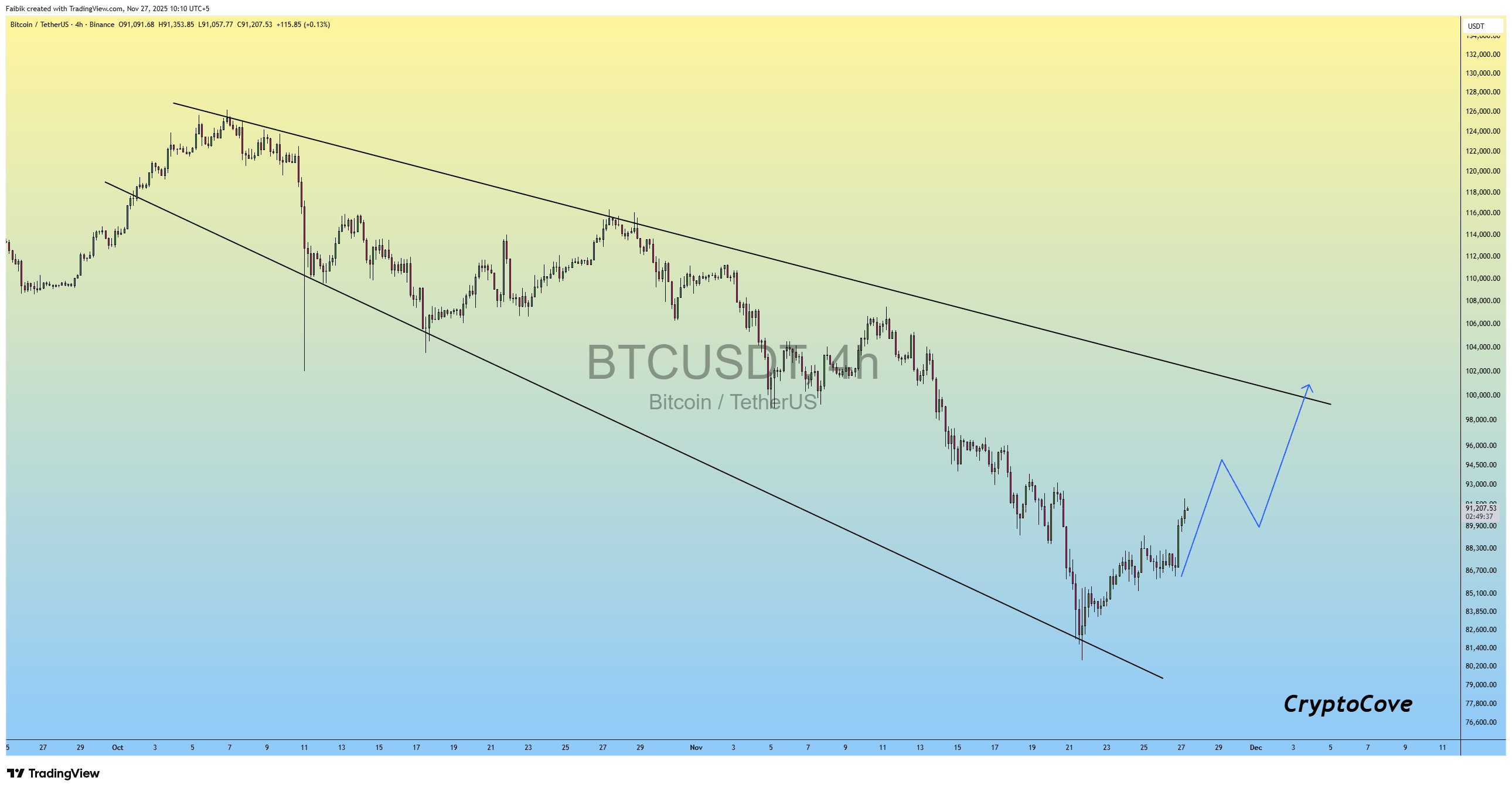
On the lower timeframe, Bitcoin’s 4-hour chart is tracing out a descending broadening wedge. In analyst Captain Faibik’s view, BTC has likely already found a floor in the $80,500 area, but upside momentum will only strengthen if buyers can drive price back toward the wedge’s upper boundary.

Image

He highlights the $100,000 region as the key resistance level, arguing that BTC bulls need to reclaim this barrier to “regain strong bullish momentum.” Such a move, he adds, could pave the way for a sustained rally in December if the breakout is confirmed.