
Home Blog Page 435

Durham University Research Paper Calls XRP a “Radical Form of Commodity Money”

0

Amid recent bipartisan legislation efforts toward legal clarity in the U.S., the XRP community has renewed discussions around XRP’s position as a commodity.

Specifically, SMQKE, a self-acclaimed researcher, recently called attention to an academic study that discussed XRP’s position in finance. The paper described XRP as a “radical form of commodity money,” adding to what the XRP community sees as evidence that the token is not a security.

XRP Has Two Major Roles in Finance

For context, the study, written by Ludovico Rella of Durham University, was published five years ago in the Journal of Cultural Economy. In his research, Rella discussed how money functions as a technological tool and a social system, using Ripple and XRP as the main examples. 

He discussed how technology, culture, and finance influence one another and argued that money’s design and use depend on the systems that support it.

Notably, Rella explained that XRP has two major roles. Specifically, it acts as a digital asset with commodity-like qualities and also as an essential part of Ripple’s payment network. 

He called attention to Ripple’s journey from its early days as a mutual credit system, which relied on trust between users, to its current form as a blockchain-based payment solution focused on speed, liquidity, and efficiency. During this change, XRP moved from a community-based credit token to a bridge asset for moving money across borders.

A Radical Form of Commodity Money

According to Rella, XRP is “a radical form of commodity money” designed to behave like digital gold, being a self-contained asset that holds value on its own. 

XRP radical form of commodity money

Importantly, it does not depend on intermediaries, company shares, or liabilities. Moreover, it exists independently, pre-mined, and transferable between any two addresses without restriction. Rella called this idea “digital metallism.”

Rella argued that XRP is more than a financial tool, as it reflects two opposing visions of money. Specifically, one focuses on community and trust, while the other values efficiency and liquidity. As a result of bridging these two ideas, XRP exists as both a technological innovation and a symbol of how money continues to develop in modern finance.

For context, SMQKE spotlighted the Durham University paper following a bipartisan draft bill from the U.S. Senate Committee on Agriculture, which seeks to settle how digital assets fit into existing laws. 

Bipartisan Discussion Draft on Regulatory Clarity 

Called the Bipartisan Market Structure Draft, the proposal wants to create a clear framework that divides oversight between the Commodity Futures Trading Commission (CFTC) and the Securities and Exchange Commission (SEC).

The bill would place digital commodities like XRP and Bitcoin under CFTC authority, while the SEC would continue regulating securities. Lawmakers believe the proposal could end years of confusion over how cryptocurrencies should be treated under federal law.

Within the XRP community, many see this as a major step forward. Commentator Arthur said the bill could confirm XRP’s place as a digital commodity, building on the 2023 court ruling that found XRP was not a security. 

He noted that XRP functions as a utility token, as it is used for payments, liquidity, and settlements, not as an investment in Ripple or any company. He added that the draft bill effectively puts that reality into law, recognizing XRP as part of the CFTC’s oversight rather than the SEC’s.

Cardano Must Hold the $0.52 Support for a Potential Breakout, Here’s How

Cardano (ADA) must hold $0.52 support for a potential breakout, with analysts targeting a 1-month high, while market liquidations highlight volatility.

Cardano is currently trading at $0.567, showing an 8.0% increase over the past 7 days, with a market cap of approximately $20.8 billion. Despite this recent uptick, ADA is still facing a 12.1% decline in the last 14 days and a 20.8% drop over the past month, indicating struggles in the midterm.

However, the positive movement in the shorter term suggests an imminent shift in momentum, with resistance around $0.66-$0.68. Will ADA bulls beat the bears?

Cardano Price Analysis

Notably, Cardano’s shorter-term chart shows a slight plunge of 2.3% in the past 24 hours. This timeframe additionally poses signs of bull exhaustion, as momentum indicators are in the overbought zone.

Cardano 1D Chart
Cardano 1D Chart

Specifically, the Stochastic RSI is currently at 84.20, which suggests Cardano is in the overbought zone, indicating that it may face short-term resistance or a potential pullback. 

Further, the MACD indicator shows a negative divergence with the signal line crossing below the MACD line, which could imply weakening bullish momentum. However, ADA is still holding steady above the key support of $0.52, suggesting that a breakout could occur if it manages to hold this range.

Traders can watch for any breakout above the $0.59 resistance zone or signs of further retracement if bearish momentum strengthens.

Expert Analyst and Derivative Market

Furthermore, an analyst on X, Ali Martinez, trusts the strength of this support zone. He, however, placed his support lower at $0.50, stating that Cardano must hold this level to keep the path open for a potential rebound.

If ADA can maintain this support, Martinez believes it could regain bullish momentum and target the $0.70 resistance zone, which represents a 1-month peak.

Notably, to reach $0.70, Cardano would need to surge by approximately 23.4% from the current price of $0.567. As resistance continues to limit Cardano bulls, the market is experiencing significant liquidation events.

Screenshot 2025 11 12T131037836
Coinglass

Over the past 24 hours, a total of $1.20 million has been wiped from the market, with long positions accounting for $1.13 million, compared to $64.94K in short positions. The smaller short liquidation figure can suggest that the market is still cautious about downward moves.

Tokentus Investment CEO Explains When XRP Price Will Finally Explode

0

German finance executive Oliver Michel, CEO of Tokentus Investment AG, has commented on the long-awaited XRP price breakout.

He said XRP’s price action depends less on news headlines and more on global liquidity shifts. In particular, he cited the end of Quantitative Tightening (QT) and the return of Quantitative Easing (QE) as a major factor.

Liquidity, Not News, Drives XRP’s Future

Speaking on DER AKTIONÄR TV, Michel noted that XRP has seen waves of positive developments, including Ripple’s Swell conference announcements. Yet, the price continues to lag in performance.

He explained that this disconnect stems from the broader financial cycle, not a lack of adoption or momentum. According to Michel, cryptocurrency prices, including XRP, heavily rely on global liquidity trends.

“News is great,” he said, “but the aid packages and liquidity injections are what will bring the market to life and deliver the final boost to the top.”

His remark stresses that it’s not just news, but the flow of liquidity that will move the market. Once central banks resume QE, effectively injecting money back into the markets, XRP could “finally explode.”

Role of Central Banks and Interest Rates

In other words, Michel emphasized that the Federal Reserve and other central banks will play a crucial role in setting the stage for the next bull market cycle. He expects that interest rate cuts, once they begin in earnest, will unleash the liquidity needed to fuel crypto rallies.

“It may be necessary to cut rates more sharply than Jerome Powell is currently willing to admit,” Michel said. He added that various economic aid packages and looser monetary policies would “form the basis for fueling the markets.”

It’s A Question of Timing and Patience

While optimistic about XRP’s eventual surge, Michel cautioned that investors need patience as the financial and crypto markets are anticipating real-world policy shifts months in advance.

“If measures are taken that might not take effect for another six or nine months, the stock market, and that includes cryptocurrencies, will react accordingly, potentially within the next five to eight weeks,” he said.

“I Hope to Wake up XRP to Trading at $8”

Michel concluded by reminding investors to adopt a more extended time horizon and resist the urge to monitor hourly price changes. “Being realistic means looking at it week by week, not letting yourself get flustered,” he noted.

He humorously added that he sometimes hopes to wake up and find XRP trading at $4, $5, or $8 overnight. But the journey to these price levels requires patience.

Essentially, XRP’s explosive move may not come from any single news event but from a turning point in global monetary policy. Once central banks pivot toward easing and inject liquidity back into the system, XRP, along with the broader crypto market, will respond accordingly.

It’s worth noting, however, that some industry observers, including Morgan Stanley, have argued that the Fed’s plan to end quantitative tightening in December may not necessarily signal a full return to quantitative easing.

In other words, the timing of XRP’s breakout may depend not just on policy announcements, but on the actual flow of liquidity into global markets.

DTCC Lists Bitwise Chainlink ETF Under ‘CLNK,’ Suggesting Pending Launch

0

Bitwise Asset Management’s proposed spot Chainlink ETF has appeared on the DTCC registry, a development that often signals a fund’s impending launch.

The listing, identified by the ticker symbol CLNK, is currently under “pre-launch,” according to the Depository Trust and Clearing Corporation (DTCC).

While the DTCC listing does not indicate that the U.S. SEC has approved the product, such registrations have historically been a strong signal that approval may be imminent.

Regulatory Filings Still in Progress

Bitwise has yet to submit Form 8-A, one of the final documents required before an ETF can begin trading on an exchange. However, the firm previously filed a Form S-1 statement in August, officially registering the fund with the SEC.

The proposed ETF aims to track the market performance of Chainlink (LINK), the token that powers the Chainlink decentralized oracle network, which delivers real-time blockchain data to smart contracts.

Grayscale Pursues Rival ETF Amid Regulatory Challenges

Meanwhile, Grayscale Investments is also pursuing a spot Chainlink ETF. However, analysts contend that the proposal may encounter heightened regulatory scrutiny due to the firm’s intention to incorporate staking.

This mechanism would enable the firm to earn rewards through the validation of network transactions. While attractive to investors, this feature raises additional questions for the SEC regarding yield generation within ETFs.

By contrast, Bitwise’s simpler design, which focuses solely on price tracking, may provide it with a smoother regulatory path.

Government Shutdown Slows Down ETF Approvals

The broader crypto ETF landscape remains affected by the ongoing U.S. government shutdown, now in its 42nd day. The SEC has been operating with limited capacity and resources, thereby delaying multiple pending ETF decisions.

However, there are signs of movement. The shutdown is expected to end soon, as the Senate passed a funding bill earlier this week that could allow the SEC to resume full operations.

Growing Wave of Altcoin ETF Applications

The Chainlink ETF is part of a broader surge in crypto asset managers filing for spot ETFs tied to altcoins. For instance, new applications have targeted tokens such as Solana (SOL), Dogecoin (DOGE), Avalanche (AVAX), Hedera (HBAR), and Aptos (APT).

This trend indicates an expanding interest among investors in opportunities beyond Bitcoin and Ethereum. In turn, this has contributed to a rise in institutional participation in alternative digital assets.

Industry analysts expect an expedited pace of ETF approvals under the new SEC generic listing standards introduced on September 17. The rules enable certain crypto investment products to be listed without a case-by-case review, streamlining the approval process.

However, the government shutdown began less than two weeks later, leaving regulators little time to implement the updated framework.

Bitcoin Proponent Says if XRP Hits $10 After ETF Launch, He’ll Admit He Was Wrong

0

A well-known Bitcoin proponent says he will admit he was wrong if XRP price ever reaches the two-digit region days after XRP ETFs debut.

Excitement around the upcoming launch of spot XRP exchange-traded funds (ETFs) has continued to build as multiple issuers, including Canary Capital, Bitwise, and Franklin Templeton, update their S-1 filings to prepare for a debut this month. 

“XRP ETFs Not Priced In”

Notably, most XRP proponents believe these long-awaited products could finally drive a strong price surge for the token, as XRP continues to struggle below $3, currently trading for $2.46 at press time.

Amid the anticipation, recent reports confirmed that the Depository Trust & Clearing Corporation (DTCC) now lists 11 XRP ETFs, covering both spot and futures products, up from 9 barely a week ago.

Responding, XRP commentator Zach Rector said XRP’s price has not yet felt the impact of the forthcoming ETFs. This remark essentially addressed critics who have suggested that the ETF hype had already been priced in and that the launch might trigger a typical “sell-the-news” event rather than a rally.

Among the individuals who believe the price impact would not match the ongoing hype is David Weisberger, a well-known Bitcoin advocate and former Chairman of Coinroutes. 

Could XRP Hit $10 After ETF Launch?

Reacting to Rector’s comments, Weisberger argued that some XRP fans might be overstating how much ETFs could lift prices, noting that ETFs don’t have the same “unit bias” advantage as spot crypto assets. He admitted that ETFs are generally bullish but said their effect might not be as powerful as XRP supporters believe.

His comment drew a response from one XRP community member, who pointed to data from the Chicago Mercantile Exchange (CME) to show strong institutional demand for XRP.

For context, XRP Futures became the fastest CME contract ever to hit $1 billion in open interest, reaching that mark in only three months, according to a CME disclosure in August. 

The individual argued that this surge showed that institutional traders, not retail investors chasing low-priced coins, were driving the action. He added that those same institutions would likely pour into spot XRP ETFs once they go live.

In response, Weisberger said the market would soon reveal the truth. According to him, if XRP climbs above $10 within days of the ETF launch, he would gladly admit that his doubts were wrong. 

Despite this, he said he doesn’t expect that outcome and doubts that the most bullish XRP supporters, such as those predicting prices as high as $1,000, will stop making bold claims even if the price stays lower.

Comparison to Ethereum’s Performance

Another investor compared XRP’s hype to Ethereum’s ETF rollout, which many investors heavily promoted before launch but later had an underwhelming impact on price. He suggested XRP might see a similar result.

For context, when Ethereum ETFs debuted on July 23, 2024, ETH traded for $3,400. However, it wasn’t until August 2025, on the back of a broader market recovery, that Ethereum reclaimed its all-time high above $4,800. Today, ETH trades for $3,556, only 4% up since ETFs launched despite the products seeing a cumulative netflow of $13.86 billion.

Notably, Weisberger emphasized that he still expects XRP ETFs to attract a fair amount of assets under management (AUM). However, he said the real test will come from how ETF inflows compare with futures positioning by market makers, whether they end up higher, equal, or lower. 

Bitcoin Whales Have Cashed Out Billions Since $100K, Says CryptoQuant CEO Ki Young Ju

0

CryptoQuant founder reveals that Bitcoin whale investors have been steadily taking profits since BTC clocked $100,000, noting heavy selling pressure. 

The Bitcoin price rose above $107,400 on Tuesday, fueled by hopes of the U.S. government shutdown resolution. However, it has dropped nearly 2% in the past 24 hours to $103,400 at the time of writing. Accordingly, several market watchers have called attention to the rising selloffs from different whales.

Bitcoin Whales Are Dumping

According to Ki Young Ju, founder of blockchain analytics platform CryptoQuant, Bitcoin whale investors have been cashing out billions of dollars ever since BTC touched $100,000.

While Ju did not provide on-chain data to support his claim, crypto founder Charles Edwards confirmed record sales of BTC by whales in an analysis on November 7.

Citing data from Glassnode, Edwards highlighted seven-plus years of on-chain spending by pre-2018 BTC holders. The data shows multiple sell-offs exceeding $100 million and $500 million in 2025 alone, occurring after BTC reached $100,000.

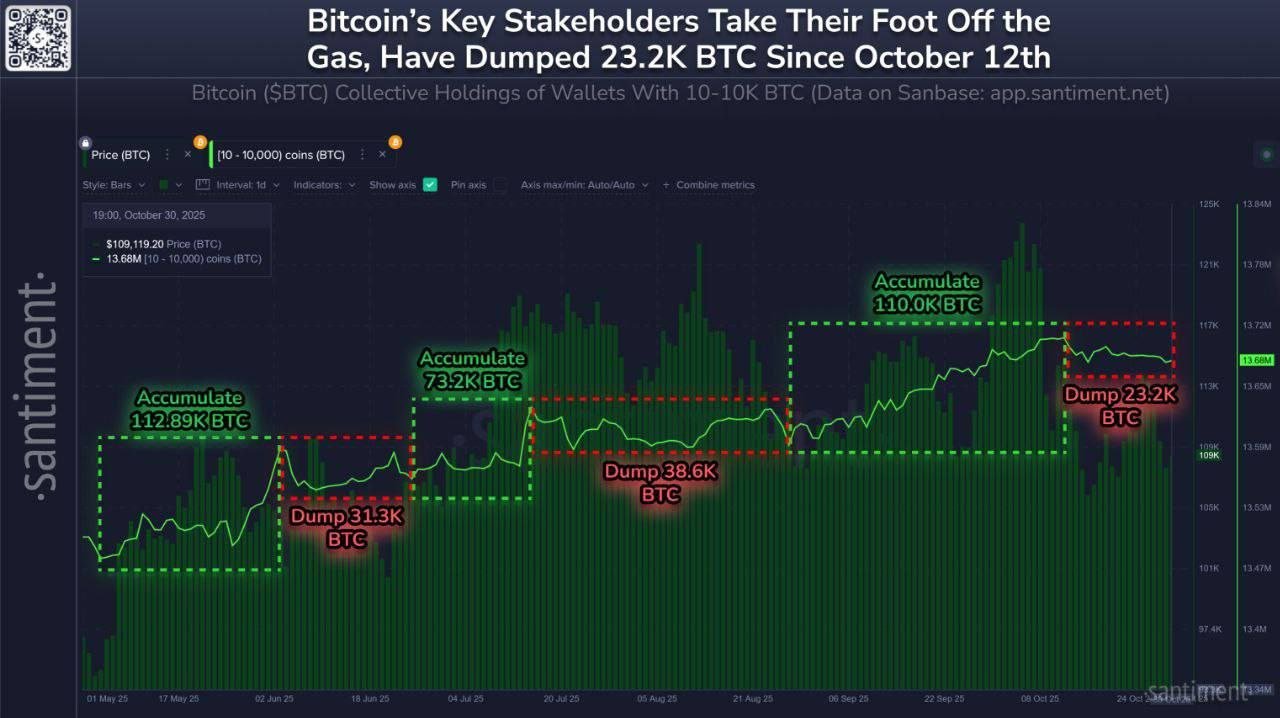
Similarly, Santiment data indicates that wallets holding between 10 and 10,000 BTC have collectively offloaded over 23,200 BTC worth over $2 billion since October 12.

Adding to the selling pressure, a long-standing Bitcoin wallet reportedly sold 11,000 BTC on November 12 after holding the coins for 15 years, according to a Wednesday update on X from TwoCryptoBros.

Image

Will Sellers Dominate?

In his post, Ju reiterated his view that the bull cycle ended in early 2025, suggesting a bear market was likely to follow. However, he acknowledged that heavy BTC accumulations from institutional investors like Strategy (formerly MicroStrategy) and notable inflows into BTC exchange-traded funds (ETFs) offset the bearish outlook.

Nonetheless, Ju has predicted that sellers will dominate the crypto market again if institutional capital and ETF inflows fade. He further highlighted in the post that there is still heavy selling pressure in the market as BTC failed to break the $108,000 resistance in its latest upswing.

However, Ju said the current levels of BTC could be a good accumulation opportunity for those investors who think the BTC’s macro outlook is strong.

Why Current Entry May Be Favorable

As earlier highlighted by CryptoQuant analyst Moreno, Bitcoin’s current level is at a liquidity setup that has historically set the tone for major BTC rallies. This further signals a good buying opportunity for Bitcoin investors.

JPMorgan Launches JPM Coin for Real-Time Institutional Settlements

0

JPMorgan Chase has officially launched JPM Coin (JPMD), a blockchain-based deposit token designed for its institutional clients. 

According to Bloomberg, which cited Naveen Mallela, co-head of JPMorgan’s blockchain unit Kinexys, the coin represents U.S. dollar deposits held at the bank that can, in turn, be transferred using Coinbase’s Base public blockchain.

The new system is to streamline large-value transactions between financial institutions.

Instant, 24/7 Settlements

Traditionally, interbank transfers can take days and often depend on business hours. However, JPM Coin aims to eliminate these limitations. Consequently, with the new system, payments can settle in seconds, operating around the clock.

The rollout follows an extended period of trials involving prominent industry participants, including Coinbase, B2C2, and Mastercard. During these trials, the system’s speed, reliability, and compliance were rigorously evaluated ahead of its public release.

Roadmap: Multi-Blockchain and Multi-Currency Expansion

JPMorgan’s ambitions for the token extend beyond its initial U.S. dollar framework. Specifically, the bank plans to expand JPM Coin to multiple blockchains and additional currencies, pending regulatory approval.

Additionally, it aims to allow clients’ clients to access the token, widening its use across global financial networks and transforming how institutions settle cross-border transactions.

Meanwhile, JPM Coin will soon be accepted as collateral on Coinbase. This, in turn, signals growing confidence in blockchain-based settlement tools and a deepening relationship between regulated banking systems and crypto infrastructure.

How Deposit Tokens Differ from Stablecoins

Although JPM Coin functions similarly to a stablecoin, it operates differently in practice. Deposit tokens represent digital claims on existing bank deposits, ensuring that each token is fully backed by client funds held at the bank.

Unlike stablecoins, which are backed by reserves and generally do not earn returns, deposit tokens can be interest-bearing, offering institutional investors both efficiency and yield potential within a regulated framework.

Growing Trend Among Global Banks

JPMorgan’s initiative reflects a larger trend among global financial institutions. For instance, Banco Santander, Citigroup, PayPal, and Deutsche Bank actively explore similar blockchain-based payment solutions to minimize transaction costs and expedite settlements.

This wave of innovation follows the U.S.’ Genius Act, establishing stablecoin regulations that direct banks in developing compliant digital assets.

Meanwhile, other major players, including HSBC and BNY Mellon, are also developing their own deposit token models. Overall, the growing participation of global banks underscores a collective move toward faster, programmable finance in the digital age.

RippleX Issues New Scam Alert to XRP Holders

0

RippleX, the XRPL development arm of Ripple, has issued a new warning about a growing wave of scams targeting XRP holders.

In a recent X post, RippleX warned XRP community members to be cautious of scams impersonating Ripple executives through fake livestreams and deepfake videos. This malicious content has been circulating across multiple social media platforms, including X.

Growing Deepfake Scams

The message comes amid a surge in deepfake scams targeting unsuspecting XRP community members. Scammers often leverage artificial intelligence to create sophisticated videos impersonating Ripple executives, specifically CEO Brad Garlinghouse, in an effort to deceive investors.

These fraudulent videos often feature scammers pretending to offer XRP giveaways in exchange for small deposits of the token. In many cases, they urge viewers to send funds to a specific wallet address with the false promise of receiving double the amount sent.

Such AI-generated videos are often posted in the comment sections of posts from Ripple’s official accounts or those of its executives, giving them a misleading appearance of legitimacy.

RippleX’s Latest Warning

In its latest advisory, RippleX emphasized that no Ripple employee will ever ask users to send funds, participate in investment schemes, or share wallet information such as seed phrases.

Moreover, RippleX urged the community to verify all information through Ripple’s official accounts on X, specifically @RippleX and @RippleXDev, before taking any action relating to giveaways.

The message concluded with a stern reminder, telling users to “Keep your XRP yours,” urging holders to safeguard their tokens.

Efforts to Combat XRP Scams

Scammers have long targeted the XRP community with deceptive giveaway campaigns. However, the trend accelerated in mid-2023 following Ripple’s partial legal victory against the U.S. SEC.

Impersonating Garlinghouse and other Ripple executives, fraudsters claimed that the giveaways were part of celebrations marking Ripple’s court success.

However, the company, along with other prominent community figures, continues to dismiss these giveaways as malicious offers.

In 2020, Ripple filed a lawsuit against YouTube over the platform’s failure to protect XRP community members from scams, particularly deepfake videos impersonating CEO Brad Garlinghouse.

A year later, the company withdrew the case after reaching an agreement with YouTube to jointly remove these fraudulent promotions.

Despite these measures, scammers continue to target unsuspecting XRP investors, prompting Ripple to reiterate its call for users to remain vigilant.

Pundit Says Do Not Make This Mistake With XRP

0

XRP proponents believe the token has recently become the focus of a FUD campaign that has swept through the crypto community. 

As a result, XRP community commentator Mickle recently sought to tackle two of such persistent claims that, according to him, misrepresent Ripple’s business model and XRP’s long-term potential.

In a video commentary, Mickle addressed what he called “brand new FUD” about XRP’s potential. He pointed out that while some skeptics once dismissed XRP as having no value, they now acknowledge its utility amid institutional adoption but argue that its potential is smaller than Bitcoin’s.

“Ripple is Pivoting Away from XRP”

The first claim he challenged was the idea that Ripple’s institutional business does nothing for XRP. This claim has circulated across crypto circles over the past few weeks and recently resurfaced during a Crypto Town Hall discussion. 

Specifically, some have suggested that Ripple’s products do not directly impact XRP or have any benefit for XRP. Mickle pointed out that there was some irony in these claims, as these individuals have also admitted that some institutions might still leverage XRP or even use it as collateral.

Mickle explained that Ripple focuses on building an ecosystem around the XRP Ledger for traditional financial institutions. However, he noted that not every Ripple product has to use XRP because not every financial process requires decentralized, instant settlement. He said people misunderstand this and wrongly assume XRP is being ignored.

He used Ripple’s first product as an example. For context, this was a messaging platform similar to SWIFT that didn’t initially involve XRP. Mickle said Ripple wanted to meet clients where they were, reduce fears around blockchain, and build trust before introducing XRP-based settlement.

He called this approach “genius” because it strengthened client relationships while proving Ripple’s systems were safe and efficient. As confidence grew, clients became more willing to adopt XRP-based solutions. Mickle argued that this shows Ripple is setting the stage for broader XRP adoption, not neglecting it.

He dismissed the claim that Ripple ignores XRP, saying it is “patently false.” According to him, “XRP is the beating heartbeat, as Brad Garlinghouse says, of everything Ripple does.” He emphasized that Ripple’s ultimate goal is to drive a push toward crypto-native settlement systems, and XRP has a central role in this vision.

“XRP’s Upside is Limited as Compared to Bitcoin”

Moving to the second controversy, Mickle responded to Bitcoin proponent Dave Weisberger, who argued that XRP’s upside potential is limited, even though Ripple’s business has value. Mickle disagreed with this argument, saying it is “hard to understand.”

He pointed out XRP’s historical performance against Bitcoin, noting that it has outperformed Bitcoin for most of its history and in almost every year over the past five years. 

However, a look at the chart data shows that XRP has dropped 59% against Bitcoin since August 2013, its earliest trading days. Nonetheless, over the past year, XRP has gained by a massive 218% against Bitcoin. Meanwhile, overall, XRP is up 41,124% since launch, per CMC data.

Considering the recent uptick, Mickle asked what could justify claims that XRP’s growth is capped, especially with ongoing market trends such as institutional adoption, ETF rollouts, and a focus on U.S.-centric crypto solutions, all of which support XRP’s potential.

“If XRP throughout its entire history has been one of the best-performing crypto assets of all time, what makes you think that its price performance is capped?” Mickle asked.

He acknowledged that people can hold different opinions but said those opinions carry little weight without data or reasoning. He likened skepticism toward XRP to early disbelief in companies like Nvidia, Amazon, and even the internet, all of which eventually proved their value.

Ultimately, Mickle said the market will reveal the truth over time. “The market will prove with time which one ends up being true,” he said.

Meanwhile, Mickle also argued that XRP’s use case in decentralized settlement has a better value proposition than Bitcoin’s role as digital gold. He said he believes XRP can outperform Bitcoin. “That’s my thesis for why I think XRP can actually outperform and flip Bitcoin,” he noted.

Shiba Inu Unlocks Real-World Utility for SHIB Holders, Here’s How to Earn

0

Blockchain-based mobile engine network Unity Nodes has announced a strategic partnership with Shiba Inu to unlock new opportunities for SHIB holders. 

The official Shiba Inu X account confirmed the partnership, stating that real-world utility has been added for its primary token, SHIB, which now powers Unity Nodes. It becomes part of a growing group of partners in the Shiba Inu ecosystem, which includes Astra Nova, Chainlink, K9 Finance, and others.

Details of the Partnership 

According to the official announcement, the collaboration offers members of the Shiba Inu community new ways to earn and expand the token’s influence in diverse industries globally, particularly in the telecommunications sector. 

For context, Unity Nodes powers a multi-country mobile edge network to monitor and verify the performance of telecom providers. It works by enabling users to earn crypto by verifying the quality of a telecom network. 

Through the Unity app, users are required to make verification calls, which are then routed, validated, and logged by various node types, including Validation and Earth Nodes.

All results are recorded on-chain, creating a Proof-of-Service system that telecom carriers can access via API. In return, participants earn crypto rewards for running Unity Licenses. 

How the Partnership Benefits SHIB Holders 

Through the partnership, Unity Nodes now accepts SHIB for the purchase of Nodes and Licenses. Users can pay with SHIB through a Shiba Inu-branded payment gateway. 

Those who purchase Unity Nodes and Licenses with SHIB will gain access to Shiba Inu-branded NFTs. Since these branded SHIB NFTs are tradable on secondary markets, Unity emphasized that they could amplify Shiba Inu’s visibility. 

Additionally, purchases made in SHIB will include a 5% bonus on Unity Licenses per node, boosting earning potential at no extra cost. This means users will receive 210 licenses per node instead of the standard 200. 

Moreover, licensed operators can choose to receive their network rewards directly in SHIB instead. Additionally, Unity has announced a special package for Shiba Inu team members. This package allows them to earn Unity Licenses for all purchases using the SHIBAINU referral code. 

As an extra perk, each $5,000 Unity Node purchase also includes approximately $1,875 in MNTx and $1,875 in WMTx tokens. Sourced directly from the official reserves, the tokens will be locked for a period of 24 months. 

How to Earn 

Per the announcement, Unity offers three flexible earning methods for Shiba Inu holders. The first, a self-operation method, enables users to manage licenses on their personal devices themselves, earning 75% of the carrier’s service fees. 

The lease method enables users to grant license access to others for passive income. At the same time, hybrid earning allows for a combination of both self-operation and leasing.  

Meanwhile, Unity confirms that Shiba Inu holders could benefit from limited supply dynamics as only 6,000 Nodes will ever be available. However, as a regulated entity, users, including Shiba Inu holders, must complete KYC verification before buying Nodes and Licenses.