
Home Blog Page 439

Ripple Valuation is Directly Linked to XRP Price: Global Investment Bank

0

In a report, global investment bank Houlihan Lokey linked the valuation of blockchain technology firm Ripple directly to the XRP price.

Notably, the February 2024 report, titled “Digital Assets: How Can Valuation Differ From Traditional Assets?”, recently re-emerged in the XRP community after researcher SMQKE called attention to its findings. 

Valuing Blockchain Firms Contrasts with Traditional Methods

The report discussed how valuing blockchain companies like Ripple contrasts with traditional methods and concluded that most of Ripple’s true valuation lies in its XRP holdings rather than corporate equity.

In the report, Houlihan Lokey explained that crypto assets have changed how investors think about value because tokens often carry the main economic upside. 

The firm noted that many investors pulled back from the crypto market after the 2022 crash, exchange failures, and fraud cases. However, several events that followed, such as banking instability, favorable rulings like Ripple’s court victory, the launch of spot Bitcoin ETFs, and a rebound in crypto prices, helped restore confidence.

The bank highlighted that in blockchain projects, investors often hold both equity and token warrants since tokens tend to capture most of the project’s value. It then used Ripple as its primary example of how this structure works.

Houlihan Lokey Ties Ripple Valuation to XRP Price

For context, Ripple built its payment network on the blockchain technology of the XRP Ledger (XRPL). Since XRP serves as the gas token of the network, Houlihan Lokey suggested that this makes the token the primary source of economic value in Ripple’s ecosystem. At the time of the report, XRP traded around $0.60 per token.

Houlihan Lokey estimated that Ripple held about $1 billion in cash and securities and roughly 46 billion XRP tokens, assuming no liabilities. Notably, though they had no affiliations with Ripple, markets like Linqto and EquityZen traded Ripple’s shares, and the company had revealed a share buyback program in January 2024.

Using its valuation model, the report presented three different scenarios. In the first, secondary-market pricing valued Ripple at $4.5 billion, which implied an XRP price of $0.076 and an 84% equity discount. 

Houlihan Lokey Ties Ripple Valuation to XRP Price

The second, based on Ripple’s tender offer, valued the company at $11.3 billion, equal to an implied XRP price of $0.224 and a 60% discount. The third, which used XRP’s actual market price of $0.60, placed Ripple’s full theoretical value at $28.6 billion, considering its XRP holdings.

Houlihan Lokey noted that this wide range shows how much token prices can affect equity valuations. The firm also called attention to new accounting standards, specifically FASB ASU 2023-08, that require companies to report crypto assets at fair market value. 

If Ripple applied that rule, it would need to record its XRP holdings at their market price, pushing its balance sheet closer to the $28.6 billion theoretical valuation rather than the $4.5 billion to $11.3 billion figures reflected in private equity trades.

Possible Ripple Valuation Today Using Same Methodology

Interestingly, using the same method today creates a much higher estimate. Specifically, Ripple currently holds about 40 billion XRP, with 5 billion spendable and 35 billion in escrow. 

With XRP trading at $2.30, those tokens are worth about $92 billion. Adding $1 billion in cash and securities brings Ripple’s updated theoretical valuation to around $93 billion, more than three times the level Houlihan Lokey estimated in early 2024.

Meanwhile, at the Ripple Swell 2025 conference, the company revealed a $500 million investment that raised its private valuation to $40 billion. 

Notably, CEO Brad Garlinghouse said earlier in the year that an IPO remains possible but is not a focus right now. However, Ripple President Monica Long has recently confirmed that the company has no plans for an IPO anytime soon and has set no timeline for it.
Here’s Why XRP ETF Could Be the Game-Changer for Price Growth

0

Skipper, an XRP community figure, recently shared a video commentary where he explained why an XRP ETF could completely change XRP’s outlook. 

According to the video, once the U.S. Securities and Exchange Commission (SEC) approves an XRP ETF, the market will enter a new phase led by strong institutional demand. The commentary comes as anticipation builds for the launch of the first set of spot XRP ETF products.

Why an XRP ETF Could Improve XRP’s Value

Skipper said that the SEC approval would allow for Wall Street to start buying XRP. Notably, he argued that big financial firms would not ignore a global payments asset still trading under $10. According to him, ETF demand would quickly soak up available XRP, leading to a supply crunch that could move prices higher.

Meanwhile, the pundit also called attention to XRP’s deflationary nature, noting that every transaction on the XRP Ledger destroys a small amount of the token. Importantly, this steady burn reduces the total supply over time. 

Skipper pointed out that, unlike Bitcoin, which maintains a fixed number of tokens, XRP’s supply keeps shrinking with use. This gives it a built-in mechanism to grow more valuable as adoption increases.

Speaking further, he spotlighted Ripple’s U.S. dollar-backed stablecoin, RLUSD. Skipper said RLUSD is a major part of Ripple’s broader ecosystem, which could drive more liquidity and transaction volume through the XRPL.

He explained that as RLUSD adoption grows, more transactions occur, which means more XRP burns and a lower supply. Meanwhile, lower supply, combined with ETF-driven demand, could set the stage for a sharp price surge.

He also highlighted early data that supports this trend. In just six months, RLUSD reached half a billion dollars in circulation, marking a 604% increase and ranking as the second-fastest-growing stablecoin in the world. He said this growth shows that Ripple has only begun to scale its stablecoin initiative.

Ripple Didn’t Need to Launch RLUSD to Succeed

Skipper added that Ripple never had to create RLUSD to succeed. The company already enabled cross-border payments using other stablecoins and XRP. 

However, he explained that Ripple chose to develop its own stablecoin to control how value moves across the XRPL. Essentially, Ripple can manage the flow of funds, improve transaction speed, and capture more value for the XRP ecosystem by owning the stablecoin layer.

He emphasized that this gives Ripple an advantage. When it dictates how billions of dollars move across the network, Ripple will be able to boost efficiency and increase XRP’s relevance. 

According to him, the company’s ultimate goal is to redesign the financial plumbing of the modern economy. Skipper suggested that once investors and institutions realize this, demand for XRP will grow exponentially.

Updates on XRP ETF Filings

Meanwhile, excitement around XRP ETFs continues to build. As of Nov. 4, the Depository Trust & Clearing Corporation (DTCC) listed nine XRP ETFs, a mix of spot-based and futures-based products. Four of the spot ETFs are waiting to launch. Most recently, the DTCC also listed Franklin Templeton’s spot product.

Also, major firms are moving to launch. Specifically, Canary Capital plans to launch its ETF on Nov. 13, pending Nasdaq approval, after updating its filing on Oct. 30 to remove delays. Franklin Templeton followed on Nov. 7, dropping its SEC delay clause and aiming for a late November decision. Bitwise also revised its filing.

Meanwhile, ETF analyst Nate Geraci said the first XRP ETF under the Securities Act of 1933 could launch this week. Notably, Canary Capital CEO Steven McClurg expects about $10 billion in inflows within the first month of trading.

Bitcoin Surges Past $106K After Senate Moves to End Historic Government Shutdown

0

Bitcoin climbed above $106,000 after the U.S. Senate voted to advance a funding measure aimed at reopening the government.

This move marked a key step toward ending the 40-day shutdown, the longest in U.S. history.

The amended bill will now go to the House of Representatives and then to the President for final approval, a process expected to take several days.

According to Singapore-based investment firm QCP Group, the Senate’s decision lifted risk sentiment, thereby helping Bitcoin and equities recover from recent declines.

Crypto Mirrors Broader Risk Rally

Following the Senate vote, Bitcoin rebounded alongside equity futures, reflecting renewed investor confidence. Notably, BTC had briefly fallen below $100,000 last week but recovered swiftly as macro sentiment improved.

QCP Group noted that this rally came despite continued selling by early Bitcoin holders and sustained spot ETF outflows. The firm described the rebound as a “notable show of resilience” in a market still dealing with long-term supply pressures.

Options Data Highlights Uncertain Outlook

Market data from QCP Group indicated a mixed outlook in Bitcoin’s options market. Specifically, some investors were purchasing complex bullish positions known as “Call Flys” with strike prices at $112,000, $120,000, and $150,000 for December 26, 2025, while simultaneously selling “Call Spreads” with strike prices at $135,000 and $140,000 for the same date.

These contrasting strategies suggest investors remain divided over whether Bitcoin can revisit its all-time highs before the end of the year. Meanwhile, risk reversals also became less skewed toward puts, signaling that concern over another sharp sell-off had eased.

Legacy Supply Still Casting a Shadow

QCP Group compared the ongoing selling from older Bitcoin wallets to historic liquidation events such as the Silk Road and Mt. Gox distributions.

Although these sell-offs create short-term pressure, the firm said markets are absorbing supply shocks more effectively than in previous cycles, thanks to deeper liquidity and broader participation. It added that OG distributions are unlikely to disrupt Bitcoin’s structural uptrend.

Digital Asset Treasuries Find Breathing Space

Digital Asset Treasuries, representing major institutional and corporate Bitcoin holders, have seen limited activity in recent weeks. However, Bitcoin’s firm rebound from the $100,000 level has provided these entities with room to rebuild positions.

QCP Group believes that, should ETF inflows stabilize and macroeconomic conditions remain supportive, demand from large holders may resume. In turn, this resumption of demand could provide a basis for a sustained recovery.

Outlook: Range-Bound Trade Likely

Despite recent gains, analysts at QCP Group expect Bitcoin to trade within a defined range over the medium term. The firm sees potential resistance near $118,000, where selling from long-term holders could re-emerge.

Until legacy supply pressures ease, QCP Group expects Bitcoin to remain range-bound but structurally stable, supported by improving sentiment and stronger institutional participation.

EasyA Founder Says XRP Surge Shows “Where Demand Is” as Government Reopening Sparks ETF Optimism

0

XRP posted the strongest rally among major crypto assets today following new signals that the U.S. government shutdown is coming to an end.

While the overall market is bullish today, XRP’s price action stood out. Specifically, XRP claimed a high of $2.57, marking a 12.22% increase on the day and outpacing Bitcoin, Ethereum, and other major cryptocurrencies.

Dom Kwok, co-founder of EasyA, noted the move in a tweet, saying, “XRP moving the most off gov’t reopening news shows you where demand is.”

His comment highlights how closely XRP’s price aligns with expectations surrounding regulatory progress, particularly spot XRP ETFs.

Kwok suggested that XRP’s price could rocket hard once the shutdown ends, driven by strong demand for XRP through ETFs.

ETF Window Reopens as SEC Prepares to Resume Activity

The U.S. Senate’s vote to advance a funding package has set the stage for the government to reopen within days. Once that happens, the SEC will regain full operational capacity, allowing pending ETF applications to move forward after more than a month of delays.

ETF analyst Nate Geraci recently said that the end of the shutdown “opens the floodgates” for spot crypto ETFs. He added that the first spot XRP ETF under the 1933 Securities Act could launch this week, aligning with the scheduled November 13 debut of Canary Capital’s XRP ETF.

Industry observers expect the incoming ETFs to attract significantly larger flows than 1940 Act products, such as the earlier REX-Osprey XRP ETF.

Developers Predict “Big Announcements” for XRP Once Government Reopens

Pro-XRP developer Vincent Van Code also hinted that major XRP announcements could follow immediately after the shutdown ends. His statement came after several issuers submitted final S-1 amendments, which included ticker symbols such as GXRP and XRPZ.

Meanwhile, Van Code expects official decisions to come about four weeks after the government reopens. This places potential approvals within a late November to early December window.

Analysts Say XRP ETFs Are “Not Priced In”

Despite today’s rally, some analysts argue that XRP remains far below the value levels that ETF-driven institutional demand could unlock. Community figure Zach Rector recently insisted, “XRP ETFs are not priced in.”

This view follows muted price action during the shutdown despite strong institutional accumulation.

CME Group’s XRP futures surpassed $26 billion in notional volume, and the REX-Osprey ETF recorded $130 million in assets.

Outlook

Ultimately, XRP’s strong reaction to the impending government reopening shows how sensitive the market has become to ETF news. As Kwok noted, today’s big price move reveals where traders and institutions are focusing their attention.

With the first XRP ETF under the 1933 Act set to launch in just a few days, XRP is entering a pivotal moment that could shape its adoption and long-term value.

Cardano Foundation Reports Steady Progress on RoadMap to Global Cardano Adoption

0

Cardano Foundation has outlined significant progress across key areas as part of its ongoing mission to drive global adoption of the Cardano network. 

The progress comes just over a month after the Cardano Foundation unveiled its roadmap for global adoption of the network. On September 23, the nonprofit organization published an X thread, highlighting how it plans to deploy resources to strengthen the Cardano ecosystem.

The roadmap centers on decentralized finance (DeFi), stablecoins, governance, real-world assets (RWA), and overall ecosystem growth. It earmarked tens of millions of ADA to enhance stablecoin liquidity, allocated 220 million ADA to new DReps, supported DeFi liquidity initiatives and promotional expansion, dedicated 2 million ADA to the Venture Hub, and committed over $10 million toward real-world asset (RWA) tokenization.

Progress So Far

Less than two months after unveiling the roadmap, the Cardano Foundation shared the progress across all key focus areas, spanning RWA and Web3 integrations to DeFi and education initiatives.

Web3 Integrations

According to the announcement, strategic alignment has been achieved between the Foundation’s current goals and its target integrations through 2026. This reflects a forward-looking plan for ecosystem growth and enterprise collaboration.

The organization has also begun recruiting technical and ecosystem specialists to support Web3 integrations and enhance developer engagement.

RWA Tokenization

The Foundation’s efforts in RWA tokenization also continue to gain traction. Following alignment with x402 sponsors, the Foundation reported that it is finalizing and implementing standardized frameworks for tokenizing RWAs.

This initiative aims to establish robust standards for transparency, interoperability, and practical adoption of RWAs on the Cardano blockchain.

DeFi Ecosystem

In the DeFi space, the Cardano Foundation has completed vendor selection, along with the signing of structural agreements, although specific details remain confidential for now.

Meanwhile, the Foundation is also finalizing key performance indicators (KPIs) and other performance metrics to track progress, ensure accountability, and maintain the integrity of Cardano’s DeFi initiatives.

Blockchain Education Initiative

On the education front, the update disclosed that the joint Cardano and Binance Academy program has officially gone live. This offers accessible blockchain learning to a global audience.

Notably, this educational initiative has already recorded massive success, with over 32,000 global learners completing the course since its launch.

Additionally, the Cardano Foundation announced the rollout of new educational resources. These include video materials and courses, designed to enhance blockchain literacy further and demonstrate Cardano’s real-world applications.

Governance Decentralization

The announcement also highlighted progress in governance decentralization. Having finalized the list of DReps and methodology, the foundation disclosed that the next phase — delegation — will commence before the end of this year.

This move will further enhance Cardano’s push for a fully decentralized decision-making process within the ecosystem.

Bloomberg Strategist Says Bitcoin Now at a Do-or-Die Stage, Identifies Level BTC Must Reclaim for Recovery

0

A Senior Bloomberg Strategist says Bitcoin has entered what he calls a “do-or-die” moment.

Bitcoin has managed a mild recovery, but it still faces heavy pressure after several weeks of losses. Notably, this downtrend began after the crash on Oct. 10 and picked up again on Oct. 27. 

From its Oct. 6 price of $123,519, Bitcoin fell nearly 20% to a new low of $98,898 on Nov. 4 before rebounding. Even after climbing back to the current price of $106,200, it remains roughly 14% lower than earlier in the month. 

Bitcoin in a Do-or-Die Region

Amid the mild recovery push, Mike McGlone, Senior Commodity Strategist at Bloomberg Intelligence, recently described Bitcoin’s current state as a “do-or-die” moment. 

He based his view on the coin’s monthly chart, which shows a rollover pattern after months of gains. McGlone pointed out that Bitcoin recently fell below its 200-day moving average at $110,000. He explained that Bitcoin must reclaim the $110,000 level to confirm a sustainable rebound and signal a return to bullish momentum.

McGlone’s chart gives context to this view. Specifically, data confirms that Bitcoin started a strong rally in 2023, breaking past old resistance zones and reaching a new all-time high of $126,272 on Oct. 6. 

Bitcoin 1M Chart Bloomberg Intelligence
Bitcoin 1M Chart | Bloomberg Intelligence

From then on, buying momentum faded, and the candles on the chart began to show long upper wicks, an early sign of sellers overpowering buyers near the top. The 12-month simple moving average (SMAVG), which had been climbing steadily, started to flatten, showing that the bullish drive was weakening.

Today, Bitcoin trades between $100,000 and $110,000, a narrow band that McGlone calls the “make-or-break” zone. A move back above $110,000 could reignite market confidence and restore the uptrend, but slipping under $100,000 could lead to deeper losses. 

Analysts Identify Bitcoin Critical Position

Other market analysts have also identified this critical position. For instance, Michaël van de Poppe, a well-known trader and analyst, noted that Bitcoin now faces strong resistance between $108,000 and $110,000. 

He said that breaking through this range could set the stage for a rally toward the all-time high, especially as the U.S. government shutdown nears its end. Van de Poppe added that if the rally resumes, altcoins could outperform Bitcoin during that bullish phase. This would likely lead to the much-anticipated altcoin season.

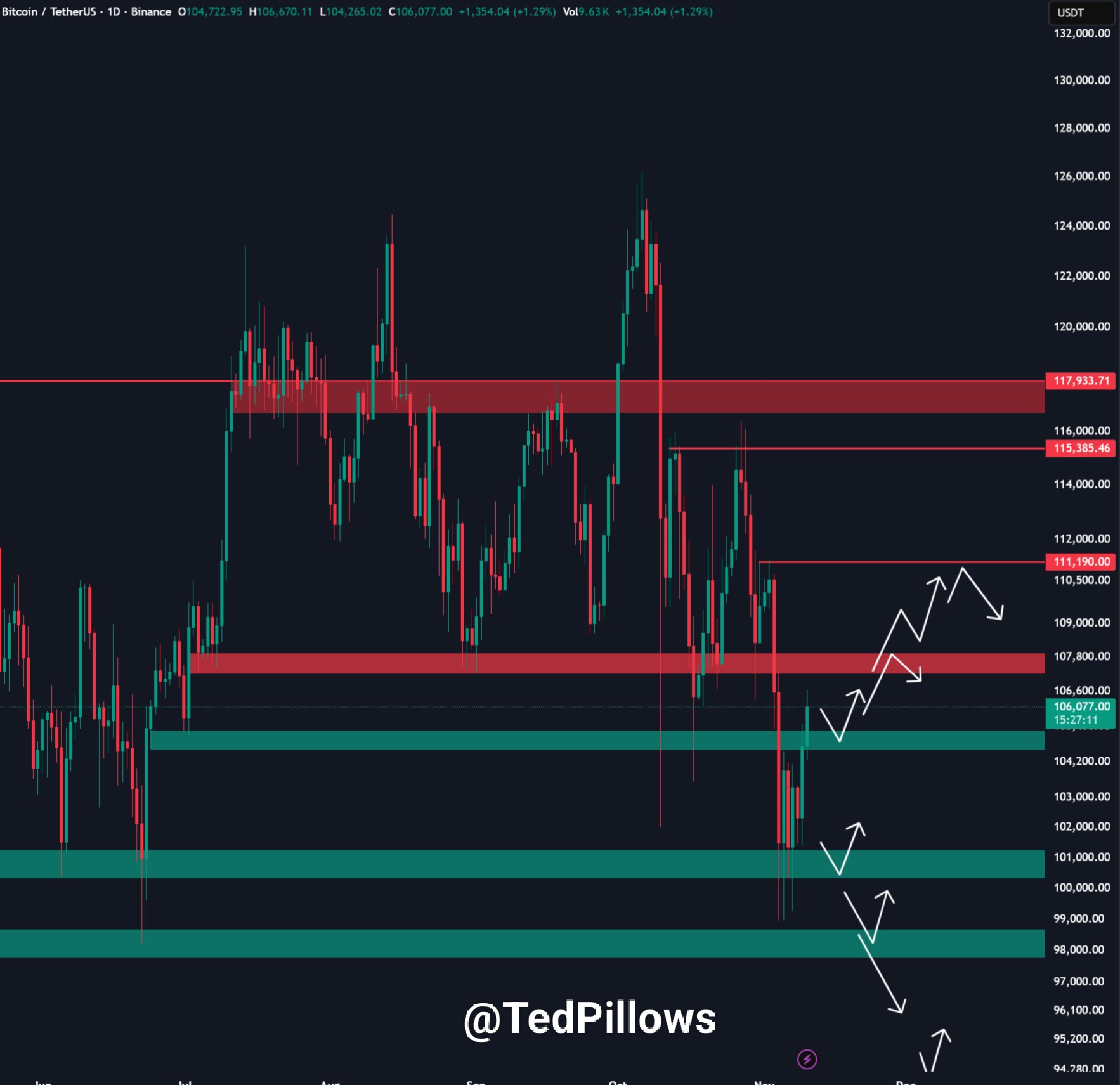
Another analyst, Ted Pillows, also identified the same price range. He noted that Bitcoin has regained support around $104,000, which currently serves as a short-term floor. 

Bitcoin 1D Chart Ted Pillows
Bitcoin 1D Chart | Ted Pillows

Pillows said that if Bitcoin reclaims the $108,000 to $109,000 zone, it could make a move toward its May 2025 highs. However, if it faces rejection, he expects the price to fall back to $104,000 to fill the CME gap left open in previous trading.

Meanwhile, institutions remain confident despite the uncertainty. Notably, Michael Saylor’s Strategy announced another purchase of 487 BTC worth $49.9 million today, bringing its total holdings to 641,692 BTC.

Economist Says XRP Could Follow Zcash’s Meteoric Rally, Predicts Conservative Target

0

Macro analyst and trader Mikybull believes XRP could be one of the next major altcoins to mirror Zcash’s explosive performance. 

His remarks come as ZEC continues dominating the market with a 1,775% surge in just two months, defying Bitcoin’s correction and leading a new narrative around privacy-focused assets.

XRP Set to Replicate ZEC’s Breakout

According to Mikybull, XRP is among the crypto assets likely to follow Zcash’s parabolic run. The economist outlined a conservative outlook that places a short-term target for XRP between $8 and $10. Notably, this range implies a 3x to 4x increase from current levels.

Mikybull’s view aligns with broader sentiment among market analysts who believe XRP has been building quiet strength amid recent volatility. With XRP trading around $2.54, the coin is up 12.14% today, marking the biggest gain among major crypto assets.

Interestingly, this one-day performance has erased XRP’s monthly red candle, now showing a 30-day gain of 3.3%. From here, moving toward $8 would require a 215% increase, while reaching $10 would demand a 294% jump.

Zcash’s Rally Sets a Blueprint

The renewed interest in XRP comes after Zcash delivered one of the most remarkable rallies of the cycle. Beginning at $40 in September, ZEC surged to $750 in two months—an 18x increase that lifted its market cap from $600 million to over $10 billion.

ZEC briefly faced a correction on Friday, dipping below $500, but it is now back at $633, looking to continue its bull run.

Notably, ZEC’s rise occurred while Bitcoin declined from $126,000 to below $100,000. This marked a major decoupling and independent run from Bitcoin’s direction.

Mikybull believes this same decoupling effect could apply to XRP, especially as it maintains a long-term bullish structure on higher timeframes and continues gaining institutional recognition.

Mikybull XRP chart
Mikybull XRP chart

XRP has demonstrated it can move sharply in compressed time frames. Specifically, from November 2024 to January 2025, XRP surged from $0.50 to $3.34, a 568% rally. Analysts believe similar momentum could return if capital rotates heavily into payment tokens and large-cap utility assets.

While $8–$10 remains “conservative” in Mikybull’s view, it also leaves room for more aggressive long-term scenarios should XRP replicate even a fraction of Zcash’s 1,775% breakout profile.

“No, XRP Is Over”

However, some market analysts do not see XRP replicating Zcash’s momentum. For instance, Bitcoin analyst “Master” argues that XRP’s bull run is over, suggesting other coins are more likely to stage a ZEC-style comeback than XRP.

He believes XRP has reached its peak momentum, especially as major news headlines over the past weeks have failed to impact the price.

Notably, XRP has seen a price growth from $0.49 to $3.66 over the past year. While some believe the best days are gone, others insist even better days are ahead.

Here’s Why Stablecoins Cannot Make XRP Obsolete in Cross-Border Payments

0

XRP community members have repeatedly praised XRP’s ability to facilitate cross-border payments, especially through Ripple Payments. 

Notably, this has been one of the most-highlighted utilities for XRP. However, some critics believe the rise of stablecoins, which promise similar capabilities without price swings, could make XRP unnecessary. 

Is Ripple Pivoting Away from XRP?

One of the individuals pushing this narrative is Vibhu Norby, Head of Product Marketing at the Solana Foundation, who recently shared his opinions on the Paul Barron Network.

Norby acknowledged Ripple’s success, saying the company is run by sharp leaders who have managed their finances wisely and built real businesses over time. Nonetheless, he argued that Ripple is now changing its focus from XRP and toward stablecoins, especially after launching its RLUSD token. 

He believes this move indicates a major strategy change, with Ripple trying to keep pace in the growing stablecoin market. Meanwhile, Norby added that Ripple is still behind in this space, and that around 90% of RLUSD supply exists outside the XRP Ledger (XRPL).

In response, host Paul Barron said RLUSD already boasts $1 billion in value. He explained that Ripple seems to be building a full financial infrastructure where the XRP Ledger has an important role. 

Barron said if Ripple executes this plan well, it could finally deliver what the company has been working toward. He also noted that Ripple must move past its legal troubles and deal with an American political environment that has often been hostile toward crypto. 

According to Barron, this new phase represents a fresh opportunity for all tokens with real-world use cases, including XRP and Solana. Notably, Ripple CEO Brad Garlinghouse has also reaffirmed that the firm is not pivoting away from XRP.

Stablecoins Do Not Make XRP Obsolete

Reacting to the conversation, Brad Kimes of Digital Perspectives argued that every G20 nation, along with many others, will eventually issue their own stablecoins or central bank digital currencies (CBDCs) on the XRP Ledger. 

He believes that when this happens, the world will still need a bridge asset to connect different currencies because not all currency pairs are equally liquid. According to him, the initial liquidity would attract more liquidity for XRP, leading to greater adoption.

Meanwhile, Molly Elmore of Valhil Capital also argued that claims suggesting that sovereign stablecoins would make XRP obsolete ignore an important economic reality. 

She questioned how stablecoins could fix the long-standing Triffin Dilemma. Elmore explained that it’s not in the interest of the United States to keep serving as the world’s main reserve currency issuer, and China wouldn’t want that role either because it would hurt its export industry.

The Triffin Dilemma

The Triffin Dilemma is the conflict when one crypto tries to be both a scarce global reserve asset (like gold) and an everyday payment currency (like the dollar). Notably, to stay scarce and valuable, it needs a low supply and high price, making people hoard it instead of spending it. 

However, for daily use, it needs stability and cheap transactions, which pushes fees up or forces more issuance, which hurts scarcity.

Bitcoin picked “digital gold,” so on-chain coffee payments became impossible. Meanwhile, Ethereum tried both and saw gas fee chaos. Also, stablecoins have fixed volatility but added centralization. Essentially, no single chain can perfectly do both without painful trade-offs.

Another investor who responded to Elmore agreed, saying that stablecoins don’t solve this fundamental problem. Instead, they only digitize it. 

Japan to Tighten Oversight of Third-Party Crypto System Providers

0

Japan’s Financial Services Agency (FSA) is preparing new regulations that would introduce a prior notification system for companies that provide management systems to crypto exchanges.

The proposal, discussed by a working group under the Financial System Council on November 7, aims to strengthen oversight of third-party service providers that handle exchange operations, according to a report from Nikkei.

Closing Gaps in Existing Crypto Regulations

Currently, Japanese crypto exchanges are legally required to follow strict deposit management practices, including storing user funds in cold wallets. However, no such framework exists for external companies offering custody or trading system support.

The FSA’s new approach aims to close that regulatory gap by ensuring that exchanges only work with registered service providers. Officials believe this move will minimize the risks of theft and system failures stemming from unregulated partnerships.

DMM Bitcoin Hack Spurs Regulatory Push

Notably, the reform discussions gained urgency after the DMM Bitcoin hack in 2024, where hackers stole 48.2 billion yen ($312 million) worth of BTC.

Subsequently, investigators discovered that the breach had originated at the Tokyo-based software company Ginco, which managed DMM’s trading system. This incident underscored vulnerabilities in outsourcing arrangements and highlighted the need for clearer accountability.

Broad Support Within the Financial System Council

Notably, most members of the Financial System Council’s working group supported the proposed registration system. They emphasized the importance of transparency and consistent regulatory standards for all system providers involved in crypto exchange operations.

Moreover, the FSA plans to prepare a comprehensive report based on the discussions and aims to propose revisions to the Financial Instruments and Exchange Act at the 2026 ordinary Diet session, the report added.

Japan Expands Focus to Stablecoins

Beyond custody reform, the FSA is advancing efforts to promote domestic stablecoin initiatives.

For instance, in October 2025, the agency approved JPYC, Japan’s first yen-pegged stablecoin, which launched shortly afterward. Furthermore, it recently announced support for a pilot stablecoin project involving MUFG, SMBC, and Mizuho Bank.

Ultimately, these developments signal the regulator’s broader strategy to achieve a balance between innovation and robust oversight in Japan’s rapidly evolving digital asset ecosystem.

Top Analyst Explains Why XRP Holds Up Better Than Others

0

A prominent crypto analyst has shared insights into why XRP’s price has remained relatively stable amid the recent market downturn affecting most altcoins.

The broader crypto market has witnessed heightened volatility over the past few weeks, with prices of major crypto assets retracing sharply at the start of November. 

Despite this widespread decline, XRP has managed to hold firm, showing little movement compared to its peers. Data from CoinMarketCap showed that XRP’s price hovered around the $2.50 region within the first few days of November. 

Expert Questions Rationale Behind XRP Stability 

Community figure 0xKOL drew attention to this unusual stability, highlighting that XRP’s resilience stood out during what he described as an “alt bear market,” where most alternative tokens were struggling to maintain momentum.

Given this performance, 0xKOL raised the question of what factors within XRP’s market structure and holder base have contributed to its enduring strength, prompting discussions about the token’s long-term support.

Why XRP Has Been Stable 

Popular crypto pundit DonAlt attributed XRP’s resilience to the nature of its holder base. Unlike many newer crypto projects that attract short-term traders constantly hopping between tokens for quick profits, DonAlt suggested that the XRP community is primarily made up of older, long-term investors. 

According to him, these investors genuinely like XRP and want to hold the token for the long term. In DonAlt’s view, these holders have been holding XRP for years and are not reactive to market swings like most younger investors are. 

Instead, they have a more profound conviction in XRP’s long-term potential, often tied to its real-world use cases in payments and banking, as well as loyalty built over the years.

The analyst noted that while younger traders, referred to as “Zoomer children”, tend to exhaust their funds chasing the trending tokens, XRP’s older, long-term investors remain unfazed, choosing to “just chill” even during market downturns. 

Their reluctance to panic sell during downturns helps dampen volatility and gives XRP a firmer price floor compared to the highly reactive altcoin market. 

In the meantime, XRP has retraced from the $2.50 mark and is currently trading at around $2.28. It ranks as the fourth-largest crypto by market cap, with a valuation of $137.25 billion. Despite its relative stability, XRP has recorded an 18.29% decline over the past month and is down 9.89% in the past week.