Home Blog Page 45

Cardano Founder Endorses AlphaGrowth and Draper Dragon as Functional Replacement for EMURGO

0

Cardano founder Charles Hoskinson has endorsed AlphaGrowth and Draper as capable replacements for the commercial and ecosystem-development role that EMURGO was originally expected to fulfill.

Hoskinson made this known during his latest AMA session after a community member asked whether AlphaGrowth could replace EMURGO and its associated investment funds.

In response, Hoskinson stated that “AlphaGrowth plus Draper Dragon functionally replaces what EMURGO was supposed to be.” He also praised both organizations, saying they are capable of delivering strong results.

The comments reflect Hoskinson’s increasing confidence in AlphaGrowth and Draper as Cardano works to expand commercial development, improve liquidity, attract institutional participation, and accelerate ecosystem growth.

EMURGO’s Changing Role in the Cardano Ecosystem

EMURGO, one of Cardano’s three founding entities alongside Input Output Global (IOG) and the Cardano Foundation, has traditionally focused on commercial adoption, venture investments, and supporting real-world applications built on the network.

However, the firm has recently reduced its involvement in the Cardano ecosystem following a $2.4 million exploit involving its SecondFi wallet.

Following the incident, EMURGO stepped back from its Pentad role and announced changes to its governance participation. The company also resigned from the Intersect board and later outlined plans to deregister its DRep role.

Functions of AlphaGrowth and Draper Within Cardano Ecosystem

Meanwhile, AlphaGrowth has emerged as a key contributor to Cardano’s decentralized finance (DeFi) expansion through its PRIME program.

The initiative is supported by a 120 million ADA treasury allocation aimed at strengthening liquidity across Cardano’s DeFi ecosystem. Through strategic capital deployment, PRIME seeks to increase on-chain liquidity, attract users and investors, and help grow Cardano’s total value locked (TVL).

Draper, on the other hand, complements AlphaGrowth’s role through its strategic involvement in Cardano’s investment and institutional growth efforts.

The partnership involving Draper Dragon and Draper University, founded by venture capitalist Tim Draper, centers around the Orion Fund. Launched in April 2026 with an $80 million initiative, the fund focuses on institutional adoption, real-world assets (RWAs), and interoperability between Bitcoin and Cardano.

While AlphaGrowth concentrates on DeFi liquidity and ecosystem expansion, Draper contributes venture capital expertise, institutional relationships, and business-development support.

In Hoskinson’s view, the combined efforts of AlphaGrowth and Draper can provide the ecosystem development, investment support, and commercial growth that EMURGO was originally expected to deliver for Cardano. 

Cardano Welcomes Institutional-Grade Tokenized Silver

0

Cardano has taken another significant step into the real-world asset (RWA) sector with the launch of an institutional-grade tokenized silver asset on its mainnet.

The launch connects Cardano’s blockchain infrastructure with physical silver, allowing ADA holders to gain on-chain exposure to the precious metal through a token backed by tangible assets.

L4VA Protocol provides the infrastructure for tokenizing and distributing the asset on Cardano. Following the announcement, L4VA explained that any ADA holder can connect a Cardano wallet to the protocol and acquire TSLVR, making the silver product accessible without leaving the Cardano network.

TSLVR Is Backed by Certified Physical Silver

At the heart of the project is the Toto Silver Vault, which stores the physical silver represented by Toto Finance Silver 1oz NFTs.

Each NFT corresponds to one ounce of physical silver. The project states that the underlying silver bars are certified, insured, and securely stored, while their purity and provenance support the value of the tokenized asset.

This model creates a direct bridge between physical silver and blockchain-based ownership. Instead of buying, storing, or transporting silver bars themselves, investors can hold blockchain assets that represent ownership of the underlying commodity.

Furthermore, the vault can accumulate additional silver as contributors add more bars and fractionalize them. This structure aims to increase the vault’s total value over time while supporting the growth of TSLVR’s fully diluted valuation.

Silver Vault Gains Early Traction

The Cardano community has shown strong early interest in the new product.

Shortly after the vault went live on August 13, 2026, it reached 63% of its initial capacity. At press time, participation had increased to 76%, indicating continued demand during the opening acquisition period.

Notably, the initial acquisition window is scheduled to close in four days. Meanwhile, users have acquired tokenized silver worth the equivalent of 8,970 ADA. It remains uncertain whether L4VA will introduce additional supply if the initial offering sells out. 

Tokenized Silver Goes Live on Cardano Mainnet

Beyond acquiring tokenized silver, participants in the L4VA ecosystem can earn L4VA incentives for engaging with the protocol. These incentives are designed to encourage participation while helping build activity around the tokenization platform that supports TSLVR.

Cardano Strengthens Its RWA Infrastructure

The TSLVR launch represents more than the introduction of another token on Cardano. Instead, it highlights how the network can serve as an infrastructure for bringing commodities and other real-world assets onto the blockchain.

By placing physical silver directly within Cardano’s on-chain ecosystem, the project combines certified silver from Toto Finance with L4VA’s tokenization infrastructure. As the RWA sector continues to grow, the launch also demonstrates Cardano’s expanding role in supporting asset tokenization beyond traditional cryptocurrencies and decentralized finance applications. 

Evernorth Revises XRP Deal to Boost XRP Per Share Ahead of Listing

0

Evernorth Holdings, the largest public XRP treasury company, is changing the terms of its planned stock market listing.

The company said on Thursday that investors’ shares will now be based on XRP’s value when the deal closes, instead of the $2.36 XRP price originally used when the deal was agreed. This change seeks to better align the company’s share structure with the actual value of its XRP holdings at closing.

Fewer Shares Could Mean More XRP Per Share

Under the amended terms, the number of shares issued at closing will decline if XRP remains below the $2.36 level used in the original agreement. XRP is currently trading at around $1.00, down 45% since January 2026.

That would spread Evernorth’s XRP treasury across fewer shares, meaning each share would represent a larger portion of the company’s underlying XRP holdings.

The adjustment is to keep Evernorth’s capitalization more closely aligned with the market value of its XRP treasury as it prepares to enter the public market. The mechanism can operate in either direction, depending on XRP’s closing price.

Investors Back Revised Terms

Evernorth said investors representing more than 95% of committed capital have agreed to the revised structure. Notably, all of the company’s advance funders have signed on to the changes.

The Armada II sponsor has also agreed to adjust its founder shares on the same proportional basis as the advance funding investors, creating similar treatment across the transaction’s stakeholders.

Evernorth CEO Asheesh Birla said that linking the share count to XRP’s closing price would preserve investor alignment while supporting the company’s strategy to expand institutional access to the XRP ecosystem.

XRP Treasury Strategy Remains Unchanged

Despite the restructuring, Evernorth said its XRP holdings and strategy remain unchanged.

The company plans to focus on increasing XRP per share through capital allocation, participation in the XRP ecosystem, and treasury operations. Its investors include Arrington Capital, SBI Group, Ripple, Pantera Capital, Kraken and GSR, among others.

The revised terms were filed with the U.S. Securities and Exchange Commission through an amended Form S-4 registration statement.

Evernorth Nasdaq Listing Expected Later This Year

Evernorth’s proposed business combination with Armada Acquisition Corp. II is expected to close in late Q3 or early Q4 2026, subject to SEC review and customary closing conditions.

The deal would allow public investors to invest in Evernorth and gain exposure to its XRP holdings. The company’s share structure is designed to better reflect the value of its XRP treasury when it goes public.

XRP Withdrawals Surge to Their Largest Share of Exchange Transactions in 7 Years

0

XRP withdrawals from centralized exchanges have surged as the token continues to struggle in a prolonged downtrend.

Notably, XRP has lost more than 72% from its $3.6 all-time high, but exchange data shows that more XRP exchange transactions now involve withdrawals. 

XRP Exchange Withdrawals Reach a Seven-Year High

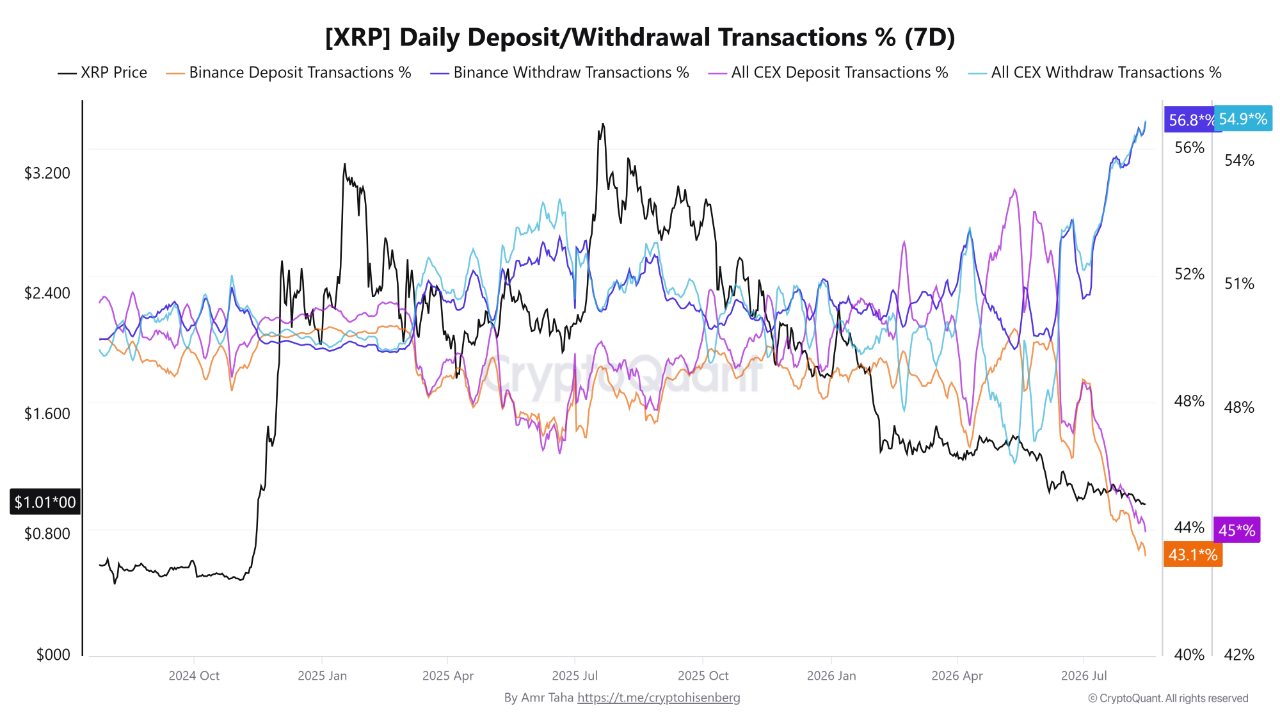
Market watcher Amr Taha called attention to this trend in a recent analysis, noting that withdrawals have reached their highest share of XRP exchange transactions since 2019.

Importantly, the increase appears across both Binance and the wider centralized exchange market. On Aug. 14, withdrawals made up 56.85% of XRP exchange transactions on Binance, while withdrawals across all CEXs reached 54.9%. 

At the same time, deposit transactions fell to their lowest shares since 2019. For context, Binance deposits accounted for 43.12%, while deposits across all CEXs stood at 45.0%.

Binance Records a Wider Gap

Notably, the trend appears to be more dominant on Binance, where the share of withdrawal transactions now stands 13.73 percentage points above the share of deposits. 

Across all centralized exchanges, the gap reached 9.9 percentage points. This shows that XRP exchange activity has moved more toward withdrawals in recent days.

XRP Deposit and Withdrawal Transactions Share
XRP Deposit and Withdrawal Transactions Share | Source: CryptoQuant

According to Taha, the figures use a seven-day measure, so the latest readings do not simply reflect activity from one day. Instead, they show a more sustained change in exchange transaction activity. 

The fact that Binance and the broader CEX market are showing similar trends also suggests that the trend is not limited to one exchange.

However, the data does not confirm that XRP is seeing net outflows from exchanges or that investors are accumulating the token. 

The metric measures the share of transaction counts rather than the amount of XRP transferred. As a result, the higher withdrawal share only shows that withdrawal transactions currently make up a larger part of exchange activity. It does not show whether more XRP is leaving exchanges than entering them.

XRP Price Remains Weak

Meanwhile, XRP currently trades at $1.0036, with a 24-hour trading volume of $932.3 million and a market cap of $63.19 billion. XRP recently dropped below $1 for the first time this year, but buyers stepped in and defended the level.

The technical picture remains bearish. XRP trades below its 50-day SMA near $1.0775 and its 200-day SMA near $1.2973, forming a death cross setup. The weekly RSI also remains weak at 31.19, confirming continued selling pressure but not yet firmly oversold.

For buyers to regain control in the short term, XRP needs to close above $1.22 for three straight days. This move could improve its momentum. On the other hand, a break below $1 could increase the downside risk and open the way for institutional outflows.

XRP ETF Demand Has Also Slowed

Also, institutional demand for XRP has weakened sharply as well. Spot XRP ETFs attracted only $27.29 million throughout July, far below the $666 million they brought in during their first month of trading in November 2025. Out of July’s 22 trading sessions, 11 recorded zero flows, showing how limited demand became during the month.

August has not brought much improvement so far. Notably, XRP ETFs recorded zero flows for four straight days before receiving a small $2.2 million inflow yesterday. Together with XRP’s weak price action, the low ETF flows show that institutional demand has cooled considerably.

Shiba Inu: Shibarium Transactions Drop From 1.56 Billion to 475 Million, But Here’s What Happened

0

The Shiba Inu community was caught off guard after Shibariumscan displayed a dramatic decline in Shibarium’s cumulative network statistics.

As of August 10, 2026, Shibariumscan showed that Shibarium, Shiba Inu’s Layer-2 blockchain, had processed 1,561,410,803 (1.56 billion) transactions since its launch in August 2023. The network had recorded about 269.93 million addresses and 18.47 million blocks at the time of that reporting.

However, those figures changed dramatically this week. At press time, Shibariumscan showed just 475,388,775 transactions, representing a 69.55% decline from the previously reported figure.

Meanwhile, the explorer also recorded sharp declines in other cumulative metrics. Total addresses fell to 71.3 million, while total blocks dropped to around 7.91 million. 

Shiba Inu Activity Crashes on Shibariumscan
Shiba Inu Activity Crashes on Shibariumscan 

Notably, the sudden decline sparked concern among Shiba Inu community members. Many questioned whether Shibarium had experienced a major technical problem or whether the network had somehow lost a significant portion of its historical transaction data.

Main Cause of the Decline

However, the dramatic drop appears to stem from Shibariumscan’s indexing process rather than an actual loss of blockchain activity.

Longtime Shiba Inu community member Mazrael provided insight into the situation through an X post. In an August 12 update, he revealed that Shibariumscan had returned online and resumed indexing the Shibarium blockchain.

According to Mazrael, the outage occurred after Shibariumscan moved behind Cloudflare, which triggered a DNS change. Specifically, the configuration shifted from direct Hetzner hosting to Cloudflare proxying.

Furthermore, Mazrael noted that the restored website initially appeared as a basic deployment without its original Shibarium branding and configuration. This suggested that the explorer was still undergoing restoration and synchronization.

Mazrael also linked a registrar-related change observed on August 11 at 19:15 to the same restoration operation. He explained that the Shibarium domain remained healthy and was not facing an expiration problem. The domain is set to expire on August 1, 2027, while all four transfer locks remain enabled.

Shibariumscan Is Still Rebuilding Its Data

Meanwhile, Shibariumscan has not finished indexing the Shibarium blockchain. The explorer is currently around 42% indexed, meaning a significant portion of the network’s historical data has yet to be processed and reflected in its displayed statistics.

Consequently, Shibariumscan currently reports 475 million transactions, compared with the 1.56 billion transactions it displayed before the outage. 

Shibariumscan Still Indexing

As Shibariumscan continues indexing the blockchain, its cumulative statistics should gradually increase. Once the indexing process reaches 100%, the transaction count is expected to return to approximately 1.56 billion. Similarly, the total address and block counts should move back toward their previous levels of roughly 269 million addresses and 18 million blocks. However, it remains uncertain when Shibariumscan will complete the indexing. 

Why XRP Could Still Crash 50% from Current Prices

0

As XRP retests the key $1 psychological level, market data suggests that the lack of reasonable demand around this area could lead to steeper declines.

XRP remains under pressure as the broader market downtrend continues. The crypto asset has already fallen 45.4% this year, with its price dropping to $1.0047 and testing the psychological $1 level.

Despite the decline so far, CryptoQuant analyst Pelinay believes XRP could still fall another 50% from current levels. Such a move could send the crypto asset back to levels last seen before the November 2024 rally.

XRP Whale Activity Has Changed

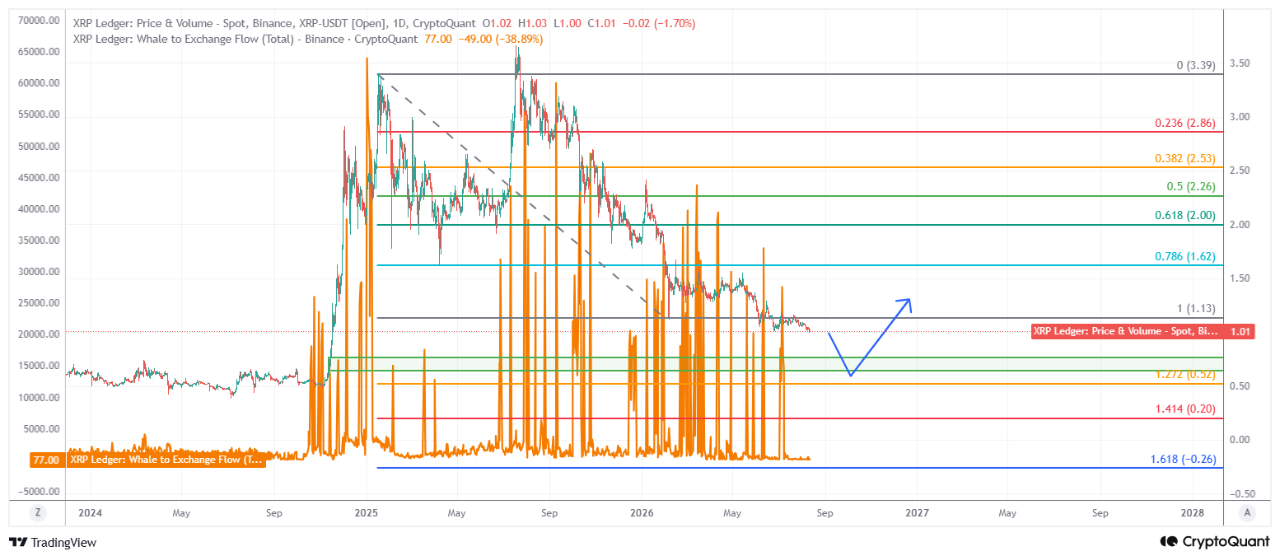
Notably, Pelinay’s analysis looks at XRP’s price action alongside whale activity. According to the analyst, XRP’s drop toward $1 is bigger than just a loss of an important support level. 

The behavior of large holders has also changed, although current whale activity does not appear to be the main reason behind the latest decline.

For context, the Whale-to-Exchange Flow indicator recorded major spikes during sudden price moves in 2025 and early 2026. During those periods, large amounts of XRP moved to Binance. 

XRP Price and Spot Volume | Source: CryptoQuant

When whale transfers to exchanges rise, they can create more selling pressure because they increase the amount of XRP that large holders could sell. CryptoQuant also considers sudden increases in whale inflows as possible signs of a change in the price trend.

However, the current data is sending a different signal. Notably, Whale-to-Exchange Flow now stands at just 77, below the large spikes seen during earlier periods. 

The latest reading also represents a decline of around 38.9%. This suggests that whales are not currently sending large amounts of XRP to Binance as the price moves toward $1. As a result, Pelinay says it would be wrong to directly attribute XRP’s current decline to whale selling.

Weak Demand Could Lead to $0.50

Falling whale activity does not necessarily mean buyers have returned. XRP has continued to make lower levels after reaching a peak of around $3.39 and has now moved toward the $1 region. 

At the same time, Whale-to-Exchange Flow has steadily declined. The combination of these two trends suggests that much of the heavy selling from large holders may have already taken place.

The bigger concern may now be the lack of strong new demand. Market data continues to show XRP struggling around $1, and the cryptocurrency would need strong spot buying to stage a meaningful recovery. 

In other words, a decline in whale selling can reduce some selling pressure, but it cannot by itself create the demand XRP needs to reverse the downtrend.

At XRP’s current price of $1.004, $1.13 acts as an intermediate resistance level. Meanwhile, the $0.52 area marks the Fibonacci 1.272 level. This makes the $1 support important in the near term. If XRP breaks and stays below $1, the decline could widen and bring the $0.52 region into play.

Importantly, Pelinay noted that she does not expect whale selling to increase for this scenario to play out. Weak demand alone could push XRP toward the $0.50–$0.52 zone. 

If buyers fail to provide enough spot demand around $1, XRP could continue making lower levels even as whale transfers to exchanges remain low. In this case, another 50% decline remains possible, with the $0.50-$0.52 area becoming the next major downside target.

Binance Executes Massive 498,891,481,684 Shiba Inu Transfer

0

Binance, the world’s largest cryptocurrency exchange, has transferred more than 490 billion Shiba Inu (SHIB) in a single transaction. 

According to blockchain analytics platform Arkham Intelligence, the exchange moved 498,891,481,684 (498.89 billion) Shiba Inu tokens, worth approximately $2.25 million at the time, on August 11. 

Binance Moves 498B SHIB tokens

Binance Transfers 498 Billion SHIB to Cold Wallet

The transaction involved Binance moving 498.89 billion SHIB from one of its hot wallets to a cold wallet. Exchanges commonly move assets between hot and cold storage as part of their security and custody practices.

Hot wallets remain connected to the internet, allowing exchanges to process deposits and withdrawals efficiently. In contrast, cold wallets stay offline and provide an additional layer of security. Therefore, the transfer appears to have been an internal wallet movement rather than a deposit to another exchange or an external sale.

Following the transfer, Binance’s sending hot wallet still held 530.98 billion SHIB, allowing the exchange to maintain a substantial amount of liquidity for active trading. Meanwhile, the recipient cold wallet held around 10.10 trillion SHIB. 

Notably, Binance also remains one of the largest Shiba Inu holders. According to Etherscan data, two of the exchange’s wallets collectively hold 44.5 trillion SHIB, representing 7.55% of Shiba Inu’s total supply. 

SHIB Exchange Withdrawals Exceed 100 Billion

The Binance transfer comes as Shiba Inu records significant exchange outflows.

Exchange flow data from CryptoQuant shows that approximately 267.21 million SHIB entered trading platforms, while users withdrew roughly 357.52 billion SHIB during the period. As a result, SHIB recorded a netflow of approximately -119.17 billion tokens. 

A negative exchange netflow means more SHIB left exchanges than entered them. Consequently, the movement could indicate that users are transferring tokens to private wallets instead of keeping them immediately available for trading.

Nonetheless, exchanges continue to hold a substantial amount of Shiba Inu. Approximately 87.27 trillion SHIB remains on trading platforms, leaving a significant supply available for potential selling. 

Shiba Inu Exchange Flows
Shiba Inu Exchange Flows 

Shiba Inu Remains Under Pressure

Despite the substantial withdrawals, SHIB has continued to trade under pressure. Shiba Inu currently trades at $0.0000045, representing a 0.36% increase over the past 24 hours. However, the token remains down 7.03% over the past week.

Meanwhile, the recent price weakness has affected leveraged traders. According to CoinGlass data, nearly $79,000 in leveraged SHIB positions were liquidated over the past day.

Long traders accounted for most of the liquidations, with approximately $74,930 in long positions wiped out. In comparison, short positions accounted for roughly $4,040 in liquidations. 

Shiba Inu liquidation

Before Buying Tokenized Stocks on XRP Ledger, Validator Says Check These Things

0

An XRP Ledger validator has urged users to exercise extreme caution when dealing with tokenized stocks and yield-generating products on the network.

XRPL validator Vet, aka Hussain Zangana, said users should not assume that tokenized assets are safe simply because they are issued on the XRP Ledger. He stressed that the ability to issue a token does not automatically make it legitimate or credible.

“Anyone can issue a token; that alone carries no credibility,” Vet said. Accordingly, he encouraged users to do proper research before investing their money.

Tokenized Stocks Require More Than an XRPL Issuance

Vet’s warning comes as tokenized real-world assets (RWAs) continue to expand on the XRP Ledger. Earlier this year, former Ripple CTO David Schwartz said enterprises will increasingly use XRPL to tokenize stocks, securities, money market funds, and loans. 

The comments highlighted the potential for the ledger to become infrastructure for on-chain financial ecosystems.

Evernorth CEO Asheesh Birla has similarly argued that the XRP Ledger’s role in tokenization should extend beyond simply holding assets. He has envisioned tokenized assets becoming productive through lending, collateralization, rebalancing and other financial applications.

However, Vet stressed that the availability of tokenized financial products also creates a need for greater scrutiny.

He advised users to investigate the entity behind a token, including its reputation, jurisdiction and custodians. Investors should also determine whether the underlying assets actually exist and whether the tokens genuinely represent the equities they claim to track.

Vet Questions XRP Yield Promises

Meanwhile, the validator extended the warning to yield products that promise returns on XRP. He cautioned users against sending XRP to projects solely because they advertise attractive yields, noting that anyone can promise potential returns.

Instead, users should establish where the yield originates and examine whether first-loss capital has been deployed. They should also understand the rules governing deposits and withdrawals before committing funds.

Vet encouraged users to approach such projects with questions and said that legitimate operators should be willing to provide evidence to support their claims.

XRPL’s Growth Means Users Should Be Careful

Indeed, the use of real-world assets (RWAs) on XRPL has grown quickly this year, while Ripple’s RLUSD stablecoin has also become more widely used. This has increased hopes that XRPL could become a major platform for tokenized stocks and other financial products.

However, as the sector grows, users may come across more projects and companies with different levels of transparency and reliability. Vet advised users not to invest large amounts of money in these products, especially money they cannot afford to lose. If users decide to invest after doing their research, he suggested starting with a small amount.

“If you get confused by any of it, just do nothing,” Vet said, stressing that protecting your money is more important than chasing high returns.

Here Are the Good, the Bad, and the Ugly Sides of the Current XRP Situation

0

A recent XRP market exposition highlights the good, the bad, and the ugly aspects of XRP’s current price situation.

XRP has remained under pressure as the broader crypto market struggles, down 45% this year. Amid the decline, market analyst CryptoInsightUK recently assessed XRP’s current position by looking at the good, the bad, and the ugly sides of its price situation.

The Bad: XRP Could Face More Downside

For the bad side, CryptoInsightUK assessed XRP’s open interest and leverage. Notably, lower-timeframe liquidity heat maps show about 7% downside from current levels. A drop to around $0.89 could remove roughly $157 million in long positions through liquidations.

Also, the daily timeframe presents a wider downside range of 15% to 22%-23%. The market analyst considers the 15% target more likely, which would put XRP near $0.85. 

Volume | Source: CryptoInsightUK

A full sweep of the 22%-23% liquidity could take the price toward $0.77. He also noted that markets take liquidity about 80% of the time, although some liquidity can remain untouched.

XRP’s price structure also adds to the bearish case, as the token continues to form lower highs and lower lows. The first major area sits around $0.93, or about 7% below the current level. 

This area previously acted as resistance, including around the period when Judge Torres ruled that XRP was not a security and before the 2022 bear-market capitulation.

He also identified $0.75 as another important support level, representing roughly a 25% decline, while $0.66 could mark a worst-case 35% drawdown. However, his preferred downside target remains between $0.88 and $0.925 because liquidity sweeps can push price slightly below the actual liquidation zone.

The Ugly: XRP Could Underperform Bitcoin and Ethereum

In the ugly aspect, CryptoInsightUK compared XRP with other major cryptocurrencies. Against Ethereum, XRP could record a possible 13% decline toward the first major support area. 

A deeper move could produce a 49% decline, potentially closing fair-value gaps and reaching the order block that appeared before XRP’s previous expansion.

XRP Against Ethereum

However, this does not necessarily mean XRP must fall that much in dollar terms. Ethereum could simply outperform while XRP moves sideways. 

Another possibility is that ETH rises while XRP declines. For example, if ETH gains 25% while XRP falls 25%, the difference between their performances would be roughly 50%.

XRP could also lose ground against Bitcoin. CryptoInsightUK sees room for a decline of about 26% toward an earlier order block. A deeper move toward 0.00001 would represent roughly a 37% loss against Bitcoin. The 0.00003 area has also remained an important resistance level since around 2019-2020.

XRP Against Bitcoin
XRP Against Bitcoin

Another concern is XRP’s dominance. CryptoInsightUK believes the chart may have completed a Wyckoff accumulation pattern and then formed a bull flag or descending-wedge consolidation. However, XRP dominance recently broke below the structure. A deeper 43% decline could push dominance toward 1.6%.

Meanwhile, XRP’s open interest has increased by roughly $400 million to $500 million from its recent lows. Funding rates can help indicate whether traders have added more longs or shorts, creating the potential for forced selling or buying if the price moves suddenly.

The Good: Massive Upside Potential

In the bullish case, CryptoInsightUK highlighted liquidity above XRP. According to him, XRP would need to rise at least 197% to reach the nearest major upside liquidity area. Another liquidity target could require a gain of as much as 330%.

The analyst also noted that a move to $1.48 could liquidate about $727 million in leveraged XRP short positions. Such a squeeze could create additional buying pressure if XRP begins moving higher.

XRP Liquidity
XRP Liquidity

Another bullish signal comes from XRP’s weekly RSI. The indicator entered oversold territory only for the second time in XRP’s history. The previous occurrence preceded a gain of about 1,085%. If XRP repeated that performance, the price could reach roughly $11.

Weekly RSI
Weekly RSI

Regarding the monthly RSI, the 44-47.5 range has historically marked important XRP price lows, yet the indicator has now fallen to around 40, its lowest reading on record. Previous bear-market lows occurred near $0.32, $0.16, and $0.004 before XRP eventually entered the overbought zone on the monthly RSI.

Historical gains from those cycles ranged from about 1,000% to as much as 86,000%. CryptoInsightUK expects the next major Elliott Wave move to include a third wave and says his current wave count would require at least a 600% increase. He uses a more conservative 1,000% gain as a possible reference point.

He also expects XRP to eventually retest its previous all-time highs against Bitcoin, Ethereum, and XRP dominance. If the broader setup plays out, Fibonacci analysis points toward a target near $14, with the possibility of a larger blow-off move above that level.

Catalysts Keeping Cardano Investors Bullish Despite Recent ADA Price Declin

0

Cardano investors remain optimistic despite ADA’s recent price correction, with ETF eligibility, DeFi growth, scalability upgrades, and Bitcoin integration fueling bullish sentiment.

Following its recent spike to $0.2107 last week, Cardano has experienced a significant correction. ADA has since hovered around the $0.18 level and currently trades at $0.1856, representing an 11.91% decline from its recent high.

Investors Remain Bullish Despite ADA Price Correction

Despite ADA’s bearish performance over the past few days, the Cardano community remains bullish. Several users on X have highlighted multiple developments that could provide fresh catalysts for ADA and strengthen the network’s long-term prospects.

Cardano Gains Spot ETF Eligibility

One of the biggest catalysts is Cardano’s eligibility for a potential spot ETF in the United States. Although Grayscale dealt ADA investors a setback by withdrawing its S-1 application for a Cardano ETF last week, the token subsequently met a key eligibility requirement under the SEC’s streamlined spot ETF review framework.

Cardano was expected to reach its six-month ETF eligibility milestone on August 9, 2026. For context, CME Group launched regulated ADA futures on February 9, 2026, giving Cardano access to a regulated futures market in the United States.

The availability of regulated ADA futures helped satisfy an important condition for the streamlined review of a potential spot ADA ETF. Consequently, August 9 marked an important milestone in Cardano’s race for a U.S. spot ETF.

Although Grayscale has withdrawn its application, the community believes ADA’s eligibility could encourage other asset managers to pursue their own spot ETF filings exclusively tied to Cardano.

Cardano Expands Its Interoperability

Another catalyst fueling ADA investors’ optimism is Cardano’s growing interoperability with other blockchain ecosystems.

Community members have particularly highlighted Cardano’s connection with Injective through a live on-chain IBC rail. Although the integration remains on testnet, it allows users to transfer ADA from Cardano to Injective and move INJ from Injective back to Cardano.

This development could broaden Cardano’s reach across the wider blockchain ecosystem while creating new opportunities for cross-chain activity.

DeFi Growth Could Boost Cardano

Meanwhile, Cardano’s DeFi ecosystem could gain significant momentum in the coming months. The community recently approved AlphaGrowth’s Cardano PRIME proposal, allocating 120 million ADA to the project to stimulate DeFi activity and help the network compete with major ecosystems such as Solana and Ethereum.

In addition, some community members have pointed to Cardano founder Charles Hoskinson’s bullish commentary about potentially growing the network’s total value locked (TVL) to $1 billion within a year through RealFi.

Although RealFi remains in its first testing phase, the project has already recorded notable activity. More than 3,000 wallets have become active since launch, while users have completed over 36,000 on-chain actions.

Leios and Hydra Offer Scalability Potential

Cardano’s upcoming scalability upgrades also remain a major source of optimism. In particular, community members continue to highlight Ouroboros Leios and Hydra as potential catalysts for ADA.

Both projects aim to dramatically increase transaction throughput without compromising the security and decentralization of Cardano’s base layer. Leios is expected to launch on mainnet this year, although Hydra’s launch timeline remains uncertain.

If these upgrades deliver the expected improvements, they could strengthen Cardano’s ability to handle significantly greater network activity and support further ecosystem growth.

Bitcoin DeFi Could Bring New Capital to Cardano

Another major catalyst is Cardano’s growing focus on Bitcoin DeFi. Investors believe this sector could eventually channel capital from the massive Bitcoin ecosystem into Cardano.

Earlier this week, Hoskinson announced major optimization breakthroughs for the BitVM-powered Bitcoin-Cardano bridge. The improvements reduced data requirements from 40 GiB to 0.0281 GB, execution time from 354 seconds to 0.149 seconds, and costs from $14,211 to just $37 with the mainnet proof.

These improvements could make the bridge significantly more efficient and potentially strengthen Cardano’s position as an infrastructure layer for Bitcoin-based DeFi applications.

Although ADA has underperformed in recent days, investors remain optimistic because ETF eligibility, expanding interoperability, DeFi growth, scalability upgrades, and Bitcoin DeFi could provide several potential catalysts for the token’s next phase of growth.