Home Blog Page 44

Top Cardano DRep Issues Crucial Midnight Airdrop Reminder to ADA Holders

0

A popular Cardano DRep has issued an important reminder to ADA holders, urging eligible participants to redeem their NIGHT tokens from the Midnight airdrop before the claim window closes.

In an X post today, Jaromir Tesar highlighted the significant gap between Cardano’s large staking community and the relatively small number of NIGHT holders currently recorded on the network. 

According to Cexplorer data cited by Tesar, Cardano has 1.3 million stakers, while only about 81,763 NIGHT holders currently appear on the network. This wide disparity suggests that many eligible participants may still have unredeemed NIGHT allocations. 

Midnight Total Holders

However, the number of holders recorded by Cexplorer does not necessarily represent the total number of users who have redeemed their tokens. In particular, some recipients may have transferred their NIGHT tokens to cryptocurrency exchanges after claiming them. 

Nonetheless, Tesar’s reminder underscores the importance of checking eligibility and completing the redemption process before the applicable deadline.

Midnight Airdrop Scope

The Midnight airdrop represents one of the largest community-focused token distributions connected to the Cardano ecosystem. The initiative involves 24 billion NIGHT tokens, with the entire allocation designated for the community.

Midnight distributed eligibility across eight supported blockchain ecosystems, including Cardano, Bitcoin, XRP Ledger, and Solana. As a result, qualifying holders of native assets on these networks gained an opportunity to participate in the distribution.

Cardano received the largest allocation, accounting for 50% of the total. Bitcoin holders received another 20%, while Ethereum, Solana, XRP, BNB, Avalanche, and BAT holders collectively received the remaining 30%.

NIGHT Redemption Window Remains Open for Eligible Cardano Users 

Eligible users still have time to redeem their NIGHT allocations. The program is currently in its third thaw period, which began on June 8, 2026, and will continue until September 5, 2026.

Afterward, the final redemption phase will begin on September 6 and run through December 4, 2026. The distribution process is part of the Glacier Drop. 

According to data from the official claim portal, users have claimed 3.5 billion NIGHT tokens across the eight participating blockchains through the Glacier Drop. That figure represents only about 14% of the total 24 billion NIGHT allocation. 

Total Claimed NIGHT
Total Claimed NIGHT

NIGHT Faces Continued Bearish Pressure

Meanwhile, NIGHT continues to face considerable selling pressure in the crypto market. The token has declined 38% over the past 30 days, while it has fallen 4.47% over the past week and another 1.2% over the past 24 hours.

At press time, NIGHT traded at $0.01719, giving the token a market valuation of about $285.43 million and placing it around the 98th position among the largest cryptocurrencies globally.
XRP Biggest Problem Isn’t Utility, but Value Capture, Altcoin Daily Founder Says

0

XRP long-standing investment narrative has centered on its real-world utility, particularly in payments, liquidity, and cross-border finance.

However, questions remain about how much of the value created by the XRP Ledger actually benefits XRP holders.

On X, Erin Lane raised this issue, referring to comments from Altcoin Daily founder Aaron Arnold on the Milk Road podcast with John Gillen.

Lane’s point is that XRP’s problem may not be a lack of real-world use. Instead, the bigger issue is that there is no clear link between the growth and revenue of the XRP Ledger and demand for the XRP token itself.

Value-Capture Question

Lane pointed to a model that has helped drive interest in Hyperliquid:

Usage → Revenue → Buybacks → Token Demand

Arnold said Hyperliquid uses much of its revenue to buy back HYPE, its native token. This creates a more direct link between the success of the network and the value of its token.

Arnold said this differs from XRP and Solana, adding that he would like to see more networks adopt a similar approach.

Indeed, the XRP Ledger is seeing growing activity, but the key question is whether that growth will also increase demand for and create value for XRP.

“My views on Ripple and XRP: I’m insanely bullish on the company, but the coin just hasn’t really done anything since 2017 or before,” Altcoin Daily founder said.

Arnold Compares XRP With Ripple

Arnold also distinguished Ripple from XRP. He said he has long been very positive on Ripple as a company but has questioned whether XRP can capture the value created by the broader ecosystem.

Arnold made a similar point about Chainlink and Ethereum. He suggests that networks can focus on adoption first and add mechanisms that allow the token to benefit later.

“Get the adoption first and then turn on what makes you money,” Arnold said.

This could become more important as the XRP Ledger expands beyond payments into stablecoins, tokenized assets, DeFi, and institutional use.

XRP as a Global Liquidity Tool?

Lane also raised the possibility that XRP could become more than just a crypto asset and play a role in the global financial system. This aligns with the idea of using XRP to move money between markets and financial institutions.

If the XRP Ledger gains widespread adoption, the bigger question is whether XRP itself will benefit from that growth.

Ultimately, these comments seek to emphasize that a growing network does not always mean a more valuable token. XRP could see more transactions, institutional use, and liquidity without creating strong demand for XRP itself.

Meanwhile, Lane also pointed to discussions surrounding XRP’s classification as a digital commodity in the U.S. However, regulatory recognition alone does not guarantee that XRP holders will benefit financially.

XRP Records First Weekly Close Below $1 Since November 2024 Rally: What Next?

0

XRP has recorded its first weekly close below the important $1 level since the November 2024 rally helped it reclaim the mark. 

The token fell below $1 several times last week, but buyers initially stepped in to protect the level. The first drop came on Tuesday, Aug. 11, 2026, when XRP slumped to $0.9910. Buyers responded almost immediately, helping XRP recover and end the day with a 1.03% gain.

The same thing happened on Thursday, Aug. 13, when XRP dropped to $0.9975. Buyers again defended the $1 area, allowing XRP to recover and close the day above $1 with a 0.38% gain. 

However, the defense did not last. On Aug. 14, sellers pushed XRP down to a new yearly low of $0.9874. XRP eventually closed that day below $1, marking its first daily close under the level since the November 2024 rally.

Meanwhile, XRP recovered above $1 on Saturday, but sellers returned on Sunday. The token dropped to $0.9901 before closing the day and the week at $0.9925, representing the first weekly close below $1 since November 2024, when the rally had helped it move back above the psychological level.

XRP Continues to Test $1

XRP has moved back above $1 at the start of the new week, but the price remains in a weak position. 

The token currently trades at $1.0002, only slightly above the key level. Its recent price action also shows repeated tests of $1, similar to the way it tested earlier support levels before breaking below them and turning those levels into resistance.

XRP Retesting $1
XRP Retesting $1

Notably, from mid to late June, XRP repeatedly tested the $1.1304 support. The token eventually lost that level on June 23, after which $1.1304 became resistance. 

XRP later showed a similar pattern from late July to early August, when it repeatedly tested the $1.06 support. Sellers eventually broke that level on Aug. 6, and $1.06 has since turned into resistance.

XRP is now showing the same behavior around $1. The repeated tests may keep the level under pressure, especially after the token failed to hold it on a weekly closing basis.

Fibonacci Levels Show the Next Supports

XRP has already fallen below the 0.888 Fibonacci retracement level at $1.0057. This leaves the Fibonacci 1 level as the next key support, around the Aug. 14 yearly low of $0.9874.

If XRP loses the $0.9874 area, the next support comes from the Fibonacci 1.272 level at $0.9443. Below that, traders may look toward the Fibonacci 1.414 level at $0.9226 as the next area where buyers could attempt to stop the decline.

These levels become important if XRP fails to regain $1 and hold above it. The recent breakdown also shows why reclaiming the psychological level could be important for preventing the current support from turning into another resistance zone.

Meanwhile, XRP’s daily RSI has fallen to 36.65, showing that bearish pressure remains strong. However, the indicator has not yet fallen below the 30 level, which means XRP has not reached the traditional oversold zone.

A short-term recovery remains possible, but the RSI also shows that XRP could fall further before reaching extreme oversold conditions.

Cardano Sets Two-Phase Roadmap for Dijkstra Upgrade Through 2027

0

Cardano is preparing for a major network evolution under its upcoming Dijkstra era, with the rollout structured into two phases. 

According to a document from Intersect, the first phase of the Cardano upgrade will focus on Ouroboros Leios, while the second will introduce Ouroboros Peras, creating a coordinated path toward higher throughput and faster transaction settlement.

Phase 1 Details

The first phase targets Q4 2026 for code completion and centers on Ouroboros Linear Leios (CIP-164). 

Leios aims to increase Cardano’s transaction-processing capacity through Supplementary Endorser Blocks. Instead of relying solely on the existing block-production process, the architecture introduces additional blocks that can help the network process transactions more efficiently and increase overall throughput.

Furthermore, the first phase will introduce several protocol improvements. These include nested transactions (CIP-118), guard scripts (CIP-112), enhanced account addresses (CIP-159), and a simpler method for withdrawing staking rewards under CIP-181.

However, Cardano must first put these changes through testing and governance before deploying them on the mainnet. As part of that process, the development team launched the public Ouroboros Leios testnet, Musashi Dojo, on June 23, 2026, giving developers and network participants an environment to evaluate the technology ahead of broader deployment.

Phase 2 to Introduce Ouroboros Peras

The second phase targets Q2 2027 and will introduce Ouroboros Peras (CIP-140).

Peras adds a stake-pool voting layer designed to accelerate Cardano’s settlement process. In practical terms, the upgrade aims to reduce the amount of time users and applications must wait before transactions can be considered firmly settled.

Therefore, while Leios primarily addresses throughput and transaction-processing capacity, Peras focuses on settlement speed and confirmation confidence. Combined, the two upgrades could strengthen Cardano’s ability to support applications that require both greater transaction capacity and faster settlement.

Cardano Outlines a Gradual Peras Deployment

The accompanying roadmap provides a clearer picture of how Cardano plans to move Peras from development to mainnet activation.

First, Cardano plans to release a Peras-compatible node for testnet operators. This step will allow stake pool operators (SPOs) to prepare their infrastructure before the network progresses through subsequent hard forks.

Next, Cardano will conduct a Preview hard fork. Based on the roadmap, the team will submit and enact a governance action on Preview, opening the first testing window for SPOs.

The Preview SPO testing window is expected to last two weeks. During this period, operators will conduct voting-overlay tests and evaluate settlement latency to determine whether the network is performing as expected.

Pre-Production Testing Follows Preview

After the Preview testing phase, Cardano will move Peras to the pre-production network. Another governance action will then be submitted and enacted, opening a second SPO testing window. 

This stage is expected to last approximately one to two weeks and will focus on final readiness checks. The additional testing period will give operators and developers another opportunity to identify and resolve potential issues before the upgrade reaches mainnet.

Mainnet Activation Will Require Governance Approval

Following pre-production testing, Cardano plans to submit a mainnet governance action for approval by DReps, stake pool operators, and the Constitutional Committee.

The upgrade will proceed to mainnet activation only after the governance process receives the required ratification. This approach reflects Cardano’s broader emphasis on community-driven governance for major protocol changes.

However, the roadmap currently lists the exact mainnet activation date as TBD, meaning Cardano has not yet established a definitive launch date. 

Peras Rollout Milestones

Shibarium Quietly Burns Hundreds of Millions of SHIB Despite Activity Concerns, Shiba Inu Contributor Says

0

While the Shiba Inu community remains focused on the sharp decline in reported Shibarium transaction activity, long-term SHIB proponent Mazrael emphasized that the network continues to reduce SHIB’s circulating supply.

Mazrael made the disclosure over the weekend after an X user asked whether Bone ShibaSwap (BONE) remains relevant to the Shiba Inu ecosystem.

In response, Mazrael explained that BONE remains directly connected to Shiba Inu’s burn mechanism through Shibarium. As the network’s gas token, BONE is collected through transaction fees. A portion of those fees is then used to facilitate SHIB burns through ShibTorch.

Shibarium Burns Hundreds of Millions of SHIB

Moreover, Mazrael emphasized that Shibarium’s fee-based SHIB-burning process remains active, even though it receives relatively little attention from the community.

According to him, the mechanism has helped burn hundreds of millions of SHIB over the past few weeks. In his view, Shibarium continues to support SHIB’s deflationary effort quietly in the background, even when network activity and burn-related discussions are subdued.

As he puts it, the process “doesn’t need to be noisy to still run.”

Part of Shibarium Function 

Shibarium’s role in reducing SHIB’s enormous supply was one of the major sources of excitement surrounding its launch in August 2023.

True to that design, Shibarium contributed to the burning of more than 50 billion SHIB during its early days. Subsequently, the Shiba Inu team launched ShibTorch about a year later to automate the burning process.

The burn portal also facilitated billions of SHIB burns following its launch. However, the community has had limited visibility into the mechanism’s ongoing activity.

Nonetheless, Mazrael’s comments suggest that the system continues to operate despite the lack of widespread attention.

Explorer Still Recovering After Indexing Issue

Meanwhile, Shibariumscan continues to index the network following a recent outage that occurred after the explorer moved behind Cloudflare, triggering a DNS change.

As a result, the explorer’s reported cumulative transaction count temporarily plunged from 1.56 billion to 475 million while Shibariumscan continued to index the blockchain.

At the latest update, indexing has reached 48%, while the displayed transaction count has recovered to 517.16 million. The network is also recording about 1,320 daily transactions.

Current Shiba Inu Burn Status

At the same time, Shiba Inu’s broader burn activity has declined significantly from its late-July peak.

Daily burns reached 1.3 billion SHIB on July 27. In contrast, only about 4.75 million SHIB were destroyed over the latest 24-hour period. Despite the relatively small number of tokens burned, the burn rate still increased by 2,212% over the previous day because the comparison period recorded an even lower burn figure.

Over the past seven days, 143.92 million SHIB have been burned, while the cumulative figure stands at about 3.45 billion tokens destroyed. 

VanEck Lists XRP Ledger in $45B Corporate Blockchain Opportunity in Payments, Settlement and Securitization

0

The XRP Ledger (XRPL) has received a notable mention from asset manager VanEck as part of its outlook for the corporate blockchain market.

Specifically, VanEck identified the network as a contender across three financial sectors representing a combined $45 billion in annual revenue opportunities by 2030.

In a report titled The Rise of Corporate Blockchains, VanEck researchers Matthew Sigel and Patrick Bush listed XRPL alongside institutional blockchain networks including JPMorgan’s Kinexys, Fnality and Tempo in cross-border payments. They also name it in collateral, settlement, and securitization.

$20B Cross-Border Payments Opportunity

VanEck estimates that cross-border payments could represent a $20 billion annual revenue opportunity by 2030.

The report identifies SWIFT and traditional banks as the legacy incumbents. Meanwhile, Ethereum, Tron, and Base are among the public-chain challengers. On the corporate and permissioned side, VanEck lists Kinexys, Fnality, Tempo, and XRP Ledger.

The opportunity is based on an estimated $7.5 trillion in daily foreign-exchange volume. VanEck assumes 5%-10% of the market moves onchain and a 5-10 basis-point take rate.

$10B Settlement Market

VanEck also places XRPL in the corporate blockchain landscape for collateral and settlement. It estimates this area could generate $10 billion in annual revenue by 2030.

Notably, XRPL appears alongside Canton and Kinexys. Meanwhile, VanEck listed Ethereum, Base, and BUIDL as public-chain challengers to traditional infrastructure such as DTCC, LCH, and Euroclear.

The research estimates that approximately $2.3 quadrillion is settled through the market, with around $5 trillion potentially moving onchain and a projected 10-30 basis-point take rate.

XRPL Also Appears in $15B Securitization Market

The third opportunity VanEck highlighted is securitization, where it listed XRPL alongside Provenance, represented by FIGR, and Canton.

VanEck estimates this market could generate $15 billion in annual revenue by 2030, based on a projected $3 trillion-$4 trillion securitization market. It sees 10%-20% moving on-chain and take rates ranging from 50 to 300 basis points.

Combined, the three categories in which XRPL appears represent a potential $45 billion in annual revenue opportunities.

Importantly, VanEck does not say that XRPL itself will capture these revenues. Rather, the figures represent the estimated size of the markets in which XRPL is identified as a corporate or permissioned-chain contender.

VanEck Lists XRP Ledger for $40 Opportunities

VanEck’s Bigger Blockchain View

Meanwhile, VanEck says more companies are creating their own blockchain systems instead of relying on public blockchains. This could help them save money on transaction and settlement fees.

The firm estimates that corporate blockchains could generate more than $60 billion in annual revenue by 2030. Key drivers include faster transactions, regulated stablecoins, and growing links between digital assets and the Federal Reserve’s banking system.

VanEck also warns that public blockchains could lose value if they don’t develop clear ways to make money as more financial activity moves to private, regulated blockchain networks.

Sentora Endorsed FXRP as Eligible Collateral Asset

0

Hugo Philion, co-founder and CEO of Flare, said Sentora, a major DeFi resource and risk management platform, approved FXRP as an eligible collateral asset.

Philion made the comments in a recent interview with Paul Barron on the Paul Barron Network, where they discussed XRP’s growing use in decentralized finance.

During the interview, Paul Barron noted that XRP ranks around fourth among cryptocurrencies by market capitalization, with a market value of about $70 billion. 

However, he pointed out that XRP does not yet have the same role in on-chain lending as Ethereum. According to him, wrapped Bitcoin and stablecoins have already shown how crypto assets can be used as collateral in DeFi.

Barron said this could allow large amounts of idle capital to become more useful. He then asked Philion whether this new use case could help expand XRP’s market base.

Flare Expands XRP Lending

Philion said he believes the development should help expand XRP’s market base. He also said Flare has played a leading role in making XRP a collateral asset and has so far seen strong results in this area. 

According to Philion, this progress benefits the XRP community, Ripple, and investors who see XRP as an asset worth holding.

The Flare CEO then highlighted the difference between Flare’s current lending setup and the upcoming XLS-66 protocol. 

He explained that Flare’s integration with Morpho on mainnet and Sentora allows users to borrow RLUSD, with other stablecoins potentially added later, using XRP as collateral. 

With this, a user could provide $1.50 worth of XRP and borrow $1. He said this gives XRP holders a direct way to put their tokens into a lending market and borrow against them. 

However, XLS-66 works differently because it focuses on uncollateralized lending. This method would allow borrowers to arrange their credit rating or payment guarantee off-chain. 

As a result, Philion said XLS-66 does not provide the same function as Flare’s system, where users can use XRP to borrow dollars. He added that Flare plans to keep expanding this market and develop more products around XRP as collateral.

FXRP Addresses Bridge Risks

Barron then called attention to the risks involved in using other crypto assets in DeFi. According to him, there are extra risks that can come from wrapping agents and F-assets, as well as the bridge risks involved when assets move between networks. He asked Philion what Flare had done to reduce these risks.

Responding, Philion said scams remain one of the biggest risks users face, especially on Twitter (now X), where fake accounts often pretend to represent Flare and other projects. As for the bridge itself, he said Flare has tested it extensively and designed its structure with security in mind.

Philion then mentioned Sentora’s review as an important sign of confidence. He said Sentora spent several months carrying out due diligence on FXRP, while many of its partner exchanges also reviewed the asset. 

The reviews covered how the bridge operates and how FXRP moves onto Ethereum. After completing those checks, Sentora approved FXRP as an eligible collateral asset.

Philion noted that the decision was a major sign of confidence because Sentora ranks among the largest curators in the DeFi sector. 

Because losses could directly affect its business, the Flare co-founder said Sentora has a strong reason to examine the risks carefully before supporting an asset. As a result, he saw its approval of FXRP as an important vote of confidence.

FXRP Expands Across DeFi

FXRP launched on the Flare mainnet on September 24, 2025, as the first asset under the FAssets protocol. Flare initially capped minting at 5 million tokens during the first week, which filled almost immediately.

By February 2026, FXRP’s circulating supply had passed 100 million tokens, worth about $140.10 million at the time. Users had minted the tokens through 38,030 transactions, with more than 60% of the supply staked in Flare-native DeFi protocols.

Flare also launched the first XRP spot market on Hyperliquid in January 2026 through an FXRP/USDH pair. FXRP later expanded to the Yellow Network and Coinbase’s Base chain. At press time, Flare held nearly $150 million worth of XRP tokens, while $58 million remained staked on Firelight.

FXRP Current Stats
FXRP Current Stats

The End of This XRP Wave 2 Correction Could Happen “Any Hour Now”

0

XRP is nearing a turning point after a long decline, with analysts Casi and ChartNerd pointing to key support levels and a possible long-term rise.

Casi: XRP Wave 2 Could End Soon

Analyst Casi believes XRP’s current correction, known as Wave 2, could be ending soon. She said the long decline may be hiding a bullish setup on the long-term chart.

“The end of this Wave 2 correction could quite literally happen any hour now,” she wrote on X. 

In her post, Casi told XRP holders to “zoom out” and not let the recent drop make them forget why they were bullish in the first place. She believes that once Wave 2 ends, XRP could enter Wave 3, which could lead to a major rally and possibly new all-time highs.

Casi also said XRP could briefly rally from around $1 before falling again. However, she believes the $1 area has already been tested several times.

XRP chart by Casi
XRP chart by Casi

For those looking to buy, she highlighted $1.004 and $0.774 as important support levels, based on Fibonacci analysis. Another key level is around $0.867.

Her main message is that Casi believes the current correction may be close to ending, and XRP could be setting up for a major rally. For context, XRP has already dipped 73% from its $3.66 peak in 2025.

ChartNerd Sees a Final Flush

Another XRP analyst, ChartNerd, is also expecting further weakness before a larger reversal. He said XRP is currently moving through a historical “weakness window” that has appeared during previous midterm U.S. election years.

“August is playing out as expected,” ChartNerd wrote, adding that XRP is now “knees deep” into its weakness window.

The analyst compared the current market structure with the periods between June and September during the 2018 and 2022 cycles, both of which eventually produced major market bottoms.

ChartNerd believes the 2026 market could follow a similar pattern, warning that a final flush of weak hands remains highly likely.

The analysis suggests that XRP’s current weakness does not necessarily invalidate the longer-term bullish thesis. Instead, another decline could complete the corrective structure before the next major advance.

XRP’s Long-Term Targets Reach $27

Meanwhile, ChartNerd has also published a much more ambitious long-term projection for XRP. In a separate analysis, he argued that XRP reaching $8, $13 or even $27 by 2030 could be more realistic than some of the $15 targets that circulated when XRP traded above $1.50 earlier this year.

The accompanying chart uses historical Fibonacci extensions and a time-based fractal to project future XRP targets. It identifies extension zones around $4.85, $13.79 and $27.72, with the highest target corresponding to the 161.8% Fibonacci extension.

Image

ChartNerd stressed that the projections are not certainties, describing them as a “data backed cyclical projection” rather than absolute predictions.

For now, the immediate question remains whether XRP can complete its current Wave 2 correction. If Casi’s analysis plays out, the $1.00 area could be a favorable entry for long-term holders.

XRP Open Interest Surges Across Exchanges, Hits 3-Month Peak on Bybit

0

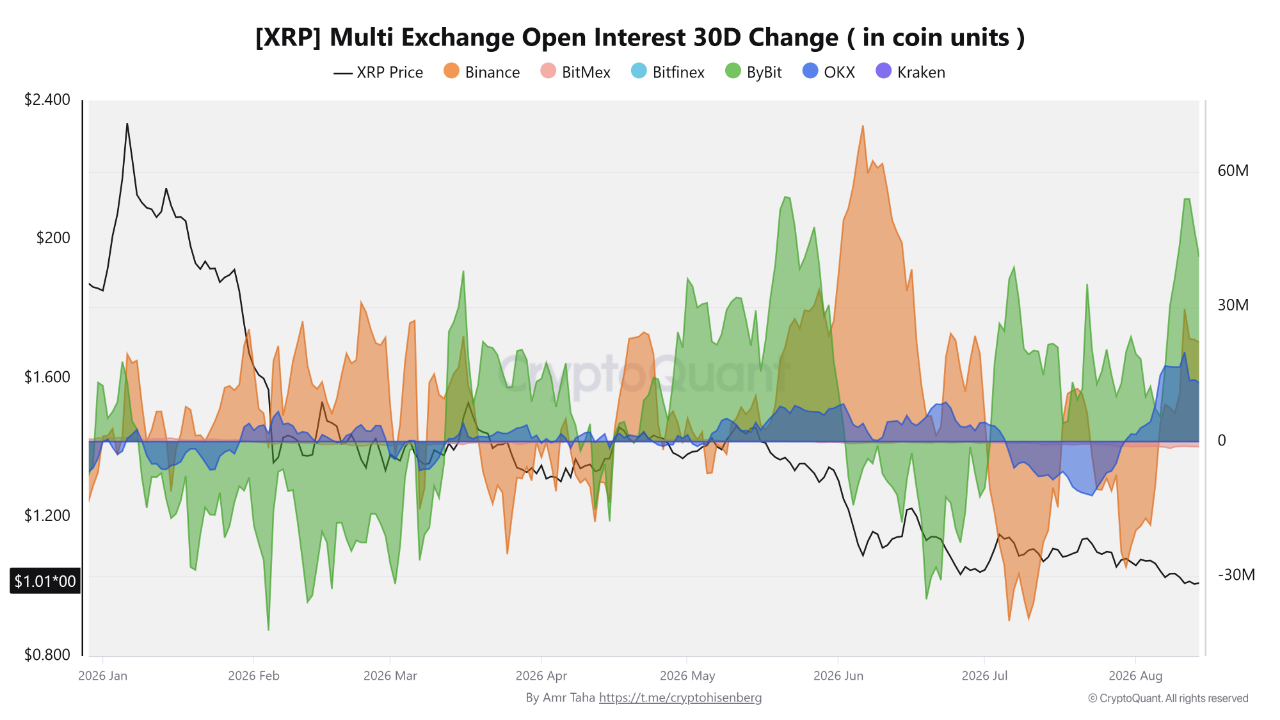
XRP Open Interest has surged across multiple exchanges despite the ongoing price struggles, reaching a 3-month peak on Bybit.

XRP remains under pressure, falling 5.7% in August and 45.6% this year. However, on-chain data shows that open interest in XRP derivatives has started to rise across major exchanges, with Bybit reaching a three-month peak.

XRP Open Interest Spikes on Bybit and Binance

On Aug. 12, Bybit’s 30-day open interest change reached +54 million XRP, almost matching the +54.5 million XRP recorded on May 21. 

XRP Open Interest Across Exchanges CryptoQuant
XRP Open Interest Across Exchanges | Source: CryptoQuant

The latest figure sits less than 1% below that previous peak, which puts Bybit near its strongest open-interest growth level in recent months. This rise is important to note because it comes while XRP continues to trade close to recent lows.

Binance also recorded a rise, with the 30-day XRP open interest increasing by 29.5 million XRP. Together, Bybit and Binance added about 83.5 million XRP to their 30-day open interest.

The distribution of this growth has changed from earlier months. On June 6, Binance recorded the larger increase, with its 30-day open interest rising by 70.4 million XRP. Bybit has now taken the lead in the latest data, showing stronger growth than Binance.

The figures also measure open interest in XRP rather than U.S. dollars. This means the increase reflects a larger amount of XRP tied to derivatives positions, not a higher dollar value caused by a rise in XRP’s price.

Derivatives Activity Grows Amid Rise in Short Bias

XRP currently trades at $1.002, which leaves it below its early-year levels. The fact that open interest is rising while the price remains weak shows a difference between XRP’s price performance and derivatives activity.

The latest data suggests that traders are rebuilding derivatives positions as XRP remains near recent lows. This could become important if the token makes a strong move in either direction. However, broader futures data shows that the overall increase in open interest remains limited.

According to Coinglass, XRP’s total futures open interest rose just 0.44% over the past 24 hours, reaching $2.71 billion at press time. Options activity, however, has moved at a much higher pace, with options volume jumping 137% to $1.18 million over the same period.

XRP Derivatives Data Coinglass
XRP Derivatives Data | SOurce: Coinglass

Futures trading volume has weakened despite the increase in options activity. XRP’s futures volume fell 20.56% to $1.27 billion over the past 24 hours, showing that traders have not increased activity evenly across the derivatives market.

The long/short ratio also confirms a slight bearish tilt. XRP’s long/short ratio fell to 0.9646, moving below the 1.0 level and showing that short positions currently have a small advantage over long positions.

XRPL Validator Predicts ‘More Violent’ Surge in XRP Ledger Activity as Ecosystem Builders Prepare for Next Bull Market

0

The XRP Ledger could see a much bigger jump in users and trading activity during the next bull market, according to XRPL validator Vet (Hussain Zangana).

Back in December 2024, Vet pointed to unusually high activity on the network. First Ledger was handling about $40 million in daily trading volume, while around 1,000 new users were joining every hour.

Now, Vet expects that kind of growth to happen again, but potentially on an even larger scale. In particular, he said the XRP Ledger could see “more violent” growth in users and trading volume, despite being criticized for making a similar prediction in 2023.

XRPL Builders Are Getting Ready for More Activity

Vet said bear markets are tough for XRP holders and developers, but work on the XRPL ecosystem is still going on. Developers are working to grow the XRPL decentralized exchange and improve areas like consumer apps, retail use, and liquidity.

Vet said the goal is not just to attract users during bull markets, but to keep them using the network afterward. He believes the key is to build a strong foundation that turns short-term spikes in activity into long-term growth.

He also said developers need to create products that XRP holders actually want to use if they want to keep those users.

Stablecoins, Tokenized Equities and RWAs

Several initiatives are already being pursued to strengthen the network’s underlying activity, Vet said. These include better ways to move money in and out of the network, stronger stablecoins, tokenized stocks, and real-world assets (RWAs).

Instead of focusing mainly on risky or speculative projects, Vet believes these areas can create more stable and long-term activity on the XRPL. He also praised RippleX for leading much of the work on these improvements.

Funding for developers is also growing. Vet highlighted programs from XRPL Commons, Glow, and other funding platforms that support developers building on the network.

XRPL Foundation Plans Creator and Education Program

Vet also identified marketing, exposure and education as areas where the XRPL ecosystem has an opportunity to improve.

He argued that the XRP community has one of the strongest groups of content creators in the cryptocurrency industry and said the ecosystem should make greater use of that existing community.

Vet revealed that he is personally working with the XRPL Foundation to establish a content creator and education program, which recently received legal approval to move forward.

Beyond adoption and marketing, he said development is also progressing across the network’s amendment process, builder-focused features, go-to-market strategies, network monitoring, security and forensics.

He specifically mentioned features such as AMM v2 and Batch as part of the broader development effort.

Vet Remains Bullish on XRP and XRPL

In sum, despite the challenges in the crypto market, Vet remains very positive about XRP and the XRP Ledger. He said the XRPL ecosystem is built through teamwork, with different groups working on infrastructure, liquidity, development, security, education, and adoption.

Vet said he believes XRPL has “something very special,” but also admitted that building a strong and lasting ecosystem will take a lot of work.

His comments show that XRPL developers are not just preparing for the next bull market. They also want to keep users and liquidity on the network after the market slows down. The main goal is to turn short-term spikes in activity into steady, long-term growth.