

Home Blog Page 455

SBF-Linked Account Posts Document Claiming FTX Was ‘Never Bankrupt’

0

A social media account once linked to Sam Bankman-Fried, the imprisoned founder of FTX, posted a new document on X late Thursday.

The 14-page file argues that the crypto exchange was never genuinely insolvent. It further asserts that the collapse resulted from mismanagement amid a liquidity crisis, rather than from fraud.

The post rekindles controversy surrounding FTX’s downfall. It also reiterates several claims Bankman-Fried made during his trial and in a jailhouse interview earlier this year.

Document Denies Fraud, Blames Legal Advisors for Collapse

According to the document, FTX faced only a short-term liquidity crisis in 2022 that could have been resolved within weeks. It claims the company’s external lawyers seized control and pushed FTX into bankruptcy unnecessarily.

The authors insist the exchange “was never bankrupt,” challenging the findings of the 2023 Manhattan jury that convicted Bankman-Fried of defrauding investors and misusing $10 billion in customer funds.

Claims of a Healthy Balance Sheet Before Bankruptcy

The document outlines a picture of financial stability ahead of FTX’s collapse. It alleges the company held $25 billion in assets and $16 billion in equity value against $13 billion in liabilities.

It further argues that if FTX and its trading affiliate Alameda Research had continued operating, their combined holdings could have been worth $136 billion today.

List of Alleged High-Value Investments

Among the assets mentioned are major stakes in the artificial intelligence firm Anthropic, valued at $14.3 billion. The portfolio also includes the trading app Robinhood, which is worth an estimated $7.6 billion. Moreover, the document cites investments in fintech company Ripple and Bitcoin miner Genesis Digital Assets. 

Last month, the FTX Recovery Trust sued Genesis Digital Assets to recover $1.15 billion that it claims was misappropriated under Bankman-Fried’s direction.

Disputed Valuation of FTT Token

The document also argues that FTX’s native FTT token would be worth nearly $22 billion if the companies had survived. However, prosecutors at Bankman-Fried’s trial contended that FTT was used to inflate Alameda Research’s balance sheet and conceal massive financial gaps.

Political Rumors and Legal Aftermath

Conservative activist Laura Loomer recently claimed there is a campaign to urge U.S. President Donald Trump to pardon Bankman-Fried.

The claim follows reports that Trump pardoned Binance founder Changpeng Zhao after the exchange was found to have violated anti-money laundering laws.

Bankman-Fried is currently serving a 25-year prison sentence handed down in 2024 by U.S. District Judge Lewis Kaplan. During sentencing, Kaplan stated that “a thief who bets stolen money successfully still does not deserve leniency.”

The reemergence of Bankman-Fried’s old account and its claims have reignited debate over FTX’s collapse and the accuracy of its founder’s defense.

While the new document seeks to recast the story, the court’s findings are straightforward. They confirm that the FTX collapse resulted from deception, not a temporary liquidity shortfall.

Cardano Founder Renews Offer to Elon Musk — Here’s What It Is

0

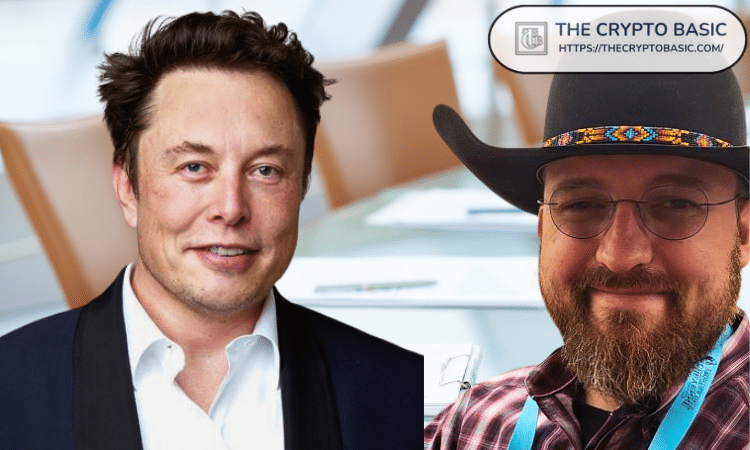
Charles Hoskinson, the founder of Cardano, has once again reaffirmed his commitment to improving Dogecoin and transforming it into the official currency of X. 

Hoskinson’s renewed comments follow a Dogecoin community member resurfacing his March 2025 proposal to Dogefather Elon Musk.

In that proposal, Hoskinson offered to help upgrade Dogecoin’s technical framework to make it more efficient and reliable, ultimately positioning it as the standard currency of Musk’s social media platform, X.

The Cardano founder noted that he already has a blueprint for the initiative—an old Bitcoin 2 roadmap he developed years ago—that could help guide Dogecoin’s transformation.

However, several months later, the two have yet to collaborate on the initiative, prompting a Dogecoin community member to remind others about Hoskinson’s proposal.

Hoskinson Still Committed to Building Dogecoin

Responding to the reminder, the Cardano founder emphasized that he “would love to build it,” potentially fixing up Dogecoin and making it the official currency of X. He also noted that it would be fun to work on the project.

Hoskinson’s renewed remarks underscore his continued enthusiasm for a potential collaboration with Elon Musk. Indeed, the Cardano founder has been preparing for a possible engagement with Musk. Last year, he remarked that people only get a once-in-a-lifetime opportunity to meet someone as influential as Musk, emphasizing that he is saving his for something big.

Beyond Dogecoin itself, Hoskinson had previously offered Musk a free blockchain solution to support the Department of Government Efficiency (DOGE) initiative, which aims to track U.S. government spending.

At the time, Hoskinson hinted at plans to leverage the combined strengths of Bitcoin, Cardano, and its privacy-focused sidechain, Midnight, to achieve the goal.

Will Musk Make Dogecoin the Official Currency of X?

Indeed, Musk has publicly supported Dogecoin since 2021, making bullish posts that fueled the token’s price appreciation. In 2022, he subtly agreed with Robinhood CEO Vladmir Tenev’s proposal to make DOGE “the official currency of the internet.”

While Tesla currently accepts Dogecoin as payment for select merchandise, Elon Musk has yet to announce any plans to adopt DOGE as the official currency of X. Even the ‘X Money’ system, launched in limited beta earlier this year, has yet to roll out support for DOGE.

It remains unclear whether Musk intends to make Dogecoin the platform’s native currency or collaborate with Charles Hoskinson to bring that vision to life.

Ripple CTO Says XRP Is Where People Can Be Their Own Bank

0

The Ripple CTO, David Schwartz, recently suggested that the XRP value proposition is that it allows people to be their own banks without depending on middlemen. 

His comments came after Western Union chose Solana over the XRP Ledger (XRPL) to build its stablecoin, a decision that led to discussions across crypto circles about whether XRP still holds unique value within the crypto scene.

For context, international payments giant Western Union recently chose to launch its stablecoin, issued by Anchorage, on Solana. This came after years of testing the XRPL tech. The decision drew ridicule from some corners of the crypto community, as critics claimed XRP had lost relevance.

Debate Around XRP Utility Following Western Union Snub

Amid the criticisms, crypto analyst Scott Melker, known as The Wolf of All Streets, asked the XRP community to explain what they believe gives XRP real utility now that many of its original advantages seem available on other blockchains.

In response, Santiago Velez, co-founder of Onami Press, noted that XRP has an important role within the XRPL. Specifically, he explained that the token helps prevent spam and denial-of-service attacks by adding a small transaction cost that discourages network abuse. 

He also said XRP was originally designed to support “rippling,” which allows users to exchange equivalent tokens of the same currency and enables easier cross-currency transactions. According to Velez, XRP is a neutral bridge currency with no issuer or counterparty risk, unlike stablecoins that rely on trust in a central issuer.

Melker appreciated Velez’s explanation, commending the designs behind the XRP Ledger. However, he questioned whether those design strengths create sustainable demand for the XRP token itself. According to Melker, spam prevention doesn’t influence price, pathfinding doesn’t always require XRP, and most of the market now prefers the stability and simplicity of stablecoins.

Ripple CTO: XRP Lets People Be Their Own Banks

Responding, David Schwartz said XRP is unique because it lets users act as their own bank. He presented a contrast of two approaches to blockchain: one where users rely on intermediaries who profit from every transaction, and another where users stay in full control without anyone taxing their activity. 

He said XRP represents the second model. Specifically, it gives individuals and institutions the ability to transact directly and globally without middlemen taking a cut. 

Schwartz explained that XRP’s unique position within the XRPL allows it to capture part of the value created by network activity. Unlike stablecoins or IOUs, XRP has no risk of default, freezing, or clawback. Every account across jurisdictions can access it freely, making it a truly neutral asset for open finance.

Meanwhile, one Dr. Roger pointed out that most businesses still prefer to act as intermediaries and profit from the system for as long as possible. He asked what could ever push them to adopt a model that removes that advantage. 

Firms Could Decide They No Longer Need Middlemen

The Ripple CTO noted that the change would come when companies decide they no longer want to rely on someone else to control or profit from their transactions. 

He compared it to platforms like eBay, which exist to connect buyers and sellers rather than enrich investors who impose unnecessary fees. He said the XRPL follows the same idea, as it acts as a public good that helps users transact without hidden costs or gatekeepers.

Also responding to Melker’s original question about how the XRPL tech benefits XRP price, Schwartz highlighted that much of the crypto market’s value comes from speculation rather than real-world use. 

He noted that many investors focus on potential future price increases instead of present-day utility, using Bitcoin as an example. Despite that, he said he still believes that real utility, not speculation, should drive long-term value.

Here’s One XRP Worth if There’s a 5% Capital Rotation from Gold to XRP

0

With gold recently seeing new ATHs, how high would XRP price go if the market witnessed a 5% capital rotation from gold to XRP?

While the broader crypto market has faced bearish pressure, leading to price struggles for Bitcoin (BTC) and altcoins like XRP, gold has been an excellent performer. Notably, the precious metal has been soaring to new all-time highs since last week, with the latest peak coming up this Monday. 

Gold Hitting New Highs

With this impressive performance, gold recently became the first asset to claim a $30 trillion market cap. At press time, gold’s price per ounce has corrected slightly below $4,200, leaving it with a market cap of $28.8 trillion. Despite this, the asset has outperformed gold and the rest of the crypto market over the past few days. 

Amid the difference in performance between gold and Bitcoin, leading asset manager Bitwise recently evaluated how much the BTC price will rise if investors trigger certain allocations from gold to the firstborn crypto. According to its findings, even just a 5% allocation from gold to Bitcoin would push the BTC price from $107,240 to $242,391, a 126% increase.

XRP Price if There’s a 5% Allocation from Gold to XRP

Against this backdrop, we chose to evaluate a similar capital rotation but for XRP. Notably, being a much smaller asset, nearly 15x smaller than Bitcoin, a similar allocation from gold to XRP would push its price much higher and deliver better gains for XRP holders.

For context, with gold having a market cap of $28.8 trillion, 5% of this figure translates to $1.44 trillion. Interestingly, this alone is miles larger than XRP’s current market cap of $145.7 billion. 

If the 5% allocation from gold enters the XRP market, XRP’s valuation will increase by a massive $1.44 trillion. Such a boost would push XRP’s market cap to $1.586 trillion, possibly making it the second-largest crypto asset in the world if Ethereum (ETH) and BNB do not see a comparable increase in size.

Considering XRP’s circulating supply of around 60 billion tokens, the $1.586 trillion valuation would push the price of XRP to $26.4. Such a price would represent a 943% increase from XRP’s current value of $2.43. Essentially, this confirms that just a 5% capital allocation from gold to XRP would boost the XRP price by 943% to $26.4.

While such a capital allocation may appear impractical, some analysts believe the $26 price for XRP is not out of reach. For instance, market watcher EGRAG has persistently suggested that XRP could rally to $26. Specifically, last October, EGRAG set XRP price targets of $9.3, $16, and $26, citing his standard deviation model.

Analyst Shares His XRP Bull Target Using Gaussian Channel, Says XRP Has Not Topped

0

Prominent analyst EGRAG Crypto insists XRP has not reached its top for this cycle, leveraging the Gaussian Channel to share his bull run target.

Notably, XRP and the wider crypto market started a recovery earlier this week, but the momentum has slowed as prices met resistance. Despite the setback, XRP has managed to hold its ground, up more than 2% over the past seven days while most coins turned lower. 

Some analysts now expect a deeper pullback before the next rally, while others argue that the bull run may already be over. EGRAG Crypto disagrees with the latter, suggesting XRP still has room to climb.

XRP Could Still Rally 244% From Here

In his recent analysis, EGRAG leveraged the Gaussian Channel. He called attention to XRP’s performance in the 2017/2018 bull run, when the coin jumped about 3,700% during its initial major rally to around $0.39. In the current cycle, XRP has only gained around 370%, or about 10% of that earlier move. 

Using this comparison on the channel, he applied the same ratio to XRP’s final surge in 2017, which rose 2,440% to the $3.3 peak. According to him, this calculation points to a price range between $5.50 and $6.00 this time around, which is roughly a 244% increase from where XRP trades today.

XRP 2W Gaussian Channel EGRAG Crypto
XRP 2W Gaussian Channel | EGRAG Crypto

EGRAG also dismissed claims that XRP now delivers weaker returns with each new cycle. Specifically, in 2021, the coin managed a 1,700% rally from bottom to top despite the SEC lawsuit and negative market sentiment. 

Due to this diminishing returns theory, some analysts think this cycle will peak at 1,200%, or around $3.65, but EGRAG disagrees. He argued that the crypto industry now grows in an era of faster technology and adoption, not slower progress. According to him, if XRP repeats the same 1,700% run as in 2021, the price could again reach above $5.

XRP’s Diminishing Downside Pattern

EGRAG also mentioned what he calls the “diminishing downside” pattern, showing how XRP’s corrections have become less severe over time. 

For context, the first major bear market saw a 96% drop, while the second fell by 86%, representing a 10% improvement. According to him, the next bear market could see a 76% decline if the market follows this trend.

Notably, if XRP peaks between $5 and $6, the next cycle’s bottom could form around $1.20 to $1.40. Even if the top lands at $3.65, a bottom near $0.87 would still fit the pattern. He noted that anyone who bought below $0.50 should relax, as they remain in a good position for the next run.

Other Analysts Expect Pullback Before Next Leg Up

Interestingly, another analyst, DustyBC, also argued that XRP still has another leg up, but said the next immediate direction could be bearish. He noted that XRP has shown strong resilience despite most of the market turning red. 

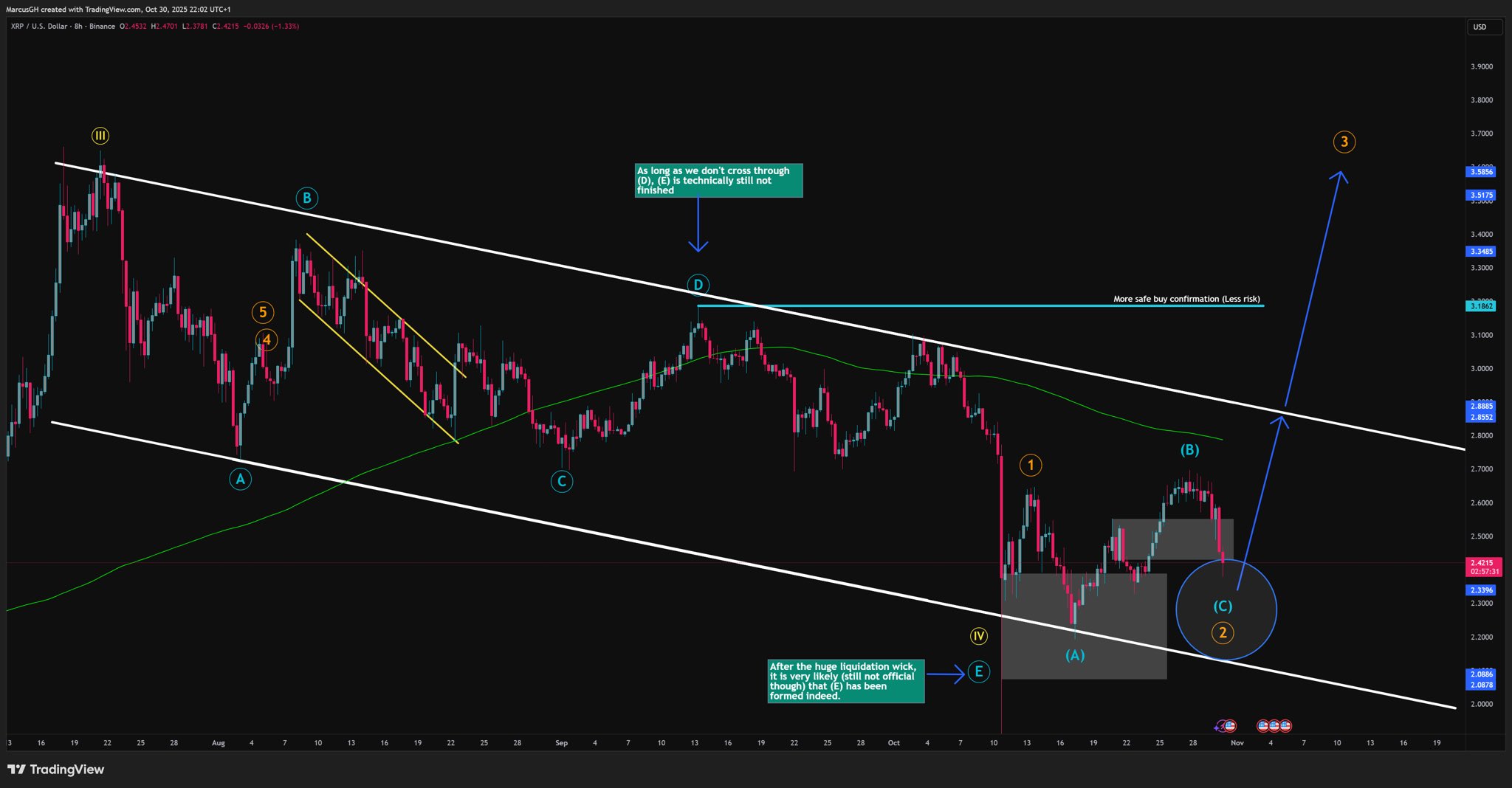
XRP 8h Chart DustyBC
XRP 8h Chart | DustyBC

According to him, XRP completed its first wave, now wrapping up its second, and preparing for the third wave, usually the most powerful stage. His analysis placed XRP’s next move in the $2 to $2.40 range to complete Wave 2 before continuing higher in Wave 3.

Notably, analyst Casi Trades holds a similar sentiment. She pointed out that XRP rejected resistance near $2.68 during the latest market recovery and has since turned bearish. 

Casi identified supports at $2.42, $2.03, and $1.65, warning that breaking below $2.42 could confirm a slide toward $1.65, matching the 0.618 Fibonacci retracement level. Still, she believes this final dip would complete the current correction and trigger a major wave-three rally that could lift XRP toward new highs.

Legendary Meme Coin Investors Accumulate Millions in Emerging Privacy Token GHOST

0

Two high-profile meme coin traders who made millions in 2025 are now turning their attention to GhostwareOS (GHOST).

According to blockchain analytics platform Lookonchain, traders identified as “LeBron” and “CLegS2” have recently accumulated large positions in the emerging privacy token.

LeBron Invests in GHOST After Major Meme Coin Wins

Firstly, Lookonchain reports that LeBron was one of the most profitable traders during the meme coin surge earlier this year. For instance, in February, he earned over $12 million from various PolitiFi-themed tokens.

Specifically, his biggest gains came from Melania Meme (MELANIA), which earned him $8.9 million, and Official Trump (TRUMP), which yielded $3.2 million. He also secured $4.56 million from LIBRA and another $1 million from Harry Bōlz (HARRYBOLZ).

Notably, the value of the latter shot up following Elon Musk’s username change on X (formerly Twitter).

Now, LeBron has directed 102 Solana (SOL), valued at around $18,300, into GHOST, purchasing approximately 2.9 million tokens, according to the data.

Another Smart Trader Joins the Move

Meanwhile, the second investor, CLegS2, made a similar strategic shift toward GHOST. Lookonchain data shows he spent 260 SOL, worth roughly $50,600, to buy 3.5 million GHOST tokens within the past eight hours.

CLegS2’s track record also includes several successful trades in meme coins. Previously, his portfolio gained $3.8 million from TRUMP, $704,000 from ARC, $558,000 from GOAT, and $378,000 from USELESS.

What Is GhostwareOS?

GhostwareOS describes itself as a privacy-first decentralized framework designed to make user activity untraceable. Specifically, its ecosystem consists of three main components: GhostMask, which manages user aliases; GhostScrub, which removes on-chain traces; and GhostRelay, which encrypts communications. 

Additionally, the project promotes “total invisibility” across blockchain layers, including identity, wallet activity, and communication.

GHOST Token Surges Amid Privacy Coin Boom

GHOST’s native token has become one of the top daily performers among privacy coins. It gained 76.1% in the last 24 hours, reaching an all-time high of $0.02352 before stabilizing around $0.015.

GhostwareOS GHOST
GhostwareOS GHOST

The token’s rise coincides with a broader market rally for privacy-focused cryptocurrencies. The privacy coin sector’s market cap now stands at $21.21 billion, marking a 71.6% increase in 2025.

By comparison, this growth outpaces major assets like Bitcoin (27.1%) and Ethereum (33.4%) for the year.

Leading the trend, Zcash (ZEC) is up 247% following the launch of Grayscale’s ZEC Trust, and Monero (XMR) has also posted strong monthly gains.

Quantoz Unveils Euro-Backed Stablecoin EURQ on XRP Ledger Sidechain Xahau Network

0

A fully regulated euro-backed stablecoin, EURQ, is set to launch on the Xahau Network, a smart contract-enabled sidechain of the XRP Ledger (XRPL).

The initiative stems from a partnership between Netherlands-based payments technology company Quantoz Payments and INFTF MTU, a nonprofit dedicated to advancing financial inclusion through blockchain. 

The collaboration aligns with the companies’ shared goal of driving blockchain adoption globally, while establishing a standard for how digital assets should operate — safely, transparently, and in compliance with regulations. 

EURQ Coming to Xahau 

In the latest partnership, Quantoz and INFTF will launch EURQ on Xahau. This will offer businesses and individuals a transparent, secure, and MiCA-compliant euro-backed stablecoin for seamless use within the ecosystem. 

EURQ serves multiple real-world use cases, ranging from enterprise treasury management to cross-border payments. By offering a stable and regulated euro-pegged stablecoin, the announcement notes that the collaboration enhances Xahau’s attractiveness as a network capable of handling enterprise-grade financial operations. 

A Pivotal Moment for Xahau 

In a statement, Arnoud Star Busman, CEO of Quantoz, noted that integrating EURQ into Xahau marks a significant milestone toward building a more inclusive, blockchain-powered financial ecosystem. 

He expressed enthusiasm about the partnership with INFTF. To him, the move will unlock new opportunities for innovation and enable the creation of services that harness EURQ’s stability and reliability. 

Additionally, Jose Antonio Lázaro Espila, Director of Strategic Partnerships at INFTF, also emphasized the importance of the collaboration. According to him, the Quantoz EURQ stablecoin would enable users within the Xahau network to transact with greater confidence.

He added that the initiative will pave the way for innovative and fully regulated financial services within the ecosystem. 

Xahau Marks Second Anniversary in Style 

Interestingly, the launch of EURQ on Xahau coincides with the second anniversary of the blockchain. For context, Xahau launched on October 30, 2023, by a team of XRPL contributors as part of efforts to expand the XRP Ledger’s capabilities and introduce smart contract functionality.

In a post on X, Quantoz issued a congratulatory message marking Xahau’s second anniversary. It highlighted the announcement of the EURQ stablecoin launch on the network as the perfect way to commemorate the occasion. 

It is worth noting that Quantoz initially launched EURQ, along with its U.S. dollar–pegged stablecoin, on the Ethereum blockchain last year. The company is now expanding its reach by extending support for EURQ to the Xahau Network.

Of its 5 million total supply, 3.35 million are currently in circulation, translating to a market cap of €3.34 million ($3.87 million). 

€648B Nordea Bank Opens Client Access to Bitcoin ETP Trading

0

Nordea, one of Europe’s biggest banks with €648 billion in assets, has announced that it will enable customers to trade Bitcoin ETPs directly on its platforms.

The bank confirmed that, starting December 2025, clients will be able to invest in a synthetic Bitcoin ETP from CoinShares, giving them Bitcoin exposure through regular investment accounts. 

Moreover, Nordea will permit the product through its execution-only service, allowing customers to buy and sell it on their own without advice.

MiCA Regulation Sets the Stage

Nordea said the move comes after the full implementation of the EU’s Markets in Crypto-Assets (MiCA) regulation in December 2024. 

For context, MiCA established the first EU-wide legal framework for cryptocurrencies. Specifically, it sets clear rules for investor protection and regulatory oversight. Nordea noted that the importance of these safeguards before it decided to offer crypto-linked investment products.

According to Nordea, Europe’s more mature crypto regulations have “broadened the basis for crypto-based investment products” and created an environment that supports “new types of business activity and growth” built on blockchain and distributed ledger technology.

Nordic Finance’s Bitcoin Embrace

Meanwhile, the move highlights a trend in the Nordic financial sector, where institutions have been increasingly adding crypto assets within regulated frameworks. 

For instance, platforms like Nordnet already offer similar ETP trading options, and crypto fund providers such as Valour are partnering with banks to list regulated ETPs across the region.

Moreover, exchanges like the Norwegian Block Exchange are expanding their fiat-to-crypto services. These moves further connect traditional finance with Europe’s growing tokenized asset markets.

Milestone for Institutional Crypto Access

Ultimately, adding Bitcoin-linked products to Nordea’s trading platforms represents a major step toward the mainstream adoption of regulated crypto investments in Europe. It marks confidence among traditional institutions that digital assets can operate securely within the region’s financial system.

By offering access to Bitcoin exposure, Nordea is reinforcing Europe’s steady move toward a well-regulated environment for institutional participation in crypto, similar to developments seen in the U.S.

Ethereum Leads as Tokenized Stocks Near $700M, More Than Double from Q2 2025

0

Led by Ethereum, the securities tokenization market is booming, as more equities become available for retail and institutional investors to buy on-chain.

Data from RWA.xyz indicates that the tokenized public stock sector is on the rise, driven by growing investor interest. Its total market value has surged to approximately $694 million, up 4.8% over the past 30 days.

Real-World Equities Thriving Onchain

Notably, interest in tokenized stocks looks even more intense when measured over a longer term. At the close of the second quarter of 2025, the sector had a value of $302.7 million. The current numbers show an over twofold, or 129%, growth, as capital continues to flow into the market.

Ethereum, leads the way, renowned for its robust smart contracts and scalability features. Specifically, the Ethereum blockchain hosts over $319 million of tokenized equities, accounting for nearly 46% of the sector’s total value.

Algorand holds $221.7 million of the tokenized stock market, while Solana accounts for $115.6 million. Other chains with notable shares of the sector are Stellar at $23 million and Base at $5.4 million.

Total Value by Network | RWA.xyz

Tokenized Equity Standing By Providers

In terms of providers, Ondo leads the tokenized public stocks league table, with approximately $317.6 million in tokenized assets on its platform. Some of the major stocks offered on the protocol include BlackRock’s iShares Core S&P 500 ETF and the SPDR S&P 500 ETF.

Securitize, which recently announced a partnership with BNY Mellon to launch tokenized funds backed by AAA-rated collateralized loans on-chain, stands in second place. The platform holds about 31.94% of the tokenized stock market shares, valued at $221 million.

Meanwhile, the next is Backed Finance (xStocks), with a total value of $121.2 million and a market share of 17.46%. Other platforms, such as WisdomTree and Centrifuge, hold less than 5% of the market share.

The Tokenization Market Is Still Young

Notably, the monthly transfer volume of the tokenized public stock market stands at $836.45 million, up 71.84% over the last 30 days. This also follows a 28% surge in monthly active addresses to 43,352 and a 23.5% growth in holders to 100,030.

Tokenized Public Stock Data | RWA.xyz

Yet many believe that the sector is still in its early stages of adoption. For the uninitiated, the tokenized stocks bring real-world equities onto the blockchain, making them tradable around the clock and accessible to all on-chain users.

This breaks down regulatory barriers and geographic constraints, enabling investors to access the world’s leading companies from the comfort of their homes using their crypto wallets.

Meanwhile, analysts expect the sector to continue to grow as more of these stocks come on-chain and users gradually become aware of them. Top companies like BlackRock and Ripple are big on real-world asset tokenization, tapping into the sector to attract trillions of dollars in the next few years.

Uphold Launches XRP Debit Card with 6% Spending Rewards

0

Uphold has reintroduced its U.S. debit card, giving customers a new way to earn XRP rewards whenever they spend. 

Notably, the crypto exchange now lets users earn up to 6% back in XRP when they make purchases with dollars, crypto, or stablecoins. This marks Uphold’s return to the U.S. debit card market after it paused the service in March 2023.

Details of the Uphold Debit Card

For context, the new Uphold Debit Card, issued by Cross River Bank under a Visa license, comes in two versions: Uphold Elite and Uphold Essential. 

The Elite card offers 6% back in XRP on purchases for the first three months after activation, with a limit of $300 in rewards. Meanwhile, the Essential card provides 4% back in XRP, capped at $120 over the same period. 

However, users who set up Direct Deposit with Uphold can earn an extra 4% back in XRP every time they deposit part of their paycheck, bringing the total possible rewards to 10% for the Elite card. 

To qualify for the Direct Deposit bonus, users must deposit at least $250 from their paycheck into their Uphold account. Each qualifying deposit earns 4% in XRP, up to $500 a month through December 2025. This will allow customers to grow their XRP holdings just by combining paycheck deposits with card spending on Uphold.

The card lets users spend more than 300 digital assets instantly, including both cryptocurrencies and fiat currencies, anywhere Visa works. It also supports Apple Pay and Google Pay for contactless payments. 

Difference Between the Elite and Essential Cards

Both card options are available as free virtual cards, while physical versions differ in cost. Specifically, Elite members receive a metal card at no charge, while Essential users can get a plastic card for $4.99.

The two cards also differ in fees and benefits. The Uphold Elite card charges a $99.99 annual fee but removes all ATM and foreign transaction fees, which makes it ideal for frequent travelers. 

However, the Essential card has no annual fee, though it includes a $2.95 ATM fee and a 1.5% foreign transaction fee. Both cards are available to U.S. residents, except for those in Louisiana, New York, and U.S. territories.

Speaking on the latest development, Nancy Beaton, Uphold’s Chief Revenue and Marketing Officer and President of Uphold U.S., said the company brought the card back because of strong demand from its large community of XRP holders. 

She noted that Uphold has always supported XRP, even during its most challenging regulatory period, when many other exchanges dropped it. This decision helped Uphold build lasting loyalty among XRP users. 

Beaton added that the new card aims to serve existing users while attracting new ones with one of the most rewarding crypto-linked payment cards on the market.

Uphold’s Focus on XRP

Meanwhile, the relaunch follows Uphold’s move in March to restore staking rewards for U.S. customers across 19 crypto assets, including Ethereum and Solana.

Uphold’s focus on XRP continues beyond the debit card. In May, it launched a $50,000 XRP giveaway during the XRP Vegas event. The company also announced an exclusive ZBCN airdrop for users holding at least $50,000 worth of XRP.

The new Uphold XRP Debit Card comes shortly after Gemini unveiled its own XRP Credit Card in partnership with Ripple, Mastercard, and WebBank. Gemini’s card, launched in August, targets XRP investors with metal cards and crypto rewards but no annual or foreign exchange fees.