
Home Blog Page 47

Nebius Surges 20% as Q2 Revenue Jumps 454% to $582.3 Million

Nebius bStock surged more than 20% on Wednesday after the AI infrastructure company reported stronger-than-expected second-quarter results and reaffirmed its 2026 outlook.

Nebius bStock (NBISB) traded at approximately $227 on Binance, up 20.51% over 24 hours. The token reached a daily high of $227.51, while trading volume exceeded $2.3 million.

The underlying Nasdaq-listed Nebius shares (NBIS) climbed approximately 17% in premarket trading to around $226.50. The stock had closed Tuesday at $193.23 after gaining 4.95% during the regular session.

Nebius Revenue Beats Wall Street Estimates

Nebius reported second-quarter revenue of $582.3 million, representing a 454% increase from $105.1 million one year earlier.

Revenue also grew approximately 46% from the $399 million recorded during the first quarter.

The latest result exceeded analysts’ average estimate of $572.75 million, according to LSEG data.

Nebius reported a loss of $0.49 per share, narrower than the $0.72 loss analysts had expected. Adjusted EBITDA reached approximately $236 million, compared with a $21 million loss in the corresponding 2025 quarter.

That placed the company’s adjusted EBITDA margin at roughly 40.5%, showing that revenue growth is beginning to produce considerable operating leverage despite Nebius’s continued infrastructure investments.

AI Cloud Business Drives Growth

Nebius’s core AI cloud operation generated approximately 98% of total group revenue and expanded by more than 500% year over year.

The Amsterdam-based company supplies Nvidia-powered computing capacity and cloud services to businesses developing and deploying artificial-intelligence models.

Demand allowed Nebius to secure four major AI cloud agreements during the quarter. The average total contract value of those deals exceeded $1 billion, while the combined value of new contracts grew nearly fourfold from the preceding quarter.

Pricing also strengthened for both next-generation AI chips and older GPU systems.

Approximately 70% of the agreements signed during the quarter included customer prepayments. Those payments covered between 50% and 60% of the associated capital expenditure, reducing the amount Nebius must fund through its own cash, debt or additional equity.

This financing structure is important because constructing data centers and purchasing large quantities of advanced Nvidia processors require substantial upfront investment.

Nebius Maintains Its 2026 Outlook

Nebius reaffirmed its full-year 2026 outlook as demand for AI computing capacity continued to exceed available supply.

Management has previously targeted between $3 billion and $3.4 billion in 2026 revenue and annualized run-rate revenue of between $7 billion and $9 billion by year-end.

The Q2 result places first-half revenue at approximately $981.3 million. Nebius will therefore need a significant acceleration during the second half to reach its full-year target, although the company expects newly deployed capacity and contracted customers to support that growth.

The results also provide evidence that Nebius is converting its rapidly expanding infrastructure footprint into revenue. However, the company remains exposed to high capital requirements, customer concentration and the execution risks involved in bringing new data-center capacity online.

Why NBISB Rose More Than Nebius Stock

NBISB’s displayed 20.51% gain was larger than the approximately 17% premarket increase in NBIS because the percentages covered different measurement periods.

Binance calculated NBISB’s performance over a rolling 24-hour window, while the underlying stock’s gain was measured against Tuesday’s official Nasdaq closing price.

The two assets remained closely aligned in price. NBISB traded at $227 while the underlying stock was quoted at approximately $226.51, leaving the token at a premium of around 0.2%.

Binance states that bStocks are tokenized certificates backed one-to-one by corresponding US-listed shares held through a regulated custodian. However, NBISB does not provide direct ownership of Nebius shares or conventional shareholder rights.

What the Results Mean for Nebius bStock

Nebius’s Q2 report provides a clear fundamental explanation for the NBISB rally. Revenue exceeded expectations, adjusted EBITDA improved sharply, contract values increased and customer prepayments reduced part of the funding burden associated with expansion.

The results are therefore bullish for the underlying business and, by extension, NBISB.

However, a 20% single-day increase also reflects substantial optimism about future execution. Nebius must continue deploying capacity on schedule, maintaining high utilization and converting its large contracts into recognized revenue to support the higher valuation.

For now, the earnings report strengthens the growth case for Nebius and confirms that demand for its AI cloud infrastructure remains exceptionally strong.
XRP Millionaire Addresses Have Accumulated $1B Since April

0

XRP has fallen by more than 25% over the past four months, but its millionaire addresses, representing the largest holders, have continued to buy. 

On-chain data shows that addresses holding at least 1 million XRP have added nearly $1 billion worth of XRP since April 2026. This shows a massive difference between XRP’s price performance and the actions of its biggest holders.

XRP Millionaire Addresses Taking Advantage of Lower Prices

According to recent data from Santiment, a market intelligence resource, addresses holding at least 1 million XRP now have a combined balance of 50.24 billion XRP. 

This represents more than 80% of XRP’s 62.67 billion circulating supply, meaning these large holders control a significant portion of the tokens currently in circulation.

Addresses holding at least 1 billion XRP have the largest share of the 50.24 billion XRP held by millionaire addresses. This group holds 26.07 billion XRP, which accounts for 51.9% of the combined balance across the four groups.

XRP Millionaire Addresses
XRP Millionaire Addresses | Source: Santiment

The 10 million to 100 million XRP group comes next, with 12.11 billion XRP. Addresses holding between 100 million and 1 billion XRP have 8.2 billion XRP, while those holding between 1 million and 10 million XRP have 3.86 billion XRP, giving them the smallest balance among the four groups.

Data also shows how much these holders have accumulated in recent months. On April 12, 2026, addresses with at least 1 million XRP held a combined 49.27 billion XRP. Their balance has since climbed to 50.24 billion XRP, meaning they have added 970 million XRP in about four months. At current prices, those tokens are worth nearly $1 billion.

10M-100M XRP Addresses Lead the Accumulation Trend

The 10 million to 100 million XRP group accounts for most of the increase. Its holdings rose from 11.38 billion XRP in mid-April to 12.11 billion XRP today. That means this group added 730 million XRP over the four-month period, making up about 75% of the total increase from millionaire wallets.

Addresses holding at least 1 billion XRP also increased their holdings. Specifically, their balance went from 25.84 billion XRP in April to 26.07 billion XRP now, representing an increase of 230 million XRP. 

At the same time, addresses holding between 1 million and 10 million XRP added about 140 million XRP, while the 100 million to 1 billion XRP group reduced their balance by 110 million XRP.

XRP Down 25% Since Mid-April

This accumulation has taken place even as XRP has struggled in the market. Notably, XRP opened at $1.35 on April 12, 2026, but fell by 2.22% that day. The token later recovered and reached $1.54 on May 14. 

However, the recovery did not last, and XRP began falling again until it reached $1.0499 on June 6, 2026, setting a new yearly low at the time.

XRP then rebounded to $1.29, but this level became resistance. The token subsequently fell again, reaching a new yearly low of $1.008 on June 26, 2026. Another recovery followed, but it also failed to hold, with the latest decline taking XRP to around $1.01.

As a result, XRP has now lost more than 25% from its price four months ago. During that same period, however, addresses holding at least 1 million XRP increased their combined holdings by 970 million XRP, worth nearly $1 billion.

Shiba Inu Briefly Surges to $0.00001004 on Australian Exchange After New Listing

0

Shiba Inu experienced extreme volatility on Australian-based crypto exchange FameEX, briefly soaring to $0.00001004 shortly after its listing on the platform.

Shiba Inu secured a new spot listing on FameEX, giving the meme token access to another trading venue. The exchange announced that it had added SHIB alongside UNUS SED LEO (LEO), with spot trading for the SHIB/USDT and LEO/USDT pairs opening at 10:00 UTC on August 11, 2026.

At the same time, FameEX enabled SHIB deposits and withdrawals, allowing users to transfer the token to and from the exchange.

FameEX described Shiba Inu as a decentralized, community-driven meme token launched on Ethereum in 2020. The exchange also highlighted the broader Shiba Inu ecosystem, including Shibarium and ShibaSwap, as well as companion tokens such as LEASH and BONE.

FameEX is headquartered and registered in Parramatta, New South Wales, Australia, and also operates regional hubs, including an office in Dubai.

SHIB Briefly Surges to $0.00001004

Following the listing, SHIB experienced significant volatility on FameEX. The token briefly surged to $0.00001004, marking a sharp move from its prevailing market price.

The spike appears to have been driven primarily by thin liquidity and heightened volatility surrounding the newly launched trading pair. However, the surge was short-lived. After reaching $0.00001004, SHIB quickly reversed and fell to a low of $0.00000442 on FameEX.

According to FameEX data, SHIB was trading around $0.00000445, representing a 55.48% decline over 24 hours on the exchange. Meanwhile, the token recorded $430,240 in 24-hour trading volume on FameEX. 

Shiba Inu Performance on FameEx

SHIB Returns Briefly to the Four-Zero Range

The brief move to $0.00001004 stands out because SHIB had not traded around the $0.00001 level since January 5, 2026. Since then, the token has suffered a substantial decline, making its temporary return to the $0.00001 region on FameEX notable despite the sharp reversal that followed.

Meanwhile, broader market weakness continues to weigh on Shiba Inu. SHIB has dipped 8.81% over the past seven days and 1.13% over the past 24 hours.

Although SHIB recently climbed as high as 25th in the global cryptocurrency rankings, it has since slipped to 30th. At press time, SHIB carried a market valuation of $2.62 billion. 

Cardano Community Approves 120 Million ADA Allocation to Boost DeFi Liquidity

0

The Cardano community has approved a proposal to allocate 120 million ADA to AlphaGrowth’s PRIME program to strengthen the network’s DeFi ecosystem.

The initiative aims to increase Cardano’s total value locked (TVL) by strategically deploying capital across the ecosystem. However, the network still faces a significant liquidity gap. Cardano’s DeFi TVL currently stands at around $68 million, leaving it well behind larger rivals such as Ethereum and Solana.

Community Approves 120 Million ADA Allocation

Cardano’s decentralized governance system approved the proposal after AlphaGrowth revised its original plan to address concerns raised by community members and delegates. The program aims to increase Cardano’s TVL to more than $200 million.

To improve accountability and reduce execution risks, AlphaGrowth introduced several safeguards. These include staggered fund releases over six months, a 24-month TVL observation period, term limits, and greater diversification among the groups responsible for managing the program.

The team also significantly reduced PRIME’s marketing budget following community feedback. AlphaGrowth cut the original $2.4 million ecosystem marketing allocation to $648,720 and divided the revised budget into three categories: 40% for external content creators ($259,488), 50% for activations and advertising ($324,360), and 10% for tooling ($64,872). 

How the Community Voted 

These changes helped the proposal gain broader support across the Cardano ecosystem. Prominent DRep Dave switched his vote to YES, while Iagon founder Dr. Navjit Dhaliwal and the Cardano Foundation also supported the revised proposal.

The vote ultimately passed with 73.04% of the voting stake, representing approximately 3.73 billion ADA, in favor. Meanwhile, 26.96%, or roughly 1.38 billion ADA, voted against the proposal.

Nonetheless, voter participation remained relatively limited compared with the total stake represented in the governance process. Of the 15.01 billion ADA represented, approximately 5.11 billion ADA participated in the final yes-or-no vote, while 9.90 billion ADA abstained. 

AlphaGrowth PRIME Proposal Approved

PRIME Targets Cardano’s DeFi Liquidity Gap

AlphaGrowth designed PRIME to address one of Cardano’s biggest challenges: turning its technological infrastructure into deeper economic activity.

Cardano has built a strong technical foundation around its eUTxO accounting model, smart-contract infrastructure, and decentralized governance. However, its DeFi ecosystem continues to lag behind larger competing networks in areas such as liquidity, user activity, integrations, and capital deployment.

Consequently, PRIME seeks to tackle the liquidity problem directly. By deploying the approved ADA allocation strategically, the program aims to encourage greater DeFi activity, attract additional capital, and expand the number of users and applications operating within the Cardano ecosystem.

Community Demands Measurable Results

The approval has generated enthusiastic reactions across the broader Cardano community. Anastasia Labs CEO Philip DiSarro described the initiative as a necessary push toward more aggressive market execution.

At the same time, the proposal’s approval does not eliminate concerns over how the 120 million ADA will be used. Community members have called for strict, milestone-based accountability to ensure AlphaGrowth delivers measurable improvements in TVL, liquidity, and ecosystem activity.

Cardano Price Prediction: Analyst Highlights 3 Bearish Indicators That Could Push ADA Below $0.15

0

Crypto analyst Ali Martinez has identified three warning signals suggesting that Cardano (ADA) could face further weakness following its recent price rally.

The analysis comes less than two weeks after Cardano staged a strong rally and climbed above $0.21. However, the token has since entered a modest correction, falling below $0.19.

Martinez Identifies Three Cardano Warning Signals

Martinez highlighted three key indicators that could signal further downside for ADA. According to his analysis, the signals could drive ADA towards $0.14 if the bearish setup continues to develop.

Cardano Whale Holdings Decline

The first warning signal involves the recent decline of whale holdings. Martinez noted that the number of wallets holding between 1 million and 10 million ADA fell from 2,370 on August 2 to 2,340 at the time of his analysis.

According to him, the decline suggests that some large holders may be taking profits or redistributing their holdings following ADA’s recent price increase to $0.2107. 

Cardano Whales' Holdings Shrink
Cardano Whales’ Holdings Shrink


ADA MVRV Ratio Forms a Death Cross

The second warning signal comes from Cardano’s MVRV ratio. Martinez stated that recent selling pressure from whales has caused ADA’s MVRV ratio to form a death cross with its 7-day simple moving average (SMA).

He explained that this development points to weakening momentum and increases the risk of a deeper correction. 

ADA MVRV Ratio
ADA MVRV Ratio 

TD Sequential Flashes a Sell Signal

The third warning signal comes from the TD Sequential indicator on Cardano’s daily chart.

Martinez said the indicator has flashed a sell signal, which could precede a pullback lasting between one and four candlesticks. Alternatively, he suggested that the signal could mark the beginning of a new bearish countdown. 

ADA TD Sequential
ADA TD Sequential

ADA Could Fall Toward $0.14? 

Notably, Martinez warned that if all three signals are confirmed, ADA could decline toward $0.170. This level represents the mid-range support of Cardano’s current trading channel. Furthermore, a breakdown below $0.170 could expose ADA to the channel’s lower boundary near $0.144, according to the analyst.

At press time, ADA was trading at $0.1862 and ranked as the 14th-largest cryptocurrency by market cap. The token has declined 2.18% over the previous week and 1.06% over the past 24 hours. Nonetheless, ADA remains up 18.41% over the past 30 days.

Meanwhile, Cardano ranks as the seventh token with the most bullish community sentiment, recording 72.9% bullish votes. The token ranked ahead of XRP and Shiba Inu on the metric. Cardano also topped the daily bullish trending token ranking, with a trending score of 10.4%, outperforming popular assets like Solana, Ethereum, Shiba Inu, and Kaspa. 

XRP Holders With 1M+ Tokens Add 32 Wallets as Market Cap Falls 29%

0

The biggest holders of XRP are increasing their holdings even as its market value has fallen massively since last year.

According to crypto analytics platform Santiment, wallets holding at least 1 million XRP increased by 32 over the past three months. This happened while XRP’s market capitalization fell by about 29%.

Specifically, the number of wallets holding 1 million or more XRP has risen from around 2,006 to 2,038. This figure suggests that large investors are becoming more confident in XRP amid the declining prices.

XRP Whales Keep Buying Despite Price Drop

Notably, XRP is now trading around $1.01, down from the $1.40–$1.50 range where it traded three months ago. At the same time, the number of wallets holding at least 1 million XRP has continued to rise.

Santiment says this suggests that some large investors have continued buying XRP instead of selling during the downturn.

While this does not guarantee a recovery in XRP’s price, the rising number of large wallets shows that major XRP holders have not been selling in large numbers despite the recent price decline.

Image

XRP’s Institutional Growth Continues

The increase in large XRP holders comes as the XRP Ledger expands beyond its original focus on payments.

Santiment highlighted RLUSD, Ripple’s dollar-backed stablecoin, as an important institutional product. Ripple is also building payment, custody, and tokenization services on the XRP Ledger.

Ripple has recently invested in ZILO and Licuido to support regulated funds and improve the use of assets on the XRP Ledger. Messari has also noted the network’s growing use for tokenized real-world assets, stablecoins, and institutional finance.

What Could XRP Whale Growth Mean?

The rise in wallets holding 1 million or more XRP, despite the drop in market value, could mean that large investors are buying during the downturn.

If this trend continues, it could support the case for an XRP price recovery. For context, XRP is down more than 73% from its $3.66 peak, which it hit in July 2025. The price briefly fell to $0.9916 yesterday, marking its first time below $1 since 2024.

Despite the major price drawdown, the recent data suggests that whales are focusing on the long term rather than short-term price changes. For XRP supporters, this could be a positive sign.

On-Chain Activity Surges as Exchange Flows Collapse

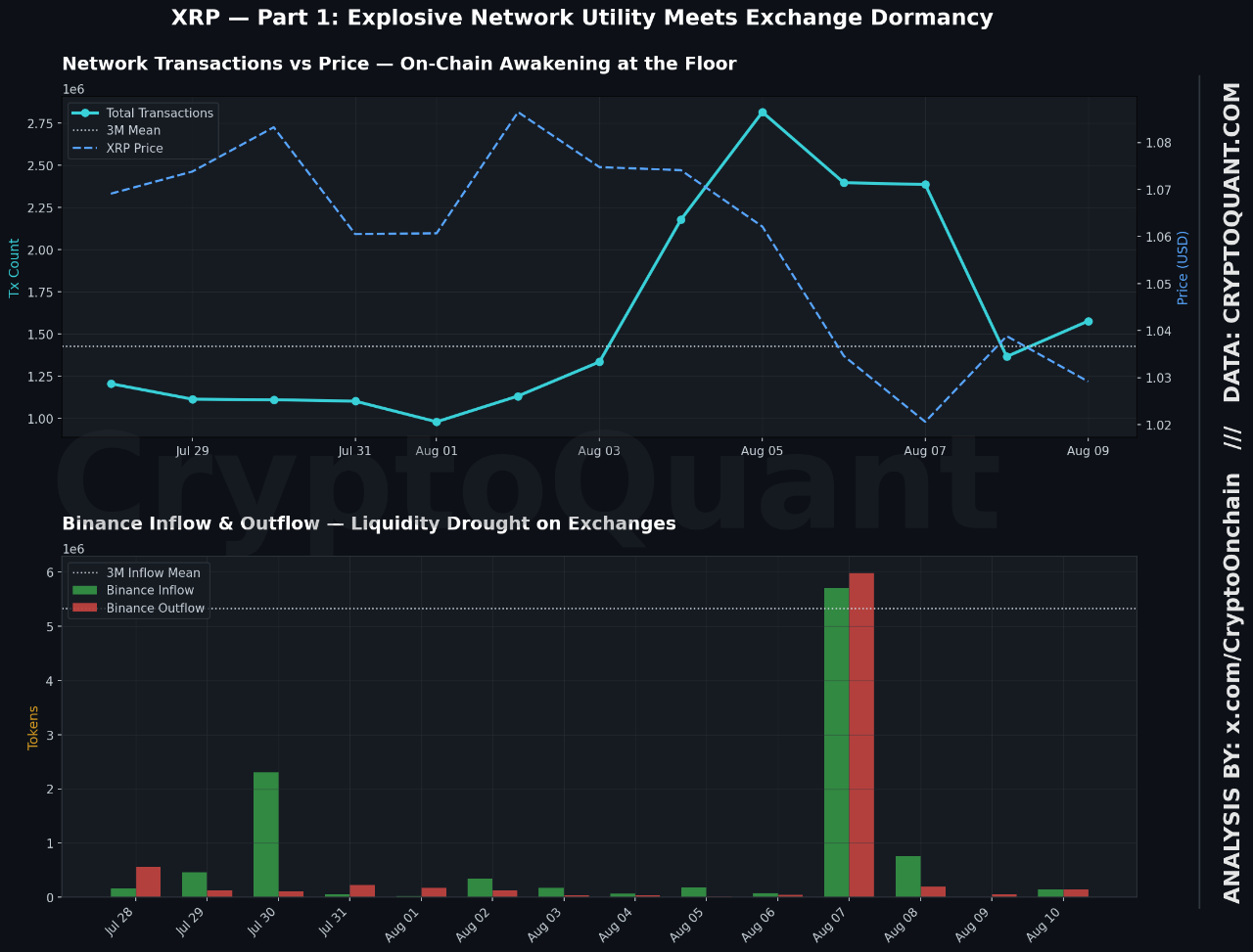
On August 5, XRP processed more than 2.8 million transactions—an 86% weekly increase and more than 81% above its 30-day average. Active accounts also rose by more than 5% over the past 30 days, signaling stronger network usage.

Meanwhile, exchange activity has fallen sharply. Binance deposit addresses dropped about 96% compared with their monthly and quarterly averages, while XRP deposits and withdrawals fell 79% and 85%, respectively, from their 90-day averages. This suggests that recent price weakness may not be driven by heavy selling into exchanges.

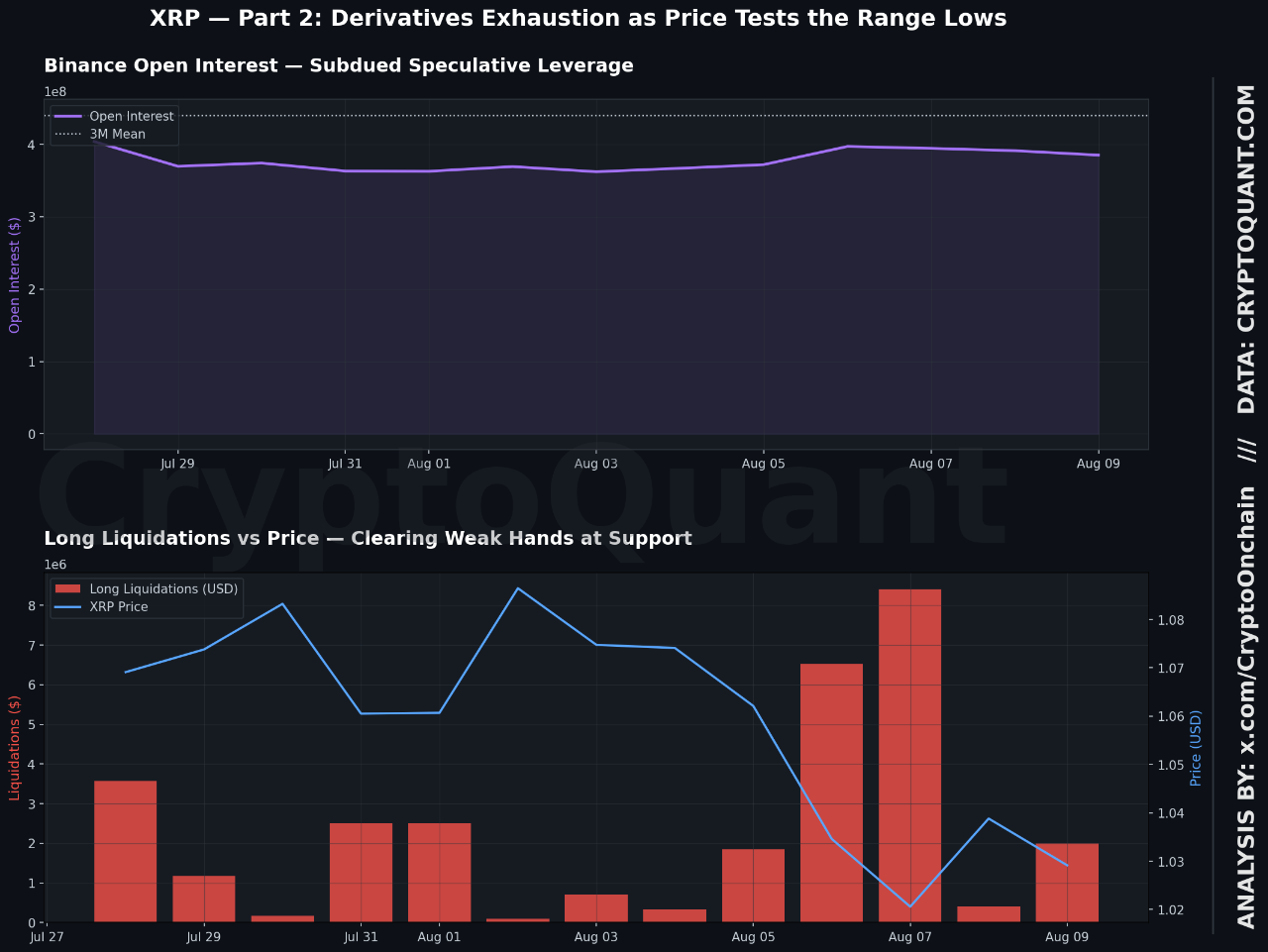
Leverage is also cooling. Open interest fell from $403 million on July 28 to $391 million on August 8, while the leverage ratio declined from 0.190 to 0.150. About $3.4 million in long positions were liquidated on August 7 as XRP briefly approached $1.02.

Market watchers note that rising network activity, declining exchange flows, and reduced leverage point to a potential local bottom.

SpaceX Stock Falls Below $135 IPO Price Again as Rally Reverses

SpaceX shares fell below their initial public offering price again on Tuesday, surrendering the recovery achieved one trading session earlier.

The Nasdaq-listed stock (SPCX) declined approximately 5.2% to around $131.50 at the time of reporting, compared with Monday’s closing price of $138.74. At that level, SpaceX was trading roughly 2.6% below its $135 IPO price.

SpaceX bStock (SPCXB) also traded near $131, tracking the decline in the underlying shares. Its displayed 24-hour change may differ because Binance measures performance over a rolling period.

SpaceX’s Return Above IPO Price Lasted One Session

SpaceX priced its IPO at $135 per share on June 11, initially raising $75 billion through the sale of approximately 555.6 million shares.

After the underwriters fully exercised their option to purchase an additional 83.3 million shares, the offering expanded to approximately 638.9 million shares and generated total gross proceeds of about $85.7 billion.

SPCX began trading on the Nasdaq on June 12 and subsequently reached an all-time intraday high of $225.64. The stock first traded below the IPO price on July 15 before recording its first closing price below $135 one day later.

SpaceX eventually fell to an all-time intraday low of $104.83 on August 3. It then staged a three-session recovery of approximately 26%, closing Monday at $138.74—its first finish above the IPO price in nearly a month.

Tuesday’s decline erased that milestone. At approximately $131.50, SPCX remained more than 41% below its post-IPO high but about 25% above its August low.

No New Company-Specific Catalyst Was Disclosed

SpaceX did not release a new earnings report, material regulatory filing or negative corporate announcement before Tuesday’s decline.

The stock was reversing part of its sharp three-session rally while considerably underperforming the broader market. The Nasdaq Composite was down approximately 0.6% at the time of reporting, compared with SPCX’s decline of more than 5%.

The move also occurred ahead of another increase in SpaceX’s potentially tradable share supply.

Approximately 911.5 million shares held by employees and early investors became eligible for trading on August 6. Another 319 million shares are scheduled to become eligible on August 20 under the staggered lockup provisions disclosed around the IPO.

Eligibility does not mean those shareholders will sell. However, each release increases the number of shares that can legally enter the public market and may affect investor positioning before the scheduled date.

SpaceX’s return below $135 therefore does not reflect a newly disclosed deterioration in its business. The most defensible explanation is renewed profit-taking and positioning following a 26% three-session rally, with investors also assessing the approaching share unlock.

The decline demonstrates that SpaceX remains highly volatile two months after its record-breaking IPO. The stock reclaimed its offering price for only one session before falling below it again.

XRP Network Activity Explodes 86% as Exchange Activity Collapses: Is a Bottom Forming?

0

XRP network activity is improving, even though its price remains near the bottom of its six-month range.

CryptoOnchain, a CryptoQuant author, said XRP closed at $1.039 on August 8. The price fell from around $1.08 to the $1.02–$1.03 range over the past week.

While XRP’s price remains weak, on-chain data shows more people are using the network and selling pressure on major exchanges is starting to ease.

XRP Transactions Jump 86% in One Week

On August 5, XRP processed more than 2.8 million transactions. That’s an 86% increase from the previous week and more than 81% higher than its 30-day average.

Daily transactions stayed high throughout the week, ranging from 1.3 million to 2.8 million. As a result, XRP’s seven-day average rose well above its six-month average of 1.83 million transactions.

The number of active accounts also grew by more than 5% over the past 30 days, showing that more people are using the XRP Ledger.

quicktake-image

XRP Exchange Activity Falls Sharply

At the same time, XRP activity on major exchanges has dropped significantly. CryptoOnchain said Binance deposit addresses fell by about 96% compared with their monthly and quarterly averages. XRP deposits and withdrawals on Binance also dropped by 79% and 85%, respectively, compared with their 90-day averages.

This could be a positive sign. XRP’s network is becoming more active, while fewer coins are moving through exchanges. This suggests that the recent price weakness may not be due to large amounts of XRP moving into exchanges for sale.

Leverage Is Cooling

XRP’s derivatives market is also showing less speculation. Open interest fell from about $403 million on July 28 to $391 million on August 8, moving closer to its six-month low. The leverage ratio also dropped from 0.190 to 0.150.

On August 7, about $3.4 million in long positions were liquidated as XRP briefly fell toward $1.02. Funding rates then turned positive again, reaching +0.008 on August 8.

According to CryptoOnchain, this suggests that some risky leveraged positions were cleared out without causing widespread panic or a large increase in short positions.

XRP Could Be Building a Local Bottom

Overall, the data gives XRP a more positive outlook despite its weak price. XRP is trading near the bottom of its six-month range, while leverage and exchange activity have fallen. At the same time, activity on the XRP network has increased.

CryptoOnchain called this a “classic bottom-building signature”. The idea is that more people are using XRP while fewer coins are moving through exchanges, which could mean some investors are quietly accumulating XRP instead of selling.

However, this does not mean XRP will rise immediately. The price could still fall under $1 as bears continue to dominate.

Charles Schwab Crypto Exec Says XRP Ledger Is Evolving Into a Stablecoin Network

0

Charles Schwab’s Head of Crypto Research, Jim Ferraioli, says the XRP Ledger (XRPL) is evolving from a payments blockchain into a network for stablecoin transactions.

He shared this view while speaking on the Thinking Crypto podcast with host Tony Edward. Ferraioli discussed how different blockchain networks are specializing in distinct use cases as the crypto industry consolidates.

“I think everyone’s gonna find their niche,” Ferraioli said, pointing to Ethereum, Solana, Tron and XRPL as examples of networks developing distinct roles.

XRP Ledger Moves Beyond Payments

According to Ferraioli, Ethereum remains the dominant general-purpose smart-contract blockchain for tokenized real-world assets. Solana, meanwhile, aligns more with active trading due to its high transaction throughput. He described Tron as a “pure play” stablecoin network before turning to XRPL.

“XRP Ledger is making the shift from kind of a payments network to more of a stablecoin transaction network,” Ferraioli said.

The comments highlight how institutional observers are viewing XRPL’s evolving utility as stablecoins and tokenized assets become more prominent across financial markets.

XRP Ledger’s Stablecoin Shift Gains Real-World Traction

Recent RLUSD supply data also points to the XRP Ledger’s growing role in stablecoin activity. Specifically, XRPL’s RLUSD supply reached approximately $801.8 million in June, slightly surpassing Ethereum’s roughly $793.1 million. The shift is notable because RLUSD initially launched with most of its supply on Ethereum in December 2024.

The change follows stronger issuance activity on XRPL, with millions of RLUSD minted on the network while Ethereum recorded larger redemption activity. With XRPL now holding the largest share of the RLUSD supply, the data provide a concrete example of the stablecoin-focused evolution Ferraioli described.

Big Banks Are Watching Blockchain Specialization

Meanwhile, Ferraioli also pointed to the Depository Trust & Clearing Corporation (DTCC) working with multiple blockchain networks, including Stellar, as evidence that financial institutions are exploring different chains for different purposes.

Rather than expecting one blockchain to dominate every application, Ferraioli said specialized networks will coexist with a relatively small number of Layer-1 blockchains handling most of the industry’s activity.

He estimated that perhaps 20 Layer-1 networks will remain relevant over time, while the majority of activity will ultimately concentrate around the top three or four.

Crypto’s Winners and Losers Are Emerging

Ferraioli compared the current blockchain landscape to the early internet and search-engine industry. At the time, numerous competitors emerged before a handful of dominant players, such as Google, captured most of the market.

He argued that a similar consolidation is already underway in crypto, with some networks gaining meaningful market share while others struggle to attract activity.

Ferraioli also argued that the crypto industry’s downturn ultimately proves healthy by eliminating excess leverage and redirecting capital toward areas with stronger long-term growth prospects. In his words:

“Recessions are painful, but they’re necessary. They kind of wash out excess leverage and shift capital into new avenues of growth and out of those that are no longer growing. And so it’s painful, but I think it’s healthy.”

Coreum XRPL Bridge Suffers 200,000 XRP Breach: Here’s What Happened

0

The Coreum XRPL Bridge recently suffered a 200,000 XRP exploit after an attacker exploited a flaw in its deposit verification process.

The Coreum Bridge suffered an exploit on Aug. 9 that led to the loss of nearly 200,000 XRP. However, an analysis by XRPL-based analytics platform xrpl.to shows that the XRP Ledger was not responsible for the loss despite an earlier report suggesting so.

Notably, the bridge account held about 200,410 XRP before the incident. At 19:16 UTC, it began sending XRP to two newly created wallets. Over the next 97 minutes, the account made 94 XRP payments totaling 199,916.3 XRP, leaving just 493.5 XRP. 

The two wallets had been created less than two hours before the first payment and later moved most of the XRP they received to other addresses.

The XRP Ledger Was Not Responsible

The transaction records show that the bridge itself sent every XRP payment. This is because each transaction listed the bridge account as the sender and carried 17 signatures from its 28 relayer keys. 

Since the bridge’s master key was disabled, its 17-of-28 multisig setup provided the only way to approve these transactions.

This goes against an earlier explanation that blamed the XRP Ledger’s DefaultRipple setting. For context, native XRP does not use trust lines and cannot be involved in rippling. DefaultRipple applies to issued tokens, not native XRP, meaning the setting could not have caused the XRP to leave the bridge account.

The transactions also did not use the tfPartialPayment flag. Every XRP that left the bridge came through a payment that its own multisig approved. In other words, the XRP did not simply leak from the account because of an XRPL setting. The bridge authorized the transfers itself.

The Problem Started on Coreum

The evidence instead reveals a flaw in how the bridge checked deposits on Coreum. Notably, the bridge uses relayers to monitor the XRP Ledger and report deposits to its Coreum smart contract. 

When enough relayers submit the same evidence, the contract accepts the deposit and issues the corresponding wrapped assets.

The problem was that the relayer code did not properly check where a payment went. It looked for successful payments in the bridge account’s transaction history that included a Coreum recipient memo, but it did not require the payment to have actually gone to the bridge.

This allowed the attacker to make payments between their own wallets look like deposits. The attacker first moved the bridge’s own wrapped-CORE token between two wallets under their control. 

Although the transaction never sent funds to the bridge, it still appeared in the bridge’s transaction history because the bridge issued the token. Twenty-one relayers then treated the transaction as a valid deposit and reported it to the Coreum contract.

The Attacker Tested the Flaw Before Draining the Bridge

The attacker first tested the system with a 100-unit transfer of the wrapped-CORE token. They then repeated the process with larger amounts, and followed a pattern that roughly doubled the amount at each step.

The exploit eventually created about 4,356,812 CORE and 200,001 XRP worth of bridge tokens without genuine deposits supporting them. After this, the attacker then used those newly created balances to withdraw real XRP from the bridge.

The first XRP payment involved 3,249 XRP. The bridge then sent a much larger 25,908.6 XRP payment before settling into a pattern of transfers of about 1,694.7 XRP to the two attacker-controlled wallets.

The pattern reveals a flaw in the bridge’s code, not a theft of private keys. Twenty-one relayers accepted the first false deposit because they all followed the same verification process. The attacker therefore exploited a weakness in the shared logic that the relayers used to determine whether a deposit was genuine.

The two wallets received about 107,397.5 XRP and 92,518.8 XRP, respectively. They later moved most of the funds to other addresses in transfers of roughly 9,600 to 9,720 XRP. Large portions went to two accounts created on June 28, 2026.

At the time of this report, Coreum had not published a post-mortem identifying the attacker or saying whether any relayer operator had acted beyond negligence.