
Home Blog Page 48

Ondas Wins Israeli Defense Tender for Next-Generation Attack Drones

Ondas has secured a multi-million-dollar tender from the Israeli Ministry of Defense to develop and produce a new tactical attack-drone capability for frontline combat units.

The Nasdaq-listed defense and autonomous-systems company announced the award on August 11, identifying the program as “Digital Bat.”

Ondas did not disclose the award’s exact value, production volume, delivery schedule or expected revenue-recognition timeline. Its financial contribution therefore cannot yet be calculated beyond the company’s description of the program as worth multiple millions of dollars.

What Ondas Will Develop Under Digital Bat

According to Ondas’s official announcement, Digital Bat will focus on low-cost tactical attack drones that can be manufactured and deployed at scale.

Ondas said its responsibilities include:

  • The aerial platform.
  • Autonomous functionality.
  • Mission software and system integration.
  • System engineering.
  • Production infrastructure and readiness.
  • Operational support.
  • Compatibility with wider command-and-control systems.

The drones are intended to give tactical units rapidly deployable aerial-strike capabilities while improving precision, operational reach and response times.

Ondas said the selection demonstrates its ability to serve as a prime contractor for complex defense programs rather than supplying only individual drone components. However, this assessment represents the company’s interpretation of the award.

Digital Bat Involves Multiple Contractors

Available reporting indicates that Digital Bat contains separate procurement areas involving multiple contractors.

In July, CTech reported that Israeli companies Kela and eyesAtop had been selected to develop the program’s autonomous command-and-control platform.

Kela is responsible for the platform’s open, modular architecture, while eyesAtop will provide software that allows a single operator to control and monitor multiple drones.

Ondas’s latest award covers the tactical attack-drone capability, including its own mission software, autonomy and integration with the wider command environment. The announcement does not indicate that Ondas replaced Kela or eyesAtop as providers of the separate command-and-control layer.

The Israeli Ministry of Defense had not published an independently accessible announcement detailing all award terms at the time of reporting.

Ondas Links the Award to the US Drone Dominance Program

Ondas said Digital Bat reflects many of the operational priorities driving the United States’ Drone Dominance Program, although the two are separate national initiatives.

The US program is a $1.1 billion procurement effort conducted over four phases. It aims to acquire low-cost, one-way attack drones rapidly while reducing unit prices, increasing production volumes and improving operational capabilities.

Ondas has not announced that the Digital Bat award gives it an order or formal role in the US program. The comparison is limited to the two initiatives’ shared emphasis on affordable, scalable and rapidly deployable unmanned systems.

ONDS Stock and ONDSon Show Muted Reaction

ONDS stock was trading near $9.34 at the time of reporting, up approximately 0.3% from Monday’s $9.31 closing price. The shares had traded between $9.17 and $9.45 during Tuesday’s session.

The limited movement showed that the tender announcement had not triggered a major rally during early trading.

Ondas’s tokenized stock, ONDSon, was trading near $9.39. Its rolling 24-hour performance differed slightly from ONDS’s regular-session change because the two figures covered different measurement periods.

ONDSon is an Ondo tokenized asset designed to provide economic exposure to ONDS, including the effect of reinvested dividends after applicable tax deductions. Ondo states that its tokenized stocks are fully backed by corresponding securities and cash in transit.

However, ONDSon is not an Ondas share and does not give holders direct ownership of the underlying stock or conventional shareholder rights.

What the Tender Means for Ondas

The Digital Bat award strengthens Ondas’s position in tactical aerial-attack and precision-strike systems. It also supports the company’s broader strategy of offering integrated defense technology across aerial attack, aerial intelligence, counter-drone systems and unmanned ground platforms.

However, the announcement’s financial importance remains uncertain. Ondas did not disclose the exact award value, development milestones, production quantities, delivery schedule or expected margins.

The tender is therefore a strategically positive development, but investors will need additional contract and financial details before determining its potential effect on Ondas’s revenue and valuation.

Morgan Stanley Maintains $300 SpaceX Target, Sees $600 Bull Case After Cursor Deal

Morgan Stanley maintained its Overweight rating and $300 price target for SpaceX, while valuing the stock at $600 under its most optimistic scenario.

The distinction is important. $600 is not the investment bank’s official price target. It represents a bull case that assumes stronger execution across SpaceX’s artificial-intelligence operations, Starship, orbital computing and other emerging businesses.

SpaceX shares were trading near $139 at the time of reporting. From that price, Morgan Stanley’s $300 target implies approximately 116% upside, while the $600 bull case would require an increase of about 332%.

Cursor Acquisition Expands SpaceX AI Opportunity

Morgan Stanley’s latest analysis focuses heavily on SpaceX’s planned acquisition of Anysphere, the company behind AI coding platform Cursor.

SpaceX exercised its option to acquire Anysphere in June. Under the agreement, the consideration will consist of SpaceX Class A shares based on an implied equity value of $60 billion.

According to SpaceX’s quarterly filing with the SEC, the acquisition is expected to close during the third quarter of 2026, subject to regulatory approval and other closing conditions.

Morgan Stanley projects that Cursor’s annual recurring revenue will reach $8 billion by the end of 2026 and approximately $33 billion by 2030.

The bank estimates that Cursor could contribute:

  • $2.5 billion to SpaceX’s revenue in 2026.
  • $13 billion in 2027.
  • Approximately 10% and 19% of SpaceX’s projected AI revenue in those respective years.

Morgan Stanley also expects Cursor’s gross margin to turn positive during the third quarter and reach the low-60% range by 2030.

At a SpaceX share price of approximately $139, the bank estimates that investors are assigning only about $12 per share to the company’s AI business. Morgan Stanley considers that valuation low compared with publicly traded AI-infrastructure companies.

SpaceX AI Revenue Is Growing Rapidly

SpaceX’s latest financial results show that AI has already become a significant part of its business.

Second-quarter revenue increased 92% year over year to $7.81 billion. Adjusted EBITDA rose 191% to $3.54 billion, while the company’s net loss narrowed from approximately $1 billion to $541 million.

AI segment revenue reached $2.56 billion, increasing 247% from $737 million one year earlier. SpaceX also disclosed cloud-service agreements representing $14.1 billion in contracted sales.

However, the AI expansion continues to require enormous investment. The division reported:

  • A $1.26 billion operating loss.
  • Positive adjusted EBITDA of $1.15 billion.
  • Capital expenditures of $15.83 billion during the quarter.

AI accounted for approximately 86% of SpaceX’s total quarterly capital expenditures of $18.37 billion.

$600 Is an Optimistic Scenario, Not a Forecast

Morgan Stanley’s valuation framework extends from a $75 bear case to a $300 base target and a $600 bull case.

The bear case assumes slower AI monetization and deployment, along with delays in SpaceX’s Starship program. The bull case depends on SpaceX successfully converting its investments in AI infrastructure, Cursor, Starship and orbital computing into substantial long-term revenue and cash flow.

Investors should therefore not interpret $600 as Morgan Stanley’s expected share price. The bank’s official target remains $300, while the unusually wide range illustrates the uncertainty involved in valuing SpaceX’s developing businesses.

What the Forecast Means for SpaceX bStock

Morgan Stanley’s valuation applies to SpaceX’s Nasdaq-listed shares rather than directly to SpaceX bStock (SPCXB).

SPCXB is designed to provide economic exposure to the underlying stock, meaning a sustained increase in SPCX would generally be expected to support the tokenized asset. However, SPCXB trades through a separate Binance order book and can temporarily move above or below the underlying share price because of differences in liquidity, demand and trading hours.

The $600 scenario therefore represents a long-term valuation possibility for SpaceX shares not a direct price prediction for SPCXB.

XRP Drops to New Yearly Low: Here are Next Support Levels to Watch Once $1 Gives Way

0

XRP recently collapsed to a new yearly low, as bears continue to test the pivotal $1 psychological level.

XRP fell to a new yearly low of $1.0017 earlier today, which brought it closer to losing the important $1 level than at any point since it recovered above that mark in November 2024. At the time of writing, XRP trades at $1.0063, down 2.22% over the past week.

Notably, both the weekly and daily charts now show a weak structure as XRP tests its most important support area. With the price sitting just above $1, the main question now is whether buyers can defend this level or whether sellers will push XRP toward lower support zones.

Key Support Levels Below $1

On the weekly chart, XRP is trading around the 1.0 Fibonacci retracement level at $1.0084. XRP now tests this Fib level at the same time as the $1 psychological level, making the area especially important for the current price action.

If XRP loses the $1 psychological level, the next support areas come from the Fibonacci extensions and pivot levels. The first major level is the S2 pivot at $0.8821, which could become the immediate target after a confirmed break below $1.

XRP Levels to Watch
XRP Levels to Watch

After that, the next major level is the 1.272 Fibonacci extension at $0.7100, which sits roughly 30% below the current price. Below that, the 1.414 Fibonacci extension at $0.5912 marks the lowest major target in the current setup.

There is also no meaningful Fibonacci support between the $1.0084 level and the $0.7100 extension. This means a clear break below $1 could leave XRP with little technical support until it reaches the $0.8821 S2 pivot. This makes the $1 area particularly important for XRP’s near-term direction.

Ichimoku Cloud Keeps Pressure on XRP

The daily Ichimoku Cloud also confirms continued weakness. XRP trades below the cloud, while Senkou Span A stands at $1.0633 and Senkou Span B at $1.0923. These levels create a wide resistance area above the current price.

The cloud itself remains bearish because Span B sits above Span A, while its downward slope suggests that resistance could remain in place in the sessions ahead. XRP also faces resistance from the Tenkan-sen at $1.0441 and the Kijun-sen at $1.0825, both of which remain above the current price.

XRP Daily Ichimoku Cloud and RSI

The Chikou Span at $1.0048 also sits below previous price action, which adds to the bearish reading. XRP would need to reclaim the Tenkan-sen and Kijun-sen before moving back into the cloud to give the daily chart a sign of a possible trend change.

XRP RSI Shows More Downside Is Possible

Meanwhile, XRP’s daily RSI is at 34.14, which puts the indicator close to oversold territory. Its signal line stands at 40.85. XRP experienced a similar RSI decline in June 2026, which led to a short-term rebound. However, the recovery failed, and sellers eventually pushed the price to another yearly low.

The RSI has also not yet dropped below 30, meaning XRP could still face further selling before the indicator gives buyers a stronger reason to step in. A low RSI alone does not confirm that a bottom is in place.

For XRP to show a more convincing recovery, the price first needs to reclaim the 0.888 Fibonacci level at $1.1651. It would then need to break above the 0.786 Fibonacci level at $1.3289, and the S1 pivot at $1.4210.

A move toward the 0.618 Fibonacci level at $1.6504 would provide a stronger sign that the market structure is improving. Beyond that, XRP would need to reach the pivot point at $2.2933 and R1 at $3.1655 to make a much stronger case for a reversal of the broader downtrend.

For now, XRP remains under pressure. As long as the price stays below these key recovery levels, the picture continues to favor sellers. If $1 gives way, the $0.8821 S2 pivot and $0.7100 Fibonacci extension remain the main support levels to watch.

Only 322,000 Accounts Hold More Than 10,000 XRP, Rich List Shows

0

Only about 322,000 XRP accounts hold at least 10,000 XRP, according to the latest XRP rich-list data.

The figures suggest that wallets with five-figure XRP balances remain a relatively small group, despite the network having more than 8 million accounts.

The data comes as XRP trades around $1, leaving the 10,000-XRP threshold worth roughly $10,000 at current prices.

The figures also provide fresh context to a recent post from crypto commentator John Squire, who argued that only around 300,000 people worldwide hold more than 3,000 XRP and asked followers whether they were among them.

322,083 Accounts Hold 10,000 XRP or More

According to XRP rich-list data, 322,083 accounts, representing roughly 4% of all XRP accounts, hold balances of 10,024 XRP or more.

With XRP currently trading near $1, an account needs approximately $10,025 in XRP to enter the top 4% of the network’s account distribution.

The threshold becomes considerably higher further up the distribution:

  • 80,521 accounts hold at least 44,760 XRP, placing them in the top 1%.
  • 40,261 accounts hold at least 80,046 XRP, representing the top 0.5%.
  • 16,105 accounts hold at least 158,775 XRP, placing them in the top 0.2%.
  • 8,053 accounts hold at least 275,026 XRP, representing the top 0.1%.
  • Just 806 accounts hold at least 3.77 million XRP, putting them in the top 0.01%.

The distribution becomes even more concentrated at the very top. The data shows six accounts holding more than 1 billion XRP, while another 18 accounts hold between 500 million and 1 billion XRP.

More Than 8 Million XRP Accounts Exist

Notably, the XRP Ledger currently has 8,052,069 accounts. However, that does not mean 8 million individual people own XRP.

One person can control multiple XRP wallets, while exchanges, institutions, and other entities can also operate numerous addresses. Some accounts may also contain only tiny balances.

The data shows that 4,068,189 accounts hold between zero and 20 XRP, while another 2,557,611 accounts hold between 20 and 500 XRP. That means millions of XRP accounts contain relatively small balances.

Top 4% Accounts Control Most Circulating XRP

Perhaps the most striking part of the distribution is how heavily XRP balances are concentrated among larger accounts.

Adding the balances across the account ranges from 10,000 XRP upward gives approximately 64.67 billion XRP. Compared with the 67.84 billion XRP in circulation, those accounts collectively represent roughly 95% of circulating XRP.

However, the rich list tracks wallets, not individual people. Large exchanges, institutions, and custodians may also control many of these wallets.

Source: XRP Rich List

XRP’s “Still Early” Argument

The latest figures add fuel to the narrative that relatively few XRP accounts have accumulated five-figure balances.

Squire’s post sought to show that XRP holders may still be early in the adoption curve. One commenter, LukeRichar, went even further, suggesting that future growth could create thousands of new millionaires and even a smaller number of billionaires.

However, this is still speculation.

XRP is currently around $1 and has fallen about 3.16% in the past 24 hours, 7% over the past week, and 45.42% this year. 

Holding 10,000 XRP does not guarantee a profit. Its future value will depend on how high or low XRP’s price goes. Nonetheless, the rich-list data confirms that holding 10,000 XRP is uncommon, as only about 4% of XRP accounts have that much.

Hoskinson Names the Cardano Product That Could Push the Network’s TVL to $1B Within 12 Months

0

Cardano founder Charles Hoskinson identified RealFi as the ecosystem’s strongest candidate to help push Cardano’s total value locked (TVL) to $1 billion within the next 12 months.

Hoskinson made the bullish projection during a recent Ask Me Anything (AMA) session while discussing RealFi’s potential. According to the Cardano founder, the project could attract substantial new capital to Cardano’s decentralized finance (DeFi) ecosystem by connecting blockchain-based finance with real-world economic activity.

Hoskinson Identifies RealFi as Cardano’s Best Path to $1B TVL

During the AMA, Hoskinson described RealFi as the Cardano ecosystem’s most promising product for reaching the ambitious $1 billion TVL milestone.

He pointed to the project’s structure and focus on real-world financial applications as key advantages. In his view, these characteristics could give RealFi a stronger opportunity to attract significant liquidity than other products currently being developed across the Cardano ecosystem.

Moreover, Hoskinson described RealFi as the “bank the unbanked” component of Cardano’s broader vision. The project seeks to connect DeFi with real economic activity, potentially giving users in underserved markets greater access to financial services.

Nonetheless, Hoskinson acknowledged that RealFi still has considerable work ahead. The project must complete several development stages, make necessary adjustments, and implement further technological improvements before it can reach its full potential.

Cardano Faces a Significant TVL Gap

Hoskinson’s $1 billion projection appears particularly ambitious when compared with Cardano’s current TVL.

Cardano’s DeFi ecosystem currently holds $67.9 million in TVL, according to data from DeFiLlama. That represents only a small portion of the $1 billion target. Furthermore, Cardano’s TVL has declined by about 2.72% over the past 24 hours. 

The gap becomes even more evident when Cardano is compared with other major blockchain networks. Ethereum currently leads with approximately $41.24 billion in TVL, while BNB Smart Chain, Solana, and Tron hold roughly $4.93 billion, $4.83 billion, and $4.79 billion, respectively.

Consequently, Cardano would need to increase its current TVL by approximately 1,372% to reach $1 billion.

Cardano TVL
Cardano TVL

RealFi Builds Momentum Through Testnet

Although RealFi is yet to launch on Cardano’s mainnet, the project has already begun generating activity through its testnet.

On August 5, RealFi marked one month since the launch of Phase 1 of its testnet and highlighted strong participation from its Pioneer community. The project reported that more than 3,000 wallets had become active since launch, while users had completed over 36,000 on-chain actions.

Additionally, more than 1,200 users had completed the full quest line, which includes activities such as swapping, staking, unstaking, and claiming. Meanwhile, RealFi’s Discord community had grown to approximately 930 members. 

The testnet allows participants to experiment with test USDr and RealFi’s efficiency layer. As a result, users can explore how diversified direct lending backed by real economic activity could improve capital efficiency.

In the meantime, RealFi remains in its testing phase, with its mainnet launch expected later this year. Therefore, the project’s development progress could play a significant role in determining whether Hoskinson’s $1 billion TVL thesis becomes achievable. 

XRP Investors May Be Quietly Positioning as On-chain Activity Sends a Powerful Signal

0

XRP continues to struggle near the lower end of its recent range, but its on-chain data is showing signs of strength amid the weak price action. 

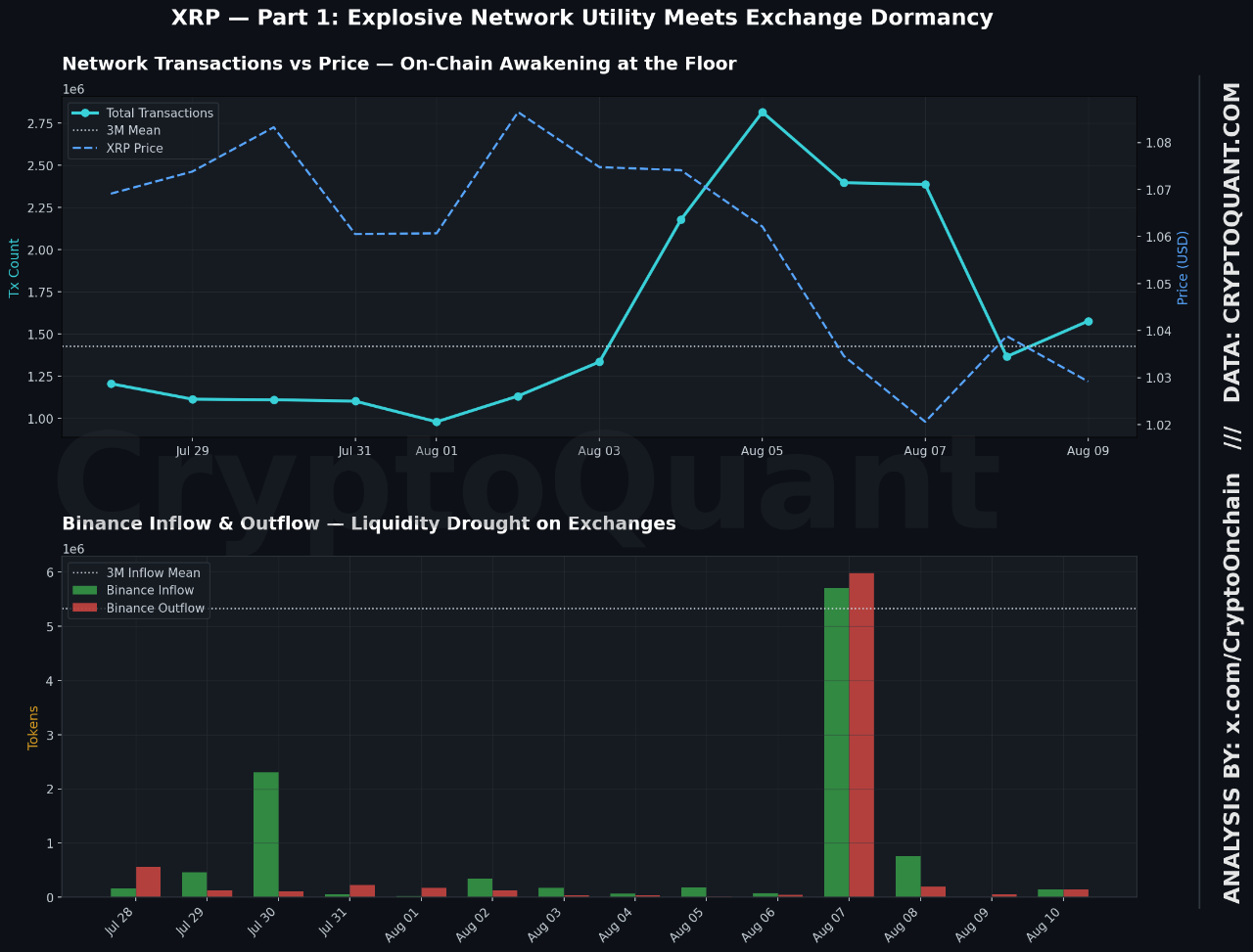
Network activity has risen massively while activity on centralized exchanges has declined. CryptoQuant analyst CryptoOnChain highlighted this, and noted that the pattern could indicate that XRP has entered a bottom-building phase.

XRP On-chain Activity Spikes

Notably, XRP closed at $1.039 on Aug. 8, as it tested the lower boundary of its six-month range. The price had remained under pressure throughout the previous week, falling from the $1.08 area toward $1.02-$1.03. Yet, while the price was losing ground, activity across the XRP network was moving higher.

As confirmed by The Crypto Basic, the network saw 2.6 million successful payments and recorded more than 2.8 million transactions on Aug. 5, an 86% increase week over week and more than 81% above the 30-day baseline. 

Activity remained elevated over the following days, with daily transactions ranging between 1.3 million and 2.8 million during the past week. 

XRP On-chain Activity Spikes CryptoQuant
XRP On-chain Activity Spikes | CryptoQuant

As a result, the seven-day average moved above the six-month average of 1.83 million transactions. Active accounts also rose by more than 5% over 30 days, confirming that people continue to use the network despite XRP’s weak price.

Exchange Activity Moves in the Opposite Direction

Meanwhile, Binance deposit addresses dropped by roughly 96% against their monthly and quarterly baselines. Also, inflows fell 79%, and outflows declined 85% compared with their respective 90-day averages.

This created a gap between on-chain activity and exchange activity. Essentially, XRP’s network is handling a much higher level of activity, yet fewer tokens are moving through exchanges. 

This could mean that selling pressure from exchange-related activity has eased, since fewer XRP tokens are reaching exchanges where holders can sell them. However, the data alone does not confirm that investors have entered a broad accumulation phase.

The derivatives market also shows that speculation has cooled. XRP’s Open Interest declined from about $403 million on July 28 to $391 million on Aug. 8. The leverage reading fell to 0.150, down from a previous high of 0.190. XRP also saw a $3.4 million long liquidation on Aug. 7, when the price dropped to $1.02.

By the following day, funding rates had returned to positive territory at +0.008. This suggests that the market had cleared out weaker long positions without triggering a major wave of panic shorting. 

XRP Still Faces a Major Test at $1

These developments give XRP some of the conditions associated with a potential bottom-building phase. The token has tested support near the bottom of its range, leverage has fallen, exchange flows have weakened, and actual on-chain activity has increased. 

When network activity rises while exchange activity falls at a range low, the pattern can help create a base for localized accumulation instead of another round of capitulation.

However, price action has yet to confirm that scenario. Currently, XRP trades at around $1.007, down 2.5% intraday, as the broader crypto market pulled back and Bitcoin fell below $64,000. Regulatory concerns added to the pressure after the Senate failed to pass the Clarity Act before recess.

The picture also remains weak. All four daily moving averages sit above XRP, which gives bulls several resistance levels to overcome. The first hurdle is $1.036. Above that, the short-term moving averages around $1.07 and $1.09 could limit any recovery, followed by stronger resistance at $1.18.

On the downside, the $0.99-$1.00 zone remains the first major test. A daily close below $1.00 could send XRP toward $0.94, with the wider $0.94-$0.86 demand zone serving as the next major support area.

Nokia bStock Falls 4.25% as NOK Extends Four-Day Decline

Nokia bStock fell 4.25% over 24 hours as the company’s US-listed shares extended their correction from a June record.

In Binance market data reviewed by The Crypto Basic, Nokia bStock (NOKB) was tracking weakness in Nokia’s New York Stock Exchange-listed American depositary shares.

NOK closed Monday at $9.13, down $0.23, or 2.46%, from Friday’s $9.36 close. The stock traded between $9.12 and $9.52 and recorded its fourth consecutive daily decline.

No new earnings release, profit warning, analyst downgrade or material company announcement preceded the selloff. The most defensible explanation is that NOKB followed the underlying Nokia shares as investors continued taking profits following an exceptional AI-driven rally.

The broader correction is also occurring as the market weighs Nokia’s strong AI and cloud growth against restructuring expenses, negative quarterly free cash flow and weaker reported earnings.

Nokia Stock Extends Its Correction

Nokia’s decline was considerably larger than Monday’s losses across the broader US market. The Nasdaq Composite fell 0.32%, while the Dow Jones Industrial Average declined 0.11%.

Monday’s close left Nokia approximately 47.7% below its 52-week intraday high of $17.45, reached on June 3. However, NOK remained around 40% above the $6.51 level at which it began 2026.

The stock has therefore not been falling throughout the year. Nokia experienced an extraordinary first-half rally before entering a sharp correction from its June peak.

That rally was supported by growing investor interest in Nokia’s optical-networking and data-center businesses, which provide infrastructure used by cloud companies and AI developers.

Nvidia’s $1 billion investment also contributed to Nokia’s repricing. In October 2025, Nvidia agreed to purchase Nokia shares at $6.01 each as part of an AI-RAN partnership focused on AI-native mobile networks and the transition from 5G to 6G.

By June, Nokia shares had risen to nearly three times Nvidia’s purchase price. The subsequent decline has removed a substantial portion of that rally.

Nokia’s Q2 Results Were Mixed

Nokia’s latest financial report contained both strong underlying growth and significant reported expenses.

Second-quarter revenue increased 8% year over year to €4.815 billion, or 9% on a constant-currency basis. Comparable operating profit rose 18% to €434 million, while comparable operating margin improved from 8.3% to 9%.

However, accelerated restructuring reduced Nokia’s reported results.

The company recorded a €50 million operating loss, compared with a €147 million profit one year earlier. Reported profit for the period fell 95% from €96 million to €5 million, while diluted earnings per share declined from €0.02 to zero.

The difference between Nokia’s comparable and reported performance largely reflects restructuring expenses, acquisition-related costs, amortization and asset impairments.

These results were released on July 23 and therefore were not a new catalyst on Monday. Nevertheless, they remain relevant as investors reassess Nokia’s valuation following the first-half rally.

Restructuring and Cash Flow Remain Concerns

Nokia recorded negative free cash flow of €732 million during the second quarter as comparable operating profit was offset by working-capital outflows, restructuring payments and capital expenditures.

The company expects approximately €800 million in restructuring-related charges during 2026, with associated cash outflows of between €700 million and €800 million.

Those expenses include the completion of Nokia’s existing cost-reduction program, the integration of its China operations and additional restructuring primarily in Europe.

Nokia expects its original restructuring program to produce between €800 million and €1.2 billion in annual savings and says it is tracking toward the upper end of that range. However, the near-term charges continue to weigh on reported earnings and cash generation.

The company’s revised 2026 comparable operating-profit range also requires context. Nokia increased the range from €2 billion–€2.5 billion to €2.1 billion–€2.6 billion, but described the adjustment as technical rather than operational.

The change resulted from classifying two businesses as discontinued operations. Nokia stated that its underlying business outlook had not changed.

AI and Cloud Demand Remains Strong

The correction has not been accompanied by evidence that Nokia’s AI networking business is weakening.

Second-quarter sales to AI and cloud customers more than doubled, rising 105% on a constant-currency basis. Nokia also reported €2.8 billion in AI and cloud orders and expects approximately half of that amount to convert into revenue within 12 months.

Network Infrastructure revenue increased 12%, supported by 20% growth in Optical Networks and 16% growth in IP Networks. The segment’s operating profit climbed 42% to €166 million.

Mobile Infrastructure produced less impressive profit growth. Its revenue increased 7% at constant currency, but operating profit remained unchanged at €310 million. Operating margin declined from 12.2% to 11.6%.

Nokia also identified component availability as the main industry constraint affecting its ability to meet AI-related demand.

The figures show that Nokia continues to benefit from the expansion of AI infrastructure. However, restructuring costs, negative quarterly cash flow and uneven segment profitability remain important financial pressures.

Why NOKB Fell More Than Nokia Stock

NOKB’s 4.25% decline was larger than Nokia’s 2.46% daily loss because the two percentages covered different periods.

The 2.46% decline in NOK compares Monday’s official closing price with Friday’s close. Binance’s figure measures NOKB over a continuously moving 24-hour window, which includes trading outside the NYSE’s regular session.

NOKB is designed to track the economic performance of Nokia’s US-listed shares. However, it is a tokenized certificate rather than direct ownership of Nokia stock. It can also temporarily trade at a premium or discount because of liquidity, spreads and demand within its own order book.

The different percentage changes therefore do not necessarily indicate that NOKB became disconnected from the underlying shares.

Why Nokia Stock Price Is Declining

No newly disclosed corporate event fully explains Monday’s decline.

The immediate market evidence shows Nokia extending a four-session losing streak and surrendering more of its earlier AI-driven rally. NOKB followed that weakness through its connection to the underlying shares.

The broader correction reflects a market reassessment of Nokia’s valuation. Investors are weighing rapid AI and cloud growth against several financial pressures:

  • Nokia remains approximately 47.7% below its June intraday high.
  • Reported quarterly profit fell 95% to €5 million.
  • Free cash flow was negative €732 million.
  • Restructuring-related charges are expected to reach €800 million in 2026.
  • The higher operating-profit range was a technical revision, not an operational upgrade.
  • Mobile Infrastructure margins declined despite higher revenue.

None of these issues was newly announced on Monday. The most accurate conclusion is therefore that Nokia shares and NOKB are continuing a post-rally correction rather than reacting to a fresh deterioration in the company’s business.

Nokia’s AI and cloud operations remain firmly in growth mode. The key question is whether that expansion can produce sufficient earnings and cash flow to justify the valuation reached during the stock’s rapid first-half rally.

UK Residents Can Now Buy Shiba Inu Via SHIB-Friendly Platform Robinhood

0

Robinhood has expanded its cryptocurrency trading services to the United Kingdom, creating another potential avenue for Shiba Inu (SHIB) adoption among UK investors.

The trading platform announced the launch on Monday, August 10, 2026, confirming that eligible UK customers can now trade cryptocurrencies like Shiba Inu directly through the Robinhood app, alongside stocks and shares ISAs, equities, options, and futures.

Notably, Robinhood will provide the service through Bitstamp, the UK-registered crypto-asset service provider it acquired in 2024. 

Robinhood Launches Zero-Fee Crypto Trading in the UK

Robinhood said its UK crypto service will offer zero-trading fees, while customers will also avoid account maintenance and custody fees. The company positioned the service as a low-cost alternative to traditional UK crypto platforms, particularly those that rely on complex pricing structures and wider spreads.

The rollout will initially reach eligible UK customers this week and will provide access to more than 50 cryptocurrencies. The lineup includes major assets such as Bitcoin (BTC), Ethereum (ETH), XRP, and Hyperliquid (HYPE). 

Robinhood’s Support for SHIB 

More importantly for the Shiba Inu community, Robinhood’s broader cryptocurrency ecosystem already supports SHIB alongside other popular assets, including Cardano (ADA), Solana (SOL), Avalanche (AVAX), and Dogecoin (DOGE).

Meanwhile, Robinhood remains a major platform for SHIB trading, with substantial amounts of the meme coin flowing through its ecosystem. The platform has also featured in notable on-chain transactions involving Shiba Inu.

For example, an investor transferred 210 billion SHIB to Robinhood, highlighting the scale of capital that can move through the platform. Furthermore, a Robinhood-associated address ranks among the largest single holders of SHIB. According to Etherscan data, the address holds 39.27 trillion SHIB, representing about 3.92% of the token’s total supply. 

Robinhood Shiba Inu holding
Robinhood Shiba Inu holdings

UK Expansion Could Broaden SHIB’s Reach

Robinhood’s UK expansion could benefit Shiba Inu by giving more retail investors direct access to SHIB through a widely used, all-in-one investment platform.

The timing also appears significant because the UK’s cryptocurrency regulatory framework is undergoing major changes. In June, the Financial Conduct Authority (FCA) finalized a package of rules for the crypto sector covering areas such as financial resilience and market conduct.

At the same time, the FCA’s 2025 consumer research showed that 8% of UK adults owned crypto-assets, down from 12% in the previous year’s research. However, crypto ownership remains widespread enough to represent a substantial potential market for platforms offering regulated access to digital assets. Crypto awareness also remained extremely high at 91% of the population.

Moreover, the FCA found that 73% of crypto users acquired their assets through centralized exchanges. This figure could be particularly relevant to SHIB because Robinhood’s expansion gives UK investors another centralized platform through which they can access the token.

Consequently, Robinhood’s UK launch could strengthen SHIB’s visibility in a market where crypto awareness remains high and centralized exchanges continue to play a dominant role in asset acquisition. Robinhood’s expansion also follows its registration with the FCA, strengthening the company’s regulatory footing as it grows its digital-asset operations in the UK. 

Shiba Inu Loses 691 Holders in Six Days as SHIB Faces Renewed Bearish Pressure

0

Shiba Inu has recorded a sharp decline in its holder count over the past six days, raising fresh concerns about recent address growth and the health of the broader SHIB community.

According to Etherscan data, Shiba Inu’s total holder count climbed to 1,678,991 on August 5 after gaining significant momentum throughout July and finally surpassing the 1.67 million mark. However, the metric reversed the following day.

Shiba Inu Holder Count Drops 1,424 Addresses in One Day

Etherscan data shows that SHIB’s holder count fell to 1,677,567 on August 6, representing a loss of 1,424 addresses within just 24 hours.

Since then, the metric has recovered some of its losses. At the time of writing, Etherscan records 1,678,300 addresses holding SHIB. Despite this recovery, the current figure remains 691 addresses below the 1,678,991 recorded on August 5. 

Shiba Inu Addresses
Shiba Inu Addresses

WoofSwap Controversy Raises Questions Over Holder Growth

It bears mentioning that Shiba Inu’s total address metric has faced controversy in recent weeks.

The metric came under scrutiny after Shiba Inu recorded an unusually rapid increase in holders earlier in July. More than 75,000 addresses joined the ecosystem within just three days, prompting on-chain observers to investigate the sudden surge.

The investigation linked the unusual growth to decentralized exchange WoofSwap. According to community figure The Dark Shib, WoofSwap deployed a smart contract called TheShibBull that generated multiple SHIB addresses and sent one SHIB token to each wallet.

Since Etherscan counts addresses holding SHIB as holders, these wallets subsequently contributed to Shiba Inu’s overall holder count.

The development sparked debate within the Shiba Inu community, with users questioning whether artificially generated addresses should contribute to the project’s holder statistics.

Amid the controversy, WoofSwap announced that it would stop inflating Shiba Inu’s total address count and end the initiative. Nevertheless, it remains unclear whether the 691-address reduction since August 5 resulted from the removal of addresses associated with the WoofSwap initiative or from genuine users exiting their SHIB positions.

SHIB Gives Back Nearly All July Gains

Meanwhile, the decline in SHIB holders comes as the token continues to face bearish pressure.

Shiba Inu staged a strong rally toward the end of July, climbing from approximately $0.0000042 to nearly $0.000006 on July 26. However, the meme coin has since surrendered most of those gains as selling pressure returned.

At press time, SHIB was trading around $0.0000045, representing a 22.41% decline from its recent high of $0.0000058. The token has also fallen 3.32% over the past 24 hours and 8.87% over the past seven days.

Cardano Leadership Shake-Up Continues as Foundation CTO Steps Down

0

Cardano Foundation CTO Giorgio Zinetti will step down from his role at the end of August 2026, bringing his 2.5-year tenure with the organization to a close.

In a statement shared on X, Zinetti reflected positively on his time at the Foundation and expressed gratitude to the people he worked with throughout his tenure. He also revealed that he plans to take a few weeks off after his departure to welcome his daughter before embarking on what he described as a new adventure in September.

Notably, Zinetti did not disclose details about his next role or organization, suggesting that he will reveal more about his plans in the coming weeks.

Cardano Foundation Confirms Zinetti’s Exit

Shortly after Zinetti announced his departure, the Cardano Foundation confirmed that he will officially leave the organization on August 31.

The Foundation thanked Zinetti for his support and significant contributions to its work and the broader Cardano ecosystem since he joined as CTO in 2024. Interestingly, the organization reassured the Cardano community that his departure would not disrupt its broader strategy.

The Foundation said its Board and Executive team would continue to work closely with its technical and senior business development leaders. Furthermore, it reaffirmed its focus on enterprise adoption and efforts to strengthen Cardano’s connections with the wider world.

Departure Comes Amid Broader Cardano Leadership Changes

Zinetti’s announcement arrives as the Cardano community continues to discuss several leadership changes and departures across the ecosystem.

In recent months, multiple developments have raised concerns among some community members about the stability and sustainability of projects operating within the Cardano ecosystem.

For instance, TapTools announced in June 2026 that it would wind down its operations. The platform cited significant leadership departures, the loss of key technical expertise, and high infrastructure costs amid an extended market downturn.

Around the same period, major Cardano contributor Chicken announced his departure from the ecosystem after filing for bankruptcy. His exit further fueled concerns among some community members about the financial sustainability of ecosystem contributors and projects.

Meanwhile, EMURGO, one of Cardano’s founding entities, faced another major development after its SecondFi wallet suffered a significant hack. The incident prompted changes to some of EMURGO’s ecosystem responsibilities as the organization redirected resources toward community support and recovery efforts.

In August, EMURGO also announced its departure from the Yoroi DRep role and resignation from the Intersect Board. The organization subsequently shifted more attention toward community support while handing responsibility for Cardano’s participation at TOKEN2049 to the Cardano Foundation.

Against this backdrop, the Cardano Foundation’s follow-up statement appears intended to prevent Zinetti’s departure from being interpreted as evidence of broader organizational instability. The development had little impact on Cardano’s price, with ADA continuing to trade around $0.1960, the same level it held before the announcement.