
Home Blog Page 472

Analyst Says XRP is Cooking Something, Predicts Next Move

0

Ether Nasyonal, a prominent crypto analyst, suggests XRP is cooking something, identifying a critical demand zone on the 1-month chart.

He disclosed this in his latest XRP analysis, confirming his bullish disposition despite XRP’s current struggles. For context, after the sharp drop and immediate recovery on Oct. 10, XRP has failed to reclaim the $2.5 price level, much less the $3 psychological mark. Currently, the altcoin is down 14.8% this month.

Gathering Strength at the Demand Zone

However, Ether Nasyonal believes the next direction for XRP is upward. Specifically, he called attention to XRP’s price action on the 1-month timeframe, sharing an inverted chart that indicates that XRP is merely testing an important demand zone that could set the stage for a rally to new heights.

Notably, this demand zone rests between the $1.6 and $2 price levels. The area acted as resistance for XRP during the 2020/2021 bull run, capping XRP’s upsurge amid the SEC’s lawsuit against Ripple at the time. As a result, XRP only hit a peak of $1.96 in April 2021, failing to claim the 2018 all-time high.
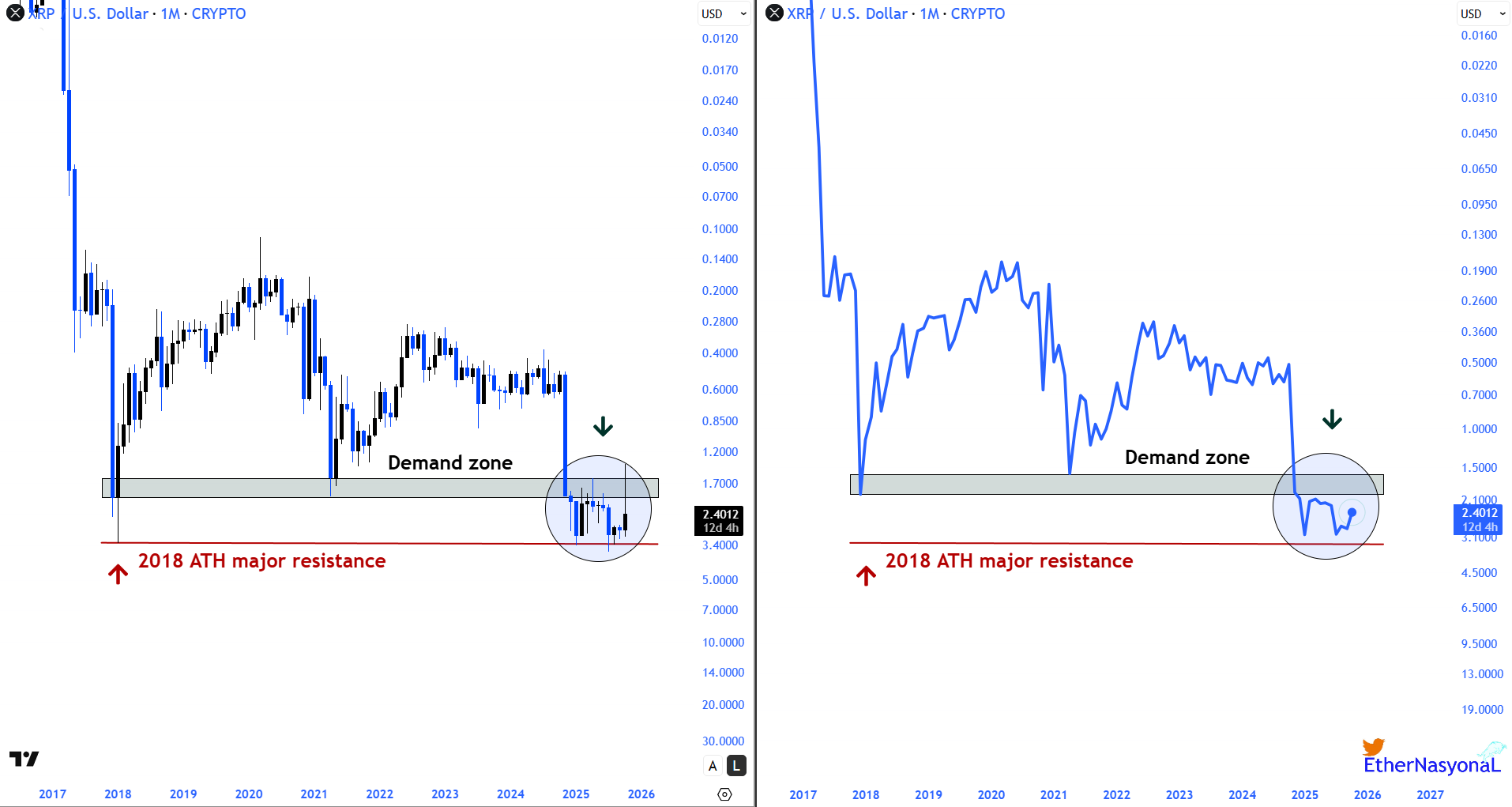
XRP Demand Zone and 2018 Resistance Ether Nasyonal
XRP Demand Zone and 2018 Resistance | Ether Nasyonal

Interestingly, following the election of President Donald Trump, XRP soared to retest this demand zone in November 2024. The next month, the rally continued, leading to a breach of the price level. After breaching the area, XRP skyrocketed to a new peak of $3.4 in January 2025 before facing resistance, which aligned with the 2018 all-time high.

Since then, XRP has been dropping to retest the demand zone around $1.6 to $2 whenever it attacks the ATH resistance above $3 and faces a roadblock. Ether Nasyonal believes the recent price crash was another retest of this demand zone, arguing that the next direction for XRP is likely upward.

“XRP Cooking Something”

According to him, XRP is currently cooking something as it lingers just above the demand zone. The market analyst suggested that the bulls are gathering strength at this critical level, insisting that the structure is clear despite confusion regarding XRP’s direction.

For XRP to sustain its upward push, it must first recover the $3 psychological price level, which it has traded below since Oct. 7. After this, the next level worth watching is the January 2025 high of $3.4, aligning with the 2018 ATH resistance. Once XRP breaches this area, it could target the new July 2025 peak of $3.66, allowing it to start eyeing new ATHs.

In a previous analysis, Ether Nasyonal identified a similar structure from an earlier cycle. Specifically, during the 2017/2018 run, XRP faced resistance at the December 2013 peak of $0.06, which repeatedly pushed it to a demand zone around $0.028. After XRP decisively breached the $0.06 resistance in May 2017, it soared to the $3.31 high by January 2018.

Historical Context
Historical Context

While Ether Nasyonal expects a similar run, he chose not to present any XRP price predictions. Interestingly, Santiment recently confirmed that amid the price struggles, XRP has been facing increased bearish sentiments. They noted that prices often go bullish once these bearish sentiments emerge.

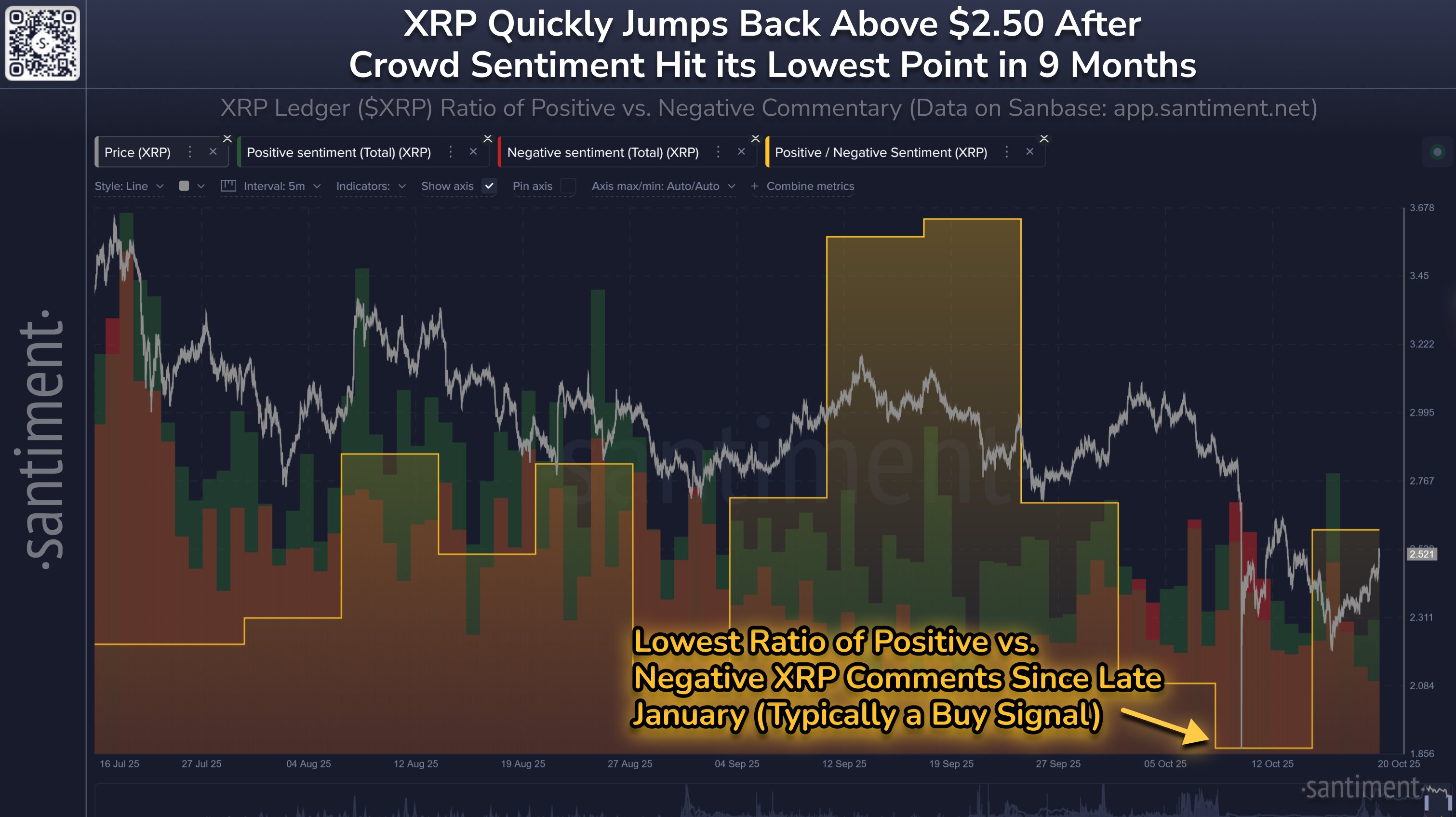
XRP Quickly Jumped Above $2.50 After Crowd Sentiment Hit 9-Month Low

0

XRP did not follow the crowd as usual, as it quickly rebounded from recent price lows despite increasing negative sentiments and FUD.

Santiment highlighted that the morale of retail traders grew low on XRP, evident in the strong negative sentiments around the asset. The market intelligence firm noted that XRP recorded its lowest ratio of positive to negative comments since late January during the famous October 10 market crash.

Crowd Selling and XRP FUD Escalated

Notably, Santiment further identified that the 9-month sentiment low sparked crowd XRP selling and widespread fear, uncertainty, and doubt (FUD). Many sold XRP at a loss during the crash, with predominant market sentiments suggesting further downsides were likely.

XRP Crowd Sentiment Hits 9-Month Low | Santiment

But what did XRP do? It rebounded instead. Santiment noted that such negativity was a buy signal, as prices usually go the opposite way to retail expectations.

The analysis proved true, with XRP bouncing from the lows of $1.327 on October 10 to reclaim $2.5 on Monday. Notably, XRP also recovered from the drop to $2.20 on October 17, showing bullish momentum while crowd sentiment suggested otherwise.

This contrarian play, as Santiment regularly highlights, aligns with the popular quote from Baron Rothschild, who advised to “buy when there is blood in the streets.” XRP has historically rebounded when the crowd is overly bearish, and this time would be no different.

XRP Whales on the Sideline

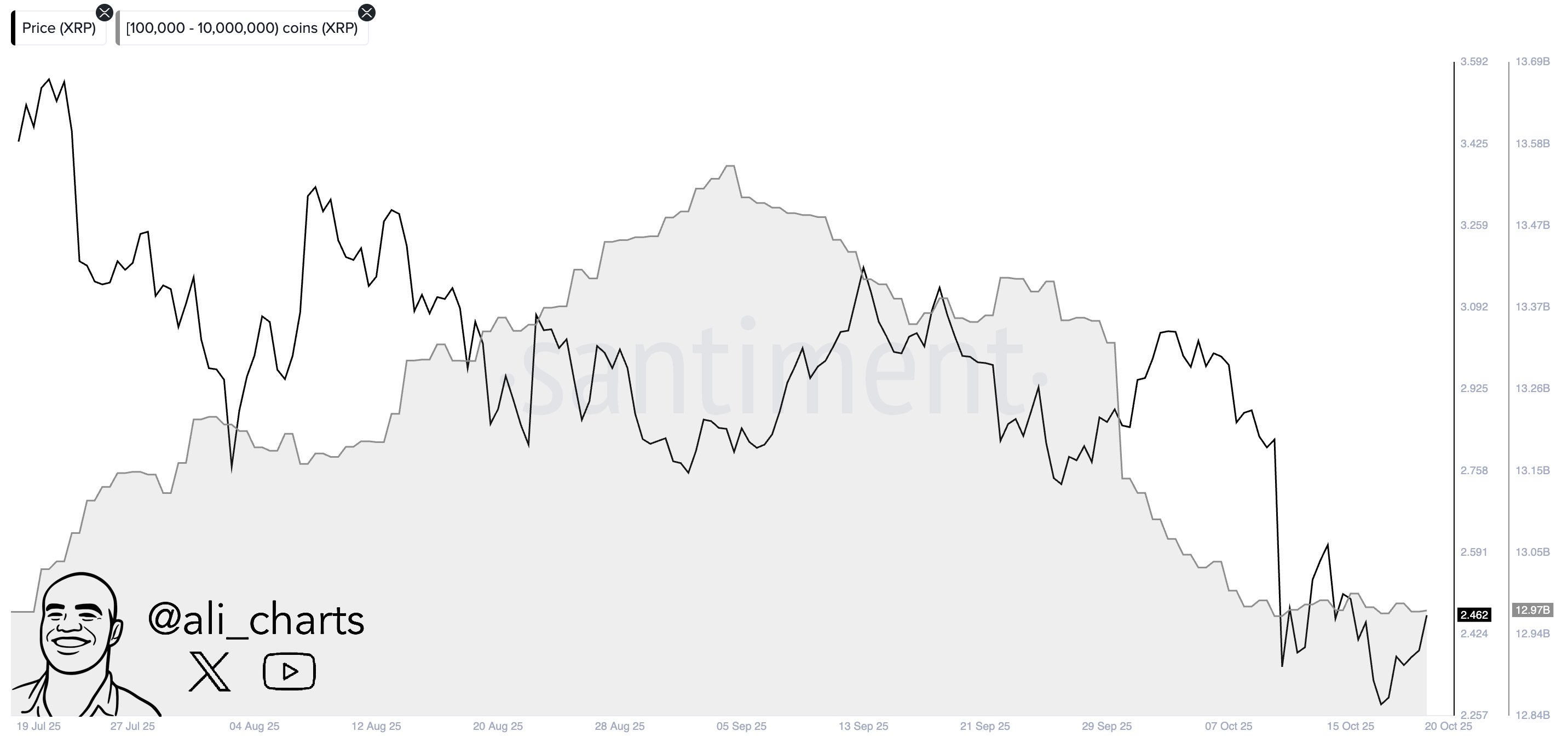
While retailers are panicking, whales have remained unperturbed. Additional Santiment data, brought forward by Ali Martinez, shows that large XRP holders have stayed on the sidelines as prices consolidate.

They have not panicked and sold like retailers or bought into the fear in the past two weeks. The inactivity suggests caution among whales, who appear keen on first observing the market development before any action.

XRP Whales on the Sideline | Santiment

Meanwhile, XRP is trading at $2.42 at press time, down 2.82% since today, having lost the $2.55 level attained yesterday. Nonetheless, the token has rebounded 76% from the October 10 low and 10.5% from the Friday floor price.

More Near-Term XRP Highs

Despite the unclear price actions, analysts have remained resolute on higher prices for XRP in the near term. For context, Whale.Guru predicted that XRP would reach a new all-time high of $5 before the end of this year. He expects XRP to follow Bitcoin’s lead, asserting that it would rally to $250,000.

Ash Crypto sees XRP higher at $8 by the end of the year but still has a lower range of $5. He also based his prediction on the possibility of a Bitcoin rebound to between $150,000 and $200,000.

Coinbase CEO Brian Armstrong Confirms $25M Purchase of “UpOnly” NFT

0

Coinbase CEO Brian Armstrong has confirmed purchasing the “UpOnly” NFT from crypto trader Cobie for $25 million.

The acquisition marks the potential return of the once-popular crypto podcast after a three-year break. In a post on X, Armstrong wrote, “The rumors are true, we bought the NFT. UpOnlyTV is coming back.”

On-chain data shows Coinbase paid 25 million USDC to Cobie for the token. The purchase effectively revives the UpOnlyTV podcast, which had been inactive since 2022. 

The high-profile transaction immediately drew attention across the crypto community, as few expected the NFT, created as part of a lighthearted challenge, to sell.

Background: The Rise and Fall of the UpOnly Podcast

The UpOnly podcast, co-hosted by Cobie (Jordan Fish) and Ledger, gained popularity during the 2021 bull run for its candid discussions with major crypto figures. Guests often included traders, project founders, and fund managers who debated emerging blockchain trends. 

However, the show went offline around 2022, following the FTX exchange collapse and the subsequent crypto market downturn. For nearly three years, fans had speculated about its possible return, but Cobie had expressed little interest in restarting it until now.

A Burn-to-Revive NFT Challenge

In May 2025, Cobie minted an NFT tied to the podcast and introduced a unique challenge. He declared that the show would return only if someone burned the NFT. 

“The power is now stored within this NFT,” Cobie wrote at the time on X, noting he had set an absurdly high price “too large for anyone to buy.” 

He also clarified that ownership of the token would not include editorial or sponsorship control over the show.

Coinbase Overpays, Revives the Show

Despite the intended joke pricing, Coinbase went ahead and bought the NFT, reportedly paying more than the listed amount. The NFT’s description humorously grants its holder the right to compel Cobie and Ledger to produce eight new episodes of UpOnlyTV. 

It also allows the creators to “call the buyer idiots” or even ignore them entirely during production. Though clearly written in jest, these terms are now legally tied to a $25 million token.

Cobie Reacts with Humor

After news of the purchase broke, Cobie reacted with surprise and humor. In a lighthearted post, he joked that he had aged since the show’s first run and might rename it “Unc Only.”

“It’s been three years since UpOnly ended,” he wrote. “I was in my 20s when it started, now I have grey hair”. He quipped about spending the NFT proceeds on cosmetic surgery before the show’s return.

What’s Next for UpOnlyTV 

Per the NFT’s conditions, Cobie and Ledger are now obligated to produce eight new episodes of UpOnlyTV. While no release schedule has been shared, Armstrong’s announcement indicates a likely return soon. 

The move represents one of the largest NFT-linked media revivals in crypto history, blending blockchain ownership with entertainment.

Research Firm Says XRP is Extremely Obvious, Just Requires Patience

0

Sistine Research, a digital asset analysis platform, has summed up the growing institutional narrative around XRP in one concise statement.

In a tweet highlighting the involvement of firms like GTreasury, Evernorth, Rail, Hidden Road, and SBI Holdings in the XRP ecosystem, it remarked: “XRP is extremely obvious, just requires patience.”

The remark reflects a growing consensus that Ripple’s recent strategic moves are setting the stage for a financial transformation with XRP at its core.

Ripple’s Expanding Institutional Web

Throughout 2025, Ripple has quietly constructed one of the most ambitious institutional ecosystems in digital finance. The company’s acquisitions and partnerships now span corporate treasury systems, global payments, and institutional clearing.

Among its latest initiatives, Evernorth Holdings — backed by Ripple and SBI Holdings — announced a $1 billion SPAC merger to form the world’s largest institutional XRP treasury.

The majority of the funds will be used for open-market XRP purchases. At the same time, Ripple executives including Brad Garlinghouse, David Schwartz, and Stuart Alderoty will serve as advisers.

Ripple Chairman Chris Larsen personally contributed 50 million XRP to support the launch, calling Evernorth “the missing link” in XRP capital markets.

Ripple chairman's commentary
Ripple chairman’s commentary

Bridging Treasury and Payments with GTreasury and Rail

Meanwhile, just last week, Ripple acquired GTreasury for $1 billion, marking its official entry into the $120 trillion corporate treasury market.

The move will allow Ripple to integrate blockchain liquidity and instant payments directly into systems used by over 1,000 multinational corporations.

This acquisition follows Ripple’s $200 million purchase of Rail in August. Rail is a stablecoin payments company handling about 10% of global B2B stablecoin transactions.

Together, these moves position Ripple to dominate both fiat and digital liquidity flows, using XRP and its stablecoin, RLUSD, as complementary assets in institutional settlements.

Connecting to the $11 Trillion U.S. Treasury Market via Hidden Road

Moreover, Ripple’s April acquisition of Hidden Road, a prime brokerage firm, added yet another layer to its expanding reach. Hidden Road joined the Fixed Income Clearing Corporation (FICC) earlier this year, granting it access to the $11 trillion U.S. Treasury clearing market.

This development effectively links Ripple’s blockchain infrastructure with one of the largest financial systems in the world.

While XRP isn’t directly used for settlement in this context, it remains integral to Ripple’s technology stack through transaction fees and ledger operations. It provides the foundation for transparent, near-instant post-trade processing.

XRP is “Obvious”

Taken together, these developments illustrate why Sistine Research calls XRP’s future “extremely obvious.”

The comment highlights that Ripple’s strategy is not built on speculation or hype, but on real-world integrations across payments, liquidity, and treasury markets.

In other words, the company is building the rails for a new financial system, one where XRP operates quietly beneath the surface.

As Sistine Research suggests, it’s only a matter of patience before the market recognizes the full scope of XRP’s role in global finance — and the potential impact on its price.

Cardano Daily MACD Nears Golden Cross—ADA Pumped 60% the Last Time

0

History suggests there could be a substantial upward move for Cardano in the coming days, as the MACD indicator flashes bullish signs on the daily chart.

Cardano has started today poorly, joining the rest of the market. After three successive days of persistent price uptrend, ADA has corrected nearly 4% on Tuesday to give back a considerable amount of the gains.

Cardano MACD Golden Cross Inches Closer

Amid the market uncertainties, the Moving Average Convergence Divergence (MACD) indicator is flashing a glimpse of optimism for Cardano. Top pundit Lark Davis identified this in his recent analysis, tipping Cardano to rally considerably.

He noted in the X post that Cardano is about to print a MACD golden cross below zero on the daily chart. For the uninitiated, this bullish cross occurs when the 12-period EMA MACD line moves above the 26-period EMA signal line.

Notably, such crossing follows a dwindling red bar, suggesting the slow exhaustion of bearish momentum. If the golden cross occurs, history shows ADA could rally on that account.

Cardano Rallied 60% the Last Time

For context, Cardano last experienced such crossing below zero in June when the price consolidated around the $0.53 support area. A few days after the cross, the token began a 62% price surge, peaking at $0.93 on July 21.

Notably, a similar surge would take Cardano well above bearish territory. For context, Cardano trades at $0.641 at the time of writing. A 62% rally from the current level would take ADA to $1.04.

Crucial Resistance Zone Ahead

Nonetheless, for a sustained rally, Davis noted that Cardano would have to break above two crucial resistance zones. One of them is the resistance around $0.74 to $0.77, a former support that could not hold the October 10 capitulation.

Since falling below this level on October 10, ADA has struggled to reclaim it, with a move to $0.73 a week ago followed by a massive rejection. If it overcomes this resistance, the next zone lies around $0.80.

Remarkably, this aligns with a descending trendline dating back to the August 14 peak of $1.020. Cardano has failed to break above this neckline and defying it would further strengthen an upward momentum to much higher prices.

Cardano Analysis | Lark Davis

From the current market price, an increase to $0.77 and $0.77 marks a 15.4% and 20% growth, respectively. Meanwhile, Cardano would have to rally by 24.8% to reach the $0.80 resistance.

Ripple Chairman Dumps 50M XRP on Retail Investors, Experts Debunk Claims

0

XRP community figures have pushed back against recent claims by CryptoQuant’s analyst Maartunn, who suggested Ripple Chairman Chris Larsen was dumping his tokens on retail investors. 

Maartunn took to X yesterday to alert the XRP community that the Ripple Chairman had transferred 50 million XRP from his wallet. At the time of the post, the transaction was valued at approximately $120 million.

Notably, he suggested that while XRP investors continue to hold their tokens, Larsen is cashing out, offloading his tokens to retail clients. 

Maartunn is known for consistently tracking on-chain movements linked to Larsen. He had previously alerted XRP community members about XRP-related transfers from Larsen’s wallets. 

In July, after the Ripple co-founder transferred 200 million XRP across four transactions, Maartunn suggested that Larsen was using retail investors as an exit liquidity. He urged investors to have a second thought before buying XRP or risk becoming Larsen’s exit liquidity.

 XRP Community Figures Debunk Claim 

However, his latest insinuation that Larsen was “cashing out” while retail investors were “holding the bag” was swiftly dismissed by prominent XRP enthusiasts. 

Community figure Vet indicated that critics are quick to react to headlines about Larsen’s 50 million XRP transfer without understanding the real motive behind the move.

Meanwhile, pro-XRP legal expert Bill Morgan clarified that Larsen’s transaction was “cashed straight” into Evernorth, the largest XRP treasury company. Morgan added that he intends to continue holding his XRP, reinforcing his confidence in the token. 

Real Motive Behind Larsen’s 50M XRP Transfer 

The development follows the public launch of Evernorth, the world’s largest XRP treasury company. Evernorth, which debuted yesterday following a business agreement with Armada Acquisition Corp II, disclosed plans to raise $1 billion in gross proceeds, from notable investors like Ripple and SBI Holdings. 

As reported earlier, most of the funds will be used to purchase XRP from the open markets, and the treasury company will hold the tokens. Notably, Larsen announced an investment of 50 million XRP in support of the project. 

Interestingly, he noted that on-chain watchers would notice a large XRP transfer from his wallet, clarifying ahead of time that the transfer was related to his investment in Evernorth, not a sell-off. 

A few hours later, Maartunn still suggested that Larsen was cashing out while XRP holders continued holding the bag. However, prior statements from Larsen and subsequent announcements from Evernorth suggest otherwise. 

Wyoming Launches Multi-Chain Test of FRNT Stablecoin Across Seven Blockchains

0

The State of Wyoming has initiated a large-scale blockchain test involving 700,000 Frontier (FRNT) stablecoins, deploying 100,000 tokens each on seven major blockchains.

Data from Dune Analytics researcher Marcov confirmed that the rollout took place on October 20 across Ethereum, Solana, Avalanche C-Chain, Arbitrum, Optimism, Base, and Polygon.

This deployment marks the first major on-chain activity since Wyoming launched the FRNT stablecoin on mainnet in August. The program positions Wyoming as the first U.S. state to issue a government-backed stablecoin.

State-Issued Stablecoin With a Public Purpose

The Frontier Stable Token (FRNT) aims to serve more than a technical function. According to the Wyoming Stable Token Commission, revenue from FRNT’s reserve yields will be directed into the state’s education fund. 

Governor Mark Gordon described this as a “modern revenue stream” that can support public services without raising taxes.

Anthony Apollo, Executive Director of the Commission, emphasized the innovation behind the project, saying that Wyoming aims to prove governments can innovate as well as regulate.

Backed by U.S. Assets and Transparent Oversight

Each FRNT token derives its value from an equal amount of U.S. dollars and short-term Treasuries safely managed in trust. Wyoming law also requires 2% overcollateralization, adding a buffer beyond standard stablecoin reserves.

Franklin Advisers manages the reserve portfolio, while The Network Firm conducts monthly attestations and audits. These moves aim to provide transparency and stability to the project and reassure both regulators and investors.

Testing Multi-Chain Infrastructure

By distributing the same number of tokens across multiple chains, Wyoming is testing cross-chain functionality and network resilience. The multi-chain strategy also aims to ensure accessibility for users and developers operating in different blockchain ecosystems. 

Officials confirmed this approach had been planned since the token’s August launch announcement.

Public Rollout Faces Regulatory Delays

Wyoming initially planned to make FRNT available to the public through Kraken, a Wyoming-based exchange, starting with the Solana blockchain.

However, regulatory reviews have slowed the public rollout despite technical readiness. Apollo said earlier this year that further compliance checks and beta testing would be required before launch.

Early Pilot Results Show Efficiency Gains

In July, Wyoming ran a pilot with Hashfire on the Avalanche network. The trial demonstrated significant efficiency improvements, cutting contractor payment times from 45 days to a few seconds.

The result supported the state’s goal of using blockchain for faster and more transparent financial operations.

Next Steps and Market Outlook

The Wyoming Stable Token Commission has not announced a timeline for public distribution or further expansion beyond the current addresses. Commissioner Joel Revill, also CEO of Two Ocean Trust, said that market forces will shape how the token is used.

Wyoming plans to release monthly transparency reports and audit results to ensure continued public accountability.

For now, the FRNT deployment remains a testing milestone, marking an unprecedented step in how U.S. state governments engage with blockchain technology.

Expert Says 1.54M Shiba Inu Holders Remain Hopeful, But Key Challenges Persist

0

A popular market commentator has highlighted the increasing number of wallets holding Shiba Inu, underscoring continued user interest in the token. 

Despite heightened market volatility over the past few weeks, the number of wallets holding SHIB has continued to grow modestly. In a recent post on X, community figure Etherscan_SHIB noted that the number of Shiba Inu on-chain holders has increased.

Citing data from Etherscan, the pundit revealed that the number of addresses holding SHIB rose by 0.01% over the past day to 1,546,558 (1.54 million). As of press time, the figure had climbed further to 1,546,786 (1.54 million), representing a daily increase of 0.003%.

Shiba Inu on chain holders

Although the growth is modest, the steady rise in wallet count suggests that new investors continue to enter the ecosystem while existing holders remain committed. This reflects the community’s enduring faith in the project.

As a result, Etherscan_SHIB asserted that the broader Shiba Inu ecosystem currently has strong momentum and encouraged users to keep building and growing together.

Shiba Inu Dips Below $0.00001

Notably, the growth in Shiba Inu’s address count comes as SHIB’s price continues to dip amid the broader market downturn. Shiba Inu has repeatedly dropped below the $0.00001 since October 10 and has been struggling to recover.

At press time, SHIB was trading at $0.000009951, with a market capitalization of $5.86 billion. The token has declined by 47.52% over the past year, 52.9% year-to-date (YTD), and 23.28% over the past 30 days. It has also fallen by 2.47% and 8.34% in the daily and weekly timeframes, respectively.

While the steady increase in on-chain holders signals renewed confidence in Shiba Inu’s long-term potential, uncertainty remains about whether SHIB can reclaim its former glory—when its price spiked by hundreds of percent in a matter of days.

Factors Preventing a Potential Rally

One of the biggest challenges hindering SHIB’s growth is its enormous token supply. Despite ongoing token burns, Shiba Inu still has a massive circulating supply of approximately 589 trillion tokens. Critics argue that a supply of this scale could obstruct future price rallies.

With a circulating supply of 589 trillion tokens, Shiba Inu would require a market cap of $52.09 billion to reach its all-time high (ATH) of $0.00008845.

Although this valuation is modest compared to that of more established tokens, many believe SHIB currently lacks the momentum to reach that milestone.

Team Leadership Style Hindering Institutional Adoption

Some community members believe Shiba Inu’s anonymous leadership has deterred institutional adoption. The identities of the project’s core team remain undisclosed, a feature once celebrated for promoting decentralization during SHIB’s early days.

However, as Shiba Inu has evolved into a multi-billion-dollar ecosystem, many now argue that increased transparency and accountability are crucial for attracting institutional investors.

Lack of New Utility

Shiba Inu has made significant progress in rolling out utility projects, particularly Shibarium, to drive adoption. However, these projects have not achieved the desired result.

To reignite momentum and clear the path for a major rally, the team needs to introduce more real-world use cases.

Rising Competition

Shiba Inu is now facing intense competition from rivals. These projects are evolving fast, attracting investors’ attention to them.

As a result, SHIB must continue to innovate to remain relevant. Notably, the team should prioritize completing existing initiatives, such as the NFT marketplace and metaverse, before launching new ones.

Team’s Support for Other Projects

Some team members have previously expressed support for other crypto projects, diverting investor focus and capital away from SHIB. Such actions undermine Shiba Inu’s growth prospects and weaken investor confidence.

To ensure long-term stability and growth, the team must show stronger commitment to the Shiba Inu ecosystem and align their efforts toward its sustained success.

Weak Community Momentum

Despite the rise in on-chain holders, the broader community momentum that once fueled SHIB’s rallies has sharply declined.

Investors are less active on social media in promoting SHIB or attracting new users, while many formerly influential supporters have shifted their focus to rival projects. For Shiba Inu to regain its previous strength, this lost community energy and enthusiasm must be revived.

Expert Reveals the Role XRP Would Play with Bitcoin Becoming the Strategic Reserve

0

Coach JV, a financial commentator and investor, has shared what he believes could be the role of XRP in a financial scene where Bitcoin becomes the strategic reserve.

With the Donald Trump administration rapidly warming up to crypto, market commentators believe the industry has an opportunity to cement its position in the American financial scene and by extension, the global one. While Bitcoin (BTC) has been a major focus, XRP proponents believe the token also has a role to play in the coming future.

Bitcoin Becoming Strategic Reserve

It is against this backdrop that Coach JV recently presented a commentary suggesting that XRP could shine as a liquidity rail. According to him, while the government is distracting the masses with politics, they are making the “real power moves” behind the scenes to cement crypto’s presence in global finance.

Notably, Coach JV suggested that in the coming future, Bitcoin would become the strategic reserve. For context, the Trump administration already established a strategic Bitcoin reserve in March after President Trump signed an executive order to this effect. 

However, U.S. lawmaker Cynthia Lummis is championing an effort to make this law, seeking to retain the campaign beyond the Trump administration. Lummis reintroduced her Bitcoin Act in March 2025, looking to purchase 1 million BTC or 5% of the total Bitcoin supply over a five-year period.

Lummis’ bill is especially important, considering President Trump’s executive order does not mandate the purchase of Bitcoin except through budget-neutral ways. Should these efforts gain momentum, Bitcoin could cement its position as the strategic reserve.

Role of XRP if Bitcoin Becomes Strategic Reserve

Notably, with Bitcoin being the strategic reserve, Coach JV believes XRP could assume the position of a liquidity rail. For the uninitiated, if a crypto asset functions as a liquidity rail, it essentially works as a medium for facilitating efficient transfer of value with minimal delays or slippage.

Coach JV on X
Coach JV on X

XRP has already proven to be effective in this area, boasting just three to five seconds of transaction time, with each transaction costing as low as 0.00001 XRP. Importantly, Blockchain payments firm Ripple has leveraged the asset for cross-border payments for years, with several organizations like the IIF recognizing this role.

Speaking further, Coach JV suggested that with Bitcoin becoming the strategic reserve and XRP acting as the liquidity rail, the Trump-inspired World Liberty Financial (WLFI) project could serve as both the political and financing operating system. 

According to him, President Trump and his special envoy to the Middle East, Steve Wickoff, who also co-founded WLFI, are not merely investing in the crypto industry. He believes they are gradually building the financial rails that the world could move on. “This isn’t investing; it’s monetary warfare,” he added.

Glassnode: Recent Bitcoin Drop Cleared Out Market Excess, as Positioning Is Much Cleaner Now

0

The recent Bitcoin price swings have again tested investor sentiment, but on-chain data suggests the market may now be healthier than before.

For context, between Oct. 10 and 17, Bitcoin’s price tumbled from $116,000 to $103,530, its lowest level in four months. The sharp drop wiped out several supports, including the $110,000 zone, and led to widespread selling. 

However, at press time, Bitcoin has bounced back to around $110,931. This represents an impressive 7% gain from the recent low. The move has given traders some optimism that the worst of the decline may be over. Meanwhile, analytics firm Glassnode believes this correction served an important purpose. 

Glassnode Says Bitcoin Market is Healthier Now

In its latest Market Pulse report, the firm explained that the sharp selloff flushed out excess leverage and cleared weaker positions from the market. The fast fall from $116,000 to $103,000 forced traders to protect their portfolios and shift to safer positions, effectively resetting the market’s balance.

Despite the rebound, Glassnode noted that traders remain cautious. Momentum indicators such as the Relative Strength Index only recently bounced from oversold levels, showing that buying pressure is still limited. 

Moreover, the cumulative volume delta remains negative, pointing to ongoing selling, while spot trading volumes dropped during the crash. Essentially, this suggests there may be weaker conviction among buyers.

Bitcoin Spot CVD Glassnode
Bitcoin Spot CVD | Glassnode

Similar Trend in the Derivatives Market

Glassnode also observed similar caution in the derivatives market. Specifically, open interest, which hit a new peak of $80 billion in May, dropped sharply, and funding rates eased as traders reduced exposure. 

Bitcoin Futures Open Interest Glassnode
Bitcoin Futures Open Interest | Glassnode

Meanwhile, in the options market, the 25-delta skew spiked as more participants sought downside protection. On-chain data showed that short-term holders now control a growing share of Bitcoin’s supply, as speculative capital becomes more active.

Nonetheless, longer-term investors appear unfazed. According to Glassnode, while both the Net Unrealized Profit and Loss (NUPL) and the Realized Profit and Loss ratios turned negative, meaning many traders are holding unrealized losses.

Realized Profit/Loss Ratio Glassnode
Realized Profit/Loss Ratio | Glassnode

In addition, the Realized Cap continues to climb. This trend indicates that new capital is still flowing into Bitcoin, likely from investors with stronger conviction and longer-term goals.

Overall, Glassnode noted that the recent drop effectively cleared the market of excess risk. Traders have bought protection, cut leverage, and cleaned up their positions. The bounce from the lows looks promising, but the firm cautioned that the market’s structure remains fragile and that confidence will take time to rebuild.

In a separate update on X, Glassnode said Bitcoin had reclaimed the 0.85 cost-basis band, turning a previous risk level into support. The firm noted that this area is crucial for determining the next move. If buyers hold this level, momentum could build; if they lose it, the price might retest lower ranges.

PlanB Does Not Expect a Large Bitcoin Crash Soon

Meanwhile, market analyst PlanB recently argued that those expecting Bitcoin to fall below $100,000 because of the four-year halving cycle are misunderstanding the pattern. 

According to him, while the halving cycle has historically led to strong rallies, typically from six months before to eighteen months after each halving, three past cycles don’t provide enough data to confirm a strict pattern.

PlanB explained that his Stock-to-Flow (S2F) model doesn’t predict tops or bottoms but focuses on the average price level across a full halving cycle, assuming a broader phase shift in the market. He pointed out that this cycle hasn’t yet shown signs of such a transition, as the RSI hasn’t crossed above 80 and the realized price hasn’t diverged from the 200-week moving average.

He added that the next phase could play out in two ways: either a major rally is still ahead, or Bitcoin is entering a more stable phase led by institutional investors who rebalance portfolios within fixed exposure limits. In both cases, he sees a bullish outcome, as he argued that a true bear market can’t happen before a major upward breakout first occurs.