Home Blog Page 481

Ripple Signs Absa Bank as Its First African Custody Partner

0

Blockchain firm Ripple has extended its institutional services into Africa by forming a strategic alliance with Absa Bank, a leading financial institution in South Africa.

The collaboration positions Absa as Ripple’s first significant custody client in Africa. This signals a pivotal moment for institutional adoption of digital and tokenized assets in emerging markets.

Absa to Offer Regulated Custody for Digital Assets

Through this partnership, Absa will adopt Ripple’s digital custody solutions to safely manage and safeguard cryptocurrencies and tokenized assets on behalf of its clients. This gives Absa the foundation to offer secure, compliant, and scalable custody services.

For Absa, the partnership represents a strategic step into blockchain-backed financial services. It offers corporate and institutional clients a trusted way to engage with tokenized markets without compromising regulatory compliance or security.

Ripple’s Global Custody Expansion Strategy

Ripple’s institutional custody product, launched in late 2024, is part of its mission to serve as a back-end infrastructure provider for regulated financial institutions. The platform is already operational in Europe, Asia, and Latin America. It supports banks and asset managers in efficiently managing their digital assets.

By extending the service to Africa, Ripple strengthens its global reach while reinforcing its reputation for regulatory readiness. The company now holds more than 60 licenses and registrations worldwide.

This compliance-first approach remains central to its expansion strategy in regions where digital asset regulation continues to evolve.

Growing Momentum for Blockchain Adoption in Africa

Ripple’s partnership with Absa builds on the company’s recent efforts to expand across the African continent. Earlier this year, Ripple teamed up with Chipper Cash to offer crypto-enabled payment solutions. It also announced intentions to roll out the RLUSD stablecoin across African countries.

Interest in blockchain adoption is also growing across the region. According to a 2025 Ripple study, about 64% of finance professionals in the MENA region prioritize quicker settlements and cost reductions when considering blockchain adoption.

With the Absa partnership, South Africa becomes one of the few African countries where a major bank provides regulated crypto custody services. This milestone could inspire other financial institutions in the region to follow suit. It also strengthens South Africa’s position in leading fintech innovation on the continent.

Saylor to Bitcoin Investors, “Don’t Feed the Bears”

0

Strategy (formerly MicroStrategy) executive chairman Michael Saylor warns Bitcoin investors against succumbing to bearish sentiments.

Saylor conveyed this message through a 15-second cinematic video titled “Don’t Feed the [Bitcoin] Bears.” The short clip features a bear wandering through a sunlit forest, with a voiceover introducing the creature as “Ursus Bitcoinius, the Bitcoin Bear.”

He used this metaphor to represent bearish traders, who are always expecting the price of Bitcoin to crash. Notably, the voiceover claims the market has awakened for good, suggesting that the prolonged periods of crypto winter are over. This implies that Saylor believes the crypto winter, a historically extended period of bearish market conditions, is now behind us.

“Don’t Feed the Bitcoin Bears”

Banking on this context, the voiceover urges investors not to “feed the Bitcoin bear”. The short clip serves as a lighthearted reminder for investors to stay focused and ignore skeptics who spread fear, uncertainty, & doubt (FUDs) about Bitcoin.

Saylor’s warning comes days after the broader crypto market suffered a steep correction, which pushed the price of Bitcoin down to around $102,000.

Notably, the ongoing U.S.-China trade tensions primarily triggered the downturn. Meanwhile, skeptics seized the moment to spread FUD, with some suggesting that the crypto winter remains active.

Saylor Reignites Optimism Among Investors

Notably, Bitcoin has rebounded significantly since the dip and currently trades at $111,517. Despite the rebound, investors remain skeptical, as the Fear & Greed index is currently at 37, signaling fear.

Consequently, Saylor shared the short clip to reignite optimism among crypto investors. The video also serves as a reminder not to give in to bearish sentiment, even during periods of high market volatility.

Meanwhile, Saylor and his company have remained committed to Bitcoin. On Monday, Saylor announced that Strategy acquired 220 Bitcoins for $27.2 million. This increased the company’s Bitcoin holdings to 640,250 BTC, which are currently valued at roughly $71.40 billion.

Mysterious Whale Acquires 10,009 Ethereum from Binance

0

While bearish fears persist in the market, whales are seizing the opportunity to load up on more Ethereum tokens ahead of the next possible rebound.

Today, a newly created Ethereum wallet took custody of 10,009 ETH, worth $41 million, from the Binance exchange. Market surveillance resource Onchain Lens drew public attention to the movement in a tweet.

The accumulation of ETH from Binance comes at a time when the coin is trading at a 9% discount from its weekly high. At press time, Ethereum changes hands at $4,069, up 2.65% today. This daily gain follows a dip to $3,895 just yesterday.

Just a week ago, Ethereum was trading above $4,500. In other words, whales are leveraging the current dip to build their portfolios amid optimism for a major rebound in the coming weeks.

Image

More Whales Buying Ethereum

In a separate update, Lookonchain revealed that another new Ethereum wallet bought a significantly larger 26,199 ETH, worth $108 million, from FalconX. This acquisition occurred 23 hours ago, and the ETH tokens remain untouched in the wallet, despite a $3 million drop in value since the purchase.

Notably, Lookonchain suggested that this wallet is connected to Tom Lee’s BitMine, an Ethereum treasury company. In an earlier post, Lookonchain noted that BitMine added 128,718 ETH to its wallet following last week’s market crash.

He reported that the acquisition was made via six new wallets, with the tokens purchased from FalconX and Kraken.

BitMine Loads Over 200K ETH

Interestingly, in a tweet on Monday, BitMine publicly acknowledged acquiring 202,037 ETH over the weekend, following the market crash. This massive accumulation pushed its total holdings past 3 million ETH, accounting for 2.51% of the total Ethereum supply. The average acquisition price was $4,154.

Chairman Tom Lee described the weekend drop as a buying opportunity, stating that the firm is now halfway toward its goal of owning 5% of all ETH. BitMine’s total Ethereum assets now stand at $12.39 billion.

How High Can ETH Go This Year?

Notably, Ethereum bulls accumulating the token now have their eyes on the $10,000 price target. Both Tom Lee and BitMEX co-founder Arthur Hayes remain confident that Ethereum will reach $10,000 by year-end.

Lee even sees a potential range of $10K–$12K, calling it “price discovery,” not a market top.

With ETH currently trading just above $4,000, hitting $10K would represent a 150% gain. However, historical Q4 data shows average returns of just 21%, which would only push ETH to approximately $5,000. Ethereum has never posted a 150% gain in Q4 — the closest was 142.82%, back in 2017.

Still, Hayes and Lee maintain their bullish outlook, arguing that fundamentals support a breakout.

Etheruem quarterly performance | Coinglass

XRP Next Leg Up Could Shake Bitcoin’s Throne, Analyst Says

0

Analyst Alex Cobb believes the next XRP price pump could turn heads across the Bitcoin community, potentially challenging BTC’s dominance.

He shared this perspective amid a mixed crypto market marked by bearish sentiment, while XRP continues to hold firm above key support levels despite recent pullbacks.

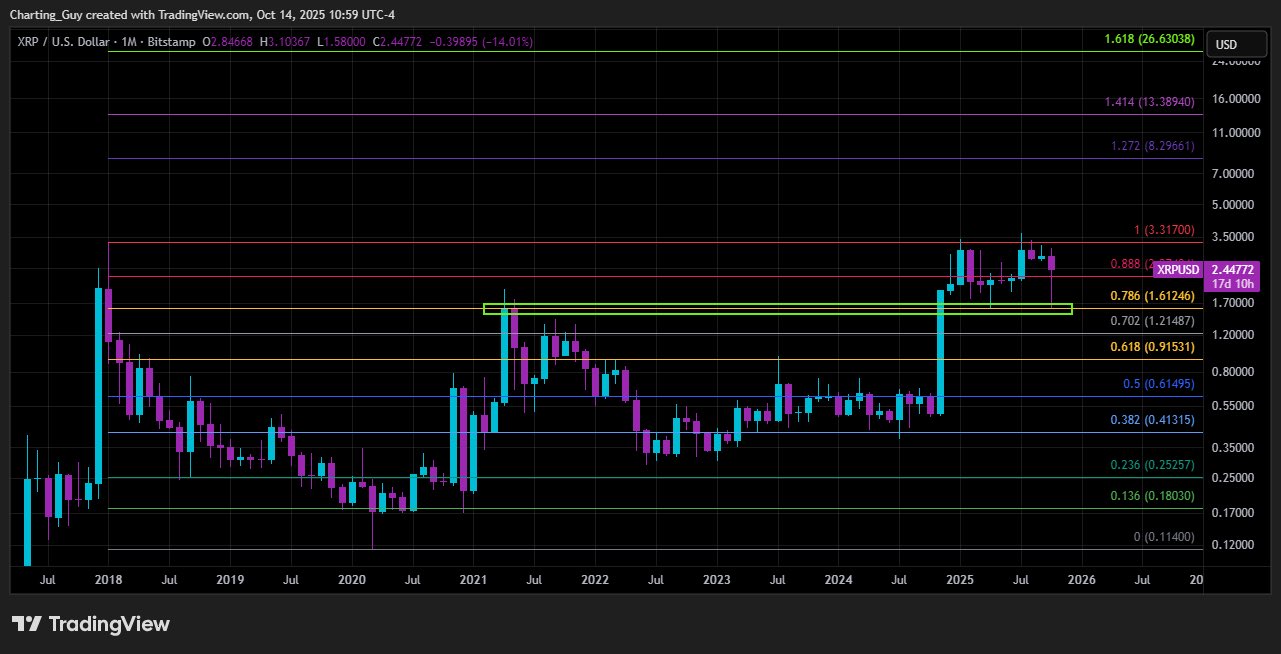
Notably, his comments followed market watcher Charting Guy’s analysis of a monthly XRP chart featuring key Fibonacci levels. The chart shows XRP hovering around the 0.888 retracement level near $2.44.

The coin is currently sitting above a powerful support zone between $1.61 and $1.70, an area previously tested during the early 2021 rally. The analysis suggests that XRP remains structurally bullish. “XRP is NOT bearish in the slightest,” Charting Guy wrote.

In other words, XRP is merely undergoing a natural consolidation phase before a potential breakout above $3.31. If that move plays out, the next Fibonacci extension levels suggest XRP could target price levels of $8.29, $13.38, and $26.63 as bullish momentum accelerates.

Charting Guy's XRP chart
Charting Guy’s XRP chart

With XRP trading at $2.50 today, these price projections imply a potential 3x to 11x return on investment for XRP holders. Notably, a $26.63 price would give XRP a market cap of approximately $1.6 trillion.

“Bitcoiners Will Be Worried” 

Given the bullish outlook, Alex Cobb remarked that XRP’s next pump will make Bitcoin holders nervous about their top spot.

Cobb’s comment suggests that XRP could challenge Bitcoin to become the number one cryptocurrency globally, a prospect many in the XRP community are eager to see. However, as of today, XRP and Bitcoin remain far apart, with over a $2 trillion market cap gap between them.

Bitcoin currently boasts a market cap of $2.24 trillion, while XRP is under $150 billion. Despite being the fifth-largest cryptocurrency, XRP held the third position just a few weeks ago. Now, it faces more competition with its market cap at approximately $149 billion.

The Journey Ahead: Before XRP Can Overtake Bitcoin

XRP must first surpass BNB, which currently leads by around $15 billion, and then USDT, which holds over a $30 billion lead. While XRP has achieved this in the past, reaching a peak market cap of $210 billion, its main challenge lies in overtaking Ethereum, which sits near the half-trillion mark.

To catch up with Ethereum’s current position, XRP would need to surge 3x to around $8. Any further increase in ETH’s price would widen the gap even more.

While Cobb maintains that XRP could overtake Ethereum, other XRP bulls like Charting Guy have previously expressed skepticism about such a flippening, noting that Ethereum is also displaying strong bullish signals.

In sum, XRP has a long road ahead, not only to catch up with Ethereum but even more so to challenge Bitcoin’s dominance. 

Hypothetically, XRP would need to rise by 1,396% to around $38, assuming Bitcoin’s price remains static, to overtake it in market cap.

While many XRP enthusiasts envision a future where XRP becomes the top crypto, few expect it to happen in the short term. 

Some, like Tradeship University founder, have given a 2030 timeline for such a flippening. Meanwhile, others believe Bitcoin could reach $1 million by then, which would further reduce XRP’s chances of taking the lead.

Binance Founder CZ Says Binance Never Delisted XRP

0

Binance founder Changpeng “CZ” Zhao recently reaffirmed that Binance never delisted XRP, even when they faced regulatory attacks.

Zhao said this amid the ongoing discussion over crypto exchange listing fees as market commentator CJ shared details of what he claimed were Binance’s and Coinbase’s listing requirements. 

Discussions around Exchange Requirements for Token Listings

Notably, in an X post, CJ compared the two exchanges, suggesting that Binance demanded several financial commitments while Coinbase only encouraged developers to build within its Base ecosystem as a requirement for listing.

CJ explained that Binance allegedly asked projects to provide airdrops, liquidity pools, and security deposits before a listing, while Coinbase only required teams to build meaningful products on Base. He used this to argue that choosing to build on Base should be an easy decision for any project founder.

Jesse Pollak, the head of Base at Coinbase, responded that exchanges should not charge anything to list a token. His comment triggered reactions across the crypto community, with some individuals accusing him of hypocrisy.

Specifically, market analyst Yazan took a jab at Pollak, saying Coinbase should first list Binance Coin (BNB) if it truly believed in equal opportunity. He implied that Coinbase’s stance meant little until it applied its own principles consistently and set an example for others.

“Binance Never Delisted XRP”

Responding to Yazan’s comment, Changpeng Zhao laughed about the situation. When a user asked him why Binance does not list new projects from the Base ecosystem, he sarcastically said they were waiting for listing fees before doing so.

However, on a more serious note, CZ added that Binance had listed every major cryptocurrency valued above $100 billion, as he sought to make a case for the exchange’s disposition toward listing proper projects without stringent requirements. He also reminded everyone that Binance never removed XRP from trading when the token came under attack.

Specifically, CZ’s comment referenced the events following the SEC’s lawsuit against Ripple in December 2020. At the time, several U.S.-based exchanges, including Coinbase, Bittrex, and Bitstamp, suspended or removed XRP to avoid possible legal risks. 

However, Binance continued supporting XRP on its global platform. Only Binance.US delisted XRP for American customers in January 2021 because of regulatory concerns, while the main Binance exchange kept the token active for international users. Coinbase and Binance.US relisted XRP after the 2023 victory.

This move became a major talking point for CZ amid the ongoing discussion. Nonetheless, the international Binance exchange faced no real regulatory pressure to delist XRP like Coinbase, as they do not serve U.S. users, so this point was not as effective. The only major U.S.-based exchange that defied this pressure and maintained support for XRP to U.S. users was Uphold.

Zhao Speaks on Exchange Listing Requirements

After speaking on XRP, CZ also shared his thoughts on listing fees. He said projects should not pay for listings if they do not feel like it, insisting that strong tokens naturally attract exchanges. According to him, if a project has to beg for a listing, it should reconsider its value and long-term potential.

CZ explained that exchanges follow different business models. Some list many tokens and earn mainly from trading fees, while others charge listing or security deposits to reduce risks and prevent scams. He said none of these models are wrong and encouraged developers to focus on building solid projects instead of worrying about competitors.

XRP 57% Vs 43%, Expert Explains To hold or Sell

0

Amid the uncertainty around whether investors should sell or hold XRP right now, market watcher EGRAG has provided an answer with technical backup.

Notably, after a turbulent week across the crypto market, XRP investors now find themselves at a crossroads. The token suffered a sharp decline during the latest market-wide crash on Oct. 10, falling from $2.80 to $1.53. Although XRP quickly rebounded to around $2.50, it still trades roughly 10% below its pre-crash level. 

Should You Sell or Hold XRP Now?

This bearish turn of events has triggered discussions within the community as traders question whether to hold their positions or sell to cut potential losses. 

Amid these community discussions, prominent market analyst EGRAG recently presented his own answers. In his commentary, EGRAG acknowledged the divide among XRP holders. 

He noted that some investors remain focused on the long-term view, looking ahead 10 years or more, while others are monitoring short-term price movements. He encouraged the long-term holders to maintain their strategy, confirming that he supports this mindset. 

However, EGRAG provided a breakdown of his own approach for those traders seeking immediate direction. He admitted that some people credited fellow analyst Blockchain Backer for selling XRP between $2.70 and $2.80, and those individuals now see the price hovering around $2.50 to $2.60. 

EGRAG suggested that, to such investors, selling at this point would not necessarily be a wrong choice if they prefer to avoid further stress. 

He noted that it would only result in a minor loss, but it could protect them from deeper declines. However, he clarified that he personally would not follow that path, as his strategy remains intact despite the recent downward push.

The Descending Broadening Wedge

EGRAG then turned to technicals, where he discussed his previous analysis involving a Descending Broadening Wedge. He confessed that he initially doubted this structure would fill its lower section, which led to his leveraged position being liquidated at $1.35.

According to him, this resulted in losses running into the thousands for him. Nonetheless, despite this setback, he reiterated that he neither promotes nor teaches leveraged trading, warning followers to avoid excessive risk.

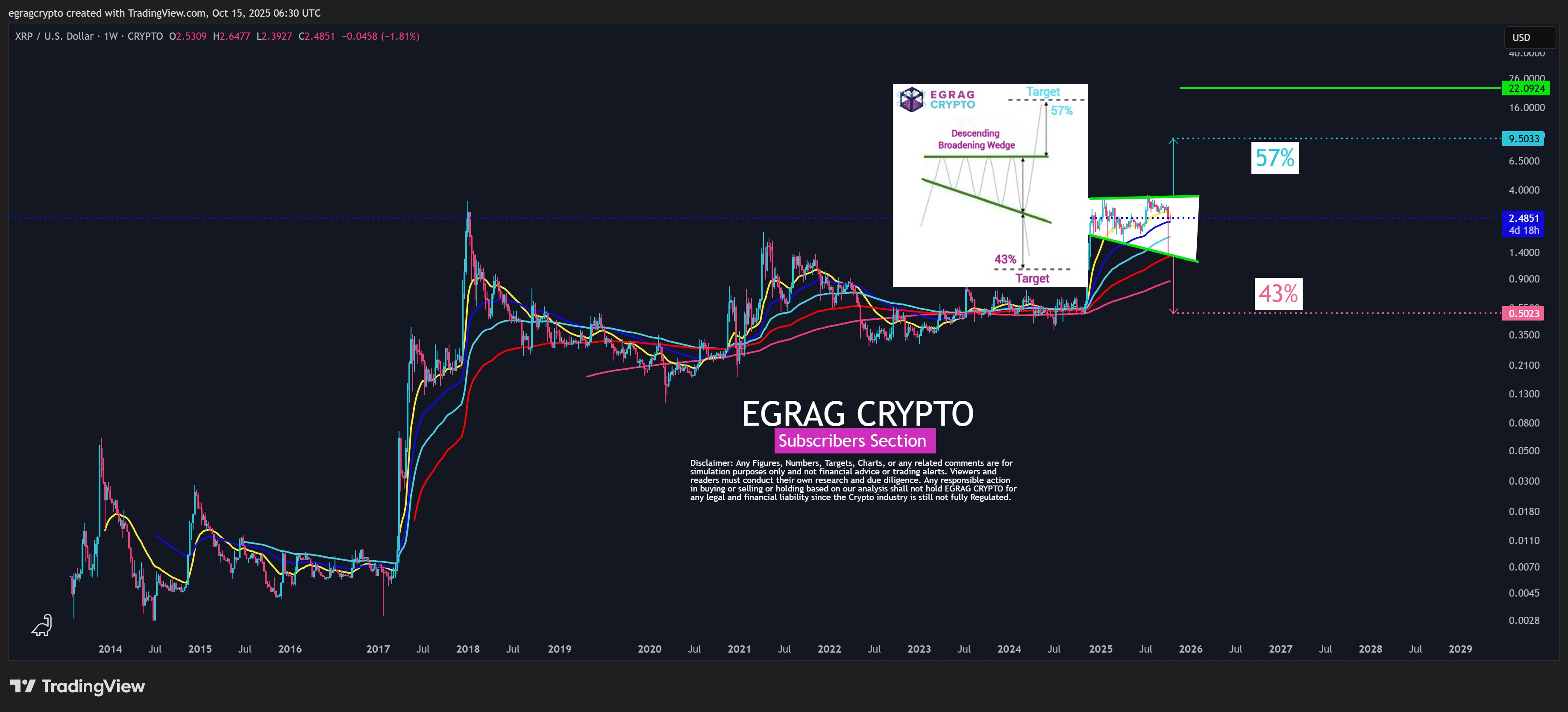
EGRAG explained that the Descending Broadening Wedge currently gives XRP a 57% probability of breaking upward and a 43% chance of moving lower. According to him, traders who fall into the cautious camp could sell now and wait to reenter around $0.50 if the market follows the bearish route. 

XRP Broadening Descending Wedge EGRAG Crypto
XRP Broadening Descending Wedge | EGRAG Crypto

In contrast, those who believe in the bullish outcome could aim to take profits around the $9 level, which aligns with the wedge’s projected measured move.

XRP May Not Have Topped for This Cycle

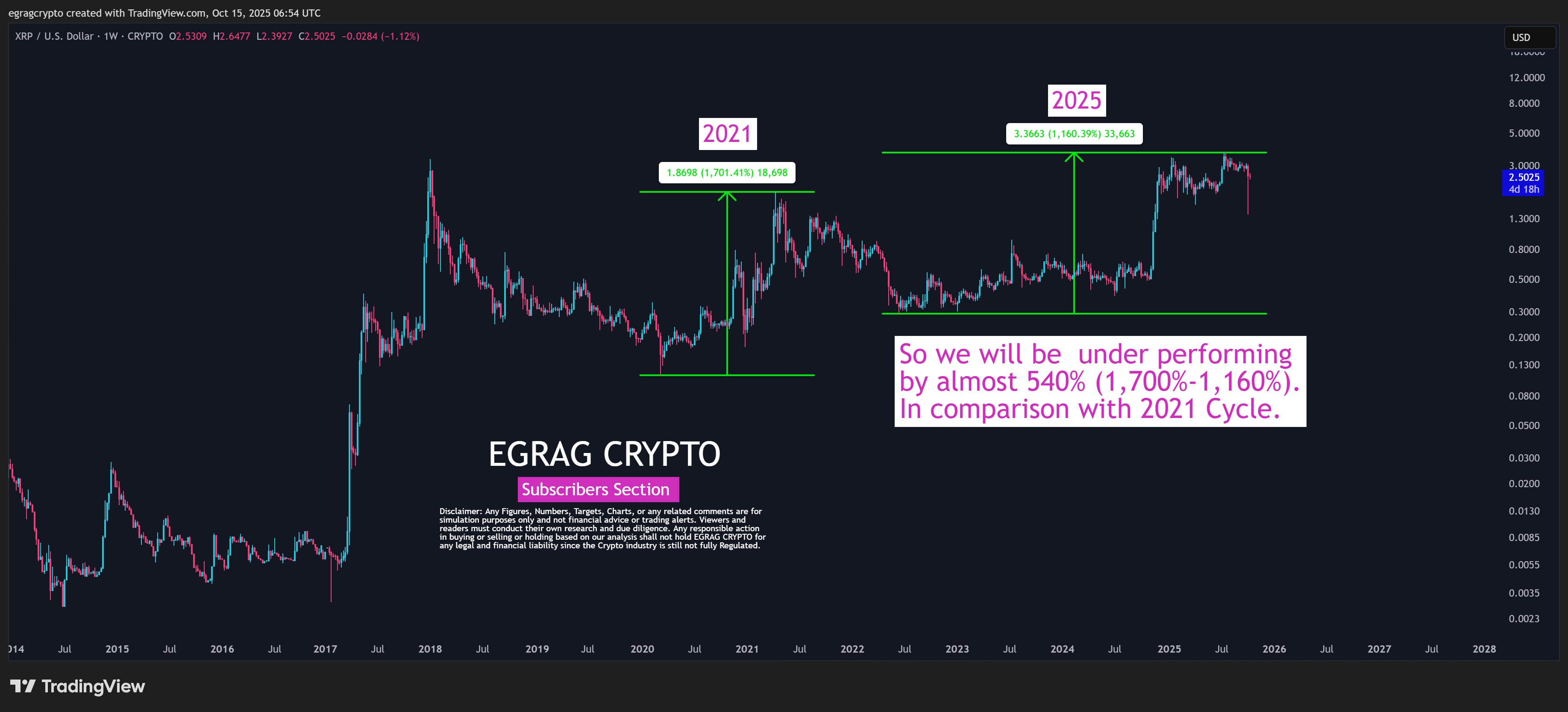
Interestingly, EGRAG also called attention to the broader market cycle. Specifically, the market analyst pointed out that during the 2021 cycle, XRP gained about 1,700% from its low to the $1.96 peak. This occurred despite the SEC lawsuit adding pressure to its price action.

XRP 2021 vs 2025 Price Action EGRAG Crypto
XRP 2021 vs 2025 Price Action | EGRAG Crypto

Meanwhile, so far in the current cycle, XRP has only risen by approximately 1,160%. For that reason, he believes it is unreasonable to assume XRP would underperform the previous cycle by 540%, especially given the favorable narratives surrounding the asset today, like the end of the SEC lawsuit, regulatory clarity, and spot ETF products.

EGRAG predicted that if XRP mirrors the 2021 performance, it could peak around $5.20. He revealed plans to sell a small portion at $5 to gauge market reactions but aims for far higher targets. 

Speaking further, the market confirmed that he remains committed to holding through potential downturns, forecasting a minimum price of $9 in this cycle, with an average target of $20 and a potential high of $27.

Expert Says These Latest XRP ETF Proposals are “Worst Idea Ever”

0

Popular crypto analyst Scott Melker has criticized Volatility Shares’ latest proposal to launch 3x and 5x leveraged XRP ETFs. 

For context, Volatility Shares applied to the SEC yesterday to launch 27 new leveraged single-asset exchange-traded funds (ETFs).

Volatility New ETF Filing

The proposed products span both major U.S. stocks and crypto assets, featuring 3x and 5x leverage exposure to names like XRP, Ethereum, Bitcoin, and Solana alongside popular equities such as Tesla, Amazon, MicroStrategy, and Circle.

The proposed ETFs aim to provide investors with three to five times exposure to the daily performance of the underlying assets, thereby amplifying losses and gains.

“Worst Idea Ever”

Reacting, Melker referred to Volatility Shares’ proposal as “the worst idea ever”. He stressed that his objection was not specific to XRP, but rather to the concept of offering leverage on altcoins to retail investors.

His frustration stems from the high-risk nature of leveraged products combined with the volatility associated with altcoins. Leverage products are known to amplify gains and losses, mainly for sophisticated investors capable of managing risk.

In Melker’s view, applying such leveraged trading to altcoins—assets already known for extreme volatility and traded mainly by retail investors—could expose individual traders to substantial losses.

Based on Volatility Shares’ proposal, a 10% drop in XRP price could mean a 30-50% loss for the 3x or 5x leveraged XRP ETF. If prices continue to fall, investors’ positions could be wiped out completely.

The dangers of leverage were on display recently when $19.31 billion worth of leveraged positions were liquidated over the weekend—the largest liquidation event in history. Notably, XRP positions accounted for around $707 million of that total.

Bloomberg ETF Analyst React

Besides Melker, other financial experts also reacted to Volatility Shares’ recent ETF filings. Eric Balchunas of Bloomberg noted that while the SEC has yet to approve a 3x leverage ETF, Volatility is pushing for 5x versions, which many consider to be even riskier.

Despite the risky nature of the proposed ETFs, Balchunas emphasized that the products will launch 75 days after the filing if the ongoing government shutdown continues and the SEC does not disapprove the application.

This puts the potential launch date of the products, including the 3x and 5x XRP ETFs, at around December 29, 2025, according to ETF expert Henry Jim.

Meanwhile, Volatility Shares already has an existing XRP ETF. Launched in May, the product gives investors 1:1 exposure to the price movements of XRP. The fund currently boasts an AUM of $189.1 million, with a daily volume of $9.7 million.

Finance Coach Explains How to Build Wealth with XRP

0

Renowned crypto commentator Coach JV has shared his philosophy on building long-term wealth through crypto assets like XRP.

He emphasizes that success in crypto doesn’t come from chasing hype, but from discipline, patience, and conviction.

In his latest post on X, he outlined how assets like XRP, Bitcoin, and Solana form the foundation of his long-term portfolio. In parallel, he describes a structured path for turning inflationary cash into appreciating assets.

“Stop Chasing Hype, Build Conviction”

According to Coach JV, many investors lose money because they chase short-term trends rather than focusing on assets with lasting value.

He stressed that running after the “next best crypto” often leads to emotional decisions and poor outcomes. Instead, he advocates focusing on what will survive the next phase of the crypto market cycle.

“My core three [assets are] XRP, Bitcoin, and Solana,” he wrote, adding that his top seven long-term plays also include Stellar (XLM), World Liberty Financial (WLFI), Hedera (HBAR), and VeChain (VET). 

The CAPL + DR Strategy for Building Wealth

Furthermore, Coach JV outlined his CAPL + DR framework, which represents a disciplined, repeatable process for compounding wealth:

Cash Flow → Appreciation → Protection → Leverage (Insurance) → De-Risk

In other words, this cycle begins with generating cash flow and redirecting it into appreciating, fixed-supply assets such as XRP and Bitcoin. Over time, the gains are protected, insured, and de-risked to create a sustainable financial base.

“This is how wealth is built,” he said. “Through discipline, patience, and strategy — not hype.”

XRP as a Tool for Financial Protection

For Coach JV, XRP plays a unique role within this ten-year investment strategy. Unlike most tokens, XRP’s fixed supply and utility in cross-border payments give it real-world application and potential staying power.

In previous posts, he explained that since 1913, the U.S. dollar has lost 96–97% of its purchasing power, making assets like XRP and Bitcoin essential for protecting wealth against inflation.

Notably, even in more recent years, such as the past decade, the dollar has lost nearly 40% of its value. Meanwhile, during this period, Bitcoin and XRP have appreciated in value by tens of thousands of times.

For Coach JV, Bitcoin serves as a “supercharged savings account,” while XRP also acts as a backup against the falling value of fiat currency. Together, they’re part of a system built to handle economic ups and downs, in his view.

Long-Term Thinking Over Emotion

Ultimately, Coach JV often reminds the crypto community that emotional investing leads to losses, while disciplined strategies can build wealth. He encourages a focus on learning, doing research, and following a long-term plan like a ten-year outlook rather than chasing every price jump or hype trend.

Here is Why Shiba Inu May Never Reach Its ATH Again

0

Despite growing optimism that Shiba Inu could reclaim its previous all-time high, several factors suggest this goal may remain out of reach.

Investors’ hopes for an “Uptober rally” are fading fast, as October has instead brought a sharp decline across the crypto market. Notably, many in the Shiba Inu community had predicted that SHIB would reach its all-time high (ATH) this month, citing the token’s strong performance in October.

However, Shiba Inu has fallen nearly 10% month-to-date, dropping from around $0.000012 to $0.00001081. At the current price, Shiba Inu is down 11.5% over the past week and has fallen 21.2% over the past 30 days. Despite posting a modest gain of 2.12% in the past day, Shiba Inu is still down 87.88% from its previous ATH of $0.00008845.

Why SHIB May Never Reach ATH Again

While parts of the community remain hopeful for a potential rebound that could drive SHIB back toward its record highs, several ecosystem factors continue to pose significant challenges to any sustained uptrend.

Insignificant Burn Volume

The Shiba Inu community has relied on token burns as a catalyst to drive SHIB’s price to lofty targets, including reclaiming the previous ATH. The idea is that these burns would help to reduce Shiba Inu’s massive circulating supply of roughly 589 trillion tokens to boost SHIB’s price.

While the burn rate has spiked by 27,014% over the past day, only 43.48 million tokens were burned. This represents a small fraction compared to the enormous 589 trillion token supply.

Shib burn rate increases

In earlier months, daily burns often reached hundreds of millions, occasionally exceeding one billion tokens. With such minimal burn volumes, the likelihood of Shiba Inu reclaiming its former all-time high continues to diminish.

Anonymous Team

Another factor hindering Shiba Inu’s growth is the team’s continued preference for anonymity. Since Shiba Inu launched in August 2020, the identities of the team members have remained hidden.

They have chosen different pseudonyms to engage with the community, ranging from Ryoshi (the founder of Shiba Inu) to Shytoshi Kusama (lead developer).

While Shiba Inu’s anonymous leadership model suited its early, community-driven beginnings, the project has since evolved into a multi-billion-dollar ecosystem.

To sustain growth, the team needs to adopt a more transparent leadership approach, similar to other established crypto projects, to strengthen investor confidence and attract significant capital investment, driving future rallies.

Lack of Engagement from Shytoshi Kusama

Following the sudden disappearance of Ryoshi, Shytoshi Kusama became the leader of the ecosystem, with the community following his X account for updates. Recently, he has been inactive on X and barely interacts with the community.

He made his last post on X on September 15, 2025, barely three days after Shibarium suffered a major security breach. Since then, he has neither posted nor commented on X.

Amid growing criticism, Kusama even set his account to private, restricting access to his posts to followers only. Such limited communication is concerning for the leader of a project of this scale and may deter institutional and sophisticated investors from taking SHIB seriously as a long-term investment.

Internal Tensions

Apparently, internal tensions are brewing among the Shiba Inu ecosystem team members. Core developer Kaal Dhairya hinted at the discord in one of his updates on the Shibarium Bridge attack, noting that some ecosystem leaders who had previously benefited from the project have since walked away, suggesting that key members may be departing.

Although the full extent of the situation remains unclear, such disunity could hamper development, slow innovation, and further reduce the chances of SHIB reclaiming its ATH.

Unfinished and Unprioritized Projects

While Shiba Inu has launched major initiatives like ShibaSwap and Shibarium, many other announced projects, including a proposed NFT marketplace and a Layer-3 blockchain, remain incomplete.

Rather than focusing on completing existing projects, the team continues to announce new ones without offering concrete timelines. This creates an impression of disorganization and a lack of strategic direction—both red flags for serious investors.

No ETF Filing

Shiba Inu recently reached a noteworthy milestone as a Europe-based ETP issuer launched a SEK-denominated ETP linked to the token. However, SHIB has yet to attract any ETP or ETF filings in the United States, where asset managers continue to focus on more established cryptocurrencies such as XRP, Solana, and even Dogecoin.

The influence of ETFs on price performance is well-documented. Analysts credit much of Bitcoin and Ethereum’s recent rallies to surging interest in their respective ETFs. Without a similar product or filing in major markets like the U.S., Shiba Inu’s chances of reclaiming its all-time high remain slim.

Final Thoughts

Ultimately, Shiba Inu remains a prominent name in the crypto space. Yet, its chances of reclaiming its previous all-time high appear slim given the current state of its ecosystem.

From low burn volumes and leadership transparency issues to incomplete projects and lack of institutional support, SHIB faces several significant hurdles that could prevent a meaningful long-term recovery

Galaxy Digital Transfers 2 Million ASTER to Binance

0

Asset management firm Galaxy Digital has transferred another 2 million ASTER tokens, valued at roughly $3 million, to Binance.

The transfer was reported by blockchain analytics account The Data Nerd, which cited data from Arkham Intelligence. The transaction took place only hours before the report was published.

Over $68 Million Moved in a Week

The latest transfer brings Galaxy Digital’s total ASTER deposits for the past week to 40.8 million tokens, amounting to roughly $68.28 million.

Despite the sizable outflow, the company’s associated wallet still holds 31.9 million ASTER, currently worth around $47.21 million.

Galaxy Digital has not issued any official comment confirming the transactions or explaining the purpose behind these movements.

Transfer Follows Crypto Market Turmoil

The transfers follow a turbulent week for the global cryptocurrency market. Last Friday, the sector suffered steep losses, with traders liquidating more than $19 billion in positions. Some digital assets saw their values collapse by over 90% within minutes. 

ASTER, the native token of the fast-expanding Aster perpetual DEX, was among those heavily impacted. Its price plummeted 40.43%, sliding from $1.8464 to $1.10. The token has since rebounded, trading around $1.53 at press time, up nearly 14% in the past 24 hours.

Binance Listing and the Seed Tag Warning

ASTER was listed on Binance on October 6, carrying a Seed Tag that flags innovative yet high-risk projects. The label serves as a caution to traders. It requires them to complete a risk awareness quiz every 90 days before engaging in spot or margin trading for such assets.

Aster Chain and Future Developments

The Aster project continues to evolve under the leadership of CEO Leonard Aster, who last month confirmed that the team is developing its own Layer-1 blockchain, named Aster Chain.

The network is currently in internal testing. It aims to deliver privacy-first architecture, low transaction fees, and sub-second finality while integrating built-in perpetual contracts.

Aster also intends to initiate a token buyback program to support long-term holders. While specifics remain under review, the CEO described buybacks as the “most direct way to return value to the community.”

Ex-Binance CEO Backs ASTER

The Aster project gained early momentum through public endorsements from Changpeng Zhao (CZ), the former CEO of Binance, who repeatedly promoted the token on his official X (formerly Twitter) account.