
Home Blog Page 480

Ethereum Tops 31,869 Active Developers in 2025, Nearly Double Solana’s Count

0

Ethereum has extended its lead as the world’s most active blockchain for developers in 2025.

Between January and September, the network added 16,181 new developers, according to data released by the Ethereum Foundation. This figure consolidates Ethereum’s position as the leading hub for blockchain innovation and infrastructure development.

Solana followed with 11,534 new contributors, reflecting the network’s appeal among developers working on decentralized finance (DeFi) and consumer-facing apps.

Bitcoin ranked third with 7,494 new developers, showing steady but slower growth compared to its younger rivals.
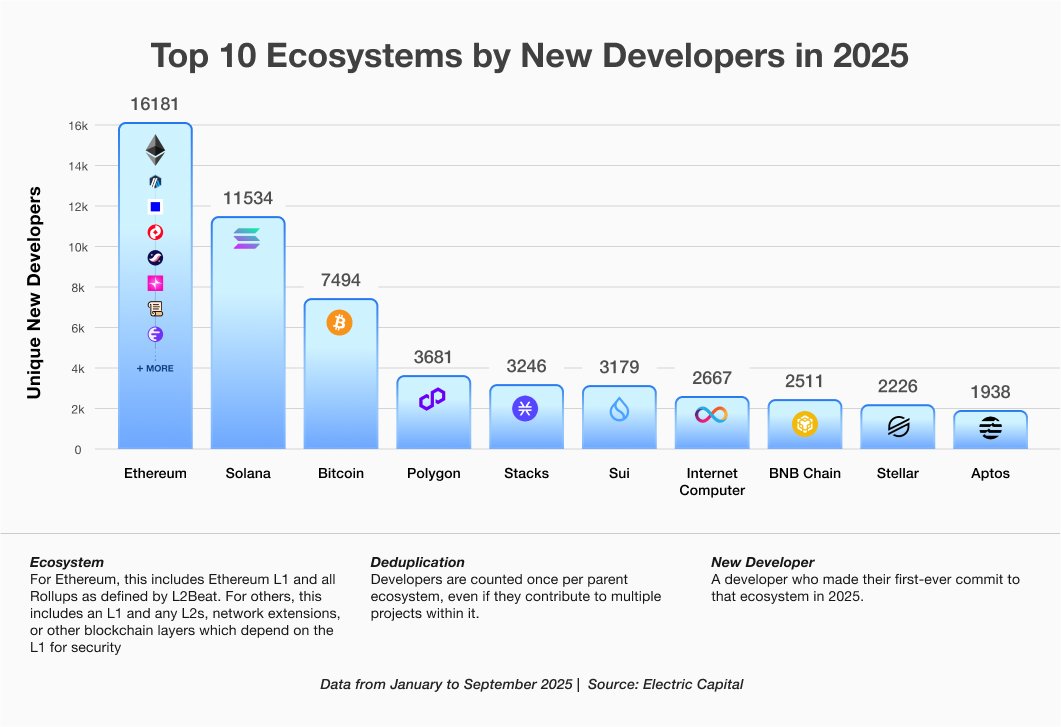
Image

Moreover, Ethereum also dominates in terms of ongoing engagement. The report shows 31,869 developers actively contributing code to Ethereum, nearly double the 17,708 contributing to Solana.

Together, Ethereum and Solana now account for almost half of all active blockchain developers worldwide. This, in turn, highlights a strong concentration of talent around these two platforms.

Market Trends Reveal Tight ETH–SOL Correlation

The alignment between Ethereum and Solana extends beyond developer activity. Price data analysis shows a correlation coefficient of 0.96 between the two assets. This means that their market movements have closely mirrored each other in recent months.

At the time of the report, Ethereum traded near $3,954, down 4.1% on the day but still above its mid-year levels. Solana hovered around $196, falling slightly more than 3%.

The near-parallel market behavior suggests that investors view both tokens as leading indicators of crypto market risk and sentiment, a sign of their shared standing as central players in the digital asset economy.

Ethereum’s DeFi Dominance Holds, Solana’s Share Expands

Despite Solana’s impressive developer momentum, Ethereum remains the undisputed leader in decentralized finance (DeFi).

According to data from DeFiLlama, the network accounts for 67.5% of the total value locked (TVL) across all DeFi protocols. Meanwhile, Solana’s TVL share stands at 8.7%, indicating a meaningful increase in on-chain activity.

By comparison, other major networks, including Binance Smart Chain (5.1%), Bitcoin (3.12%), and Tron (1.83%), account for smaller portions of the total DeFi market.

The data illustrates how Ethereum continues to anchor DeFi, while Solana’s expanding footprint signals a maturing and increasingly credible challenger.

Outlook: ETH–SOL Rivalry Set to Define Next Blockchain Era

As 2025 progresses, the Ethereum–Solana rivalry is emerging as the principal driver of blockchain platform development.

Ethereum retains its structural advantage through deep liquidity, mature tooling, and a vast developer base. However, Solana is rapidly catching up, driven by its speed, efficiency, and expanding presence in consumer applications and high-performance DeFi.

The ongoing competition will shape innovation, user adoption, and the trajectory of blockchain technology over the next few years.
Expert Says No Technical Analysis Can Predict XRP Price in a Utility Market

0

A well-known figure in the XRP community, UnknowDLT, recently shared his views on the future of XRP in the growing financial scene.

In a recent commentary, he argued that traditional technical analysis (TA) cannot predict XRP’s price in a utility-driven market. According to him, XRP is not merely a speculative asset. Instead, it is part of a new financial system focused on real-world use cases like cross-border payments and decentralized finance.

“Technical Analysis Doesn’t Work for XRP”

UnknowDLT believes that the price of XRP does not follow the same market forces as other cryptocurrencies. Instead, he argues that its value is tied to its role in global finance.

He pointed out that while some investors expect large price jumps, like $10 or $20, based on Bitcoin’s market behavior, XRP’s true value comes from its use in financial systems, which, in his view, cannot be predicted by chart patterns or past price movements.

A 70-Year Financial Transformation

UnknowDLT also stated that the world is entering a new financial system that could last for at least 70 years. This vision aligns with the belief that blockchain technologies like XRP will reshape the global financial system over decades, not months or years.

Holding XRP, he suggests, is about positioning oneself for long-term change in how money moves across borders and economies.

XRP as the Future of Global Finance

He believes XRP will play a central role in creating a more efficient and cost-effective financial system, especially for cross-border payments and remittances.

Ripple has already partnered with several banks and financial institutions to improve global transactions. Prominent names include Santander, Japan’s SBI, Onafriq, and Tranglo.

When asked about the future of the financial system beyond his 70-year outlook, UnknowDLT acknowledged that we may not witness the full impact in our lifetimes. However, he sees owning XRP as an investment in a long-term vision that will unfold over decades alongside advances in technology, such as quantum computing and new consensus mechanisms.

X user Kaitlyn Perrine shared this perspective, suggesting that investing in XRP today could be akin to investing in the early days of the internet.

TA to Know When to Take Profits, Then Reinvest

Even though UnknowDLT dismisses the role of technical analysis in predicting XRP’s long-term potential, some in the XRP community believe it still has merit for short-term price movements.

Specifically, XRP supporter Tyler Bolli argues that TA is useful for identifying key moments to take profits and reinvest during market retracements. “Nothing goes in a straight line up and to the right,” he said.

He added that those who are already wealthy can ignore XRP technical analysis, as they can choose to hold for the long term.

In other words, this approach encourages a more practical investment strategy of balancing short-term actions with long-term goals.

Market Veteran Says XRP Looks Like It Wants to Retest $2

0

Recent insight from a top market analyst has suggested more price downsides for XRP, further highlighting two crucial levels to look out for.

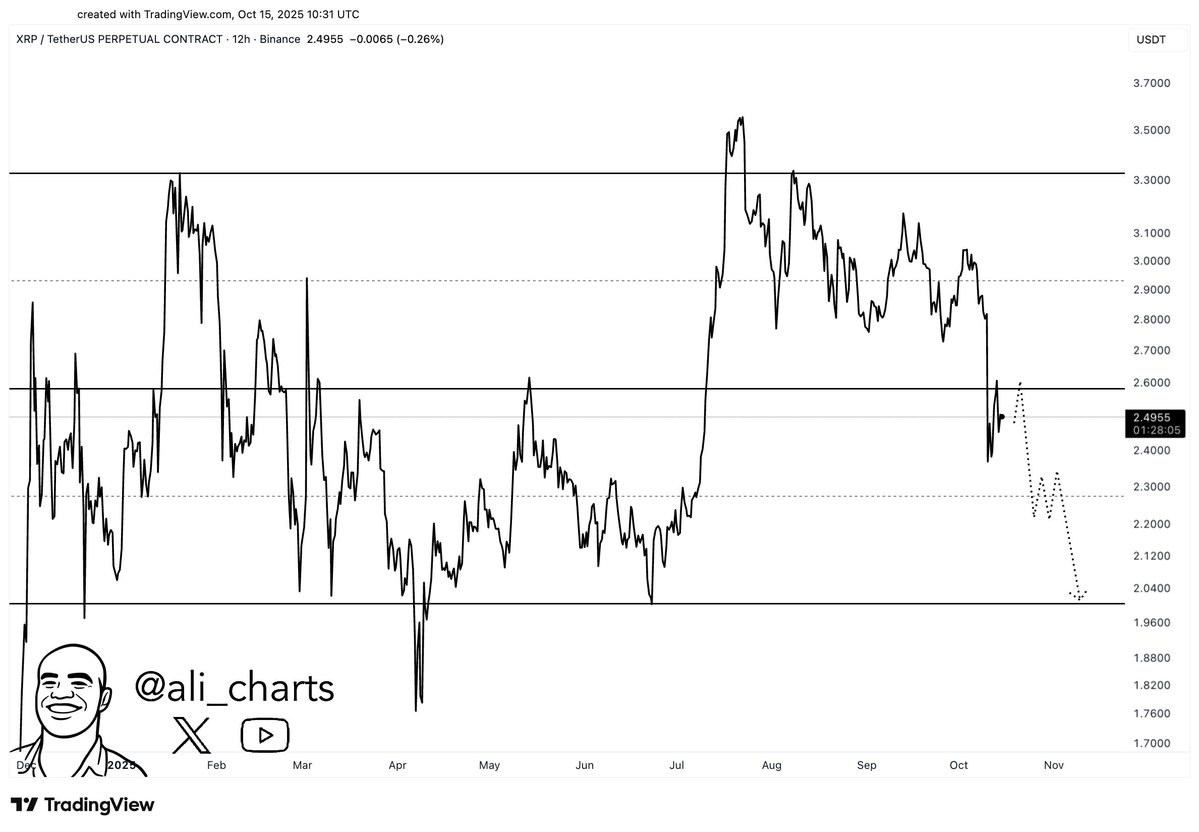
Analytical guru Ali Martinez highlights that XRP looks weak, as recent price action shows continued correction. If this momentum persists, he suggests that the XRPL native token could see lower prices.

Lower XRP Prices?

XRP quickly flushed out millions of leveraged traders when it tapped $1.37 nearly a week ago before recovering swiftly. At the current market price of $2.42, this represents a 76% rebound.

Meanwhile, XRP reached $2.64 on Monday to retest a critical resistance level identified in an earlier report by The Crypto Basic. Martinez also acknowledged this supply zone, which aligns with the midpoint of a price channel in an accompanying 12-hour chart.

XRP retested the zone but was met with a strong rejection, sparking an 8% decline to the current market price of $2.42. With momentum still bearish, Martinez has highlighted further downsides potentially targeting the $2 price mark. 

Notably, this aligns with the lower support level within the range, presenting a 17.3% correction from the current market price.

XRP to Retest Lower Support at $2 | Martinez

Expert Shares Price Levels to Watch

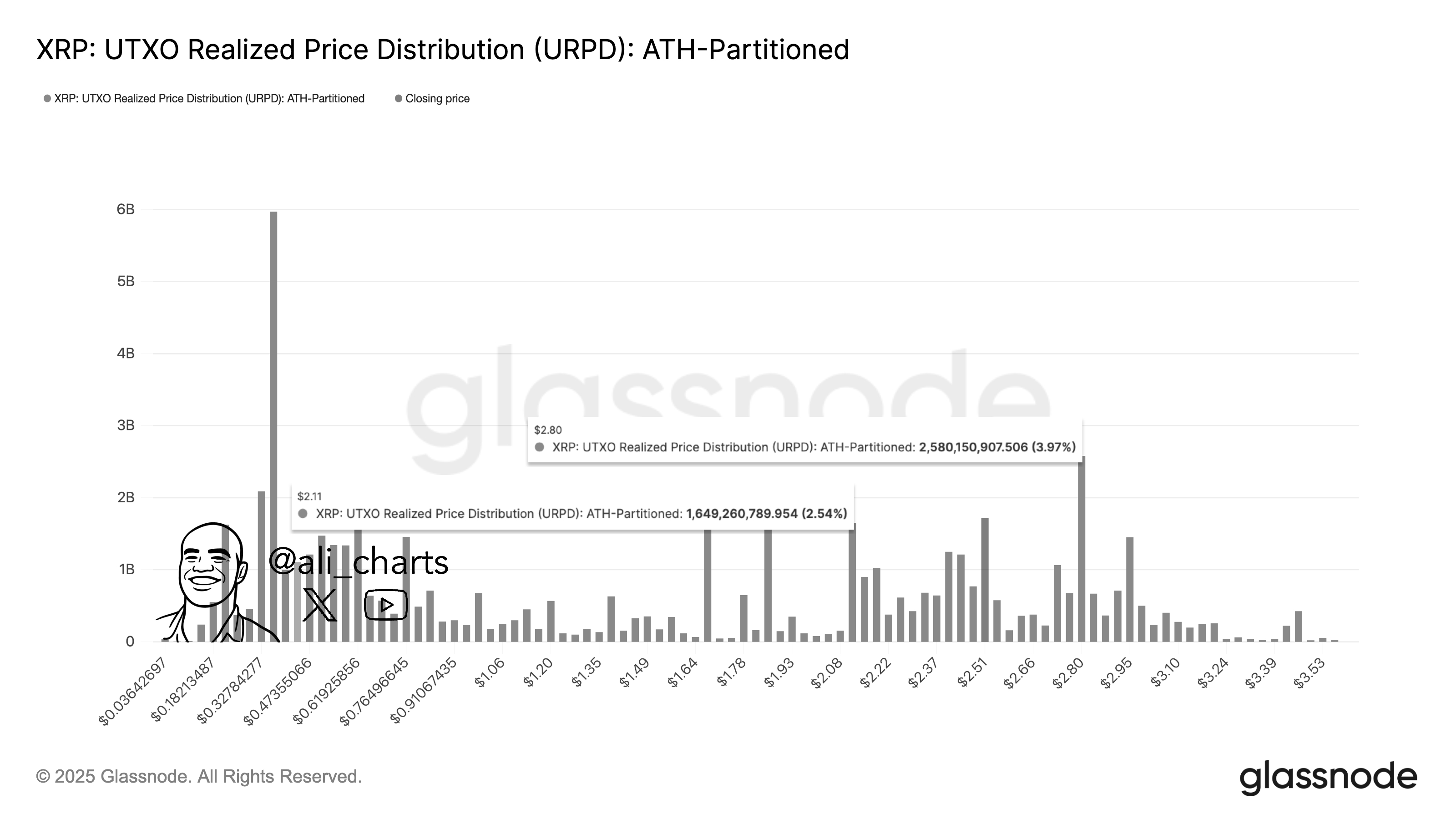
Furthermore, Martinez shared critical levels to watch while the price of XRP develops. He spotlighted this in a parallel analysis, utilizing the UTXO realized price distribution (URPD): ATH-partitioned metric.

The indicator shows crucial price levels where whales moved massive amounts of XRP, providing potential points of support and resistance. Using this data, he noted that key resistance and support levels stand at $2.80 and $2.10, respectively.

For $2.80, the URPD metric indicates that 2.58 billion XRP (3.97% of supply) exchanged hands at the price mark, serving as an area of massive selling pressure for the token. 

Meanwhile, $2.10 could serve as a major demand zone for XRP if it reaches the low. Specifically, over 1.64 billion XRP (2.56% of its circulating supply) moved in the zone and could provide sufficient buying pressure to counter bearish momentum.

XRP Resistance and Support Using URPD Indicator

At the current market price, XRP would have to drop 13.2% to reach the $2.10 support. However, it would need to increase by 15.7% to get the resistance level at $2.80.

Here’s ADA Price If Cardano Team Launches a Successful Stablecoin Rival to USDC

0

With analysts suggesting that Cardano could launch a stablecoin capable of rivaling USDC, a leading entity has predicted how this move could impact the price of ADA.

Circle and Tether have long dominated the stablecoin market. While Tether’s USDT is at $181.42 billion, Circle’s USDC stablecoin has a market cap of $76 billion.

Cardano Founder Says Circle and Tether Will Soon Lose Stablecoin Dominance

In a recent X post, Cardano founder Charles Hoskinson suggested that Tether and Circle could soon lose their dominance in the market. This follows reports that several financial institutions, including Barclays and Citibank, are collaborating on a unified stablecoin initiative.

In his view, this move could create a more open and competitive stablecoin market, rather than one dominated by Circle and Tether.

Meanwhile, the team behind Cardano has been pushing to have a tier-1 stablecoin within the ecosystem. This commitment prompted the development arm of Cardano, Input Output Global (IOG), to launch the Djed stablecoin (DJED) in January 2023.

Despite maintaining a stable value between $0.97 and $1.03 for 99% of the time since its launch, DJED has yet to gain widespread adoption. Currently, the token only boasts a market cap of around $3.2 million, which is significantly lower than USDC’s $76 billion valuation.

Last week, Hoskinson referred to DJED as a “fun experiment,” with analysts suggesting that the team could make another attempt to create another stablecoin that could rival existing ones.

In light of this, The Crypto Basic examined how much one ADA token could be worth if the Cardano team were to launch a stablecoin capable of rivaling USDC.

Price of ADA If Cardano Launches a Stablecoin Rival to USDC

As of press time, USDC ranks as the second-biggest stablecoin globally, boasting a valuation of $76 billion. USDC’s valuation surpasses the entire stablecoin market cap on Cardano, which currently stands at $36.9 million.

To rival USDC, Cardano would need to develop a stablecoin that achieves significant market adoption and demonstrates the same level of stability and trust.

To compete for the second spot in the stablecoin market, a potential Cardano stablecoin would need a market cap in the tens of billions, possibly even matching USDC’s valuation.

However, developing a USDC competitor within the Cardano ecosystem would not directly affect ADA’s price, as ADA’s value is primarily determined by its market capitalization and circulating supply. Essentially, a rise in market cap would lead to a corresponding price increase, and vice versa.

Yet, the successful launch of a stablecoin capable of competing with USDC could stimulate DeFi growth and overall network activity, which may indirectly strengthen ADA’s value over time.

Citing forecasts from crypto analysts, Google’s AI model Gemini predicts that ADA’s price could rise to between $1.25 and $3 by 2027 if Cardano successfully launches a stablecoin that rivals USDC. The chatbot further projects that ADA could reach $10 by 2030 under favorable market conditions.

Gemini ADA forecast
Gemini ADA forecast

As of press time, ADA was changing hands at $0.69, representing a 24-hour decline of 3.93%. This indicates that ADA demands a rally of 1,349% to reach the $10 target.

Expert Predicts Cardano Above $1 Soon After Liquidation Hunting

0

A top market analyst says Cardano is now ready for its next leg up past $1 after rebounding extensively from the recent market crash.

The recent market capitulation did not spare Cardano (ADA), the tenth-largest cryptocurrency by market cap. On October 10, ADA fell to a low of $0.279 but recovered to close at $0.636 on the same day.

Cardano Holds Major Support Level Despite Crash

Amid the current struggles to recover fully, analyst MMB Trader recently said Cardano is holding a crucial support zone on higher time frames, despite what he described as “market manipulation.”

He claimed that the flash dump signals that something massive was on the horizon, so market makers targeted to clear out leveraged traders before the impulsive move.

Notably, ADA was quick to reclaim the crucial support at $0.51 after the drop to $0.279, further strengthening the massive upward pressure around the region. Notably, this demand zone has stood firm on three different occasions this year to counter bearish momentum.

For perspective, prices rebounded from $0.51 during the February dump. It did so in April, following the broader market sell-off. Another scenario also occurred in June when the support quenched downward pressure, establishing itself as an important level for ADA.

Cardano Analysis | MMBTrader

Cardano Ready for Comeback

In an updated outlook, the market commentator highlighted on Wednesday that the market is gearing up for the next leg up. He believes this would happen soon, potentially taking Cardano to prices above $1.

ADA trades at $0.673 at the time of writing, down over 4% since yesterday. Meanwhile, MMBTrader’s first uptrend target is a run towards $1.077, representing a 60% growth from the current price level.

Interestingly, Fibonacci levels from his technical analysis show more upside could follow. Specifically, ADA could rise to the -0.272 Fibonacci level at $1.60, a 137% uptick from here. The final highlighted price target is $2, culminating in a 197% increase from the current market price.

Remarkably, other projections also align with these targets. For instance, Javon Marks predicted that ADA would break to $1.2 before a bullish continuation to $2.9. He expects a breakout from a recent descending channel to spur this.

Developer Phil also sees Cardano reaching $2, while Deezy predicts a run to $2.50. From the current price, the latter represents a 271% growth.

Eric Trump Sets to Tokenize Trump Family Real Estate

0

World Liberty Financial (WLFI) co-founder Eric Trump has unveiled plans to tokenize a portion of his family’s real estate empire.

In a preview clip from an upcoming CoinDesk interview, Trump said the initiative will begin with one specific building.

The move aims to allow ordinary investors to own fractional ownership of landmark properties through blockchain-based tokens. In turn, the model could challenge traditional real estate financing.

“If I want to build a hotel in Washington, D.C., Dubai, or New York, why should I have to depend on Deutsche Bank?” Trump said. “Why not go directly to the public instead?”

Fractional Ownership Through Digital Tokens

Under the proposed model, investors would be able to buy micro-shares of luxury developments such as Trump Tower. Each share would be represented by a digital token recorded on a blockchain ledger. 

These tokens would reflect ownership, transaction history, and regulatory data. This approach, known as property tokenization, aims to make real estate investment more transparent and accessible. It could also reduce reliance on large institutional lenders.

World Liberty Financial’s Role and USD1 Stablecoin

The initiative will be integrated into the World Liberty Financial ecosystem, which operates a U.S. dollar-pegged stablecoin (USD1). According to Trump, WLFI provides the ideal infrastructure for merging traditional real estate with blockchain finance.

Earlier this month, WLFI CEO Zach Witkoff said the company is researching tokenization across multiple asset classes. Specifically, these include real estate, oil, and gas. Additionally, WLFI recently introduced a crypto debit card to broaden its offerings.

Trump Organization’s Expanding Digital Ambitions

Founded by Donald Trump and built over generations, the Trump Organization manages a vast portfolio of luxury developments worldwide. As of September 2025, Forbes valued the company’s real estate holdings at approximately $1.2 billion.

By connecting this portfolio to blockchain systems, Eric Trump aims to bridge traditional property markets with decentralized finance, creating new pathways for investment and liquidity.

Financial Momentum Behind WLFI

In recent months, World Liberty Financial has become one of the most prominent ventures associated with the Trump family.

The firm’s WLFI token debut earlier this year generated billions in paper wealth. Notably, President Donald Trump reported earnings exceeding $57 million from the platform, according to his latest financial disclosure.

Overall, the move toward tokenization highlights the family’s strategy to merge traditional real estate with blockchain finance. If successful, this could transform how large-scale projects are funded and owned in the future.

Although specific launch dates and project details remain undisclosed, Trump called the concept a “democratization of real estate ownership.”

Coinbase User Executes Biggest Shiba Inu Burn in Nearly 3 Months

0

A Coinbase user has burned more than 140 million Shiba Inu tokens in one transaction, marking the biggest single incineration reported in nearly three months. 

Community-driven burn tracker Shibburn called the public’s attention to the transaction, which occurred yesterday, on October 15, at approximately 20:14 (UTC).

Notably, an anonymous address, 0x27d…fe606, transferred 140,033,123 (140.03 million) Shiba Inu tokens to the dead wallet. This action permanently removes the tokens from the circulating supply. 

Coinbase user burns 140 million Shiba Inu

Coinbase User Behind Transaction 

Shibburn did not disclose the identity of the user behind the transaction. However, Etherscan data indicates that the wallet was newly created and has only executed a single transaction — the 140.03 million SHIB burn. 

Notably, the address received funding from a wallet associated with Coinbase, suggesting that a user of the San Francisco-based exchange initiated the burn. Currently, the wallet has a zero SHIB balance and holds only 0.002 ETH, worth around $9. 

Burn Rate Spikes 222% 

Meanwhile, the transaction made a notable impact on Shiba Inu’s burn activity over the past day. Data from Shibburn shows that a total of 140.39 million SHIB were destroyed across nine transactions, pushing the daily burn rate up by 222.84%. 

Overall, a total of 410.75 trillion SHIB have gone up in flames, with Ethereum co-founder Vitalik Buterin contributing significantly to the deflationary efforts. 

Biggest Single Burn in Nearly 3 Months 

The 140.03 million SHIB burn also marks the largest single incineration in nearly three months. The last comparable event occurred on July 28, when an anonymous user burned 600.7 million SHIB. Since then, individual burns have stayed below 100 million until this recent transaction, where a Coinbase-linked user sent over 140 million SHIB to the dead wallet. 

In the meantime, Shiba Inu still maintains an enormous supply of around 589.25 trillion tokens. The supply has remained almost unchanged over the past few years, with little progress made since Buterin sent around 410 trillion to the burn contract. 

Meanwhile, the latest burn was not enough to drive SHIB’s price higher. SHIB has plunged 3% over the past 24 hours and currently trades at $0.00001039 per token.

Notably, Shiba Inu’s price is still reacting to the broader market downturn, as major assets like Bitcoin and Ethereum are also down 0.6% and 1.76%, respectively. 

Here’s XRP Price if BTC and ETH Hit $250K and $12K by Year-End as Predicted by Tom Lee and Hayes

0

XRP price could also benefit as industry Leaders Tom Lee and Arthur Hayes present some bold predictions for Bitcoin and Ethereum for year-end.

After four months of consistent upward push from April to July 2025, Bitcoin (BTC) and the broader crypto market have hit a snag, as prices witness occasional pullbacks and subsequent consolidation in the weeks that followed. While BTC reached a new ATH above $126,000 earlier this month, it has since corrected to $111,000.

In addition, Ethereum (ETH) has continued to battle the bears at the $4,000 mark, struggling to maintain its hold above this level. This trend has spilled into the XRP market, where the token has relinquished the pivotal $3 psychological level, now battling to reclaim it, as it trades for $2.42.

Tom Lee and Hayes Present Bitcoin and Ethereum EOY Targets

However, despite the current struggles, Fundstrat CIO Tom Lee and BitMEX co-founder Arthur Hayes, both prominent industry leaders, remain confident that Bitcoin and Ethereum will soar to much higher prices by the end of this year, with just two months and two weeks left.

Lee and Hayes appeared on the latest Bankless episode with host David Hoffman to discuss the markets. In a section of the episode, Hoffman first asked Hayes what his end-of-year (EOY) price targets for Bitcoin and Ethereum are.

In response, Hayes noted that he would remain consistent, aligning with previous projections despite current market realities. According to him, Bitcoin could soar to $250,000 by the end of this year, while Ethereum may reach a price of $10,000 within the same timeframe.

Hoffman pointed out the projected scale of the Ethereum outlook and questioned if Hayes believes it is possible within the next two and a half months. Hayes answered affirmatively. The podcast host then presented the same question to Tom Lee, with Lee revealing that their EOY target is $200,000 to $250,000 for Bitcoin and $10,000 to $12,000 for Ethereum.

While Hoffman noted that the assets may have little time to reach these goals, which he suggests could represent blow-off top goals, Lee and Hayes maintained their projections.

XRP Price if BTC Hits $250,000 and ETH Claims $12,000

Notably, if these predictions do play out, the impact on the broader crypto market could be immense. Specifically, Bitcoin, which holds a market cap of $2.22 trillion, has a market dominance of 59.5%. Meanwhile, Ethereum, with a market cap of $486 billion, boasts a dominance of 13.01%.

If BTC hits $250,000, its market cap would reach $4.92 trillion. Also, if ETH claims the $12,000 mark, its market cap would hit $1.448 trillion. If Bitcoin maintains its market dominance of 59.5% at that valuation, the broader crypto market will have a market cap of $8.27 trillion. Interestingly, at the $1.448 trillion valuation, ETH’s dominance will have risen to 17.5%.

Meanwhile, XRP, which currently has a market cap of $144.8 billion, holds a dominance rate of 3.89% in the market. If XRP retains this dominance when the broader market cap reaches $8.27 trillion, its market cap would rise to about $321.7 billion. Considering a circulating supply of 60 billion tokens, this valuation could translate to a price of $5.36 for XRP by year-end.

Solana’s $2.85B Revenue Surge Signals A Shift. All Eyes Turn To The Next Mover

0

Solana’s explosive growth continues, generating $2.85 billion in 2025 revenue and solidifying its position as a real-world, enterprise-grade blockchain driving mass adoption. As its ecosystem expands, Unich emerges as a standout Solana-based project, aiming to redefine OTC trading with smart contracts and trustless pre-market innovation.

Solana’s $2.85B Revenue Surge: What’s Driving the Next Phase of Growth

Solana’s strong performance in 2025 confirms its position as a real-world, enterprise-level blockchain ecosystem. Over the 12 months from October 2024 to September 2025, the network generated around $2.85 billion in revenue, putting it in the same league as tech firms such as Palantir and Robinhood. This achievement highlights genuine, sustainable demand for blockspace beyond the short-lived memecoin speculation that once drove activity.

Even as the memecoin trend cooled, Solana maintained robust growth through a diversified revenue model. Increased engagement from developers, DeFi platforms, and real-world asset integrations reinforced the network’s transition from narrative-driven hype to a utility-based, revenue-generating platform. Institutional confidence has also deepened, with corporate and treasury holdings exceeding 2.2 million SOL (worth roughly $525 million), signaling long-term conviction in Solana’s ecosystem stability.

Technically, Solana’s Q2 2025 contraction in application revenue represented a healthy market recalibration rather than structural weakness. At the same time, the introduction of Grayscale’s staking-enabled SOL ETP opened new pathways for institutional investors to access yield, expanding liquidity and market participation. Combined with continued inflows into U.S. Bitcoin ETFs, these developments are fueling optimism for Solana’s next phase of growth and innovation across DeFi, infrastructure, and upcoming projects.

As Solana’s ecosystem matures, attention is shifting toward projects like Unich – the world’s first OTC exchange to surpass $1.2B in trading volume, signaling growing institutional interest in Solana-based infrastructure. But what innovation allows Unich to stand out in a market long plagued by counterparty risks and scams?

Unich: Redefining OTC Trading with Smart Contracts

In a market where most OTC deals still take place through Telegram or Discord, counterparty risks, scams, and lack of transparency remain major barriers for investors. Unich tackles this problem head-on with Unich Pre-Market – a unique collateral-based and smart-contract-based OTC platform designed for pre-TGE assets.

By using a dual collateral locking system, Unich ensures fairness and eliminates the need for trust between parties – funds are secured on-chain until both sides fulfill their commitments.

Built on Solana, Unich benefits from ultra-low transaction fees, lightning-fast settlement, and global accessibility, making it the ideal infrastructure for next-generation OTC trading.

In just 10 months since mainnet, the platform has achieved over $1.3 billion in total trading volume, attracted 5.5 million users across 190 countries, and generated $21 million in revenue. So far, the platform has featured more than 70 listed tokens, reflecting real product adoption and liquidity depth.

On the networking side, Unich has secured $2 million in angel investment and formed 40+ strategic partnerships to accelerate its global expansion. The Unich dApp is now integrated with top Web3 wallets including OKX Wallet, Binance Wallet, and Bitget Wallet, further enhancing accessibility for traders worldwide

At the heart of Unich’s momentum at the moment is the Unich IDO, structured to expand community participation and strengthen real utility across the ecosystem.

The $UN token drives platform growth through trading fee discounts, staking rewards of 20 – 30% APY, governance rights, and a buyback-and-burn mechanism that supports long-term value.

While the token currently trades near $1 on Pre-Market, it’s available for only $0.1576 during the token sale, offering investors a compelling entry point along with 11% referral bonuses and 25% discounts for NFT holders.

All in all, while Solana’s momentum continues to dominate headlines, the Unich token sale stands out as a rare opportunity for forward-looking investors. Backed by a strong foundation, innovative features, and rising market traction, Unich is emerging as one of the most promising projects to watch in 2025.

Disclaimer: This Press release article is provided by the Client. The Client is solely responsible for this page’s content, quality, accuracy, products, advertising, or other materials. Readers should conduct their own research before taking any actions related to the material available on this page. The Crypto Basic is not responsible for the accuracy of info and any damage or loss caused or alleged to be caused by the use of or reliance on any content, goods, or services mentioned in this press release article.

Please note that The Crypto Basic does not endorse or support any content or product on this page. We strongly advise readers to conduct their own research before acting on any information presented here and assume full responsibility for their decisions. This article should not be considered investment advice.

Ripple Signs Absa Bank as Its First African Custody Partner

0

Blockchain firm Ripple has extended its institutional services into Africa by forming a strategic alliance with Absa Bank, a leading financial institution in South Africa.

The collaboration positions Absa as Ripple’s first significant custody client in Africa. This signals a pivotal moment for institutional adoption of digital and tokenized assets in emerging markets.

Absa to Offer Regulated Custody for Digital Assets

Through this partnership, Absa will adopt Ripple’s digital custody solutions to safely manage and safeguard cryptocurrencies and tokenized assets on behalf of its clients. This gives Absa the foundation to offer secure, compliant, and scalable custody services.

For Absa, the partnership represents a strategic step into blockchain-backed financial services. It offers corporate and institutional clients a trusted way to engage with tokenized markets without compromising regulatory compliance or security.

Ripple’s Global Custody Expansion Strategy

Ripple’s institutional custody product, launched in late 2024, is part of its mission to serve as a back-end infrastructure provider for regulated financial institutions. The platform is already operational in Europe, Asia, and Latin America. It supports banks and asset managers in efficiently managing their digital assets.

By extending the service to Africa, Ripple strengthens its global reach while reinforcing its reputation for regulatory readiness. The company now holds more than 60 licenses and registrations worldwide.

This compliance-first approach remains central to its expansion strategy in regions where digital asset regulation continues to evolve.

Growing Momentum for Blockchain Adoption in Africa

Ripple’s partnership with Absa builds on the company’s recent efforts to expand across the African continent. Earlier this year, Ripple teamed up with Chipper Cash to offer crypto-enabled payment solutions. It also announced intentions to roll out the RLUSD stablecoin across African countries.

Interest in blockchain adoption is also growing across the region. According to a 2025 Ripple study, about 64% of finance professionals in the MENA region prioritize quicker settlements and cost reductions when considering blockchain adoption.

With the Absa partnership, South Africa becomes one of the few African countries where a major bank provides regulated crypto custody services. This milestone could inspire other financial institutions in the region to follow suit. It also strengthens South Africa’s position in leading fintech innovation on the continent.