
Home Blog Page 485

Cardano Founder Says DJED’s Strong Two-Year 99% Stability Record is Magical

0

Cardano founder Charles Hoskinson highlighted the impressive performance of the network’s native stablecoin, DJED.

He noted that DJED has maintained price stability 99.9% of the time over the past two years. Hoskinson shared this information during a recent livestream while addressing the latest depeg of DJED. 

DJED Recovers Dollar Peg Within 5 Hours 

Notably, the DJED stablecoin was developed by the Cardano research and development arm, Input Output, in partnership with the COTI Network. Over the weekend, it experienced a sharp drop from around $0.99 to $0.55, losing its $1 peg.

The decline occurred amid a broader market sell-off on October 10, triggered by fears of a renewed trade war following U.S. President Donald Trump’s proposal to impose an additional 100% tariff on goods imported from China.

Meanwhile, after losing its dollar peg, Hoskinson noted that DJED recovered within five hours, which he considered ‘magical.’ 

DJED’s Design 

Hoskinson noted that the development team did not design DJED to maintain minute-by-minute or second-by-second stability. Instead, the goal is to ensure that the stablecoin eventually recovers from any depeg. 

As an algorithmic stablecoin, DJED maintains its peg through an over-collateralized mechanism that uses both ADA and SHEN as reserve assets. This collateral ratio ranges between 400% and 800%. 

According to Hoskinson, whenever there is high volatility, the system freezes new DJED deposits to prevent further price drops. In his view, the approach is part of a learning process of a two-year experiment exploring how to build an efficient stablecoin system. 

Impressive 2-Year Performance 

Meanwhile, the Cardano founder cited on-chain data indicating that DJED has maintained a narrow trading range between $0.97 and $1.03 for 99.9% of the time since its launch in January 2023. 

While he acknowledged a few rare deviations, most notably a brief surge to $2.46 and a recent drop to $0.55, Hoskinson emphasized that, overall, DJED has demonstrated remarkable stability within its intended dollar peg. 

Notably, Hoskinson expressed pride in the stablecoin, noting that it has been a fun experiment over the past two years.

In the meantime, DJED is trading at $0.99, currently hovering within the range of its dollar peg. It has a market cap of $3.28 million, which is relatively smaller compared to established stablecoins like USDT and USDC. 

Hoskinson Pushes to Introduce Tier-1 Stablecoin on Cardano

Meanwhile, Hoskinson has been pushing for the introduction of a tier-1 stablecoin within the Cardano ecosystem.  Many believe this move could significantly strengthen the network’s DeFi landscape. 

As part of this effort, Hoskinson has met with Ripple executives, including CEO Brad Garlinghouse, to discuss the possibility of bringing Ripple’s stablecoin, RLUSD, to Cardano.

While Hoskinson noted that discussions are progressing smoothly, no official launch date has been set for RLUSD’s potential debut on the Cardano blockchain.

Peter Brandt Says XRP Has a Purer Long-Term Chart

0

Veteran trader Peter Brandt seems to have updated his tone on XRP, turning bullish after sharing a short-term bearish outlook only days earlier. 

The recent change comes as XRP looks to recover from the latest market-wide slump, which pushed its price to $1.57 on Friday, Oct. 10. Interestingly, as the rebound takes shape, Brandt’s latest analysis suggests XRP could be entering a major breakout phase.

XRP Historical Data Confirms Bullish Structure

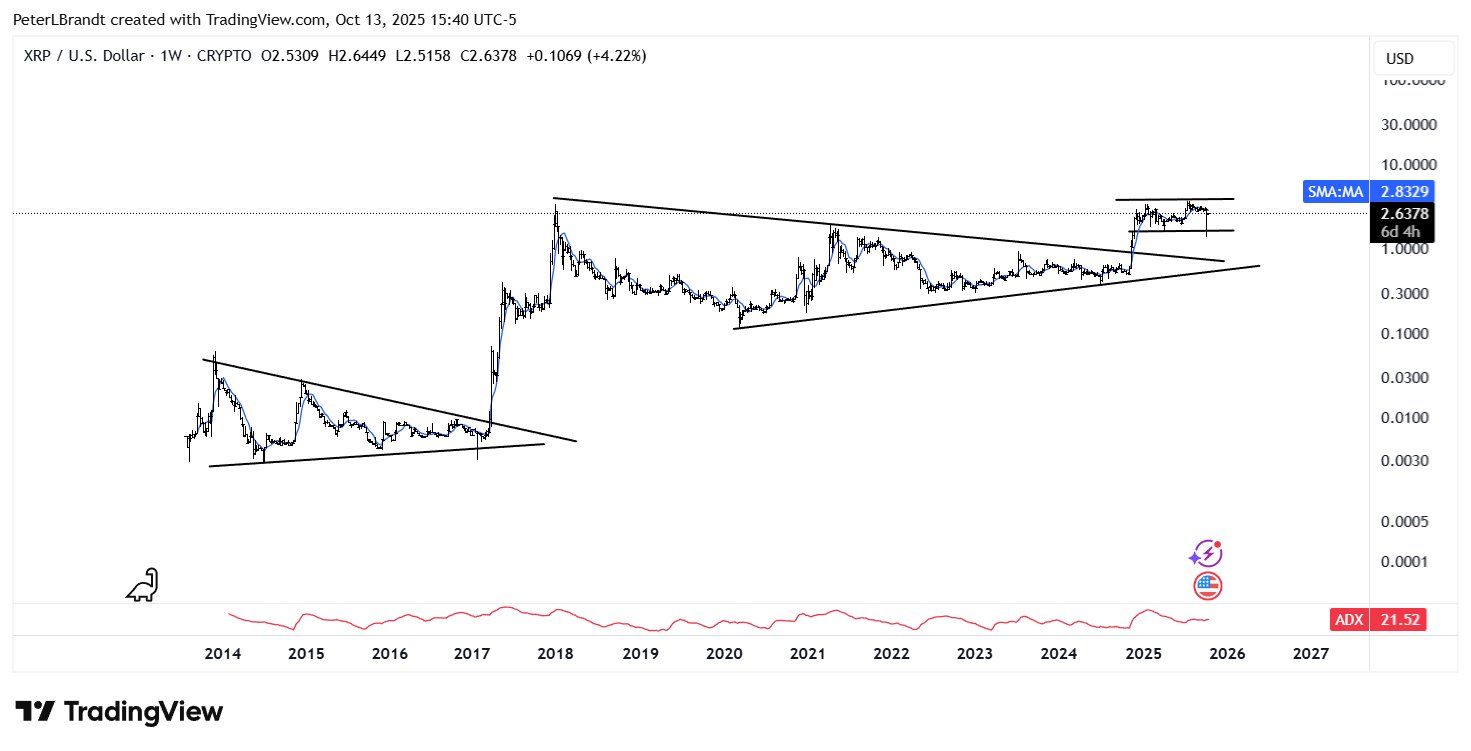
The analyst shared a weekly chart that covers more than a decade of XRP price movement, from 2013 to 2025. Notably, the chart shows how XRP’s price has moved in large triangle-shaped formations over the years, with long periods of sideways action leading to strong rallies. 

Historical data indicate that XRP usually spends years in quiet consolidation before making its large moves. For instance, between 2014 and 2017, XRP traded inside a symmetrical triangle before breaking out in March 2017, with prices eventually hitting the peak of $3.31 by January 2018. 

Image

After the rally cooled off, XRP entered another long stretch of sideways movement, slowly forming higher lows and making way for its next breakout. Specifically, this stretch involved the most recent triangle, which began forming after XRP dropped from the $3.31 peak in January 2018, with the pattern lasting for six years.

A Parallel Channel After Triangle Breakout

A breakout finally happened during the November 2024 rally, when XRP surged above the upper boundary of the multi-year triangle. The move indicated renewed strength and a possible tilt toward a larger bullish cycle. However, following the breakout, XRP has since entered a consolidation phase featuring a parallel channel.

Interestingly, the recent market crash pushed XRP to retest the lower trendline of the channel, and the altcoin could leverage this support to build strength for a breakout. 

At the time of Peter Brandt’s latest chart, XRP traded around $2.64, just below its 1-week simple moving average of $2.83. XRP has since corrected further to $2.55 at press time. The price now hovers beneath a strong resistance zone around $3.6, an area that lines up with its July 2025 peak.

Conditions for Bullish Momentum

While XRP looks bullish, it still lacks momentum. Specifically, the Average Directional Index (ADX) sits at about 21.5, pointing to a developing trend rather than a strong one. This means XRP could spend some time moving sideways or retesting support before building enough momentum for another leg higher.

For now, the bullish setup remains intact as long as XRP holds above its breakout zone and the rising trendline that stretches from roughly $0.8 to $1.5. A weekly close above $3 could confirm renewed strength and open the door for another upward move. 

However, if the price slips below the breakout level or the lower trendline of the parallel channel, it could fall back toward the $1 region before stabilizing again.

In the coming weeks, for the market to decisively confirm a bullish bias, XRP needs to reclaim and stay above its weekly moving average, and the ADX must start rising to show stronger momentum. If these conditions align, XRP could repeat the explosive move that defined its 2017 rally.

For context, Brandt’s latest bullish outlook comes days after he suggested that XRP was on his list of candidates to short, but the analyst did not confirm the bearish structure. Following the market crash, he noted that he had taken his profit on the short trade. Today, he has flipped bullish. 

If 100 Bitcoin is Life-Changing, Here’s the Price at Which 100 XRP May be Enough to Retire

0

With several market commentators suggesting that 100 Bitcoin is life-changing, what price does XRP need to reach before 100 XRP can be enough for retirement?

Being the original cryptocurrency, Bitcoin (BTC) has mostly taken center stage in discussions surrounding the growing crypto market. BTC also stands as the most dominant asset in the market, currently commanding 58.2% of the overall market, with a valuation of $2.24 trillion.

100 BTC is Life-Changing

For an asset that once traded below $5, the firstborn crypto has come a long way from its humble beginnings over 15 years ago. Now, market commentators have pointed out repeatedly that investors holding just 100 BTC possess life-changing wealth capable of making them retire.

Earlier this year, when Bitcoin was still battling to maintain the $100,000 mark, Chartered Financial Analyst Rajat Soni noted that investors used to regard 1,000 BTC as life-changing money, and then the figure dropped to 100 BTC. Interestingly, Soni claimed that now, only 10 BTC represents life-changing wealth. 

Moreover, in July 2020, when Bitcoin traded for just around $9,000, Bitcoin developer Adam Back responded to a question asking whether 100 BTC is enough. Back suggested that 100 BTC is enough to retire in low-cost areas, especially if predictions of $100,000 ever materialize. Bitcoin has since hit the $100,000 mark.

Today, 100 BTC is worth $11.4 million, enough for even American investors to retire. Notably, earlier in the year, a survey by Northwestern Mutual found that American adults believe they could retire with $1.26 million, down from the $1.46 million figure from last year. 

At What Price Can an American Retire with 100 XRP?

Interestingly, XRP community pundits have repeatedly suggested that XRP could become the next Bitcoin, capable of also being an avenue of retirement for its holders. As a result, we recently assessed how much XRP would need to reach for the average American adult to be able to retire with 100 tokens.

Today, as XRP changes hands at $2.50, 100 XRP tokens are worth only $250. For these tokens to cross the $1.26 million mark, the price of 1 XRP needs to hit $12,600. Notably, this would mark a 438,924% increase from the current XRP price, representing a near impossible feat in our lifetime. 

Additionally, at a $12,600 price, the XRP market valuation would balloon to $756 trillion, surpassing the combined total of global debt and M2 money supply. This confirms how unfeasible the price target is within our lifetime. Essentially, more realistic retirement targets would require holding at least 10,000 XRP in countries with lower costs of living.

Here’s How High Cardano Price Could Reach if Its TVL Reaches $50B

0

Following the recent surge in Cardano total value locked (TVL), speculation suggests that the network could maintain this momentum and potentially reach an impressive $50 billion. 

Over the past few weeks, Cardano has been gaining significant attention across the crypto community. Interest in the project has surged following the launch of Hydra 1.0.0, an L2 scaling solution designed to boost Cardano’s scalability and drive broader DeFi activity on the Cardano mainnet. 

Cardano’s TVL Soars Over 43% in 24 Hours 

Despite its strong fundamentals, Cardano’s DeFi activity still trails behind more established ecosystems like Ethereum, which currently has a total value locked (TVL) of $83.85 billion. 

However, momentum is rapidly building for Cardano as its DeFi activity continues to surge. At the time of writing, the total value locked on the network has reached $276.52 million, marking an impressive 43.4% increase within the past 24 hours. 

Cardano TVL
Cardano TVL

Following this surge, many enthusiasts believe Cardano’s DeFi activity will continue to gain momentum, potentially driving a significant increase in the network’s TVL. Amid this growing optimism, we explored what Cardano’s price could look like if its TVL soars to $50 billion. 

ADA Price if Cardano’s TVL Reaches $50B

As stated earlier, Cardano boasts a TVL of $276.52 million, with the figure soaring 43.4% over the past day. This indicates that reaching the $50 billion TVL target requires a rally of 17,981% from the current level. 

However, such an increase is not expected to impact the price of ADA. Although TVL serves as a major indicator that determines the growth and liquidity of a blockchain, it does not directly determine the price of the network’s underlying token. 

TVL measures the amount of assets locked within a network’s smart contracts, reflecting user confidence and the scale of DeFi activity on that platform. A token’s price is only determined by its overall market cap. 

For instance, if Cardano’s market capitalization were to surge to $50 billion, each ADA token would trade around $1.38, assuming the circulating supply remains at 36 billion.

While TVL does not directly determine a token’s price, a significant rise in locked value often reflects growing network confidence and usage — factors that can indirectly contribute to upward price momentum. However, it is not a guaranteed catalyst that can be relied on to drive the growth of a token’s price. 

Cardano Still Bearish, But Expert Remains Optimistic 

In the meantime, Cardano’s performance remains affected by the broader market downturn. As of October 12, the token has lost 4.26% of its value in the past 24 hours, and has plummeted 25.42% over the past week. 

Despite the recent downturn, analysts and community members remain optimistic about a rebound. Prominent voices such as Chris O project that ADA could soar to as high as $8 in the current market cycle, a move that would require a 1,140% rally from the current level of $0.6448. 

Pundit Claims XRP Had a 1,200x Multiplier During the Friday Crash

0

An XRP community commentator recently suggested that XRP had an unusually large market cap multiplier during the Friday crash, but the analysis had limitations.

For context, the crypto market faced one of its worst selloffs on Friday, October 10, when a massive liquidation wave wiped out more than $19 billion across the market. This marked the biggest single-day wipeout in crypto’s history. 

XRP Slumps in the Market Crash

Notably, XRP took a hit, with about $700 million in total liquidations, including roughly $610.5 million from long positions. It plunged from $2.8 to $1.58 within hours, losing over 43% of its value before bouncing back to close the day at $2.37. Currently, XRP has climbed slightly to $2.55.

Meanwhile, in the aftermath, market commentator Zach Rector tried to make sense of XRP’s sudden drop. He analyzed what he called “capital outflows” to measure how much money may have left the asset during the crash. 

Rector leveraged data from CoinGlass in his attempt to calculate the “market cap multiplier effect.” For the uninitiated, this is a way to compare changes in market cap with the net amount of funds moving in or out of the asset.

Rector Presents a 1,200x Multiplier

The market pundit claimed that during the most volatile hour of the crash, XRP recorded net outflows of around $55.79 million while its market cap plunged from $152 billion to $83 billion. This marked a $69.97 billion drop. 

XRP Exchange Netflow Coinglass
XRP Exchange Netflow | Coinglass

Based on this difference, he calculated a “multiplier” of about 1,254x. According to him, this was the largest multiplier he had seen since he began tracking market inflows and order book data in 2024.

Meanwhile, looking at a wider four-hour window, Rector found $64.87 million in total outflows and a decline in market cap from $162 billion to $82 billion, a $78.85 billion loss. This data produced a slightly smaller multiplier of 1,215x. 

XRP Exchange Netflows Coinglass
XRP Exchange Netflows | Coinglass

Minor Inflows Could Push XRP Price Northward

According to him, these huge ratios showed how a relatively small amount of money moving in or out of XRP could trigger massive swings in its market value. He argued that thin order books and limited liquidity made XRP’s market extremely sensitive. This allowed even minor sell pressure to cause outsized effects.

Rector concluded that XRP features a fragile market structure dominated by a few large players. He said the same multiplier effect could also drive major rallies once institutional money starts flowing in through upcoming XRP exchange-traded funds (ETFs). 

He compared it to Bitcoin’s surge after ETF approval, predicting a similar scenario for XRP. The market pundit referenced projections from Canary Capital CEO Steven McClurg, who suggested that XRP ETFs could attract between $5 billion and $10 billion in inflows during the first month. 

Using these predictions, Rector highlighted “conservative” multipliers of 100x to 200x and estimated that XRP’s market cap could grow by $500 billion to $1 trillion on top of its existing value.

Some Fundamental Limitations 

While Rector’s analysis was interesting, it has some fundamental limitations. The data he used shows exchange flows, which refer to the movement of XRP tokens into and out of exchanges, not actual money entering or leaving the overall XRP market. 

For context, exchange flow data only shows how traders move their holdings between wallets and exchanges, often as a reaction to price swings, rather than indicating true capital movement.

Specifically, a better way to assess real buying and selling pressure is through the Cumulative Volume Delta (CVD). This metric tracks the balance between buy and sell orders over time. Unlike exchange flow data, CVD shows how actual trading activity affects price changes.

Notably, the days after the October 10 crash highlighted this difference. XRP posted three straight days of gains between Oct. 11 and 13, even though exchange flow data remained mixed. 

Exchanges recorded $6 million in outflows on Oct. 11, $21.44 million in inflows on Oct. 12, and $47.05 million in outflows on Oct. 13. Those figures didn’t match XRP’s steady recovery, showing that exchange flows alone don’t explain price movements or capital shifts. 

However, Rector’s suggestion that even small capital netflows could lead to a massive increase or decrease in XRP’s market cap was accurate. Nonetheless, what accurately measures these netflows is the CVD, not exchange netflows.

Bitcoin ETFs See Explosive Start with $2.6B Volume in First Two Hours

0

U.S. Bitcoin ETFs opened for trading with strong momentum, recording billion-dollar trading volumes just minutes after the market opened.

Interestingly, a report suggested that total spot Bitcoin ETF volume surpassed $1 billion within just ten minutes of trading. Meanwhile, at press time, updated data from SoSoValue indicates that daily turnover has already exceeded $2.6 billion—less than two hours after the market opened.

Why This Strong Opening Matters

This massive early trading volume is particularly significant considering the extraordinary losses the crypto market experienced from Friday night into the weekend. Specifically, traders lost over $19 billion through liquidations, while some crypto assets saw catastrophic losses exceeding 90% within minutes.

During this market bloodbath, financial markets were closed, and Bitcoin ETFs recorded only a modest outflow of $4.5 million. Interestingly, at the close of the market, Bitcoin was at $116,661. However, BTC’s price later tanked to $102,000 in one sharp drop before rebounding to around $112,000, where it remained for most of the weekend.

As of today, market conditions have significantly improved. Bitcoin approached $116,000 earlier in the day before settling just under $114,500 at press time.

Amid these improved conditions, Bitcoin ETFs are posting substantial volumes, suggesting that the day could end with new BTC acquisitions by the ETFs.

Inflows to Bitcoin ETFs

Notably, on Friday, Bitwise, Grayscale, Fidelity, Ark & and 21Shares sold Bitcoin worth $37.45 million, $24.8 million, $10.28 million, and $6.21 million, respectively. On the other hand, BlackRock’s Bitcoin ETF bought $74.21 million worth of BTC by the close of business.

This single inflow from BlackRock helped mitigate the overall ETF sell-off effect to just $4.5 million.

BlackRock Maintains Landslide Lead

Today, BlackRock is once again leading in trading activities. At press time, BlackRock’s Bitcoin ETF volume alone has surpassed $2 billion. The second-largest volume among competitors is just over 10% of BlackRock’s figure.

Specifically, Fidelity’s FBTC has seen only $261 million in turnover at press time, followed by Grayscale with $202 million. Other asset managers like Ark & 21Shares, Bitwise, and VanEck trail far behind, with volumes under $100 million.

Interestingly, asset managers Valkyrie and WisdomTree have a combined volume below $10 million at press time.

U.S. Bitcoin ETF market data | SoSoValue

Last week, BlackRock’s IBIT recorded its largest single-day ETF trading volume ever, with $7.02 billion in value traded. The asset manager holds over $93 billion in Bitcoin, amounting to more than 804,000 BTC tokens.

These figures further cement BlackRock’s position as the most dominant Bitcoin ETF player. For context, its closest competitor, Fidelity, holds only around 207,000 BTC, worth approximately $23 billion.

Given BlackRock’s enormous presence in the Bitcoin ETF market, the crypto industry eagerly anticipates its participation in the broader altcoin ETF space. However, the asset manager has shown no interest in pursuing other crypto ETFs beyond Bitcoin and Ethereum.

China Renaissance to Raise $600M to Buy More BNB

0

China Renaissance, a Hong Kong-listed financial firm, is negotiating a plan to raise around $600 million in the United States.

The funds would support a new investment vehicle focused on BNB accumulation, according to Bloomberg.

The fundraising effort will see YZi Labs, formerly known as Binance Labs, participate as a major partner. Together, the two firms intend to commit $200 million to the project, forming a cornerstone for the new entity.

The proposed vehicle would be publicly listed in the U.S., enabling broader institutional participation.

Expanding BNB Holdings

This development builds on China Renaissance’s earlier move in August, when the firm revealed plans to invest $100 million in BNB under a strategic agreement with YZi Labs. That investment made the company the first Hong Kong–based institution to include BNB in its proprietary assets.

The latest initiative reflects a broader industry shift toward corporate crypto accumulation strategies, a model popularized by the Bitcoin-focused DAT Strategy. Several firms have followed suit, allocating significant capital to specific digital assets as part of long-term treasury diversification plans.

BNB Demand and Market Impact

The appetite for BNB treasuries has surged alongside the token’s strong performance. For context, CEA Industries recently disclosed holdings of 480,000 BNB and $663 million in combined crypto and cash assets. 

Meanwhile, Nano Labs, another China-based tech firm, holds 128,000 BNB in its balance sheet. 

Adding to the trend, B Strategy is planning to raise $1 billion to establish what could become the largest BNB treasury to date.

Launched in 2017 through an initial coin offering linked to Binance, BNB serves as the backbone of the BNB Chain ecosystem. According to CoinGecko, the token is trading near $1,288, marking a 4% rise following last week’s crypto market turmoil.

Meanwhile, futures open interest (OI) for BNB has surged to $2.97 billion, a record high. According to CoinGlass, average OI levels have jumped by 75% since July, underscoring robust retail demand and bullish sentiment.

Top Trader Says BNB Swallowed The Dump To Make New ATH

0

BNB is defying broader market uncertainties with its recent rally to a new all-time high, and analysis suggests it is part of a Binance supercycle.

Binance Coin (BNB), the utility token of the BNB Chain, is making waves, while others struggle. A few days after the broader cryptocurrency market recorded a bloody leveraged wipeout worth nearly $20 billion, the token is marking historical highs.

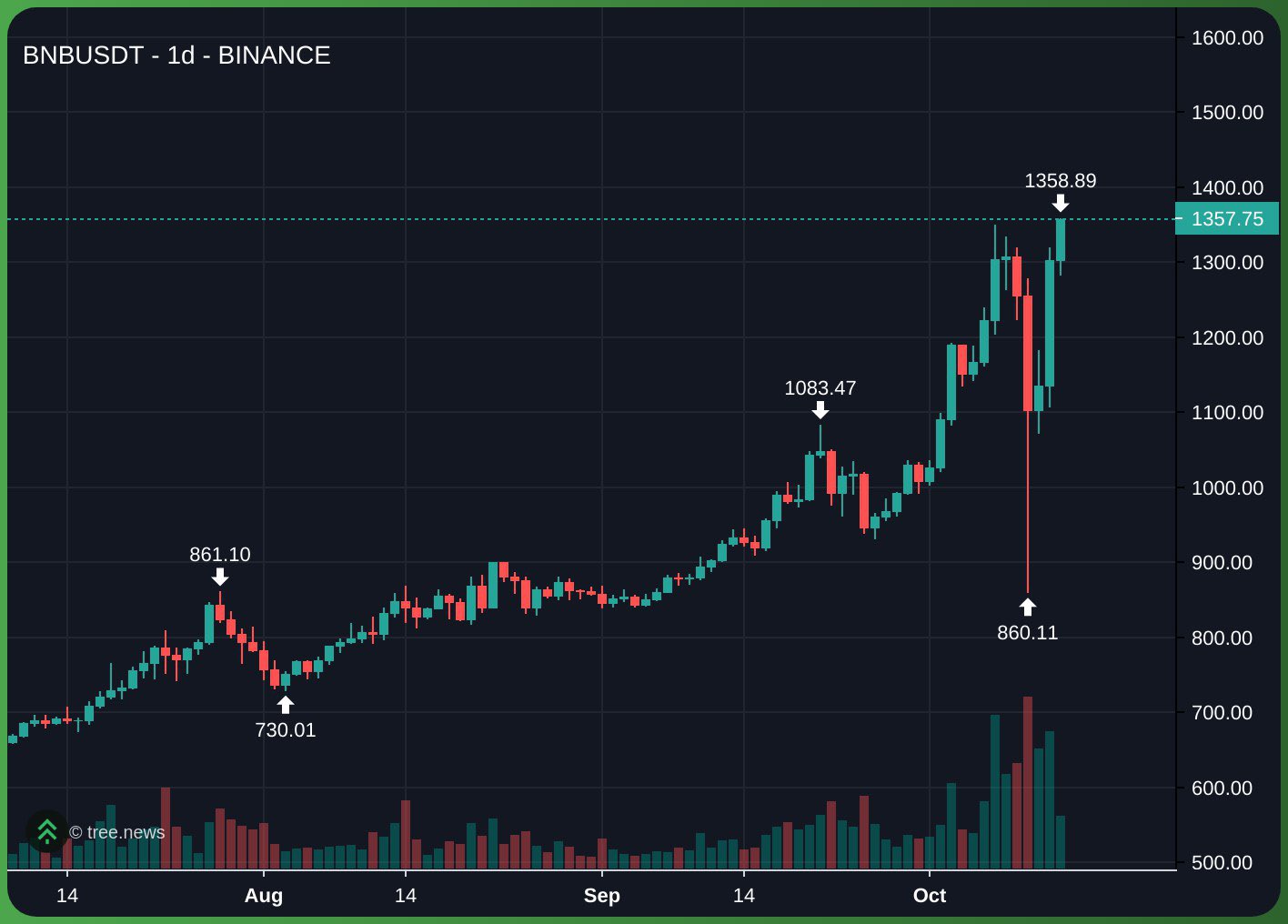
On Monday, it rallied to a new all-time high of $1,375, surpassing the earlier record high of $1,350 reached on October 7. It also remains the only asset in the top 20 ranking by market cap to close bullish last week, recording an 11.6% price increase during the period.

BNB On An Obvious Uptrend

Top trader Big Wiz highlighted this astonishing BNB price action in his recent post. He emphasized that BNB has “swallowed” last week’s price crash like nothing happened and has gone on to make newer highs.

Notably, an accompanying chart further elaborates BNB’s price action as its parabolic expansion course intensifies. It shows a new high followed by a healthy correction, which suggests a clear uptrend pattern.

BNB Price Action | Big Wiz

After BNB rallied to $861 in July, it corrected 15.2% to a low of $730 before resuming its northward push. Another correction followed immediately after $1,083, taking the token back to $932, before BNB rallied to October 7’s high.

Meanwhile, BNB corrected from this high, joining the massive sell-off to $860, but has since recovered completely from that capsize. It swung to its current all-time high of $1,375 before the latest dip to $1,262.

Big Wiz claimed this bullish development suggested a Binance supercycle. While he did not provide further context, some believe this means it is the BNB season. However, others share the sentiment that Binance is pushing its token to new highs despite a broader market uncertainty. This remains highly speculative and is unconfirmed.

BNB Is Strong: CZ

Notably, former CEO Changpeng Zhao sees the entire situation from a standpoint of strength. He has highlighted several times the strength of BNB and the broader ecosystem, noting that they have been committed to building.

CZ recently posted on this topic, noting that while many other projects have a market maker, BNB doesn’t. He tied the show of tenancy to the builders, the community, and the token’s deflationary quality.

He also added today that the FUD around BNB may be fueling this strength. The little BNB drop is sparking a hot debate in the crypto community, and CZ suggested it might be what is pushing more people to buy.

“I hope they keep on talking about us,” he added.

Meanwhile, top market analysts still believe BNB has more upside. EGRAG Crypto predicted that BNB would reach $2,000, as the cryptocurrency follows the trajectory of gold.

Bitcoin Leads as Crypto Funds See $3B+ Inflows with ATH Volumes Despite Price Crash

0

Bitcoin led as digital asset investment funds drew in over $3 billion last week, showing strong resilience despite crypto prices falling sharply on Friday.

According to CoinShares, crypto funds saw $3.17 billion last week. In addition, total inflows for the year have climbed to a record $48.7 billion, already surpassing last year’s full total. However, total assets under management (AUM) slipped 7% from the previous week’s high, settling at $242 billion after the market dip.

Interestingly, trading activity reached historic levels as investors took advantage of the price correction. For context, weekly trading volumes in digital asset ETPs surged to $53 billion, twice the 2025 weekly average, while Friday alone hit a record $15.3 billion. 

Despite the heavy trading, Friday’s outflows reached only $159 million. This indicates that most investors used the dip to add to their positions rather than exit them.

Bitcoin Leads, While Ethereum, Solana, and XRP Follow

Expectedly, Bitcoin led the charge again, attracting $2.67 billion in fresh inflows. Its year-to-date total now stands at $30.2 billion, still below the $41.7 billion recorded in 2024. Trading volumes spiked to an all-time daily high of $10.4 billion on Friday, yet Bitcoin flows for that day totaled just $0.39 million.

Ethereum followed as the next most popular asset, gaining $338 million for the week. However, it also saw $172 million in outflows on Friday, marking the largest daily withdrawal among all assets tracked. 

Flows by Asset CoinShares

This indicates that investors viewed Ethereum as more exposed to short-term uncertainty. Despite this, Ethereum’s year-to-date inflows stand at $13.99 billion, with $36.46 billion in AUM.

Notably, interest in Solana and XRP cooled slightly despite the growing anticipation around their upcoming U.S. ETF launches. 

Specifically, Solana brought in $93.3 million during the week, raising its total inflows for the year to $2.67 billion and its AUM to $4.8 billion. Meanwhile, XRP saw $61.6 million in new weekly inflows, lifting its 2025 total to $1.89 billion and its AUM to $2.94 billion.

Flows by Fund and Region

Among fund providers, iShares dominated the market, posting $3.26 billion in inflows for the week and $38.98 billion for the year. Its AUM now stands at a massive $110.33 billion. Fidelity’s Wise Origin Bitcoin Fund followed with $89 million in weekly inflows and $427 million month-to-date, taking its AUM to $24.19 billion. 

Flows by Provider CoinShares
Flows by Provider | CoinShares

21Shares also saw positive results, adding $92 million over the week and $14 million month-to-date, with $5.8 billion in AUM. However, Grayscale continued to face redemptions, losing $110 million over the week and $1.76 billion year-to-date, leaving its AUM at $34.9 billion.

By region, the United States was the leader, contributing $3.01 billion in weekly inflows and $6.18 billion month-to-date, with total inflows of $45.28 billion so far this year and $169.83 billion in AUM. 

Flows by Country CoinShares
Flows by Country | CoinShares

Switzerland ranked second, adding $132 million for the week, bringing its yearly inflows to $1.06 billion. Germany followed with $53.5 million for the week, pushing its total inflows for the year to $1.86 billion. Meanwhile, Canada added a smaller $3.8 million but continues to hold steady with $567 million in 2025 inflows.

If You’re Not Willing to Hold XRP for 10 Years, Don’t Get In: Crypto Coach

0

Crypto coach and influencer Coach JV has again reiterated the importance of patience and conviction when investing in XRP.

He urged followers to stay focused on long-term value rather than short-term price action. In his latest remarks, he emphasized holding a strategy built on discipline, with XRP, Bitcoin, and Solana (SOL) forming the core of his portfolio.

“Be Ready for a 10-Year Journey or Get Wrecked”

According to Coach JV, many investors are still chasing quick profits without understanding what they’re holding. He stressed that those who aren’t prepared to hold an asset for a decade or who lack strong conviction in their choices should reconsider entering the market. He believes acting solely on emotion often results in significant financial setbacks.

In parallel, Coach JV disclosed that Bitcoin remains his “supercharged savings account,” an asset he says he plans never to sell. 

As for XRP and Solana, they also represent long-term investments, but among altcoins, he plans to take profits during blow-off tops due to their tendency for exceptional price action.

Bitcoin as Savings, XRP as Utility

Coach JV’s strategy aligns with what many investors now believe: that Bitcoin is digital gold, while XRP offers real-world utility for global payments.

He takes profits from altcoins when prices rise and reallocates them to build a safer, more stable financial base for long-term strength rather than short-term gains.

Friday’s big market swings showed exactly why, in his view, it’s better to stay patient and prepared than to trade on impulse.

For context, Bitcoin’s price dropped over 16% on Friday night, while XRP plunged 56%. Other altcoins, like SUI, crashed by over 85%. However, most of the market has since recovered, with some tokens, such as BNB, already reaching new all-time highs.

Discipline Over Emotion

“Discipline, patience, and conviction will always beat emotion,” Coach JV said, summing up his approach to building a strong financial foundation. He believes holding assets like XRP for the long term can protect against the falling value of traditional money and help investors avoid panic during market downturns. 

Essentially, Coach JV urges investors to stay disciplined, stay confident, and let time work in your favor.

XRP’s Potential Price Ten Years from Now

XRP is trading at $2.60 today, and there have been numerous long-term forecasts about where its price could go in the years ahead.

An analysis by The Crypto Basic in September suggests XRP could reach between $20 and $50 by 2030. The estimate assumes continued adoption and favorable regulatory developments.

Over longer horizons, the report estimates potential prices of $100–$300 by 2035, $500–$1,000 by 2040, and even $1,500–$5,000 by 2050 in a best-case scenario.

These bullish forecasts continue to fuel optimism among investors holding XRP for the long term, as they suggest a potential 1,000X return. However, these projections remain speculative and come with no guarantees.