
Home Blog Page 501

XRP ETF Approval Could Face Major Delay: Here’s Why

0

Although anticipation is building for potential XRP ETF approvals later this month, their launches may still face delays.

According to Crypto in America, the U.S. government shutdown is impacting the operations of several federal agencies, including the SEC. Notably, while the SEC retains the authority to act on fraud and market emergencies during a shutdown, routine operations, such as ETF approvals and IPO reviews, are suspended. 

Unlike futures products, the SEC’s Division of Corporation Finance typically signs off on spot ETFs before trading can commence. With the shutdown in effect, the anticipated ETFs for XRP are unlikely to debut until government funding is restored.

The same is also applicable to other crypto-related ETFs, including Litecoin and Solana, which were expected to launch this month. 

XRP ETF Approval Deadlines Now Irrelevant 

Previously, the SEC faced several October deadlines to either approve or reject XRP ETF proposals from issuers such as Bitwise and Grayscale. However, according to an earlier update from Eleanor Terrett, those deadlines are no longer in effect following the approval of the SEC’s Generic Listing Standards framework last month. 

Under the new framework, the SEC instructed issuers and their partner exchanges to withdraw their 19b-4 filings. The move effectively renders the original deadlines irrelevant. 

Although the change was initially welcomed as a step toward expediting crypto ETF reviews and approvals, it now leaves the SEC with no obligation to advance spot crypto ETF applications during the shutdown. 

SEC Misses Final Deadline for Litecoin ETF 

Notably, the SEC missed its decision deadline for Canary Capital’s proposed Litecoin ETF, which was due on October 2. As a result, many are speculating that the same fate awaits other crypto ETF proposals during the shutdown, including those linked to XRP. 

Nonetheless, the Generic Listing Standards framework could set the stage for a wave of spot XRP ETF launches once the SEC resumes full operations. In the meantime, the regulator’s operations remain limited, as it is even unable to respond to press inquiries. 

There are currently no signs that the government shutdown will end soon, as Republicans and Democrats continue to blame each other for the funding lapse that triggered it. 

The White House is also considering halting or delaying billions of dollars in projects in Democratic-led states as a means of putting pressure on Democrats. It’s not clear if this would fix the funding problem.


Walmart-Backed OnePay to Add Bitcoin and Ethereum Trading in Super App Push

0

Walmart’s fintech venture OnePay is preparing to introduce cryptocurrency services in its mobile app, thereby expanding its push to become a U.S. super app.

According to a CNBC report, OnePay will soon allow customers to buy, hold, and sell Bitcoin and Ethereum directly from its app.

The service is expected to roll out later this year in partnership with crypto infrastructure startup Zerohash. By integrating Zerohash’s platform, OnePay can offer secure custody and trading services without having to build the technology from scratch. 

Once live, the feature will enable customers to store Bitcoin and Ethereum directly inside their OnePay wallets. Users could then convert their digital assets into cash to shop, settle card balances, or make bill payments, making crypto part of everyday spending.

The Super App Vision

OnePay was created in 2021 through a joint effort between Walmart and venture capital firm Ribbit Capital. From the start, the company’s goal was ambitious: to design an “everything app” that combines traditional banking with modern digital services.

Over the past three years, the fintech has gradually expanded its offerings. Today, OnePay users can access high-yield savings accounts, credit and debit cards, buy now, pay later (BNPL) loans, and even wireless phone plans.

Now, the upcoming crypto service represents the latest step in that journey. Through this addition, OnePay seeks to position itself alongside global super apps such as WeChat, which dominate overseas markets by integrating payments, social features, and financial tools into a unified ecosystem.

Strong Traction in a Crowded Market

Despite being relatively young, OnePay has already made its mark. The app currently ranks No. 5 among free finance apps on Apple’s App Store, surpassing well-established players such as JPMorgan Chase, Robinhood, and Chime.

That success is notable because nearly all of OnePay’s closest rivals already provide crypto services, including PayPal, Venmo, and Cash App. By adding Bitcoin and Ethereum trading, OnePay is closing the competitive gap while strengthening its appeal to younger, tech-savvy consumers.

Walmart’s Built-In Advantage

OnePay benefits from a powerful distribution channel that no other fintech can match: Walmart. The world’s largest retailer serves around 150 million U.S. shoppers each week through its stores and online platforms.

The OnePay app is tightly integrated into Walmart’s checkout systems. This means customers can move seamlessly between shopping and managing their finances. For OnePay, this built-in exposure is a massive growth lever that competitors cannot easily replicate.

At the same time, the company operates as a separate entity. This independence allows OnePay to broaden its reach beyond Walmart’s customer base, targeting millions of Americans who remain underserved by traditional banking institutions.

Crypto Momentum in U.S. Finance

The timing of OnePay’s move reflects a broader shift in U.S. financial markets. After years of hesitation, major banks and financial institutions are beginning to embrace cryptocurrency.

Morgan Stanley, for example, recently announced that it will soon give its E-Trade clients direct access to crypto investments. This decision follows a wider industry trend, as regulatory attitudes toward digital assets continue to evolve.

Meanwhile, Zerohash, OnePay’s partner for crypto services, is also benefiting from this shift. The startup raised $104 million last month from high-profile investors, including Morgan Stanley and Interactive Brokers.

The funding will help Zerohash expand its infrastructure as more banks, brokers, and fintechs seek to integrate cryptocurrency into their offerings.

Pundit Predicts XRP to $20,000, Linking It to Ripple’s New Privacy Project

0

Ripple has put privacy and scalability at the center of its new strategy, and the recent move has triggered bold theories about the XRP price. 

The discussion picked up after RippleX Senior Director of Engineering, J. Ayo Akinyele, shared his vision for the XRP Ledger (XRPL) in a recent Ripple Insights post.

Akinyele said his team is building the privacy, scale, and reliability that financial institutions demand. Over the next year, he plans to roll out zero-knowledge proofs so institutions can process private but compliant transactions more efficiently.

Steingraber Resurrects XRP to $20,000 Projection

This renewed focus on privacy has revived an XRP valuation model first shared in 2022 by game developer and community analyst Chad Steingraber. At the time, he presented what he believed could be the road to a $20,000 XRP, building his case on three principles.

Specifically, he started with supply and demand, noting that weak demand leaves assets undervalued while rising demand can trigger massive price swings. 

He then used housing markets to explain market appreciation, arguing that one higher sale price can lift the perceived value of all similar assets even without fresh money entering. The market pundit called this “phantom value.” 

His third principle focused on scarcity, comparing XRP to rare art like the Mona Lisa, where limited supply and cultural importance drive high valuations.

Steingraber related these ideas to XRP. Notably, he noted that with fewer than 100 billion tokens in existence and small amounts burned on every transaction, XRP remains deflationary. He also mentioned that the XRPL can issue other assets, including IOUs.

At the time of his assessment, XRP carried a market cap of $18 billion. However, he argued that the figure overstated real investment, since market cap only indicates what people are willing to pay. He described XRP as cheap because most trading came from retail wash activity in shallow markets and emphasized that circulating supply ultimately drives price.

The Importance of Privacy

Steingraber then turned to banks. According to him, institutions like Bank of America, Chase, and Wells Fargo would never rely on public exchanges or on-demand liquidity the way retail traders do. Instead, he said they would build private ledgers and hold XRP as a reserve asset, much like gold.

In his model, banks would issue internal coins backed by their XRP reserves for customer balances without moving their XRP. Meanwhile, to handle cross-bank transfers, he expects institutional-grade liquidity providers to manage massive asset pools on private ledgers.

Interestingly, he described this as a digital arms race where banks and liquidity providers would compete to accumulate XRP. He also argued that most of Ripple’s escrowed supply would never reach the open market.

Steingraber warned that once over-the-counter options dry up, demand would move to public exchanges, where available supply is far smaller than assumed. He noted that large sums of XRP have already disappeared forever, including one billion tokens reportedly lost after banker Andrew Mellon died without his keys. 

He estimated that only around 20 billion XRP sit on exchanges today. From there, the pundit presented a situation where institutions wipe out order books in hours. At this point, prices at $0.3, $0.4, $0.5, and $1 would vanish one after the other, with arbitrage and private wallets fueling a surge. This is the XRP path to $20,000.

As XRP Breaks Out, Analyst Says No Need to Tell You What Comes Next

0

Renowned analyst Mikybull believes the market may still be underestimating the magnitude of the incoming XRP price rally.

In a tweet, Mikybull shared a chart showing that XRP has broken out of a months-long falling wedge pattern, igniting fresh bullish momentum. On the two-day chart, the token pushed above the $3.05–$3.10 resistance zone, a move technical analysts have been anticipating as a turning point.

XRP “Mega Breakout” Unfolding

In his update, Mikybull noted that XRP was experiencing a “mega breakout” and implied that significant movement was expected to follow. “I don’t need to tell you what comes next,” he said.

This remark came after his earlier observation that a “big move” was imminent as XRP consolidated within a wedge formation. The breakout above the wedge resistance shows the market is turning from bearish to bullish.

Mikybull's XRP chart
Mikybull’s XRP chart

Notably, XRP established support at $2.70 and $2.80 over the past few weeks, consolidating until yesterday when it finally recaptured the $3 region. At press time, the coin continues to hold this level, trading at $3.05.

Now, analysts believe XRP is set for more gains. Important immediate levels to watch soon are $3.40 and $3.66. These are the price levels at which it previously faced rejection.

Overcoming these would open the path for XRP to retest the stubborn $3.84, a level it has not seen since 2018, potentially leading to price discovery at $4 and beyond.

What Will the XRP Mega Breakout Deliver?

While Mikybull remains a permabull on XRP, forecasting a mega breakout, he has consistently refrained from specifying how high he expects the price to go. However, many other analysts in the XRP community have not been shy about disclosing their ambitious expectations.

Last month, after XRP initially broke above $3 and showed strong bullish momentum following a dip to $2.60, analyst Matt Hughes projected a rally ranging from $8.30 to as high as $26.

Meanwhile, another well-known XRP analyst, EGRAG, shares a similar $27 target, while others like Dustin Layton are looking for a $50 XRP. These price targets suggest around 3x to 16x price performance for XRP from its current position.

While some consider the highest targets ambitious, the bullish sentiment draws inspiration beyond technical charts.

Foundations for the Outlook

Many are hopeful this month due to upcoming SEC decisions on XRP ETFs and Ripple’s bank charter approval, both of which could drive significant price gains. Approval could open regulated access for investors, potentially sparking a strong price surge similar to the impact seen with past Bitcoin ETFs.

In the broader market context, crypto commentator Ash Crypto predicts that if Bitcoin reaches $150,000 or $200,000 by the end of 2025, XRP could follow with gains of $5 to $8.

His outlook highlights XRP’s potential to outperform Bitcoin’s momentum, especially with XRP ETFs launching soon.

Australian Firm Fitell Expands Solana Strategy with $1.5M PUMP Token Purchase

0

Fitell Corporation, an Australian fitness firm, has invested millions in Pump.fun (PUMP) tokens to expand its Solana-focused strategy.

In a press statement, Fitell revealed that it has added 216.8 million Pump.fun (PUMP) tokens to its corporate treasury. These tokens are valued at around $1.5 million. Notably, this marks the company’s first direct allocation to the meme-inspired Solana token.

According to Chief Executive Sam Lu, the move reflects the company’s focus on increasing its engagement with Solana’s ecosystem while simultaneously managing a more varied long-term treasury. Moreover, the company is also committed to sharing regular updates as its digital asset holdings expand.

Expanding Role in the Solana Ecosystem

The token purchase builds on Fitell’s previously announced Solana-focused treasury initiative, which it has described as Australia’s first of its kind. 

To align with this strategy, the firm has initiated a rebranding effort under the name Solana Australia Corporation. This, in turn, marks the company’s transformation from fitness roots to blockchain finance.

Fitell’s broader roadmap includes building a presence in staking Solana tokens to earn rewards. In addition, it plans to participate in decentralized finance yield opportunities to generate ongoing returns.

Finally, the company also plans to explore structured products, including options and liquidity provisioning, while ensuring it applies institutional-grade infrastructure to manage risks.

Strategic Advisory Appointments

To support its expansion, Fitell has brought in two seasoned digital asset specialists.

David Swaney, active in the cryptocurrency space since 2017, brings extensive expertise in institutional integration and corporate treasury operations. Meanwhile, Cailen Sullivan, who worked at Coinbase in its early days and later co-founded Adrena, a perpetual exchange built on the Solana blockchain, brings more than ten years of experience in the blockchain industry.

Both Swaney and Sullivan are expected to play an important role in shaping a scalable and risk-conscious strategy for Fitell.

Market Reaction

The announcement had an immediate effect on the PUMP price. Specifically, the token climbed 1.7% to $0.006848, continuing its strong momentum. This, in turn, extends a 30% rally over the past week and a 90% surge in the past month. Its market capitalization now stands at $2.42 billion.

However, Fitell’s own stock moved in the opposite direction. FTEL shares closed at $5.32 on Thursday, down 11.63% in a single day and nearly 15% across the last five trading sessions.

$100M Financing Backs Treasury Growth

The Pump.fun allocation follows Fitell’s recently announced convertible note facility of up to $100 million with a U.S.-based institutional investor. From the initial funding round, $10 million has been set aside for Solana (SOL) purchases.

Fitell has set its sights on being the largest Solana holder among publicly listed companies in the Asia-Pacific.

To ensure security and compliance, the company will store its SOL assets with BitGo Trust Company in the U.S. and delegate staking to professional institutional providers.

Looking ahead, Fitell is considering a secondary listing on the Australian Stock Exchange (ASX). This move aims to broaden investor access and strengthen the company’s profile among traditional market participants.

Pundit Says XRP at $10,000 Will Create Over $800 Trillion in Liquidity

0

An XRP community figure has made an argument against suggestions that XRP could not reach lofty targets due to market cap constraints.

Notably, while a few market analysts have predicted ambitious targets for XRP, citing its utility in payments, most believe these bold price targets face hard limits, especially considering XRP’s extensive supply.

XRP Market Cap Constraints

For instance, if XRP ever got to the audacious $1,000 mark with its circulating supply of 59.91 billion tokens, its market value would jump to $59.91 trillion. 

This figure would more than double the market cap of gold, the world’s most valuable asset, and even surpass the combined value of the 10 largest assets worldwide. As a result, several analysts argue that such projections remain far out of reach in the near term.

Amid this widespread pessimism, software engineer Vincent Van Code recently presented a counterargument. In a recent commentary, Van Code referred to a past comment from Ripple CEO Brad Garlinghouse, which he believes shows how XRP could break through these doubts. 

Specifically, at the 2025 XRPL Apex event in Singapore, Garlinghouse addressed a journalist who asked him and Ripple CTO David Schwartz how much of SWIFT’s transaction volume the XRP Ledger could realistically capture over the next five years.

Responding, Garlinghouse pointed out there’s a difference between SWIFT’s messaging system and its role in providing liquidity. He stressed that liquidity drives XRP’s future more than messaging. The Ripple CEO then estimated that the XRPL could handle about 14% of SWIFT’s global transaction volume within that time frame.

XRP at $10,000 Will Release $800T in Liquidity

Building on this, Van Code argued that crypto’s biggest contribution is in solving liquidity challenges. He said governments cannot just print money to create liquidity because that approach risks breaking fiat currencies. 

In contrast, he suggested XRP can create nearly limitless liquidity. According to his calculation, if XRP climbed to $10,000, it would generate over $800 trillion in liquidity, more than enough to meet global needs.

Van Code acknowledged that critics often question how such figures could exist when the total supply of money worldwide falls far below that level. He argued that those critics misunderstand how liquidity works. 

The community pundit explained that if anyone tried to convert $800 trillion worth of XRP into fiat, the price would naturally adjust. He compared the process to a logarithmic decay, saying the mechanism ensures liquidity expands without simply draining out.

According to him, the idea of limitless liquidity would dominate conversations in the coming years. He also warned that a severe global liquidity squeeze could bolster the movement, pushing markets toward a system where XRP has a major role.

Emerging Counterpoints

Notably, responding to Van Code, a market participant pointed out that central banks already control liquidity. He highlighted how authorities use quantitative easing (QE) and quantitative tightening (QT), with the M2 money supply continuing to grow. 

He noted that currencies, including the US dollar, keep losing value through debasement but argued they have not collapsed. The investor then questioned how a neutral digital asset like XRP could replace the liquidity that governments manage today.

In response, Van Code stressed that XRP works as a bridge token or swap tool. He said liquidity in foreign exchange depends more on available trading pairs than on sheer money supply. According to him, where the liquidity sits globally matters just as much.

Cardano Founder Shares Why Bitcoin Will Reach $250,000 by Mid-2026

0

Cardano founder Charles Hoskinson has argued that Bitcoin will rally to $250,000, further highlighting the primary reasons why it could reach the price mark.

The Cardano founder is making headlines again for his new timeline for Bitcoin to reach the quarter of a million mark. He told Bloomberg Insight that the pioneering cryptocurrency will grow to $250,000 around June or July 2026.

Remarkably, this would make a new all-time high for BTC as it currently trades around $120,000. Buyers at the current market price will also see a 108% increase in their portfolio in less than a year if Bitcoin reaches the price target as predicted by Hoskinson.

What Will Drive This Rally to $250,000?

Speaking to Bloomberg, Hoskinson explained why Bitcoin is going to $250,000, one of which is regulatory clarity. The vocal Cardano founder asserted that the CLARITY Act will be passed, ushering in a greater wave of institutional adoption.

Notably, the US House of Representatives passed the GENIUS Act, the CLARITY Act, and the Anti-CBDC bill during Crypto Week in July. While the White House has signed the GENIUS Act into law, the CLARITY Act will now head to the Senate for approval.

For context, the CLARITY Act focuses on establishing a proper structure for the cryptocurrency market, determining who regulates what in the industry. Hoskinson noted that this legislation will likely gain approval, drawing in strong demand for Bitcoin and cryptocurrencies.

Furthermore, he noted that new users are also entering the Bitcoin ecosystem. Specifically, he predicted that 500 million to 1 billion users will integrate cryptocurrencies into their platform, further enhancing their reach and credibility.

Institutional Demand Still “Very Strong”

Digital asset treasury (DAT) firms are the latest trend in the crypto space, as more and more companies are making Bitcoin a huge part of their balance sheet. New entrants are stacking up the limitedly capped BTC tokens, taking a page from Strategy’s playbook.

Currently, 343 entities are holding Bitcoin, up by 27 in the past 30 days. These entities have now accumulated a staggering 3.86 million BTC, showing a strong demand for the premier asset.

The Bitcoin spot ETFs have also attracted impressive traction, nearing a cumulative total of $60 billion in inflows. This comes as the funds recorded a $627 million daily inflow on Thursday.

Yet Hoskinson expects more institutions to dabble in the crypto market. He expects more significant Bitcoin adoption, with venture capitalists also expected to pick up again towards the end of this quarter to inject new liquidity into the market.

These factors, he believes, will propel Bitcoin to $250,000 by mid-2026. Remarkably, some believe Bitcoin could reach the price mark this year, citing similar reasons to the Cardano founder but with a slimmer timeframe.

Analyst Predicts 150% Shiba Inu Rally: Here’s Why

0

Community analyst Javon Marks argues that Shiba Inu could be gearing up for a major rebound that could see it spike by more than 150%. 

In an X post, Marks highlights a regular bullish divergence forming on Shiba Inu’s chart over the two-day timeframe. For the uninitiated, a bullish divergence is a technical signal that often indicates a potential trend reversal, suggesting a shift from a downtrend to an uptrend.

Confirming the formation of a bullish divergence, Marks suggested that the signal could pave the way for a major SHIB recovery.

SHIB to $0.000032?

He projects that this move could drive a surge of over 150%, pushing Shiba Inu’s price from its current level of $0.000012587 to around $0.000032. 

Shiba Inu last traded around the $0.000032 mark in December 2024, following the broader market’s reaction to President Donald Trump’s re-election. However, it has since dropped from this level, with its price stuck around the $0.00001 region for months. 

Despite SHIB’s underperformance, Marks has consistently projected a return to $0.00003 since July, keeping his nearly 60,000 followers on X updated with the latest price action. Last month, he expressed confidence that Shiba Inu would reach $0.00003, noting that it is only a matter of time before the projection materializes. 

In one of his updates, he stressed that Shiba Inu’s spike to $0.000032 could be the beginning of a broader bullish reversal.  He forecasted the uptrend could extend toward $0.000081, putting SHIB within striking distance of its previous all-time high of $0.00008845. 

Shiba Inu chart by Javon Marks

Shiba Inu Already in the Green

Shiba Inu kicked off October with renewed momentum, with its community members rallying behind the ‘Uptober’ rally expectations. It started the month on a good note, soaring over 6% on October 1. 

This spike strengthened community sentiment across social media platforms. Consequently, some proponents have pointed to the significant gains that October has historically brought for SHIB, particularly in 2021, when the asset spiked by more than 800%, reaching $0.00008845. 

Amid the growing optimism, pundit YourPop noted that Shiba Inu will register a new all-time high this year.

Despite starting the month on a positive note, Shiba Inu has corrected slightly, with its price dropping 1.47% over the past day. However, the canine-themed token boasts a month-to-date gain of 5.29%. 

Ethereum Closes in on Bitcoin Annual Performance Following Strong Q3

0

Market data shows that Ethereum, the king altcoin, has dramatically closed in on Bitcoin’s annual performance following Q3 gains.

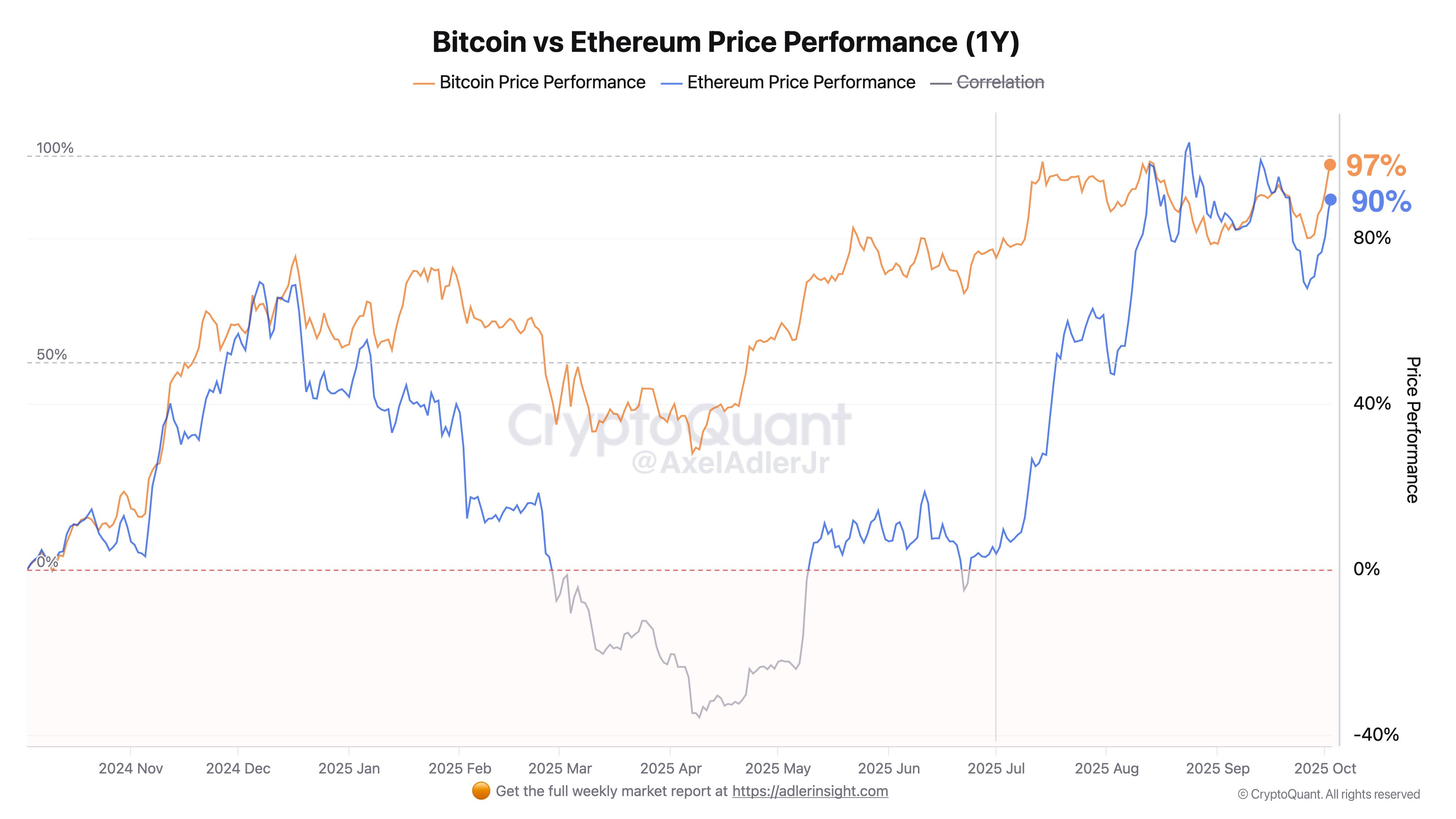
Ethereum has nearly matched Bitcoin’s annual performance over the last quarter, according to a chart shared by CryptoQuant analyst Axel Adler Jr. This comes as both assets hit all-time highs this year.

Ethereum Price Performance Matching Bitcoin Over the Past Year

The data shows Ethereum’s price growth aligning closely with Bitcoin, pushing their correlation up as of early October 2025. This marks one of the strongest synchronized movements between the two largest cryptocurrencies in recent months.

The comparative chart highlights Bitcoin’s steady climb, gaining around 97% in performance year-over-year. Ethereum follows closely at 90%, reflecting its strongest rebound since early 2025 after a prolonged drawdown earlier in the year.

Between November 2024 and January 2025, both assets surged, with Ethereum briefly outpacing Bitcoin as it crossed the 50% performance mark. However, a sharp decline followed in February 2025, dragging Ethereum’s performance below zero, while Bitcoin maintained moderate gains.

Ethereum vs Bitcoin 1Y Performance CryptoQuant
Ethereum vs Bitcoin 1Y Performance | CryptoQuant

By May 2025, Bitcoin’s upward run resumed, hovering consistently above 50% performance gains. Ethereum, though still lagging during the mid-year period, began a rapid recovery from July, lifting its yearly performance back into positive territory. 

By September, the gap between the two had nearly closed, showing synchronized rallies that drove the correlation to near-perfect levels.

Ethereum Could Be Bitcoin’s Replacement

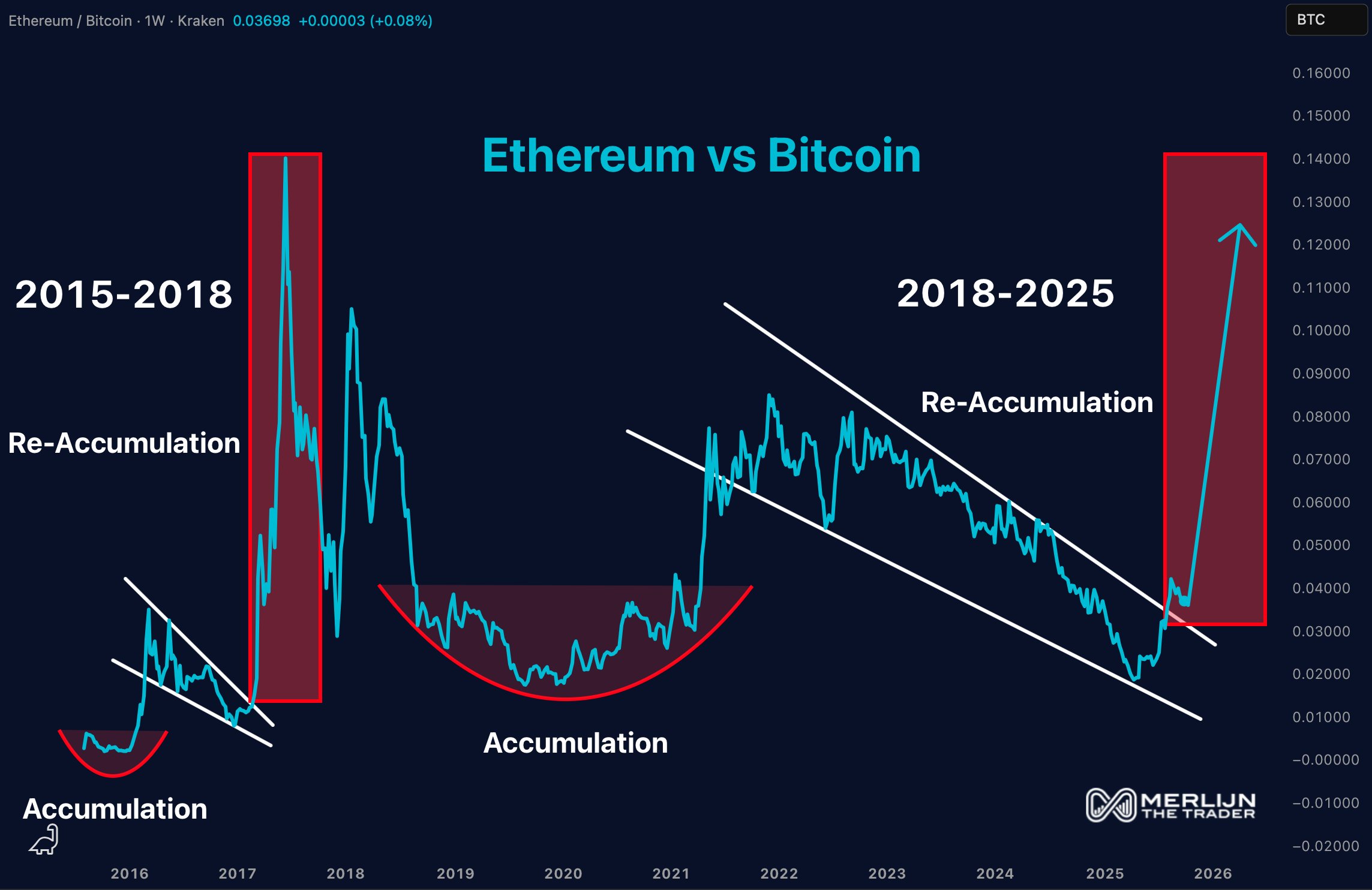
Analyst Merljin also backs up the analysis, emphasizing Ethereum’s current bullish push. According to the market watcher, the ETH/BTC ratio has broken above a long downtrend, potentially positioning Ethereum for its strongest relative rotation against Bitcoin since 2017. 

ETHBTC 1W Chart Merlijn
ETHBTC 1W Chart | Merlijn

While the prior cycle ended with ETH hitting record dominance levels, the new breakout suggests that Ethereum is again reasserting strength in the pair.

Market snapshots confirm the trend. As of press time, Bitcoin trades near $119,992 with a 9.4% gain over the past week. Ethereum trades at $4,461, advancing 13.2% across the same period. Bitcoin’s market capitalization stands at $2.39 trillion, while Ethereum holds $538 billion. 

Bitcoin Approaching Historical Post-Halving Peak Window, What Next for Prices?

0

The current Bitcoin market cycle may be approaching a peak, according to historical post-halving patterns observed by a prominent market analyst.

The analyst, Quinten, highlighted that in each of the last three cycles, market tops emerged within a defined number of days following the halving.

Bitcoin’s Cycle Timing Across Halvings

Data from his chart shows that the 2012 halving triggered Bitcoin’s earliest parabolic rally, culminating just over a year later. The 2016 halving cycle extended for nearly a year and a half before topping out. In 2020, the timeline was similar, with the peak arriving just beyond the 540-day mark.

Bitcoin Price Post Halvings Quinten
Bitcoin Price Post Halvings | Quinten

This historical data suggests that Bitcoin’s most aggressive rallies tend to occur between one year and 18 months after halving events. The convergence of the 526-day and 548-day peaks from the last two cycles narrows the expected range even further. With the 2024 cycle, which led to several altcoins pumps, now entering day 531, Bitcoin sits almost exactly in line with this pattern.

At present, the Bitcoin price action is consolidating around $120,000, represented in black on the halving chart. The trajectory is tracking closer to the 2016 and 2020 cycles, both of which accelerated in this same post-halving stage. If the historical rhythm holds, the market is now within the same timeframe where prior cycle tops formed.

Uptober Narrative: Bitcoin Could Rally in Q4

While the halving window frames the cycle, seasonal psychology has historically amplified price action. Analysts often refer to “Uptober,” the start of Q4 when Bitcoin’s performance shifts into higher gear. The very narrative of October rallies attracts buyers, and subsequent momentum reinforces the trend.

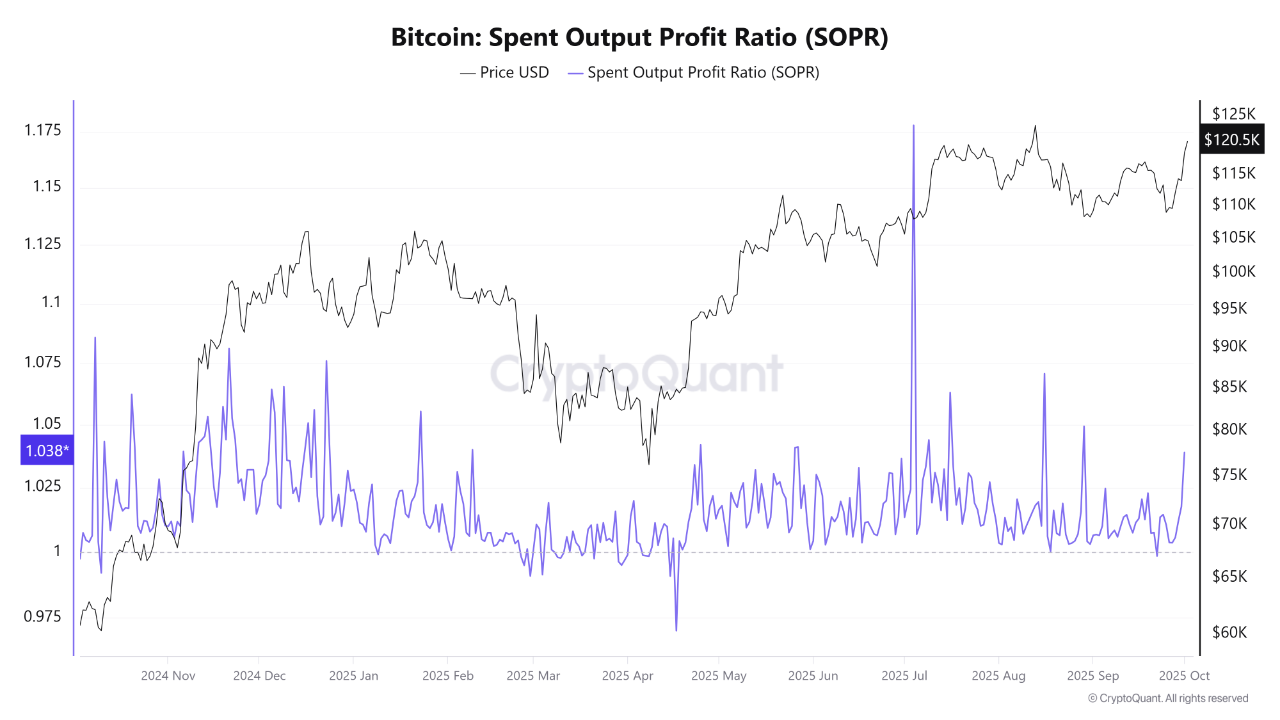
CryptoQuant’s SOPR chart adds evidence to this effect. The ratio, which measures whether coins are being sold at a profit or loss, consistently rises above 1 in Q4. This shows that coins change hands at a profit without overwhelming the market with selling pressure. The shift reflects a psychological cycle where early gains reinforce conviction and encourage further participation.

Bitcoin SOPR CryptoQuant
Bitcoin SOPR | CryptoQuant

Bitcoin Inflows Set to Increase

Beyond psychology, institutional activity often strengthens October rallies. Portfolio rebalancing in Q4 introduces new capital into markets, with Bitcoin increasingly positioned as a beneficiary. Macro conditions, from Federal Reserve policy adjustments to U.S. election cycles, often coincide with heightened risk appetite.

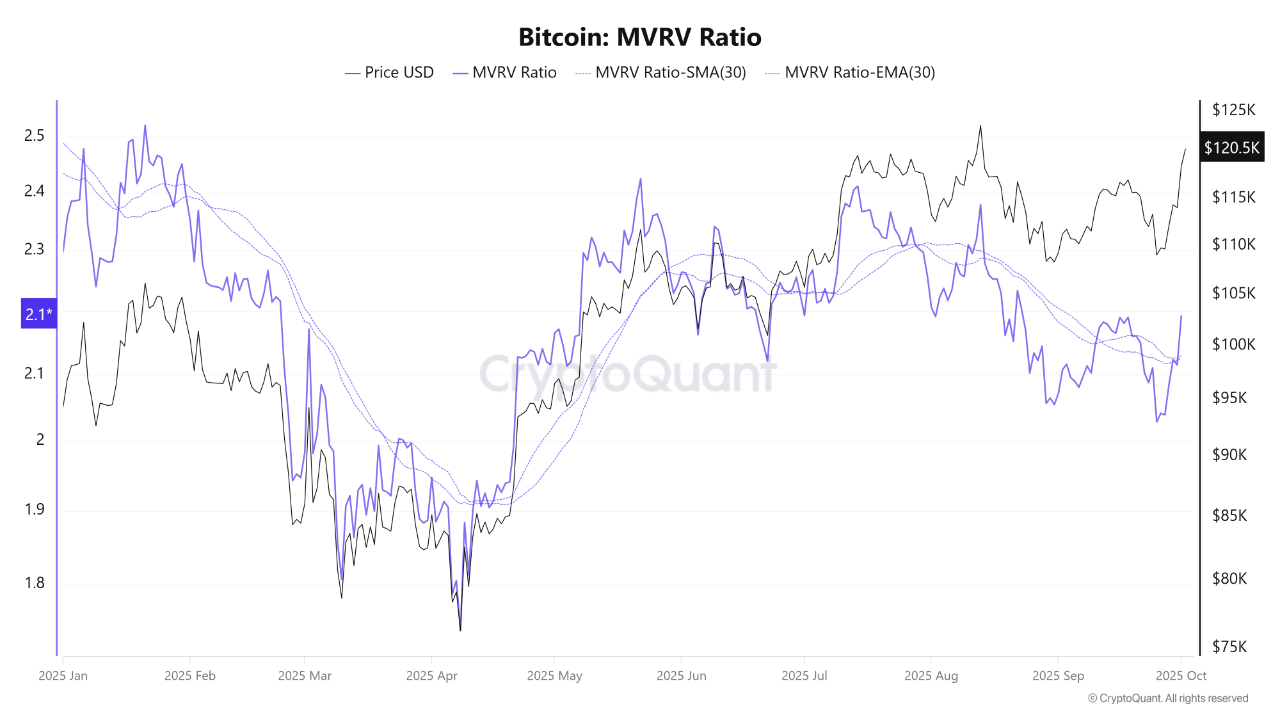
Bitcoin MVRV Ratio CryptoQuant
Bitcoin MVRV Ratio | CryptoQuant

These flows layer onto the halving-driven supply dynamics, magnifying their effect. While halvings create structural scarcity, capital inflows during Q4 provide the demand side of the equation.

The MVRV ratio, which compares Bitcoin’s market value to its realized value, shows this alignment. Notably, current readings hover around 2.1, signaling expanding unrealized profits. This level has historically represented the middle stage of bull cycles, well before overheated conditions above 3.0 emerge.

The steady rise in MVRV suggests that conviction among holders is strengthening, while the structural demand implied by declining exchange balances points to accumulation rather than short-term trading.