Home Blog Page 505

US Treasury Eases Tax Rules on Bitcoin Holdings

The U.S. Department of the Treasury and the Internal Revenue Service (IRS) have formally clarified that corporations will not be subject to taxation on unrealized gains on Bitcoin under the Corporate Alternative Minimum Tax (CAMT).

Specifically, the interim guidance, released on Tuesday, addresses a critical issue for companies that maintain substantial cryptocurrency holdings.

What the Guidance Means

The CAMT, enacted through the Inflation Reduction Act of 2022, imposes a 15% minimum tax on corporations with average annual financial statement income exceeding $1 billion. However, pursuant to the newly issued clarification, corporations may exclude unrealized gains and losses on digital assets in determining adjusted financial statement income (AFSI).

Consequently, corporations will not incur tax liabilities based on cryptocurrency price fluctuations unless such gains are realized through actual transactions. Furthermore, the Treasury has indicated its intent to promulgate revised regulations in alignment with this interim guidance.

Industry Concerns Resolved

Before this clarification, lawmakers and industry stakeholders had expressed concern that taxing unrealized gains could compel corporations to liquidate digital assets to cover tax obligations. In light of this, Senator Cynthia Lummis welcomed the update, calling it essential for protecting firms that build Bitcoin treasuries.

Overall, the ruling is seen as an effort to encourage digital asset adoption in U.S. corporate finance. At the same time, it aims to prevent tax policies from discouraging innovation and long-term investment in emerging technologies.

Strategy Inc. Emerges as a Key Winner

In particular, Strategy Inc., formerly MicroStrategy, stands among the biggest beneficiaries. The company, led by co-founder Michael Saylor, is the largest corporate holder of Bitcoin.

Following the announcement, Strategy said it no longer expects to fall under CAMT in 2026, as previously projected. Its shares rose as much as 3.7% in premarket trading on Wednesday.

The company reported an $8.1 billion unrealized gain in the first half of 2025 amid a rise in Bitcoin’s price. As of this writing, it holds approximately $74.6 billion worth of Bitcoin.

Bitcoin ETFs Could Soon Be Available to Vanguard’s 50M Clients

0

Bloomberg financial analyst Isabelle Lee revealed that Vanguard is considering adding crypto-related products, specifically Bitcoin ETFs, to its platform. 

She noted that the firm is currently evaluating the potential of offering such investment options and is discussing it with clients. 

Vanguard Considering Offering Bitcoin ETFs Amid Soaring Demand 

The shift comes as competitors, such as BlackRock, continue to see strong demand for Bitcoin ETFs. Isabelle emphasized the impressive success of Bitcoin ETFs, noting that they have collectively accumulated $142 billion in assets under management (AUM). 

Of this amount, $80 billion belongs to BlackRock’s iShares Bitcoin ETF (IBIT), Vanguard’s biggest competitor. Data from Farside shows that these products have attracted inflows of about $57.73 billion since going live in January 2024. 

Given the overwhelming demand for Bitcoin ETFs, the financial analyst said it would be a massive mistake if Vanguard “closes its door to that kind of money.” 

Shifting Stance on Crypto 

News of Vanguard’s potential entry into the Bitcoin ETF market surfaced last week. The Crypto Basic reported that the $11 trillion asset manager was considering granting its brokerage clients access to Bitcoin and other crypto-related ETFs. 

Unlike rival firms that have launched their own products, Vanguard is not expected to roll out a proprietary crypto ETF. Instead, the firm would give its clients the option to invest in third-party funds directly through its platform.

Until now, Vanguard has maintained a strict stance against Bitcoin, effectively barring its 50 million users from accessing crypto investment products. However, following the arrival of Salim Ramji as Vanguard’s CEO last year, rumors suggested that the company might open its doors to cryptocurrencies. 

Isabelle emphasized that Ramji has expressed openness to crypto and even played a major role in the launch of BlackRock’s iShares Bitcoin ETF. According to insiders, his leadership could push the firm toward greater flexibility on digital assets.

However, the financial analyst stressed that Vanguard has not officially confirmed plans to offer crypto-related products, including an ETF focused on Bitcoin. 

In the meantime, a Bloomberg analyst cautioned that Vanguard’s openness to crypto could backfire if asset prices experience a sharp downturn, potentially prompting critics to question why the firm embraced the move in the first place.

However, Isabelle countered the view, noting that people should be given the freedom to choose what to invest in. 

Deutsche Börse and Chainlink Bring Institutional Market Data Onchain for the First Time

0

Deutsche Börse, a major player in Europe’s financial markets, is partnering with Chainlink, the leading decentralized data provider.

The collaboration seeks to bring real-time market data on-chain using a new tool called DataLink. The move makes data from some of Europe’s most prominent trading venues accessible to blockchain developers and decentralized applications (dApps) across multiple chains.

What’s Coming Onchain?

Through Chainlink’s DataLink service, Deutsche Börse is delivering real-time, multi-asset class data on-chain, including:

Eurex: Europe’s biggest derivatives exchange, with over 2.08 billion traded contracts and €3.6 trillion in capital open interest in 2024.

Xetra: The leading European venue for ETFs and ETPs, with €230.8 billion in trading volume last year.

360T: A global FX trading platform with 2,900+ buy-side clients and 200+ liquidity providers across 75 countries.

Tradegate: A stock exchange serving private investors, with €247.8 billion in turnover and over 34 million transactions since January 2025.

This marks the first time in history that data of this caliber from Europe’s traditional financial markets will be available directly on public blockchains.

Why Chainlink?

Chainlink is the most widely adopted oracle infrastructure in the blockchain space. It has enabled over $25 trillion in transaction value and currently secures more than $100 billion in total DeFi value. Institutions like SWIFT, Mastercard, Euroclear, and Fidelity already trust Chainlink’s infrastructure.

By using Chainlink’s secure and proven technology, Deutsche Börse doesn’t need to build its own blockchain system. Instead, the DataLink service provides data providers with an easy and secure way to publish data on-chain.

“By using Chainlink, we are empowering global financial institutions to build the next generation of regulated financial products,” said Alireza Dorfard, Managing Director at Deutsche Börse Group.

Laying the Foundation for Institutional DeFi

This partnership represents a major step toward bringing decentralized finance (DeFi) into the mainstream. Notably, Chainlink and Deutsche Börse are enabling the creation of regulated financial products, tokenized assets, and advanced on-chain analytics.

Deutsche Börse is demonstrating that blockchain has a meaningful role in modern finance and that institutions are beginning to take digital assets seriously.

For developers and institutions, DataLink provides access to the same high-quality market data used by major financial players.

Expert Says Bitcoin Will Be Extremely Bullish If It Closes Around This Range

0

Bitcoin could continue its current form into uncharted territories if it closes around the $118,000 to $120,000 price range.

It’s “Uptober”, and Bitcoin is already living up to the buzz. Typically marked with positive price actions, Bitcoin has started October as bullish as many expect, with its 2.86% rally to reclaim $117,000.

Could we see more highs? Analyst Egrag Crypto believes so. In his Wednesday Bitcoin price prediction, he identified encouraging developments for Bitcoin, uncovering what needs to happen for the upward trend to continue.

Positive Signs for Bitcoin

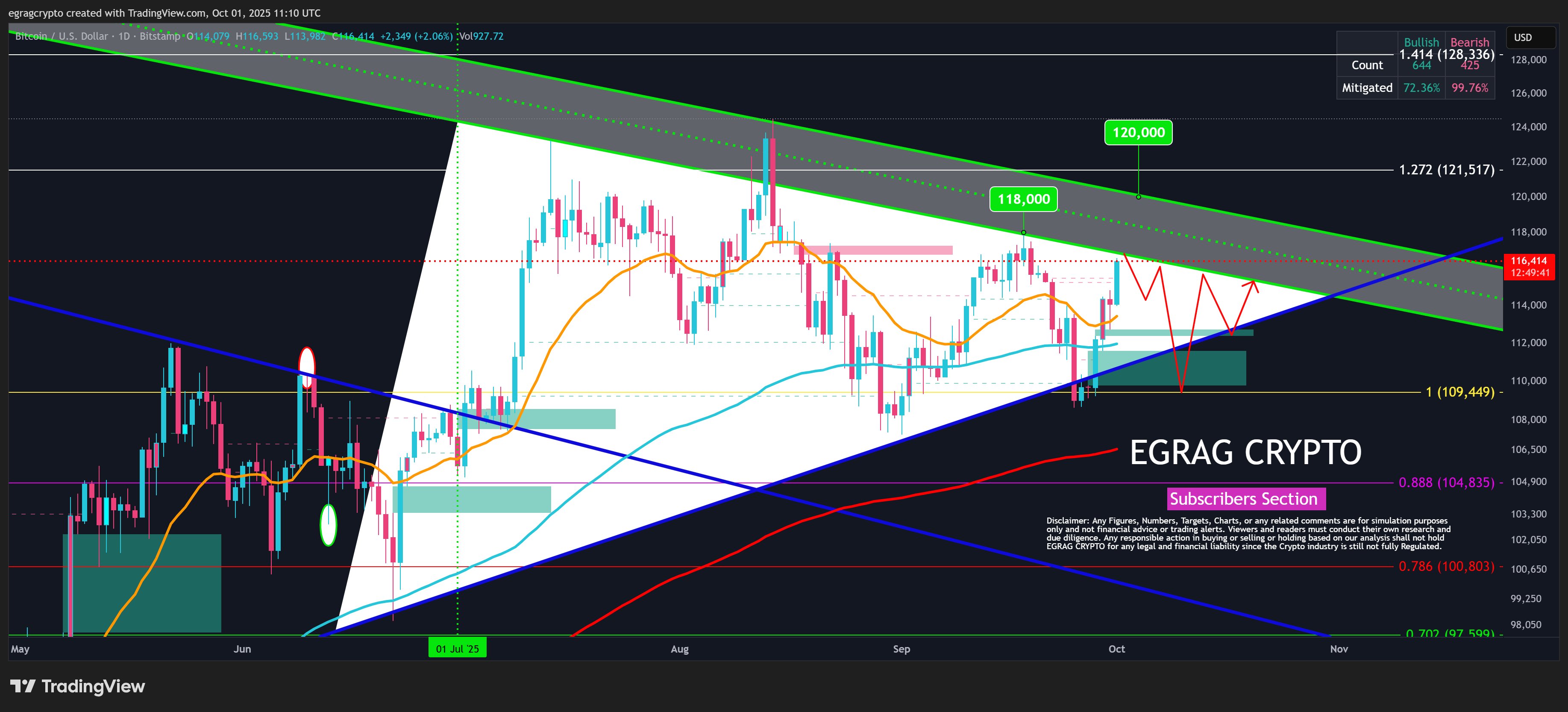
Egrag shared that Bitcoin has closed above a key support on the daily timeframe, which, according to him, is a positive sign. The chart accompanying the analysis shows that Bitcoin rebounded extensively from the $112,000 support level on September 30, closing above it on both the daily and monthly timeframes.

Bitcoin Price Analysis/Egrag Crypto

While this shows that Bitcoin seems headed in the right direction, the analyst noted that one of two things can happen from here. Currently, BTC trades within a symmetrical triangle, with prices now close to the tip of the structure.

Bullish Case for Bitcoin

He noted that if Bitcoin closes with three daily candlesticks around $118,000 and $120,000, it could turn extremely bullish for the cryptocurrency. Remarkably, the price range aligns with a descending channel, where Bitcoin earlier failed to sustainably trade above during its rally to the all-time high of $124,457 in August.

Particularly, Egrag suggested that closing above the $118,000 to $120,000 supply zone could take Bitcoin to a new all-time high of $128,336, aligning with the 1.414 Fibonacci extension. From the current price of $117,000, this represents a 10% increase.

Bearish Case for Bitcoin

Meanwhile, if Bitcoin fails to break to the level, the market commentator suggested it would continue to consolidate within its symmetrical triangle. This trend will see BTC move sideways to fill up the triangle.

His chart indicates a key support level around $109,449, representing a 6.4% retracement from this point. Nonetheless, a drop toward this seems less likely right now as Bitcoin continues to trend higher at the time of writing.

Bitcoin Recovers Above $117,000: Why is BTC Surging Today?

0

Bitcoin has recovered from the latest downtrend amid the recent political developments in the United States.

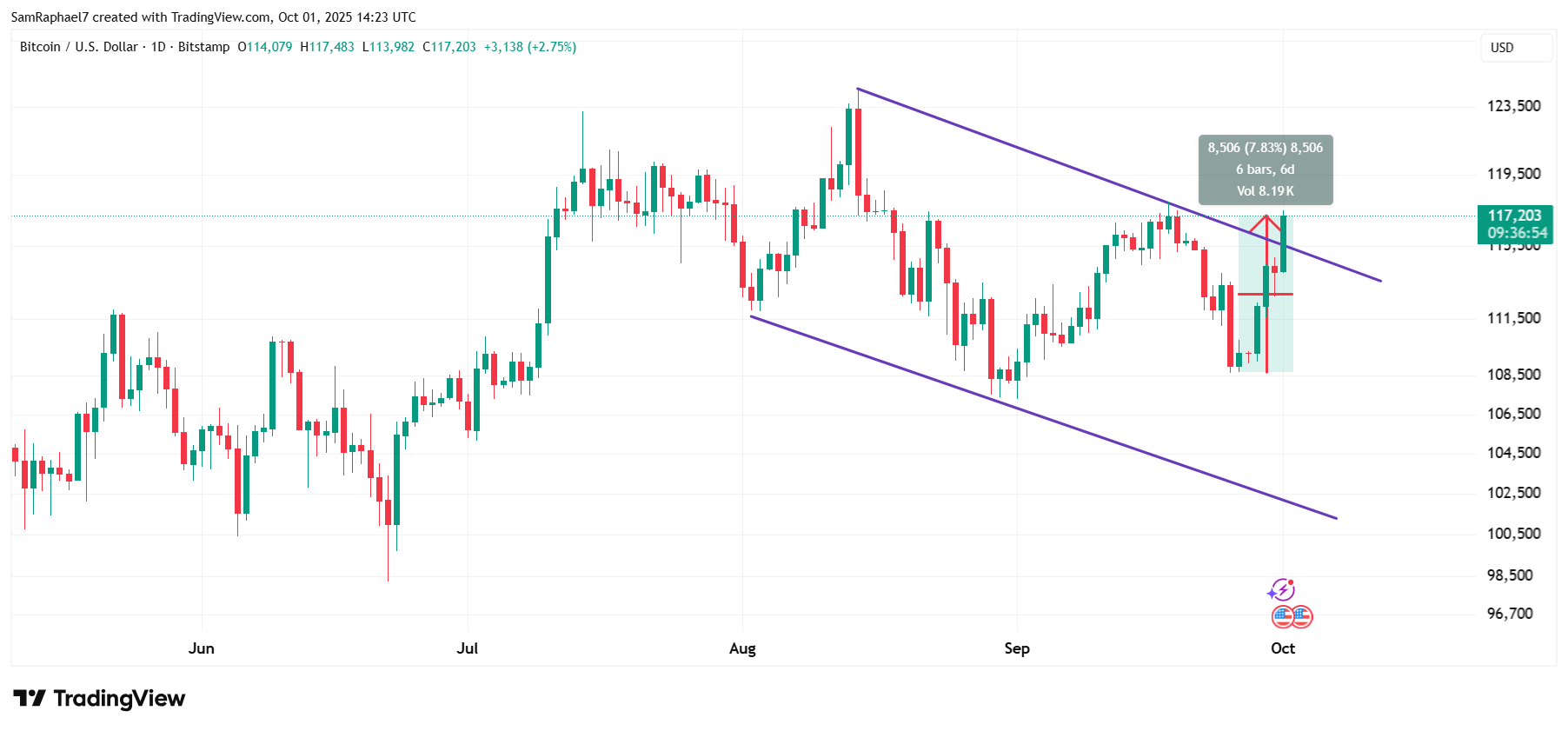
Notably, Bitcoin bounced back strongly after more than a week of heavy losses. The leading cryptocurrency dropped from $117,968 on Sept. 18 and kept falling until it broke below $110,000, hitting a low of $108,676 on Friday, Sept. 26. This drop capped one of Bitcoin’s roughest stretches in recent months.

However, a rebound emerged on Sept. 28, triggering a fast recovery. Bitcoin pushed through $110,000, $111,000, and $112,000 almost in a single move. It hit resistance at $114,000 on Sept. 30, but today it pushed higher, reclaiming the $117,000 level and trading at $117,180 at press time. From last Friday’s bottom, Bitcoin has gained 7.83%.

Bitcoin 1D Chart
Bitcoin 1D Chart

US Government Shutdown

This run has left investors wondering what is contributing to the recent buying pressure. Notably, the main driver appears to be the latest U.S. government shutdown. 

Investors had been bracing for political gridlock as Congress failed to agree on a new short-term spending plan. The anxiety started pushing up Bitcoin earlier this week, but once the shutdown officially began on Wednesday, demand for BTC appears to have shot up.

For context, the deadlock came after Republicans and Democrats failed to come to a deal on funding to keep federal operations running until late November. Republicans, who hold the majority Congress, were unable to secure the Senate votes needed to push their bill forward. 

Notably, the major points were disagreements over Affordable Care Act funding and the extension of tax credits for health insurance. The impasse has forced government services to shut down and has paused federal employee salaries.

Bitcoin in a Decisive Position

Expectedly, the political drama has also benefited gold. Specifically, the precious metal has now posted five straight days of gains, setting a new all-time high of $3,895 before easing slightly to $3,875 today. Gold usually thrives during shutdowns, while Bitcoin’s track record has been mixed.

During the last prolonged shutdown from December 2018 to January 2019, Bitcoin initially climbed but then slipped as the standoff dragged on, falling from $3,843 to $3,511 by the end. This history leaves questions about whether Bitcoin can hold on to its latest gains if the current shutdown stretches out.

Meanwhile, market analyst Ted Pillows revealed today that at its current position, Bitcoin sits between two major liquidity zones. He pointed out that one cluster sits between $107,000 and $108,000, where about $8 billion in long positions could face liquidation. 

Bitcoin Liquidity Data Coinglass
Bitcoin Liquidity Data | Coinglass

The other cluster sits higher, between $118,000 and $119,000, with around $7 billion in short positions at risk. Now, it remains to be seen whether buyers will push Bitcoin higher into the short liquidations, or sellers will drag it back down into the longs.

Cambridge Analyst Explains Why Wall Street Sees XRP as the Next Bitcoin

0

XRP is emerging as Wall Street’s “dark horse,” according to Cambridge analyst Bradley Peak, who says many funds are considering it the next Bitcoin.

Indeed, Bitcoin and Ethereum ETFs have already brought in billions in institutional inflows, but now all eyes are shifting to XRP.

Seven XRP ETF applications are currently under SEC review, with decisions scheduled for mid-October. The list includes Wall Street behemoths Bitwise, Grayscale, 21Shares, WisdomTree, Canary Capital, Franklin Templeton, and CoinShares. Collectively, these firms manage over $1.7 trillion.

Beyond the weight of ETFs, Ripple’s application for a U.S. national bank charter is also awaiting a decision during the same October window. Notably, approval on both fronts could give XRP a dual boost—legitimizing it as an investable product and a regulated financial utility.

The Case for XRP as Wall Street’s “Dark Horse”

Amid these factors, analyst Bradley Peak argues that XRP is shaping up to be Wall Street’s dark horse. He suggested the asset could surprise skeptics just as Bitcoin and Ethereum once did.

He cited Nate Geraci of The ETF Store as echoing this view. For context, Geraci noted in September that early doubts about Bitcoin and Ethereum ETFs quickly vanished once billions of dollars poured in.

For XRP, the momentum is already strengthening this case. CoinGlass data shows CME XRP futures have topped $1.25 billion in open interest.

CME first reported in August that its XRP futures reached the $1 billion mark faster than any other crypto derivatives contract.

Now, market watchers like Peak see the momentum spilling into spot ETFs. Canary Capital has already projected $5 billion in demand in the early weeks, while JPMorgan estimates as much as $8 billion annually.

Meanwhile, not all issuers are sticking to plain price-tracking ETFs. Asset manager Amplify has filed for a fund that mixes XRP with income-generating strategies like covered calls. Other firms are testing leveraged and derivative-based products.

This shows that asset managers see a chance to attract more advanced investors with customized XRP offerings.

BlackRock Still Not Interested

Despite the optimism, there is still skepticism. BlackRock has explicitly ruled out immediate plans to pursue an XRP ETF, citing limited client interest. According to Robbie Mitchnick, Head of Digital Assets at BlackRock, any new crypto ETF must align with customer demand.

Other considerations include the asset’s market cap, liquidity, maturity, and how the ETF fits into broader client strategies. However, Mitchnick emphasized that the evaluation is ongoing.

Institutional Accumulation Ahead of ETF News

Meanwhile, institutional wallets have accumulated close to $1 billion worth of XRP in the last two weeks. Santiment data shows wallets typically holding between 10 million and 100 million tokens added 340 million tokens during that period.

This suggests that strategic players are positioning themselves ahead of this month’s regulatory rulings. Their collective holdings are now approaching 8 billion XRP, worth over $20 billion.

Essentially, October could be a turning point for XRP. If it gets approved for both an ETF and a bank charter, it could become a major player in global finance.

However, if both are denied, XRP’s price trajectory might stagnate, leading to slower growth.

Here’s Why October Could Be a Massive Month for XRP

0

The new month, October, could be one of the most pivotal months in XRP history, potentially rewarding today’s holders massively.

For context, multiple ETF applications are awaiting SEC approval, and Ripple’s national bank charter is under review, with decisions due soon. As a result, many believe the stage is set for developments that could transform the token’s price trajectory.

Starting October 18, the U.S. SEC must deliver its final verdict on a wave of spot XRP ETF applications. Seven issuers are in line: Grayscale, 21Shares, Bitwise, Franklin Templeton, WisdomTree, CoinShares, and Canary Capital.

ETF Floodgates

Grayscale’s conversion of its XRP trust into an ETF has the earliest October deadline, specifically on the 18th. Applications from 21Shares, Bitwise, and Canary Capital follow in close succession.

Given that the SEC can no longer delay its decision on Grayscale’s filing, there is a strong likelihood that the regulator will either approve or deny it.

If approved, the SEC may grant consent to all pending applications on the same day. The regulator followed a similar pattern for Bitcoin and Ethereum spot ETF applications, granting collective approval to over 10 applications in one day.

Accordingly, many expect the XRP price to surge, as these ETFs would give institutions and retail investors regulated access to XRP.

Shortly after a similar clearance, Bitcoin’s price spiked to $48,000. Meanwhile, a week later, it dipped to $38,000 despite the existence of ETFs buying BTC. However, that low price quickly became history as the price continued to soar, reaching its current level above $116,000.

Analysts argue XRP could face a similar fate, as anticipation around the approval is at its highest point. A Bloomberg analyst said it is essentially 100% guaranteed.

Ripple’s Bank Pursuit

Meanwhile, October also brings a second critical development: Ripple’s application for a national bank charter with the U.S. Office of the Comptroller of the Currency. Filed in July, the 120-day decision window closes this month.

An approval would allow Ripple to operate as a federally chartered bank in the U.S., expanding its influence in the financial system and strengthening its RLUSD stablecoin ambitions.

The timing means Ripple and XRP could secure two landmark approvals — one regulatory, one structural — within weeks.

Analysts See Double-Digit XRP Prices Ahead

Community commentators and market analysts are eyeing dramatic upside if ETFs secure approval. Kenny Nguyen has argued that XRP “should be around $22 to $50” once the first ETFs launch.

Canary Capital’s Steven McClurg believes XRP could attract $5 billion in its first few weeks, while others say the inflow will drive the price into the $20–30 range.

The optimism comes from futures products around XRP seeing surprising multiple million-dollar turnover in a single day. Accordingly, commentators believe spot ETFs will have an even greater effect.

Millionaire Speculation

Meanwhile, much of the community’s excitement stems from the possibility of creating new XRP millionaires. The XRP Rich List shows fewer than 35,300 accounts hold 94,000+ XRP. Notably, this is the closest threshold to reach millionaire status if XRP surges to $11.

Further upside to, say, $50 as some community members suggest, would elevate even those holding 20,000 tokens to millionaire status.

As enticing as this sounds, XRP has a long journey to $50. Its price must increase more than 17 times for that to happen, which some believe is a tall ambition for the coin.

While not every holder will reach such lofty heights, the idea underscores how transformative an ETF approval could be for long-term investors. Yet, the likelihood of ETFs failing to substantially impact XRP’s price remains.

For instance, Ethereum took more than a year to break its all-time high despite investments from ETFs throughout the period.

Here Is the Only Way Shiba Inu Can Come Back to Life

0

While critics often dismiss Shiba Inu as a “dead token,” addressing the project’s core issues could help revive its momentum and potentially breathe new life into SHIB. 

Shiba Inu has struggled to regain the explosive momentum that previously defined its early days. Since reaching its all-time high (ATH) of $0.00008845, SHIB has crashed over 86% from this level.

Its price has also plummeted nearly 44% this year alone to $0.00001185. While the broader crypto market has endured phases of volatility, SHIB’s underperformance stands out. Unlike Bitcoin and Ethereum, which have recorded steady gains this year, Shiba Inu has remained stuck around the $0.00001 range.

How to Revive Shiba Inu Again

SHIB’s stagnant performance has drawn criticism across social media, with skeptics frequently dismissing it as a “dead” project. However, for Shiba Inu to regain momentum and prove otherwise, key challenges must be addressed to reignite growth.

1. Greater Transparency from the Team

A major concern among investors is the lack of transparency surrounding the project. The core team has continued to operate under pseudonyms. This practice may have been acceptable in SHIB’s early days, but it is less appropriate now that it has evolved into a multi-billion-dollar ecosystem.

While the Shiba Inu team continues to operate under an anonymous leadership structure, other multi-billion-dollar crypto projects, including XRP, Cardano, and even SHIB’s direct rivals, like Dogecoin, are led by teams with publicly known identities. 

Establishing a verifiable public identity would build credibility, foster accountability, and restore investor confidence in SHIB.

2. Refocus on the Shiba Inu Ecosystem

Over time, some team members have been observed supporting other cryptocurrency projects outside the ecosystem. Shiba Inu’s lead developer Shytoshi Kusama has continuously promoted the SHY token, which was themed after him.

This practice has shifted investors’ attention away from SHIB and other ecosystem tokens, such as TREAT, LEASH, and BONE.

If the team refocuses its commitment to SHIB, this could help boost confidence and possibly drive adoption.

3. Reignite Community Engagement

The community, widely known as the Shib Army, was once the driving force of the ecosystem, actively campaigning and pushing for SHIB’s listing on major platforms. This support fueled past rallies, including the 2021 surge that pushed SHIB to an all-time high.

However, this support has waned recently. Reinvigorating grassroots engagement through transparent communication, interactive initiatives, and incentive-driven programs could restore the vibrant energy that once propelled SHIB forward.

4. Commit to Meaningful Supply Reduction

Shiba Inu’s enormous supply has remained a challenge since its inception. The massive supply of 589 trillion tokens reduces the growth rate of SHIB, making it difficult for the token to reach new heights.

Shiba Inu has made notable progress in reducing its enormous supply. More than 41% of the total supply has already been burned, thanks to coordinated community efforts and a significant burn contribution from Ethereum co-founder Vitalik Buterin. 

Reducing SHIB’s supply by sending more tokens to the dead wallet creates scarcity and possibly drives the price higher.

To achieve a meaningful impact, the community must actively participate in a structured and consistent burn mechanism designed to significantly reduce the circulating supply.

5. Rebuild Trust After the Shibarium Bridge Hack

The Shibarium Bridge attack shook investor confidence and raised serious concerns about the ecosystem’s security. So far, it has taken steps to strengthen security and rebuild trust.

These include collaborating with law enforcement agencies, adopting a multi-party custody solution, and even offering scammers a 50 ETH bounty, which they refused to accept. 

Nonetheless, the team must sustain this momentum to rebuild confidence fully. Safely reopening the bridge would be a key step toward regaining trust and encouraging users to return.

6. Complete Unfinished Projects

Critics have frequently faulted the ecosystem for its unfinished projects, such as Shib: The Metaverse. Also, there have been no meaningful updates on other previously announced projects, including the NFT marketplace.

Rather than announcing new ventures, the team should prioritize finishing and delivering on existing commitments. Successfully launching these projects could boost ecosystem utility and drive renewed interest in SHIB.

Tackling these issues could help Shiba Inu regain momentum and stage a rebound from its prolonged underperformance.


Telegram Founder Pavel Durov Predicts Bitcoin Will Eventually Hit $1 Million

0

Pavel Durov, the billionaire founder of Telegram, has projected a staggering future for the world’s largest cryptocurrency, Bitcoin.

Speaking on the Lex Fridman podcast, Durov said he is convinced Bitcoin will eventually be worth $1 million per coin, a bold forecast rooted in his decade-long belief in digital assets.

Durov said he has been a strong supporter of Bitcoin since its early days. He purchased several thousand coins in 2013 at around $700 each, investing a few million dollars. While the cryptocurrency plunged below $200 soon after, he refused to sell.

Critics laughed at him during the downturn, but Durov insists that his long-term confidence in Bitcoin never faded.

“Nobody can confiscate your Bitcoin. Nobody can censor you for political reasons. This is how money should work,” he said.

Why Durov Sees $1 Million Ahead

For Durov, Bitcoin’s fixed supply makes it vastly different from government-issued money. With only 21 million coins ever to exist, he believes increasing demand will inevitably drive the price higher. 

“Governments are printing money like no tomorrow. Nobody is printing Bitcoin,” he said. I believe it will come to a point when Bitcoin is worth $1 million.

His prediction reflects a broader trend among crypto advocates who view Bitcoin as a hedge against global inflation and political instability.

Notably, several other influential figures in the cryptocurrency and financial world, including BitMEX co-founder Arthur Hayes, Coinbase CEO Brian Armstrong, Eric Trump, the son of U.S. President Donald Trump, and Gemini co-founders Cameron and Tyler Winklevoss, have also suggested that Bitcoin could one day rise to the $1 million mark.

Bitcoin as His Lifeline

While many assume Telegram funds Durov’s lifestyle, the entrepreneur clarified that the messaging app has been a loss-making venture for him personally. Instead, he credits his crypto holdings with enabling his lifestyle, from renting luxury spaces to traveling privately.

“Bitcoin is what allowed me to stay afloat,” he said, dismissing claims that he extracts money from Telegram.

TON: A Parallel Blockchain Vision

Beyond Bitcoin, Durov also highlighted the progress of the Telegram Open Network (TON). Initially developed by Telegram between 2018 and 2019, TON was designed to address the scalability limitations of Bitcoin and Ethereum. However, U.S. regulators blocked its launch, forcing Telegram to step away.

Today, the project, rebranded as The Open Network, has become a cornerstone of the Telegram ecosystem. TON now powers NFT trading and decentralized applications, with its native cryptocurrency, Toncoin, becoming one of the top tokens by trading activity.

Although Toncoin surged to $8.25 in mid-2024, it has since dropped more than 67%. Still, Durov described the project as a major success, particularly in NFT adoption.

Past Legal Scrutiny

Durov’s remarks come just a year after his arrest in France, where he was accused of enabling criminal activities on Telegram. While those legal troubles cast a shadow on his public image, he continues to emphasize the platform’s neutrality and his personal belief in decentralized technologies.

Stablecoin Growth and Bitcoin DeFi in Focus in the State of Cardano Q2 Report

0

A mild stablecoin market cap uptick and progress in Bitcoin DeFi were the shining lights in the quarterly update of the state of the Cardano ecosystem.

Market intelligence platform Messari highlighted these details in the Q2 update report of the Cardano ecosystem. The piece highlighted how the ADA ecosystem fared in the quarter alongside significant developments and upgrades.

Cardano Stablecoin Stands Out in Underwhelming Quarterly Metrics

Notably, the Messari report spotlighted a downtrend in key ecosystem metrics in the second quarter of 2025. The market cap of Cardano declined by 13% from $23.88 billion to $20.7 billion quarter-over-quarter. This reflected in the ADA price, which closed at $0.57, down 14% in the same period.

Transaction fees in USD followed this dump, declining 45% QoQ to $724,600. The number of daily active users and daily transactions also declined, mirroring the drop in the price of Cardano.

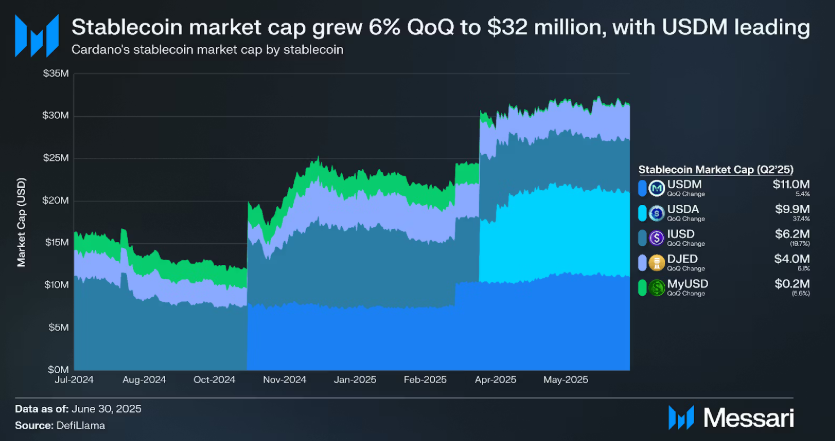
However, the Cardano stablecoin sector experienced slight growth. Specifically, the stablecoin market cap increased to $32 million, representing a 5.8% rise from the previous quarter. This highlights that the network is making progress in harnessing the stablecoin boom in the broader cryptocurrency market.

Cardano Stablecoin Data Q2 2025

Nonetheless, Cardano’s DeFi TVL receded considerably, as the network continues to struggle to match its contemporaries. The metric dropped 20% to $259.2 million in dollar terms, and 7% to 452.7 million in ADA in Q2 2025.

Bitcoin DeFi, On-Chain Governance and Other Developments

Notably, Bitcoin DeFi premiered at the Bitcoin 2025 Conference in Las Vegas. The Charles Hoskinson-founded Input Output Global (IOG) and Fairgate demoed running Cardano smart contracts on the Bitcoin network using the BitVMX and UPLC-to-RISC-V compiler.

The exhibition demonstrated how Bitcoin holders can utilize Lace Wallet to exchange Bitcoin for the Minswap tokens, with fees paid in BTC. The debut attracted accolades from Hoskinson, who welcomed DeFi to the Bitcoin ecosystem.

Furthermore, Cardano had its first on-chain constitutional committee election under the Cardano Improvement Proposal (CIP) 1694. This was part of its roadmap after the Voltaire Era debut, aiming to forge a decentralized governance system.

In other developments, details of the ongoing Glacier Drop came to light in Q2 2025. Midnight is currently distributing 24 billion NIGHT tokens to eligible users, with 1.2 billion reserved for XRP holders. A previous report from The Crypto Basic shows that over 11,000 addresses have already claimed, with the first phase closing on October 4.