
Home Blog Page 518

Expert explains XRP $943 Price Scenario, Citing Ripple CEO Brad Garlinghouse

0

An analyst has broken down how XRP price could cross the $900 mark if it captures 14% of SWIFT’s $1.5 quadrillion in annual transaction flows.

For context, the suggestion that XRP could take over this much volume from SWIFT originally came from Ripple CEO Brad Garlinghouse in June.

Now, XRP analyst Diana has brought renewed attention to this claim, using it to argue for an aggressive triple-digit price target for the coin.

$210T Moving Through the XRP Ledger

Notably, Garlinghouse’s five-year outlook comes as real-world asset tokenization, stablecoin development, exchange-traded funds (ETFs), and central bank digital currencies (CBDCs) are seeing their highest levels of adoption.

Amid this, Diana suggests that XRP could benefit from a historic liquidity wave that pushes its price to unprecedented points. 

Notably, she claimed that SWIFT moves $1.5 quadrillion in annual payment flows, although reports of $150 trillion annually are more common. Using the ambitious $1.5 quadrillion figure, capturing 14% would mean about $210 trillion in transactions moving through the XRP Ledger.

To XRP proponents, such a scale of volume would be a game-changer for the coin, trading under $3 today.

“All the Money” Narrative 

Furthermore, Diana claimed that Ripple’s network is already in talks across multiple large-scale financial sectors. She cited various valuations for monetary flows that major institutions supposedly process annually.

Specifically, the analyst referenced DTCC settlements of around $3 quadrillion. Notably, Ripple’s connection here is through its acquired prime broker, Hidden Road.

Global banks (U.S. and Japan) hold $37.5 trillion in deposits. The company has widely known partnerships with firms like BNY and SBI.

Diana also mentioned Visa, Mastercard, and American Express, which handle $26 trillion in annual payments, as well as tokenization markets projected to reach trillions this decade.

To XRP supporters, these connections strengthen the argument that XRP is positioned to grow far beyond retail speculation, becoming a backbone for high-value institutional flows.

Breaking Down the XRP $943 Price Math

According to Diana’s calculations, capturing just 1% of the estimated $530 trillion in global financial flows could imply an XRP price near $96.

In a more ambitious scenario, with a 5.6 billion “effective” circulating supply and 14% of SWIFT flows, the price could theoretically surge toward $943 per XRP. 

For a coin trading under $3 today, this projects a 314x return that would turn a 2,000 XRP portfolio into over $1.8 million.

She said even smaller participation, such as 0.1% of global flows, would equate to a potential valuation of about $9.60 per token, underscoring the scale of the opportunity.

“Just Wishful Thinking”

Meanwhile, this aggressive prediction by Diana has attracted significant attention in the crypto community, with many laughing it off.

While the numbers remain speculative, the scenario highlights what many long-term XRP supporters envision. Other XRP commentators have leveraged similar analyses to even call for loftier prices beyond $10,000.

Outside the XRP community, however, many dismiss these analyses as wishful thinking or outright “BS.”

Helius Medical Buys 760,190 Solana Tokens After $1.25B Fundraise

0

Nasdaq-listed Helius Medical Technologies has announced the purchase of $167 million in Solana tokens.

In a press statement on Monday, Helius Medical revealed that it had bought 760,190 SOL tokens. The purchase is worth $167 million and was made at an average cost of $231 per token. This marks the company’s first step into the Solana ecosystem, signaling its intention to diversify beyond traditional reserves.

Big Capital Raise Supports Solana Strategy

To support its treasury plan, Helius disclosed that it currently holds more than $335 million in cash reserves. According to executives, these funds will be directed toward further purchases of Solana and potentially other digital assets.

The investment strategy is backed by a major $1.25 billion fundraising effort that was completed last week. The package combined over $500 million from a private investment in public equity (PIPE) deal, with an additional $750 million raised through a sales offering. The financing round was led by Pantera Capital and Summer Capital, both of which have been active investors in blockchain-related ventures.

Helius described the fundraising as an approach to strengthen both liquidity and flexibility, enabling the company to capitalize on future opportunities in the digital asset space without jeopardizing its core operations.

Ecosystem Support and Market Sentiment

Executive Chairman Joseph Chee stated that the move has been welcomed across the Solana ecosystem. He pointed to positive signals from staking providers, DeFi projects, and other community stakeholders.

However, market reaction told a different story. On Monday, shares of Helius Medical plunged by 33.61%, closing the trading session at $16.02. 

At the same time, Solana’s price continued to weaken. The token slipped to $218.90 on Tuesday, extending weekly losses to 7%.

Institutional Confidence in Solana

Meanwhile, the purchase highlights growing institutional confidence in Solana. Last week, Pantera Capital founder Dan Morehead noted that his firm holds $1.1 billion worth of Solana, calling it the fund’s largest single position.

He added that Solana’s performance has beaten Bitcoin over the past four years, underscoring its potential appeal for long-term investors.

Wall Street Analyst Explains How $15,000 in XRP DeFi Can Make You a Millionaire With No Risk

0

Wall Street analyst Rob Cunningham has shared a ten-year projection for how just $15,000 invested in XRP DeFi could make investors millionaires.

The audacious outlook comes amid Ripple’s latest institutional DeFi update. The announcements position the XRP Ledger (XRPL) as a major platform for institutional decentralized finance (DeFi).

Notably, the update cited over $1 billion in monthly stablecoin volume and expanding real-world asset (RWA) activity on XRPL. With this, the network is evolving into a go-to platform for compliant, scalable finance solutions.

Key new features like Credentials for compliance verification, Deep Freeze to block illicit token transfers, and an upcoming native lending protocol are attracting institutional investors by offering a secure and regulated DeFi ecosystem.

In this context, Cunningham released a bullish investment model demonstrating how an initial $15,000 investment in XRP-based DeFi could grow into over $1 million in 10 years.

5,000 XRP Could Turn Into Seven Figures

His assumptions include:

  • Locking 5,000 XRP at an average price of $3 per token.
  • Earning a 5% annual yield, paid monthly in Ripple’s stablecoin RLUSD.
  • Experiencing a 50% compound annual growth rate (CAGR) in XRP price over a decade.

According to Cunningham’s calculations, the combined effect of monthly yield and price appreciation could generate over $100,000 in interest income. At the same time, the underlying XRP holdings will increase in value to $865,000.

Interestingly, this outlook suggests 1 XRP will be worth $173 by 2035. Prediction platforms like Telegaon believe XRP could someday reach $170 but project a timeline exceeding 2040, more than 15 years away and five years beyond Cunningham’s timeline.

Meanwhile, by the same date, the Changelly exchange expects XRP’s price to be above $1,000. This suggests 5,000 XRP alone could be worth $5 million by 2040, without factoring in interest from Cunningham’s analysis.

The Infrastructure Behind the Opportunity

Notably, Ripple’s announcement also revealed that a native lending system (XLS-65/66) will come with XRPL Version 3.0.0 later this year. This will create low-cost, rule-following credit markets directly on the blockchain.

Moreover, the team is working on zero-knowledge proofs (ZKPs) to keep transactions private but still verifiable. This includes confidential Multi-Purpose Tokens (MPTs), coming in early 2026.

Ripple noted that these updates aim to make XRPL a top platform for stablecoin payments, collateral management, and tokenizing real-world assets, making XRP more useful.

First Liquid Staking Token on XRPL

Meanwhile, the buzz around the XRP DeFi opportunity intensified this week as Axelar Network introduced mXRP, XRPL’s first liquid staking token offering a 10% APY. 

The product unlocks DeFi opportunities for XRP holders, enabling them to stake their tokens and earn rewards while maintaining liquidity for DeFi use. The team dubbed the concept the “Infinite Money Glitch.”

mXRP aims to deliver passive income with minimal risk. Anodos Finance founder Panos Mekras praised it as a major catalyst for XRPL adoption, highlighting near-zero impermanent loss and high yield potential.

Since launch, mXRP has quickly gained traction, with $6.5 million locked on the XRPL EVM sidechain. Mekras called it “a dream come true” for XRP investors.

Here’s the Price of Cardano if Ethereum reaches $20,000

0

Cardano could rally multiple times from its current market valuation if Ethereum reaches an unprecedented price of $20,000.

Cardano currently trades at $0.82, recovering slightly from yesterday’s dip. Despite the rebound, ADA is down 5% and 9% over the past seven days and 30 days and remains one of the few assets with a negative year-to-date performance in the top 10 cryptocurrencies by market cap.

Nonetheless, bullish sentiments remain high among market analysts. With emerging institutional use cases, a broader positive market outlook, and ecosystem developments, many expect Cardano to reverse its current bearish state and target much higher prices.

As a result, we recently analyzed the possible price target for Cardano if Ethereum, being the leader of the altcoin sector, reaches $20,000.

Ethereum to $20,000 Projections

Notably, Ethereum has been one of the standout cryptocurrencies since July. After a period of price underperformance earlier in the year, the leading altcoin by market cap has regained bullish momentum, rallying from around $2,500 to $4,950 in August before the current consolidation.

Meanwhile, many suggest that Ethereum could see far higher prices. Fundstrat Capital CIO Tom Lee is one of the top industry leaders who shares the sentiment, predicting that Ether could reach $15,000 this year and rally to as high as $60,000 in a few years.

Moreover, analyst Ted shared on X on September 21 that Ethereum will peak between $18,000 and $20,000 during this cycle. He based this projection on Ether catching up with the global M2 supply amid trend correlation.

The Price of Cardano if Ethereum Reaches $20,000

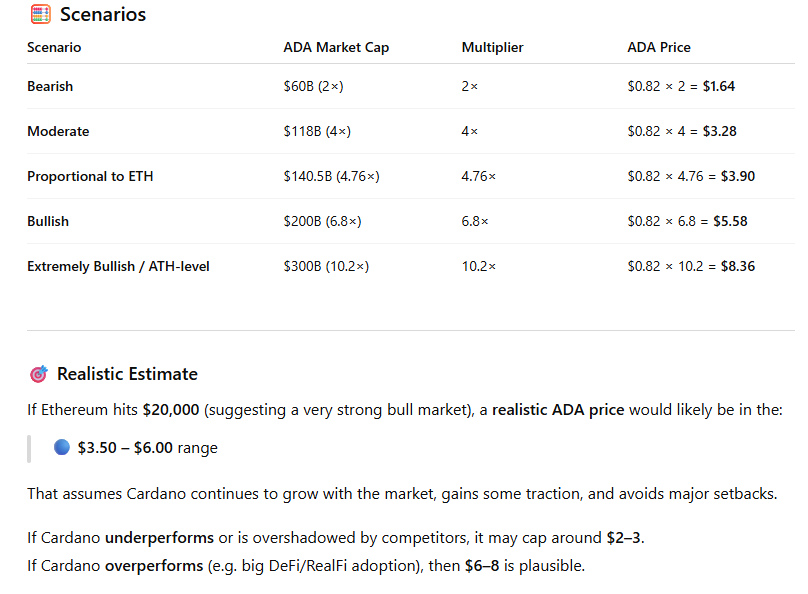
To buttress the full effect of an Ethereum rally to $20,000 on Cardano, we employed analysis from OpenAI’s ChatGPT. The chatbot presented several analogies to this event, presenting both bullish, moderate, and bearish cases.

For context, Ethereum is currently trading at $4,200, with a market capitalization of $508 billion. As a result, a rally to $20,000 will culminate in a 4.76x increase, taking its market cap to $2.42 trillion.

Applying that directly to Cardano, assuming it rises proportionally to Ethereum, would see ADA reach a new all-time high of $3.90. However, ChatGPT noted that the market dynamics make such an ideal correlation largely unrealistic. As a result, it shared a more realistic target under different market conditions.

In a bearish case, Cardano would rally 2x as Ethereum hits $20,000, reaching a price of $1.64. In a moderate case, it would increase fourfold, taking its price to $3.28. However, a bullish and extremely bullish case will see ADA outperform Ether with a 6.8x and 10.2x uptick. This culminates in prices of $5.58 and $8.36, respectively.

Screenshot 2025 09 23 102918
Cardano Price Prediction/ChatGPT

Gemini Predicts Cardano Price if Ethereum Reaches $20,000

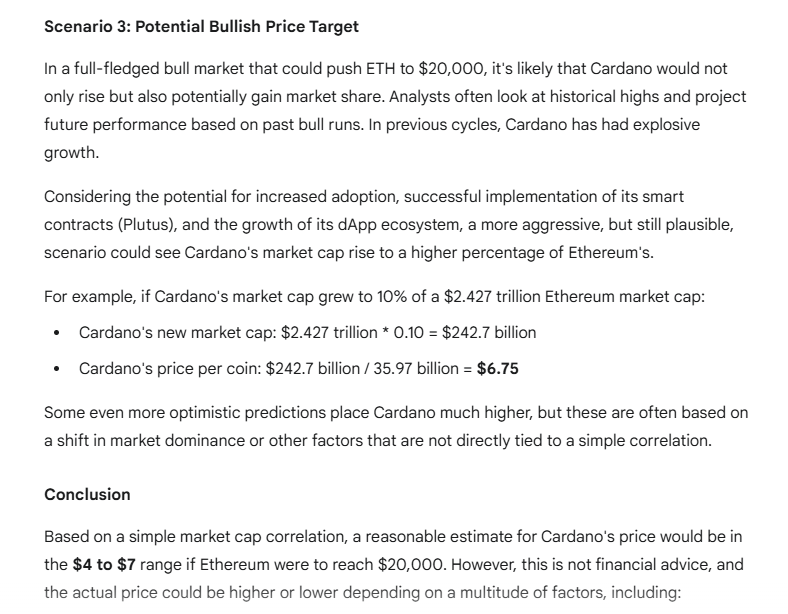
Meanwhile, Google’s Gemini AI had a different approach to predicting the price of Cardano if Ethereum reaches $20,000. The first scenario is if the ADA/ETH ratio remains constant.

For context, at the current price, Cardano has a ratio of 0.0001958 ADA per ETH. If this continues and Ether reaches $20,000, ADA will attain a new price of $3.916.

Furthermore, it presented another approach, which is the market cap correlation. Ethereum has a market cap of $508 billion, and Cardano is at $29.5 billion, meaning that ADA accounts for approximately 5.8% of ETH’s valuation. 

If this correlation persists, Cardano will reach a market cap of $140.7 billion when Ether hits $2.24 trillion, following its hypothetical rally to $20,000. Dividing by its circulating supply of 35.97 billion, this would result in a price of $3.91.

Screenshot 2025 09 23 102829
Cardano Price Prediction/Google Gemini

Nonetheless, Gemini noted that the market cap correlation is more likely to shift during market rallies. Hence, the bot painted a picture where Cardano records explosive growth, similar to past cycles, to outperform Ethereum.

The scenario is that Cardano’s market cap would grow to 10% of Ethereum’s projected $2.42 trillion. The adjusted correlation takes ADA’s market cap to $242.7 billion, and its new price to $6.75.

Analyst Says XRP Now in the Early Stage of an ‘All at Once’

0

“Slowly, then all at once,” a market analyst says, calling attention to the impressive gains XRP has witnessed over the past year.

Notably, while XRP has been one of the best performers among the top 100 crypto assets in the last year, its price action was less impressive just a few years back. For context, after reaching the $3.31 peak in January 2018, XRP dropped to $0.43 in August of that year, recovered to $0.76, and then collapsed harder.

XRP Price Journey 

By March 2020, XRP had dropped to a low of $0.1140 amid price struggles. This bearish pressure was exacerbated by the SEC’s lawsuit against Ripple, which sprang up in December 2020. The suppression that emerged as a result led to XRP missing the 2021 bull run.

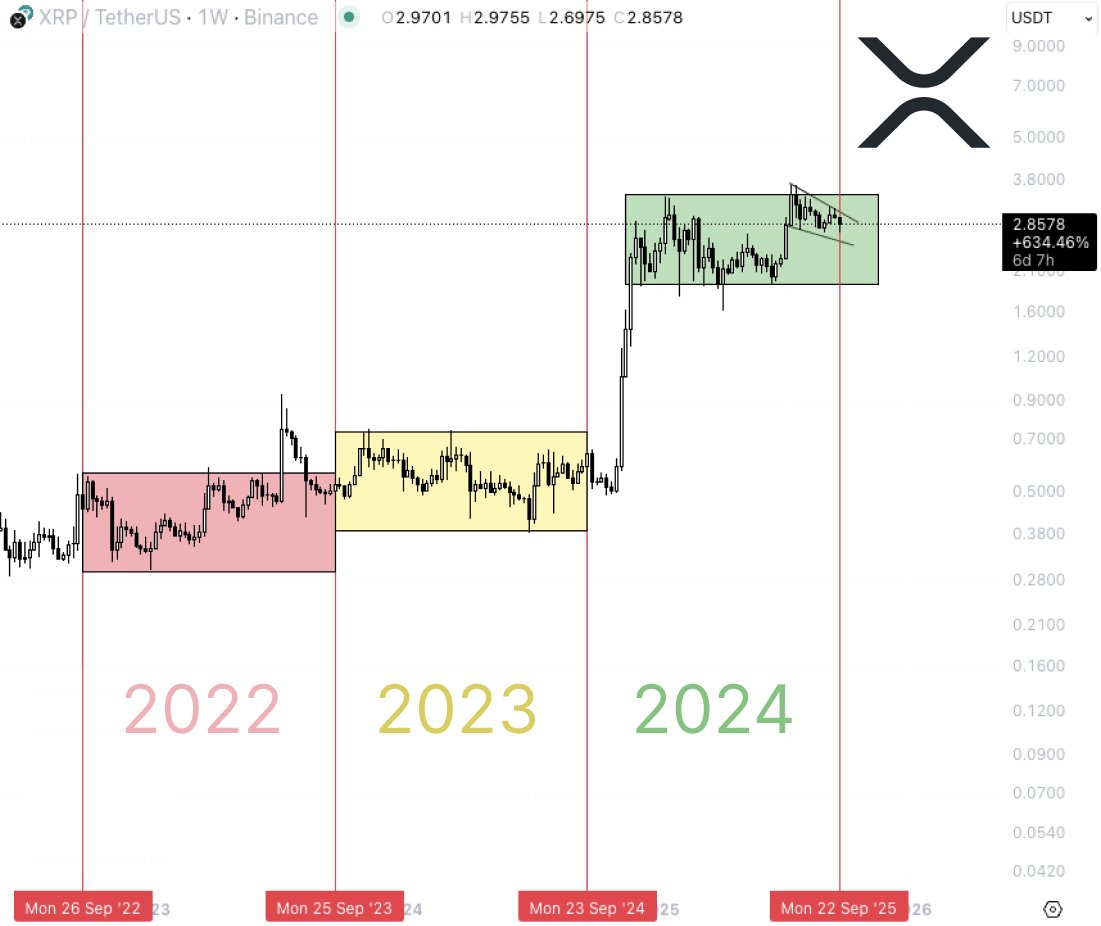
In a recent commentary, market analyst Tokenicer further called attention to the extensive struggles XRP suffered in the years that followed despite seeing mild gains. Particularly, the market commentator highlighted XRP’s price performance on a year-on-year (YOY) basis from Sept. 22, 2022.

According to him, by Sept. 22, 2022, XRP changed hands at $0.4926. While this was an improvement from the $0.1140 low in 2020, it exemplified XRP’s underperformance, considering the altcoin already saw a $3.31 peak years back.

Notably, the next year, on Sept. 22, 2023, XRP saw a slow rise to $0.502, representing a meager 1.91% growth. For context, at this stage, XRP had already achieved legal clarity, which came up in July 2023 following Judge Analisa Torres’ ruling. This pushed the price to $0.94 in July 2023 before the drop to $0.502 by September.

“Slowly, then all at once”

Meanwhile, by Sept. 22, 2024, the XRP price had increased to $0.587, representing a 16.93% rise year-over-year. Importantly, the takeaway here is how XRP’s YOY gains have progressed since September 2022. Despite how slow this progress was from 2022 to 2024, it was a clear testament to gradual growth.

XRP YOY Performances Tokenicer

Interestingly, the growth from 2024 to 2025 was anything but “gradual,” as XRP has since exploded. Much of this explosion emerged from November 2024 to January 2025 on the back of the U.S. presidential election. Now, despite recent bearish pressure and a slump below $3, XRP is up 387% year-over-year, the largest single-year rise.

Tokenicer compares this growth from 2021 to 2025 to the saying, “slowly, then all at once,” popularized in the 2012 book The Fault in Our Stars by John Green. This indicates that XRP had been following a slow growth pace over the past few years, but is now looking to explode “all at once.”

According to Tokenicer, we are now at the early stages of the “all at once” phase. This commentary suggests that he expects XRP to witness more explosive gains in the coming years. However, he failed to provide any targets. Interestingly, other market commentators have set their sights on ambitious goals such as $100.

Cardano Accelerates RWA Tokenization With Landmark London Stock Exchange Collaboration

0

Cardano is gaining traction in the real-world asset (RWA) tokenization sector, following its involvement in a landmark initiative tied to the London Stock Exchange Group (LSEG). 

Yesterday, the LSEG welcomed investment manager Members Capital Management (MembersCap) to open the market. The event was part of efforts to celebrate the launch of its flagship MCM Fund I. 

This marked the first institutional-grade reinsurance fund to be tokenized and recorded on LSEG’s new Digital Markets Infrastructure (DMI). For context, MembersCap launched the fund in collaboration with Archax. The Cardano Foundation also supported the initiative. 

Although the investment was recorded on LSE’s private blockchain, it was tokenized on the Cardano blockchain, with Archax overseeing this process. 

Cardano Foundation CEO Reacts 

Frederik Gregaard, the CEO of the Cardano Foundation, expressed enthusiasm about the recent launch of the MembersCap fund, which was tokenized on the Cardano network. He views the MembersCap fund as a milestone to drive the adoption of RWAs through the Cardano network. 

In his view, this move could open the door for qualified investors to access reinsurance-backed products through the Cardano platform. Gregaard stressed that the network is built on security, compliance, predictability, and operational resilience.

He also emphasized that the foundation will continue to promote Web3 adoption by supporting similar projects and innovative use cases from its partners in the future. 

Cardano Stepping Into RWA Tokenization Spotlight 

The initiative elicited reactions among Cardano proponents. Popular advocate Jaromir Tesar emphasized that Cardano is stepping into the spotlight for RWA tokenization. 

Indeed, Cardano has been gaining traction in RWA tokenization lately. Earlier this year, Kinka partnered with EMURGO to mint gold-backed tokens on the Cardano blockchain. 

EMURGO, a co-founding entity of the Cardano network, continues to push for the expansion of the network’s RWA ecosystem. It intends to achieve this goal through partnerships with compliant tokenization platforms such as Haus, OpenEden, and DigiFT. 

Through the partnerships, EMURGO aims to bring tokenized assets, including private credits, U.S. government bonds, and insurance factoring to Cardano. 

Analyst Highlights Bearish Cardano Pattern: How Low Could ADA Go?

0

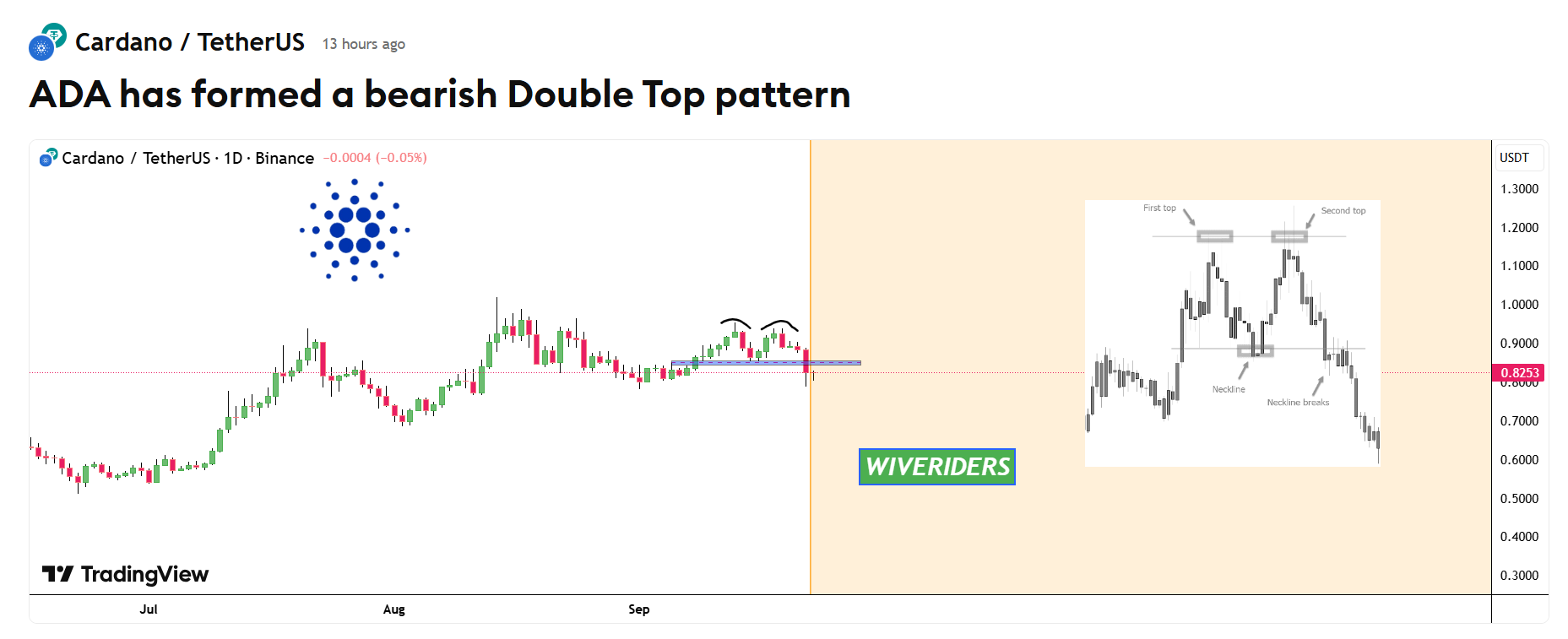
As the overall crypto market crashed today, WiverRiders, a notable market analyst, has identified a bearish formation in Cardano price structure. 

According to the analyst, Cardano currently remains in a bearish trend with no signs of price stabilization, as the token has broken below key levels that previously acted as support.

Bearish Double Top Formation On Cardano

Specifically, the analyst highlighted a bearish Double Top pattern on Cardano’s chart, with both peaks forming around the $0.9300- $0.9600 region, a zone that has now proven to be a significant resistance. The first top formed on September 13 at $0.9546, while the second occurred on September 18 at $0.9358, confirming the bearish setup.

Notably, Cardano has broken the neckline at approximately $0.8500, which signals further downside momentum.

Meanwhile, based on this breakdown, the projected target points toward $0.7682, aligning with the next key support zone. 

Conversely, the structure indicates that sellers currently hold the upper hand, pressing ADA toward lower levels if buying pressure does not re-emerge.

However, historical data shows that each time ADA formed this structure, it often collapses further before eventually recovering. For instance, when a double top occurred in May 2025, Cardano dropped to $0.51 by June 22 before recovering to $0.9373 in July.

Another occurred in August and resulted in a drop to $0.78 on Sept. 1. While the latest could lead to steeper declines, Cardano still has hope for a rebound.

Cardano Bearish double top pattern New1010101
Cardano chart by WiverRiders

Will ADA Extend Losses Toward $0.7682?

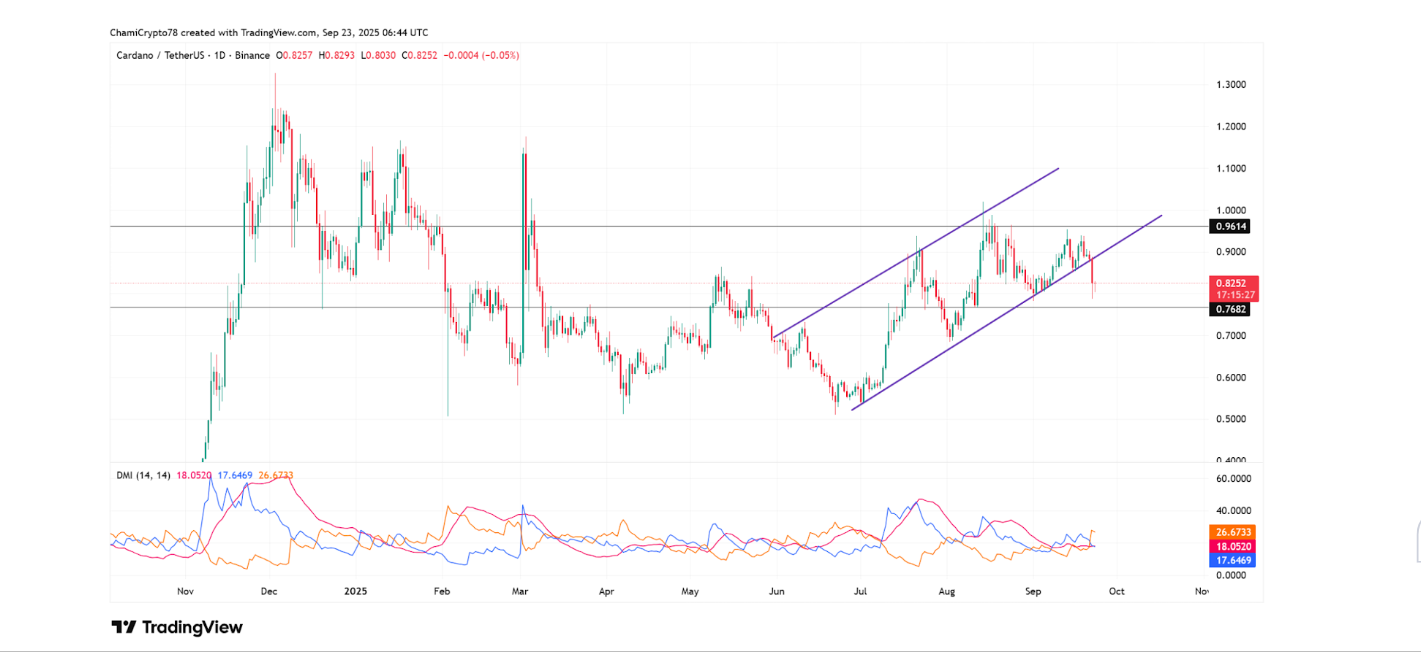
Moreover, Cardano had been trading within a rising channel since mid-June, consistently forming higher highs and higher lows. 

Nonetheless, on September 22, ADA broke decisively below the channel’s lower boundary, signaling the end of its short-term uptrend and a shift in momentum back to sellers. This breakdown indicates that buyers failed to defend the ascending trendline, allowing bearish pressure to dominate. 

Notably, the Directional Movement Index (DMI) reinforces this outlook, with the +DI line crossing beneath the -DI line as the ADX strengthens. Together, the channel breakdown and bearish DMI crossover confirm a downside bias, with ADA now targeting the $0.7682 support level.

Cardano 1 Day Chart New10101c1010c101
Cardano 1-day chart

Cardano Derivatives Show Weak Participation

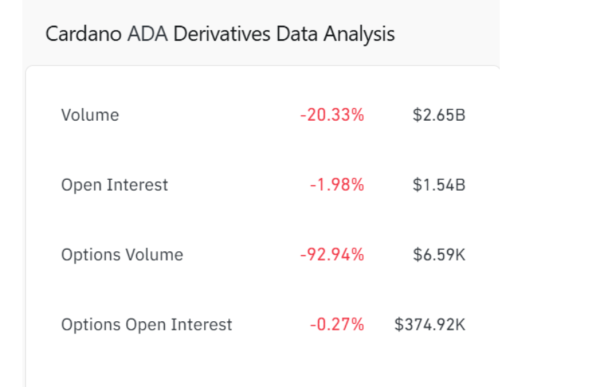
Additionally, Cardano’s derivatives market has also reflected the growing bearish momentum. According to CoinGlass, trading volume declined by more than 20% to settle at $2.65 billion, while open interest slipped by nearly 2% to $1.54 billion, signaling reduced participation from futures traders. 

Cardamo Derivates New10101c01v10
Cardano derivatives 

Furthermore, options activity weakened significantly, with options volume dropping by more than 90% and open interest edging 0.27% lower to around $374,000. These declines suggest waning speculative demand and limited hedging activity, aligning with the broader downward trend in ADA’s spot market.

Top Expert Says SEC Lawsuit No Longer an Excuse for XRP Price Stagnation

0

Pro-XRP lawyer Bill Morgan argues that the SEC lawsuit is no longer a valid excuse for XRP’s stagnant price and limited adoption. 

The prominent legal commentator made this assertion in response to a community member’s query regarding the fine in escrow that Ripple was ordered to pay to the SEC.

Ripple Has Paid $125M Fine

For context, after Judge Torres issued her final judgment in the case, Ripple placed the $125 million fine in an interest-bearing account managed by its lawyers, while also appealing the verdict.

Following a settlement earlier this year, the SEC agreed to reduce the fine to $50 million. However, Judge Torres rejected attempts to reduce it further from her initial order of $125 million.

Although both parties withdrew their respective appeals in the Second Circuit in August, little has been disclosed regarding the status of the escrowed funds. This prompted a community member to ask on X yesterday whether Ripple has fulfilled the payment.

In response, attorney Morgan affirmed that Ripple’s lawyers have paid the fine. Although the payment did not go viral, a court document shared by former SEC official Marc Fagel shows that Ripple’s lawyers paid the $125 million fine to the U.S. Treasury last month.

SEC Lawsuit No Longer Responsible for XRP Stagnation

Notably, Morgan suggested that the lawsuit is no longer a valid excuse for XRP’s relatively flat price performance and slow adoption pace. He emphasized that the SEC lawsuit has run its course.

Previously, many attributed the SEC case as the primary reason behind XRP’s lackluster performance. This speculation lingered throughout the duration of the lawsuit, which began in December 2020.

To put things into perspective, while many crypto assets registered new all-time highs in the 2021 bull cycle, XRP could not surpass its peak price of $3.84 set in January 2018. Instead, it only reached $1.96 in April 2021.

Meanwhile, XRP moved close to establishing a new peak in July 2025, several months after the parties agreed to withdraw the case.

Since then, XRP’s momentum has slowed, with its price mostly hovering around the $3 price mark. Some enthusiasts attributed the stagnation to the so-called “price suppression theory,” while others linked it to the broader crypto market’s bearish trend.

In his commentary, Morgan dismissed attempts to blame the SEC lawsuit as the primary reason behind XRP’s limited adoption and sluggish price action.

In other words, the legal uncertainty surrounding XRP is over, and the token’s fundamentals should dictate the price.

At the moment, XRP has dropped to the fourth position in the global crypto ranking. It is currently trading at $2.87 per token, with a market cap of $171.77 billion.

Expert Says XRP Is Like a 401(k), Here’s Why

0

Leading decentralized exchange First Ledger, operating on the XRPL, has called 401(k) and XRP “basically the same thing.”

The remark came as U.S. lawmakers urged the SEC to implement President Donald Trump’s executive order aimed at opening the $12 trillion 401(k) retirement market to crypto.

Specifically, nine lawmakers, including key House committee chairs French Hill and Ann Wagner, wrote to SEC Chair Paul Atkins to make it easier for retirement plans to include alternative assets like cryptocurrencies.

They asked the SEC to relax specific investor rules so that the 90 million Americans saving for retirement can diversify their portfolios with crypto assets like Bitcoin, Ethereum, and XRP.

Why 401(k) Access Could Unlock Massive Crypto Liquidity

Analysts estimate that a 1% to 2% crypto allocation across the $12 trillion in 401(k) plans could result in $120 billion to $240 billion in inflows.

To put this in perspective, Bitcoin ETFs have attracted $57.3 billion since January 2024. During that time, the price of Bitcoin surged from $45,000 to $124,457, and the global crypto market grew from $1.65 trillion to over $4.17 trillion.

In other words, the $60 billion from Bitcoin ETFs and other investments had a compounding effect on the market. Expectedly, this has fueled discussion about the potential impact of 401(k) plans making even a modest 1% allocation to crypto.

Notably, public pension funds have also begun embracing crypto exposure. For instance, the State of Michigan Retirement System recently expanded its holdings in Bitcoin and Ethereum trusts.

To First Ledger, the parallel between 401(k)s and XRP shows the shared goal of building long-term wealth and enabling more efficient value transfer. Just as 401(k) plans aim to grow retirement savings over decades, XRP is positioning itself as a global bridge asset for institutional adoption and cross-border settlement.

Analysts See a Breakout Opportunity for XRP ETFs via 401(k)

Market commentators like Paul Barron have argued that Trump’s policy shift could be transformative for XRP.

Barron noted that 401(k) capital would likely flow first into crypto exchange-traded funds (ETFs), which are already on the verge of approval for XRP.

Rupert from AllinCrypto echoed this sentiment, stating that access to crypto ETFs through retirement accounts “is going to really change the course that XRP is on.”

He compared the potential impact to the historic launch of the BlackRock Bitcoin ETF. Rupert suggested that XRP’s strong institutional interest could help it exceed expectations and possibly break away from the typical four-year crypto cycle once ETFs go live.

What if Retirement Funds Allocated 1% to XRP?

Meanwhile, amid the wait for XRP ETFs and growing interest from retirement funds, there has been wide speculation about the potential impact on XRP’s price.

An analysis published by The Crypto Basic in early August suggests that if global retirement funds managing around $50 trillion allocated just 1% ($500 billion) to XRP, the price could reach $12 based on a linear estimate. With a multiplier effect, the price could rise to between $17 and $34.

In comparison, a recent analysis by Bill Miller IV suggests that a 2% allocation to Bitcoin could push its price to $175,000, increasing its total market valuation to $3.4 trillion.

21Shares Dogecoin (DOGE) ETF Listed on DTCC

0

Swiss-based asset manager 21Shares has moved closer to launching a Dogecoin exchange-traded fund (ETF) in the United States.

The proposed product, listed under the ticker TDOG, recently appeared on the Depository Trust & Clearing Corporation (DTCC) website, signaling preparation for a potential market debut.

However, the listing does not indicate an imminent approval. It is part of the standard technical setup before trading begins for any ETF. The U.S. Securities and Exchange Commission (SEC) still holds the final say on whether the fund can launch.

SEC Review Process Still in Progress

The U.S. Securities and Exchange Commission is currently evaluating the 21Shares filing. The company submitted its registration statement on April 9, 2025, through Form S-1. The SEC formally acknowledged it in mid-May 2025, beginning the review.

This process includes several rounds of public comments and agency feedback. Regulators will examine whether the ETF protects investors, ensures transparency, and meets existing compliance rules. The SEC’s final deadline for a decision is January 9, 2026.

Structure of the Proposed ETF

If approved, the 21Shares ETF would hold Dogecoin directly, unlike futures-based products. Its value will be tracked through a dedicated spot index. The cryptocurrency itself would be stored securely by Coinbase Custody Trust Company, a well-known provider of institutional custody services.

This structure aims to provide investors with regulated access to Dogecoin while reflecting its actual market price. For many, such products offer a simpler alternative to buying and storing tokens directly.

Competition in the Dogecoin ETF Market

The race to offer Dogecoin investment products is heating up. Earlier this month, REX Shares and Osprey Funds introduced DOJE, the first U.S.-listed Dogecoin ETF. This product already gives investors direct exposure to the token.

Meanwhile, Bitwise is also pursuing approval for its Dogecoin ETF. The SEC recently extended its decision deadline for that proposal until November 12, 2025.

At the time of writing, Dogecoin trades at $0.2421. The price has risen 1% in the last 24 hours, although it is still down 9.2% over the past week.