Home Blog Page 52

History Shows XRP Has Entered the Final Phase of the Bear Cycle

0

History suggests XRP may have entered the final phase of its current bear cycle as it prints a monthly signal that previously appeared near major market bottoms. 

The latest XRP chart structure looks exactly like earlier cycle patterns that eventually led to long-term reversals and the start of strong bullish trends.

XRP Structure Matches Previous Bear Cycle Endings

Notably, XRP closed July below its 1-month 50-period moving average (1M MA50), represented by the blue trend line, for the second straight month. This marks the first time the asset has recorded two consecutive monthly closes below the 1M MA50 since June 2024.

Back then, XRP still traded within its 6-year Buy Zone before launching the parabolic rally that defined the previous bull cycle. The return of this pattern now suggests the market has entered a stage that has historically appeared near the end of prolonged market corrections.

The current monthly close resembles a pattern that developed during the 2021/22 bear market. In both cases, XRP slipped below the 1M MA50 before entering the final stage of its long-term Channel Down.

If history repeats, the next major downside level is at the 1M MA100. However, XRP’s long-term Fibonacci Channel Up structure and the behavior of its 1-month Relative Strength Index (1M RSI) suggest the cycle low could form even lower before a sustained recovery begins.

XRP RSI Approaches a Historically Bullish Level

For context, the 1M RSI has repeatedly produced its strongest long-term buy signals whenever it reached its Lower Lows trend line, highlighted by the green circles on the chart.

The indicator did not make direct contact with that trend line in 2022. Instead, it moved sideways, much like it did in 2020. This allowed buyers to enter slightly later while still accumulating XRP at prices close to the cycle bottom.

XRP Enters FInal Phase of the Bear Cycle

The 1M RSI now trades close to the Lower Lows trend line once again. A direct touch or another period of sideways movement could produce the next long-term buy signal. This process could still take another three to four months, but it represents the strongest long-term signal on the chart.

XRP Could Bottom Between $0.80 and $0.65

If this timeline plays out, XRP could move deeper into its 6-year Buy Zone before completing the current bear cycle.

The projected bottom range sits between $0.80 and $0.65. This zone covers a possible move to both the 1M MA100 and the 1M MA150, with the latter represented by the black trend line.

The lower boundary near $0.65 also falls slightly below the 0.618 Fibonacci retracement level. Notably, XRP also formed its June 2022 bottom around that same Fibonacci retracement level, which confirms the historical support at this bottom zone.

A New Bull Cycle Could Follow

Once the current bear cycle reaches its bottom, history suggests the possibility of another extended bullish cycle.

The next bull cycle could last for a prolonged period but may feature shorter bursts of parabolic rallies, similar to XRP’s price behavior after 2022.

For now, the Higher Highs trend line continues to limit upside momentum. Until XRP breaks above that long-term resistance, it remains the next major target on the chart. A successful breakout above that level would open the door to an initial bull cycle target of around $6.
“Don’t Just Hold XRP”: Evernorth CEO Shares His Vision for the Token’s Future

Evernorth CEO Asheesh Birla believes companies should rethink how they use XRP, arguing it should be put to work to generate yield rather than simply held on corporate balance sheets.

In an interview with CoinPost during WebX 2026 in Japan, the former Ripple executive explained Evernorth’s strategy. The company is focusing on actively managing XRP as a productive on-chain asset while betting on the long-term growth of tokenized real-world assets (RWAs) and the XRP Ledger ecosystem.

“Don’t Just Hold Assets, Put Them to Work”

Birla said Evernorth views XRP as an operational asset rather than a passive treasury holding. He explained that blockchain’s value goes beyond asset ownership. On-chain strategies can make digital assets more productive by creating new ways to generate returns.

“We see significance in being active beings, not just passive vehicles,” Birla said. He added that Evernorth plans to build yield-generating strategies around XRP on the XRP Ledger.

Birla believes companies will increasingly seek ways to generate returns from tokenized real-world assets rather than leaving them idle. He said Evernorth believes the XRP Ledger is well positioned to support this shift.

XRP Ledger Sees Strong RWA Growth

Birla also addressed concerns about digital asset treasury (DAT) models during recent crypto market weakness.

He said Evernorth’s approach is different from companies that simply accumulate cryptocurrencies. Instead, the company plans to actively operate on-chain by using decentralized finance tools built on the XRP Ledger.

As a sign of growing adoption, Birla pointed to the rise of tokenized real-world assets on XRP Ledger. He said the market has grown to approximately $3.6 billion, representing around 24 times growth over the past year. According to Birla, these figures show growing confidence in blockchain-based financial markets and the future of tokenization.

RLUSD Boosts Activity on XRP Ledger

Birla also highlighted the growing role of Ripple’s U.S. dollar-backed stablecoin, RLUSD, within the XRP ecosystem. He said activity on the XRP Ledger has increased significantly since RLUSD launched. Transactions settled in U.S. dollars and RLUSD have grown 12-fold.

Birla said the global importance of the U.S. dollar makes regulated dollar-backed stablecoins an important part of tokenized financial markets.

He added that about 54.74% of RLUSD currently circulates on the XRP Ledger, while the remaining supply is issued on Ethereum. He expects even more activity to move onto XRPL over time.

Advice for Japanese Companies Exploring Digital Assets

Birla encouraged Japanese companies interested in digital assets to start with digital asset treasury strategies before moving into broader blockchain applications. He said XRP was designed for financial use cases and could provide an entry point for companies exploring blockchain-powered capital markets.

Using SBI Holdings’ early investment in Ripple as an example, Birla suggested that companies can begin with investment exposure before expanding into deeper blockchain adoption.

SBI Partnership and Nasdaq Plans

Evernorth has secured more than $1 billion in funding, including a $200 million investment from SBI Holdings. Birla described the partnership as an important step in Evernorth’s expansion in Japan.

He also confirmed that Evernorth recently submitted updated S-4 filings to the U.S. Securities and Exchange Commission. The company is continuing work toward a planned Nasdaq listing through its merger with Armada Acquisition Corp. II.

Birla said a public listing would allow investors and businesses to gain exposure to blockchain finance through traditional equity markets. This would give them access without requiring them to directly hold and manage XRP.

Evernorth Five-Year Goal

Looking ahead, Birla said Evernorth aims to become a leader in generating yield from tokenized assets. The company plans to start with XRP before expanding into other tokenized assets as blockchain adoption grows.

Its long-term goal is to use decentralized finance tools on the XRP Ledger to help businesses and institutions make their on-chain holdings more productive.

XRP Ledger Reaches $4.06B in RWAs, 199 Holders After Ripple’s Infrastructure Investments

The long-term effort of Ripple to turn the XRP Ledger (XRPL) into a hub for tokenized real-world assets (RWAs) is showing signs of progress. 

New data from RWA.xyz points to growth in both tokenized asset value and network participation. Specifically, the XRP Ledger’s represented asset value has climbed to $4.06 billion. That marks a 2.18% increase over the past 30 days. During the same period, the number of RWA holders rose 25.16% to 199.

The update comes just days after Ripple announced strategic investments in infrastructure firms ZILO and Licuido. The company said the investments are intended to expand the XRP Ledger’s institutional capabilities.

XRP Ledger RWAs Metric

RWA Activity Grows on XRP Ledger

In addition to higher represented asset value and more RWA holders, the RWA.xyz dashboard shows the XRP Ledger now hosts 373 tokenized real-world assets. Distributed asset value stands at $368.82 million.

Stablecoins also remain an important part of the ecosystem. Stablecoin market capitalization has reached $901.4 million, with approximately 60,240 stablecoin holders on the network.

However, not all activity increased. RWA 30-day transfer volume fell sharply to $18.15 million. Stablecoin transfer volume also declined 1.79% over the past month to $3.89 billion, according to the dashboard.

Tokenization Outpaces XRP ETF Inflows

The latest figures also align with data shared by Evernorth, which said tokenization on XRPL is growing faster than attention toward spot XRP exchange-traded funds.

According to the company, tokenized real-world assets on the XRP Ledger grew from about $73 million in January 2025 to roughly $900 million by December 2025. They have since climbed to around $4.3 billion.

Evernorth added that spot XRP ETFs have attracted about $1.5 billion in cumulative net inflows since launching in November 2025. By comparison, the value of tokenized assets on XRPL is now nearly three times larger.

The comparison underscores Ripple’s strategy of positioning the XRP Ledger as more than a payments network. The company is also building it into infrastructure for institutional tokenization.

Ripple Builds Institutional Capabilities

The growth follows Ripple’s August 3 announcement that it had invested in ZILO and Licuido to bring regulated transfer agency, digital asset issuance, and collateral management to the XRP Ledger (XRPL).

The company says these additions will help solve issues like slow settlements, unused collateral, and fragmented liquidity. Its platform now supports token issuance, custody, collateral management, multiple currencies, and atomic settlement, with the RLUSD stablecoin used for secure delivery-versus-payment transactions.

Ripple is also building on partnerships with Aviva Investors, Franklin Templeton, and DBS as it grows its tokenized finance ecosystem. The recent rise in tokenized real-world assets (RWAs) on XRPL suggests these investments may already be helping drive adoption, as Ripple continues to position the network for institutional digital finance.

3 Major Exchanges Turn Negative in XRP Wallet Metric: Coinbase Leads at -10.9K

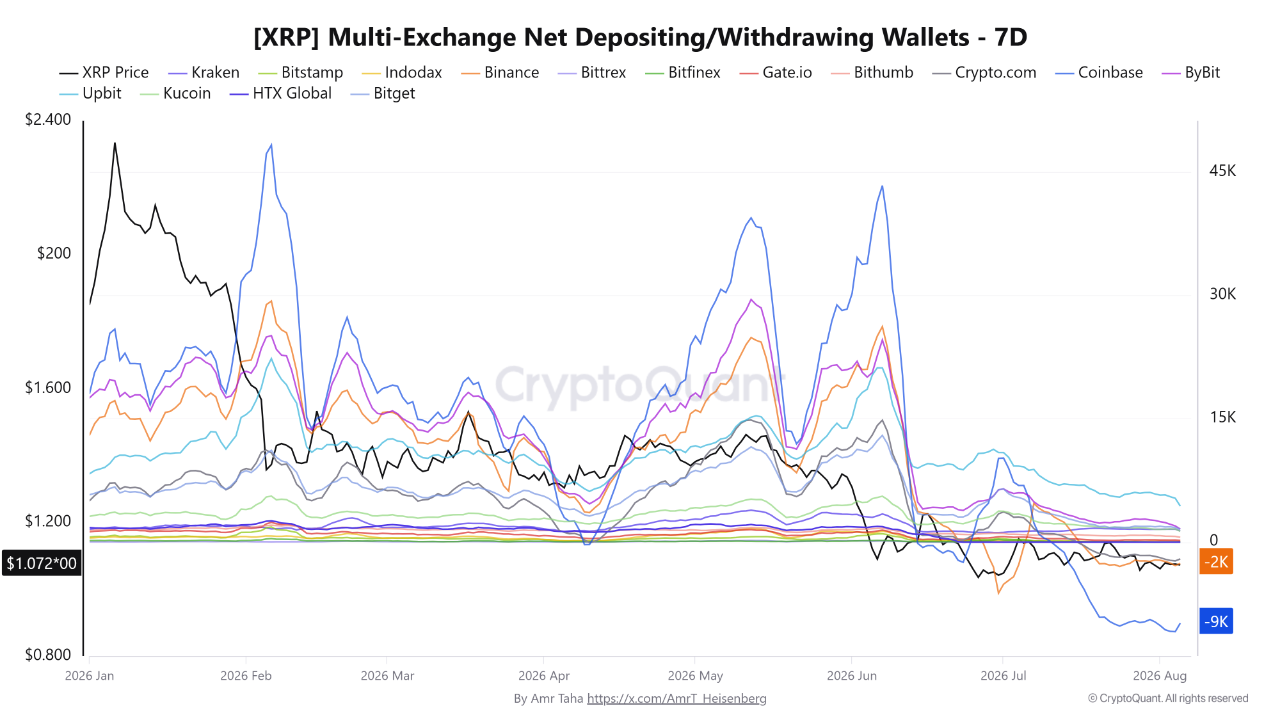
XRP may be entering a new phase in the market as more people are moving XRP off major exchanges like Coinbase, Binance, and Crypto.com.

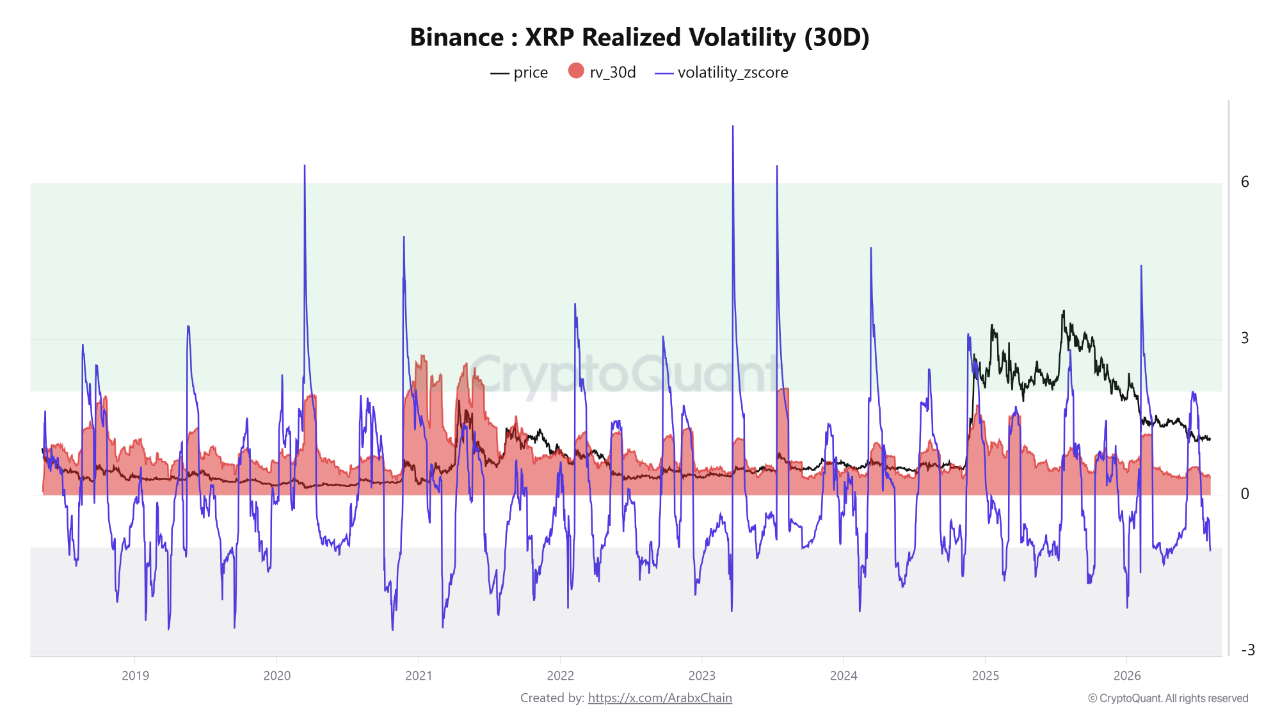
Meanwhile, the price has become the least volatile it has been in the past three months.

According to CryptoQuant analyst Amr Taha, these exchanges are seeing more XRP withdrawals than deposits. This suggests that investors are taking their XRP off exchanges instead of sending it there, which can be a sign that they plan to hold it rather than sell.

Coinbase Sees Largest Increase in Withdrawal Wallets

According to Taha, Coinbase recorded the biggest shift. Its seven-day net depositing/withdrawing wallets metric fell to -10,900 on August 4. In other words, withdrawing wallets outnumbered depositing wallets by 10,900 during the period.

The reading was about 3.4 times deeper than Coinbase’s previous low of -3,200, recorded in June 2025. This points to a sharp increase in withdrawal activity.

The trend was not limited to Coinbase. Taha said Coinbase, Binance, and Crypto.com all entered negative territory on July 17 and have remained there through early August. That suggests withdrawal activity has stayed elevated across multiple centralized exchanges.

Binance recorded -2,550 wallets on August 4. It last reached a lower level in June 2025, when the metric fell to -4,380. Crypto.com posted -2,290, compared with its June 2025 low of -4,470.

Although Binance and Crypto.com have not yet matched their June 2025 lows, Taha said the simultaneous decline across all three exchanges strengthens the broader cross-exchange signal.

The metric measures the number of wallets that deposit and withdraw, not the amount of XRP transferred. As a result, it shows how widespread withdrawal activity is among users rather than the value of exchange outflows.

XRP Volatility Drops to Three-Month Low

In a separate CryptoQuant analysis, contributor Arab Chain said XRP’s 30-day realized volatility on Binance has fallen to about 0.34. That is its lowest level in three months. The token was trading near $1.07 at the time of the analysis.

The drop suggests daily price swings have become much more subdued than they were in June.

According to the analyst, periods of low realized volatility often coincide with weaker speculative trading. They can also reflect less panic- or greed-driven market behavior. Such conditions may indicate a temporary balance between buyers and sellers as the market waits for a new catalyst.

Quiet Market May Set Up Bigger XRP Price Move

Low volatility is not inherently bullish or bearish. However, Arab Chain noted that extended periods of market calm have historically been followed by larger price moves.

Major news, rising trading volumes, or shifts in investor sentiment can all trigger a fresh increase in volatility after a long period of compression.

With realized volatility at a three-month low, the analyst said investors can assess XRP’s broader trend without the distraction of sharp daily swings. If low volatility persists, however, the likelihood of a significant breakout—or breakdown—could increase. That is especially true if trading activity picks up or derivatives market positioning changes.

Ultimately, the combination of rising withdrawal-wallet activity across major exchanges and falling price volatility suggests XRP may be entering an important phase.

Cardano Founder Pushes for Reputation Revival, Says ADA Needs a Narrative Reset

0

Cardano founder Charles Hoskinson believes the blockchain network needs a narrative reset to reshape public perception.

According to Hoskinson, Cardano’s greatest challenge is no longer technological innovation but convincing the broader cryptocurrency market that the project continues to evolve. His remarks come as the network prepares for major protocol upgrades while simultaneously restructuring its governance and organizational framework.

Hoskinson Says Cardano Still Battles an Outdated Reputation

Discussing Cardano’s current standing in the crypto industry, Hoskinson acknowledged that the project continues to carry the stigma of unmet expectations following its meteoric rise during the 2021 bull market.

At the time, Cardano reached an all-time high (ATH) of $3.10 and became the third-largest cryptocurrency by market cap, fueling speculation that it could eventually overtake Ethereum in the rankings. However, the network failed to achieve that milestone. Moreover, as decentralized finance (DeFi) expanded, Solana emerged as the dominant competitor, further shifting market attention away from Cardano. 

As a result, many investors concluded that Cardano had failed to launch or had become a dying project. 

Cardano Still Has the Capability to Succeed but Needs a Narrative Reset: Hoskinson

However, Hoskinson rejected that narrative, arguing that it does not reflect the ecosystem’s current reality. Instead, he emphasized that Cardano’s community remains highly engaged and that the blockchain continues to offer unique technological capabilities.

“The people haven’t gone anywhere. The passion hasn’t gone anywhere. Cardano needs a narrative reset,“ Hoskinson said.

He added that Cardano faces a marketing and branding challenge rather than an ecosystem problem. Consequently, he identified improved executive function and stronger organizational coordination as top priorities for the remainder of the year. 

According to him, better execution will allow Cardano to establish a new roadmap, move beyond past criticisms, and communicate its long-term vision more effectively.

Leios and Peras to Strengthen Cardano’s Competitive Edge

Beyond changing the project’s public image, Hoskinson pointed to several upcoming protocol upgrades that could significantly strengthen Cardano’s position in the blockchain industry.

Among the most anticipated are Leios and Peras, two major scaling initiatives designed to increase transaction throughput and deliver faster transaction finality. Hoskinson believes these upgrades will provide the network with the performance needed to compete more aggressively with leading smart contract platforms.

He also argued that pairing stronger infrastructure with more effective messaging could fundamentally reshape how the broader crypto industry views Cardano.

Hoskinson Criticizes EMURGO’s Performance

In addition to discussing Cardano’s future, Hoskinson criticized EMURGO, the organization previously responsible for driving the ecosystem’s commercial growth.

He described EMURGO’s performance as a major failure, arguing that effective leadership and strong execution are essential for any blockchain ecosystem seeking to adapt, innovate, and regain momentum.

His remarks come as Cardano undergoes broader governance changes. Following recent developments involving its wallet operations, EMURGO has stepped away from several ecosystem leadership roles, including its positions within Pentad, Intersect, and the Delegated Representative (DRep) framework.

Governance Reforms Continue to Take Shape

Meanwhile, Hoskinson continues to advocate for deeper political participation within Cardano’s governance model.

As part of that vision, he has proposed creating a community-aligned political party that could operate as a Delegated Representative (DRep) and participate in key governance decisions. The initiative reflects his broader goal of strengthening decentralized governance while improving coordination across the ecosystem.

He believes Cardano’s next chapter depends on two parallel efforts: reshaping the market’s perception of the project and delivering the technical upgrades needed to compete with the industry’s leading blockchain networks.

Meanwhile, Cardano’s market performance has begun to improve. ADA climbed above $0.195 this week, reaching its highest price since July 4. The cryptocurrency currently ranks as the 13th-largest digital asset by market capitalization, with a valuation of approximately $7.01 billion. 

Shiba Inu Team’s Most Active Voice Returns to X After Two Months of Silence

0

The Shiba Inu community has received a morale boost as Lucie, the ecosystem’s marketing lead, quietly returned to X after nearly two months of inactivity.

Lucie’s prolonged absence has not gone unnoticed as she is one of the most active and visible members of the Shiba Inu ecosystem team. Between early June and the end of July, she neither shared updates nor reposted ecosystem developments, prompting widespread speculation among supporters about the reason behind her silence.

Before stepping away, Lucie last posted on June 9, informing the community that the ShibaSwap website had resumed normal operations. Following that update, she remained inactive for almost two months without providing any explanation.

Return of Shiba Inu Marketing Lead Restores Community Confidence

This week, Lucie resumed activity by reposting several Shiba Inu-related updates originally published between July 30 and July 31. Although she has not yet issued a personal statement explaining her return, her renewed engagement has already attracted significant attention within the SHIB community.

For many supporters, Lucie is more than the project’s marketing lead. Throughout previous market cycles, she has served as one of the ecosystem’s most consistent communicators, regularly sharing development updates while encouraging holders to remain patient during periods of market weakness.

Consequently, her optimistic messaging has helped sustain community confidence even during prolonged price declines. Her return therefore provides reassurance at a time when investors continue to navigate uncertain market conditions.

Shytoshi Kusama’s Absence Continues to Draw Attention

While Lucie’s return has energized the community, Shiba Inu’s lead ambassador, Shytoshi Kusama, remains absent from social media.

Kusama has not posted on X since May 13 as he continues to focus on an independent artificial intelligence initiative. His extended silence has sparked criticism from some observers, who argue that the ecosystem currently lacks a highly visible public leader while the broader crypto market remains under pressure.

Nonetheless, the Shiba Inu ecosystem continues to advance through its broader development team and active community contributors. Even so, Kusama’s absence remains a recurring topic of discussion among both supporters and critics.

SHIB Maintains Strength Despite Broader Market Weakness

Meanwhile, Shiba Inu has continued to show resilience despite the wider market downturn.

It recently surged nearly 40%, climbing to around $0.000006 before retracing below the $0.000005 level. Despite the pullback, SHIB has retained a portion of its recent gains, suggesting that buying interest remains intact.

At press time, SHIB trades at $0.000004922, up 10.21% over the past 24 hours. In addition, the token remains the world’s 26th-largest cryptocurrency, with a market cap of roughly $2.9 billion.

Lucie’s return comes as the Shiba Inu community seeks renewed engagement from the ecosystem’s key figures. Although her recent activity does not necessarily indicate that a major announcement is imminent, it restores one of the project’s most influential voices during a period of heightened market uncertainty. 

Uniswap Whales Step In as UNI Corrects From $4.57, Binance Outflows Hit Five-Year High

Large Uniswap (UNI) holders are accumulating the token despite its recent pullback from a local high. 

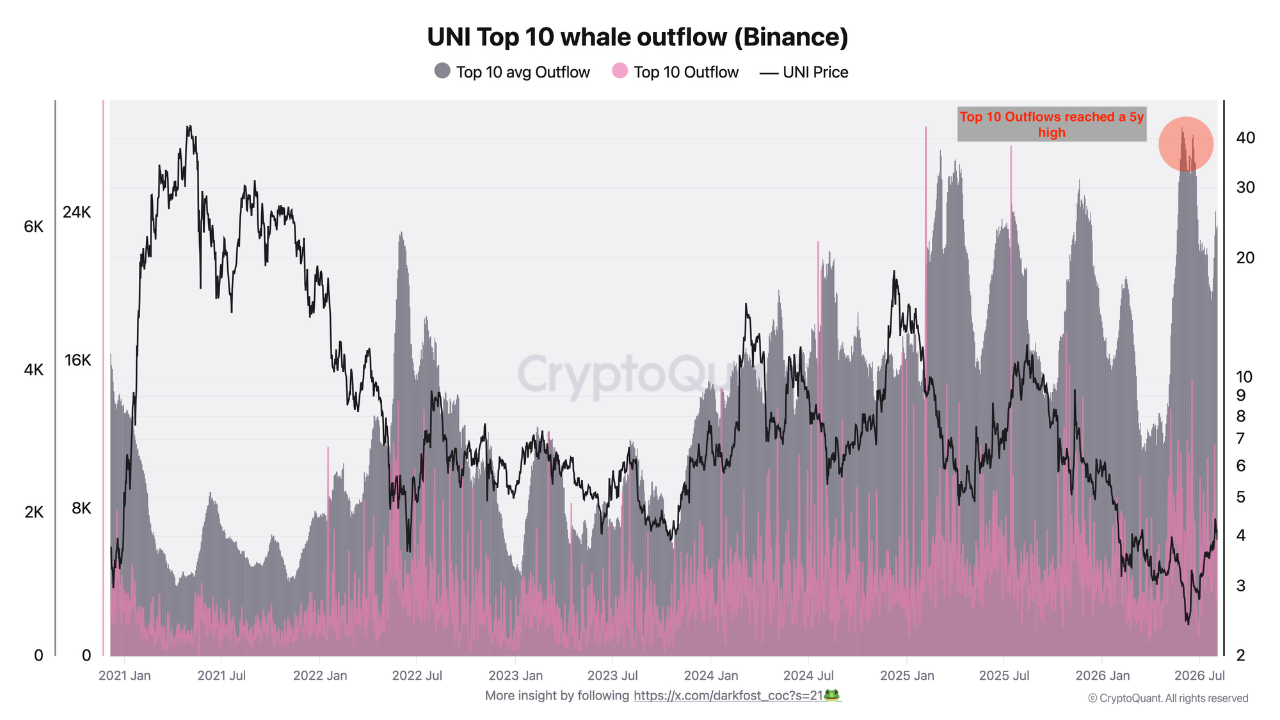
According to CryptoQuant analyst Darkfost, Binance has recorded its highest level of major UNI withdrawals in five years.

Darkfost said the monthly average of the 10 largest UNI withdrawal transactions from Binance has reached its highest level since 2021. The trend suggests that some of the exchange’s biggest participants are continuing to accumulate UNI during periods of price weakness.

The analyst noted that the monthly average of these top-10 withdrawals has surpassed 7,200 UNI. On some days, the combined withdrawals from the 10 largest transactions exceeded 10,000 UNI.

quicktake-image

According to the analysis, the largest outflows have increased during periods of sharp declines in UNI prices. This suggests that large investors may be using market dips as opportunities to accumulate.

“These outflows therefore suggest that UNI accumulation is continuing, particularly among the largest players on Binance,” Darkfost wrote.

He added that despite UNI’s extended decline from its all-time high, some investors remain confident in Uniswap’s long-term growth potential and the future value of its native token.

UNI Still Down 90% from Previous Peak

For context, UNI is among the major altcoins that have yet to reclaim their previous cycle highs. The token is still trading more than 91% below its 2021 all-time high of around $45.

Meanwhile, the latest accumulation trend comes after one of UNI’s sharpest corrections in recent years. The token dropped to $2.316 on June 6, 2026, marking its lowest level in roughly five years.

The decline came just days after Standard Chartered projected that UNI could reach $100 by 2030. After hitting its low, UNI recovered strongly and climbed to $4.577 five days ago before losing momentum and pulling back.

According to CoinMarketCap data, UNI is trading at $3.84 at the time of writing, down 5.45% over the past 24 hours. Despite the daily decline, the token remains up 21.7% over the past month and 52% over the past two months. However, it is still down 32% year-to-date.

Uniswap Fee Switch Boosts Network Activity

Notably, UNI’s recent recovery happened after Uniswap v4 activated its fee switch, which led to a jump in network activity.

According to Santiment, UNI’s price rose about 19%, from $3.83 to $4.54, between July 29 and July 31 after the fee switch and buy-and-burn system launched. The price later dropped back near $4.07 as the first wave of excitement faded.

Uniswap (UNI) chart by Santiment

The increase was not caused solely by price movements. On-chain activity also grew. New addresses nearly doubled, reaching 510 on July 30 and 582 on July 31, compared with the usual July range of 250–320.

Active addresses also increased, reaching 2,341 and 2,457 on those days, above the normal range of 1,300–1,700. Whale activity picked up too, with 142 transactions worth more than $100,000 recorded on July 30.

Santiment said that continued network growth, even after UNI’s price cooled, could be a sign of stronger adoption, not just a short-term price boost.

Cardano Expands Interoperability as First IBC Integration With Injective Goes Live

0

Cardano has achieved a major milestone in its long-term interoperability strategy by establishing its first live on-chain Inter-Blockchain Communication (IBC) connection with Injective on testnet.

The achievement marks the first time Cardano has connected to another blockchain through a live on-chain IBC rail, enabling native cross-chain asset transfers between the two ecosystems. Through the testnet integration, users can send ADA from Cardano to Injective and transfer INJ from Injective back to Cardano.

Both the Cardano Foundation and Injective described the development as the beginning of a new era of interoperability between the two networks.

According to the announcement, the integration will eventually make ADA accessible across the Injective ecosystem while allowing INJ to be used on Cardano once the solution reaches production.

However, both ecosystems stressed that the implementation remains experimental. The current version only supports Cardano Preprod and Injective Testnet with test tokens that hold no real-world value. 

How the Cardano-Injective IBC Integration Works

The current implementation serves as an experimental proof of concept rather than a production-ready bridge.

Using the IBC protocol, users can transfer test ADA from Cardano to Injective through a trust-minimized process. When the transfer begins, the ADA is locked in escrow on Cardano. Injective then mints an equivalent IBC voucher that represents the locked assets.

When users transfer their assets back, Injective burns the IBC voucher and releases the original ADA from escrow on Cardano. This mechanism enables secure bidirectional transfers without duplicating the underlying assets.

Historical Context 

The successful testnet launch highlights the significant engineering work required to connect Cardano with the broader interchain ecosystem.

Cardano first announced its IBC integration initiative in June 2024 as part of a broader plan to connect with more than 115 blockchains. The latest achievement demonstrates that the initiative is now moving from concept to implementation.

Unlike Injective, which is built on the Cosmos SDK and supports IBC natively, Cardano required custom infrastructure to achieve compatibility.

To overcome the architectural differences, developers built specialized modules that translate between Cardano’s Extended UTXO (eUTXO) accounting model and Injective’s account-based architecture. These custom components enable the two fundamentally different blockchain designs to communicate seamlessly through the IBC protocol.

Cardano Continues to Expand Cross-Chain Connectivity

The IBC milestone adds to Cardano’s growing list of interoperability initiatives.

In addition to its IBC efforts, Cardano expanded its cross-chain capabilities through its LayerZero integration. Announced in February 2026 by Cardano founder Charles Hoskinson, the integration deployed LayerZero’s Endpoint smart contracts directly on Cardano, enabling the network to connect with more than 80 blockchains, including Ethereum and Solana.

Notably, the IBC and LayerZero integrations represent important building blocks in Cardano’s strategy to become a highly interoperable blockchain capable of communicating with multiple ecosystems while expanding access to decentralized applications, liquidity, and digital assets across networks. 

Ethereum Network Is Getting Busier, But Why Isn’t ETH Price Moving?

Ethereum network is growing stronger even though interest from U.S. investors is still low, according to two new CryptoQuant reports. 

The reports show that Ethereum use and staking are increasing, but weaker institutional demand and lower exchange activity may slow ETH’s price growth in the short term.

At the time of the analysis, ETH was trading near $1,900. It stayed within its recent price range, despite major changes happening in the network behind the scenes.

Coinbase Premium Shows Weak U.S. Demand

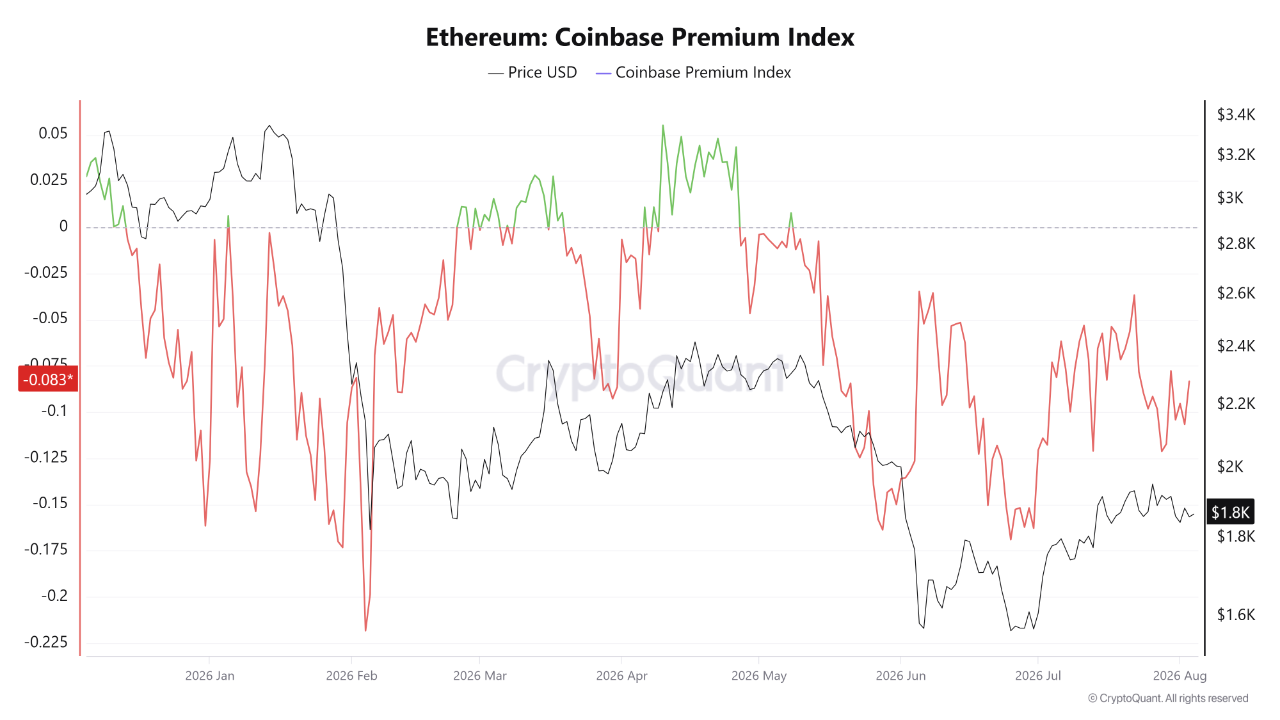
CryptoQuant analyst Arab Chain said Ethereum’s Coinbase Premium Index is still negative at -0.0833, meaning ETH is cheaper on Coinbase than on Binance.

A negative premium suggests that U.S. investors and institutions are buying less ETH compared to traders in other markets. Binance, which handles more global crypto trading, is currently showing stronger demand.

The index briefly turned positive in April, showing a short boost in U.S. demand, but it quickly fell back below zero in early May and has stayed there.

According to Arab Chain, this shows global demand is currently stronger than U.S. demand. If the index remains negative, Ethereum may struggle to build a strong price rally. A return to positive levels could mean fresh U.S. institutional interest and support a stronger ETH outlook.

Ethereum Coinbase Premium Index Chart | CryptoQuant

On-Chain Activity Keeps Growing

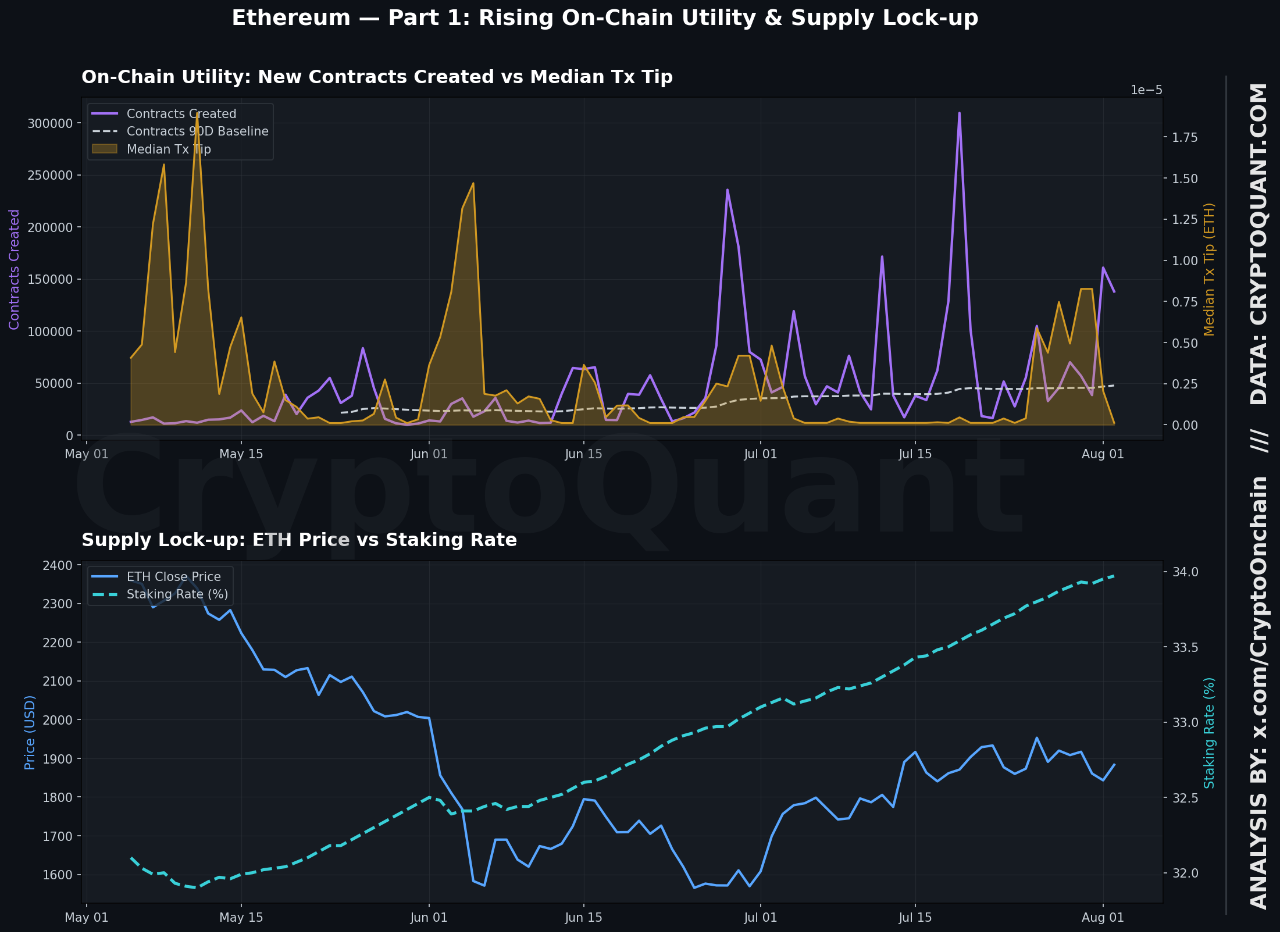
In a separate report, CryptoQuant contributor CryptoOnchain highlighted a widening gap between Ethereum’s on-chain activity and exchange participation.

Ethereum closed at $1,883 on August 2, staying within the $1,840-$1,950 range. While price action has remained relatively flat, on-chain metrics suggest network usage is increasing.

Over the past 90 days:

  • New smart contract deployments rose 82.3%.
  • Median transaction tips more than doubled.
  • Median token transfer volumes across externally owned accounts (EOAs) and smart contracts increased by 50% to 80% compared with quarterly averages.

These metrics point to organic growth in Ethereum’s network activity. However, that growth has yet to benefit the price.

Ethereum Exchange Activity Continues to Slow

While on-chain activity is strengthening, exchange metrics continue to weaken. CryptoOnchain reported that aggregate exchange netflows have fallen to 354% below their 90-day baseline.

Binance is also seeing weak inflows of stablecoin. Stablecoin net flows remain 120% below their 90-day average, suggesting investors are not moving significant capital to exchanges to buy ETH aggressively.

Large-holder activity has also slowed. Top-10 exchange inflows and outflows have declined by nearly 40% over the past quarter.

Meanwhile, Ethereum’s staking rate has continued to climb, reaching 33.97%. This reduces the amount of ETH available for trading.

quicktake-image

Combined with the still-negative Coinbase Premium, the data suggests rising on-chain activity alongside weak U.S. spot demand. CryptoOnchain said similar market conditions have historically preceded periods of tightening ETH supply. If demand returns, that could provide a stronger foundation for future price gains.

Cardano Emerges as Crypto Market Leader With Biggest Weekly Gain Among Top 100 Assets

0

Cardano has emerged as the best-performing cryptocurrency among the top 100 digital assets by market cap after delivering an impressive weekly gain of 25%.

According to CoinMarketCap data, ADA climbed 25.03% over the past seven days, pushing its price to $0.1956. As a result, Cardano has become the biggest gainer among the top 100 cryptocurrencies, outperforming several major altcoins during the same period.

Its closest competitors posted significantly smaller gains. Algorand (ALGO) rose 13.99%, Pi (PI) advanced 11.06%, Ethena (ENA) gained 10.34%, Polkadot (DOT) increased 9.79%, Pump.fun (PUMP) added 7.38%, and Monero (XMR) recorded a 6.75% weekly increase.

Consequently, Cardano’s weekly performance nearly doubled that of its nearest rival, underscoring the strength of its recent bullish momentum. 

Cardano Emerges as Biggest Gainer

Santiment Highlights Cardano Strength Despite Retail FUD

Blockchain analytics platform Santiment also recognized Cardano as one of the strongest-performing assets in an otherwise sluggish cryptocurrency market.

Interestingly, Santiment noted that ADA’s rally has unfolded despite persistent fear, uncertainty, and doubt (FUD) among retail investors. Rather than attracting a wave of new participants, Cardano has continued to climb even as its holder base has declined.

According to the analytics firm, the network currently has 7,070 fewer non-empty wallets than it did two months ago. Under normal market conditions, a rally of this magnitude would typically encourage new investors to enter the market. However, many smaller holders have remained on the sidelines throughout Cardano’s latest advance. 

Cardano Reaches Highest Price Since July 4

Santiment suggested that this unusual divergence points to accumulation by larger, more conviction-driven investors while retail participants remain cautious. Supporting this view, Cardano whales accumulated 240 million ADA within five days, increasing their combined holdings to 14.5 billion ADA. 

Ecosystem Developments Strengthen Cardano’s Bullish Case

Beyond favorable market dynamics, Santiment believes Cardano’s recovery is being driven by tangible ecosystem progress rather than speculative trading alone.

The firm highlighted several major developments that continue to strengthen the network. These include ongoing work on the Leios testnet, continued advancements in Hydra scaling technology, improvements to the Mithril protocol, integration with Pyth Network’s oracle infrastructure, and fresh funding distributed through the Catalyst innovation program.

Collectively, these technical milestones reinforce Cardano’s long-term development roadmap. Moreover, they provide a stronger fundamental foundation for the network, which may be contributing to renewed investor confidence and ADA’s market-leading performance.