Home Blog Page 523

Here’s How Realistic Shiba Inu $0.5 or $1 Price Predictions Are

0

Despite Shiba Inu’s outstanding performance in the 2021 market cycle, it remains to be seen whether the asset can reach ambitious targets like $ 0.50 or $1. 

Leading canine-themed token Shiba Inu has been one of the most popular cryptocurrencies in recent years, thanks to its remarkable performance during the 2021 bull market. 

Boosted by factors such as Ethereum co-founder Vitalik Buterin’s 410 trillion SHIB burn and multiple major exchange listings, Shiba Inu skyrocketed in 2021, gaining over 100,000,000% in a single year and reaching an all-time high of $0.000088 in October. 

While many expected the token to continue its rally, it plunged tremendously in subsequent years. This decline aligned with the broader market downturn triggered by events such as the Terra collapse and the FTX implosion. 

Shiba Inu Potential Surge to $0.5 or $1 

Despite the heavy plunge, speculations over Shiba Inu’s long-term potential have continued to rage. Its spectacular performance in 2021 has influenced bullish predictions among crypto analysts, with some predicting a climb to $0.5 or $1. 

From its current price of $0.00001290, Shiba Inu would need to surge by about 3,610,008% to hit $0.50 and 7,220,116% to reach $1. 

Despite the astronomical growth required to meet these targets, some enthusiasts still suggest that such predictions could come to fruition. Earlier this year, Shiba Inu’s lead developer, Shytoshi Kusama, expressed confidence that SHIB would attract the attention of the broader crypto community before reaching the $0.5 target. 

In November, prominent UAE-based investor Carl ‘The Moon’ predicted that SHIB could replicate its 2021 performance and surge to the $0.5 target. Interestingly, Carl teased that he would not sell his SHIB holdings until the $0.5 prediction materializes. 

Meanwhile, Shiba Inu’s marketing lead, Lucie, shared an insight from ChatGPT, which framed $1 as a realistic target. The AI model emphasized that the $1 prediction is a challenge that requires the alignment of several factors, including burning a massive chunk of its supply. 

Community expert Luis Delgado noted that serious discussions about the $1 target would likely only begin once SHIB first achieves the highly anticipated $0.01 milestone. 

Can SHIB Hit $0.5 or $1? 

Although Shiba Inu has previously staged significant rallies, the major question remains whether SHIB will be able to attain the $0.5 or $1 target in its lifetime under its current supply dynamics. Notably, experts like DaVinci Jeremie emphatically dismissed the possibility of these predictions, particularly the $1 forecast, coming to fruition due to Shiba Inu’s hefty supply. 

With Shiba Inu currently boasting a supply of 589 trillion tokens, reaching the $1 target would push SHIB’s market cap to $589 trillion. This estimated valuation is nearly six times the global GDP of around $100 trillion. 

Also, Shiba Inu’s market cap would reach roughly $295 trillion if one SHIB token trades at $0.5 under its current supply levels. The valuation is also an unfeasible figure by any stretch of imagination. 

How Can SHIB Reach $0.5 or $1?  

As stated earlier, Shiba Inu’s hefty supply could hinder the token’s chances of hitting the ambitious $0.5 or $1 target. 

Shiba Inu has already made significant progress in reducing its hefty supply over the years. Although Shiba Inu initially launched with a supply of 1 quadrillion tokens, the community, alongside Buterin, has successfully burned over 410.75 trillion SHIB. 

Nonetheless, there is still a need for more substantial burns, which could ultimately drive the price to $ 0.50 or $1. This can be achieved by boosting the widespread adoption of Shibarium, the official L2 blockchain, which contributes to SHIB’s deflationary mechanics. Notably, a portion of Shibarium’s transaction fees, paid in BONE, is automatically converted into SHIB and permanently sent to a dead wallet.

Another possible way to boost Shiba Inu’s price is to enhance the token’s utility, which could potentially increase its adoption. The team has introduced several projects aimed at achieving this goal. Some of these projects include the decentralized exchange ShibaSwap, games such as Shiba Eternity and Agent Shiboshi, and Shib: The Metaverse, among others. 

While $0.50 or $1 may appear unattainable under current supply dynamics, the crypto market has often shown that nothing is impossible. However, investors should always conduct proper due diligence and invest with an amount they can afford to lose. 
Coinbase XRP Holdings Drop to 32M, with Only 2 Cold Wallets Remaining

0

The number of Coinbase XRP cold wallets has continued to shrink over the past few days, recently dropping to just two.

This is according to the latest update from community commentator “XRP Liquidity,” who suggested that each of the two wallets holds 16.4 million XRP. Remarkably, this is a massive drop from the 52 cold wallets the exchange held just three months ago.

Coinbase XRP Cold Wallets Shrink to 2

Data from XRPScan, an XRPL explorer, confirms the recent claims. Specifically, a look at the XRP Rich List indicates that there are currently 2 Coinbase XRP cold wallets, namely Cold 247 and Cold 438.

Coinbase XRP Cold Wallets XRPScan
Coinbase XRP Cold Wallets | XRPScan

Notably, Cold 247 currently holds 16.483 million XRP worth $49.45 million XRP at press time. Meanwhile, Cold 438 has a balance of 16.396 million XRP valued at $49.19 million. Together, these two accounts hold 32.88 million XRP tokens worth around $98.64 million at the current XRP price of $3.

This represents a massive 96.59% drop from the $2.88 billion worth held by Coinbase XRP cold wallets just three months ago. For context, the latest figure suggests that Coinbase has moved out $2.78 billion worth of XRP from its cold wallets since June 2025, and up to $197.79 million since the previous report from The Crypto Basic four days back.

Recall that the previous report confirmed that as of Sept. 16, there were six Coinbase XRP cold wallets holding 98.81 million XRP. Since then, Coinbase has emptied four of those wallets, with only two left at press time. 

Latest Fund Movements

Notably, a quick on-chain investigation by The Crypto Basic indicates that Coinbase emptied two of the four wallets over the past two days. Specifically, Cold 124 moved 16.483 million XRP to the Coinbase (10) hot wallet on Sept. 18 at 01:12 UTC. Meanwhile, just yesterday, Cold 384 sent 16.483 million XRP to the Coinbase (7) hot wallet at 08:14 UTC. 

This is consistent with the pattern observed with all other Coinbase XRP cold wallets. However, the hot wallets have always immediately moved out the XRP tokens received.

For instance, after receiving the recent assets, the Coinbase hot wallets swiftly distributed them in outbound transfers to unknown addresses and other platforms such as Stake, Binance, ChangeNow, and Hype, a pattern we highlighted in previous reports. 

This suggests that Coinbase may have used the tokens to meet withdrawal requests from customers to these platforms or addresses. At press time, Coinbase (7) holds just over 1 million XRP, while Coinbase (10) only has a balance of 56,992 XRP tokens. 

Notably, Coinbase has not made any announcements surrounding the depletion of its XRP reserves, leading to community speculations around the possible reason. While some suggest that whales could be gulping XRP’s available supply, potentially resulting in a supply shock, this remains merely speculative. Coinbase has not responded to a request for information from The Crypto Basic.

Financial Expert Claims Suppressing XRP Price Is Not Coincidental

0

Renowned financial expert Dr. Jim Willie suggests that the stagnation in the XRP price is not coincidental, but rather a coordinated effort by major institutions. 

Speaking in an interview with Versan Aljarrah, Dr. Willie claims XRP’s recent lack of significant price movement reflects a deliberate stall in price action. 

He alleges that large financial institutions, especially banks, are actively trying to accumulate XRP at suppressed prices before the token makes its next major move. Despite specifically mentioning banks, Dr. Willie singled out BlackRock among the institutions suppressing XRP price, labeling it a “disgustingly corrupt equity firm.” 

Banks Want to Accumulate XRP Cheaply 

According to him, institutions like BlackRock are secretly working behind the scenes under non-disclosure agreements (NDAs) to suppress the XRP price. In his view, these powerful players are reluctant to acquire XRP at its actual value price, which he believes should be around $7 to $ 8. 

Instead, they are influencing Ripple to keep the price stagnant below $3, enabling them to accumulate a “boatload” of the token before the market fully reprices it to its actual value of $7-8. 

XRP Price Suppression Theory 

Dr. Willie’s statement reflects widespread speculation in the XRP community about the token’s suppression theory. Speculation suggests that several strategies have been employed to keep XRP’s price undervalued, including Ripple’s monthly escrow release and regulatory woes. 

While the allegation has gained steam over the years, there is no evidence that Ripple is cooperating with banks or other financial institutions to suppress XRP’s price. 

Ripple’s CTO, David Schwartz, has consistently dismissed these claims. Last year, he emphasized that XRP’s performance is comparable to that of other established cryptocurrencies, such as XLM and ADA. 

His comparison was aimed at debunking persistent theories that Ripple is deliberately suppressing XRP’s price through its monthly escrow releases and token sales.

Price Drops Below $3 Again 

XRP recently slipped back below the $3 mark, falling from $3.18 on September 13 to a weekly low of $2.96 on September 15. Although it briefly rebounded to $3.14, the token has since dropped again and is currently trading at $2.99. 

The recent dip does not confirm that XRP is being deliberately held below $3. Instead, its movement has largely mirrored the broader crypto market over the past 24 hours. For context, while Bitcoin is down 1.05% over the past day, XRP’s price has retraced 1.43% in the same timeframe. 

Here’s the Price XRP Needs to Settle CBDCs and Global FX

0

XRP community voice Pumpius recently presented the price levels XRP might need to hit if it became a major part of global finance. 

Our latest review of his remarks follows an earlier report in which Pumpius argued that XRP could help reduce the U.S. national debt.

For context, he suggested that if Ripple applied its escrow holdings of roughly 35.6 billion XRP toward America’s $35 trillion debt, XRP would need to rise to $983 to settle the debt. The report confirmed that such a price would represent a 32,000% increase from the level at the time.

XRP Would Need to Hit $10,000 to Settle CBDCs and Global FX

Interestingly, in his commentary, Pumpius also looked at the prices at which XRP could hit higher milestones. For instance, he argued that if XRP powered settlements for central bank digital currencies (CBDCs) and global foreign exchange markets, its price could rise above $10,000. 

Notably, this ambitious target, which would demand a 328,847% gain from the current level of $3.04, still did not represent Pumpius’ peak price for XRP. According to him, the ceiling for XRP’s long-term value is higher than most people expect.

His argument in the CBDC and FX utility section comes from XRP’s design as the native asset of the XRP Ledger (XRPL). The original architects built XRP to act as a neutral bridge for quick, low-cost cross-border payments. 

The ODL system already allows banks and financial firms to convert currencies in real time without holding large pre-funded accounts, unlike the traditional SWIFT network. Each transaction settles in three to five seconds and costs less than a cent. This gives XRP the efficiency to handle global payment volumes.

Importantly, CBDCs, which now cover projects representing 98% of global GDP according to a 2024 BIS report, show where XRP could fit in. 

For instance, direct transfers between CBDCs often face issues due to liquidity shortages and settlement delays. XRP is a bridge that allows one digital currency to flow easily into another. 

Adoption Already Underway

Interestingly, Central banks already testing Ripple’s technology, such as Bhutan and Palau, use private versions of the XRPL in pilots for remittances, FX swaps, and cross-border trials. Similar efforts are underway in Colombia, Montenegro, and Georgia. 

To facilitate these, Ripple’s private CBDC platform, built on XRPL tech, enables central banks to issue and redeem digital currencies while optionally using XRP for global settlements.

Meanwhile, the global FX market, which moves around $7.5 trillion daily, presents another opportunity. SWIFT, the network that currently dominates, suffers from high fees and slow processing. If banks tap XRP liquidity directly, they could free up as much as $27 trillion tied up in Nostro and Vostro accounts.

XRP community figures like Ripple Van Wickle have championed the narrative that XRP could attract adoption in these areas, citing multiple hints, but these remain speculative. It is against this backdrop that Pumpius believes a price of $10,000 is reasonable for XRP.

Cathie Wood Predicts BTC to Hit $1,000,000 — Here’s XRP Price if This Happens

0

Analyst Levi Rietveld links Cathie Wood’s $1 million Bitcoin forecast to the possibility of XRP soaring to triple digits, citing other key drivers.

He expressed this view in a recent video, where he referenced Ark Invest CEO Cathie Wood reiterating her ultra-bullish stance on Bitcoin. She projected a long-term price target of over $1 million within five years.

Wood emphasized that Bitcoin has become a new institutional gateway into digital assets, replacing gold as the preferred store of value. She highlighted the accelerating adoption of stablecoins, the growing role of Ethereum and Solana, and the increasing appeal of blockchain transparency to institutional investors.

She argued that the U.S. economy is moving from a “rolling recession” into a stronger-than-expected recovery, setting the stage for renewed growth in risk assets like cryptocurrencies. According to her, the combination of friendlier regulation, market certainty, and institutional participation strengthens the bull case for Bitcoin and the overall crypto market.

“XRP Is Easily Going to $100 With Bitcoin’s Rise”

Commenting on this outlook, analyst Levi Rietveld suggested that if Wood’s Bitcoin projection materializes, XRP could easily surge to $100 or more per coin. He noted that as capital floods into crypto markets at those levels, altcoins like XRP will benefit from increased institutional demand.

Furthermore, Rietveld pointed out that XRP has performed “outlandishly well” over the past eight months, particularly in December and January, and continues to attract interest beyond Bitcoin. He believes XRP investors must prepare for what could be a generational opportunity if institutional flows expand beyond Bitcoin.

Meanwhile, Rietveld is not alone in calling for a $100 XRP price should Bitcoin reach $1 million. Last month, veteran investor Steve Shultz compared the five-year potential of a $5,000 investment in XRP versus Bitcoin.

He noted that if BTC hits $1 million, that investment would grow to approximately $41,400, a 730% return. Meanwhile, if XRP hits $100, the same $5,000 worth of XRP would rise to $155,800, a 3,016% return, over five times more profit than Bitcoin.

Shultz’s estimate was based on XRP trading around $3.20, though as of today, the price has dropped lower.

With XRP trading at $3.00 as of today, it boasts a yearly growth rate exceeding 400%. This is more than four times Bitcoin’s 96% growth over the same period.

Indeed, a price increase to $100 would reward today’s investors with a return on investment of 3,471%, or over 35 times their initial investment. To put that in perspective, someone holding 10,000 XRP tokens worth $28,000 today would see their position rise to $1 million.

Inflation, Liquidity, and the Case for Crypto

Rietveld also tied XRP’s potential to macroeconomic trends. He argued that government spending, high interest payments, and tariffs are contributing to inflationary pressures. However, lower interest rates could unlock the liquidity XRP needs to skyrocket.

He suggested that a weakening of major fiat currencies, such as the U.S. dollar, euro, or Canadian dollar, might be the catalyst that compels people to recognize the value of cryptocurrencies as incorruptible assets that cannot be inflated away.

Beyond Bitcoin

While acknowledging Bitcoin’s historic role as the pioneer of digital assets, Rietveld argued that XRP and other utility-driven projects like Hedera (HBAR) are better positioned to solve real-world problems. He described Bitcoin as a “beta test coin” that will remain a historical relic, but not the cryptocurrency that defines the future.

For Rietveld, the higher the utility and efficiency of a blockchain, the greater its long-term value. On that basis, he maintains his strongest conviction in XRP as a long-term investment.

WLFI’s Wild $40B Valuation. Savvy Traders Eye Undervalued OTC Alternative

0

The crypto market just watched World Liberty Financial’s WLFI token debut with a fully diluted valuation hovering between $36-40 billion, sparking heated debates across trading floors and social media.

While retail investors scrambled to understand how a governance token without proven utility commanded such astronomical numbers, experienced traders quietly shifted focus to platforms with actual traction – Unich. The disconnect between hype and reality has never been more obvious.

Technical Issues And Market Reality Check Hit WLFI Hard

WLFI’s September 1st unlock came with technical glitches that left Coinbase Wallet users unable to connect during the critical pre-trading window. The real shock came when futures launched on Hyperliquid at $0.44, only to crater 44% below $0.25 within hours. Negative funding rates piled up fast as shorts dominated the order book, betting against what many saw as unjustifiable pricing.

The token’s structure raised eyebrows from the start. With only 20% circulating and 80% locked behind governance votes, the effective float remained tiny relative to that massive FDV.

Compare this to established DeFi protocols with clear revenue models and years of operation, and the disconnect becomes obvious. Even supporters struggled to explain what justified placing WLFI among crypto’s top 30 projects by market cap before demonstrating any real-world adoption.

While WLFI rode political hype to a $40 billion valuation without proving anything, smart money quietly moved to Solana’s ecosystem. They found Unich – a platform that had already processed $1.2 billion in OTC volume and generated $20 million in real revenue, all while maintaining a modest $150 million valuation. The numbers told the whole story: one project built on promises, another on proven metrics.

Why Smart Money Chooses Unich Over WLFI’s Empty Promises

Unich Pre-Market solved a problem traders face daily: safely buying tokens before they launch. Traditional OTC deals through Telegram carry massive scam risks, with buyers sending money upfront and hoping sellers deliver weeks later. Unich’s smart contract collateral system changed the game completely. Both parties lock deposits, and if someone defaults, the contract automatically compensates the victim.

The platform’s credibility extends beyond just volume numbers. Unich secured $2 million in angel funding from sophisticated crypto investors who conducted thorough due diligence before committing capital. This actually wasn’t friends-and-family money or retail FOMO – these were experienced players who analyzed the platform’s code, revenue model, and growth metrics before writing checks.

The fact that they invested after Unich had already proven traction, not before, speaks volumes. Angel investors typically see hundreds of pitches monthly but only fund projects with genuine product-market fit and sustainable business models. Their backing validates what the numbers already show: this is infrastructure crypto actually needs, built by a team that delivers rather than promises.

The Unich IDO has recently just opened at $0.15 per token, but what’s happening on their own Pre-Market is what is worth noticing: $UN bounces between $0.85-$0.95, barely below its $0.99 peak. That’s a 6x difference sitting right there.

Platform users who actually trade OTC daily keep buying at these levels, knowing what’s coming. Major exchanges already confirmed listings for Q3-Q4 2025, and when that happens, IDO buyers who grabbed tokens at $0.15 could see serious returns. The gap tells you everything – real traders using Unich daily value it far above the public sale price.

Conclusion

The contrast crystallizes the current market moment. WLFI grabbed headlines with inflated valuations lacking foundation. Unich quietly built infrastructure processing billions in volume at a fraction of competitors’ valuations, now in the spotlight for the quiet yet influential Unich token sale. One project launched on promises and politics, the other on proven metrics and solving real problems. For traders seeking asymmetric opportunities, the choice between $40 billion speculation and $150 million utility becomes straightforward.

Disclaimer: This Press release article is provided by the Client. The Client is solely responsible for this page’s content, quality, accuracy, products, advertising, or other materials. Readers should conduct their own research before taking any actions related to the material available on this page. The Crypto Basic is not responsible for the accuracy of info and any damage or loss caused or alleged to be caused by the use of or reliance on any content, goods, or services mentioned in this press release article.

Please note that The Crypto Basic does not endorse or support any content or product on this page. We strongly advise readers to conduct their own research before acting on any information presented here and assume full responsibility for their decisions. This article should not be considered investment advice.

First Bitcoin ETF in Poland Debuts on Warsaw Stock Exchange

0

The Warsaw Stock Exchange (GPW) has debuted its first Bitcoin-focused exchange-traded fund (ETF), marking a milestone in Poland’s financial market.

The new product, called the Bitcoin BETA ETF, offers domestic investors a regulated way to gain exposure to Bitcoin through futures contracts rather than direct ownership of the cryptocurrency.

Managed by AgioFunds TFI SA, the ETF tracks Bitcoin futures listed on the Chicago Mercantile Exchange (CME), one of the leading platforms for crypto derivatives.

To protect investors from currency fluctuations between the U.S. dollar and the Polish zloty, the fund incorporates an FX hedge using forward contracts. This makes it the first ETF on the GPW to combine cryptocurrency exposure with built-in currency risk management.

The Polish Financial Supervision Authority (KNF) approved the ETF prospectus on June 17, 2025. Following this, AgioFunds TFI issued two series of investment certificates (A and B). To ensure liquidity and stable trading, Dom Maklerski Banku Ochrony Środowiska S.A. has been appointed as market maker.

Expanding ETF Market in Poland

The launch comes amid strong growth in Poland’s ETF market. GPW now hosts 16 ETFs, covering local indexes such as WIG20, mWIG40, and sWIG80. These funds also extend to global benchmarks, including the S&P 500, Nasdaq-100, and DAX.

ETF trading has surged, with turnover hitting PLN 1.9 billion year-to-date, a 94.2% increase from the previous year.

Industry Leaders Welcome the Launch

Industry leaders welcomed the move. GPW board member Michał Kobza emphasized that regulated Bitcoin exposure enhances safety for investors wary of unregulated crypto markets.

Kazimierz Szpak, CEO of BETA TFI SA, added that the ETF reflects growing demand for new asset classes and offers a transparent and straightforward investment path.

By introducing the Bitcoin BETA ETF, Poland joins financial hubs such as the U.S. and Germany, strengthening GPW’s role in the global ETF ecosystem while meeting rising investor appetite for digital assets.

SEC Chair Backs Trump’s Proposal to Let Companies Choose Quarterly or Twice-Yearly Reporting

0

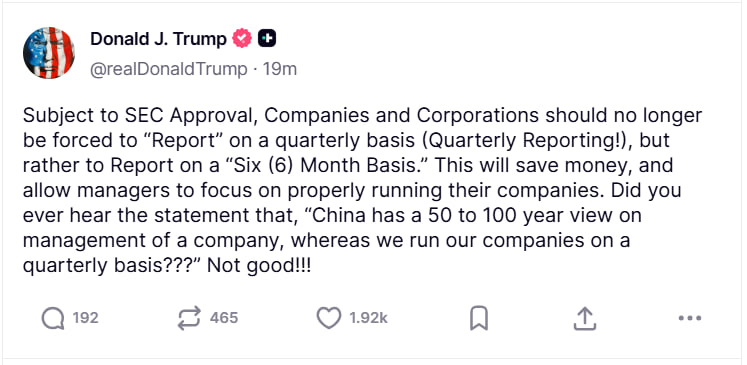
The U.S. SEC is considering a rule change that would allow companies to choose between quarterly and semiannual earnings reports.

This follows renewed calls from President Donald Trump. In a post earlier this week, President Trump revived his 2018 suggestion that companies move away from quarterly earnings disclosures in favor of a semiannual schedule.

He argued that reporting every six months would reduce costs and allow executives to focus more on running their businesses rather than meeting short-term targets.

Image

SEC Chairman Supports Proposal for Rule Change

SEC Chairman Paul Atkins welcomed the idea, saying his agency will propose a rule change to accommodate it.

Speaking on CNBC’s Squawk Box on Friday, Atkins noted that he has already discussed the plan with Trump and sees it as a “good way forward.”

Once approved, the rule would not mandate semiannual reporting. Instead, companies would be able to choose whether to continue with quarterly updates or switch to twice-yearly disclosures.

Market and Investor Reactions Will Shape the Outcome

Furthermore, Atkins said the frequency of corporate reporting should ultimately be determined by the market, in a way that benefits both shareholders and companies.

Specifically, he stated that investors and banks will largely influence how often companies report, based on each company’s needs and obligations.

While no timeline for implementation has been set, the SEC currently has a 3–1 Republican majority. This makes a simple vote sufficient to advance the proposal.

Notably, a shift to less frequent reporting could benefit public crypto companies with large holdings, including crypto-focused ones like Coinbase, MicroStrategy, and Marathon Digital. It would lower compliance costs and reduce pressure from short-term market expectations.

Controversy Over Impending Rule Change

However, the proposal is not without controversy. Supporters argue that easing reporting requirements would free management to focus on long-term strategy, citing similar practices abroad.

Foreign private issuers in U.S. markets already report on a semiannual basis, and Norway’s sovereign wealth fund has advocated for the same.

However, critics argue that less frequent reporting could hurt transparency and disadvantage small investors, who rely more on regular updates than large institutions with access to advanced research tools.

Atkins acknowledged this concern but argued that quarterly reporting has often been blamed for encouraging short-term thinking.

MetaMask Looking to Roll Out In-Wallet Perpetuals Trading via Hyperliquid

0

MetaMask appears to be preparing a major update to its mobile wallet that could allow users to trade perpetual futures directly inside the app. 

Evidence from the project’s public GitHub repositories shows that developers have been building and testing an integration with Hyperliquid, a decentralized exchange famous for its derivatives products. 

MetaMask Repo Shows Updates to Perpetual Trading Feature

Notably, the activity dates back to July 2025 and has intensified in recent weeks. This indicates that the feature is heading toward release. Nonetheless, as of this press, there has been no official confirmation.

The first indication emerged in July when MetaMask merged code that introduced perpetual trading functions into the mobile application. Developers created a dedicated section for perpetual contracts and tied it to Hyperliquid’s trading infrastructure. 

MetaMask GitHub Repo

Interestingly, one of the updates added a deposit system that let users fund a trading account with USDC. This had features such as minimum thresholds, a token selector, and real-time gas fee estimates. 

Meanwhile, another update enabled order creation, allowing traders to set up market and limit positions. By the end of that month, the team had merged a new navigation tab specifically for perpetuals, which organized positions, balances, and market lists into a single interface.

Testing Began in August

After those features appeared in the codebase, the first round of practical testing began in August. Specifically, testers flagged problems with the deposit function, noting that transactions failed regardless of which token they used. This was the beginning of a wave of bug reports, the natural phase that follows major feature development.

By early September, testers were stress-testing the new trading experience in greater detail. Reports highlighted delays in loading token lists, miscalculated profit-and-loss displays, inaccurate transaction time displays, and occasional glitches when opening and closing positions. 

Importantly, these issues revealed that MetaMask had already moved the integration into a stage where real trading flows were being tested within the mobile app environment.

The most intense activity came recently, in mid-September, as the development team labeled several of the builds as release candidates. A flood of bug reports came up, covering problems such as duplicate entries for trades.

An Imminent Launch?

For the average MetaMask user, this development indicates a potential expansion of what the wallet can do. Today, trading perpetual futures typically requires visiting an exchange platform, connecting a wallet, and moving through separate interfaces. 

If MetaMask finalizes this update, users could deposit stablecoins and open leveraged positions without leaving the app. While this convenience may attract advanced traders, some market participants have called attention to potential risks from slow loading times. The integration is not yet live for all users, but the pace of testing suggests a broader rollout could arrive soon. 

Notably, the updates come amid the recent confirmation from Consensys CEO Joseph Lubin that MetaMask could be looking to launch its token MASK. Recall that the wallet announced its proprietary stablecoin MetaMask USD (mUSD) just last month. 

Snoop Dogg Joins Cardano Founder and Mark Cuban as Advisor and Investor in Stuff.io

0

Decentralized media platform Stuff.io has welcomed legendary rapper and entrepreneur Snoop Dogg to its cap table and advisory board. 

Joshua Stone, the CEO and co-founder of Stuff.io, announced the addition in a tweet on Thursday, noting that Snoop Dogg is now part of the project. He added that the team will soon release an official press release confirming Snoop’s addition, as well as details of its first asset sale. 

Hoskinson and Cuban Among Stuff.io Board Members 

With his addition, the rapper will join an impressive roster of investors and advisors, including Cardano founder Charles Hoskinson and billionaire investor Mark Cuban. 

Other entities lined up among Stuff’s advisors and investors include publishing giant Ingram Content Group and VC firm Bertelsmann Digital Media Investments (BDMI). 

Notably, Stuff.io is a Web3 project focusing on giving people actual ownership of digital media through its Cardano-based token, STUFF. The project has been assembling its group of investors and advisors from the entertainment and crypto sectors. Its native token was initially named BOOK but was later rebranded to STUFF last year. 

The rebranding is part of efforts to give users actual ownership over their digital media. In the meantime, Stone expressed gratitude to Snoop’s record label, Death Row Records’ crew, its team members, and the community. 

Snoop Dogg’s Crypto Engagement 

Meanwhile, Snoop Dogg is no stranger to the world of Web3 and crypto. The rapper has been leveraging his influence to bring mainstream attention to blockchain projects. 

In 2022, Snoop Dogg and his son, Champ Medici, collaborated with the Cardano-based NFT project Clay Nation to release an NFT collection called Baked Nation on the blockchain. 

Part of the partnership also saw Cardano’s founder, Hoskinson, feature in Snoop Dogg and Champ Medici’s “Bron and Bronny” music video, which was released in November 2022. 

Before his foray into the Cardano ecosystem, Snoop Dogg had already been active in crypto. In 2013, he tweeted that he was open to accepting Bitcoin for his album sales. 

While many described the tweet as a promotional stunt at the time, his continued involvement, including his addition as one of Stuff.io’s advisors, shows his genuine engagement with the crypto world.