Home Blog Page 525

ConsenSys CEO Joseph Lubin Teases Imminent MetaMask Token Launch

0

Ethereum co-founder and ConsenSys CEO Joseph Lubin has hinted that the long-awaited MetaMask token, MASK, might launch sooner than expected.

The announcement comes as MetaMask, one of the world’s most widely used crypto wallets, also introduces its own stablecoin, MetaMask USD (mUSD).

MASK Token May Arrive Sooner Than Expected

Rumors about a MetaMask token have circulated since 2021, but Lubin’s latest comments have revived excitement. In a recent interview, he said a MASK token is on the way, suggesting that its launch could be imminent. 

Lubin said the MASK token will support decentralizing key MetaMask features, potentially giving users more say in governance and platform decisions.

If launched, MASK could offer rewards, voting power, and new use cases, giving the community more reasons to actively engage with MetaMask.

User Growth Strengthens the Case

MetaMask already has the scale to support a token launch. The wallet currently serves over 30 million monthly active users worldwide, making it the largest gateway to Ethereum-based applications.

Available as both a browser extension and mobile app, MetaMask allows users to connect to Ethereum and multiple compatible blockchains. Its massive user base makes the potential MASK token a candidate for rapid global adoption.

Earlier this year, Co-founder Dan Finlay confirmed that the MASK token would be promoted directly inside the wallet. This move ensures it gains visibility from day one. He also noted that the regulatory environment is more relaxed today, creating a safer space for token issuance.

ConsenSys Expands Its Ecosystem

MetaMask is a flagship product of ConsenSys, an Ethereum-focused software company also responsible for Infura, a core infrastructure provider for blockchain developers.

The firm powers activity across layer 2 solutions such as Linea. It also collaborates with networks like Base, collectively processing billions in transaction volume. 

The MASK token could strengthen this ecosystem by linking users more tightly to ConsenSys services, while also distributing governance rights across the community.

MetaMask USD (mUSD) Joins the Stablecoin Race

Alongside token developments, MetaMask has released its own stablecoin, MetaMask USD (mUSD). Each mUSD is backed 1:1 by U.S. dollars or short-term Treasury assets. It is created through Bridge, a platform built in collaboration with Stripe, and relies on the M0 protocol to handle minting.

The new stablecoin is now live on the Ethereum mainnet and layer 2 network, Linea. Wallet users can immediately swap, send, store, or transfer mUSD across supported chains.

Additionally, MetaMask plans to integrate mUSD with its MetaMask Card, which integrates with Mastercard’s global network. This would enable users to spend mUSD at millions of merchants worldwide, turning the wallet into a tool for DeFi and real-world payments. The card integration is expected sometime this year.
Here’s Why This Analyst Predicts Shiba Inu 568% Surge

0

Popular community member Heber Mayen suggests that Shiba Inu is poised for an explosive breakout.

In a tweet yesterday, Mayen shared Shiba Inu’s one-month price chart, showing the asset up 3.65% over the past 30 days to $0.00001345. 

The chart shows Shiba Inu consolidating within a long-term descending triangle pattern, with successive lower highs forming since its peak at $0.00008845. Per the chart, Shiba Inu has reached the extreme low point of the triangle, signaling that a decisive breakout is imminent. 

Shiba Inu one month chart by Heber Mayen
Shiba Inu one-month chart by Heber Mayen

Indicators Signal Strong Momentum for Potential Rally 

Mayen predicted the imminent breakout would be massive, hinting at a strong bullish move with a rocket emoji. His confidence stems from the strong momentum the Shiba Inu’s indicator showed at the time of the analysis. 

Shiba Inu’s moving averages indicate that the token has stabilized after a prolonged downtrend, during which its price crashed from a high of $0.000088 to around $0.00001. Additionally, with an RSI of 49.15, SHIB remains in neutral territory, poised for a potential explosive move. 

Although optimistic about an upward breakout, Mayen did not specify a target price for the token. Moreover, he provided no timeline for when Shiba Inu could make the bullish breakout. 

In the meantime, Shiba Inu is currently changing hands at $0.00001323 per token, down 1.33% over the past 24 hours. Over the past week, Shiba Inu has plunged by 1.03%. Meanwhile, it maintains a positive monthly performance with an 8% gain.

Is Shiba Inu ATH Incoming? 

Heber is not alone in predicting a major rally for Shiba Inu; other analysts share a similar bullish outlook. Popular community analyst Shib Spain speculated that SHIB is preparing to bounce off its critical support zone, potentially setting the stage for a major rally toward a new all-time high. 

The accompanying chart shows that Shiba Inu has been consolidating within the $0.00001270 – $0.00001347 support zone in recent weeks. Notably, he anticipates a rebound from this support zone that could ignite a sustained uptrend. 

With sustained momentum, he projects SHIB could set a new all-time high, potentially surpassing the October 2021 peak of $0.00008845. Surpassing the previous ATH demands a 568% surge from the current level of $0.00001323. This move will ultimately push the token’s price to $0.0000885. 

Binance Founder CZ Explains Why BNB Hits $1,000

0

Binance founder and former CEO Changpeng “CZ” Zhao has shared the possible factors that triggered the BNB run to a four-digit ATH price.

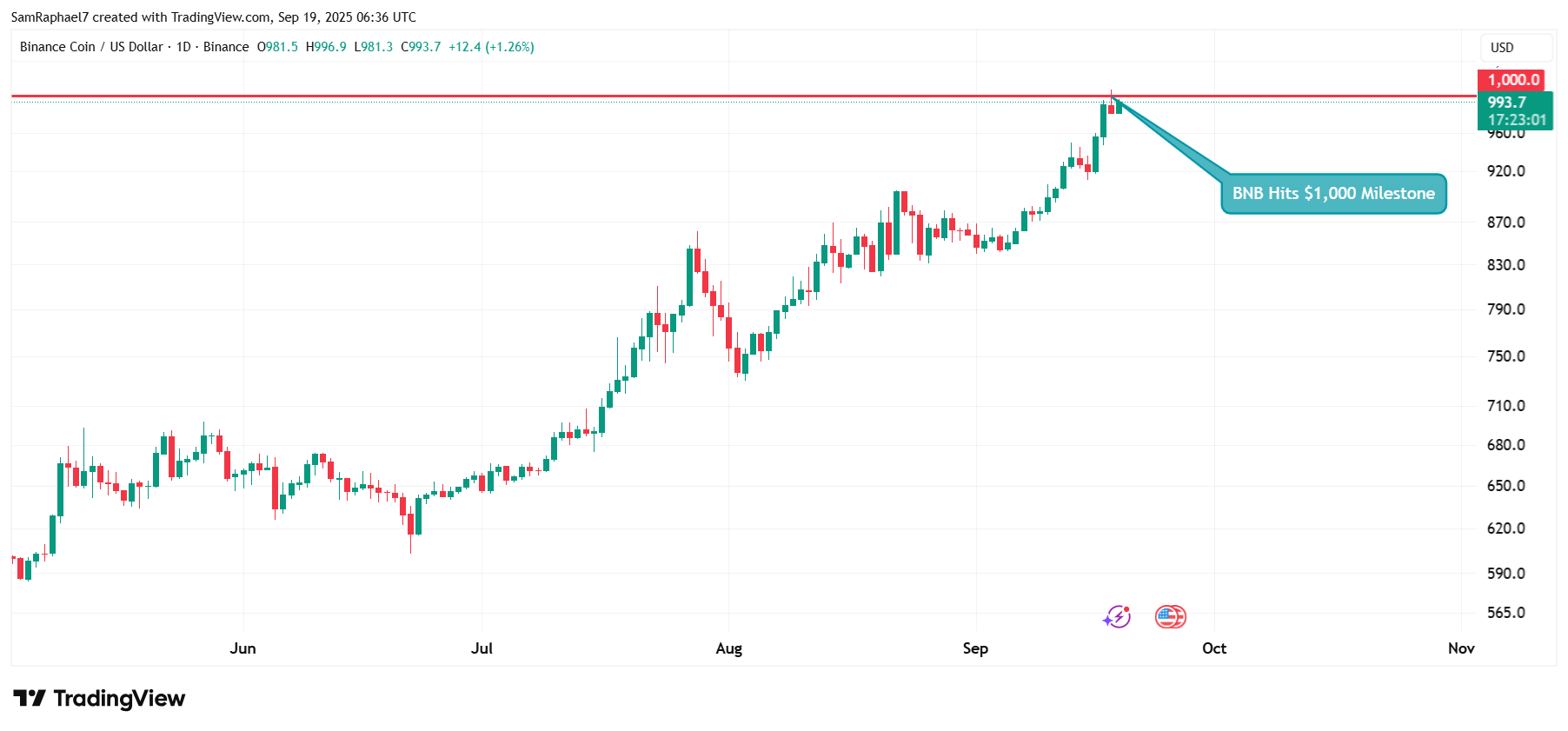
For context, BNB recently reached a historic milestone, surpassing $1,000 for the first time since its launch. Notably, this achievement marked a massive 999,900% jump from its initial coin offering price of $0.10 eight years ago. 

BNB Hits $1000 Milestone

After the rally, several market commentators discussed the possible triggers behind the run, especially as the broader crypto market still struggles with volatility. Amid these discussions, Binance founder and former CEO Changpeng Zhao shared his thoughts.

In his commentary, Zhao first noted that no one can point to a single explanation. He stressed that people often give him more credit than he deserves, as he plays more of a symbolic role in the Binance community rather than a technical one. Still, he presented the major factors that likely fueled the rise.

Pro-Crypto US Government and Meme Coins

To him, the first came from the pro-crypto stance of the current U.S. administration. This policy change changed the tone in the United States and also encouraged other countries to adopt more supportive approaches. Zhao described it as a rising tide that lifted the entire industry, including BNB.

Meanwhile, he also pointed to the comeback of meme coins on BNB Chain earlier this year. At first, he admitted his inexperience slowed their progress and even caused rifts within the community. This was a possible reference to the controversies surrounding the Broccoli meme coin.

However, despite the backlash, CZ confirmed that he became more aware of problems like MEV attacks through the meme coin discussions. Developers, validators, wallets, decentralized exchanges, and other players on the chain then worked hard to reduce these issues.

BNB Chain Upgrades and Binance Alpha

Also, Zhao credited upgrades on BNB Chain as another reason for the surge. For instance, block times dropped from three seconds to 1.5 seconds and later to just 0.75 seconds. 

In addition, capacity grew, and fees fell tenfold overnight. Notably, these changes made BNB Chain one of the cheapest blockchains to use, which helped transaction volumes skyrocket, supporting BNB’s price action.

He also highlighted the impact of Binance Alpha, which gave projects a smoother way to move from DeFi to centralized platforms without first listing on smaller exchanges. Zhao stressed that he had no part in designing the feature, but acknowledged its positive effect.

Growth in BNB Chain Ecosystem 

Notably, BNB Chain’s growth extended beyond meme coins. Stablecoins, decentralized exchanges, artificial intelligence projects, and real-world assets all gained traction as well.

Zhao spotlighted the launch of WLFI’s USD1. It filled the gap left when regulators shut down BUSD in 2023, and its fast adoption boosted liquidity. Alongside USD1, more RWA issuers and hundreds of AI-based projects joined the chain.

Further, CZ also mentioned the BNB token burn program. According to him, in the last quarter alone, BNB Chain removed $1.6 billion worth of tokens from circulation, following several billion in earlier quarters. 

He acknowledged that some people questioned why this money was not spent on marketing, but he maintained that burning directly reduced supply and supported value growth.

Clearer Regulations and Venture Capital Interest

In addition, regulation also played an important role. Zhao described the U.S. SEC’s decision in May to drop its lawsuit against Binance, Binance US, and himself as a huge relief. This move removed the lingering concern that BNB could be labeled a security.

Meanwhile, venture funding bolstered the bullish outlook. Specifically, firms like YZiLabs backed dozens of projects, while established platforms within the ecosystem kept expanding. PancakeSwap continued handling massive volumes, with Lista and Venus also driving competition in decentralized lending. 

Other entities entered the scene with new meme coins, RWAs, and DeFi offerings. Zhao added that several firms had bought hundreds of millions of dollars’ worth of BNB, showing strong institutional interest.

He then added that none of this would have been possible without the builders and community members who continue to drive the ecosystem forward. CZ mentioned that the recent quarter-point interest rate cut probably gave markets an extra push, even if he could not fully explain its impact.

Notably, BNB’s price has stayed volatile despite its breakthrough. After peaking at $1,006 on Sept. 18, it fell to $981 before recovering to around $994. Even though BNB dropped slightly below four figures, it still stands out as one of the best-performing assets this year, up 41.71% since January.

The XRP Math: How High Could XRP Rise if Crypto Market Cap Grows by $10T

0

Digital Asset Investor (DAI), a familiar voice in the XRP community, recently discussed XRP’s current market position and multiple bullish developments. 

He highlighted all this in a recent video commentary, calling attention to what he called the “XRP Math.” In a section of his presentation, the market commentator mentioned the launch of the Rex Osprey XRP ETF. Specifically, the fund opened at $25.82 and marked a milestone in institutional recognition of XRP. 

XRP ETF Delivers on First Day

The Rex Osprey product saw a volume of $37.7 million, the largest natural volume for any ETF launch in 2025. Notably, this is according to Bloomberg’s James Seyffart. This institutional recognition could have a massive impact on the XRP price. Interestingly, the U.S. SEC will also rule on multiple products next month.

Amid the anticipation, DAI highlighted figures from Julio Moreno, head of research at CryptoQuant. Moreno estimated that in the first year, ETFs might absorb between 1% and 4% of XRP’s circulating supply. This works out to between 600 million and 2.4 billion tokens.

The XRP Math

Following this, DAI then called attention to XRP’s recent price action during a broader market move. Specifically, when the crypto market cap rose by $0.08 trillion, XRP climbed by $0.24, moving from $2.75 to $2.99. He used this example to show how XRP reacts to overall market liquidity, calling it the “XRP Math.”

Building on this, we assessed what might happen if $10 trillion poured into the crypto market. Since $10 trillion equals about 125 times the earlier $0.08 trillion increase, the same ratio suggests XRP could add another $30 on top of its current price. This would push XRP to around $33, giving it a market cap near $1.98 trillion. 

At such a level, XRP would hold about 14% of the total market, a sharp jump from its current 4.52% dominance but still below its past highs of 18% in January 2018 and 31% in May 2017.

Meanwhile, if the crypto market reached $14 trillion and XRP simply kept its present 4.52% market share, its value would land at about $10.54 amid a $632 billion market cap. Even under this scenario, XRP would see notable growth without needing to gain dominance.

DAI Discusses XRP Market Position

Notably, in the earlier part of his commentary, DAI warned that the urge to lend or borrow against XRP could backfire in today’s still-developing market. To him, institutions are just beginning to arrive, and the market needs more time to mature. For now, he said the smartest move is to hold XRP securely and stick to a clear exit strategy.

He also noted that XRP was already trending across the crypto scene due to major developments, including the SEC approval of Grayscale’s multi-asset fund featuring XRP, the launch of the Rex Osprey XRP ETF, and CME Group‘s announcement to introduce XRP futures options.

Here’s Volume Needed for XRP to Hit $100 as Expert Links XRP Value to XRPL Activity

0

A re-evaluation of Quincy Jones’ famous XRP commentary shows how much volume the XRPL needs to push XRP price to three digits.

Jones Suggests XRP Value Tied to XRPL Activity

For context, back in 2021, Quincy Jones, a former Corda developer, shared an interesting take on XRP’s potential value. Specifically, he argued that XRP’s price doesn’t stand on its own. Instead, it connects directly to the value of financial instruments issued on the XRP Ledger (XRPL). 

Jones called XRP the liquidity that bridges assets like bonds, currencies, and equities. He suggested that XRP could climb to ambitious levels, whether $100, $100,000, or even $1 million, depending on how much value issuers decide to put on the network. The more equity and debt issued on XRPL, the higher XRP’s potential worth.

XRPL Eyeing the Growing Tokenization Market

Four years later, the XRP community has revisited Jones’ ideas as tokenization of real-world assets (RWA) gains ground. Ripple executives, including CTO David Schwartz, have touted the XRPL’s potential to dominate the sector. Interestingly, even Bitwise believes buying XRP is a clean way to invest in the future of tokenization.

Notably, the XRPL still plays a small part in the growing tokenization trend. Of the $30.14 billion in tokenized value across blockchains, it holds about $294 million, giving it a 1.75% share, according to data from RWA.xyz. This ranks XRPL as the tenth largest chain for RWAs. 

Still, the link between how much value sits on the XRPL and XRP’s market price remains unclear. Essentially, no one has pinned down a formula that connects tokenized assets, liquidity flows, and the token’s valuation.

Google Gemini Assesses XRPL Volume for a $100 XRP Price

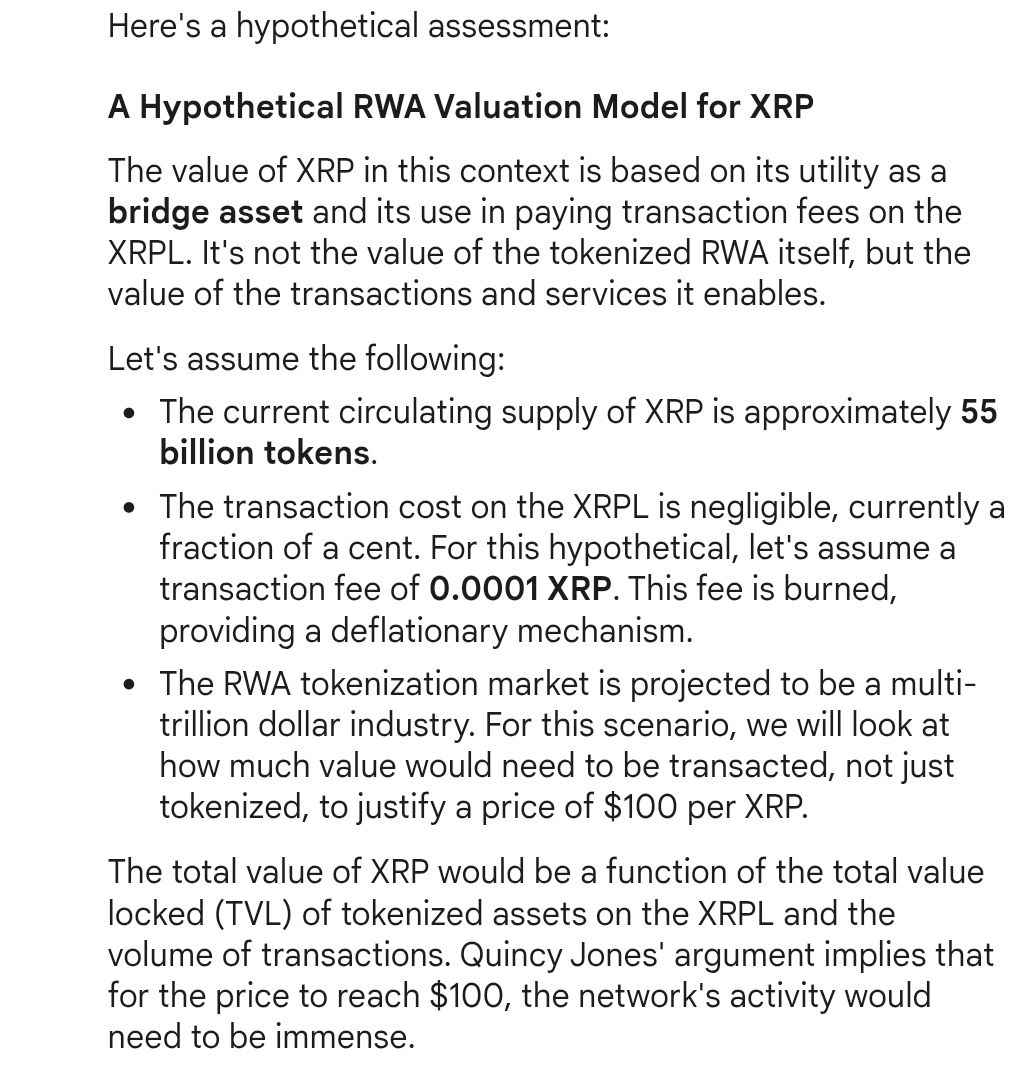
However, to assess this, we asked Google’s AI chatbot, Gemini, to present a model. Responding, Gemini noted that Jones never offered a precise equation, but it built a hypothetical one around his argument. According to Gemini, XRP’s worth should come from how much value it helps move rather than speculation alone.

Gemini used an XRP circulating supply of about 55 billion tokens. At the $100 price prediction, XRP’s market cap would reach roughly $5.5 trillion. To support this number through utility, XRPL would need to handle an enormous amount of transactions. 

XRP Hypothetical Price Valuation Model Google Gemini
XRP Hypothetical Price Valuation Model | Google Gemini

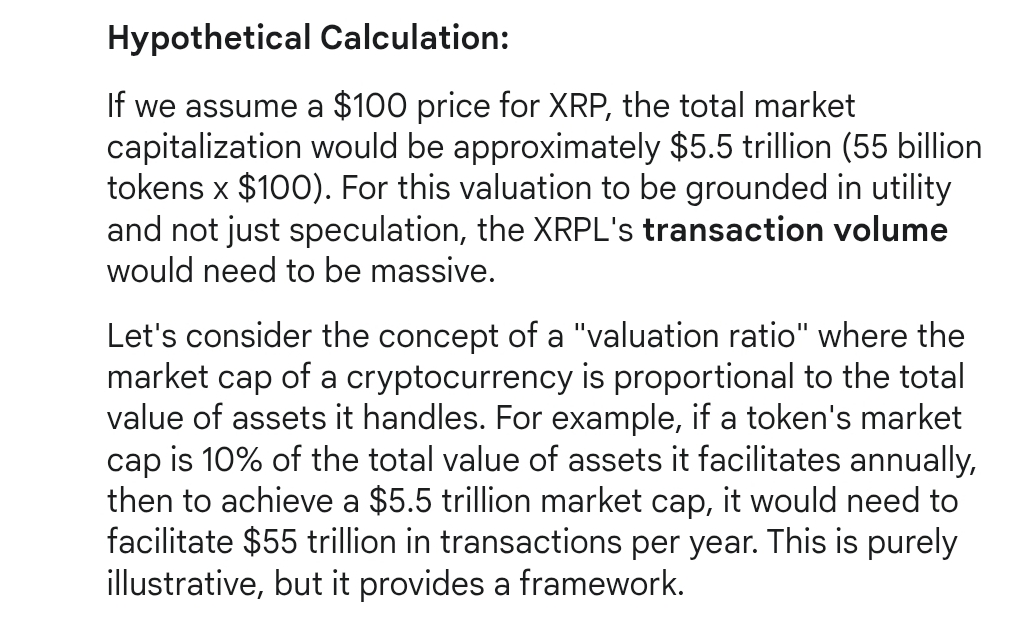
To explain further, Gemini introduced the idea of a “valuation ratio.” In simple terms, if a token’s market cap equals 10% of the value it processes in a year, then XRPL would need to move around $55 trillion annually to justify a $5.5 trillion XRP market cap. Notably, this translates to around $150.7 billion a day.

XRPL Volume Required Google Gemini
XRPL Volume Required | Google Gemini

According to Gemini, reaching this milestone would mean that XRPL must become a major part of the global financial system. It would need to process tokenized real estate, commodities, corporate debt, equities, and institutional funds at a level that matches or surpasses existing financial infrastructure.

Analyst Predicts Crypto Market to Hit $23T, Here’s XRP Price if This Plays Out

0

XRP price could benefit tremendously as a well-known analyst predicts the total crypto market cap to hit tens of trillions.

Notably, crypto analysts have consistently presented bold forecasts for the market, and one of the biggest comes from Dark Defender, who believes the total crypto market cap could climb to an astonishing $23.26 trillion. 

Data from his chart confirms why he believes this, with historical context bolstering the optimism. The chart first highlights the downturn in 2018, when crypto endured a painful bear cycle. Notably, the total crypto market cap dropped to a bottom of $91 billion by December 2018.

Total Crypto Market on a 5-Wave Structure

Interestingly, from January 2019, the market started to recover, kicking off a powerful rally that peaked in 2021 amid the bull run. Specifically, this run pushed the total crypto market cap to $3.01 trillion by November 2021, coinciding with Bitcoin’s all-time high at the time. Dark Defender marked this rally as the first wave in a five-wave Elliott structure.

However, after the $3 trillion peak in November 2021, the market slipped into a correction from 2022, representing Wave 2. This second wave bottomed in January 2023, when the total market cap fell to about $752 billion. 

Interestingly, the market recovered to about $810 billion on Jan. 10, 2023. It was on this day that Dark Defender first presented his ambitious forecast for the crypto market. He noted that the market was on a five-wave structure that could eventually lead to $23.26 trillion, which aligns with the 161.8% Fibonacci extension.

Total Crypto Market Cap Dark Defender
Total Crypto Market Cap | Dark Defender

Notably, following his prediction, the third wave began to take shape from the $810 billion low, pushing the crypto market above $3 trillion by May 2025. This month, the market cap initially climbed to $4.17 trillion, representing a 414% increase. However, it has corrected slightly since then, with a reading of $3.99 trillion at press time. 

The candles now sit above the Ichimoku cloud, which signals long-term strength, and the Relative Strength Index has pushed above its moving average, pointing to renewed momentum. To reach $23.26 trillion from here, the market would need to climb another 482%. That would mark a 29-fold increase compared to the 2023 low.

XRP Price if Total Market Hits $23.26T

The chart also highlights major Fibonacci levels at $236 billion, $569 billion, $1.11 trillion, and $1.84 trillion. These levels could act as strong support zones if the market pulls back along the way. Notably, the rally to $23.26 trillion could have a positive impact on altcoins like XRP.

Particularly, at the current $3.99 trillion market cap, XRP holds a 4.52% dominance, which equals a $180 billion valuation while trading at $3.02. 

If the total market cap jumped to $23 trillion and XRP held on to that same 4.52% share, its market cap would balloon to about $1.0396 trillion. Now, with around 60 billion tokens in circulation, that would give XRP a price close to $17.

Interestingly, Dark Defender has also specifically discussed XRP’s short-term prospects. With XRP now trading at $3.02, he noted that weekly resistance is breaking. 

XRP 1W Chart Dark Defender
XRP 1W Chart | Dark Defender

He has set price targets at $4.39 and $5.85 based on Fibonacci levels, while pointing to supports at $3.01 and $2.85. He describes the setup as one of the clearest signals yet for XRP.

Coinbase ‘1k Shib Index’ Spurs Talk of Shiba Inu ETF Arrival

0

Shiba Inu (SHIB) has taken a step closer to mainstream finance after Coinbase introduced regulated futures for the token under the “1k Shib Index.” 

Lucie, the Shiba Inu market lead, argues that this development places SHIB on the same regulatory path that Bitcoin and Ethereum followed before winning approval for their spot ETFs.

Her remarks have triggered speculation about whether SHIB could eventually see a U.S. spot ETF, a move that would mark a huge milestone for the token and its community.

Why Shiba Inu Market Lead Comment Matters

In a post on X, Lucie highlighted a key regulatory link: Bitcoin and Ethereum’s spot ETFs gained approval after both assets established active and regulated futures markets. 

“Because SHIB has regulated futures on Coinbase, it fits the framework the SEC applied to Bitcoin and Ethereum,” she wrote. 

This reasoning suggests SHIB now meets one of the essential conditions regulators look for when considering ETF applications.

ETF Possibilities for SHIB

Even if the SEC hesitates on a standalone SHIB ETF, Lucie noted that the token could find its way into a basket ETF.

Such funds combine multiple assets, for example, a “Top 10 crypto ETF” that tracks leading tokens by market capitalization. In this structure, SHIB would gain indirect exposure to mainstream investors without requiring its own dedicated ETF.

The Regulatory Landscape

The timing of Lucie’s remarks is significant. The U.S. Securities and Exchange Commission (SEC) recently approved generic listing standards for crypto ETFs, streamlining the process for issuers by eliminating time-consuming case-by-case reviews.

For SHIB, the existence of a regulated futures market is an advantage. Coinbase Derivatives already lists SHIB contracts, giving regulators a reference point for pricing and oversight. This mirrors the structure that paved the way for Bitcoin and Ethereum spot ETFs.

Hurdles Still Remain

Despite the optimism, SHIB faces challenges that Bitcoin and Ethereum did not. The SEC also evaluates factors such as market liquidity, custody solutions, and resistance to manipulation.

SHIB’s reputation as a meme coin could pose a major obstacle. Its trading volume is significant, but regulators may question its long-term stability and whether it meets the same market depth standards as BTC or ETH.

Additionally, institutional demand for a SHIB-specific product remains unclear. Without strong backing from major ETF issuers, authorization may take longer.

What This Means for Investors

For SHIB holders, even being part of the ETF discussion is a breakthrough. It shows how far the token has come since its meme-driven launch. Institutional acknowledgment, even in a futures form, represents progress toward mainstream recognition.

If SHIB eventually enters a multi-asset ETF, it could grant the token new visibility among both retail and institutional investors. That exposure may help stabilize its reputation and drive further adoption.

Nonetheless, Lucie’s claim does not guarantee an imminent SHIB ETF, but it points to progress. Regulated futures on Coinbase strengthen its case, and new SEC rules open doors for broader spot ETF approvals. 

For now, SHIB joins what many are calling the “ETF watchlist club,” a growing list of cryptocurrencies in Wall Street’s expanding crypto product lineup.

Cardano Founder Applauds SEC Approval of Grayscale’s ETF Conversion of GDLC Which Includes ADA

0

Cardano founder Charles Hoskinson has applauded the SEC’s approval of Grayscale’s Digital Large Cap Fund (GDLC) conversion into an ETF.

For context, this Grayscale fund holds ADA, along with other high-caliber crypto assets such as XRP, Ethereum, Solana, and Bitcoin.

The SEC clearance marks the United States’ first multi-asset crypto ETP. Notably, the approval gives traditional investors a regulated way to gain exposure to five major cryptocurrencies without directly buying or storing the tokens.

According to Grayscale’s website, GDLC carries a net asset value of $57.70 per share and currently manages over $915 million in assets.

How the Approval Came

Notably, before this approval, the SEC initially granted Grayscale the green light to convert GDLC into an ETF on July 1. This coincided with the expiration of the 240-day deadline from the October 2024 filing.

However, the very next day, the SEC unexpectedly issued a stay, asking Grayscale to delay the launch for further review.

In response, Grayscale submitted a formal letter challenging the SEC’s authority to halt the product, arguing that the agency had run out of time to act. 

Under U.S. securities law, they claimed the ETF was automatically approved, and that internal rules like Rule 431 couldn’t override that statutory deadline.

Grayscale even threatened legal action, but two months later, the SEC ultimately allowed the ETF to launch.

The clearance has since attracted industry-wide commendation from leaders, including Cardano’s founder.

In a tweet, Grayscale CEO Peter Mintzberg thanked the task force for its “unmatched efforts in bringing the regulatory clarity our industry deserves”. He called the GDLC approval a milestone for U.S. crypto finance.

Generic Listing Standards Fast-Track ETF Launches

Notably, the SEC’s approval came alongside the adoption of new standards of listing for crypto ETFs on traditional exchanges such as NYSE Arca, Nasdaq, and Cboe BZX. 

These standards streamline the process, allowing eligible digital asset products to secure listing without lengthy, case-by-case reviews. SEC Chair Paul Atkins said the move will “maximize investor choice and foster innovation.” 

At the same time, Bloomberg ETF analyst Eric Balchunas noted that when similar standards emerged for other ETFs, launches tripled. This has raised the possibility of over 100 crypto ETFs hitting the market in the next year.

With GDLC providing a single vehicle to gain exposure to altcoins alongside Bitcoin, analysts believe the timing could attract retail and institutional investors seeking diversified bets during the next market upswing.

Expert Says XRP Supply Shock Is Inevitable, Never Sell Your XRP

0

Versan Aljarrah, co-founder of Black Swan Capitalist, believes an XRP supply shock is only a matter of time.

In a recent podcast, he warned retail investors not to sell their holdings. He argued that major financial institutions like JPMorgan and BlackRock have been quietly accumulating XRP for years while retail traders are shaken out of the market.

However, there is no concrete evidence of this, with Aljarrah admitting he is merely speculating. Nonetheless, he insists that speculation is not only natural but necessary to stay ahead of the curve. He stresses that the big players will not sit idle and watch the next phase of financial innovation pass them by.

David, a co-host on the show, highlighted that Robert Mitchnick—now leading BlackRock’s blockchain department—previously worked at Ripple. To him, this is an indication of something deeper.

Building on this speculation, Aljarrah argues that BlackRock and JPMorgan are likely suppressing XRP prices to accumulate more tokens at lower levels. According to him, these firms are using Bitcoin and Ethereum as an “ulterior motive” to attract regulated capital into crypto markets, which could later be redirected into XRP. However, these remain unconfirmed.

“Evidence of Market Manipulation”

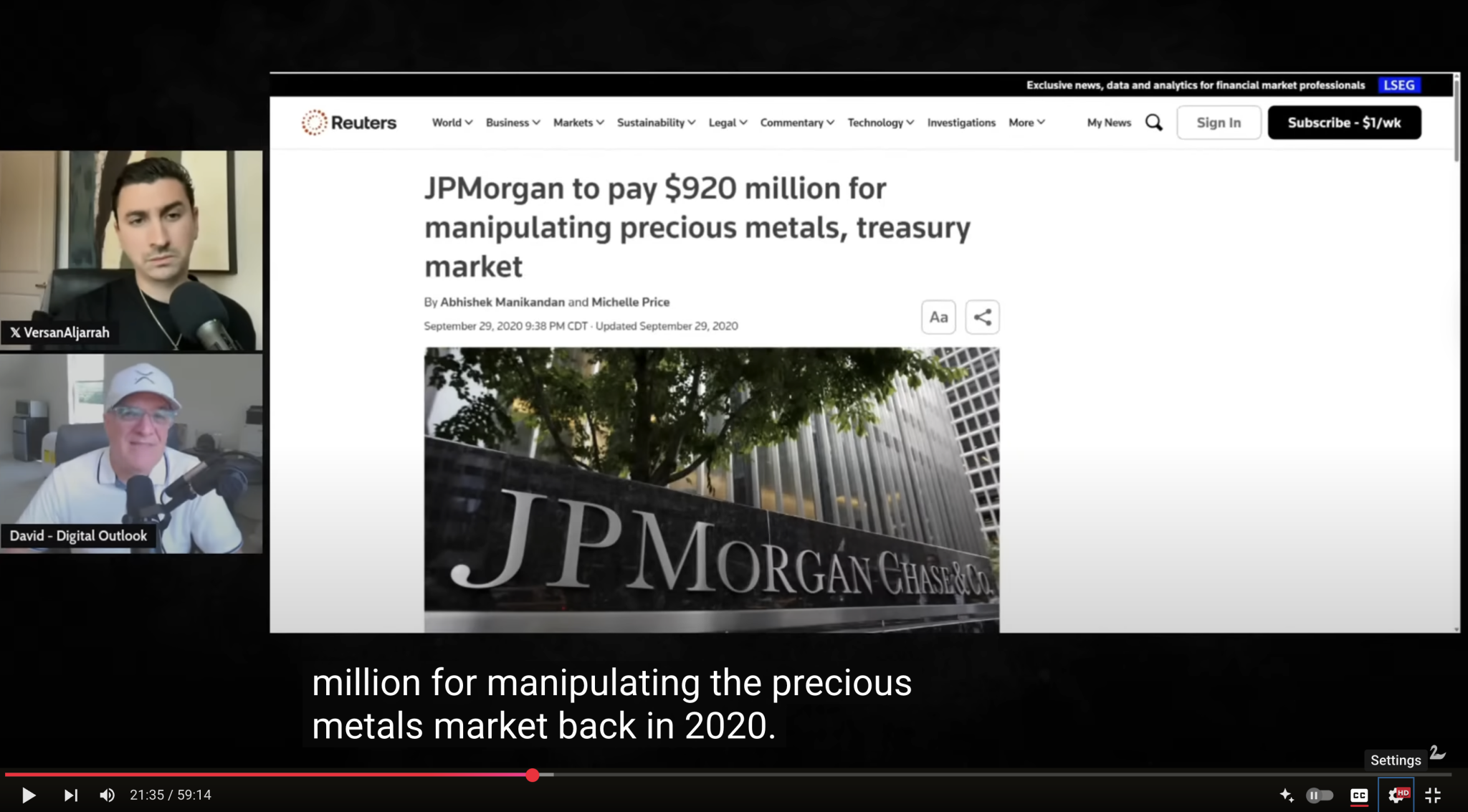
Supporting Aljarrah’s claims, David called attention to JPMorgan’s history of market manipulation. He noted that in 2020, the bank paid a $920 million fine for manipulating the precious metals market.

“Do you know how many billions upon billions they made doing that? That $920 million is just a cost of doing business,” David speculated. “Do you think they’re not involved in this space and part of the manipulation?”

To him, it would be no surprise if they were deploying similar tactics in the crypto space to influence XRP’s valuation.

Screenshot from Versan Aljarrah podcast

David also highlighted that market sentiment is one of the biggest tools for manipulation, noting it can easily distort perceptions. For him, the key is to focus on fundamentals, and one of the biggest fundamentals is understanding what XRP truly represents. “Know what you hold,” he said.

Silence Around XRP Speaks Volumes

Aljarrah further shared a conversation with a JPMorgan branch manager, who confirmed that the bank plans to allow borrowing and lending using digital assets as collateral. Interestingly, the bank’s report mentioned Bitcoin and Ethereum but was silent on XRP. Aljarrah views it as a strategic omission.

“When they made that report, they said Bitcoin, Ethereum, and other digital assets. The thing is—the silence around XRP speaks volumes,” he said.

He believes that by the time mainstream headlines finally confirm institutional involvement with XRP, it will be too late for retail investors to capitalize.

According to Aljarrah, the biggest institutions are “years ahead of retail speculators”. Based on this, he urged early accumulation before the coming supply shock takes effect.

Stablecoins, SBI, and Ripple

Furthermore, Aljarrah highlighted that Ripple’s 2022 partnership with Japan’s financial giant SBI is resurfacing with fresh significance. Reports indicate that SBI plans to use Ripple’s RLUSD stablecoin in early 2026.

In parallel, David noted that SBI has been an early Ripple investor and could hold some of the tokens in escrow, reinforcing its deep ties to Ripple’s long-term plans.

He stressed that many investors underestimate XRP’s role, calling it the “literal backbone of the new digital economy”. To him, XRP is beyond a speculative asset.

SBI Group Pushes XRP Adoption in Japan with New Banking Service

0

SBI Group is strengthening its push for XRP adoption in Japan with the launch of a new banking product called SBI Hyper Deposit. 

The service, which starts accepting applications on Sept. 23, 2025, and officially goes live the next day, combines everyday banking with crypto rewards by giving customers XRP when they open an account.

Details of the Hyper Deposit Service

According to a press release today, Hyper Deposit works as a yen deposit account that links directly with SBI Shinsei Bank and SBI Securities. Specifically, customers who hold accounts with both can use their deposit balance instantly as purchasing power within their securities account, without needing to transfer money manually. 

Notably, when they sell securities, the proceeds flow back into the deposit balance automatically, making transactions more convenient and efficient.

In addition, the service also offers an option to set up automatic transfers. Customers can schedule a fixed amount from their regular deposit account to move into Hyper Deposit on a recurring basis. 

On top of these features, the product pays an annual interest rate of 0.42% before tax, slightly above SBI Shinsei Bank’s current maximum of 0.40% for yen deposits.

To celebrate the launch, SBI confirmed that it will reward customers who open Hyper Deposit accounts with XRP credited to their exchange wallets. Crypto YouTuber and XRP community figure Eri called attention to this move in a recent post on X.

Moreover, the bank also plans to offer lower mortgage interest rates as part of its promotional campaign. Its decision to tie these incentives to XRP confirms SBI’s persistent effort to connect traditional banking with crypto and promote the XRP ecosystem along the way.

SBI Group Continues to Promote XRP and Ripple

Interestingly, this new development builds on SBI’s long history with Ripple. The group first invested in Ripple in 2012 and still holds a 9% stake. Since then, it has played a major role in bringing Ripple’s technology to Japan’s financial sector and expanding real-world use cases for XRP.

The partnership took off in January 2016 when SBI and Ripple created SBI Ripple Asia, a joint venture for rolling out XRP-based remittances across Asia-Pacific. 

In 2021, SBI Remit introduced Japan’s first international transfer service powered by XRP, using Ripple’s On-Demand Liquidity to cut costs and speed up transactions. A year later, it renewed the partnership.

SBI has since extended its collaboration into the digital asset space. Last year, its subsidiary SBI Digital Community teamed up with Ripple to drive adoption of the XRP Ledger in NFTs. Through the xrp.cafe marketplace, they issued NFTs and rewarded creators with XRP.

In January 2025, SBI Holdings Chairman Yoshitaka Kitao reaffirmed the group’s backing of Ripple by highlighting Ripple Payments’ global growth and its new U.S. money transmitter licenses. 

Moreover, SBI Ripple Asia spotlighted Ripple’s acquisition of Hidden Road, a prime brokerage, in April. Last month, SBI signed a memorandum of understanding with Ripple and SBI VC Trade to bring RLUSD to Japan in early 2026. The rollout will take place on both XRPL and Ethereum, supporting regulated payments and tokenized assets.