Home Blog Page 526

Here’s Why Cardano Potentially Rallying to $6.25 Is in Early Stage

0

Market veteran Ali Martinez has argued that the Cardano bull run may still be in its early stages, citing its historical price action.

Martinez highlighted this on the back of the recent market stagnation, insisting that Cardano (ADA) still has more room to grow despite the altcoin already seeing an impressive 168% gain since November 2024, when the current bull run gained momentum.

Interestingly, ADA has observed two bullish closes over the past two months, gaining nearly 40% within this period and rising by about 13% this month alone. Yet, Martinez insists that the Cardano bull run has only just begun. The market analyst called attention to historical chart patterns as backing for his conviction.

ADA Repeating Historical Pattern

Specifically, Martinez compared ADA’s price action following the 2018 peak with its movements since the 2021 peak. For context, after reaching a top of $1.31 in January 2018 during the bull run at the time, Cardano collapsed as the broader crypto market entered a bear phase.

From the $1.31 peak, ADA slipped into a parallel channel when it slumped below $0.1 in August 2018. This parallel channel dictated Cardano’s price action from August 2018 to July 2020, as the altcoin consolidated between $0.1 and $0.02 within this period. 

Cardano eventually broke out in July 2020 but collapsed again to retest the channel breakout before exploding from November 2020 to the current all-time high of $3.1 attained in August 2021. 

Cardano Bull Run Still Early Ali Martinez
Cardano Bull Run Still Early | Ali Martinez

Notably, following the $3.1 peak, ADA collapsed again, entering another bear phase with the rest of the crypto market. Cardano slipped into another parallel channel when it dropped below $0.75 in May 2022 on the back of the Terra ecosystem collapse. 

Cardano Bull Run Still Early

ADA continued to trade within this channel until it recorded another breakout during the November 2024 rally. This breakout pushed Cardano to a three-year peak of $1.32 by December 2024, but the rally lost momentum, with ADA eventually retesting the channel breakout in the months that followed, similar to the 2020 retest.

Now, Cardano is recovering from the months-long retest, and Martinez believes Cardano is in the same position it was in November 2020, right before the explosive run. Notably, from late November 2020, ADA rallied 1,966% to reach the $3.1 peak in August 2021. If the same run repeats from the current price of $0.91, the Cardano price could reach $18.

However, Martinez’s chart points to a less ambitious target. Data shows that he expects Cardano to cross the $5 mark, potentially rallying to $6.25, which aligns with the 127.2% Fibonacci extension. Martinez leverages this to argue that the Cardano bull run is still in its early stages.

Interestingly, other analysts agree that the run still has more room. For instance, market watcher Quintn recently suggested that ADA was on a five-wave structure, and the fifth wave could lead to a peak above $1 in the short term. Meanwhile, Dan Gambardello insists that $10 for Cardano is not unrealistic.
SEC Adopts Generic Listing Standards to Accelerate Spot Crypto ETF Approvals

0

The SEC has approved a key policy change that could alter the way cryptocurrency exchange-traded products (ETPs) are introduced to the market.

The regulator has adopted generic listing standards, which allow stock exchanges to expedite applications for spot crypto ETFs. Consequently, individual case-by-case reviews are no longer necessary.

Major exchanges such as Nasdaq, NYSE Arca, and Cboe BZX highlighted the update in their filings. Covered under Rule 6c-11, the rule aims to streamline approvals and shorten the historically lengthy timelines, which previously extended for several months.

SEC Chair Paul Atkins welcomed the move and highlighted its importance. He described it as a vital step for preserving the United States’ competitive edge in digital finance. According to him, the streamlined system ensures that American capital markets remain a trusted place for both innovation and investment. 

“At its core, this update is about giving investors more choice while lowering barriers for new financial products,” Atkins said.

Pending Decisions on Multiple Crypto Assets

The news emerges as multiple spot crypto ETF proposals are under review by regulators. Among them are ETFs linked to widely known digital currencies, including Solana, XRP, Litecoin, and Dogecoin. 

Other applications associated with Avalanche, Chainlink, Polkadot, and Binance Coin (BNB) are also awaiting approval. The SEC has looming decision deadlines for these filings beginning in October, which adds urgency to the process.

Industry analysts believe the updated framework could lead to a significant increase in ETF launches over the coming months.

According to Bloomberg ETF analyst James Seyffart, the approval sets up a framework for crypto ETPs that investors have been anticipating. Writing on X, he suggested that it may serve as a bullish catalyst for the sector. Additionally, it could create long-awaited diversification opportunities for investors.

Eligibility Criteria for New Products

While the process is faster, the SEC has established specific criteria that spot crypto ETFs must meet to be approved.

One option requires the fund to hold a commodity that either trades on a market within the Intermarket Surveillance Group or is linked to a futures contract. If the latter applies, the futures contract must have been actively listed on a regulated exchange for at least six months. Moreover, it must be subject to a surveillance-sharing agreement.

Alternatively, an ETF can qualify if its underlying assets are already represented by an exchange-traded product listed on a national securities exchange. In such cases, at least 40% of the fund’s assets must be invested in those tracked holdings.

However, the SEC made clear that products falling outside these “generic” categories will still require exchanges to submit a formal rule filing for consideration.

Divided Opinions Within the SEC

Despite strong support from some corners, the new framework has also raised concerns within the Commission. SEC Commissioner Caroline Crenshaw voiced dissent, warning that faster approvals could compromise investor protection.

She argued that by shifting to a broad standard, the SEC risks allowing untested products into the market without proper vetting. 

“The Commission is essentially avoiding its responsibility to review these proposals and ensure necessary investor protections,” Crenshaw remarked. She cautioned that such inaction might result in markets being flooded with ETFs that are “arguably unproven.”

Ripple Partners Trillion-Dollar Manager Franklin Templeton and DBS to Launch Tokenized Finance Solutions

0

Ripple, Franklin Templeton, and DBS have joined forces to advance tokenized finance through a new collaboration.

The three firms signed a partnership to develop lending and trading tools using tokenized money market funds and Ripple’s new stablecoin, Ripple USD (RLUSD).

With collaboration, the trillion-dollar asset manager will tokenize its Franklin OnChain U.S. Dollar Short-Term Money Market Fund as sgBENJI on the XRP Ledger, adding to its existing blockchain offerings.

This makes it easier for investors to access and trade a familiar financial product using blockchain technology.

DBS Digital Exchange to List sgBENJI and RLUSD

To support adoption, DBS Digital Exchange (DDEx) will list sgBENJI, the token representing Franklin Templeton’s fund, alongside RLUSD. This dual listing enables DBS clients to switch between a stablecoin and a yield-generating asset without leaving the exchange.

For investors, this offers the ability to maintain stability during volatile periods while also earning yield when markets present opportunities.

Ripple Calls the Collaboration a “Game Changer”

Ripple’s Vice President and Global Head of Trading and Markets, Nigel Khakoo, hailed the collaboration as a turning point for institutional blockchain adoption. He emphasised that 2025 has already seen several first-of-its-kind moves by traditional financial institutions exploring tokenization.

According to Khakoo, combining a tokenized money market fund with a liquid and regulated stablecoin such as RLUSD opens the door to more efficient repo trading and enhances overall liquidity in capital markets.

“Investors can seamlessly rebalance portfolios between a stablecoin and a yield-bearing money market fund within a single ecosystem,” said Khakoo. “This unlocks real-world capital efficiency and utility that institutional players have long been seeking.”

DBS Highlights the Future of Tokenized Securities

Lim Wee Kian, CEO of DBS Digital Exchange, noted that tokenization is no longer a futuristic idea but a practical tool for modern financial markets. He argued that securities such as money market funds can play a central role in increasing liquidity. Issuing them on-chain, he said, can further improve efficiency.

For DBS, this collaboration is also about building investor trust by combining regulated assets with innovative financial technology.

Future Liquidity Options

DBS is also considering additional use cases for sgBENJI. One possibility under review is allowing token holders to use sgBENJI as collateral to borrow funds, either from DBS itself or through partner platforms.

This would grant investors access to new liquidity streams and ensure they continue benefiting from the underlying returns of the money market fund. Such a model could appeal particularly to institutional clients seeking to maximise the utility of their assets.

Data Indicates Over 500,000 Wallets Hold 10.7M XRP in Idle Balance

0

On-chain data indicates that more than 500,000 XRPL wallets hold nearly 11 million XRP tokens in idle balance.

Dr. Artur Kirjakulov, co-founder and CEO of analytical platform XPMarket, first highlighted this interesting metric, calling attention to the sheer amount of XRP tokens residing idle in these wallets.

Over 500,000 Accounts Hold 10.77M XRP

According to him, up to 538,586 XRPL wallets hold 20 XRP tokens, currently worth $62 at the current price of around $3.1. For context, these accounts make up about 7.64% of the total wallets on the XRPL, which recently crossed the 7 million mark, now at 7,048,872.

Put together, these 538,596 XRPL wallets collectively hold 10.771 million XRP tokens worth over $33 million. Notably, these assets have remained dormant in these accounts, leading to suggestions that they might represent the earliest reserve balance necessary for opening an XRPL account.

For context, upon the launch of the XRP Ledger in 2013, the original architects, which include current Ripple CTO David Schwartz, embedded a minimum account balance requirement of 20 XRP for each wallet created. This balance, worth just around $0.12 at XRP’s earliest trading prices, was unspendable and acted as a means to mitigate spam activity on the network.

However, as XRP’s price appreciates, the dollar worth of this requirement increases with it. As a result, the XRPL community voted in September 2021 to reduce the base reserve requirement for opening XRPL wallets to 10 XRP. At the time, these 10 XRP tokens had a worth of $12, as XRP traded at around $1.2.

Again, in early December 2024, following the XRP price surge above the $2 psychological mark, XRPL validators agreed to reduce the reserve from 10 XRP to 1 XRP, representing a 90% reduction. 

Nonetheless, it appears the owners of some of the accounts opened in the early days, as well as those opened since 2021, have either abandoned or left the accounts dormant. Notably, with 538,586 wallets holding 20 XRP, this is the second most common balance on the XRPL.

1.13M XRPL Wallets Hold $51.7M in Idle Balance

Meanwhile, data from XRPL Stats, an analytical resource for the XRP Ledger, shows that 10 XRP is the most common holding, representing the mode balance on the network. For context, 592,818 XRPL wallets, accounting for about 8.4% of total wallets, hold 10 XRP. Recall that 10 XRP also served as the minimum reserve balance from September 2021 to December 2024.

XRPL Wallets Mode Balance

Combined, both categories amount to 1.13 million XRPL wallets, holding a total of 16.7 million XRP worth over $51.7 million. Notably, this also bolsters the sentiment shared among some market commentators that XRP’s circulating supply is smaller than most perceive, and a supply shock could be imminent. However, this remains speculative at press time.

Reacting to Dr. Kirjakulov’s recent disclosure, a market participant called attention to California’s bill AB 1052. For context, part of the bill allows the state to take control of assets on centralized exchanges that have been dormant for over three years as unclaimed property. 

The individual asked if this might not impact the dormant XRPL wallets. Notably, the bill only pertains to tokens on exchanges such as Coinbase and not on-chain wallets. In addition, the state will not liquidate any assets it confiscates, and owners can always reclaim them by verifying their ID.

Next Couple of Months Will Be Wild for XRP: Wealth Manager

0

Wealth manager Nate Geraci has reiterated his view that the coming months will be “wild” for XRP.

This comes as the XRP community braces for another major milestone in the ETF space. Specifically, asset manager REX Shares has confirmed that the first U.S.-listed exchange-traded fund (ETF) offering spot exposure to XRP will begin trading today.

ETF commentator Nate Geraci summed up the market sentiment, declaring, “Like I said, the next couple of months will be wild.”

REX-Osprey XRP and DOGE ETFs Go Live

Notably, in an X post yesterday, REX Shares announced the launch of the REX-Osprey XRP ETF (ticker: XRPR) and the REX-Osprey DOGE ETF (ticker: DOJE).

These will be the first ETFs in the United States to give investors direct exposure to XRP and Dogecoin through a regulated fund structure. Notably, the new ETFs fall under Registered Investment Companies (RICs) as defined by the 1940 Investment Act, which made approval more straightforward.

Turning Point for XRP Investment Access

Many in the community have long anticipated the debut of a true spot XRP ETF. Meanwhile, some earlier reports questioned whether the REX-Osprey fund is truly a “spot” ETF.

This is because it plans to invest at least 80% of its assets in XRP, while allocating the rest to XRP futures, money market funds, and U.S. Treasuries. Even so, its launch is still the first U.S.-listed ETF to offer direct XRP exposure.

Interestingly, just as the REX Shares XRP ETF goes live today, the SEC has also granted Grayscale’s bid to convert its Digital Large Cap Fund into a multi-asset crypto fund. Notably, this fund holds XRP among other major assets like Bitcoin and Ethereum.

Its launch marks the first multi-crypto asset ETP on the market. In the announcement tweet, Grayscale CEO Peter Mintzberg thanked the SEC Crypto Task Force for advancing regulatory clarity.

With the greenlight, XRP is seeing multiple investment funds related to it go live concurrently.


October SEC Deadlines Add to the Momentum

Meanwhile, today’s launch sets the stage for an even bigger catalyst next month. The U.S. SEC faces final decision deadlines in October on more than ten spot XRP ETF applications from issuers such as Grayscale, 21Shares, and Bitwise.

Industry analysts currently estimate up to a 95% chance of approval. The combined effect of the REX-Osprey launch and the looming SEC decisions has triggered bullish speculations.

Some community voices predict that spot approvals could send XRP soaring, potentially creating new “XRP millionaires” before year-end.

With XRP at $3, analysts such as Oliver Michel of Tokentus Investment AG believe it could see 300% gains if spot ETF approvals materialize.

As Geraci noted, the next few months could be “wild” for XRP investors, with today’s launch serving as the opening act in what could be a transformative season for XRP and the crypto ETF market.

Cardano Founder Praises Ripple After Senate Crypto Roundtable

0

Cardano founder Charles Hoskinson commended Ripple and other industry leaders following a high-level Senate Banking Committee roundtable on crypto market structure legislation.

For context, the closed-door session took place on September 17 in Washington, D.C. It drew some of the biggest names in the crypto industry, as lawmakers worked to refine the latest draft of U.S. crypto regulation.

Hoskinson Hails Ripple and a16z

After the meeting, Hoskinson took to X to applaud the progress made and the contributions of key participants, particularly Ripple.

He noted that Ripple and a16z performed well in representing the interests of the crypto industry at the Senate meeting. While emphasizing that significant work remains, he also highlighted the meaningful strides being made toward passing bipartisan legislation this year.

His comments highlight Ripple’s expanding influence in policy discussions, especially following its recent legal victories against the SEC. 

Ripple’s Monica Long: Regulatory Clarity Is Coming

Ripple President Monica Long also shared her optimism following the meeting. She called blockchain “a financial revolution” that has yet to fully integrate into the existing financial infrastructure, largely due to regulatory delays.

However, Long noted that the environment is beginning to change, citing successive legislative efforts: first the GENIUS Act for stablecoins, then the Clarity Act, and now the Senate’s Responsible Financial Innovation Act (RFIA), which is taking shape.

Accordingly, she expressed appreciation for lawmakers’ willingness to engage with the industry. She highlighted their openness to practical applications and their commitment to crafting legislation that protects consumers, encourages innovation, and remains adaptable over time.

“It’s incredible to see the outreach from lawmakers to our industry to listen to practical applications,” Long said. She specifically thanked Senators Tim Scott and Cynthia Lummis for their leadership in the effort.

Broad Industry Presence at the Table

According to journalist Eleanor Terrett, the roundtable attracted several crypto heavyweights beyond Cardano and Ripple. Representatives from a16z, Kraken, Coinbase, Multicoin Capital, Paradigm, and Circle also participated.

The discussion, which lasted ninety minutes, focused on refining the language in the Senate’s draft of the market structure bill.

This bill will define which federal agencies, such as the SEC, CFTC, and FinCEN, will manage various aspects of the crypto market. It could also elevate the CFTC as the primary regulator.

Toward Bipartisan Crypto Legislation

The Senate Banking and Agriculture Committees will now continue consultations before finalizing the draft. The bill requires 60 Senate votes to pass, making bipartisan support essential before it can move to the House and, eventually, the President’s desk.

In other words, the path to finalizing and passing the bill remains lengthy. But the industry is hopeful that 2025–2026 will mark a pivotal period for blockchain regulation in the U.S. Notably, Rep. French Hill recently expressed confidence that the CLARITY Act could pass by the end of this year.

Golden Statue of Trump Holding Bitcoin Appears Near US Capitol

0

A towering golden sculpture of President Donald Trump holding Bitcoin has been placed near the US Capitol

The unusual display, measuring about 12 feet in height, was revealed on Wednesday by a group of crypto enthusiasts during a livestream hosted on the Pump.fun platform.

The statue stands on the National Mall, across from Union Square, not far from the White House and Capitol Hill.

Donald Trump Statue Holding Bitcoin

Crypto Supporters Frame Trump as a Champion of Bitcoin

The group behind the stunt described the installation as a symbolic gesture of gratitude to Trump. According to their website, the statue was meant to honour his “unwavering commitment” to promoting Bitcoin and decentralized technologies.

One of the organisers, Hichem Zaghdoudi, told local media that the goal was to spark conversation about the future of money. 

“This is a statement,” Zaghdoudi said, “to show everyone that without the president, mass adoption of Bitcoin might never have happened.”

He added that the statue reflected the belief that Trump’s encouragement of digital assets had opened doors for institutional investors. 

Timing Tied to Federal Reserve Rate Cut

The statue was unveiled the same day the Federal Reserve cut interest rates by 25 basis points. Lower borrowing costs are often seen as positive for riskier assets, including cryptocurrencies, and the organisers highlighted the timing as a symbolic boost for Bitcoin.

Trump’s open embrace of digital currencies has been a cornerstone of his latest presidential run. His campaign has attracted heavy donations from the crypto industry, which views him as an ally against tighter regulation.

However, his family’s financial ties to digital assets while in office have stirred concerns. Critics cite conflicts of interest, especially as the president benefits politically and financially from the industry’s growth.

Bitcoin Bull Run Predates Trump’s Comeback

Not all observers attribute Bitcoin’s rising popularity to Trump. Market analysts note that the cryptocurrency entered a strong bull run in late 2023, long before Trump re-entered the White House.

The launch and approval of spot Bitcoin exchange-traded funds under the Biden administration were key catalysts. These investment products gave major financial institutions regulated access to Bitcoin, fueling its rally.

This context has led some to argue that Trump’s role is overstated, even if his outspoken support has added momentum.

Foam-Built Statue Linked to Pump.fun Memecoin

Beyond the political message, the statue was tied to a marketing effort. The organisers launched a new memecoin named “DJT GOLDEN STATUE,” with the symbol DJTGST on Pump.fun. They aim for the stunt to spark greater interest in their token.

During a livestream, one organiser revealed the statue was made from “high-density foam”. The lightweight material allowed several people to carry it into position. 

Video clips posted on social media showed machines carving Trump’s head and others lifting the finished piece into place.

The 12-foot figure depicted Trump in a suit, holding up a golden Bitcoin. Organisers said they hoped the President might see the installation, though he was overseas in the UK at the time.

National Mall Becomes Stage for Trump-Related Statues

The golden Bitcoin statue is at least the third Trump-inspired installation to appear on the National Mall this year. Unlike earlier works, which were critical of him, this one expressed open support.

In June, an eight-foot statue titled “Dictator Approved” was erected. It showed a golden hand flashing a thumbs-up while crushing the crown of the Statue of Liberty, a direct protest against Trump’s controversial military parade held just days earlier.

Later that same month, another installation emerged, a gold television decorated with a bald eagle. The screen displayed a looping video of Trump dancing with Jeffrey Epstein, referencing the administration’s reversal on releasing additional Epstein-related documents.

By contrast, the new golden Bitcoin statue is designed as a gesture of admiration. Its blend of political symbolism and crypto marketing makes it one of the most striking tributes to appear on the Mall so far.

Shiba Inu Offers 50 ETH Bounty to Recover Shibarium Stolen Funds

0

The Shiba Inu team has released a new update on the Shibarium bridge hack and introduced a bounty program to recover stolen assets.

For context, the September 12 exploit drained millions from the Ethereum layer-2 network and left the community facing one of its most serious challenges to date.

Shiba Inu Team Launches 50 ETH Bounty

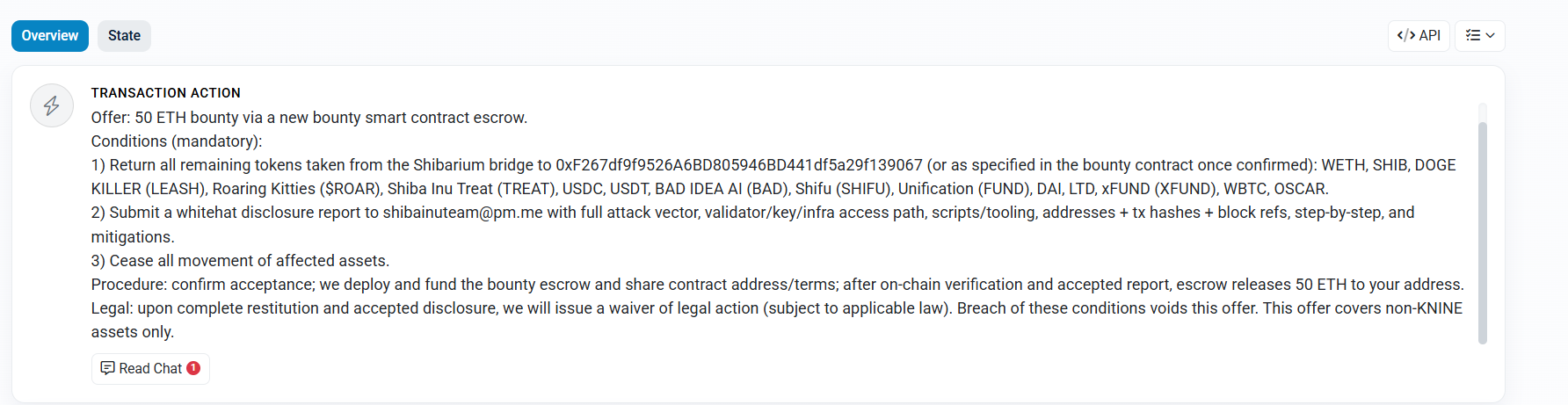
In the latest update, the Shiba Inu ecosystem team revealed that they teamed up with K9 Finance to create a bounty program that offers the attacker 50 ETH ($229,000) if they return the stolen tokens. Notably, the reward sits in a dedicated escrow contract. 

To claim it, the attacker must send all the assets back to a designated recovery wallet. These assets include SHIB, ETH, LEASH, xFUND, Treat, FUND, DAI, WBTC, Bad Idea AI, ROAR, USDC, LTD, USDT, Shifu, and OSCAR, according to on-chain data.

Moreover, the team also set conditions for the bounty. Specifically, the attacker must prepare a whitehat disclosure report that lays out the full method of the exploit. 

This includes details on how they gained validator access, the scripts and tools they used, the addresses involved, the transaction hashes, and recommended steps for prevention. 

Shiba Inu Team Offers Bounty to Shibarium Hacker

In addition, the attacker must also stop moving the compromised tokens. Once the tokens return and the team verifies the report, the bounty escrow will release 50 ETH to the attacker’s wallet.

Moreover, the developers added that if the attacker complies, they will not pursue legal action and will issue a waiver, provided this falls within the law. However, they clarified that the bounty excludes KNINE tokens, which K9 Finance already secured.

For context, the K9 Finance team has already issued its own bounty of 5 ETH for the KNINE tokens. Notably, the team froze over $700,000 worth of KNINE, which the hacker gained control of. Now that they cannot spend the assets, the team has offered a 5 ETH bounty for their return.

Updated Account of the Shibarium Hack

Meanwhile, alongside the bounty program, the Shiba Inu ecosystem team shared an updated account of how the exploit happened. 

The team said the attacker executed a flash loan swap to acquire 4.6 million BONE from ShibaSwap. They then delegated the tokens to Ryoshi Validator 1, which gave them more than two-thirds of validator voting power. With this control, they used compromised internal validator keys to sign a malicious state, draining $4.1 million from the bridge.

On-chain records show the attacker stole 17 different tokens. Losses included $1 million in ETH, $1.3 million in SHIB, $717,000 in KNINE, $680,000 in LEASH, and $260,000 in ROAR, along with smaller amounts of other tokens. 

The attacker sold only their USDT and USDC by converting them into ETH. They also tried seven times to sell $700,000 worth of KNINE, but K9 Finance blocked the wallet before the sales went through. The attacker still holds the other stolen assets, with the Shiba Inu tokens sitting across more than eight wallets.

Notably, the developers believe a compromise of Shibarium validator keys caused the breach. They suspect the attacker may have gained access either through a developer’s machine or the server’s key management system. In response, they suspended bridge operations and began forensic analysis.

To contain the damage, the team revoked root chain manager access from the proof-of-stake bridge, extended the exit time on the plasma bridge, and disabled predicate burn-only functions to stop further withdrawals. They also flagged suspicious transactions and ruled out the cross-chain contract, which some initially thought caused the breach.

Shiba Inu Team Promises Stronger Security

In the recent disclosure, the Shiba Inu team promised stronger security going forward. They said they will improve monitoring and alerts and tighten internal security practices. They also plan to publish a full post-mortem report once the investigation concludes.

Notably, this update follows earlier analyses from industry figures and security firms. For instance, Tikkala Security and Pulse Digital claimed there were deeper governance issues, mentioning how the hack also involved leaked keys and manipulated Merkle roots.

Here’s What XRP Requires to Reach $100, According to a Financial Strategist

0

Amid persistent discussions around the potential for XRP to reach greater heights, one market pundit has revealed what needs to happen for this to occur.

Notably, while XRP continues to struggle at $3, certain market commentators have pushed for higher prices, especially ranging from $100 to $10,000. For instance, most recently, Zach Rector argued that an XRP run to $100 would represent a flight to safety.

Amid these price predictions, Versan Aljarrah, founder of Black Swan Capitalist, recently shared what he believes needs to happen before XRP can realistically climb to $100, $1,000, and even $10,000. 

What XRP Needs to Reach $100

Specifically, Aljarrah explained that the road to $100 begins with quiet accumulation by large institutions. He believes banks, investment firms, and other financial institutions have already spent years building their XRP positions, often during volatile periods that pushed smaller retail investors out. 

According to him, this slow but steady buying reduces the available supply on the market and could lead to a genuine supply shock. 

At the same time, Aljarrah believes XRP’s growing use in cross-border payments and liquidity transfers boosts demand. He argued that when shrinking supply meets rising usage, the conditions for XRP to reach $100 start to fall into place.

Requirements for a Rally to $1,000

Meanwhile, the market commentator suggested that moving from $100 to $1,000 requires a much bigger transformation. Specifically, XRP would need to move beyond its current reputation as a speculative asset and instead act as digital collateral and a core settlement tool. 

He believes this stage depends on widespread adoption across the financial sector, where banks, tokenized assets, and stablecoins all rely on XRP to manage settlements and liquidity. 

Once this happens, the speed and size of transactions flowing through the network will grow quickly. As each token represents a larger share of financial activity, Aljarrah believes XRP’s price could naturally rise toward $1,000.

What a $10,000 XRP Price Demands

From here, he then described what XRP would need to hit $10,000. Aljarrah tied this milestone to complete global adoption and utility. He highlighted that XRP was built to handle enormous amounts of value at high speed and with little friction, something most other cryptocurrencies cannot do. 

If the financial system begins to use XRP for cross-border settlements, stablecoin transfers, tokenized debts, and collateralization, demand could become virtually unlimited. 

Aljarrah suggested that at this point, XRP would not trade on speculation but on the vast amounts of liquidity it processes. In that role, it would act like digital gold, acting as a foundation for the financial system.

However, while this roadmap presents a definite path, these targets remain highly ambitious. From its current price of $3.10, XRP would need to jump over 3,200%  to reach $100. Meanwhile, to move up to $1,000, it would need to climb more than 32,000%. Finally, to reach $10,000, it would have to surge by over 322,000%.

Top Research Firm Predicts XRP Run to $50, Here’s Why

0

XRP has continued to maintain support within an important multi-year channel months after Sistine Research predicted a massive rally.

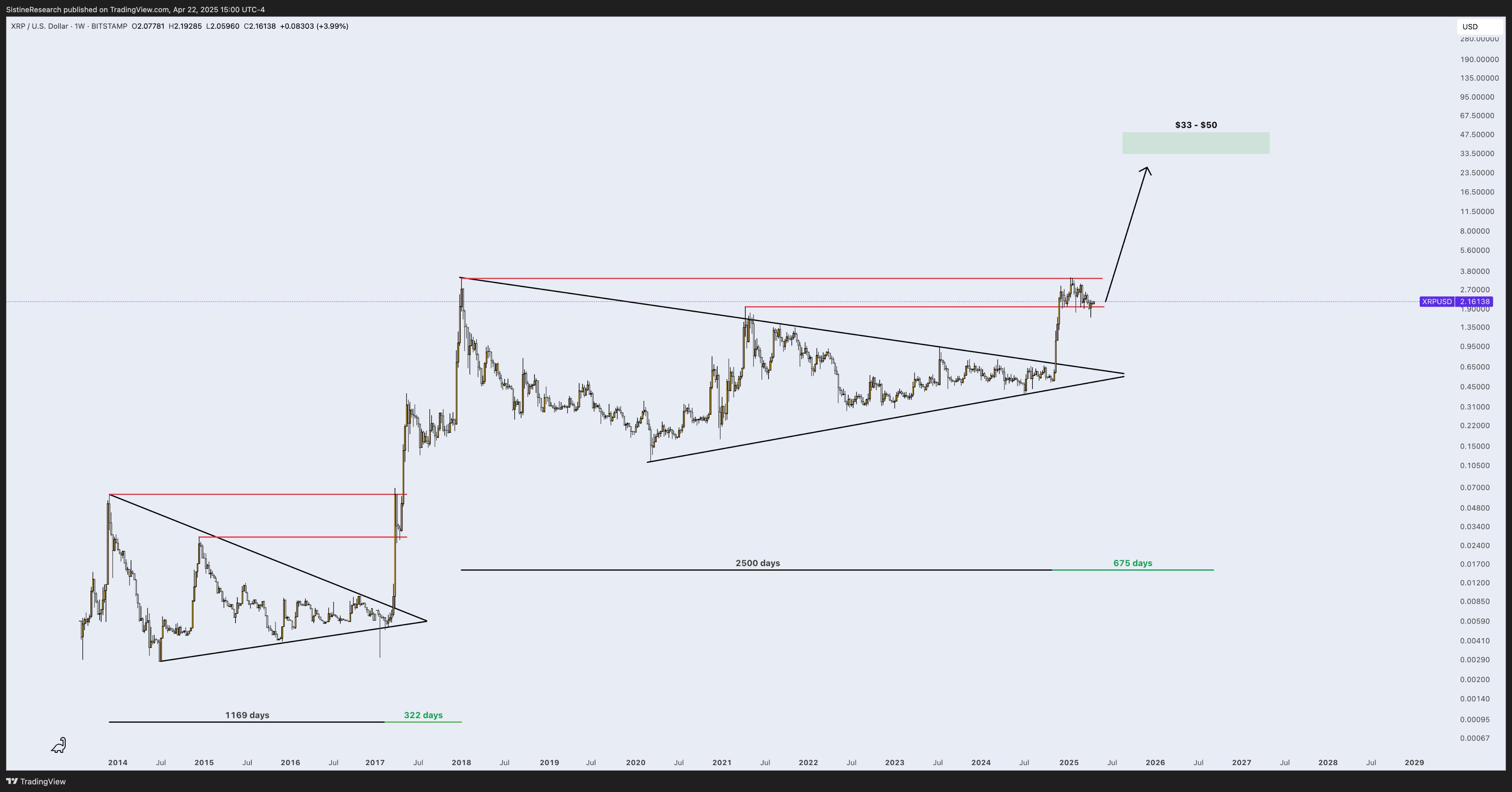
For context, Sistine Research first shared its long-term analysis in April, using a weekly chart to compare XRP’s current setup with its 2017 pattern. According to the analysis, XRP could rally to a peak of $50 if the right conditions align.

XRP Breaches Symmetrical Triangle 

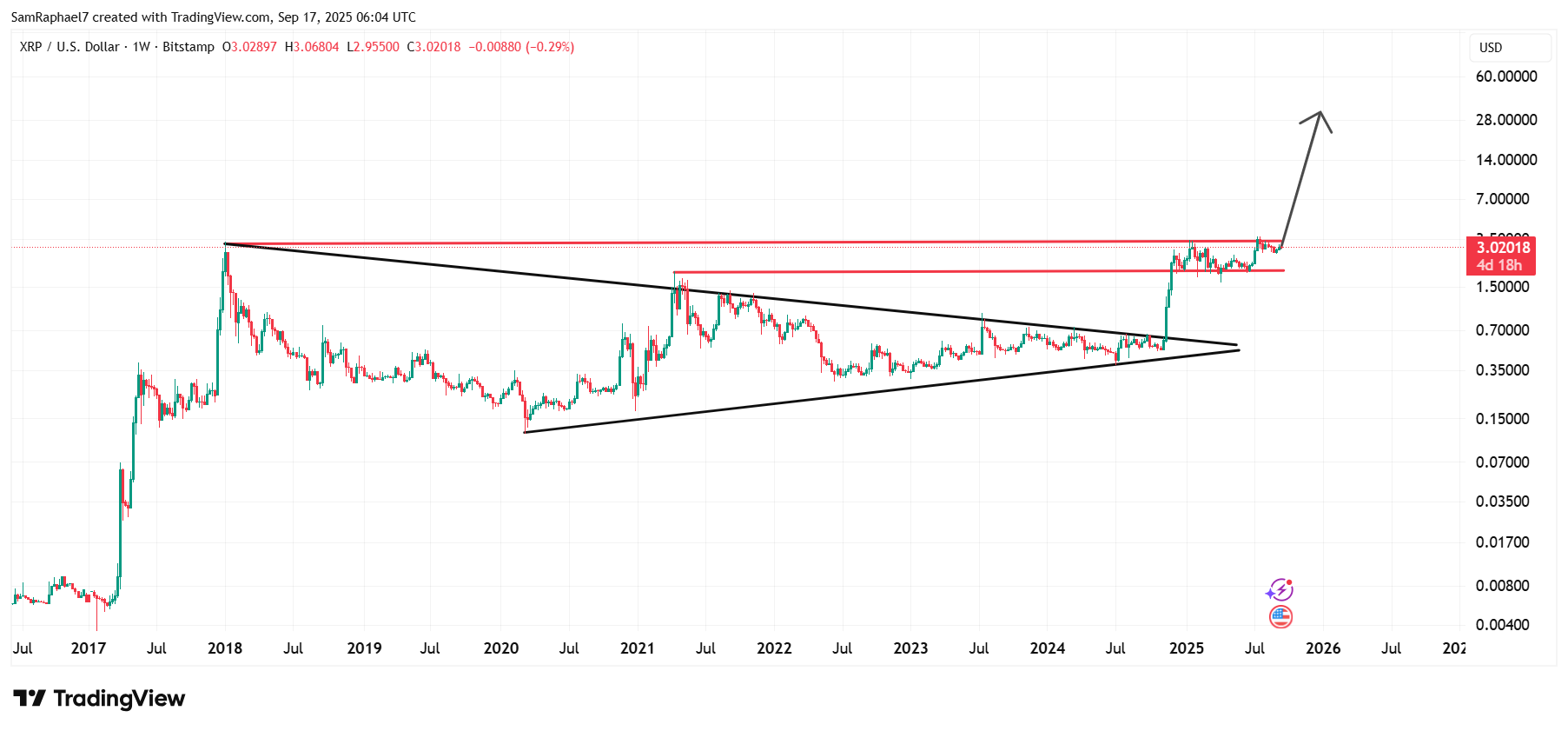
Data from the chart shows that after XRP dropped from the $0.06144 high in December 2013, it moved inside a tight symmetrical triangle that lasted 1,169 days between 2014 and 2017. 

However, once the price broke out of this triangle in March 2017, it surged in a rally that stretched for another 322 days and delivered the 2017–2018 peak of $3.31 by January 2018. 

After this peak, XRP immediately slipped into a massive consolidation, forming another symmetrical triangle. This pattern lasted for an extended period, specifically 2,500 days, according to Sistine Research. XRP broke out in November 2024 amid the broader market uptrend at the time.

The Parallel Channel

However, the chart from Sistine Research identifies another parallel channel that took shape from April 2021. Notably, the upper red trendline of this channel emerged from the $3.31 peak in January 2018, representing the resistance of the channel. Meanwhile, the lower red trendline emerged from the $1.96 peak in April 2021, representing the support of the channel.

After XRP broke out of the symmetrical triangle, it entered this parallel channel, with support around $2 (the April 2021 peak) and resistance around $3.4 (the January 2018 peak). The Sistine Research chart indicates that it would need to breach the upper trendline to continue its uptrend.

XRP 1W Chart Sistine Research
XRP 1W Chart | Sistine Research

Importantly, this huge base mirrored the 2017 setup, only on a much larger scale. Measuring the triangle, the research firm set a conservative target between $33 and $50. It added that if the same structure is read as a cup and handle, the projection expands to $77–$100. 

To frame the timeline, Sistine marked 675 days beyond the breakout zone for these targets to materialize. Specifically, this points to 2026 or early 2027 as the period when the targets could play out.

XRP Maintains Support at the Parallel Channel

Interestingly, XRP price action since April has remained within the channel. In mid-May, XRP climbed to $2.65 but failed to reach the upper red trendline. From here, it dipped to $1.96 in June, touching the lower red trendline and confirming support. 

XRP Maintains Channel Support

However, bulls quickly stepped in, driving the price to a new peak of $3.66 by mid-July for a direct retest of the upper red trendline. Nonetheless, XRP faced a massive rejection. Despite this, XRP has not dropped to retest the lower trendline support. Instead, it continues to consolidate above $3, preparing for another attempt at the ceiling.

Analysts Remain Bullish

Notably, other analysts remain bullish that another leg up could push prices above the channel. For one, Dark Defender recently pointed out that XRP has begun to break through initial weekly resistance. 

He presented near-term targets at $4.39 and $5.85 based on Fibonacci levels and highlighted support at $3.01 and $2.85, almost exactly where the lower red trendline from the Sistine Research channel sits. 

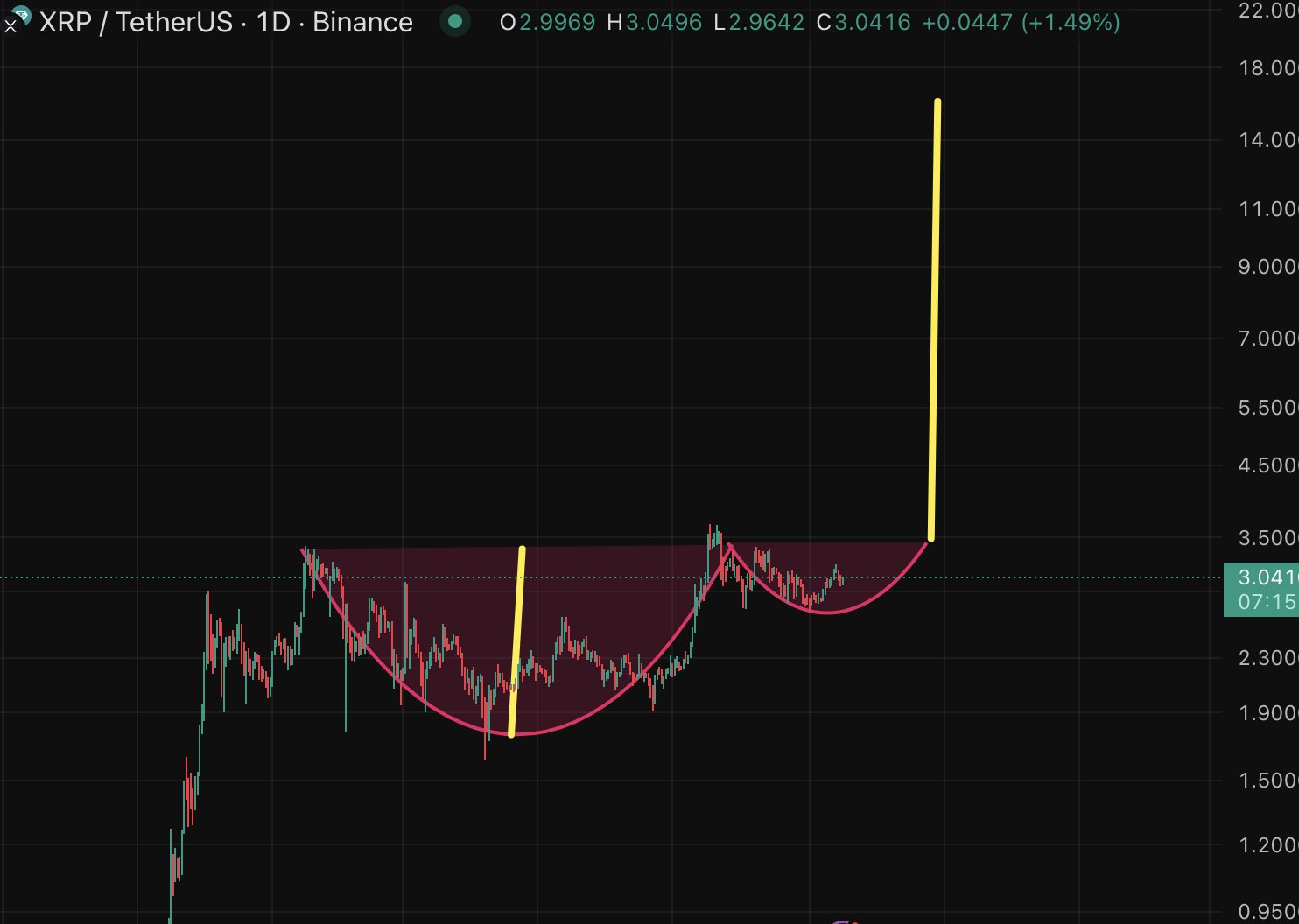
Meanwhile, Baron Dominus highlighted a cup-and-handle formation on the daily chart. The cup formed when XRP dropped from the January peak to $1.61 in April and then recovered to $3.66 in July. XRP is now forming the handle, with potential to reach $15 before year-end if momentum holds.

XRP Cup and Handle Structure Baron Dominus
XRP Cup and Handle Structure | Baron Dominus