Home Blog Page 536

Decade-Old Bitcoin Wallet Moves $15M as BTC Hits $114K

0

A Bitcoin wallet untouched for over a decade has suddenly transferred millions in BTC.

The move coincides with fresh institutional inflows and rising market liquidity as Bitcoin trades above $114,000.

Forgotten Bitcoin On The Move

A once-forgotten Bitcoin wallet holding 444 BTC, valued at more than $50 million, has reappeared on the blockchain. According to the on-chain monitoring platform Onchain Lens, the dormant address executed its first transactions today after remaining inactive for over 13 years.

The wallet transferred 132.03 BTC, worth about $15.06 million, to a new address in a single transaction. Additionally, it sent five BTC directly to the Kraken exchange.

Despite the transfers, the wallet still holds 307.79 BTC, with an estimated market value of nearly $35 million.

Early Investment, Massive Profit

Blockchain history shows that this address first received Bitcoin on November 26, 2012. At that time, Bitcoin was trading at a modest $12.22 per coin. The wallet’s total purchase amounted to only $5,437.

Fast forward to today, and the same coins are worth over $15.63 million. That represents an extraordinary profit of $15.629 million, highlighting the unmatched gains of early Bitcoin holders who resisted selling through years of volatility.

Such stories continue to fuel the narrative of Bitcoin as a long-term store of value, especially when seen alongside today’s institutional adoption.

Bitcoin Price Reclaims $114,000

The whale’s reactivation comes as Bitcoin strengthens in global markets. After slipping below key levels in late August, BTC has now reclaimed the $114,000 mark.

As of press time, Bitcoin trades at $114,163, marking a 0.27% daily gain and a 3.33% increase over the past week. This recovery follows a sharp correction after Bitcoin’s record-breaking run last month.

For context, BTC hit a new all-time high of $124,457 on August 14, 2025, underscoring the asset’s remarkable rally this year.

ETFs Record Largest Inflows in Weeks

Institutional demand has played a major role in Bitcoin’s recovery. Data from SoSoValue shows that Bitcoin spot ETFs recorded $757.14 million in inflows on Wednesday.

This figure marks the highest single-day inflow since July 17 and extends a three-day streak of positive flows. These consistent inflows suggest growing confidence among large investors who see Bitcoin as both a hedge and a growth asset.

If ETF demand continues to accelerate, it could help BTC maintain its upward momentum and is poised to test new highs in the near term.

Stablecoin Reserves Reach Record Levels

Another bullish signal comes from stablecoin activity on Binance, the world’s largest crypto exchange. According to CryptoQuant, Binance recorded its highest net stablecoin inflow of the year on Monday, totaling more than $6.2 billion.

The exchange’s total stablecoin reserves have now climbed to nearly $39 billion, setting a new record. Notably, across all exchanges, stablecoin reserves also reached an all-time high of $70 billion last week.

Stablecoins are widely viewed as “dry powder” for traders, funds parked on exchanges that can be quickly deployed to buy crypto. This surge in reserves suggests that traders and institutions are holding unprecedented levels of liquidity. In other words, the holdings could translate into stronger demand for Bitcoin and other cryptocurrencies if market conditions remain favorable.
Analyst Says XRP Is Now Breaking the Initial Weekly Resistance: Here’s How High It Can Go

0

XRP has broken past its first major weekly resistance, a move analysts see as the beginning of a new bullish phase.

Market watcher Dark Defender shared a chart pointing to the next levels XRP could reach if momentum continues.

XRP Breaking Through Resistance

In a tweet update today, Dark Defender shared a weekly chart highlighting XRP’s move above the $2.85 level, which aligns with the 61.80% Fibonacci level. This zone acted as the initial weekly resistance for XRP.

At press time, XRP is trading at $3, holding above this resistance zone, which could flip to support soon. The breakout suggests the market is shifting from consolidation to the next bullish phase.

Notably, Dark Defender’s analysis follows Elliott Wave Theory. Specifically, XRP recently completed its Wave 1 rally and Wave 2 correction. The breakout may mark the start of Wave 3, another stage for strong gains.

Here’s How High XRP Can Go

The chart highlights key Fibonacci extension levels, including the 161.8% level, aligning with a $4.39 price target. The second outlook is the 261.8% Fibonacci level, corresponding to a $5.85 price target.

These levels serve as potential upside targets if XRP maintains momentum above the breakout zone.

XRP Weekly chart by Dark Defender

Notably, this latest update from Dark Defender comes a week after he previously noted that XRP may be gearing up for a major rally following the completion of a Wave 4 correction. At the time, he identified $2.85 as the level to beat.

With XRP breaking past its first weekly resistance, all eyes are on the $5 level as the next major price point. Indeed, more analysts are becoming increasingly bullish about XRP’s prospects following its 26% correction from the July peak of $3.66.

Other Analysts on Why XRP Is Bullish

In a separate update, veteran analyst Michael XBT urged market participants to “watch XRP this week,” hinting at a potential major move.

His cryptic post has stirred bullish expectations, given his accurate past calls, including predicting XRP’s 600% surge from $0.50 to $3.40 in 2024.

Michael believes XRP’s next rally could align with a broader Bitcoin breakout, which is currently following a slow rhythm. Bitcoin has now rebounded to a new three-week high of $114,566 amid hopes for rate cuts, with expectations for a continuation to the $120,000 level and beyond.

Further supporting the bullish outlook for XRP, other technical analysts like Davie Satoshi have said XRP’s setup is “too clean to ignore”. In his commentary, he noted that XRP is entering Wave III of the Elliott Wave cycle, with price targets ranging from $4.50 to as high as $30.

Beyond technicals, other factors driving the positive outlook for XRP include the imminent launch of ETFs in the coming months and a continued wave of institutions adopting XRP for treasury use.

Dogecoin Whale Gulps 345,000,000 DOGE from Robinhood

0

The DOGE community has called attention to several Dogecoin whale transactions involving the trading platform Robinhood and an unknown wallet.

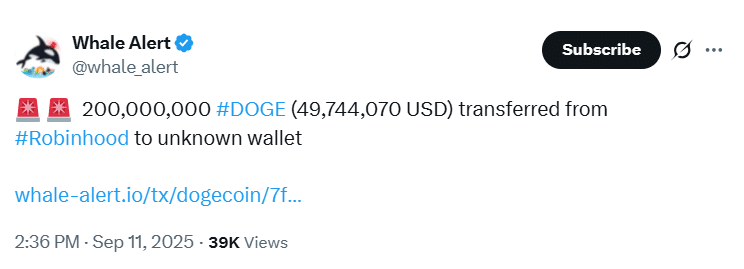
Notably, wallet tracking resource Whale Alert first flagged the fund movements, which involved a total of 345 million DOGE tokens moved by a single wallet. Specifically, Whale Alert confirmed that at 1:34 PM UTC today, a Dogecoin whale moved 200 million DOGE worth $49.74 million from Robinhood to an unidentified wallet.

Dogecoin Whale Transaction from Robinhood

Interestingly, in a second alert, the whale tracking resource revealed that 145 million DOGE worth $36.064 million moved from Robinhood to the same unknown wallet at 1:34 PM UTC today. These two movements totaled 345 million DOGE, worth a combined $85.8 million. 

Details of the Dogecoin Whale Transactions

However, a look into the transactions confirms that both movements came from the same Robinhood address, DDu…wKF, marked as a cold wallet belonging to the trading platform. On-chain data indicates that the address carried out the two transactions in one fell swoop, transferring the assets to the same whale address DGT…4Km.

Notably, while the Dogecoin whale address does not carry the Robinhood tag, it appears to have been interacting multiple times with Robinhood, with each interaction involving millions of DOGE. Since July, the Robinhood cold wallet has moved 2.185 billion DOGE tokens to this Dogecoin whale address.

Despite these massive flows, DGT…4Km currently only holds 754.64 million DOGE worth $186.35 million at current rates. Interestingly, the wallet has periodically moved its DOGE tokens to other exchanges such as Coinbase and Bitstamp, as well as other unidentified addresses.

This indicates that the address might actually belong to Robinhood. If this is the case, Robinhood likely uses that wallet as an operational hub. It probably serves for batching user deposits, managing liquidity, settling trades with exchanges, funding hot wallets from cold storage, and routing assets through custodians and partners.

A Trend of Whale Movements

The latest Dogecoin whale transactions are part of a broader trend of recent movements on the network. For context, The Crypto Basic confirmed last month that Dogecoin whale activity surged to a 1-month peak, as whale transactions averaged 20 to 60 per day amid an accumulation spree.

Moreover, on July 24, market commentator Ali Martinez found that Dogecoin whale addresses gulped 310 million DOGE tokens in just 48 hours. These movements coincided with a massive price correction at the time, leading to speculations that they were part of a “buy the dip” campaign.

Meanwhile, the latest whale transactions come at a time when Dogecoin is recovering after nearly two weeks of sideways movements. Specifically, after dropping from a high of $0.25 on Aug. 24, DOGE consolidated between $0.23 and $0.20 until Sept. 7, when it joined a broader market rebound. Today, Dogecoin trades for $0.249, up 15% since Sept. 7.

Bitcoin Sharks Amass 65K BTC Worth $7.3B in One Week, Reaching Record Holdings

0

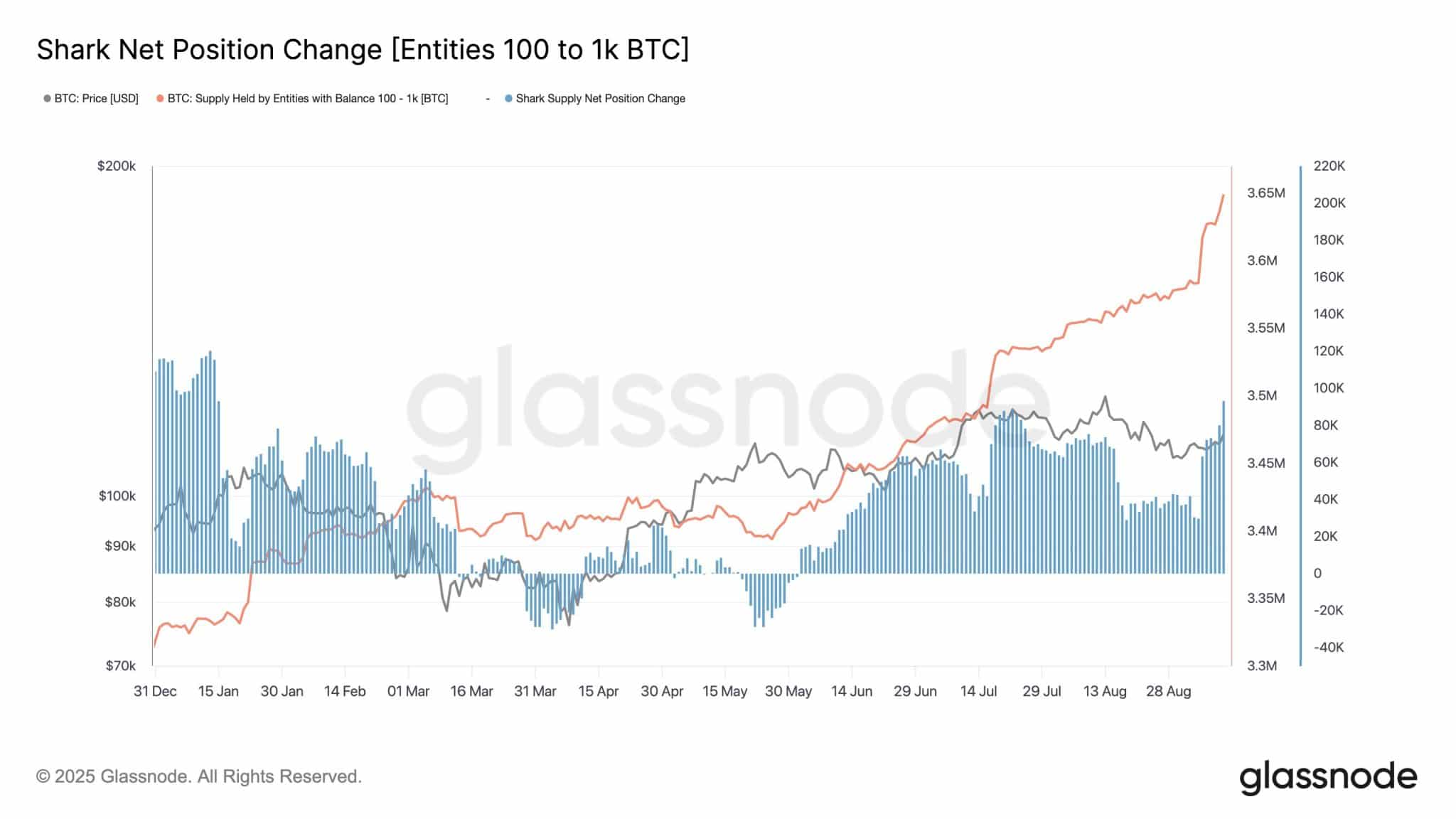
Fresh data from blockchain analytics platform Glassnode shows that mid-sized Bitcoin investors have significantly increased their BTC holdings in recent times. 

The data shows that entities holding between 100 and 1,000 BTC, often referred to as sharks, have added approximately 65,000 BTC in the last seven days alone. At the current price of $113,595, their accumulation in the past week is equivalent to roughly $7.38 billion. 

This buying spree has brought their net monthly accumulation to 93,000 BTC, representing one of the most aggressive buying trends from this group in recent times. 

Sharks Now Control 18% of Bitcoin Supply 

Following the recent accumulation, this group currently holds a record 3.65 million BTC. For context, the total holdings of Bitcoin sharks represent about 18.32% of Bitcoin’s current circulating supply of 19.91 million coins. 

Bitcoin shark holdings

Although shark wallets are not as influential as institutional whales, their accumulation still has a meaningful impact on market dynamics. Their accumulation of Bitcoin reduces the liquid supply of BTC, putting upward pressure on the premier asset as demand soars. 

Moreover, the development signals confidence in Bitcoin’s near-term outlook. The surge in accumulation suggests that these mid-sized holders could be positioning themselves for a potential upside in BTC price. 

Investors Brace for the Next Leg of the Bull Run 

It comes as investors anticipate the next phase of the 2025 bull run. Bitcoin has already delivered an impressive 102% gain over the past year. It has spiked 22.1% year-to-date (YTD) and 40.6% over the past six months. 

Despite its impressive gains, industry stakeholders believe the leading cryptocurrency still has substantial room to rally before the end of this year. 

As reported earlier, Bitcoin bull Michael Saylor teased that Bitcoin could surpass $150,000 by this year’s Christmas. Saylor’s projection is conservative compared to the forecast issued by Tom Lee of Fundstrat, who predicts Bitcoin will reach $200,000 by Christmas. 

Other entities forecasting a Bitcoin rally toward the $150,000-$200,000 price range this year include Standard Chartered and blockchain research company Steno. Amid these bullish predictions, Bitcoin shark investors are accumulating the asset in anticipation of an upsurge toward these lofty targets. 

In the meantime, Bitcoin is still recovering from the recent downturn that sent its price crashing to $107,000 on September 1. Since then, Bitcoin has experienced consistent gains, climbing to $114,000 earlier today. It has retraced slightly from this level and currently changes hands at $113,595. 

SEC Chair Paul Atkins: “Crypto’s Time Has Come”

0

US SEC Chair Paul Atkins has announced a major policy shift, declaring that cryptocurrencies are ready for mainstream adoption.

The regulator now promises clearer rules, global cooperation, and support for innovation in digital assets.

For years, the US crypto industry faced what many described as a regulatory witch hunt. Companies struggled with unclear rules, heavy legal costs, and a constant risk of enforcement actions. According to SEC Chair Paul Atkins, this era is finally coming to an end.

Speaking at the inaugural OECD roundtable on global financial markets in France, Atkins acknowledged that the SEC’s previous approach led to innovation and investment away from the US. Many firms relocated to friendlier jurisdictions, while those that stayed spent millions defending themselves in court.

Quoting Victor Hugo, Atkins said, “An invasion of armies can be resisted, but not an idea whose time has come. And today, crypto’s time has come.”

Clearer Guidelines for Digital Assets

Atkins revealed that the SEC is preparing “clear and predictable” rules for digital asset service providers. He stressed that most cryptocurrencies will not be classified as securities, a decision that could remove one of the biggest hurdles facing the industry.

He added that with well-defined rules, startups and investors will be able to raise capital directly on blockchain networks without unnecessary regulatory bottlenecks. This approach, Atkins argued, will unlock growth while protecting market participants.

Building the World’s Crypto Capital

Moreover, the SEC Chair outlined a vision for the US to become the global leader in digital assets. However, he emphasized that this ambition will not come at the cost of isolation.

Atkins said the US is ready to collaborate with international regulators, particularly in Europe. He praised the European Union’s Markets in Crypto-Assets (MiCA) framework, describing it as a “comprehensive playbook” for regulating virtual currencies.

Such cooperation, he suggested, will help align global standards while fostering trust among investors.

Backing for Crypto “Super-Apps”

Atkins also announced support for the development of crypto super-apps. These platforms would allow users to trade, lend, stake, and store digital assets under a single regulatory license.

According to Atkins, allowing investors and financial advisers to choose among multiple custody solutions will foster healthier competition and improve security. Such flexibility, he said, is essential for a maturing market.

AI and Blockchain: The Next Frontier

Looking to the future, Atkins highlighted the convergence of artificial intelligence (AI) and blockchain technology as a game-changing opportunity. He argued that combining on-chain capital systems with AI-powered financial tools could accelerate market efficiency, reduce transaction costs, and foster the development of novel financial frameworks.

Atkins described this merger as a crucial step in positioning the US at the forefront of global financial innovation.

XRPL Devs Now Working on an Amendment to Protect Your XRP Even if You Fall Victim to a Scam or Hack

0

The XRP Ledger (XRPL) community is now exploring a Firewall proposal that could help protect user assets even after a private key compromise.

XRPL dUNL validator Vet recently brought attention to the amendment. Notably, GitHub records show that Kris Dangerfield, an entrepreneur and XRPL innovator, originally put forward the idea in November 2024 under the name XLS-86d.

Details of the Firewall Amendment

The amendment, called Firewall, seeks to protect XRP Ledger accounts even if a private key falls into the wrong hands. Specifically, it introduces a system where account owners can set daily spending caps and time-based limits on outgoing transactions. 

These restrictions give users enough time to react if their wallet is compromised. Meanwhile, to keep transactions smooth, the amendment also includes a whitelist option so payments to trusted accounts, like exchanges or secondary personal wallets, go through without delay.

Dangerfield’s proposal addresses a long-standing challenge. While the XRPL already offers multisignature protection, most wallets don’t support it in a way that’s easy for everyday users. Many also see multisig as too complicated to set up and manage. 

On the other hand, the Firewall uses a simpler solution. Once enabled, it blocks attempts to drain an account in one sweep, even if attackers try advanced tactics like disabling the master key, draining funds through NFT sales, or deleting the account entirely. Owners would still have the final say and could adjust limits, update whitelists, or remove the Firewall if necessary.

In practice, the Firewall would work a lot like security features in modern banking apps. For instance, a user could set a 500 XRP daily limit. Any payments to trusted accounts would go through normally, while other payments would face a cap. Also, if someone tried to exceed the limit, the transaction would fail. 

This design ensures that users can spend their money, but it prevents attackers from wiping out their balance in one attempt. The trade-off may be a bit of extra setup or the need to adjust settings occasionally, but in return, users gain peace of mind knowing their funds remain safe.

XRPL Seeing Impressive Improvements

Such a mechanism has become increasingly important amid recent multiple cases of account compromise. One instance involving the XRPL was the hack that targeted Ripple Chairman Chris Larsen’s wallets last January. Notably, the perpetrators siphoned over 200 million XRP.

As of now, validators have not started voting on the Firewall amendment, according to XRPScan, as it is still in development. If it moves forward and gains approval, it will join a growing list of changes that have steadily improved the XRPL.

In March 2024, the network activated the Automated Market Maker (AMM) amendment, which introduced AMM capabilities and liquidity pools, and allowed users to earn income from trading fees. 

In February of that year, the Clawback amendment went live, giving token issuers the ability to reverse transactions in cases of fraud or mistakes. Meanwhile, in October 2024, the XRPL added Decentralized Identifiers (DIDs), giving users cryptographically secure, self-owned identities that align with global W3C standards. 

Giant Whale Still Holds 124,449,000,000 Shiba Inu Hours After Massive SHIB Transfer

0

A major investor has quietly accumulated over 124 billion Shiba Inu tokens, with the entire holding still intact in their portfolio. 

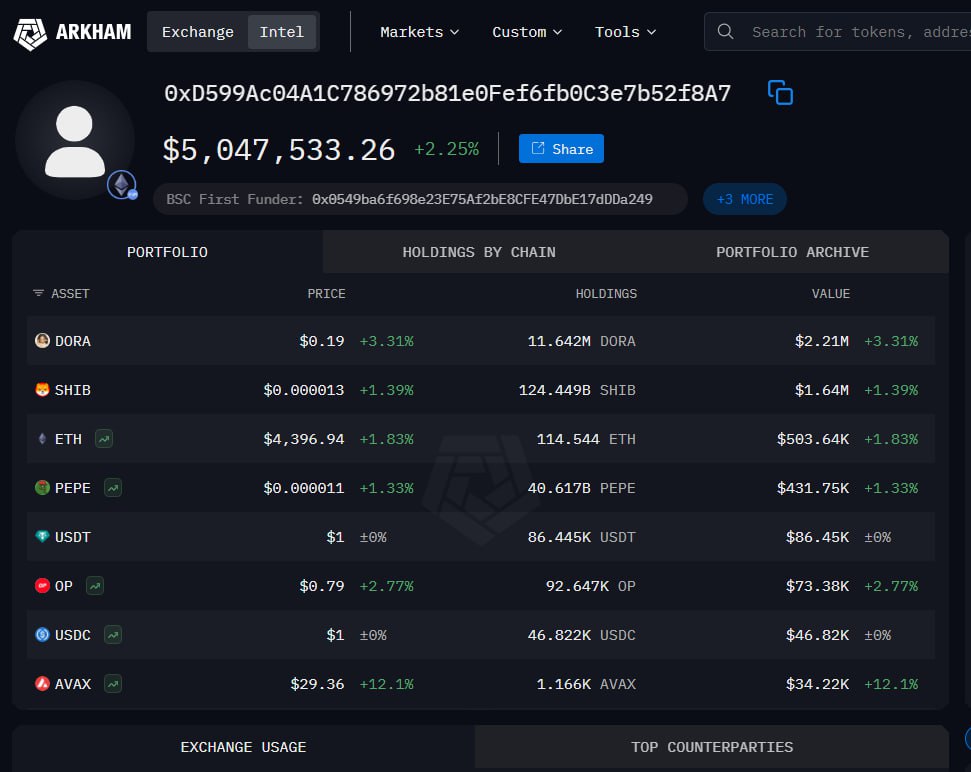
The unidentified entity behind the wallet address, 0xD59…52f8A, received a total of 124,449,000,000 (124.44 billion) SHIB yesterday, worth approximately $1.64 million. 

On-chain data shows that another unlabeled address, ‘0x0fF…979b6’, sent the funds to the recipient wallet in two tranches of 100 million and 124.337 billion SHIB tokens. Per the data, the transactions occurred yesterday at 08:57 AM (UTC) and 09:05 AM (UTC), respectively. 

Funds Remain Untouched 

At press time, on-chain data confirms that the address has not sold. The entire 124.44 billion SHIB tokens remain intact in the wallet. This suggests that the entity behind the wallet may be positioning itself for a potential price move in Shiba Inu. 

In addition to SHIB, the wallet also maintains a diversified portfolio, featuring other major assets, such as DORA, ETH, PEPE, and various stablecoins. Notably, Shiba Inu ranks as the second-biggest cryptocurrency by dollar value in the wallet, with a valuation of $1.64 billion, trailing only the meme-inspired token DORA. 

Unknown whale receives 124 billion SHIB

Whale Interest in SHIB Soars 

Meanwhile, the transactions align with the growing interest in SHIB among large crypto investors. Multiple reports have shown large investors accumulating substantial amounts of SHIB tokens. 

Last month, The Crypto Basic reported that an unknown investor withdrew 3 trillion SHIB from the Coinbase exchange. In the same month, another Coinbase user transferred 193 billion SHIB from the exchange to an unknown address. 

The latest transaction of 124 billion SHIB adds to the widespread accumulation of SHIB by crypto whales. 

Growing Optimism in Shiba Inu 

The move comes amid renewed optimism around Shiba Inu, as market sentiment improves. This is evident in the recent spike in Shiba Inu search interest on Google Trends, which has soared to a score of 100 over the past seven days. 

In the meantime, Shiba Inu is among the beneficiaries of the recent relief rally across the market. The rally pushed Shiba Inu’s price above the $0.000013 mark earlier this week. 

It is trading at $0.00001315 in the hours leading up to press time. At the current price, SHIB is up 7.78% over the past week. However, the token has underperformed in the past month, with a slight loss of 0.35%. 

Analyst Says Many Dogecoin Holders are About to Get Rich Following Recurring Historical Pattern

0

A shared Dogecoin chart shows that it is repeating a pattern from the previous cycle, which followed a parabolic expansion for the meme coin.

JezzaBTC shared this bullish chart in an X post on Wednesday, assuring Dogecoin enthusiasts that many of them are about to get wealthy. According to him, history is repeating for Dogecoin, and a full realization of this price action would take the token to uncharted territories.

Dogecoin History Is Repeating

Dogecoin is the only cryptocurrency in the top 10 market cap ranking with negative year-to-date price action. While most others have recorded double-figure price growth since January 1, DOGE has declined by over 20%.

The underwhelming price action is not typical of Dogecoin, as it has increasingly appreciated in the last two bull cycles, rallying over 5,000% and 21,000% in the 2017 and 2021 seasons, respectively.

Nonetheless, all hope is not lost for holders of the most prominent meme coin in the crypto sector. This is because JezzaBTC has identified a recurring pattern from its 2021 bull cycle, which could mean we are in the early stages of a Dogecoin rally.

For perspective, Dogecoin broke out from a descending triangle in April 2020 after trending within the channel since its January 2018 peak of $0.0194. After the breakout, the meme coin consolidated for a few months before a 15,420% price spike from $0.0049 in January 2021 to its current all-time high of $0.7605 in May 2021.

Recurring Dogecoin Bullish Pattern/JezzaBTC

Meanwhile, a similar pattern is repeating. Dogecoin broke out from a similar pattern in November 2023 and has been consolidating since then, as in the previous cycle. The analyst highlighted this pattern, suggesting that a similar uptrend seen with this development in 2021 could occur.

Dogecoin to $18?

If this happens, JezzaBTC claims that many Dogecoin holders will become wealthy. Moreover, his shared chart indicates that DOGE could potentially rally to $18, representing a 7,100% increase from the current price of $0.250.

Notably, this would take the market cap of Dogecoin to $2.7 trillion, based on a circulating supply of 150.89 billion tokens, surpassing the current market cap of Bitcoin, the industry’s leading asset. Considering the sentiments that DOGE has practically no utility, many may find this rally unrealistic.

Nonetheless, even a small portion of the rally would be beneficial to holders. For one, other analysts suggest that Dogecoin could realistically rally past $1 this cycle, particularly as institutional interest begins to emerge. 

Recall that the Rex-Osprey Dogecoin ETF will launch in the United States today, providing a new avenue for liquidity to flow into the Dogecoin market.

Avalanche Foundation Plans $1B Raise to Launch Two AVAX Treasury Companies

0

Avalanche Foundation, the non-profit organization behind the Avalanche blockchain, is in advanced talks with global investors to create two US-based digital asset treasury companies.

These firms would be tasked with purchasing and holding Avax tokens, the native cryptocurrency of the Avalanche network.

If successful, the move could bring in a total of $1 billion, marking one of the largest treasury-focused projects in the crypto sector this year.

Deal Structure and Fundraising Plans

According to the Financial Times report, the foundation is pursuing two separate but complementary deals.

The first deal aims to raise up to $500 million through a private investment led by Hivemind Capital in a Nasdaq-listed company that would be converted into a crypto treasury vehicle.

This effort is being led by Hivemind Capital, with Anthony Scaramucci, a crypto investor and former White House press secretary, advising on the transaction. This deal will be finalized before the end of the month.

The second deal also targets $500 million but is being structured differently. It involves the creation of a special purpose acquisition vehicle (SPAC) sponsored by Dragonfly Capital. While the proposal has generated significant interest, this transaction may not be completed until October.

In both cases, the newly created entities will initially acquire Avax tokens at discounted prices directly from the Avalanche Foundation. The approach aims to encourage investor participation while increasing the token’s circulation in the market.

Why the Fundraising Matters

Avalanche has set a maximum supply of 720 million Avax tokens, with about 420 million already in circulation. By selling a portion of its holdings to treasury firms, the foundation aims to create a stable base of long-term investors and increase liquidity.

The $1 billion raise is also meant to reinforce Avalanche’s broader ambition: becoming the digital ledger of choice for global capital markets.

Market Backdrop: Opportunities and Risks

The fundraising push comes at a time of mixed signals in the crypto economy. Several publicly traded crypto treasury companies have seen their share prices fall in recent months. This suggests fading enthusiasm among stock market investors.

However, the broader crypto market tells a different story. Tokens like Ethereum and Solana have surged, buoyed by large fundraising rounds and growing institutional interest. According to research firm Kaiko, companies using the treasury model have already raised over $16 billion this year.

Avalanche, by contrast, has lagged in token performance. Its Avax token has not participated in the same rallies enjoyed by rivals. This fundraising effort may help close that gap by signaling strong backing from institutional players.

Wall Street Testing Grounds

Despite the token’s weaker price momentum, Avalanche’s technology is gaining traction among major financial institutions. BlackRock, Apollo, and Wellington Asset Management have all conducted pilot projects using Avalanche’s blockchain to issue tokenized funds.

These experiments reflect a trend on Wall Street, where firms are testing whether blockchain technology can streamline settlement and fund management.

New Crypto ETFs Featuring Dogecoin, XRP, Trump Coin Set to Launch Under REX-Osprey Brand

0

Asset managers REX and Osprey are set to introduce five crypto ETFs in the United States this week, following the end of the SEC’s 75-day review period.

Unless the regulator raises objections, the products are free to move ahead. The upcoming lineup features funds tied to Bonk, Trump, Bitcoin, XRP, and Dogecoin, all launched under the REX-Osprey brand.

In a post on X, Bloomberg ETF analyst Eric Balchunas noted that the Dogecoin fund could start trading as early as Thursday. He added that the remaining funds are likely to follow before the week concludes.

“These are post-effective filings,” Balchunas said in a media statement, “meaning they’ve essentially received a green light to launch.”

Different Rulebook: 1940 Act vs. 1933 Act

The funds are being registered under the Investment Company Act of 1940. The act provides a framework that streamlines approvals for products that hold securities such as futures contracts. This contrasts with the Securities Act of 1933, the pathway used for last year’s physically backed Bitcoin ETFs.

According to Balchunas, the ’40 Act process is more straightforward: “If the SEC doesn’t raise concerns, the funds can automatically go live 75 days after filing.”

SEC Delays Other High-Profile Applications

While REX and Osprey move forward, the SEC continues to delay decisions on several high-profile filings. Applications from BlackRock, Fidelity, and Franklin Templeton remain under review. The regulator has indicated that additional scrutiny is required, particularly concerning Ethereum staking features.

In addition, the SEC has pushed back its decisions on Bitwise’s Dogecoin ETF and Grayscale’s Hedera ETF, with the next review date now in November.

Evolving SEC Stance on Staking and Securities Laws

The regulatory delays come amid broader shifts in how the SEC defines digital assets. In recent months, the agency clarified that certain liquid staking services do not fall under securities laws. As a result, these offerings remain outside its jurisdiction. Additionally, it concluded that proof-of-stake blockchains should not automatically be classified as securities.

These clarifications have provided some relief to the crypto industry. Industry experts argue that the SEC’s cautious approach reflects its effort to strike a balance between investor protection and innovation in a rapidly evolving market.