Home Blog Page 538

Stellar CEO Pushes for Bigger Growth, Targets $1B TVL to Boost Network Traction

0

Despite Stellar’s remarkable performance in recent months, CEO Danelle Dixon believes the network is only scratching the surface of its potential. 

Dixon made the assertion in a recent interview with CoinDesk, where she outlined the network’s growth priorities. Notably, the interviewer highlighted Stellar’s recent momentum, with the network adding 400,000 new addresses in a single quarter and real-world asset (RWA) tokenization surpassing $600 million in the first half of the year. 

Stellar CEO Wants More Growth 

Reacting, Dixon praised the network’s recent momentum. She attributed the address growth to wallet expansion, with platforms like Decaf and Vibrant expanding their user base on Stellar. According to her, the wallet’s growth suggests that people are using the network. 

However, she emphasized the need for faster expansion, particularly in total value locked (TVL). The Stellar CEO suggested that reaching a $1 billion TVL milestone on Soroban, the network’s smart contract platform, is among her key goals. 

Despite referring to the $1 billion TVL target as a vanity number, she acknowledged that it plays a critical role in showcasing Stellar’s traction. 

For context, Stellar had a TVL of $143.35 million in the hours leading up to press time, according to data from DeFiLlama. This implies that reaching the $1 billion target would require a 597% rally from the current figure.  

Another Growth Catalyst 

Furthermore, another critical factor Dixon believes could fuel engagement on Stellar is asset diversity. She pointed out that some tokenized assets on the network are permissioned, suitable for specific user needs. 

Notably, Dixon emphasized the long-term potential of permissionless assets, which are open to all users, adding that she wants to see more of these available on Stellar. 

Launched in 2014 by Ripple’s co-founder Jed McCaleb and Joyce Kim, Stellar was initially designed to facilitate low-cost and fast cross-border payments. It did not take long for it to become a major rival of Ripple, which also processes cross-border settlements on behalf of its users. 

Since 2014, the Stellar team has rolled out major upgrades to the network, including the addition of smart contract functionality last year. At press time, the native token of the Stellar network, XLM, is trading at $0.3851, representing a 5.35% increase over the past week. 
Spot XRP ETFs in October Could Spark XRP Price: Analysis at Frankfurt Stock Exchange

0

Spot XRP ETFs expected in October could trigger a major price breakout for XRP, according to an analysis shared by Tokentus CEO Oliver Michel on a German financial media platform.

Michel delivered an in-depth market analysis from the floor of the Frankfurt Stock Exchange, highlighting a change in momentum from Bitcoin to altcoins. He argued that while Bitcoin still has upside potential, greater opportunities lie in Ethereum, XRP, and other major altcoins. With altcoins, he believes gains could reach up to 300%, compared to Bitcoin’s projected 30%.

Ethereum Holding Key Levels Before Next Rally

Michel noted that Ethereum has already broken past its 0.786 Fibonacci retracement level and briefly touched an all-time high before undergoing a correction. He stated that Ethereum is now retesting former resistance as new support.

He believes that once Bitcoin makes a new upward move, Ethereum could surge past $5,000 and trigger the beginning of altseason. At press time, ETH is holding at $4,325, a modest improvement from last week’s $4,200 low. Bitcoin is also holding at $112,350 after briefly dipping to $107,000 last week.

XRP Set for Breakout

Meanwhile, according to Michel, XRP is also approaching a decisive moment. The token currently trades around $2.97, consolidating below its recent swing high of $3.66.

He explained that XRP is awaiting a catalyst and is unlikely to move independently of the broader market. He expects a breakout once the overall market gains momentum, setting the stage for a strong upside move.

Spot XRP ETFs in October

Importantly, the key trigger Michel emphasized is the approval of spot XRP ETFs. With over seven applications currently under review, the SEC faces a final decision deadline between October 18 and 25.

He drew parallels to the launch of Bitcoin and Ethereum ETFs, noting that demand for XRP products is already evident from record-breaking futures activity on the CME over the past three months.

For context, CME Group’s XRP futures reached $1 billion in open interest in just over three months, making it the fastest crypto futures contract to hit that milestone on CME.

Meanwhile, futures-based XRP ETFs have also seen significant inflows, with assets surpassing $800 million.

Michel believes that spot ETFs will further amplify momentum, as such products bring real market demand for the coin. If XRP rallies in October, spot XRP ETFs could accelerate the move, pushing prices higher.

With this outlook, Michel joins the expanding list of analysts calling for a new peak for XRP based on ETF developments.

While he did not issue a specific price target, popular expectations for the coin by year-end are above $10. For instance, Zach Recor forecasts XRP reaching as high as $30 by 2026.

Other Altcoins

Beyond Ethereum and XRP, Michel also mentioned Hedera (HBAR) and Chainlink (LINK) among coins with bullish prospects. Chainlink recently secured a partnership with U.S. authorities to implement its blockchain technology for official use.

While neither coin has seen major price jumps recently, Michel expects both to perform well in the upcoming altcoin season.

Solana Treasury Firm SOL Strategies Makes Debut on Nasdaq

0

Shares of SOL Strategies Inc., one of North America’s largest Solana treasuries, began trading on Nasdaq this week under the ticker STKE.

The company, formerly known as Cypherpunk Holdings, will also maintain its listing on the Canadian Securities Exchange under the ticker HODL. Meanwhile, its OTCQB Venture Market shares (CYFRF) have automatically converted to the Nasdaq listing.

This transition gives the firm broader exposure to U.S. investors, positioning it among a small but growing group of blockchain-focused treasury companies on Wall Street.

Trading Debut and Market Reaction

On opening day, STKE shares launched at $13.05 before sliding to $7.84, according to Google Finance.

Market analysts say such volatility is common for digital-asset companies entering mainstream exchanges. The listing, nevertheless, is viewed as a long-term boost for the firm’s visibility and liquidity.

One of the Largest Solana Treasuries

SOL Strategies is a major institutional holder of Solana (SOL) in North America. The company holds approximately 435,064 SOL tokens, valued at $94.25 million based on current market prices. At press time, Solana trades around $221.10, reflecting a 6.1% gain over the past week.

This holding places SOL Strategies among the top corporate backers of the Solana ecosystem, underscoring its commitment to blockchain-based treasury strategies.

CEO Leah Wald on the Listing

Company CEO Leah Wald hailed the Nasdaq debut as a milestone that strengthens SOL Strategies’ credibility. 

“Joining Nasdaq aligns us with the world’s most innovative technology companies,” she explained in the official announcement. Wald added that the move opens doors for institutional investors and enhances shareholder liquidity. Together, these factors grant the firm deeper access to capital markets.

She also highlighted the firm’s plans to expand validator operations and increase staking capacity. 

Coinbase data shows that about 66% of Solana’s supply is already staked. By scaling its validator presence, the firm aims to capture additional rewards and contribute to the network’s long-term security.

This approach not only strengthens the company’s revenue base but also deepens its role in the Solana ecosystem.

Competing Solana Treasuries

SOL Strategies is part of a growing race among companies amassing significant Solana holdings.

Upexi Inc. (NASDAQ: UPXI) currently leads with 1.9 million SOL valued at approximately $319.5 million. DeFi Development Corp (NASDAQ: DFDV) is second with 1.18 million SOL worth around $198.9 million, while Torrent Capital holds 40,039 SOL, valued at roughly $6.7 million.

Collectively, these firms manage more than 3.5 million SOL, or roughly 0.65% of the circulating supply and 0.58% of the total, according to CoinGecko.

New Entrant: Forward Industries

On September 8, Forward Industries announced a Solana-focused treasury program. It raised $1.65 billion through a private investment in public equity (PIPE) led by Galaxy Digital, Jump Crypto, and Multicoin Capital.

CEO Michael Pruitt said the move reflects confidence in Solana’s long-term growth.

“Solana has emerged as one of the most innovative and widely adopted blockchain ecosystems,” he said. 

According to Pruitt, building an active Solana treasury allows the company to directly participate in the network’s expansion while creating shareholder value.

Top Analyst Predicts Ambitious Shiba Inu Price if Ethereum Reaches $10K

0

Crypto analyst Amonyx predicts that Shiba Inu could deliver a remarkable rally this bull run, provided Ethereum climbs to a new all-time high of $10,000.

As the crypto market braces for another potential bull run, market watchers have continued to issue bold predictions. Amonyx, a pseudonymous investor with nearly 130,000 X followers, recently joined the trend.

Shiba Inu Price if Ethereum Hits $10K

The analyst took to X to speculate on how top cryptocurrencies, including Ethereum (ETH) and Shiba Inu (SHIB), might perform in this bull run.

Many expect this year’s bull run to reach a peak by December 2025. With only a few months remaining, Amonyx anticipates that ETH and SHIB will hit ambitious price targets before the cycle ends.

Notably, he forecasted that Ethereum would reach a target of $10,000. This would mark a new all-time high for Ethereum, surpassing the previous peak of $4,959 by 101.89%. However, Ethereum must rally 131% from its current value of $4,329 to clinch the $10,000 target.

Similarly, Amonyx projects that Shiba Inu would reach an ambitious target of $0.001 during this bull run. Achieving this milestone would require Shiba Inu to eliminate two zeros after its decimal, potentially marking a new all-time high for the token.

From the current price of $0.00001297, SHIB must rally 7,610% to reach $0.001. In other words, Amonyx expects Shiba Inu to stage a jaw-dropping event by December 2025.

Close Relationship Between Shiba Inu and Ethereum

Meanwhile, Shiba Inu’s 2025 performance has been far from expectations. The asset has lost 38.7% of its value since the start of the year. Despite the recent slump, many remain optimistic about Shiba Inu’s prospects.

As an ERC-20 token, SHIB’s performance is often influenced by ETH’s price movements and sometimes outperforms Ethereum. For context, while Ethereum’s price has increased by 0.17% over the past week, SHIB has recorded a surge of 4.65% in the same period.

Meanwhile, it remains uncertain whether SHIB could achieve outsized gains strong enough to push its price to $0.001 should Ethereum climb to $10,000 in this bull run.

$0.001 Predictions

Meanwhile, the $0.001 target is not new to Shiba Inu community members. It has featured prominently in several analyses.

Analyst Krao previously predicted that the SHIB price would hit $0.001 in Q1 2025. However, the prediction did not materialize.

Likewise, Crypto Sheriff referenced a breakout from a multi-year descending trendline last year to project a rally to $0.001. Unlike Krao, Sheriff did not set a timeline for when SHIB might achieve the milestone.

Earlier this year, The Crypto Basic estimated that SHIB might reach the $0.001 target by August 2042. The analysis assumed that SHIB would grow at a 30% annual rate.

While Amonyx projects that Shiba Inu could climb to $0.001 at the peak of the bull run, such a rally would require the alignment of multiple favorable factors. They include sustained retail enthusiasm for meme coins, as well as positive Shiba Inu initiatives, such as increased token burns.

Earlier, The Crypto Basic outlined five supply-reduction strategies Shiba Inu could adopt to address its massive 589 trillion token supply. The analysis suggested that the substantial burn could drive SHIB’s price to loftier targets, particularly $0.001.

Analyst Highlights Cardano Targets with Altseason Breakout Looking Inevitable

0

With the prospects of an inevitable altcoin season gaining momentum, a top market analyst has outlined the price targets for Cardano.

Specifically, Crypto Patel, a key opinion leader for Binance and CoinMarketCap, predicted how high Cardano could go amid growing optimism of bullish market conditions for the altcoin sector. This comes on the heels of a broader market rebound, which has seen ADA appreciate by 5.58% over the past seven days.

Cardano Coiling Up for Expansion

For context, ADA has the second worst year-to-date performance in the top 10 cryptocurrency ranking by market capitalization, only above Dogecoin, which has seen a 23% decline. However, Crypto Patel highlighted that Cardano has been accumulating in the $0.85 to $0.60 demand zone but is now coiling up for an expansion.

His accompanying chart shows that ADA has been trending within a triangle since the low of $0.27 in August 2024. It consolidated around the support area until November’s rally to reach a significant resistance at $1.32 before a pullback.

Cardano Analysis/Crypto Patel

It again retested the structure’s support trendline at $0.51 in June but has since rebounded and now targets a breakout. Now, with the indicators starting to tick in favour of the altcoin season, Crypto Patel suggested that an outbreak looks inevitable.

Cardano Targets Following Breakout

Importantly, the analyst highlighted the liquidity targets for a breakout from the triangle. His first target is a retest of the 2021 peak price of $3.10, representing a 253% increase from the current market price of $0.87.

The second target is a 469% rally to $5, which would be a new all-time high for Cardano. Notably, several analysts have predicted this price mark for ADA, with Crypto Target basing his outlook on a recurring accumulation and re-accumulation pattern. Mr. Banana also shared that $5 is a minimum bullish target for Cardano.

Ultimately, Crypto Patel identified the $7 mark as the last liquidity target, representing a 697% increase from its current price. The prediction aligns with that of Mubsalat, who urged holders to hold onto their ADA bags until it hits $7. Egrag also shared the possibility of ADA reaching $7 but noted that this would depend on broader market growth.

Cboe to Launch 10-Year Continuous Futures for Bitcoin and Ethereum in US Markets

0

Cboe Global Markets will launch continuous futures contracts for Bitcoin and Ethereum this November, introducing long-dated crypto derivatives to US markets.

On Tuesday, the company confirmed plans to launch continuous futures contracts for BTC and ETH. The contracts will go live in November, subject to regulatory clearance.

This move represents a significant shift for Cboe, which has a long history in derivatives but previously slowed its expansion into crypto. The exchange first offered Bitcoin futures in 2017 but later scaled back. Now, it is returning with a product designed for modern crypto traders.

What Makes Continuous Futures Different

Traditional futures contracts expire after a set period, often forcing traders to roll over their positions. This process can add both costs and complexity.

Cboe’s continuous futures aim to address this issue. Each contract will have a 10-year expiration, a longer term than standard futures contracts. This duration allows investors to manage positions with fewer adjustments over time.

The structure also draws inspiration from perpetual futures, a product popular in decentralized finance (DeFi) and on offshore exchanges. Unlike traditional futures, perpetuals have no expiry date and allow traders to hold positions indefinitely, supported by ongoing funding mechanisms.

Cash Settlement and Price Tracking

According to the announcement, the new contracts will be cash-settled, meaning traders will not receive or deliver the actual cryptocurrency. Instead, settlement values will follow the spot prices of Bitcoin and Ethereum.

Cboe stated that the pricing mechanism will use transparent funding methods to keep contracts closely aligned with underlying market movements. This ensures exposure to crypto price action without the operational challenges of holding digital assets directly.

Why It Matters for US Markets

Perpetual futures are already dominant globally. According to Kaiko, a cryptocurrency research firm, perpetuals account for 68% of Bitcoin’s trading volume in 2025. Until now, however, most of this activity has taken place on offshore platforms outside US regulation. 

By offering a regulated version, Cboe aims to capture part of this growing demand.

Catherine Clay, Cboe’s global head of derivatives, noted that perpetual-style futures have seen significant adoption internationally, and the company is now introducing them on its U.S.-regulated futures platform.

Friendlier Regulatory Environment

For years, US financial watchdogs blocked exchanges from introducing perpetual futures. Concerns included excessive volatility and risks for retail investors.

However, under the current Trump administration, the stance toward crypto derivatives has shifted. Regulators have taken a more open approach, allowing firms to experiment with innovative products. Cboe’s upcoming launch highlights this changing policy environment.

Competing Exchanges Already Ahead

Although Cboe’s move is significant, it is not the first of its kind in the US. Bitnomial launched perpetual contracts earlier this year in April. Coinbase followed in July with nano Bitcoin and nano Ethereum perpetual futures. 

Both platforms gained early traction by catering to retail and professional traders seeking exposure to perpetual-style products. Cboe now aims to challenge them by leveraging its established position in the derivatives market.

Cardano Founder Shares Why He Thinks Ethereum Is Doomed to Fail

0

Cardano founder Charles Hoskinson has continued to predict the doom of Ethereum, sharing a new perspective to support his persisting prophecy.

Hoskinson appeared on an exclusive CoinDesk interview and again insisted that Ethereum will fall. He highlighted the failed vision of the Ethereum mainnet and why its perceived solution could make the ecosystem would not stand the test of time.

Problematic Approach to Spell Ethereum Demise

Specifically, Hoskinson noted that the Ethereum Layer 1 network failed to meet the vision its co-founders envisioned. Despite being the hub of smart contracts and decentralized finance (DeFi), Ethereum has had challenges with scalability and high transaction fees.

To address this issue, the network adopted Layer 2 solutions, which offer lower fees and improved output. However, Hoskinson noted that this move is problematic and would hinder Ethereum’s long-term viability, particularly due to their structure.

He noted that L2s are neither strong allies nor partners; instead, he referred to them as “partners of necessity.” Despite feeding off the mainnet’s security, users, and transaction volumes, they can easily migrate to other Layer 1 networks or become multi-chain.

This suggests that their nature means that Layer 2s are not loyalists and move where the grass is greener. Hoskinson stated that “if there is a more attractive target, they can simply migrate or go multichain.”

Moreover, he noted that a majority of new dApps and liquidity are outside the Ethereum network. The Cardano founder referred to Midnight, stating that the privacy-focused sidechain is akin to a Layer 2 for every other chain. As a result, this emerging trend could draw L2s away from Ethereum, potentially having a significant impact on the network.

A Recurring Ethereum Doom Prophecy

Remarkably, Hoskinson has repeatedly flaunted the narrative that Ethereum would not survive in the long term. He shared in April that the network housing the second-largest cryptocurrency by market cap would not last another 10 or 15 years.

The Cardano founder mentioned three reasons for this sentiment, including a poor choice of consensus mechanism and the L2 issues. He further insisted that Ethereum lacks sound governance, aligning with his comments that the blockchain is a dictatorship controlled by co-founder Vitalik Buterin.

Meanwhile, Hoskinson has also recently expressed discontent that Ethereum is ahead of Cardano. Nonetheless, he assured that his life depends on winning against competitors like Ethereum. Recall that he added during the CoinDesk interview that Bitcoin DeFi TVL will surpass Ethereum’s entire market cap.

Hoskinson Reveals Cardano Biggest Mistake That Benefited Solana

0

Charles Hoskinson, founder of Cardano, admits one of the project’s biggest missteps regarding its smart contract model, acknowledging how it lost momentum to Solana.

In a recent interview, the Cardano founder publicly admitted that the team made a wrong bet with the project’s early approach to smart contracts. According to him, this wrong bet made it difficult for developers to build on Cardano. 

While Cardano’s design prioritizes security and robustness, as evidenced by its record of no major hacks or bugs, the tradeoff comes in the form of limited flexibility, weak composability, and challenges for developer accessibility. He emphasized that building smart contracts on Cardano in its early days was difficult. 

Cardano Lost Momentum to Solana 

Meanwhile, Hoskinson recounted Cardano’s incredible performance in September 2021, when its native token reached an all-time high of $3.10. 

He stated that Cardano was doing well at the time and eventually ranked as the third-biggest cryptocurrency by market cap. Notably, one of the factors that fueled Cardano’s 2021 rally was the anticipation of smart contracts. 

The Alonzo hard fork in September 2021 marked the launch of Cardano’s smart contract functionality, implemented through the eUTXO model. 

According to Hoskinson, the difficulty of building decentralized applications on Cardano hindered this momentum and allowed Solana to gain traction. Developers seeking a faster and easier smart contract-enabled platform moved to Solana, which launched in 2020. 

Hoskinson Remains Optimistic 

Despite the wrong bet, Hoskinson remains optimistic. He believes Cardano’s early choices will be vindicated, especially with the ecosystem now offering improved development tools. 

However, he still sees the missed opportunity as a clear example of where Cardno bet wrong, which gave Solana an edge. 

Despite facing multiple technical issues over the years, Solana has emerged as a key hub for developers seeking an alternative to Ethereum. This has elevated SOL’s value, propelling it to sixth place in the global cryptocurrency ranking.

Cardano, on the other hand, has dropped from the third position, where it ranked in September 2021, to 10th place. 

Meanwhile, Cardano has made significant progress in enhancing its smart contract functionality. A year after implementing the Alonzo hard fork, the Cardano team launched the Vasil hard fork, enhancing the Plutus smart contract language. 

This upgrade makes building on Cardano cheap and efficient. Since then, Cardano’s smart contracts, particularly Plutus, have remained under continuous development.  

These efforts have fueled wider adoption, evident in the recent surge in smart contract deployments on Cardano. As reported last month, the number of active smart contracts on the network surpassed 300,000.

XRP Re-enters Bloomberg Galaxy Crypto Index, Securing Second-Largest Weight at 14%

0

XRP has officially rejoined the Bloomberg Galaxy Crypto Index (BGCI), securing the second-largest weight on the list while holding a third position.

Community commentator Digital Asset Investor (DAI) first called attention to the development. He pointed out that XRP, which had no place in the index in 2022, now ranks third overall and has overtaken both Solana and Cardano. 

Specifically, data shows that XRP now boasts a weight above 14% on the index. Speaking on this, the community figure predicted that Bitcoin and Ethereum, each holding a weight of 35%, could shrink further in the future, giving XRP more market share.

Creation of the BGCI and XRP’s Exclusion

For context, the BGCI, created in August 2017 and launched in May 2018, acts as a benchmark that tracks the performance of the biggest cryptocurrencies traded in U.S. dollars. 

Bloomberg manages the index in partnership with Galaxy Digital Capital Management. Each month, the index rebalances and resets its components, using market capitalization, calculated from an asset’s circulating supply and price, to set weightings. 

According to Bloomberg, the rules ensure that no single cryptocurrency makes up more than 35% or less than 1% of the index. Meanwhile, between rebalances, the weights can temporarily move above or below these limits.

Importantly, Bloomberg noted that an asset must clear several hurdles to join the BGCI. Specifically, it needs to trade in U.S. dollar markets, avoid classification as a security by the U.S. SEC, and carry reliable pricing from at least two vetted sources verified by Digital Asset Research. 

In addition, it must also rank within the top 25 cryptocurrencies by market value. The rules further include a three-month buffer period for entry or exit, but any asset that slips below the top 30 faces faster removal.

Notably, XRP appeared in the BGCI at its launch in 2018 but later disappeared without any public explanation. Market watchers believe Bloomberg took it out after the SEC filed its lawsuit against Ripple, claiming XRP was an unregistered security. Since the index bars assets flagged as securities, the lawsuit likely triggered XRP’s exclusion.

XRP Makes a Comeback

In his recent commentary, DAI showed that as of April 2022, the index’s target weights left out XRP. However, data confirms that Bloomberg maintained this exclusion in January 2024, even though a July 2023 court ruling clarified that XRP itself does not qualify as a security. 

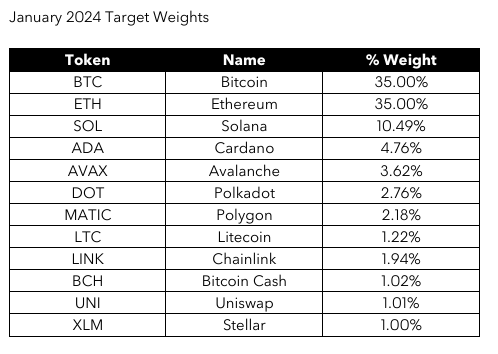
The ruling allowed major U.S. exchanges, including Coinbase, to bring XRP back to their platforms. Still, Bloomberg kept XRP off the list at that point. Instead, Bitcoin and Ethereum each held 35%, while Solana and Cardano received 10.49% and 4.76% respectively.

Bloomberg Galaxy Crypto Index Weights for January 2024

Notably, the latest update has changed this. As of August 2025, Bitcoin and Ethereum still hold the maximum 35% each, but XRP now takes 14.19%. This places it ahead of Solana at 7.56% and Cardano at 2.19%. Other cryptocurrencies in the index, including Sui, Chainlink, Avalanche, Stellar, Litecoin, and Bitcoin Cash, each hold 1%.

XRP Rejoins the BGCI

XRP’s current position at the third spot of the index reflects its current market standing. For context, XRP currently has a market cap of $176.2 billion, ranking it as the third-largest crypto asset. This is an impressive improvement from a year ago, when XRP ranked seventh, with a market cap of just $29.8 billion.

Eric Trump No Longer Joining Alt5 Sigma Board of Directors

0

Eric Trump will no longer be joining the board of fintech firm Alt5 Sigma, despite earlier announcements linking him to a multibillion-dollar crypto fundraising deal with World Liberty Financial.

Alt5 Sigma, a fintech company, disclosed in a filing with the U.S. Securities and Exchange Commission (SEC) that it has withdrawn Trump’s nomination as a director. 

According to Forbes, the decision followed consultations with Nasdaq to ensure compliance with its listing rules. However, the company did not specify which requirement prompted the reversal.

High-Profile Debut Turns Uncertain

Just weeks ago, Eric Trump and Donald Trump Jr. appeared alongside World Liberty Financial executives at the Nasdaq MarketSite in New York, celebrating Alt5 Sigma’s $1.5 billion private fundraising plan. 

The initiative aimed to raise funds through share sales, which would then be used to purchase WLFI tokens, the digital asset issued by World Liberty Financial.

A Trump-affiliated business, which controls about 38% of WLFI, is also entitled to receive up to 75% of the proceeds generated from token sales, giving the family a substantial stake in the venture.

In the revised SEC filing, Alt5 Sigma named Zachary Witkoff as its incoming chairman and director nominee. Meanwhile, Eric Trump and Zachary Folkman were downgraded to board observers without voting rights.

Trump Family Wealth Rising Through Crypto Projects

Since Donald Trump returned to office in January, his family’s fortune has surged, powered largely by cryptocurrency ventures.

World Liberty Financial is the most prominent of these projects, serving as the cornerstone of their digital investments. Another high-profile initiative is Official Trump, a personal memecoin promoted directly as Donald Trump’s own token. The family also supports American Bitcoin, a mining company that recently secured a Nasdaq listing.

In addition, Trump Media & Technology Group, which owns Truth Social, has strengthened the family’s presence in the digital economy.

Over the past week, American Bitcoin shares began trading publicly, adding momentum to the family’s financial profile. 

At the same time, World Liberty Financial unlocked 24.6 billion WLFI tokens. That release temporarily boosted the valuation of the Trump family’s stake to nearly $5 billion, highlighting the extent to which crypto has become central to their wealth.

World Liberty Financial Faces Investor Scrutiny

While the Trump family benefits from crypto, World Liberty Financial has attracted controversy among some investors.

Several token holders reported that their WLFI assets were suddenly locked. The company cited “high risk” wallet designations as the reason.

Tron founder Justin Sun, one of WLFI’s largest backers, also faced issues. Sun revealed that his wallet address was blacklisted after he moved 50 million WLFI tokens to the HTX exchange.

The incident raised concerns about transparency and user protections. In response, at least one investor proposed opening the matter to a governance vote, allowing token holders a direct say.