Home Blog Page 541

Kazakhstan to Launch Strategic Crypto Reserve and Build ‘CryptoCity’ in Alatau

0

Kazakhstan President Kassym-Jomart Tokayev has announced the creation of a National Digital Asset Fund and confirmed plans for “CryptoCity” in Alatau, where residents will be able to make everyday payments using cryptocurrencies.

In his annual address to the nation, President Tokayev outlined a bold vision for the country’s financial future. A central pillar of this vision is the establishment of the National Digital Asset Fund, to be administered by the Investment Corporation of the National Bank.

This state-backed fund will build a strategic reserve of digital assets, focusing on high-potential cryptocurrencies poised for significant growth.

Tokayev emphasized that this reserve will be part of Kazakhstan’s new digital financial system. It aims not only to bring bank money back into the economy but also to increase long-term returns.

Tokayev Pushes for Digital Asset Legislation

To support these initiatives, Tokayev instructed the Agency for Regulation and Development of the Financial Market to prepare a comprehensive law on digital assets. The law is expected to be ready by 2026, paving the way for the regulation of digital assets. It will establish a legal framework for the use, investment, and oversight of cryptocurrency in the country.

According to the president, having a clear legal foundation is critical to building trust among investors. It also ensures that Kazakhstan can compete in the rapidly growing global digital asset market.

Kazakhstan Advances with CryptoCity in Alatau

Building on the national fund and the upcoming legal framework, Tokayev confirmed the creation of “CryptoCity” in Alatau, a town in southeastern Kazakhstan. The project, first hinted at earlier this year, has now been formally included in the government’s roadmap. It is envisioned as a showcase for how digital assets can transform daily life.

The government plans to transform Alatau into the region’s first fully digitalized city, enabling residents and businesses to make routine payments with cryptocurrency. From groceries to essential services, transactions will rely on digital assets.

“This city will represent the future of Kazakhstan,” Tokayev declared. “It must combine advanced technology with the most favorable living conditions.” 

By moving forward with CryptoCity, Kazakhstan demonstrates its intent to evolve from a mining hub into a global leader in digital adoption.

Global Trend Toward State-Backed Crypto Reserves

Kazakhstan’s move aligns with global trends, as several countries are exploring the creation of national cryptocurrency reserves. The United States, under an executive order signed by President Donald Trump, has advanced plans to hold Bitcoin and other digital assets as part of its strategic reserves. Similarly, Brazil and Indonesia are considering comparable measures.

For Kazakhstan, which already holds a strong position in the cryptocurrency industry, establishing a strategic digital asset reserve could strengthen its economic resilience and global standing.

Strength in Bitcoin Mining, But With Challenges

Kazakhstan is no stranger to cryptocurrency. Over the past few years, the country has emerged as a major hub for Bitcoin mining. At its peak, it contributed roughly 13% of the global Bitcoin hashrate.

The country’s relatively low electricity costs and favorable regulations have attracted both local and foreign miners. However, this rapid growth has not come without problems. Authorities have struggled with illegal mining operations that consume vast amounts of power, putting stress on the national grid.

Tokayev’s new initiatives indicate a shift from being solely a mining powerhouse. They point toward a broader vision of a comprehensive digital asset economy with stronger regulation and oversight.

Coinbase Drops Out of the Top 10 Exchanges Holding XRP

0

The XRP reserve of prominent US-based cryptocurrency exchange Coinbase has continued to dwindle, with the unexplained dump sparking controversy.

“XRP Liquidity” called the community’s attention to yet another Coinbase XRP reserve drop. Notably, the subject has been raising eyebrows among XRP enthusiasts, particularly due to the exchange’s pedigree in the sector.

Coinbase Drops Out of Top 10

Yesterday, the account shared that Coinbase has now dropped out of the top 10 exchanges with the largest XRP reserve. This marks a rapid decline, especially from a platform that was the fifth-largest XRP holder among exchanges just over two months ago.

For context, XRP Liquidity shared on June 20 that Coinbase ranked fifth in the list of exchanges holding the token, with a stash of 884.3 million XRP at the time. Interestingly, yesterday, he shared that Coinbase now holds 132.4 million, an 85% drop within a short time frame.

Currently, the top 10 rankings include Upbit (5.871 billion XRP), Binance (2.822 billion XRP), Uphold (1.739 billion XRP), Bithumb (1.655 billion XRP), and Bitbank (575 million XRP). Others include Coincheck (555.4 million XRP), eToro (472.3 million XRP), Crypto.com (378.7 million XRP), Coinone (295.18 million XRP), and the recent entrant, Kraken (185.13 million XRP).

Meanwhile, Coinbase remains in focus. An earlier report from The Crypto Basic showed that it held 199 million XRP, with “XRP Liquidity” confirming it was as close as September 1. Yesterday, that figure dropped to 132.4 million, representing a 67.07 million XRP ($200 million at the current market price) decline in reserve over seven days.

Notably, another report also spotlighted a $52.68 million XRP transfer from Coinbase yesterday. Nonetheless, on-chain analysis shows it was a mere internal XRP transfer.

Allegations of Coinbase Manipulating XRP Price Intensify

What has triggered speculation about the 85% reserve drop is the absence of an official statement from Coinbase. Some even claimed that it was intentional and a well-crafted act to suppress XRP’s bullish price action, but these are still mere allegations.

For perspective, Stern Drew called the suspicious pattern a blatant XRP price manipulation, particularly as it coincided with a period of sideways price trend for the token. The XRPL native token dropped from its high of $3.66 in July to $2.7 last week before the recent recovery push.

Furthermore, he also alleged that Coinbase’s relationship with the Ethereum Foundation was part of this suppression theory. Again, he suggested that it was a broader conspiracy on Wall Street to keep the XRP price low, allowing institutions to buy it at a lower price.

Nonetheless, none of these claims carries verified proof; hence, they remain mere allegations. However, Coinbase’s sales continue to create mixed reactions within the crypto community.

Cardano Founder Predicts Bitcoin DeFi TVL Will Surpass Ethereum Entire Market Cap

0

Cardano founder Charles Hoskinson has raised eyebrows with his latest remarks on the future of decentralized finance, warning that Bitcoin could overthrow Ethereum as the leader of the sector. 

The Cardano founder made this bold assertion in an interview, where he commented on the future of DeFi and the potential role Bitcoin could play in the sector. Despite Ethereum being the hub for DeFi, Hoskinson argued that it is not the ultimate leader in decentralized finance.

Bitcoin is the Sleeping Giant of DeFi

He calls Bitcoin the sleeping giant of DeFi, given that the blockchain network has yet to develop its DeFi ecosystem. Hoskinson suggested that when Bitcoin eventually integrates DeFi capabilities, its total value locked could reach billions of dollars.

In his view, Bitcoin’s TVL will surpass the market cap of Ethereum, which currently stands at $520.78 billion.  For context, Ethereum’s TVL stands at $91 billion as of today.

According to him, Bitcoin will attract far more liquidity than Ethereum currently sees in the sector. In addition, Hoskinson predicted that sovereign entities and institutions, including BlackRock, will build on Bitcoin rather than Ethereum.

“Cardano, Not Ethereum, Should Power Bitcoin DeFi”

Further, Hoskinson contended that there is no compelling reason to leverage Ethereum-based solutions to power Bitcoin DeFi. He argues that the inherently adversarial relationship between the two blockchains makes it unlikely for Ethereum to serve as the backbone of Bitcoin’s DeFi ecosystem.

Instead, Hoskinson believes that alternative blockchains, such as Cardano, or Layer-2 solutions, like Stacks, are better positioned to support Bitcoin DeFi.

Hoskinson has consistently maintained that Bitcoin will ultimately take the lead in the DeFi space, surpassing both Ethereum and Solana in the process. He is also working to ensure that Cardano becomes the enabler of Bitcoin’s DeFi solution.

Progress So Far on Bitcoin DeFi

This initiative, which began last year, saw Cardano’s development arm, EMURGO, team up with BitcoinOS to introduce DeFi solutions to the premier blockchain.

Following the partnership, Hoskinson revealed plans to revive the Bitcoin Education Project and also train developers on leveraging Aiken, a Cardano programming language, to build and deploy smart contracts.

The goal is to educate Bitcoin developers on how to utilize Aiken, enabling them to create hybrid applications that bridge the Cardano and Bitcoin ecosystems.

In a February podcast, Hoskinson noted that Cardano’s Babel fees could enable Bitcoin holders to tap into the growing DeFi economy without leaving the Bitcoin ecosystem. He also highlighted the potential role of Cardano’s privacy-focused sidechain, Midnight, in supporting Bitcoin DeFi by allowing users to stake their BTC without having to wrap it.

Further advancing this vision, Cardano’s light wallet, Lace, introduced BTC support earlier this year, allowing users to send, receive, and manage their Bitcoin directly within the platform. This integration also allows users to swap native BTC with other Cardano-based assets.

Interestingly, analysts suggest the project could also benefit Cardano significantly, with some forecasting that enabling Bitcoin DeFi might push ADA’s price above $20

Analyst Says Boring Shiba Inu Accumulation Ends in Explosion, but Most Will End Up Chasing the SHIB Top Again

0

An analyst has suggested that the boring Shiba Inu accumulation will soon translate to a price explosion, leaving the unexposed to chase the top.

Specifically, “Polaris_xbt” shared this bullish Shiba Inu sentiment in an X post today, as the dog-themed, light-hearted meme coin shows signs of bullish development. It recorded its second consecutive daily green candlestick on Monday with its 3.12% uptick, marking the start of what many believe will be an explosive northward trajectory.

Boring Shiba Inu Accumulation to Translate to Fireworks

The market enthusiast shared that there has been plenty of time to acquire Shiba Inu following its period of price accumulation. Notably, the meme coin trended between $0.000016 and $0.000010 for most of the last seven months.

During this time, Shiba Inu retested the major weekly support at $0.00001 multiple times. It dropped to the zone in April and June, with bulls stepping in to push prices higher during the attempts.

Moreover, Shiba Inu’s recent trend around the support mirrors its trend during the 2022-2023 bear market. SHIB accumulated around the zone during the harsh market conditions before its March 2024 breakout to $0.00004567.

As a result, Polaris_xbt suggested that Shiba Inu was reaccumulating at the old range, which could set the stage for a similar breakout. He highlighted that such “boring” price accumulations usually precede an explosive move, and it could be the case for Shiba Inu soon.

Analyst Shares Shiba Inu Price Target

As such, the market analyst urged the unexposed to accumulate Shiba Inu now or end up chasing the market top when the fireworks start. He also predicted the price target for SHIB when it finally breaks out from its consolidatory phase.

The accompanying chart shows that SHIB would target a rally to an 18-month high of $0.00003396. Remarkably, this culminates in a 165.7% price growth from its current price of $0.00001278. It also means a retest of the December 2024 price peak of $0.00003343.

Shiba Inu Price Accumulation

Growing Confidence that Shiba Would Surpass $0.000030

Interestingly, the analyst is not alone in this price outlook, as several others have predicted a similar target. For instance, GehavianGoals shared in a July prediction that Shiba Inu will fly to $0.0000335.

Analyst Javon Marks also shared a similar price prediction, projecting a massive Shiba Inu price reversal to reach $0.000032. He cited a bullish divergence on the SHIB chart as a catalyst for this rally.

Meanwhile, on-chain data shows that Shiba Inu faces several supply clusters between the current price and $0.000035. The token must overpower them if it will reach the projected target.

Here’s What XRP Price Would Be If Its Market Cap Reached Elon Musk’s Net Worth

0

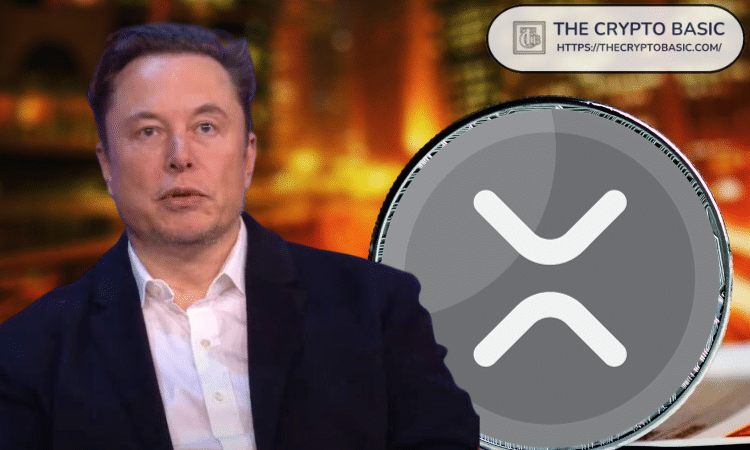
XRP stands to gain massively if its valuation rises to the level of the current richest man in the world—Elon Musk.

Currently, XRP boasts a market capitalization of $168 billion with a price of $2.90, making it the third-largest cryptocurrency. The only cryptos ahead of XRP are Ethereum and Bitcoin, with market caps of $537 billion and $2.17 trillion, respectively.

Many believe XRP is significantly undervalued at its current position. They continue to project future valuations where XRP would be worth much more. 

Based on this popular sentiment within the XRP community, this article explores the potential valuation of XRP if its market cap were to match Elon Musk’s net worth.

XRP and Elon Musk’s Net Worth

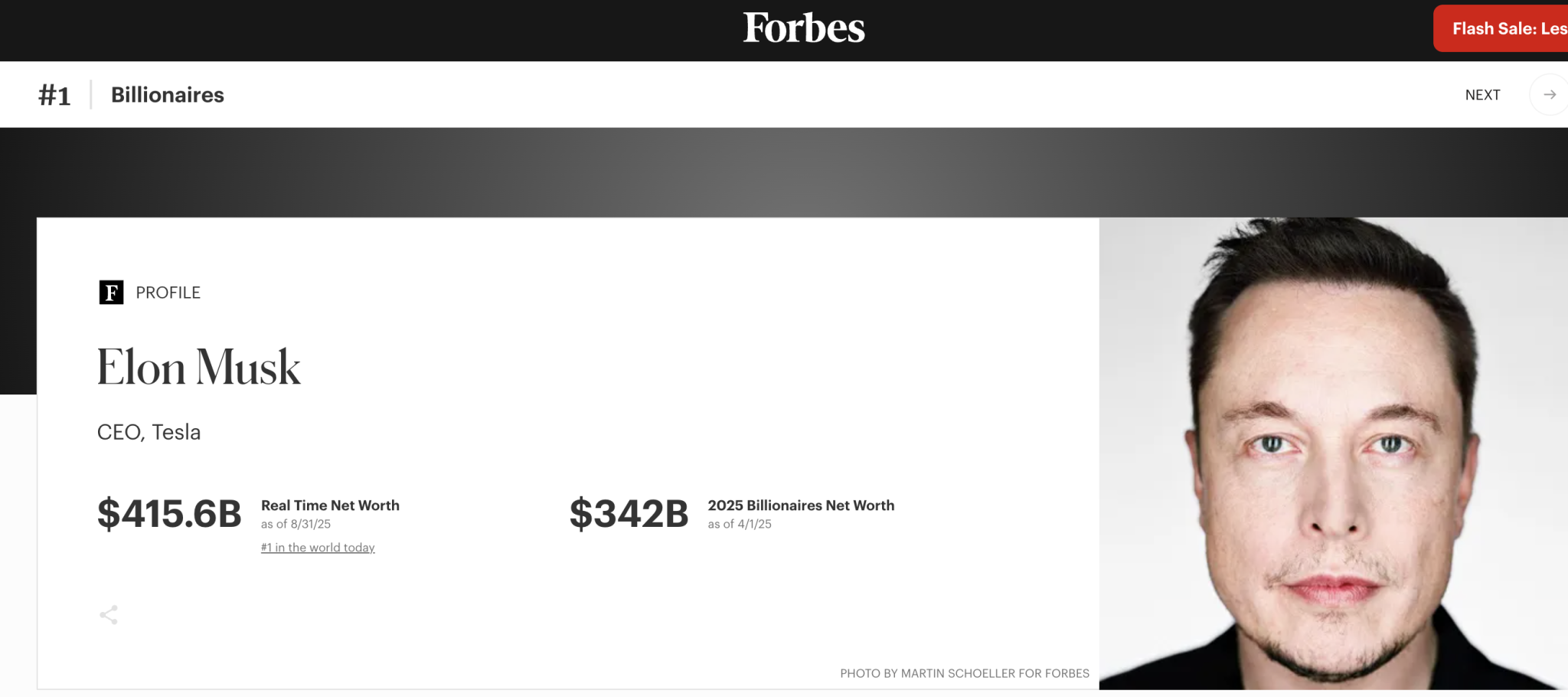
According to Forbes, Elon Musk’s real-time net worth is $415.6 billion, making him the richest person in the world. Notably, Musk accumulated his wealth through seven companies he co-founded, including SpaceX, Tesla, and xAI.

He owns about 12% of Tesla (excluding options), although over half of that is pledged as loan collateral. Musk also holds a 42% stake in SpaceX, which was valued at $350 billion in late 2024. 

In 2022, he acquired Twitter (now X) for $44 billion, though its value had dropped nearly 70% as of August 2024. Additionally, Musk owns 54% of xAI, which was valued at $50 billion in November 2024.

It’s worth noting that Tesla is one of the top 11 public companies holding crypto, with a Bitcoin portfolio exceeding $1.2 billion. Given X’s planned rollout of payment integration features, speculation has emerged within the XRP community that XRP could potentially be adopted as the underlying blockchain.

As TRIBLU Founder Joshua Dalton tweeted in June, Elon Musk “will do anything” to make XRP the chosen one.

However, Musk himself has not shown any clear interest in XRP. In October last year, he did mention XRP publicly—but only in response to a question during a Trump campaign event. Nonetheless, the XRP community continues to push for Musk to endorse the coin.

What Would XRP Price Be at Musk’s Net Worth?

Currently, Musk’s net worth of $415.6 billion is roughly 2.5 times larger than XRP’s market valuation of $168 billion. Given XRP’s circulating supply of 59.48 billion tokens, a market cap equivalent to Musk’s net worth would result in an XRP price of approximately $7 per token.

Elon Musk Net worth | Forbes

Considering XRP’s all-time high of $3.84, this projected price would mark a historic new peak. Notably, XRP only needs to soar by 150% from its current position to reach $7 price and match Musk’s wealth. 

When Could XRP Reach This Level?

According to several analysts and voices within the crypto community, the $7 price point could materialize this year. For instance, widely followed crypto commentator Mario Nawfal predicted that XRP could reach $10 by December. Interestingly, this valuation would give XRP a market cap that far exceeds Musk’s current net worth.

Another community member, Alex Cobb, believes a $22 price is achievable by December. This price would give XRP a valuation of $1.3 trillion, setting it to rival the valuations of Facebook and Saudi Aramco.

Here’s How High XRP Must Close For Bulls To Take Over

0

Amid the ongoing XRP price struggles, a notable market strategist has shared where XRP must close above before bulls can take control.

Notably, XRP has staged a recovery move on the back of a recent rebound push across the crypto market. While some altcoins like Ethereum (ETH) have failed to join this campaign, XRP has taken advantage of it to soar 5.69% over a 7-day timeframe to the $2.95 level.

Amid this rebound effort, analyst EGRAG Crypto has called attention to the level XRP must close above before bulls can take full control of the market. In his report, he called the recent correction, which dragged XRP to a $2.7 low earlier this month, a “throwback.”

XRP Must Cross the 33 SMA

According to EGRAG, as a recovery campaign emerges, XRP must decisively close above the $2.94 price level and further breach above the 33-day simple moving average (SMA). To him, this will represent early signs that the bulls are starting to take charge.

Interestingly, XRP fulfilled only one of these conditions yesterday. Specifically, it closed Sept. 8 at $2.9694, slightly above the $2.94 mark. This represented its highest intraday close in two weeks and the highest in September. 

XRP 1D Chart EGRAG Crypto
XRP 1D Chart | EGRAG Crypto

However, despite closing above the $2.94 level highlighted by EGRAG, XRP has not yet pushed above the 33-day SMA. Recall that this is the second condition necessary for the arrival of the bulls. This 33-day SMA, which stood at $2.9962 yesterday, mounted resistance to the upward push, preventing XRP from crossing the $3 psychological mark.

Currently, the 33-day SMA sits at $2.9853, while XRP trades for $2.9616. EGRAG’s analysis suggests that XRP must cross above the $2.985, aligning with the 33-day SMA, essentially reclaiming the $3 mark before the market can see signs that the bulls are regaining control. 

According to the analyst, should this happen, XRP would be on track to finish the throwback. He confirmed that if the market takes this direction, then the $2.7 low from Sept. 1 would represent the bottom of the latest correction or throwback.

Further Conditions and the Go-Go Signal

He then suggested that after XRP breaches the 33-day SMA, a subsequent development that would further confirm that the market is flipping bullish is a push above the 55-day SMA. Currently, this moving average sits at $3.066, and represents the next pivotal level just after the 33 SMA.

Meanwhile, EGRAG identified the $3.4 price level as the final level to breach for the bulls to take full control. He called this region the “Go-Go Signal,” aligning with the previous January 2025 peak from which XRP slumped into a months-long consolidation. EGRAG believes XRP will have a full launch once it breaks above the level. Data from his chart shows he sets an initial target above $4.2.

However, he warned of the possibility of continuing the ongoing throwback despite the recent recovery effort. According to EGRAG, if XRP shows weakness within the $2.94 to $3 level, which it now trades at, the correction will likely continue.

Interestingly, as conditions continue to improve, market watcher Gordon is rather bullish on XRP. In his recent commentary, he pointed out that XRP has consolidated around its current position for a long time, and a push to $6 will likely emerge.

HYPE Breaks All-Time High as Lion Group Dumps Solana and SUI for Hyperliquid

0

Nasdaq-listed Lion Group Holding is making a major adjustment to its crypto asset treasury, disclosing plans to liquidate its Solana and SUI holdings to purchase the HYPE token.

In a press statement today, the firm said it will be reallocating all of its SOL and SUI tokens to acquire Hyperliquid (HYPE).

The move follows BitGo Trust Company’s launch of institutional custody services for HYPE in the United States, an event the firm sees as a critical step toward massive adoption. As a result, Lion Group believes now is the ideal time to go all-in on Hyperliquid to capitalize on what lies ahead.

Gradual Sale and Accumulation Over Time

However, rather than making a one-time conversion from SOL and SUI, the company plans to accumulate HYPE gradually. This strategy aims to smooth out acquisition costs during volatile market conditions while positioning Lion Group to secure HYPE tokens at favorable prices.

The company described the shift as part of its long-term approach to both risk management and value creation.

Hyperliquid’s Appeal

The decision reflects growing interest in Hyperliquid, a blockchain-based decentralized perpetual futures exchange built around an on-chain order book model. Lion Group’s leadership highlighted the platform’s trading efficiency and scalability as major factors in their decision.

Wilson Wang, CEO of Lion Group Holding, expressed confidence in HYPE, calling it one of the most promising opportunities in the decentralized finance space.

Meanwhile, the company remains committed to exploring further opportunities in the crypto sector and has pledged to keep stakeholders informed through periodic updates. It frames this transition as part of its mission to expand trading solutions for both corporate clients and retail investors.

HYPE Price Reacts

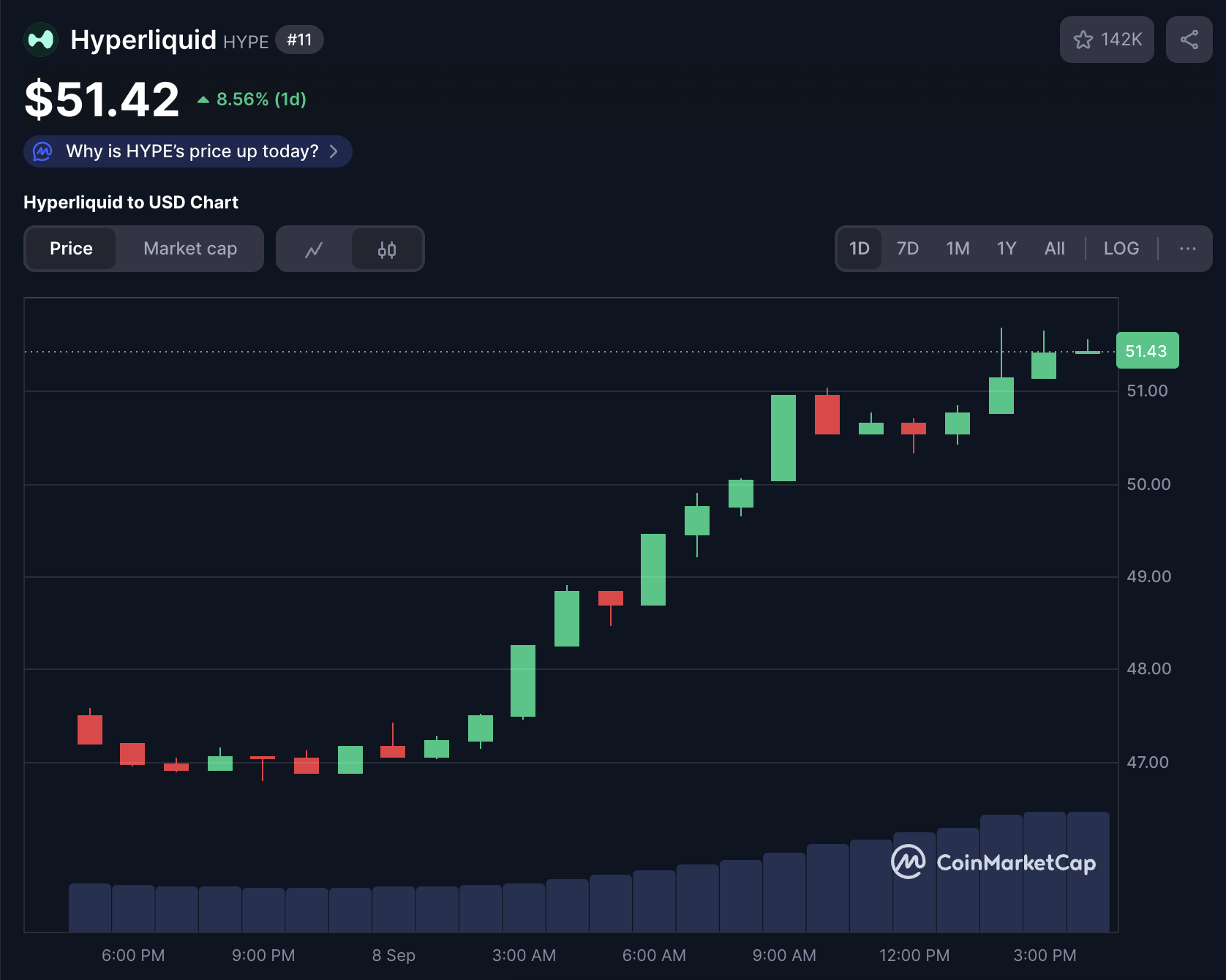
Lion Group Holding’s announcement to acquire the HYPE token using proceeds from Solana and SUI sales has coincided with a major run for the coin. Specifically, HYPE is up 8.56% at press time, trading at $51.42.

Interestingly, it hit an all-time high of $51.68 just an hour ago, now ranking as the 11th largest cryptocurrency, overtaking Chainlink.

Hyperliquid (HYPE) chart | CoinMarketCap

Notably, HYPE has been one of the top-performing tokens since last year. It saw an all-time low of $3.20 just nine months ago but has since surged by 1,507%, reaching over $51.

Grayscale Becomes Second to File for a Chainlink ETF

0

Grayscale Investments has become the second asset manager to file for a Chainlink exchange-traded fund (ETF). 

The firm submitted its registration for the Grayscale Chainlink Trust on Sept. 5, 2025, moving closer to bringing LINK, the native token of the Chainlink network, into the ETF market.

Details of the Grayscale Chainlink ETF Filing

The filing shows that the Trust, which Grayscale set up in December 2020, plans to rebrand as the Grayscale Chainlink Trust ETF once regulators give the green light. Notably, Grayscale plans to list the product on NYSE Arca under the ticker GLNK.

The asset manager designed the Trust to let investors gain exposure to LINK without holding the token directly. For context, each share will represent a fraction of the Trust’s LINK holdings. 

The filing names Coinbase Custody Trust Company as custodian, The Bank of New York Mellon as administrator and transfer agent, and Coinbase as prime broker. 

Its structure allows authorized participants to create or redeem shares in blocks of 10,000, called baskets, by delivering Chainlink. This creation-and-redemption process helps keep the ETF’s market price in line with its net asset value through arbitrage.

Moreover, the filing also sets the sponsor’s annual fee at 2.5%, payable in LINK. Grayscale will cover most operating costs up to $600,000 a year, but the Trust itself must cover extraordinary expenses like unexpected legal or tax bills. Importantly, this could force the Trust to sell LINK at unfavorable times. 

Meanwhile, another detail worth noting is that the Trust cannot stake LINK yet because it has not met the required conditions. This leaves price performance as the only source of potential gains for now.

Grayscale, Other Firms Pushing for Altcoin ETFs

Notably, it bears mentioning that Grayscale is not first to the table. Specifically, Bitwise Asset Management submitted its own application for a Chainlink ETF on Aug. 26. Bitwise also plans to track LINK’s price and will use Coinbase Custody as custodian.

The new filing comes as Grayscale pushes deeper into altcoin ETFs. Earlier this year, the company filed for Cardano and Polkadot ETFs. 

It registered both trusts in Delaware earlier in August, and the Cardano product, set to trade as GADA on NYSE Arca, awaits an SEC decision next month, in October. Grayscale’s Polkadot trust is also under review.

Grayscale further filed for a Dogecoin ETF, entering a crowded race with Bitwise and Rex-Osprey. The firm also registered a Hedera trust in Delaware. In addition, Grayscale submitted paperwork to convert its Solana Trust into an ETF. Its XRP Trust is also seeking conversion, joining multiple other pending XRP ETF applications.

Besides Grayscale, other asset managers such as WisdomTree, 21Shares, Bitwise, and Canary Capital have filed for multiple altcoin ETFs, with most of these products having deadlines in October.

Prediction markets show growing confidence that regulators will approve these products. At press time, Polymarket odds for Cardano ETF approval in 2025 stand at 87%, while XRP approval chances have climbed to 93%.

Nasdaq Seeks SEC Approval to Trade Tokenized Securities

0

Nasdaq is seeking regulatory approval to trade tokenized securities, a move that could bridge the Wall Street and blockchain.

The proposal, filed with the SEC, would allow stocks and exchange-traded products to be listed in either traditional or tokenized form. If granted, it would be the first time investors could trade blockchain-settled securities on a major American exchange.

How Tokenization Fits into Wall Street

Tokenization is the process of converting financial assets, such as stocks, bonds, or real estate, into digital tokens. These tokens can then be traded on blockchain systems, often promising faster settlement and improved transparency.

Nasdaq argues that tokenization can work within existing frameworks without undermining investor protections. 

In its filing, the exchange stressed that tokenized instruments must carry the same rights and privileges as traditional securities. If these conditions are met, tokenized and traditional assets would share the same order book and follow identical execution rules. If not, Nasdaq will treat tokenized assets as distinct instruments with separate trading conditions.

Regulatory Shifts Supporting Change

The proposal comes as the SEC reviews its regulatory stance on cryptocurrencies and tokenized products. Chair Paul Atkins has been leading an effort to simplify crypto-related rules that Wall Street considered too restrictive.

Last week, the SEC listed updates to its rulemaking agenda, signaling possible amendments that would allow crypto trading on national exchanges. This regulatory shift is seen as an opportunity for traditional financial institutions to expand into blockchain-based settlement.

Rising Demand and Global Momentum

Investor appetite for tokenized products is growing worldwide. Proponents say the technology can unlock liquidity, reduce settlement times, and lower transaction costs.

Coinbase, America’s largest cryptocurrency exchange, has already asked the SEC for permission to offer tokenized equities to its customers.

Major banks, including Bank of America and Citi, are considering the launch of tokenized assets, such as stablecoins and other blockchain-based financial products.

Globally, tokenized securities have already begun trading on several European platforms. However, Nasdaq has criticized these systems for offering exposure to U.S. equities without granting investors actual share ownership.

Regulatory Concerns and Safeguards

While enthusiasm is high, regulators remain cautious about potential risks. Some warn that tokenization could add new vulnerabilities if oversight is weak. In July, SEC Commissioner Hester Peirce, known for supporting crypto innovation, clarified that tokenized securities must still adhere to existing securities laws. 

Nasdaq aligned its proposal with that view, stressing that any integration of blockchain will occur inside the national market system. The exchange also noted that avoiding regulatory protections is not in the best interests of investors.

Nasdaq’s filing states that tokenized securities must provide the same material rights as traditional securities. This includes voting rights, dividend entitlements, and legal protections.

Without these guarantees, tokenized assets would not be considered equivalent and would trade separately. The approach is designed to ensure tokenization enhances efficiency without weakening investor safeguards.

Timeline for Implementation

If regulators approve the plan, the first tokenized securities could trade in the United States by late 2026.

Nasdaq stated that the rollout depends on the Depository Trust Company, which is developing the necessary clearing infrastructure. Once operational, investors could buy shares that settle directly on the blockchain, without changing how orders are routed or reported.

The development would represent a landmark in modernizing U.S. markets, blending traditional protections with digital innovation.

Michael Saylor Predicts Bitcoin Price by Christmas 2025

0

Strategy Executive Chairman Michael Saylor revealed that most equity analysts expect Bitcoin to surpass $150,000 by Christmas. 

With just three months left before Christmas, industry stakeholders have been predicting Bitcoin’s price for the yuletide season. Notably, Michael Saylor joined the trend today during his appearance on CNBC’s Squawk Box. 

Bitcoin at $150K This Christmas 

The executive chairman disclosed that most equity analysts already expect Bitcoin to surpass $150,000 by Christmas, signaling confidence in BTC’s prospects among industry stakeholders. From the current price of $112,210, Bitcoin must rise 33.67% to hit the $150,000 target. 

He suggested that the upcoming surge will be driven by increased adoption of Bitcoin. Saylor noted that as more people learn about Bitcoin, more companies will include it in their balance sheets, potentially driving up its demand. 

Further, he emphasized that since Bitcoin has a fixed supply, this rising demand will push the price higher, potentially surpassing the $150,000 mark. 

Lee Sets $200K Price Target for Bitcoin

It is worth noting that Saylor issued this bold forecast in response to an earlier prediction from Tom Lee, the Head of Research at Fundstrat Global. 

In the interview, Lee emphasized Bitcoin’s sensitivity to monetary policy, noting that the September 17 FOMC meeting—where the Fed is expected to cut interest rates—could be a major catalyst for the next BTC rally. 

He pointed out that Bitcoin has historically performed well in the fourth quarter, and this year will be no exception. Therefore, he predicted that Bitcoin would reach $200,000 by Christmas 2025 (December 25).

Interestingly, Lee also envisions a broader market rally, projecting that small-cap crypto assets could post substantial gains. He argues that the positive performance of small-cap cryptos could be bullish for Ethereum, given ETH’s historical correlation with these tokens. 

Bitcoin to $150K-$200K Predictions 

Meanwhile, several analysts have predicted that Bitcoin will rise to the $150,000-$200,000 target this year. Last month, Canary CEO Steven McClurg stated that the odds of Bitcoin reaching $150,000 this year are at 50%. 

Leading research company Steno also predicted that Bitcoin will climb $150,000 by year-end. Interestingly, Standard Chartered is among the leading entities that consider $200,000 a realistic target for Bitcoin in 2025. 

At the time of writing, Bitcoin was trading at $112,210, representing a 0.83% increase over the past 24 hours.