Home Blog Page 566

Analyst Says Time Is Running Out, Shiba Inu Close to Price Explosion

0

TradingView analyst Hamidemo believes time is running out to seize the current opportunity to buy Shiba Inu (SHIB) at a discount.

He suggests that SHIB is preparing for a decisive move after spending more than a year consolidating within a massive triangular pattern. According to Hamidemo, SHIB is approaching the final stages of compression on the weekly timeframe.

Indeed, SHIB has been one of the worst-performing top-ranked crypto assets in recent times. Currently trading at $0.00001246, Shiba Inu has recorded a 10% loss over the past year, during which Bitcoin’s price has surged by 90%.

Hamidemo’s chart confirms SHIB’s underperformance but also offers hope for a turnaround. It highlights a descending resistance line that has consistently capped upside moves since 2021, now converging with a support base. This setup suggests a breakout from the downtrend is imminent. The analyst noted: “Tik tak… time is running out.”

Shiba Inu Could See 528% Upside from Here

According to Hamidemo’s chart, the expected Shiba Inu breakout could result in a price surge of over 528%. This would push SHIB’s price to $0.00007837, approaching its all-time high region.

However, along the way, Shiba Inu must overcome key resistance levels at $0.00002381 and $0.00003300, levels it failed to breach in January.

Resistance also extends to $0.00004601, around where SHIB lost momentum in March 2024. Beyond this point, there are no significant hurdles until the next resistance at $0.00006589, a level last seen in 2021.
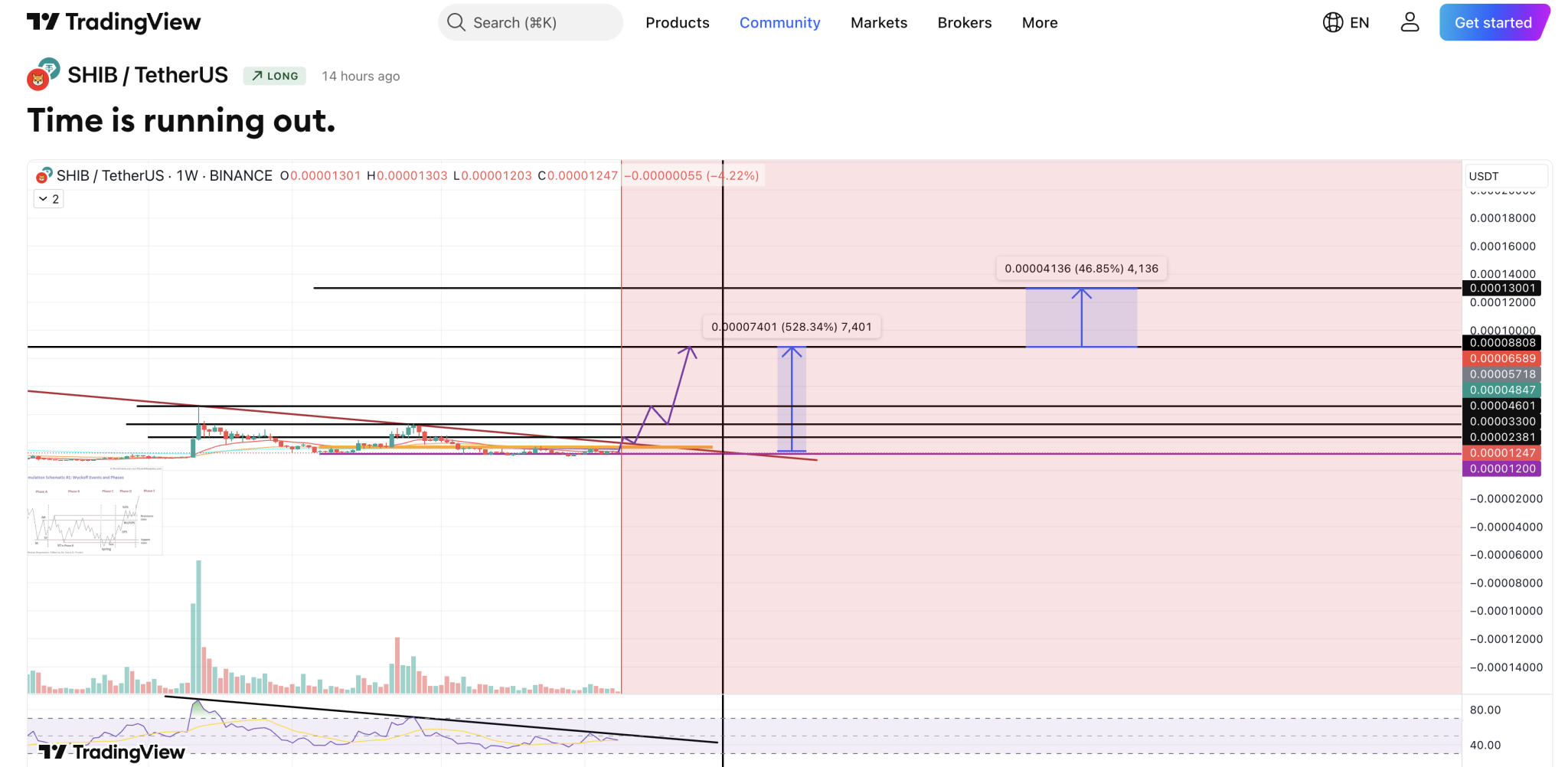
Hamidemo’s Shiba Inu weekly chart

$0.00011 Price on the Table

Interestingly, Hamidemo has an even more ambitious outlook for SHIB beyond $0.00007837. He believes that once SHIB reaches $0.000078, it could still climb another 46% to hit $0.0001151. 

Achieving this would mark a historic milestone, as SHIB would effectively “cancel” another zero after several years of trading with four leading zeros.

Other Analysts Also Bullish on SHIB

Notably, this projection aligns with the long-term price forecast of analyst Javon Marks, who continues to emphasize SHIB’s potential to reach $0.00015 in the future.

In his latest commentary, Marks maintains his bullish outlook, stating that the market should watch for a 155% surge back to the $0.000032 resistance level, which could pave the way for further gains.

Many other market watchers are also optimistic about SHIB’s prospects. Shah Faisal Shah noted that while few are currently paying attention to SHIB, it will likely be among the fastest-moving assets when the breakout occurs.

Similarly, analyst Sheriff remarked that the longer SHIB remains in its accumulation phase, the more powerful its eventual breakout will be. 

As for when this promising market shift might materialize, some analysts believe meme coins will have their moment after large-cap altcoins hit new peaks.
At the Current XRP Release Rate, Here’s When Ripple Will Drain Its XRP Escrow

0

Ripple’s escrow system, designed to manage XRP supply, is gradually moving toward depletion.

As of today, Ripple has 35.6 billion XRP still locked in escrow. Projections suggest that these holdings could last another decade or less, depending on how much of each monthly release is returned to escrow.

Ripple’s Escrow Today

Ripple first locked over 54 billion XRP in escrow in December 2017, committing to a structured release of 1 billion XRP each month. The company typically re-locks a large portion of this amount to avoid market oversupply.

As of August 2025, 35,599,999,905 XRP remains in escrow across multiple wallets collectively worth $106.8 billion.

Monthly XRP Release and Re-Lock Pattern

Ripple’s escrow activity over the first eight months of 2025 has shown a consistent pattern of re-locking tokens.

From January to August 2025, Ripple released 1 billion XRP each month and re-locked 700 million XRP—except in June, when it released 1 billion XRP and re-locked 670 million XRP.

This pattern indicates that Ripple is typically utilizing 300 million XRP per month, with occasional increases to 330 million.

Projections on Escrow Depletion

The “XRP Liquidity” account, which closely tracks Ripple’s escrow activity, has shared several potential timelines based on the company’s current behavior.

According to their analysis, if Ripple continues using 300 million XRP monthly, it could run out of escrowed XRP in approximately 9 years and 8 months. With 35.6 billion XRP currently remaining, this projects a depletion date around 2035. By September 2025, after the re-lock process, the escrow balance will drop to 35.3 billion XRP.

Meanwhile, if Ripple’s usage increases to 400 million XRP monthly, the escrow could be depleted in 7.5 years, around 2033.

Conversely, if Ripple stops re-locking tokens altogether, 12 billion XRP would enter the market each year. In that case, the escrow would be fully depleted within just 3 years.

Conclusion

Ultimately, the timeline for Ripple’s escrow depletion depends on whether the company maintains its current re-lock pattern of 700 million XRP per month or shifts toward keeping more XRP in circulation.

If the current pace continues, the escrow could last close to a decade. However, if Ripple increases its monthly usage, the reserves could run out much sooner—in just three years.

This uncertainty keeps the XRP community closely watching Ripple’s monthly decisions as each release offers new clues about how long its reserves will last.

DBS Bank Rolls Out Tokenized Structured Notes on Ethereum

0

DBS, Singapore’s largest bank, has announced the rollout of tokenized structured notes on the Ethereum public blockchain.

The launch marks a significant step in its long-term blockchain strategy and underscores its commitment to bringing advanced financial instruments to a wider investor base.

Until now, such structured notes were largely available only to DBS’s private clients. By taking them to public blockchain networks, the bank is making these products more tradable and accessible.

Distribution Beyond DBS Clients

The tokenized notes will be distributed through Singapore-based digital exchanges ADDX, DigiFT, and HydraX. This marks a shift for DBS, as the bank is extending access beyond its private banking clients to a wider pool of accredited and institutional investors.

By partnering with these platforms, DBS is opening the door for investors who previously could not access structured strategies typically reserved for high-net-worth individuals.

Lowering Barriers with Tokenization

Structured notes have traditionally required a minimum investment of around $100,000, making them accessible mainly to high-net-worth investors. DBS is now reducing this threshold by tokenizing the instruments into $1,000 units.

The bank explained that this approach makes the securities fungible, easier to buy and sell, and more flexible for portfolio management. Investors can now gain exposure to complex instruments without committing to a large sum of capital.

First Offering

The first product in DBS’s tokenized range is a participation note tied to cryptocurrency markets. It delivers cash returns when digital asset prices move upward, while also including safeguards that reduce losses during downturns.

This design caters to a growing group of investors who want to combine exposure to digital assets with traditional protective features. DBS noted that demand for such hybrid solutions has been building steadily as investors seek structured ways to enter crypto markets without assuming full risk.

That demand is already showing up in trading volumes. In the first half of 2025, DBS clients completed transactions in structured notes worth more than $1 billion. The pace of activity accelerated quickly, with volumes rising by almost 60% between the first and second quarters.

Family offices and professional investors have been leading this growth. By 2024, the number of single-family offices in Singapore had passed 2,000, marking a 43% increase compared with the year before.

Singapore as a Hub for Tokenized Finance

DBS’s latest step also fits within Singapore’s wider strategy to strengthen its position as a hub for digital assets. The Monetary Authority of Singapore (MAS) is currently running several pilots through Project Guardian, which examines how tokenization could be applied across bonds, currencies, and investment funds.

Another initiative, known as Global Layer One, aims to build cross-border systems that connect liquidity from different markets. DBS has been deeply involved in these efforts, often starting with trials on private blockchain networks before moving certain projects onto public platforms.

Expansion Plans Beyond Crypto Notes

Although DBS is starting with crypto-related notes, the bank has also outlined plans to introduce tokenized products tied to equities and credit markets in the near future.

Li Zhen, who heads foreign exchange and digital assets at DBS, said the initiative signals a major step forward. According to him, tokenization is shaping the future of financial markets, and this launch will allow a wider range of investors to participate in the bank’s digital asset ecosystem and gain exposure to new asset classes.

Shiba Inu Faces Increased Selling Pressure as This Key Metric Dips Over 90%

0

Leading canine-themed token Shiba Inu is facing increased selling pressure as its burn rate has dropped significantly over the past day. 

Shiba Inu has been attempting to recover from the broader market downturn, which sent its price to a multi-week low of $0.00001206 yesterday. Shortly after the collapse, it recovered to an intraday high of $0.00001267 and suffered a slight retracement to $0.00001250. 

Shiba Inu Burn Rate Slumps Over 90%

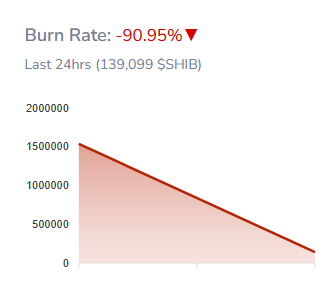
As Shiba Inu battles persistent bearish momentum, token burns have drastically reduced. Data from Shibburn shows that Shiba Inu’s burn rate has slumped by 90.95% over the past day, with only 139,099 SHIB tokens sent to the burn wallet across three transactions. 

Shiba Inu burn rate reaches 90

Many attribute the long-term value proposition of Shiba Inu to reducing its massive supply of 589 trillion tokens through burns. As the rate is now dropping, it could impact sentiment.

Notably, removing more tokens from circulation and sending them to the dead wallet contributes to Shiba Inu’s price seeing a long-term spike. As the burn activity declines, it raises supply concerns, and some investors might panic sell. 

Shiba Inu Current Performance 

In the meantime, Shiba Inu has continued to show resilience, rising from a multi-week low of $0.00001206 to $0.00001250. With a current price of $0.00001250, Shiba Inu has surged by a mere 1.57% over the past day. However, it is still down 8.15% over the past week and 16.36% over the past month. 

Investors’ momentum has waned in the past day, with the trading volume plunging by 3.08% over the past 24 hours to $197.77 million. 

Liquidation Overview 

Amid the ongoing recovery, Shiba Inu futures traders have suffered a total liquidation of $87,450 in the past day. While long positions comprised $37,450, the short ones incurred most losses at $49,990. 

Notably, investors betting on a Shiba Inu price drop (shorts) could face $746,520 in liquidations if SHIB climbs to $0.000013. Conversely, those expecting the rally to continue (longs) risk $919,610 in liquidation if the price falls under $0.000012. 

Meanwhile, several community experts remain confident in Shiba Inu’s prospects. Analyst MMB Trader projects an imminent rally to $0.00007716.

Founder of X DAO Predicts XRP Price if BNB Hits $3,300

0

Founder of X DAO, Rekt Fencer, has shared fresh Q4 2025 price targets for major crypto assets, including XRP and BNB.

His latest forecast comes as the market struggles with short-term volatility. Downplaying the growing fear among participants of a prolonged bearish trend, Fencer painted a promising outlook for crypto market leaders Bitcoin, Ethereum, XRP, BNB, and six other assets.

BNB to $3,300

According to Fencer, BNB could rise to between $2,800 and $3,300 before the end of 2025. At present, BNB is trading at $833, down 1.2% today but still up 46% over the past year.

Notably, it hit a new all-time high of $848 just six days ago, ranking it among the few crypto assets that have established new peaks this season. BNB needs an additional 4x surge from its current level to reach $3,300.

Such a surge would give BNB a market cap approaching $500 billion. This would place it among the largest global assets, such as Netflix and Mastercard.

XRP Forecast at $8.50 to $9

Alongside BNB, Fencer projected XRP to reach between $8.50 and $9 by Q4 2025. Currently, XRP is trading at $2.88, down 4.51% today.

Unlike BNB, XRP has yet to set a new all-time high but came close in July when it hit a multi-year high of $3.66. If it claims the $9 price, Fencer’s forecast would represent a tripling of XRP’s price over the next four months.

Meanwhile, this $9 outlook is a much more conservative figure compared to estimates by other commentators. For instance, Alex Cobb said XRP could reach $22 in December, which is over 8x today’s price. Ultra-bullish calls even place XRP December targets between $50 and $99.

Nonetheless, reaching $9 would grant XRP a market cap above $530 billion, positioning it close to Ethereum’s historical highs.

Bitcoin and Ethereum Targets

Fencer’s broader forecast pins Bitcoin between $215,000 and $230,000 by the end of Q4 2025. Bitcoin is currently trading at $113,636, down from a record $124,400 price set earlier this month.

For Ethereum, he predicts a move to $9,000–$12,000, compared to its current price of $4,182. This aligns with other bullish voices like Tom Lee of Fundstrat, who sees Ethereum climbing as high as $15,000 by year-end.

Outlook for Solana, Dogecoin, and More

Fencer’s forecast extends beyond the top four. Specifically, he sees Solana (SOL) reaching between $800 and $900, more than four times its current levels. As for the meme coin leader Dogecoin (DOGE), he predicts a likely range of $1 to $2.50, which would mark a historic milestone.

For Chainlink (LINK), he projects a surge to $250–$400, far above its current trading price near $24. He also highlights smaller projects such as ENA ($2–$3), PENGU ($0.70–$1), and FARTCOIN ($4.50–$6.50) as part of his end-of-year outlook.

Here’s XRP Price if XRPL Secures 20% of the Tokenized RWA by 2026

0

Amid recent commentaries, we assessed what XRP price could rise to if the XRP Ledger (XRPL) secured 20% of the tokenized RWA value by 2026.

Notably, in a recent report, Ripple called attention to the importance of crypto custody. The firm described custody as the gateway for institutions entering the market. 

It explained that proper custody gives institutions the tools to manage risk, stay compliant with regulations, and build new business models. Ripple then linked the rising demand for custody directly to the expected boom in tokenized real-world assets (RWA).

XRPL Pivoting to RWA Tokenization

Interestingly, Ripple executives and XRP community members have continued to suggest that the XRPL could become an important platform for RWA tokenization. For instance, Ripple CTO David Schwartz said in 2023 that the XRPL was shifting its focus toward RWA tokenization. 

Last month, investment manager Bitwise supported this narrative, suggesting that buying XRP could act as a straightforward way to gain exposure to the tokenization market.

Right now, tokenized RWA on-chain carries a value of $26.44 billion, according to data from RWA.xyz. Of this total, XRPL accounts for just $302.4 million, which equals just about 1.1% of the market. 

Tokenized RWA Value
Tokenized RWA Value

Meanwhile, with these metrics, XRP trades at $2.9, supported by a market cap of $172.6 billion and a circulating supply of 59.41 billion tokens. 

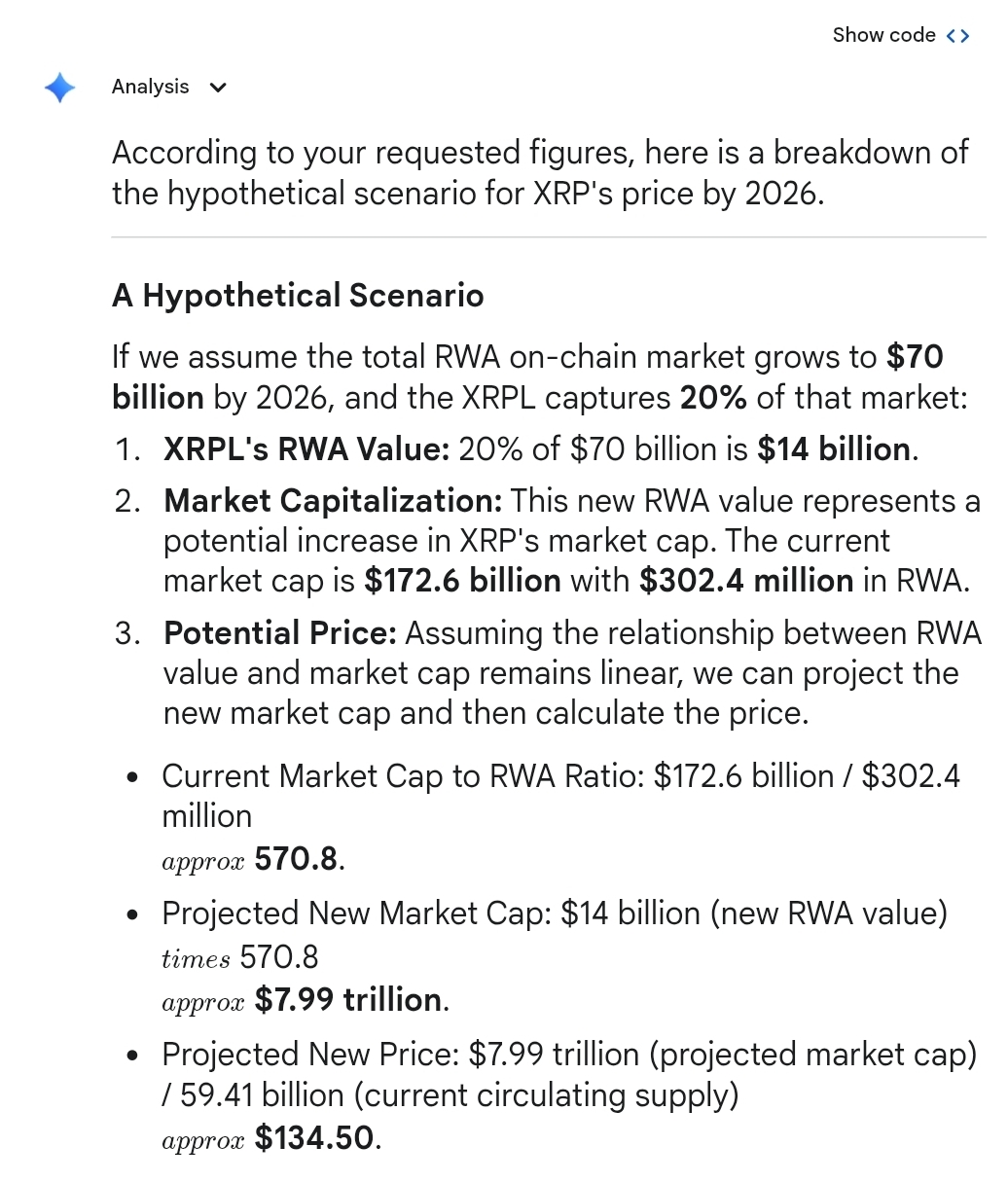
The bigger question is would there be any reasonable impact on XRP price if XRPL wins a larger slice of the RWA market in the coming years. To assess this, we asked Google Gemini what might happen if XRPL captured 20% of the market by 2026.

XRP Price by 2026 if It Captures 20% of Tokenized RWA

According to Google Gemini, there are too many unknowns to give a precise forecast. The current $26.44 billion RWA valuation will almost certainly change by 2026, which makes exact predictions impossible. Still, Gemini presented a hypothetical assessment to show the scale of what could happen.

The chatbot suggested that the total RWA value could grow to $70 billion by 2026. If the XRP Ledger captured 20% of that, its share would stand at about $14 billion. 

Gemini then used today’s market position as a reference, pointing out that XRP’s current market cap of $172.6 billion comes from only $302.4 million worth of RWA. This means the ratio of market cap to RWA exposure is about 571 to 1.

XRP Price Prediction Google Gemini
XRP Price Prediction | Google Gemini

Applying the same ratio to a $14 billion share of RWA, XRP’s market cap could rise to nearly $8 trillion. When divided across the current circulating supply of 59.41 billion tokens, this would put XRP’s price at roughly $134.5.

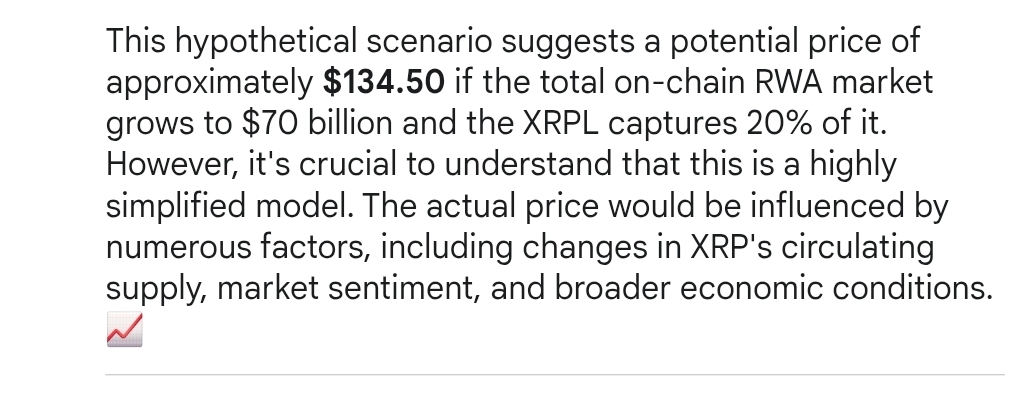
However, Gemini stressed that this example is highly simplified. The projection assumes there is linear growth between XRP price and its share of tokenized RWA, which would not be the case. For instance, the XRPL RWA value recently surged to the $302 million mark, but this had minimal impact on XRP price. It remains to be seen if a larger spike would have a reasonable impact.

Disclaimer from Google Gemini

Expert Says LINK Should Focus on Flipping Cardano Rather Than XRP

0

The rivalry between the XRP and Chainlink (LINK) crypto communities shows no signs of subsiding anytime soon.

It has centered around LINK flipping XRP, both in terms of crypto market ranking and adoption scale. The discussion intensified following a viral post suggesting that LINK’s progress toward overtaking XRP has reached the 10% milestone.

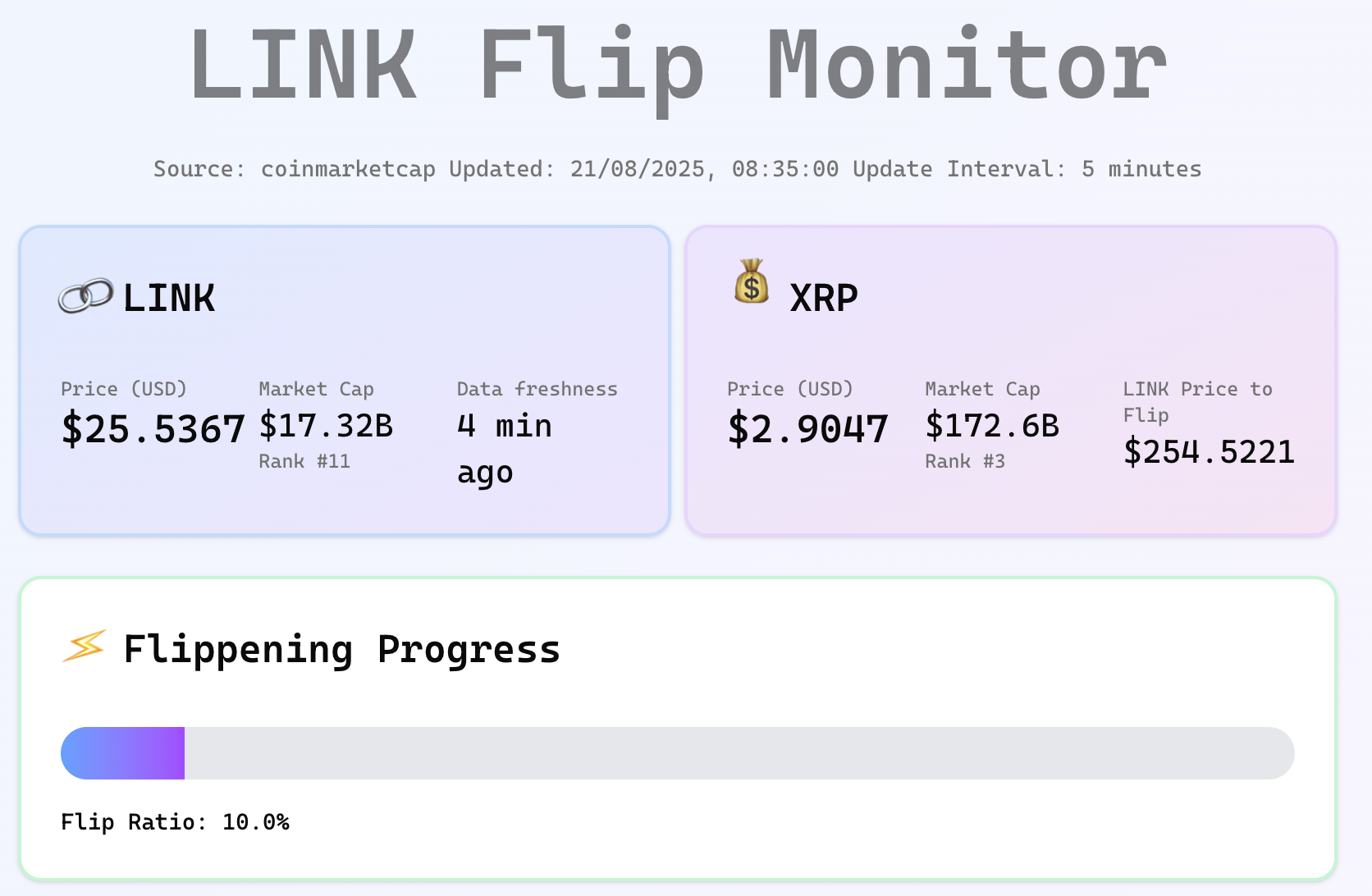
X user “Chainlink Revolution” triggered the conversation. In his tweet, he urged traders to “save their XRP gains” and rotate into LINK before the “flippening” occurs, sharing a dashboard screenshot to emphasize the momentum.

The latest data on the dashboard shows that at a price of $25.59, LINK has reached a 10% ratio in its journey to overtake XRP. While the journey remains long, a growing voice in the Chainlink community believes it’s becoming a reality.

They view LINK’s retail and institutional adoption as justification for a potential valuation shift.

Chainlink XRP Flip monitor

“Focus on Flipping Cardano Rather Than XRP”

However, pro-XRP attorney Bill Morgan poured cold water on the growing enthusiasm. He noted that sophisticated institutional players, such as Tidal Trust II, are already applying for XRP ETFs — including leveraged strategies that invest directly in other XRP-based exchange-traded products.

Morgan argued that instead of targeting XRP, Chainlink should set its sights on Cardano (ADA), which currently sits only about $14 billion ahead of LINK in market capitalization.

Notably, ADA has a market cap of $31.11 billion at press time, while LINK trails behind at $17.32 billion.

Meanwhile, XRP holds a much larger valuation of $172.5 billion. In other words, XRP’s market cap remains 10 times larger than Chainlink’s, making the path to an XRP flippening significantly more challenging.

XRP vs Chainlink

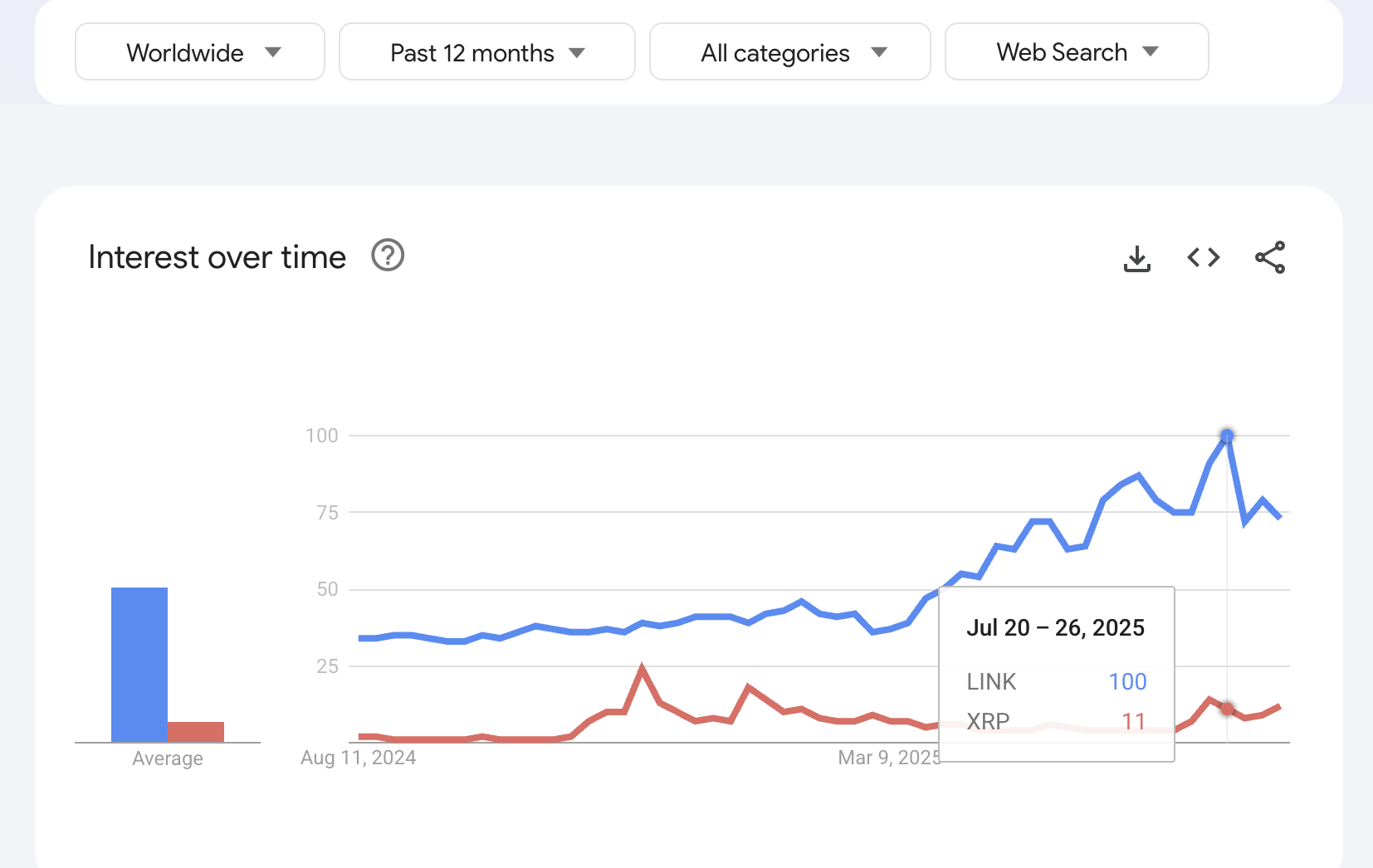
The discussion about LINK flipping XRP comes as Chainlink enjoys renewed optimism, highlighted by dominance in Google Trends.

LINK recently overtook XRP in global search interest, achieving a perfect score of 100 versus XRP’s score of only 11, as of July 2025.

Google Trends data for XRP and LINK

In terms of DeFi strength, LINK’s total value secured (TVS) crossed $93 billion days back. When compared to XRP’s $85 million, the difference is clear.

Still, XRP has maintained stronger long-term price performance. Over the last year, XRP has surged 386%, compared to LINK’s 145% despite the recent resurgence.

The SWIFT Factor and Institutional Adoption

Chainlink advocates argue that LINK has become what many once expected XRP to be — a bridge for global finance. Through its ongoing partnership with SWIFT, Chainlink has demonstrated cross-chain interoperability, tested tokenized asset transfers with banks such as BNY, and run pilots with UBS Asset Management.

These milestones strengthen LINK’s institutional adoption case. XRP has also seen institutional traction via treasury asset inclusion and Ripple partnerships. However, Chainlink proponents believe their project has been far more successful in this regard.

Meanwhile, XRP supporters believe ETF investments and continued integration into financial markets may further extend XRP’s dominance in terms of valuation.

Coinbase CEO Sets $1M Price Target for Bitcoin by 2030

0

Coinbase CEO Brian Armstrong has set an audacious target for Bitcoin by the end of the decade. 

Armstrong now joins other industry figures to predict Bitcoin’s surge to $1 million by the end of the decade, specifically by 2030. He made the bold prediction in an interview yesterday on the Cheeky Pint podcast

Armstrong’s forecast comes as Bitcoin struggles to recover from a recent price dip that saw it crash to around $112,387. Despite the collapse, the Coinbase CEO believes the premier cryptocurrency would pick up steam and rally to $1 million over the next few years. 

Factors Backing Coinbase CEO $1M Prediction 

Some factors backing his prediction include the regulatory progress in the United States’ crypto industry. Specifically, he mentioned the GENIUS Act, which has already been signed into law to create a regulatory framework for stablecoins. 

He also highlighted the Market Structure legislation, currently in the Senate, as another regulatory progress that could provide a clear set of rules for crypto. Armstrong noted that if the Market Structure legislation passes by the end of the year, it would represent a major milestone for the industry. 

In addition, the Coinbase CEO referenced the U.S. government’s interest in Bitcoin as evident in President Trump’s signing an executive order mandating the creation of a strategic reserve for BTC. 

He noted that just five years ago, the idea of the government holding Bitcoin would have been considered crazy. However, the U.S. government has already signaled its intention to hold Bitcoin. The top industry stakeholder believes other G20 countries are likely to follow the U.S. to create a national-level demand for Bitcoin. 

Bitcoin to $1M Predictions 

Meanwhile, Armstrong is not the only industry leader who believes Bitcoin could hit $1 million by 2030. In June, Robert Kiyosaki, the author of Rich Dad, Poor Dad, also shared a similar prediction, arguing that the world’s largest cryptocurrency could trade at $1 million per coin by the end of the decade. 

Eric Trump, the second son of the U.S. President, recently teased that Bitcoin could reach $1 million in the next couple of years. In addition, Twitter (now X) co-founder Jack Dorsey expects Bitcoin to clinch the $1 million target by 2030. 

From the current price of $113,715, Bitcoin’s price must soar 779.39% to hit the $1 million milestone. This would push its valuation to $20 trillion, assuming 20 million Bitcoins are in circulation. 

Bitcoin Must Hold $124K Before Aiming for Loftier Targets 

As expected, the Coinbase CEO’s $1 million prediction has sparked a major debate in the industry. Some users are debating whether the target is within the realm of possibility. 

James McKay, founder of McKay Research, emphasized that the $1 million forecast is a realistic target, given that Standard Chartered also expects Bitcoin to reach $500,000 by 2028. 

However, he issued a caution, reminding investors that Bitcoin still needs to revisit and hold the $124,000 level–its ATH target–before considering loftier targets like $500,000 or $1 million. 

U.S. Government Wallet Linked to Uranium Finance Hack Receives $332K in Ethereum

0

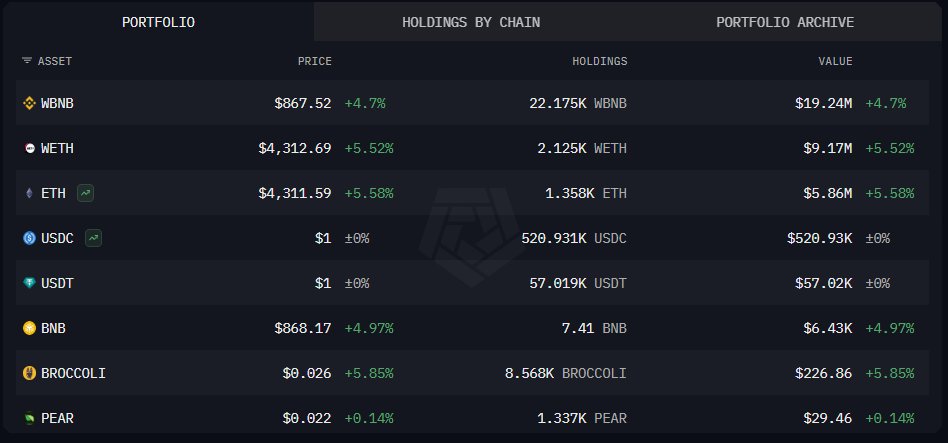
A U.S. government wallet linked to seized funds from the Uranium Finance hack has received $332,000 worth of Ethereum from Coinbase.

Data from blockchain analytics firm Arkham confirmed a significant Ethereum transaction to a wallet controlled by the U.S. government on Wednesday evening.

The wallet, tagged “Uranium Finance Hacker Seized Funds,” received 76.56 ETH valued at around $332,000. The transaction occurred at 08:51:11 PM UTC and originated from a Coinbase hot wallet.

While the amount may seem modest compared with the larger seizure, the transfer has drawn attention because it confirms the government’s continued activity in handling the recovered assets.

Wallet Balance Grows Beyond $34 Million

After the latest inflow, the government-controlled address now holds 1,358 ETH, with a market value of about $5.83 million.

The wallet also contains several other digital tokens, pushing its total balance to approximately $34.71 million. This figure suggests that authorities have consolidated multiple assets seized from different stages of the investigation.

So far, neither Coinbase nor any government agency has provided public comment on this particular movement of funds.

U.S. Government crypto portfolio

Uranium Finance Exploit: One of DeFi’s Biggest Hacks

The Uranium Finance incident remains one of the most notorious exploits in the history of decentralized finance (DeFi).

Uranium Finance, launched as a clone of Uniswap on Binance Smart Chain, was targeted in April 2021. A vulnerability in the project’s pair contracts allowed a hacker to siphon off more than $52 million in tokens. 

At the time, the exploit ranked among the largest monetary thefts in DeFi. This highlighted the risks associated with immature codebases and forked projects.

Government Seizure Announced in February 2025

Nearly four years after the hack, U.S. authorities achieved a significant breakthrough. On February 27, 2025, the U.S. Attorney’s Office for the Southern District of New York and Homeland Security Investigations (HSI) San Diego announced they had recovered approximately $31 million in stolen assets. This marked one of the most substantial recoveries tied to a DeFi exploit.

The official announcement highlighted the growing ability of law enforcement to trace blockchain movements despite obfuscation techniques.

The Uranium hacker had used various methods to disguise the stolen funds. Techniques included routing assets through Tornado Cash, breaking down transactions into smaller amounts for centralized exchanges, and allegedly purchasing rare Magic: The Gathering cards.

Despite these tactics, blockchain forensics and cross-border collaboration eventually led to significant asset recovery.

Victims Still Waiting for Compensation

Following the attack, Uranium Finance shut down permanently, leaving investors without answers or compensation. For years, victims had little hope their funds might ever be returned. The recent seizures, however, have renewed expectations that at least part of the stolen money could be returned to those affected.

Although no formal restitution plan has been announced, the gradual consolidation of assets in government wallets signals a possible future recovery effort.

Winklevoss Twins Donate $21 Million in Bitcoin to Support Trump’s Pro-Crypto PAC

0

Cameron and Tyler Winklevoss, founders of Gemini, have donated $21 million in Bitcoin to the Digital Freedom Fund PAC to support Donald Trump’s pro-crypto initiative.

They announced the funding on Wednesday, committing 188.45 BTC to back the glaring efforts by POTUS to make America the “crypto capital of the world.” The twins, who founded the New York-based Gemini exchange, lauded the efforts of the current administration to make digital assets mainstream and hoped the $21 million donation would help the Digital Freedom Fund PAC support Trump in his crypto reform.

PAC Fund to Focus on Continuity and Key Crypto Legislation

The Digital Freedom Fund Political Action Committee (PAC) was filed for on July 11, according to its website. Notably, the movement would commit to delivering the required assistance to Trump to ensure that “America’s Golden Age” remains.

Specifically, donations to the PAC fund would support pro-crypto senators and House reps in the midterm elections. Tyler emphasized that Trump has speedily achieved his crypto-friendly agenda because of the support received from the Republican-dominated Congress.

The Digital Freedom Fund will help ensure that it remains that way after the midterm election scheduled for November 3, 2026. This way, Trump would continue to receive the backing to finish off his pro-crypto agenda.

Further, the pro-crypto alliance would also focus on thoughtful legislation that would enable the crypto industry to thrive. It will fight for a “Skinny Market Structure Bill” that permanently limits regulatory overreach and allows ecosystem builders to build without government pitfalls.

For context, the ideal Bitcoin and crypto bills of rights will codify the right to own, self-custody, and transact Bitcoin and crypto. It would also protect software developers and publishers, allowing them to operate without fears of sanctions from authorities. This seeks to address the issues seen with the Tornado Cash builders and Silk Road creator Ross Ulbricht.

Anti-CBDC, Open Banking, and Support for Crypto Project

Meanwhile, another focus of the Digital Freedom Fund PAC would be to ensure that they fight for a legislative ban on CBDCs. Recall that the House passed a bill preventing the Federal Reserve from creating CBDCs in July, but the bill is still in the Senate.

They would also fight for legislation that allows for equal access to banking services without consideration of your political affiliations, religious beliefs, or business activity. Trump also signed an executive order in that regard earlier in the month.

Additionally, the PAC fund would fight to reduce the registration cost for crypto startups in the United States. Tyler noted that certain regulatory captures have intentionally or unintentionally created an unconducive environment for up-and-coming crypto firms in the United States.

Notably, the Digital Freedom Fund’s website has yet to reflect the $21 million donation at the time of writing.