Home Blog Page 567

Insiders Reap Huge Profits as Kanye West YZY Token Launches, Experts Urge Extreme Caution

0

Kanye West’s newly launched meme coin has already surged past a $2 billion market cap, but unusual trading patterns point to heavy insider activity, sparking red flags for investors. 

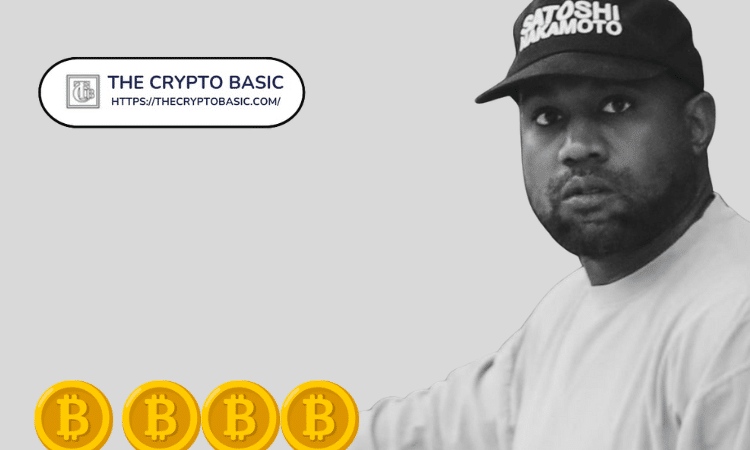
Popular American rapper Kanye West ventured into the crypto sector and launched a new meme coin, dubbed YZY Money (YZY), on the Solana blockchain. 

Kanye West Token Launch 

The launch comes several months after the rapper teased the YZY launch. He first revealed plans for the meme coin project in late February, following an extended period of social media activity where he frequently referenced “crypto” and “coin” in various posts. 

This led to the temporary suspension of his X account. When he returned to X, the rapper appeared to have lost interest in pursuing the project, as he deleted every related post. 

However, he stunned his 33.1 million followers yesterday when he announced the launch of YZY Money alongside its contract address. 

Notably, YZY is the utility token of the YZY Money ecosystem. Other projects expected to roll out in the ecosystem include a payment processor called YZY Pay and a debit card, YZY Card. 

Controversies Surrounding YZY Launch 

Despite launching only a few hours ago, the token’s fully diluted valuation reached a peak of $2.41 billion. However, data on top holders and trading patterns strongly suggest insider activity. 

Notably, the top six holders of YZY hold about 90.3% of the token’s 1 billion supply. Also, several blockchain addresses that were aware of YZY before the token’s public launch positioned themselves early by purchasing the token at an extremely low price. 

One of such addresses is 2DNb2…f8nha. This address mistakenly acquired the fake YZY token a few days before the original token launched.  

Lookonchain called the public’s attention to the address, noting that the user splashed 4,216 SOL ($768,000) to purchase 27.72 million YZY tokens. Upon realizing the mistake, the user dumped the entire 27.72 million YZY tokens four hours later, losing $710,000 of his capital. 

Following the public launch of the original YZY token, the same user spent another $761,000 worth of USDC to acquire the real token, netting a profit of more than $710,000 and recouping his initial loss. 
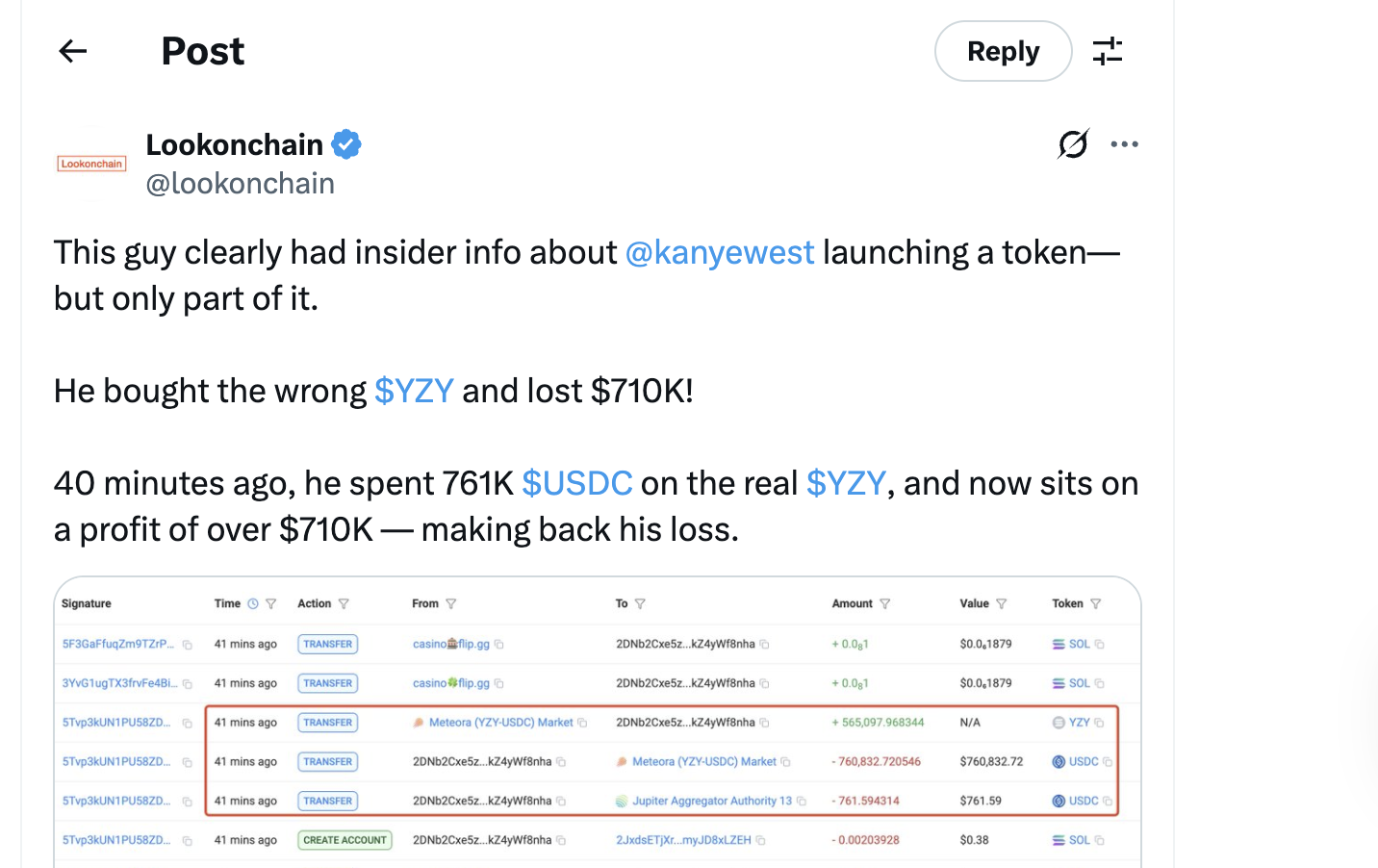
Lookonchain analysis

Another alleged insider wallet, 6MNWV…BF3Yx, also knew the token before its public launch. The address purchased 1.29 million YZY tokens for an aggregate cost of $450,611 worth of USDC. A few hours later, the address sold 1.04 million YZY for $1.39 million. The value of the remaining 249,907 YZY tokens had recorded a profit of more than $1.5 million, according to Lookonchain data. 

Further, another insider purchased 1.89 million YZY across two blockchain wallets for $450,000. This user made the purchase when YZY was priced at $0.24. According to Lookonchain, the user even paid a priority fee of 129 SOL, worth around $24,000, for the purchase. 

With the price soaring to $2.12, the user sold 1.59 million of his holdings for $3.37 million. The remaining 303,425 tokens were worth around $510,000 at the time of publication.  

Industry Stakeholders Warn Retail Traders 

In the meantime, several industry stakeholders have warned retail traders to exercise caution and avoid getting scammed. Lookonchain emphasized that the team behind the token only added YZY to the liquidity pool, with no USDC. 

Based on this, the on-chain tracker warned that the developers may add or remove liquidity at will, just as was done with the LIBRA token. The presence of several insiders also puts regular traders who got in late at risk. 

Additionally, Ki Young Ju, founder and CEO of CryptoQuant, quoted Kanye West’s token launch announcement to warn retail investors. The industry stakeholder reminded traders that the Official Trump meme coin also surged for four days following its announcement tweet, only to crash 88% from its peak. 

Like TRUMP, YZY also spiked tremendously after the announcement, with its market cap peaking at $2.41 billion. Its valuation has dropped to $1.08 billion in the hours leading up to press time, with a token currently worth $1.08. 

U.S. Patent Clearly Shows XRP Registered as a Payment Method in the United States

0

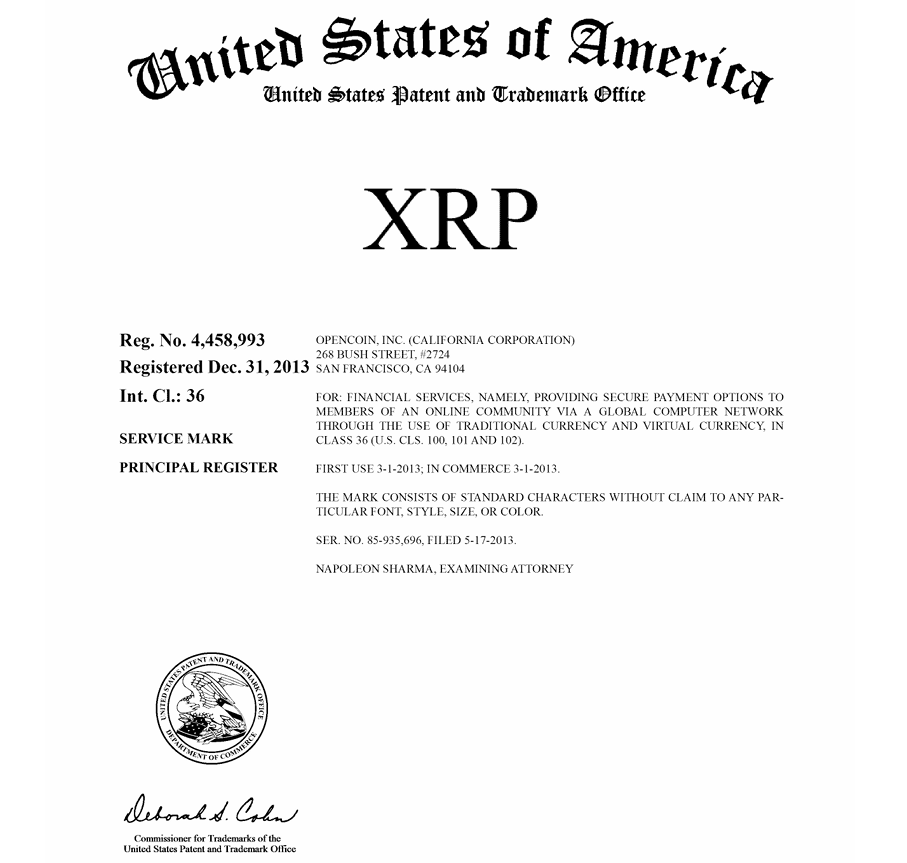
A United States trademark registration for XRP as a payment method has resurfaced in the crypto community, triggering excitement and confusion. 

The document, issued by the U.S. Patent and Trademark Office (USPTO) in December 2013, carries Registration Number 4,458,993. While the certificate is authentic, we have confirmed that it does not actually mean what some community voices claim it does.

The XRP Patent: What We Know

Notably, OpenCoin, Inc., which has since rebranded to Ripple Labs, filed the trademark on May 17, 2013. The filing fell under International Class 36, which covers financial services. Specifically, the registration states that XRP provides secure payment options for an online community through both traditional and digital currencies on a global computer network. 

Ripple (then OpenCoin) listed its first commercial use of XRP as March 1, 2013. Moreover, the certificate also clarifies that the mark applies only to the standard characters “XRP,” without any restriction. In simple terms, it simply protects the name XRP as a service mark for financial services.

US Patent Registering XRP as a Payment Method

Interestingly, we consulted multiple independent sources, and they all confirm the details. Particularly, Justia Trademarks, uspto.report, and Trademarksoncall.com all show the same serial number (85935696), the registration date of December 31, 2013, and Ripple Labs as the current owner. 

In addition, the UC Davis Law Review has also referenced the registration, adding another layer of confirmation. Further, the USPTO’s own TSDR system lists the registration as active, with regular updates and renewals in line with Ripple’s continued ownership.

Community Excitement Largely Misplaced

However, it appears some influencers in the XRP community have taken the rediscovery of the document to a different level. 

For instance, community figure Amelia suggested that the U.S. itself patented XRP and officially recognized it as a payment method back in 2013. Her comment led some holders to see the filing as proof that XRP already enjoys government backing. Influencer JackTheRippler also made similar commentaries.

Nonetheless, the reality is different. For context, Ripple filed the trademark itself in 2013 as part of its early efforts to establish XRP in the financial scene. Last year, Ripple filed a similar trademark request for its proprietary stablecoin RLUSD.

The registration does not mean the U.S. government granted XRP any special status as a payment method, nor does it signal regulatory approval. It simply gave Ripple the exclusive right to use the XRP name in financial services.

The re-emergence of the certificate is still important because it shows how early Ripple moved to legally protect XRP in the intellectual property framework. Notably, this isn’t the only U.S. patent filed by Ripple. Data confirms the firm boasts 39 patents in the U.S., and the government has granted 18. Moreover, over 62% of these patents are active.

Pundit Says XRP Under $3 is Not Real, It’s a Psyop to Steal Your Coins

0

XRP has slid 5% in the past day, slumping below $3 and struggling to recover amid a market-wide bloodbath.

While the move unsettled some traders, influential voices within the XRP community continue to urge calm. They frame the dip as both temporary and even a golden opportunity.

Sub-$3 XRP a “Psyop”

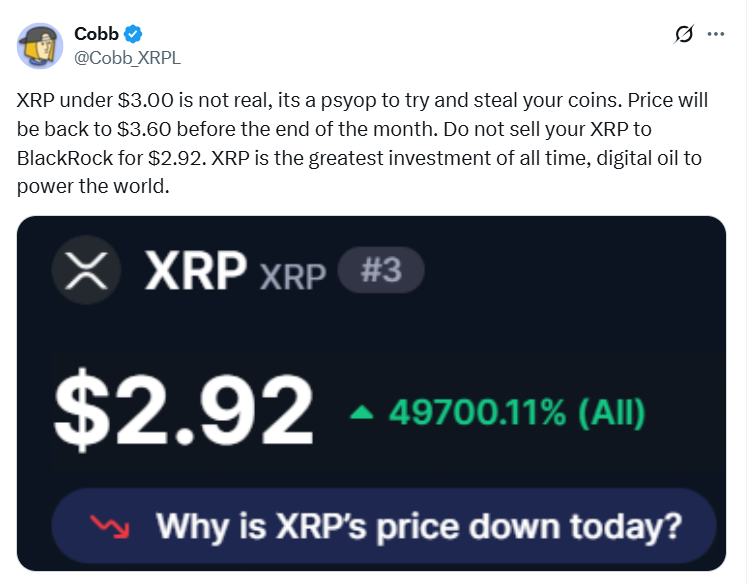
In reaction to the XRP dip, advocate Alex Cobb dismissed the sentiments surrounding the current price action. He argued that XRP under $3 is “not real,” but rather a tactic to shake investors out of their positions. “It’s a psyop to steal your coins,” he said.

Cobb suggested that institutions like BlackRock could be the real beneficiaries if retail holders panic-sell their tokens cheaply. He predicted XRP would rebound to $3.60 before the end of the month.

He went on to reinforce his long-standing view that XRP is not just another crypto asset but “digital oil” to power the financial world. In particular, Cobb framed XRP as the greatest investment asset of all time.

Alex Cobb on X
Alex Cobb on X

This bold perspective is rooted in XRP’s inherent utility and the perceived future value its proponents ascribe to it. They view the current price range as undervalued and see a future where it trades closer to Bitcoin’s level.

For instance, Cobb’s December outlook for XRP sees the coin trading above $20, a price that would give it a trillion-dollar valuation, a landmark only Bitcoin currently enjoys.

“Massive Blessing” in Buying XRP Below $3

Notably, the belief that XRP is undervalued is widespread among members of the XRP community. Just two days ago, Coach JV, another influential voice in the community, described XRP trading under $3 as “a massive blessing.”

He stressed that wealth is not built when prices are up, but during quiet, sideways markets — periods when most investors grow impatient. Using a farming analogy, Coach JV likened today’s XRP market to planting seeds in barren soil. The real harvest will come to those who consistently accumulate through uncertainty and hold through downturns.

Essentially, the theme is that XRP remains “cheap,” and its future upside could be life-changing — at least in the eyes of the XRP Army. Within the community, projections for XRP’s eventual price range widely, from $10 to $100, to $1,000, and even $10,000.

Critics React

These bullish views often face resistance from other market participants. Responding to Cobb’s post, critic John Cash challenged the feasibility of the widely touted XRP valuations, pointing out that XRP’s massive supply limits its price potential.

He argued that even in an extreme scenario, XRP couldn’t reach $100 without an implausible $10 trillion market cap.

However, while many of the lofty targets stretch the bounds of market cap assumptions, they reflect the belief among long-term holders. Many argue that once institutional adoption accelerates, today’s sub-$3 levels will look like a historic bargain.

Analyst Identifies XRP Price path for $23 Rally and Bear Market Warning Zone

0

A top market analyst has identified the level XRP must breach to soar to “Valhalla” as well as the region that could trigger the next bear market.

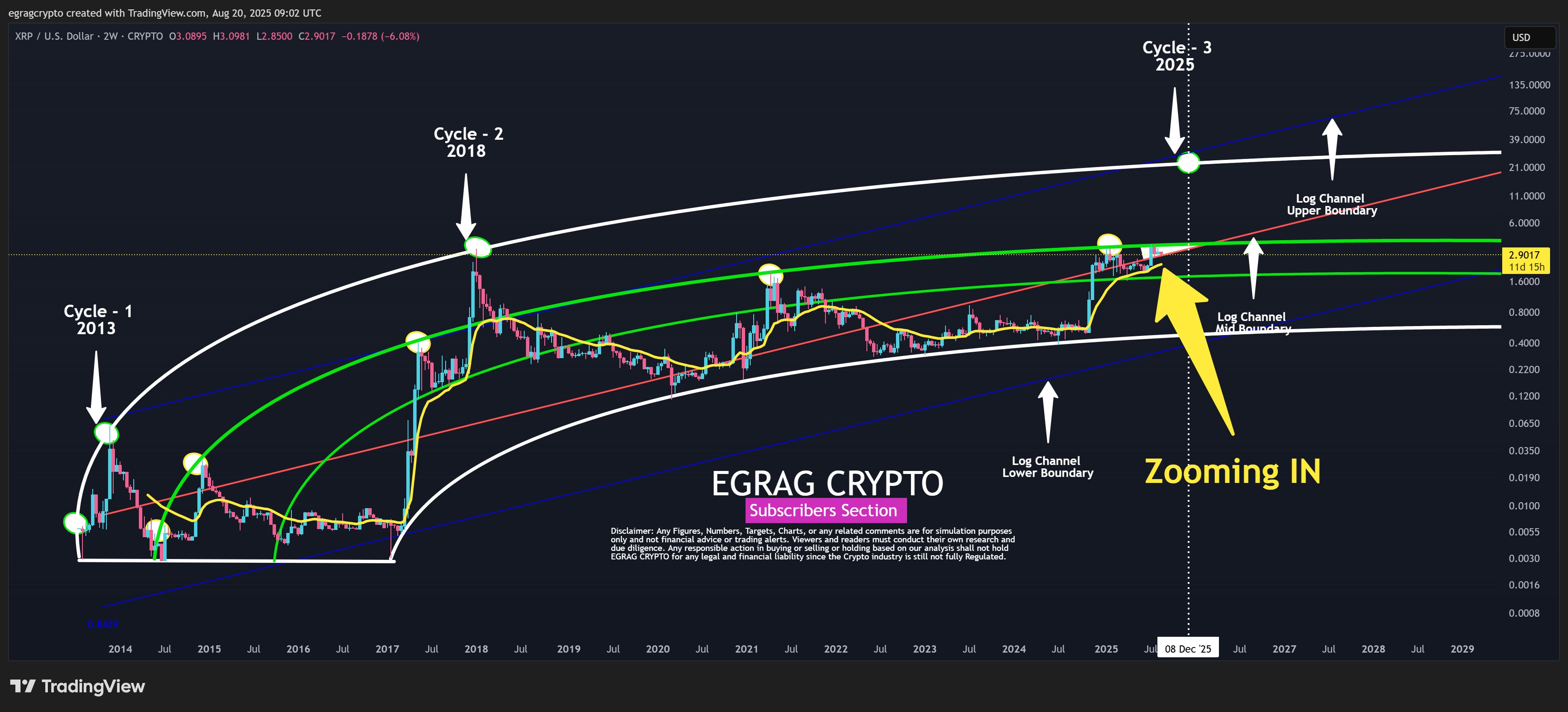
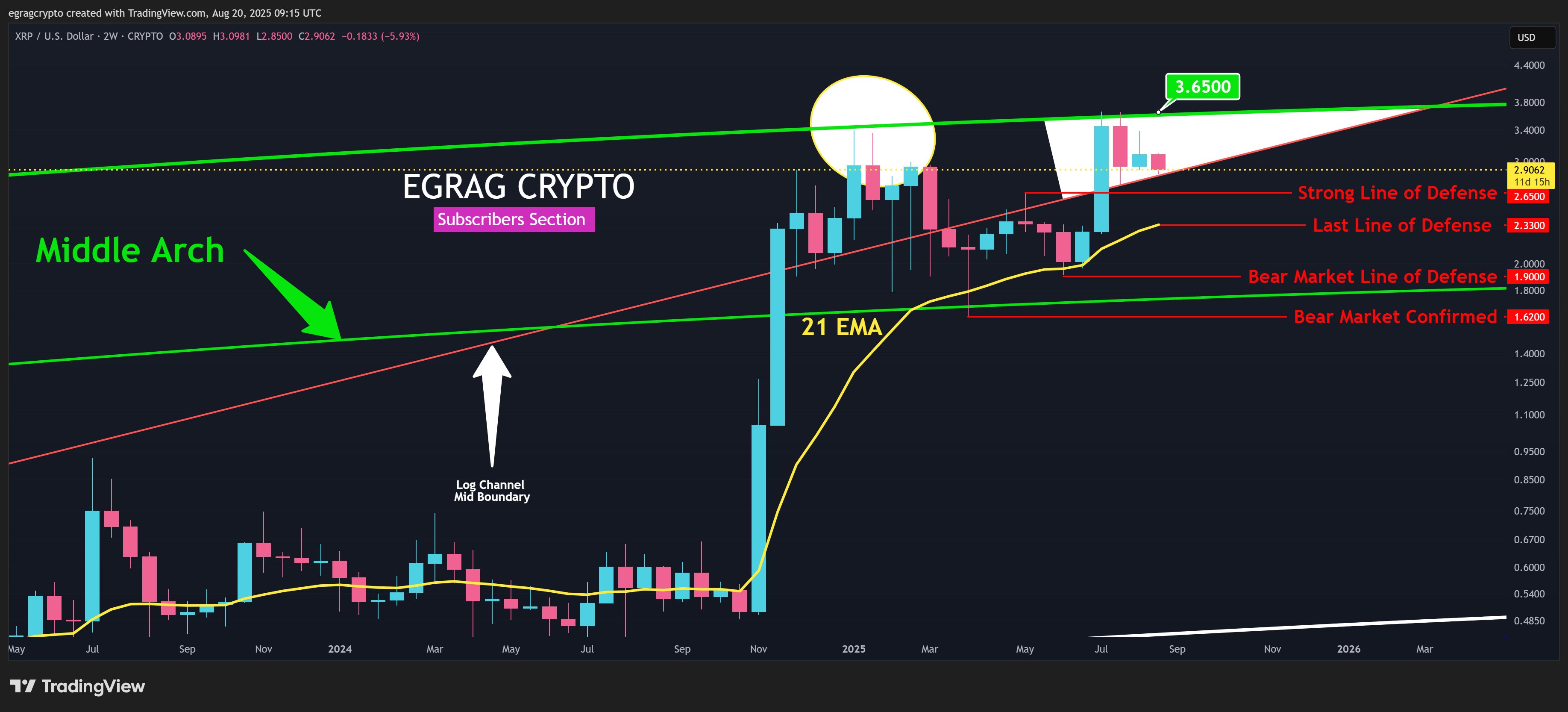
EGRAG Crypto recently discussed these levels as XRP battles the bears at $3. Notably, his analysis uses a logarithmic regression model and a formation he calls the “Bent Fork,” which shows both the upside potential and the danger zones for XRP.

Importantly, his chart features a regression channel drawn on a logarithmic scale. This model highlights previous cycles and how XRP moved in parabolic waves during these cycles.

XRP Needs to Close Above $3.65 to Aim for Valhalla 

According to his charts, XRP now sits in its third major cycle and is pressing against the mid-point of the channel. Further, the Bent Fork identifies arches and boundaries on this structure, showing where momentum could either break free or collapse.

Specifically, EGRAG pointed to the July 18 high at $3.65 as the major breakout trigger. He noted that if XRP can close above this level, the market will push into price discovery and set up a run toward a region he calls “Valhalla,” which aligns with the $23 price mark.

Interestingly, this target matches the upper boundary of the Bent Fork, which has provided a guide for his cycle analysis. Similar breakouts in earlier cycles produced massive gains that culminated in a rally to the upper boundary, and EGRAG believes this one could follow the same path.

XRP Bent Fork EGRAG Crypto
XRP Bent Fork | EGRAG Crypto

Particularly, when XRP soared in Cycle 1, it reached the upper arch of the Bent Fork at an all-time high of $0.0614 in December 2013. A similar run during Cycle 2 saw XRP hit the upper arch at $3.3 in January 2018. Now, in Cycle 3, the upper arch sits at $23, and EGRAG expects a similar run.

A Drop to $1.62 Would Mark the Start of a Bear Market

However, the bullish case depends on XRP holding important support levels. The first level sits at $2.90, which marks the middle of the regression channel. As long as the price stays above this zone, the bullish structure remains intact. 

Critical XRP Support Levels EGRAG Crypto

EGRAG noted that if XRP slips below it, the next strong defense appears at $2.65. A quick dip under that level may not matter, but closing the day below it would weaken the setup. This aligns with his previous suggestion that it is all noise until XRP breaks above $3.65 or dips below $2.65.

Meanwhile, another important marker sits at $2.33, which aligns with the 21-week exponential moving average. EGRAG describes this level as the final lifeline for the bullish structure. A fall through $2.33 would make it much harder for XRP to reclaim its former all-time high, let alone aim for the higher arches of the Bent Fork.

If the slide continues, $1.90 becomes the line where bearish momentum begins. Dropping through that level would flip the market tone from hopeful to defensive. 

Meanwhile, the danger zone would deepen at $1.62, which EGRAG marks as confirmation of a full bear market. A close below that point, especially under the mid-arch of his model, would indicate the start of a downward cycle.

Right now, XRP trades for $2.92, still holding the primary support at $2.9. Notably, the larger cycle structure leaves room for upside as long as XRP maintains its ground above this region or the lower support levels.

Solana Dominates User Charts This Week. Could An Emerging Gem On It Spark the Next Rally?

0

The crypto market has been moving sideways lately, but Solana keeps making noise in its own way. Over the past week (Aug 12–19, 2025), activity on the network has been buzzing, once again putting Solana at the top for user engagement.

Solana’s Strong Showing In User Growth And Key Metrics

Recent figures lay out why Solana is leaving others behind. Nansen data puts the network at over 20.71 million active addresses for the week ending August 19, 2025, way ahead of BNB Chain’s 10.26 million and Base at 7.19 million in similar periods.

Another look from Nansen highlights Solana hitting 22.24 million in a comparable stretch, with Tron and others trailing far back, thanks to its cheap fees and quick processing that appeal to users everywhere.

DeFi on Solana is holding steady too. TVL is sitting around $10.4B (DefiLlama), slightly down over 24 hours but still up 5% on the week. DEX volumes remain healthy, averaging $2.6B daily, with a weekly total above $28B. The token itself trades at about $184, giving Solana a market cap close to $99B. Not bad for a chain that only a year ago was battling network hiccups.

Early 2025 tweaks to the network have smoothed out operations, making it a go-to for developers tinkering with games, social apps, and DeFi tools. It’s this kind of steady momentum that reminds observers of past cycles where one chain’s rise lifts innovative projects built on it, creating those unexpected winners that savvy traders spot early.

Unich: A Solana-Built Project Improving The OTC Space

Amid this momentum, one project catching attention is Unich, a Solana-based platform designed to clean up the messy world of OTC deals for pre-launch tokens. Normally, these trades happen informally through Telegram chats, not exactly the safest setup.

Unich Pre-Market changes that dynamic by leveraging smart contracts to secure collateral from both buyers and sellers, ensuring automatic compensation if a deal falls through after the token generation event (TGE). This approach minimizes risks in a space where trust has been hard to come by, turning what was once a gamble into a more reliable process.

Complementing this, Unich Pre-Order enables leveraged exposure to listed tokens with only 5% collateral required, settling trades at a predetermined price to avoid liquidation pitfalls and short-term volatility. These tools highlight a shift toward strategic trading over pure speculation, especially appealing in Solana’s fast-paced environment where meme coins and DeFi plays dominate.

Recently, Unich IDO has launched, targeting 100 million $UN for fundraising. The starting price is set at $0.15 per UN, with a referral program aimed at community growth, and includes an 11% referral program (8% in USDT, 3% in $UN) to encourage community expansion.

The same as many market analysts, we consider Unich IDO one of the most anticipated token sales in Q3/2025 because of the solid milestones they’ve reached. In just six months, Unich has already processed $1.2B in OTC volume and become the world’s first OTC exchange to hit that amazing number. The platform so far has attracted over 5M users from 100+ countries, and generated $20M in revenue, before its own token launch.

For anyone watching Solana’s ecosystem, Unich feels like one of those projects that could ride the wave higher. With expected listings on top-tier CEXs on the horizon after the token sale, Unich may be worth keeping an eye on.

Disclaimer: This Press release article is provided by the Client. The Client is solely responsible for this page’s content, quality, accuracy, products, advertising, or other materials. Readers should conduct their own research before taking any actions related to the material available on this page. The Crypto Basic is not responsible for the accuracy of info and any damage or loss caused or alleged to be caused by the use of or reliance on any content, goods, or services mentioned in this press release article.

Please note that The Crypto Basic does not endorse or support any content or product on this page. We strongly advise readers to conduct their own research before acting on any information presented here and assume full responsibility for their decisions. This article should not be considered investment advice.

XRP Profit-Taking Volume Hits $375M, Highest Since December 2024 Rally

0

Data shows XRP profit-taking volume by long-term holders recently reached a new yearly peak, mirroring the distribution trend from December 2024.

XRP ended last month, July, on a bearish note after reaching a new peak of $3.66 earlier in the month. While the recovery that emerged this month, August, pushed XRP above $3 for an extended period, recent data from Glassnode has identified what contributed to the late-July crash.

XRP Profit-Taking Volume Hits $375M

Notably, Glassnode took to X today to reveal the extent of profit-taking trades by investors of the top five assets over the past month. According to the market analytics platform, the recent market downturn, which has resulted in the global crypto market cap losing over $200 billion over the past three days, was due to these profit-taking trades.

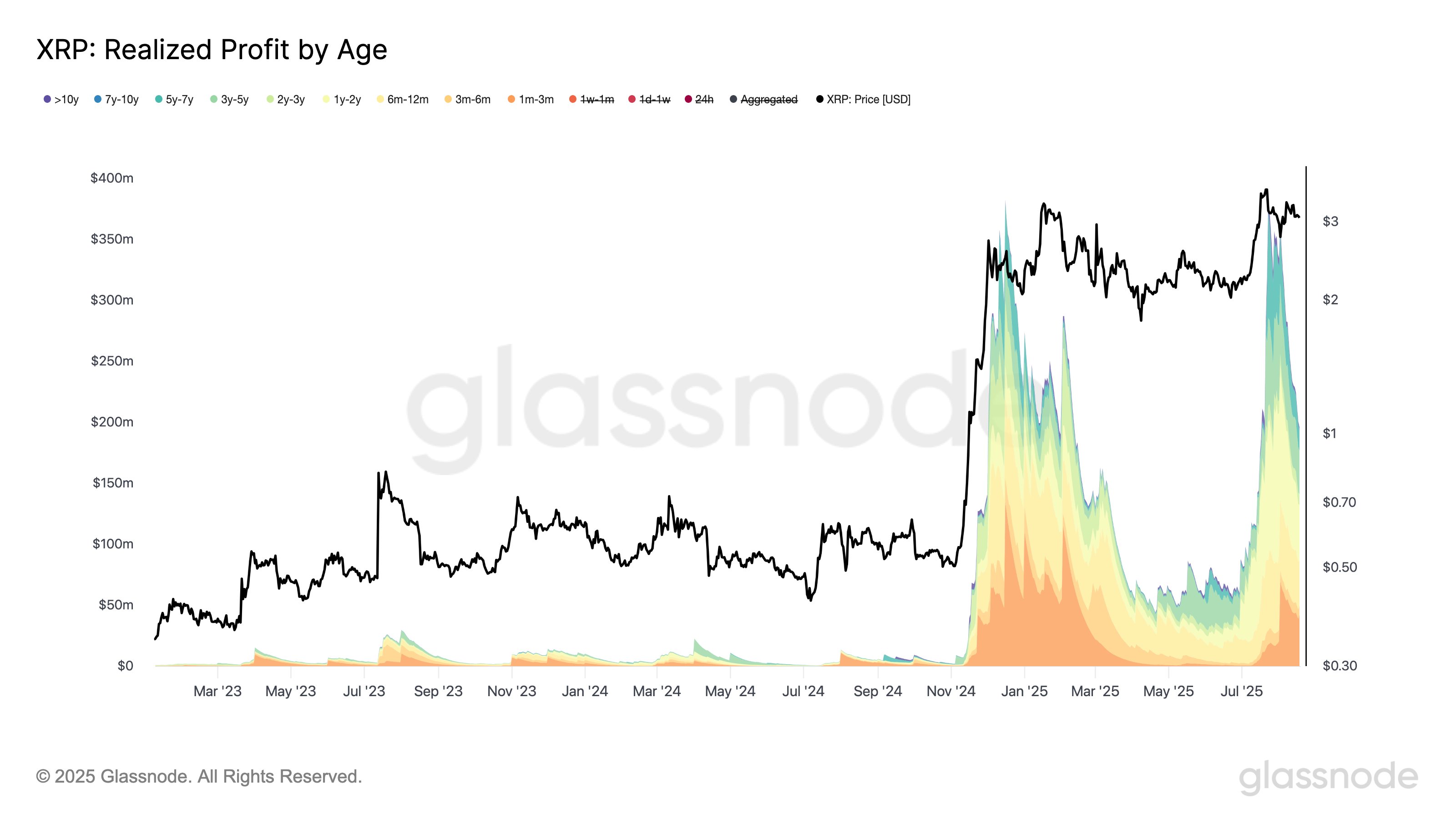
For XRP, Glassnode revealed that the heightened profit-taking volume did not emerge recently, as is the case with other assets, but took place last month. Specifically, XRP profit-taking volume skyrocketed to $375 million on July 24. While investors holding for 1 month to 1 year contributed massively, the largest volumes came from those holding for at least 2 years.

XRP Profit-Taking Volume Glassnode
XRP Profit-Taking Volume | Glassnode

This large distribution event occurred amid the panic that ensued as a result of the broader market crash on July 23, which saw XRP collapse by a massive 10.34% in a single day. This marked its highest intraday drop in three months. Following this slump, investors panicked and began taking profit, leading to the $375 million XRP profit-taking volume the next day, on July 24.

According to Glassnode, this marked XRP’s largest profit-taking volume this year, and mirrored the extent of the distribution observed by the market during the December 2024 rally. For context, XRP soared nearly 290% from November to December 2024, retesting the $3 mark and leading to a similar heightened profit-taking event.

Meanwhile, after the latest July 24 volume, XRP held strong for a few days before going into a death spiral that led to a 13.2% collapse by Aug. 2. XRP has since recovered from this drop, but Glassnode’s recent analysis suggests the most recent crash below $3 could also be a direct product of such profit-taking trades.

XRP Address Profitability Remains High

Interestingly, a previous report from The Crypto Basic confirmed that Glassnode data also revealed a rise in XRP address profitability above 90%. Specifically, as XRP held above $3, addresses seeing gains on their holdings surged to 94%. 

Citing this data, market commentator Winny suggested at the time that this could lead to heightened XRP profit-taking volume. This trend has since materialized, contributing to the recent crash below $3 for XRP. However, XRP has shown more resilience than in previous instances of profit-taking trades due to multiple bullish factors.

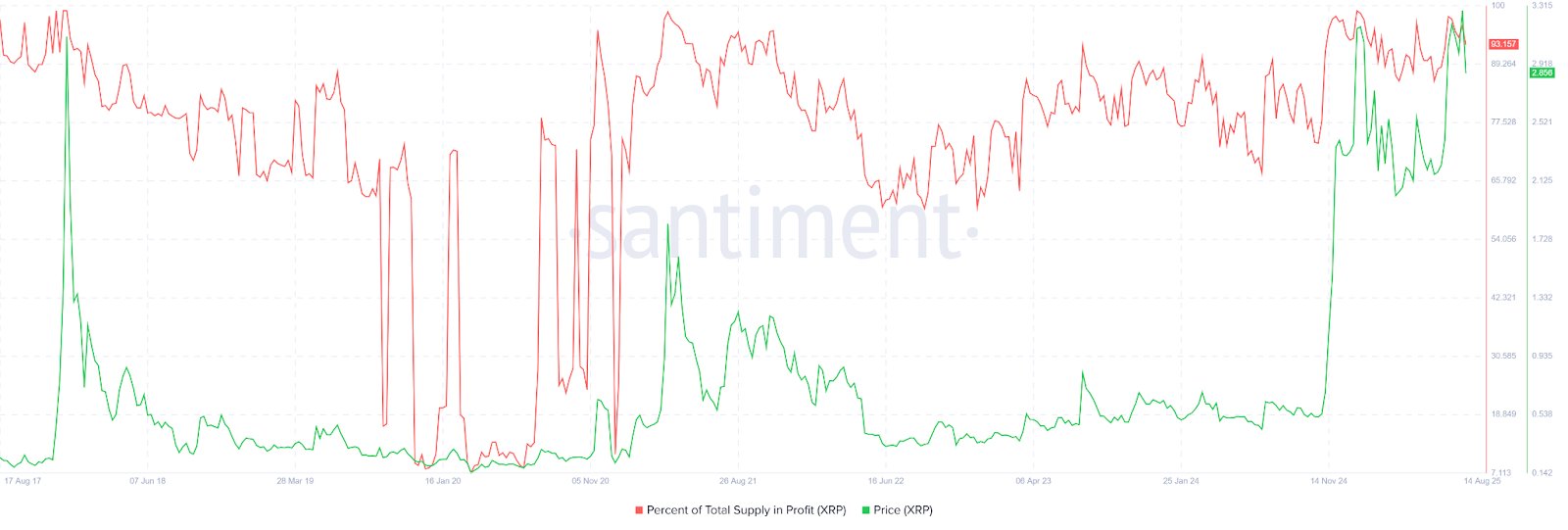
Meanwhile, despite the recent pullback, trader Xaif Crypto confirmed today that 93% of XRP addresses are still in profit, citing Santiment data. Notably, since July, address profitability has averaged 90%. While this is a positive sign, it also shows that there could still be increased XRP profit-taking volumes going forward.

XRP Address Profitability Santiment
XRP Address Profitability | Santiment

Bitcoin Price Alert: Analyst Predicts Potential Fall to $88,000

0

Amid the latest Bitcoin price struggles, a prominent market analyst has warned of a steeper decline if rejection hits at the $120,000 psychological mark.

Technical analyst CasiTrades, who has over a decade of market experience, outlined a setup that could determine whether Bitcoin continues its correction or breaks into new highs.

Bitcoin Completes Wave 1 at $112,500

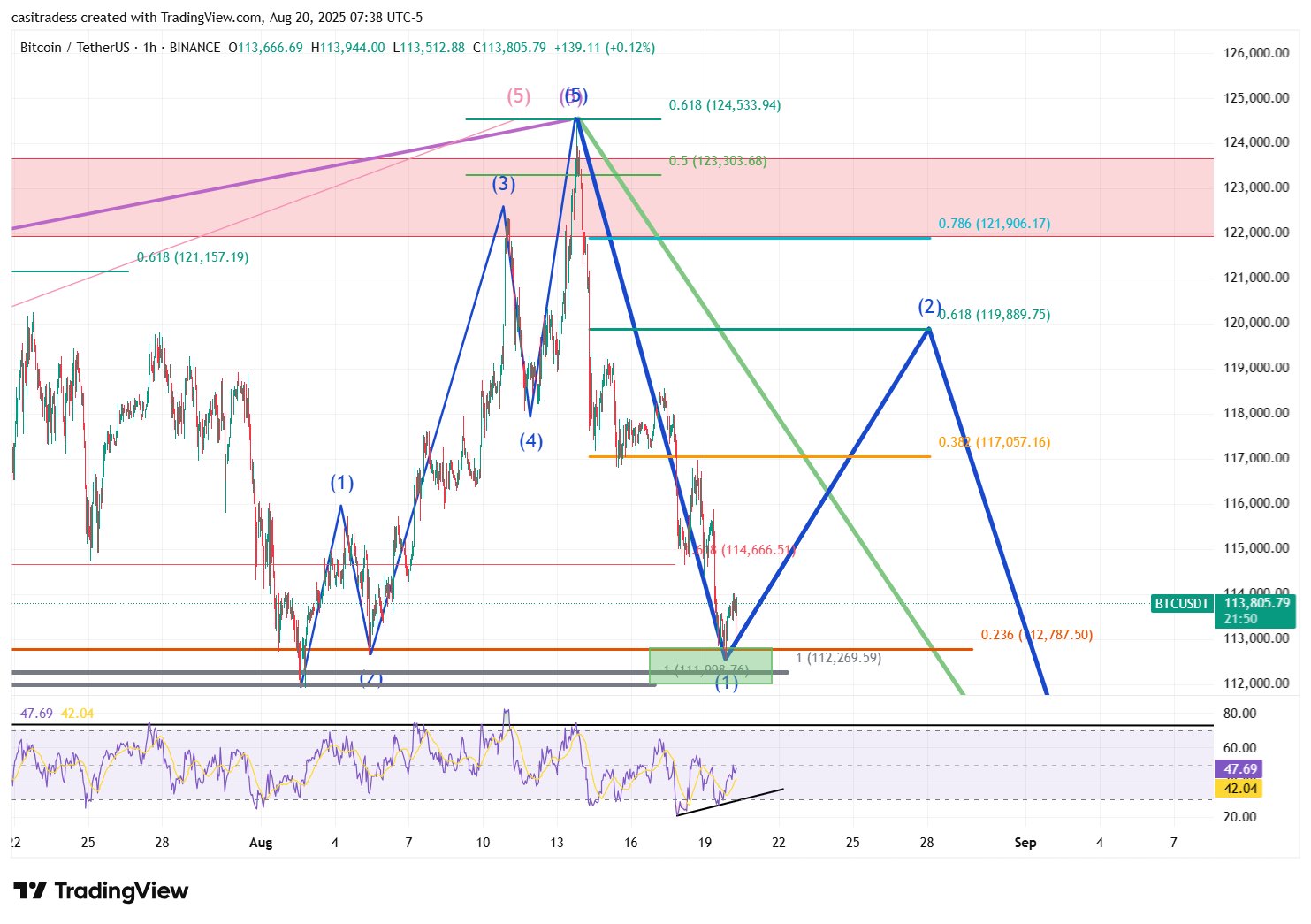
According to CasiTrades, Bitcoin has completed Wave 1 of a corrective A-wave after bottoming at $112,500 earlier today. The analysis notes that this level aligned with multiple targets across different timeframes and also showed bullish divergences on momentum indicators, suggesting that a relief bounce was due.

For context, Bitcoin’s retracement has been ongoing for the past seven days since it briefly touched $124,457. It has since dipped by over 9% from that high. Meanwhile, a strong recovery has yet to materialize.

The analyst believes Bitcoin is now entering a Wave 2 bounce, which often retraces a significant portion of Wave 1’s decline. This rebound could extend toward the $119,900–$121,900 zone before the next major downward move (Wave 3) begins.

Why This Level Matters

If Bitcoin climbs toward the $120K–$122K zone and then faces strong rejection, it could trigger a larger Wave 3 decline. According to Casi, downside targets could reach as low as $88K.

However, the bearish setup would be invalidated if Bitcoin breaks into a new all-time high above the previous $124,500 peak. Such a move would require a complete reassessment of the corrective structure.

Bitcoin 1hr chart by CasiTrades

Large-Cap Altcoins Like XRP Expected to Outperform Bitcoin

While Bitcoin battles resistance, CasiTrades expects altcoins to shine during this Wave 2 bounce. She believes large-cap coins like XRP may see stronger upward moves as traders rotate into higher-beta assets while Bitcoin stalls under resistance.

At the moment, XRP is also feeling the impact of Bitcoin’s correction, with its price dipping to $2.85 earlier today. Bulls are attempting to counter the bearish pressure, and XRP is now trading at $2.90, though still down 1.34% over the past day.

Meanwhile, Ethereum has entered positive territory, showing 2% gains and trading at $4,270 at press time. A similar scenario is unfolding with Solana, which is now posting a 3% gain over the past 24 hours, trading at $183.55.

Among the top-ranking altcoins, Chainlink (LINK) is seeing the biggest comeback. It now trades with a significant 8% gain at press time, priced at $25.91, while many other rivals remain in the red.

China Considers Yuan-Backed Stablecoins in Major Policy Reversal

0

China is preparing to allow yuan-backed stablecoins for the first time, signaling a major shift in its crypto policy and a new push to expand the global role of its currency.

China is reportedly considering authorizing the use of stablecoins backed by local currencies, according to the latest Reuters report. The move would mark a sharp policy turnaround after Beijing banned cryptocurrency trading and mining in 2021.

The proposal is part of a strategy to strengthen the yuan’s role in international finance. The State Council is set to review and could approve the roadmap later this month, according to the report. The plan is to expand global use of the yuan and counter Washington’s accelerating push for stablecoin dominance.

Beyond the council review, China’s top leadership will hold a study session by the end of August.  That meeting will specifically focus on the yuan’s internationalization and the potential role of stablecoins.

Senior leaders are expected to provide policy guidance, specify how the tokens should be integrated into business, and determine clear rules for their position in trade and finance, the report added.

Challenging U.S. Dollar Dominance

The shift comes at a time when the United States is entrenching its dominance in digital currencies. Dollar-pegged stablecoins already account for the bulk of the $275 billion global stablecoin market.

Washington has also moved to formalize its lead. President Donald Trump recently signed the GENIUS Act, which aims to promote USD-backed tokens worldwide.

By comparison, China’s currency has been losing ground. The yuan accounted for just 2.88% of global payments in June, its weakest share in two years. The U.S. dollar, meanwhile, controlled nearly half of international transactions, according to SWIFT data.

For Beijing, the stablecoin strategy is to close that gap, positioning the yuan as a digital rival to the U.S. dollar.

Laying the Regulatory Groundwork

To avoid destabilizing its financial system, China is crafting a detailed framework for the rollout. The People’s Bank of China (PBOC), with other regulators, will be tasked with defining rules, assigning responsibilities, and setting targets for yuan use abroad.

According to sources, the plan will also include mechanisms to manage risks such as capital flight, speculative flows, and cyber vulnerabilities. Officials see this as essential to ensuring that stablecoins complement, rather than undermine, existing monetary policy.

Hong Kong and Shanghai as Launch Pads

Two financial hubs will serve as launch pads for the project. Hong Kong, which introduced a stablecoin ordinance on August 1, will play a key role in offshore issuance. A PBOC advisor has already floated the idea of a Hong Kong-based yuan stablecoin to bypass capital restrictions.

Meanwhile, Shanghai is building an international operations hub for the digital yuan. Together, these two financial centers will accelerate both domestic trials and offshore applications of yuan-backed stablecoins.

International Push and SCO Summit

China’s global ambitions will also feature at the upcoming Shanghai Cooperation Organisation (SCO) Summit in Tianjin. The summit, scheduled for August 31 to September 1, could see Beijing discuss the use of yuan stablecoins for cross-border trade and settlement.

Chinese exporters have already embraced dollar-backed stablecoins for faster international transactions. By introducing a yuan alternative, Beijing hopes to wean them off the dollar and accelerate the adoption of its own currency in global commerce

Challenges That Remain

Despite the enthusiasm, China faces steep hurdles. Its strict capital controls limit the free movement of money across borders, raising questions about how a yuan stablecoin could function on a truly global scale.

Analysts warn that unless Beijing loosens some restrictions, yuan-backed tokens may struggle to compete with the liquidity and flexibility of dollar-based stablecoins.

Still, the broader significance is clear. By embracing stablecoins, China is signaling that it no longer views crypto technology purely as a threat but as a strategic asset in the global currency race.

Ripple Becomes Founding Member of Crypto’s First Real-Time Crime Response Protocol

0

San Francisco-based fintech firm Ripple has announced that it is a founding member of the Beacon network, a first-of-its-kind money laundering response system.

Ripple disclosed in a tweet today that it is an integral member of the Beacon network and would share in its goal to sanitize the crypto industry of its attack-prone reputation. It further lauded the innovation, insisting it would help intercept bad actors before they exit the blockchain.

Beacon Network: The First Real-Time Crypto Crime Response Protocol

Notably, this follows the launch of the Beacon network, a platform teased to stop crypto crimes in real-time. TRM Lab designed this platform, introducing a transformation to how the digital asset industry tracks illicit activities.

The system flags addresses tied to hackers or fraudsters and traces them in real-time as they move from wallet to wallet and across blockchains. Once they enter an exchange or financial institution, the Beacon network alerts concerned parties to seize these assets before withdrawal occurs.

Interestingly, this is a departure from the heavy dependence on crypto sleuths and individual tracking services to a platform automated to monitor these funds round-the-clock. TRM Labs proposed this as a solution to curbing the activities of hackers, who are tarnishing the reputation of the crypto industry.

Major Collaborations with Exchanges

The system, which TRM Labs confirmed is already running and has helped solve some crimes, quickly received adoption from major exchanges and law enforcement agencies. Besides Ripple, platforms such as OKX, Crypto.com, and Anchorage Digital are also inaugural members of the Beacon network.

TRM also secured collaboration exchanges such as Binance, Coinbase, and Kraken, which would share the real-time status of flagged addresses. Nonetheless, TRM Labs failed to mention stablecoin issuers Tether and Circle in the list. Still, it assured that it is working with most industry leaders and law enforcers globally to enhance the potency of the platform.

Notably, the need for such a platform became evident in the wake of the Bybit hack in February. Hackers tied to North Korea’s Lazarus Group drained $1.5 billion from the prominent exchange and, with a cleanly worked tactic, laundered the entire proceeds.

Speaking on the new initiative, Ripple’s head of financial crime compliance, Andrew Rosenberg, stated that the Beacon network will enhance trust and security within the crypto landscape amid its near mainstream adoption. He shared that Ripple is proud to be a founding member of the system, which he highlighted will provide real-time intelligence to freeze money laundering efforts proactively.

“There’s no program like Beacon Network,” Vaterie-Leila, the global head of anti-money laundering at Coinbase, stated. “It is a true early warning system that helps us identify and freeze assets so law enforcement can recover them,” she added.

Goldman Sachs Predicts Stablecoin Market Could Reach Trillions of Dollars

0

Goldman Sachs believes the current stablecoin market is in its early stages, projecting its potential growth into the trillions of dollars. 

The investment bank made this disclosure in a recent paper published by some of its analysts, as reported by Fortune. They argued that even though the stablecoin market has already gained traction, its true potential lies beyond its current use case of crypto trading and offshore demand for U.S. dollars. 

Massive Opportunity Awaits Stablecoins 

The report highlighted vast opportunities for stablecoins in the payments sector, citing a recent study from Visa. Notably, Visa claimed that the global payments market boasts an annual volume of $240 trillion. 

While consumer spending accounts for $40 trillion of this volume, business-to-business transactions are estimated at $60 trillion. The remaining $140 trillion is tied to peer-to-peer (P2P) disbursements and payments. 

Goldman Sachs’ experts believe that payments represent the biggest opportunity for stablecoins. However, stablecoins have yet to explore this opportunity, as their major use case currently revolves around crypto trading and offshore demand for the dollar. 

The rationale is that if stablecoins capture even a small share of global payments, their market value could expand into the trillions of dollars. 

Circle as Major Beneficiary of Stablecoin Market Growth 

Meanwhile, the investment bank highlighted Circle’s USDC as the major beneficiary of the stablecoin’s current growth path. It attributed this growth to Circle’s exposure to Binance, broader crypto adoption, and clearer stablecoin regulation like the GENIUS Act, which has further enhanced the ecosystem’s legitimacy. 

Notably, Goldman Sachs’ experts project that the market cap of Circle’s USDC will surge by $77 billion from 2024 to 2027, representing a 40% compound annual growth rate (CAGR). 

In the meantime, the stablecoin market is valued at $288.18 billion, with Tether (USDT) leading the sector with a valuation of $167.01 billion. On the other hand, USDC ranks as the second-biggest stablecoin, thanks to its market cap of $67.62 billion. 

Stablecoins to Boost Demand for US Treasuries 

Elsewhere, sources told the Financial Times that U.S. Treasury Secretary Scott Bessent expects upcoming demands for stablecoins to boost the demand for U.S. treasuries. 

It is common knowledge that stablecoins, particularly those pegged to the dollar, are backed 1:1 by U.S. dollar deposits or other assets, like T-Bills. 

Since the GENIUS Act requires stablecoin issuers to back their tokens with U.S. dollars or other cash equivalents like treasuries, rising demand for stablecoins would also drive demand for government debt.

Interestingly, Bessent said the U.S. government is committed to selling more short-term debt to cater to the upcoming demand from stablecoin issuers.