Home Blog Page 577

Here’s Why XRP Lags Behind Ethereum and Solana in DeFi

0

The XRP Ledger, despite its established presence in the crypto industry, still lags behind other networks such as Ethereum and Solana in DeFi.

Notably, the XRP Ledger (XRPL) has been part of the blockchain sector for more than ten years, making it one of the industry’s oldest networks. Yet, when it comes to decentralized finance (DeFi), it has fallen far behind its competitors. 

Only recently has the XRPL started introducing upgrades aimed at catching up. These include automated market maker (AMM) features and stablecoins. While these updates show progress, the XRPL still trails well behind other blockchains that made DeFi growth a top priority from the start.

Why XRP Ledger Lags in DeFi Attention

As a result of this stagnation, some institutions have prioritized other platforms with well-established DeFi ecosystems. Speaking on this, Adam Kagy, co-founder of the NFT marketplace XRP Cafe and founder of First Ledger, highlighted why the XRPL could keep lagging.

He said enterprises, businesses, and institutions will not build on networks with little retail participation or on-chain activity. From his point of view, large-scale adoption depends on factors like how widely a layer-1 blockchain’s tokens are distributed, how decentralized its consensus system is, and how many users it can potentially reach. 

He argued that these factors are why Ethereum and Solana have taken the lead in the DeFi space. Kagy compared it to a choice between a chain with 10,000 unique active wallets and one with 10 million. To him, the choice is obvious, as retail users form the backbone of any network’s growth and success.

For perspective, the XRPL’s total value locked (TVL) sits at just $87.85 million, with a daily decentralized exchange (DEX) volume of less than $70,000. On the other hand, Ethereum leads the market with a staggering $96.9 billion in TVL. Solana follows with $11.273 billion. 

Even Coinbase’s Base network, launched only two years ago, already holds $4.90 billion in TVL. None of these competitors records a daily DEX volume under $1 billion, a massive contrast to XRPL’s current figures.

Community Commentaries

In response to Kagy’s comments, XRP community figure Eri encouraged investors to follow the work of developers such as Kagy rather than influencers. She stressed that focusing on developer-led initiatives ensures that support and investment go toward what truly drives the network forward.

Meanwhile, former Ripple CBDC advisor Antony Welfare argued that, besides retail activity, adoption also depends on the strength of projects and, most importantly, enterprise-grade capabilities. 

He highlighted Hyperledger Besu, which now processes over 10% of Ethereum’s mainnet transactions, as an example of a blockchain serving enterprise needs effectively. 

Welfare explained that large organizations need networks that can handle their scale and complexity, and to him, Ethereum is one of the few that can. He pointed out that Hyperledger Fabric, while important in its time, lacked the public accessibility and core blockchain features needed for broad deployment. 

Calling attention to his experience with Oracle, DXC, and Ripple, he added that no enterprise will risk its reputation or operations on an unproven chain.

XRPL Now Pushing Forward with DeFi Development

Meanwhile, the XRPL community has started working to change the network’s DeFi position. Last March, the network introduced AMM functionality and witnessed the launch of several AMM pools. 

Also, Ripple released the RLUSD stablecoin on the XRPL, while Circle rolled out a native version of USDC on the network. Ripple also launched the XRPL EVM Sidechain to improve interoperability with Ethereum. 

Externally, Flare is developing ways to bring DeFi to the XRPL, and Cardano founder Charles Hoskinson has hinted that his Midnight project could serve as a DeFi layer for it. These moves represent progress, but the XRPL still has a long way to go before it can compete with Ethereum and Solana’s established dominance in DeFi.
Here’s What History Says About August XRP Price Trends

0

Here’s how XRP price has historically performed in August over the past 12 years, and let’s try to predict XRP’s outlook for the coming days.

After a bearish start to the month, the market has turned around significantly in just two weeks. Specifically, Bitcoin has established a new all-time high at $124,400, and Ethereum is on track to do the same, potentially breaking into the $5,000 range.

The broader altcoin market is also gradually booming, and all eyes are on XRP to see how it will perform. Notably, XRP briefly touched $3.35 before settling at $3.12 at press time.

XRP Prices in August

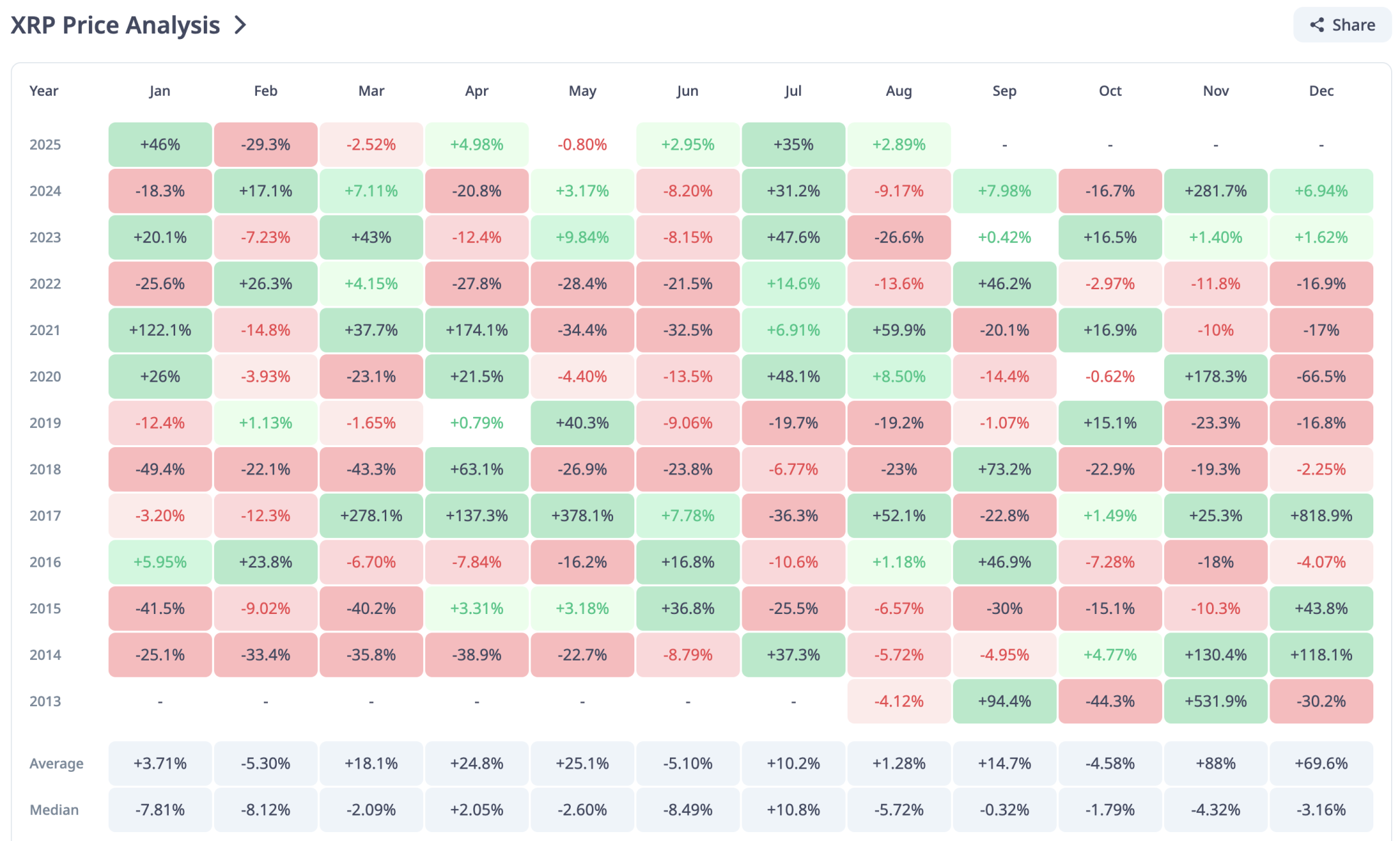
According to data from CryptoRank, in this month of August, XRP is up 6.2%, currently trading at $3.12 after closing July at $3.0252.

XRP’s overall performance for August 2024 was a cumulative loss of 9.17%. It opened the month at $0.6239 but dipped to close at $0.5663.

XRP had an even worse performance in August 2023. It opened the month at $0.6985 and closed at $0.5108, marking a significant 26.6% loss. This was the worst August performance in XRP’s history. 

Notably, in the previous month, XRP had traded as high as $0.94 on the back of its lawsuit victory, but it quickly gave up those gains.

XRP also posted losses in:

  • August 2022: down 13.6%
  • August 2019: down 19.7%
  • August 2018: down 23%
  • August 2015, 2014, and 2013: down 6.57%, 5.72%, and 4.12% respectively

On the other hand, XRP reported notable August gains in:

  • 2021: +59.9%
  • 2020: +8.5%
  • 2017: +52.1%
  • 2016: +1.18%

In total, over the past 12 years, XRP has posted losses in August eight times and gains only four times. If the current trend holds, this August may become the fifth time XRP ends the month in the green.

Historically, XRP’s average performance in August is a modest +1.25% gain, with a median performance of -5.72%. This suggests that August is typically not a favorable month for XRP. If XRP observes the +1.25% average gain this August, it will close the month at $3.0577. Meanwhile, if it witnesses the -5.72% drop, its price will slump to $2.85.

XRP historical chart
XRP historical chart/ Data from Crypto Rank

XRP in September and July

Also, XRP’s performance in September hasn’t been much better. Since 2013, it has posted an equal number of bullish and bearish returns in September. The average return stands at +14.7%, but the median return is -0.32%.

Conversely, July has historically been a bullish month for XRP, recording gains in seven out of twelve years. The average return for July is +10.2%, and the median return is +10.8%, making it one of XRP’s stronger months.

XRP’s Most Promising Months

Meanwhile, the most promising months for XRP Price have been November and December.

In November 2013 and 2014, XRP posted massive returns of +130% and +531%, respectively. Similar surges occurred in November 2020 and 2024, with gains of +178% and +281%.

In December, XRP saw a 118% gain in 2014, and an extraordinary 819% gain in 2017. Other months that have shown occasional strong performances include March and April.

While XRP’s historical performance in August and September may not appear promising, some analysts believe this time could be different. One analyst even suggested that XRP could overtake Ethereum by September.

Bitcoin Fills CME Gap in Recent Crash to $118K

0

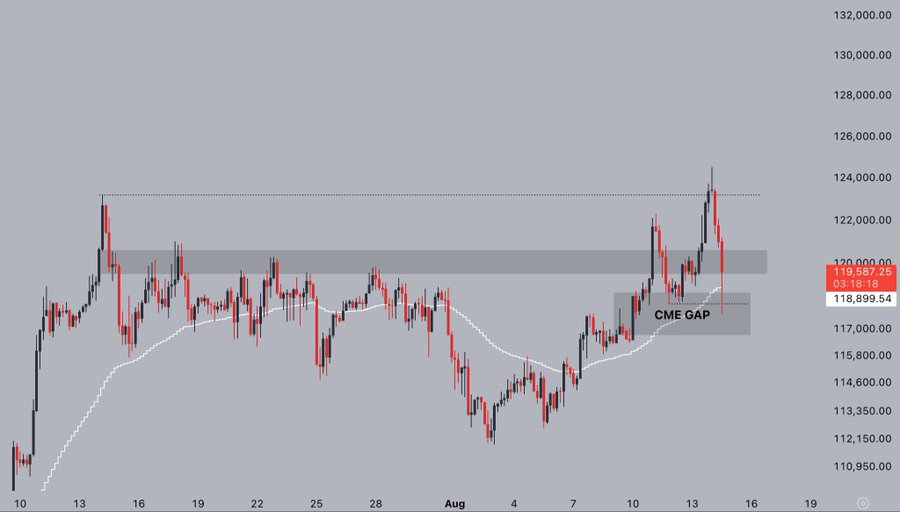
Bitcoin is rebounding to the $120,000 support level after a sharp drop which briefly filled a CME futures gap at $118,335, removing a key technical overhang.

In a post on X,  analyst Jelle described Bitcoin’s move as a “sharp reaction” to the unexpected jump in the Producer Price Index (PPI), with Bitcoin dropping to clear recent lows before rebounding toward the $120,000 support level.

Jelle Flags Volatility After PPI-Driven Sell-Off

A chart shared by the analyst showed price action slicing through intraday lows and dipping into the $118,000 range before rebounding. The move partially filled a CME futures gap before Bitcoin recovered to trade back around the $120,000 support area. 

PPI leads to Bitcoin volatility

Notably, Bitcoin has failed to sustain the rebound, now trading at $118,335, a 1.9% drop in the past day. In the past hour, Bitcoin has dropped by 0.7%. For context, Bitcoin reached a new all-time high earlier today at $124,128 before falling to the current price. 

Jelle described the immediate aftermath as a volatile period and suggested that further swings are possible as traditional markets absorbed the inflation surprise.

British Hodl Confirms CME Gap Closure

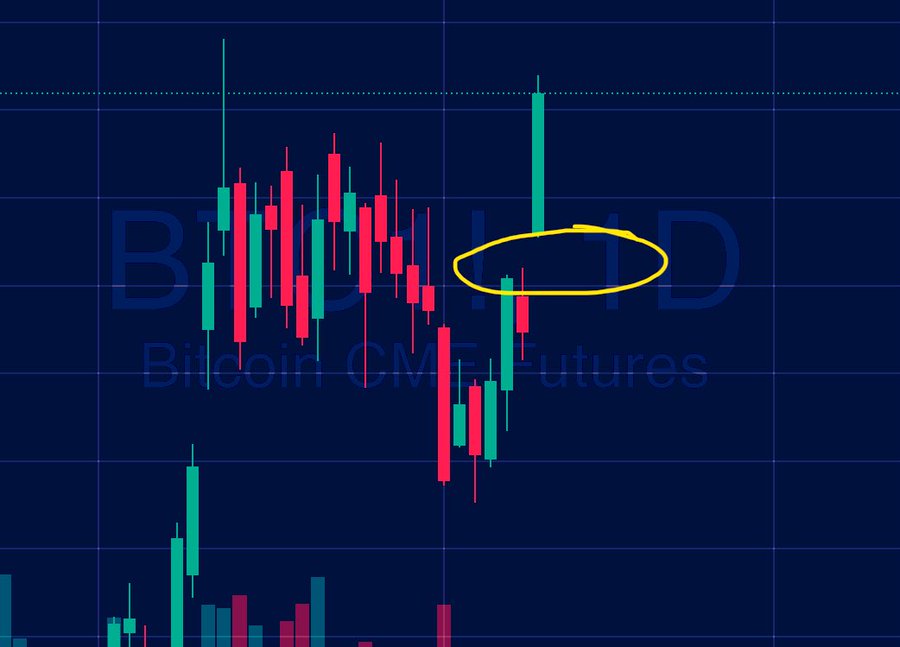
British Hodl, who on August 11 had pointed out the creation of a new CME gap at $118,335, confirmed today that the gap was now closed. The post-PPI sell-off briefly took Bitcoin into this gap range, completing the move before a swift rebound.  With this gap now resolved, a notable piece of technical overhead has been removed from the market.

CME filled
Bitcoin CME Gap Filled

Notably, the U.S. Bureau of Labor Statistics reported that July’s PPI rose 0.9%, the largest monthly gain since June 2022, and was up 3.3% year-over-year, higher than the expected 2.5%, leading to the current volatility in the crypto market. Meanwhile, core PPI, which excludes energy, trade, and food, increased 0.6%, marking its biggest rise since March 2022.

Technical Context and Market Outlook

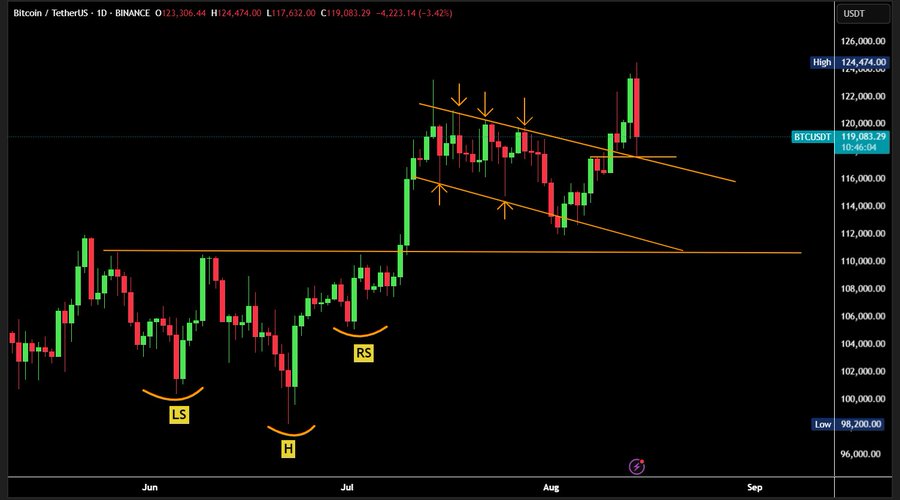
Bitcoin is now trading below the $120,000 level as it failed to absorb selling pressure in the immediate post-PPI volatility. Bull Theory noted that key support sits at $117,500, with a potential drop to $110,000 if it breaks. Meanwhile, resistance remains at $124,000. He urged the market to watch for the latest ETF report, as tariff-driven manufacturing pressures could influence next month’s CPI.

Bitcoin technical pattern

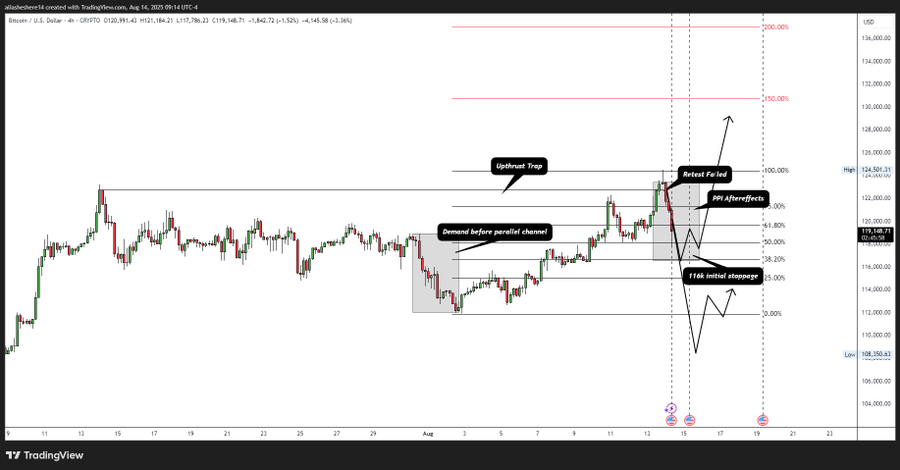
Notably, analyst Ali Ash described the short-term Bitcoin outlook as bearish, noting that a failed support-resistance retest has created a textbook “Upthrust Trap” that drained buyer liquidity. He identified $116,000 as the first key support, warning that a break below could open the door to $110,000.

Bitcoin looks bearish

Meanwhile, Crypto Patel has earlier noted that a confirmed close above the $120,000 level could pave the way for Bitcoin to reach $150,000, while rejection risks a pullback toward $111,000 or even $100,883. Similarly, Crypto Rover expected a new all-time high if Bitcoin clears resistance at $121,500–$123,000.

Here’s Why Bitcoin Has Corrected 4% Despite Reaching an All-Time High Today

0

Bitcoin reached a new all-time high today, but has shed over $5,800 since the high. Here’s what could be fueling the correction.

There have been mixed reactions in the cryptocurrency market today, particularly with the massive price fluctuation seen with Bitcoin. Much earlier today, the crypto firstborn attained a new all-time high of $124,277. However, this has gone south quickly, with BTC correcting 4% from the high a few hours after.

Why the Quick Price Turnaround?

Notably, Bitcoin has lost $5,850 from its ATH today, dropping to $118,427 at the time of writing. This has seen it give back all its gains in the past two days, fueled by a series of macroeconomic and on-chain developments.

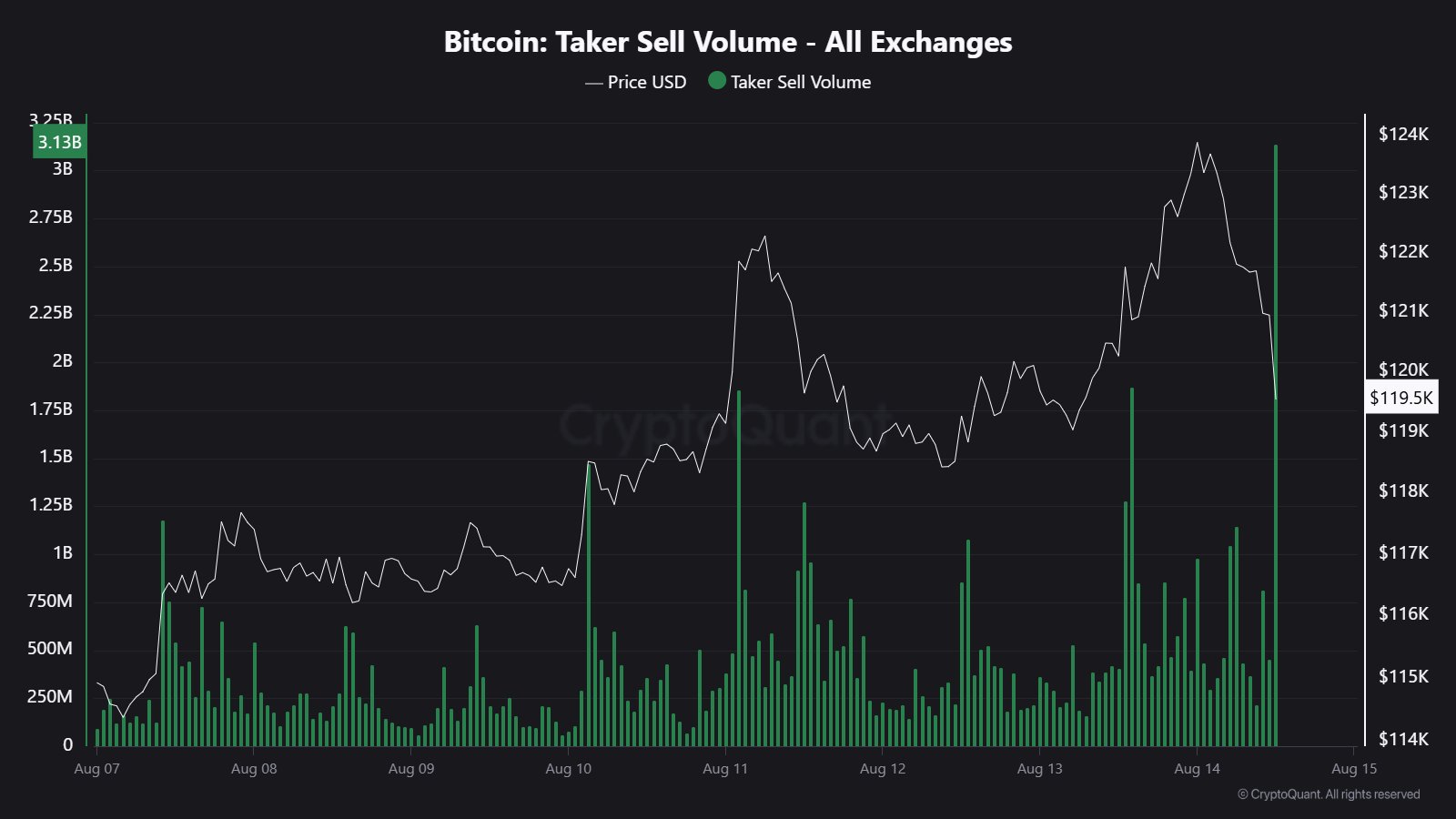
Specifically, CryptoQuant verified analyst JA Maartunn highlighted in a tweet that the Bitcoin taker sell volume has just spiked to $3.13 billion, a massive uptick from the normal market conditions over the past week.

Bitcoin Taker Sell Volume/JA Martunn

This indicator tracks the total volume of Bitcoin liquidated by holders instantly. The spike suggests that users are taking liquidity off the market through sell orders, adding selling pressure to Bitcoin’s price.

Meanwhile, a recently released economic indicator is also fueling this dump. The US producer price index (PPI) rose to 3.3%, which is higher than expected. For the uninitiated, this indicates that the price producers receive for their products has increased, signaling rising inflation.

While the core consumer price index (CPI) looked good, the high PPI raises concerns over the inflation situation in the United States. This is also a setback to the highly expected interest rate cut in September, with Polymarket showing a drop in the odds of the event happening.

Crypto Liquidation Spike Amid Bitcoin Downturn

Bitcoin’s massive correction has spurred a broader market downturn, with over $1 billion in open positions liquidated in the past 24 hours. Of this figure, $218 million were BTC positions, with $149.5 million longs and $68.6 million worth of shorts.

Remarkably, Ethereum had a higher liquidation figure, with $309.9 million in leveraged trading positions chalked off. Notably, $222.3 million of them are bull bets, while $87.6 million are bear positions. The largest single liquidation order happened with an ETH/USDT trade on OKX, where a user lost $6.25 million.

Don’t Panic Sell Your Bitcoin: Reactions

The profit-taking spree did not impress a faction of the crypto community. For context, a user stated that those selling their BTC after the new all-time high do “deserve to be broke.”

Another prominent market participant, Quinten, disapproved of selling Bitcoin due to an economic metric. Notably, BTC has shown resilience in the face of macroeconomic factors, rebounding each time it dumps on account of such development, and the user believes that selling has never been the best approach.

BtcTurk Exchange Suspends Withdrawals After $48M Multi-Chain Hack

0

Turkish crypto exchange BtcTurk has temporarily paused crypto deposits and withdrawals after detecting unusual activity involving its hot wallets. 

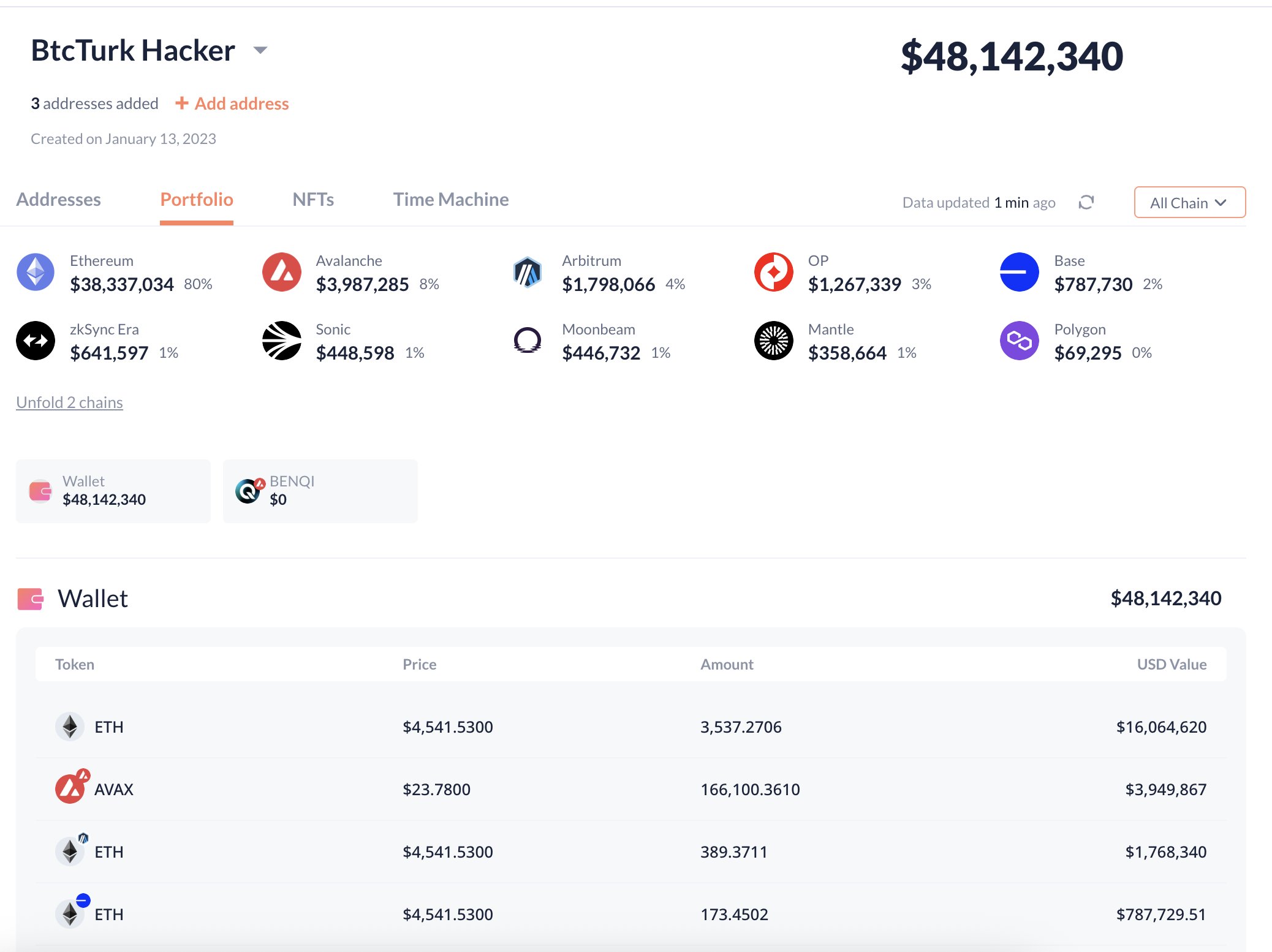
Blockchain security platform Cyvers estimates the hacker has moved out around $48 million in crypto assets.

Unusual Transfers Across Multiple Networks

Cyvers reported detecting the suspicious activity roughly 30 minutes before the public alert. The transactions spanned Ethereum (ETH), Avalanche (AVAX), Arbitrum (ARB), Base (BASE), Optimism (OP), Mantle (MANTLE), and Polygon (POL), with the majority of funds consolidated into just two addresses.

Image

Blockchain data shows that the attacker has begun swapping the stolen tokens for Ethereum via MetaMask swaps. While Cyvers pegged the suspicious outflow at $48 million, other blockchain trackers report varying figures. 

For instance, CertiK estimates that the damage could exceed $50 million. CertiK also identified three wallets involved in the incident: two Ethereum addresses and one Solana address. 

Following the alert, BtcTurk announced that it had suspended deposits and withdrawals for cryptocurrencies. However, the exchange confirmed that trading and fiat currency transactions remain operational.

In its statement, BtcTurk assured users that the majority of the exchange’s assets are in secure cold wallets and remain unaffected by the breach. Moreover, the exchange noted that it has informed the appropriate authorities regarding the incident.

Not the First Major Security Incident

The hack comes just over a year after a June 2024 incident, in which attackers stole $55 million from BtcTurk’s hot wallets. That breach was attributed to compromised private keys. Binance helped recover roughly 10% of the stolen funds by freezing $5.3 million linked to the attackers.

The 2024 incident also had ripple effects on the broader market. It caused price drops in certain tokens after the hacker offloaded large amounts on the open market.

The latest exploit highlights ongoing vulnerabilities in BtcTurk’s security practices regarding the management of users’ crypto assets. The exchange says its investigation is ongoing, and withdrawals will remain suspended until further notice.

Meanwhile, other crypto exchanges have also been targeted in recent times. The largest crypto heist to date occurred in March, when bad actors successfully siphoned $1.5 billion from ByBit. The event attracted global attention due to the scale and the parties involved.

Treasury Secretary Confirms the U.S. Will Not Buy Any More Bitcoin

0

Treasury Secretary Scott Bessent has clarified that the United States will not be purchasing additional Bitcoin, a position that diverges from earlier suggestions made by other government officials. 

Speaking on FOX Business during the Mornings with Maria program, Bessent addressed several issues from the Trump administration’s agenda, including tariffs, the selection of the next Federal Reserve chair, the housing market, and the future of the country’s gold and digital asset holdings.

Host Maria Bartiromo asked whether the Treasury planned to revalue its gold reserves. She pointed out that the government’s 261.5 million ounces of gold are currently valued at $42.22 per ounce based on a 1973 price, which amounts to $11 billion on paper. 

However, Maria noted that at current market rates, these gold holdings would be worth around $750 billion. She questioned Secretary Bessent if the Treasury was looking at revaluing these holdings.

Bessent: US Government Will Not be Revaluing Its Gold Nor Buying Bitcoin

Bessent responded by noting that the government maintains a large gold reserve, which they might not be revaluing. He emphasized that the gold would remain in place as a store of value for the American people. 

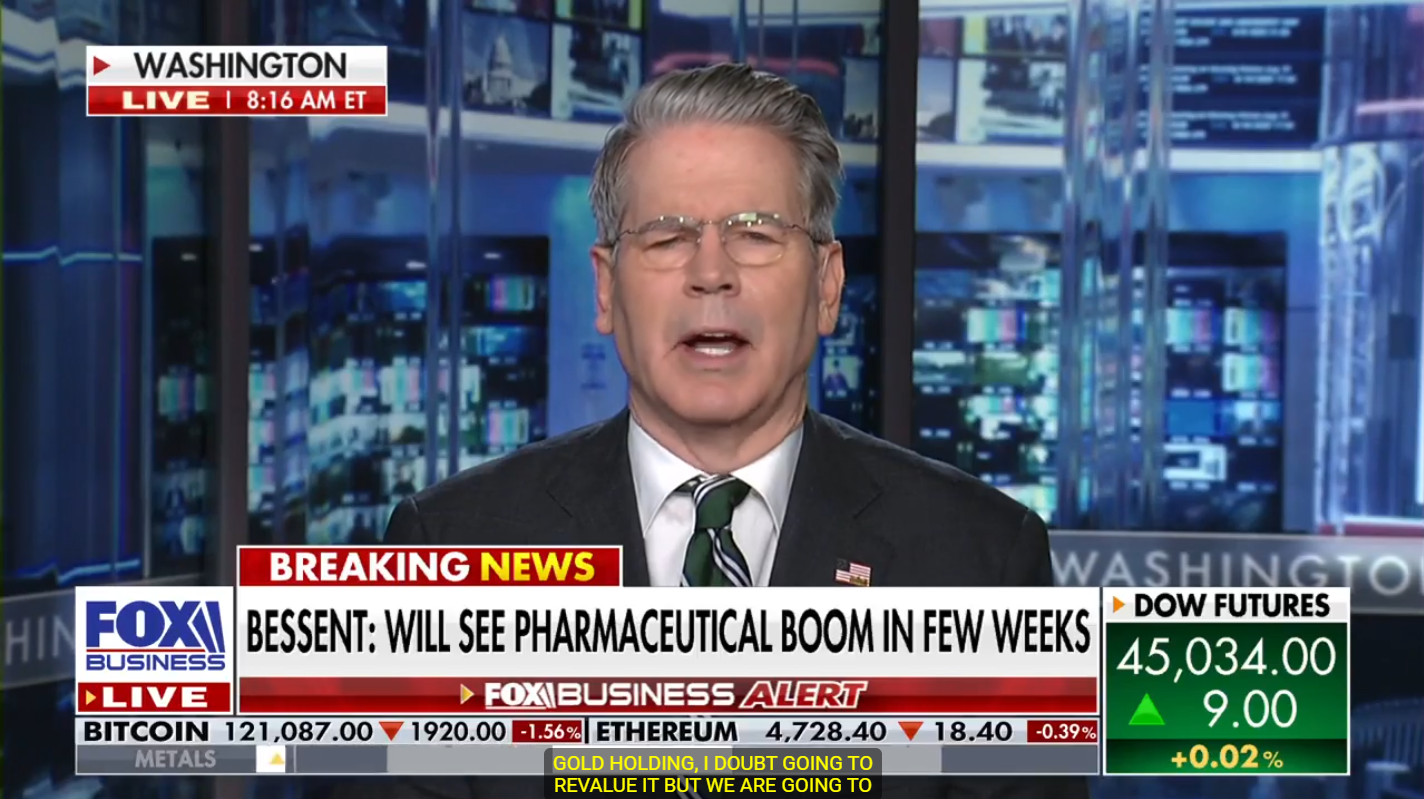
Treasury Secretary Bessent on FOX Business

The Treasury Secretary then switched to digital assets, noting that the administration has moved to modernize its holdings by establishing a strategic Bitcoin reserve. He explained that the government has funded the reserve through seized assets.

According to Bessent, the reserve is worth between $15 billion and $20 billion at current prices. However, he revealed that the administration has no plans to buy more Bitcoin, reiterating that it will continue to grow the reserve only through confiscated assets. Data from Arkham shows the US government holds 198,022 BTC worth $24.34 billion.

Bessent also confirmed that the government has no plans to sell any of the assets already in the reserve. Recall that in March, White House Crypto Czar David Sacks noted that the previous administration lost around $17 billion by selling some of its Bitcoin holdings.

Meanwhile, Bessent further explained that each of these initiatives, whether related to gold or Bitcoin, would require legislative action to formalize. 

He said the administration would pursue statutory measures to create a dedicated fund to manage these assets responsibly for future generations. Bessent added that President Trump wants people to remember him as the leader who built national wealth through asset accumulation rather than increasing debt.

Treasury Secretary Bessent’s Comments Contrast Previous Remarks

Notably, this stance on halting Bitcoin purchases contrasts with previous remarks made by Bo Hines, former Executive Director of the US President’s Council of Advisers on Digital Assets. Hines had repeatedly indicated that discussions were underway with the Treasury and other agencies to explore budget-neutral ways to acquire additional Bitcoin.

Hines’ comments came after President Trump signed an executive order on March 6, 2025, creating a Strategic Bitcoin Reserve and a United States Digital Asset Stockpile, which received initial funding from existing BTC holdings.

The order classified Bitcoin as a reserve asset similar to gold, prohibited the sale of reserve holdings, and directed Treasury and Commerce to seek cost-free acquisition methods for more Bitcoin.

Following the order, Hines had floated the idea of re-evaluating gold certificates and using the resulting gains to purchase additional Bitcoin. He also suggested in March that the US wants to accumulate as much Bitcoin as possible, much like gold.

Bessent’s latest remarks have now placed doubt on those ambitions. Shortly after his remarks, Bitcoin, which had recently been reaching record highs, fell sharply. Within minutes, the price dropped below $120,000, and it is currently trading at $119,090, marking a 3.51% decline for the day.

Analyst Says XRP Will Dethrone Ethereum by September 2025

0

XRP and Ethereum take center stage as recent comments reignite intense discussion about which asset could experience the next major “flippening.”

Besides XRP and Ethereum, Chainlink (LINK) has also entered the discussion. Some point to LINK’s surge in global search interest over XRP as a key indicator. Others, like well-known XRP influencer Alex Cobb, believe the real story will be XRP surpassing Ethereum in market cap before the end of Q3 2025.

Google Trends Data Sparking the Argument

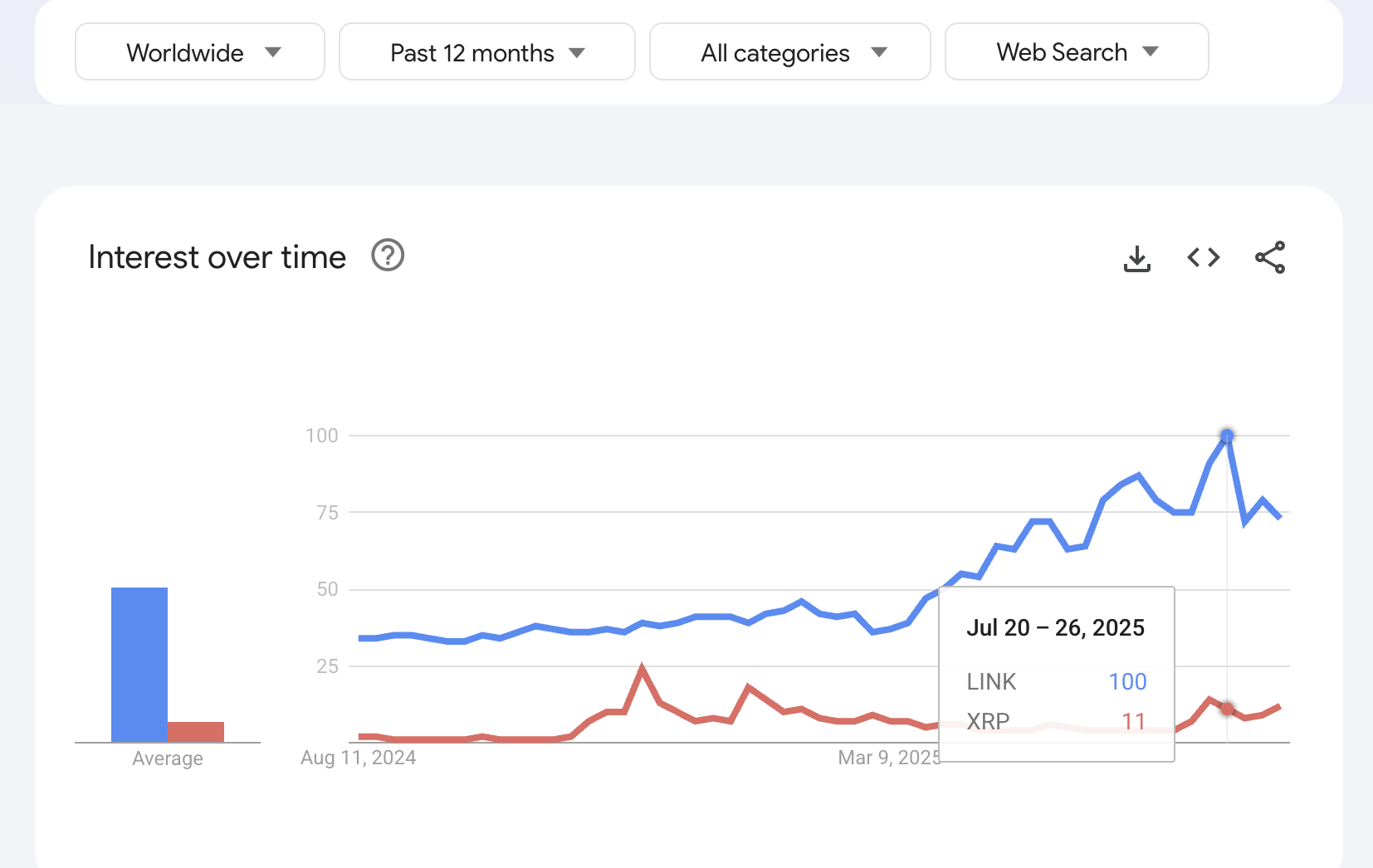
For context, the discussion began when Quinten Francois, host of CoinCompass, shared Google search trend data showing LINK overtaking XRP in relative global interest.

Over the past several years, XRP has typically held the lead in search volumes. However, more recently, search interest in LINK has surpassed that of XRP by a significant margin.

For instance, in July 2025, LINK scored the maximum 100 points on Google’s index, while XRP trailed with only 11. This was specifically during the week of July 20–26, even as XRP’s price was trading near its all-time high. Meanwhile, LINK, though still far from its own peak, was staging a historic price comeback.

Link overtaking XRP in Google search

Even in August, LINK maintained a substantial lead, with a score of 72 compared to XRP’s 13. Francois called this “the real flippening,” suggesting public attention may be shifting toward Chainlink’s ecosystem.

In other words, Chainlink may be overtaking XRP in retail interest, which could further boost LINK’s upward momentum.

Cobb: XRP Will Overtake Ethereum

However, XRP influencer Alex Cobb countered that the true flippening will occur in September 2025, when XRP surpasses Ethereum to become the second-largest cryptocurrency by market cap.

This bold prediction comes despite recent market data showing ETH extending its lead over XRP in terms of valuation.

As of now, Ethereum’s market cap stands at approximately $570 billion, while XRP’s remains at $191 billion — a gap of over $380 billion. Just yesterday, the gap was $368 billion. This indicates that ETH has added another $12 billion while XRP has stayed roughly the same.

What It Would Take for XRP to Flip Ethereum

Ethereum has been on a strong upward trend, reaching $4,788 today and trading just 3.4% below its all-time high of $4,890.

Meanwhile, XRP is trading at $3.23, up 8% over the past week, compared to Ethereum’s 28% gain. Over the last 30 days, ETH has surged 59%, while XRP has climbed just 13%.

Given this performance disparity, Cobb’s statement suggests that within the next 30 days, attention could shift from Ethereum to XRP, as he expects XRP to enter its own bullish phase. Notably, Cobb believes XRP will surpass $20 by December 2025.

If realized, this would give XRP a market cap of over $1.1 trillion. However, that valuation may still fall short of overtaking Ethereum.

For comparison, Tom Lee has predicted Ethereum will range between $10,000 and $15,000 by December 2025, implying a valuation of $1.2 trillion to $1.8 trillion.

Meanwhile, assuming Ethereum’s uptrend loses steam and XRP gains momentum, XRP could flip ETH only if it reaches $10 before Ethereum rebounds. This would require XRP to surge over 210% while Ethereum remains stagnant — a highly speculative scenario.

Here’s the Timeline for a Cardano Run to $3 After Golden Cross Pattern

0

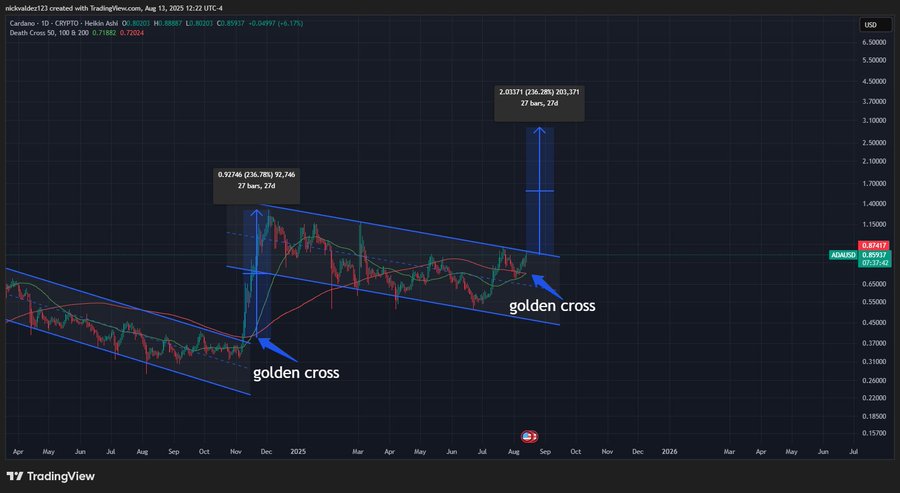
Cardano has observed the formation of a golden cross, with its 50-period moving average moving above the 200-period moving average. 

Historical Rally After Previous Signal

According to market analyst Crypto Deezy, the last time ADA formed this golden cross was in December 2024. After this, it rallied about 237% in 27 days. That move lifted the price from below $0.40 to more than $1.40. Notably, data from TradingView corroborates this value, showing a move of 0.92746 in value.

Analyst expects ADA at $3

Meanwhile, at press time, ADA is trading at $1.01, gaining more than 19% and 35.4% in the past day and month, respectively.

Deezy noted that applying the same percentage increase as the 2024 rally would bring ADA close to $3 in the next 27 days. The chart’s second measurement box supports this projection, showing a potential move of 2.03371 points in value, or roughly 236%.  A rally to this price will bring ADA close to its all-time high of $3.10 recorded in 2021.

What’s Next for Cardano?

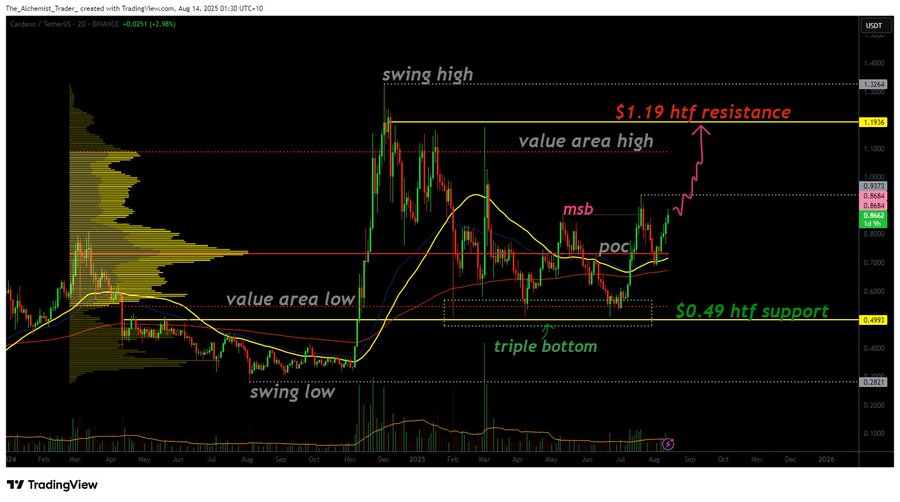
Data from TradingView highlights that Cardano is showing strong bullish momentum after breaking market structure to the upside and reclaiming the Point of Control (POC) on the 2-day chart. 

Cardano triple bottom

ADA has now moved above its value-area low and is targeting the higher-timeframe resistance at $1.19, with the swing high at $1.3264 as a potential next objective. The chart highlights a triple-bottom formation at the $0.49 support zone, confirming it as a key level for bulls to defend. 

Holding above the POC and value-area high could pave the way for continued upside, while a drop back below $0.49 would invalidate the bullish outlook.

How High Can Cardano Go?

In a separate disclosure, prominent analyst Ali Martinez said Cardano could reach $1.50 if the price clears key resistance at $0.94. His chart shows an inverse head-and-shoulders pattern with the neckline at $0.94, where a breakout could fuel moves toward $1.20 and $1.50. Notably, Cardano now trades above the neckline.

Meanwhile, analyst Christopher Visser is particularly more bullish. He suggested that Cardano is nearing a breakout after four years of consolidation, backed by bullish MACD crossovers and a rare six-hour Bollinger Band squeeze. 

He sees strong support at $0.73–$0.74 and thin resistance above, with a potential long-term target of $3.91, over 350% above current prices and beyond its $3.1 all-time high.

Similarly, analyst Dan Gambardello revealed that Cardano’s setup and risk score match December 2020, before ADA’s run to $3.09, and projects a possible move toward $3, a 197% gain from current levels. 

TerraForm Labs’ Do Kwon Pleads Guilty to Fraud Charges, Faces 25 Years Jail Term

0

TerraForm Labs founder Do Kwon has pleaded guilty to fraud charges in the United States. 

Kwon admitted guilt to two counts of fraud during his latest appearance at a New York federal court. Notably, he admitted to committing wire fraud while also conspiring to perpetrate other financial fraud relating to securities and commodities.

His recent admission signals a shift from his initial claims in January, when he denied being guilty of nine charges relating to the collapse of the Terra ecosystem. Then, he faced a maximum of 135 years’ jail term if found guilty of the charges.

Kwon’s Plea Deal

However, he entered into a plea arrangement to reduce the sentence. Although he could spend 25 years in prison, the BBC reported that prosecutors have agreed not to seek a sentence longer than 12 years as part of the deal.

The deal also requires the founder of TerraForm Labs to forfeit $19.3 million plus the interest he benefited from the crime. Notably, his sentencing hearing is scheduled for later this year, by mid-December.

Terra and Kwon’s Crisis

His recent admission of guilt comes three years after the Terra project collapsed, causing investors losses to the tune of $40 billion. According to prosecutors, Kwon issued false claims about how TerraUSD (UST) maintained its peg to the dollar.

Despite initially claiming that the Terra Protocol was responsible for maintaining UST’s dollar peg, he secretly planned with a trading company in 2021 to buy huge amounts of the token to ensure it stays 1:1 to USD.

This false claim prompted many investors to purchase TFL’s products, including its ecosystem token Luna, which boosted its price. However, the project imploded the following year, causing UST to lose its peg while Luna crashed from nearly $120 to less than a cent.

Kwon went into hiding after the project collapsed. After fleeing South Korea, Interpol issued a warrant for his arrest. A few months later, Montenegro authorities arrested him and later extradited him to the United States, where he has now pleaded guilty to two counts of fraud.

In his recent court appearance, Kwon admitted to making false statements about how UST maintains its peg and subsequently apologized for his misconduct.

While Kwon could face 25 years in prison in the United States, his attorney suggested that South Korean authorities could press further charges against him once he completes his sentence.

Canary Capital Registers Trump Coin ETF on Delaware

0

The prospects of another Trump memecoin ETF filing have gained momentum after the latest Delaware registration by Canary Capital.

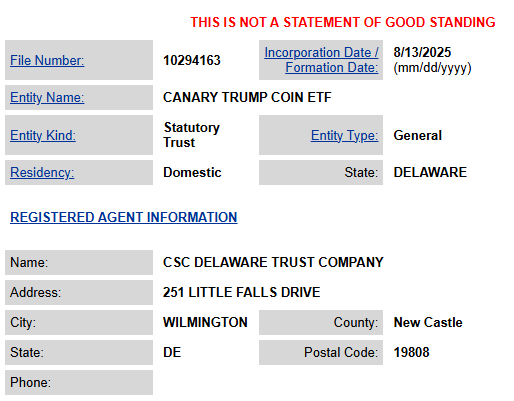
On Wednesday, Canary Capital registered the Canary Trump memecoin ETF with the Delaware State Department, according to its website. The filing, which is one of the first steps in launching an ETF product, has triggered speculation of an impending official application with the US Securities and Exchange Commission.

Another Trump Meme ETF Imminent

Bloomberg senior analyst Eric Balchunas buttressed the recent Delaware registration, suggesting that Canary is preparing to file for the first Act 33 ETF tracking the Trump-affiliated token. For the uninitiated, 33 Act exchange-traded funds are registered under the Securities Act of 1933, allowing investment in alternative assets with softer oversight.

Canary Capital Trump Coin Registration in Delaware

He deduced this from the filing, highlighting that Canary registered the entity name as a statutory trust. Earlier filings, like the Tuttle 2x ETF for both the Trump and Melania coins, were under the Investment Company Act of 1940 (40 Act).

Meanwhile, if Canary Capital files for a Trump Coin ETF as the Delaware registration suggests, it would join the long altcoin ETF waitlist. It would also accompany a combined effort from the Osprey Funds and REX Shares to file the REX-Osprey Trump ETF as a fund offering spot exposure to the token. Notably, the latter submitted its application with the US SEC on January 21.

Bold Prospect Of a Memecoin ETF

Under the formal US SEC regime, the prospects of a memecoin ETF were seemingly impossible, considering the tightened regulatory landscape. However, with Trump’s election and a change in power in the Commission, altcoin ETFs, especially meme-based funds, have had a fighting chance.

Moreover, the US SEC does not see meme coins as securities, a sentiment that would further ease their approval. The agency’s Division of Corporate Finance made this disclosure in February, classifying them as collectibles.

Leading the line are the Dogecoin ETFs, which have seen prominent asset managers like Bitwise, Grayscale, and 21Shares file for. Bitwise recently amended its application to include in-kind creation and redemption, a feature now seen in the Bitcoin and Ethereum spot ETFs.

Meanwhile, there is also a BONK ETF filing, but none yet for Shiba Inu and Pepe. Nonetheless, the Shiba Inu ecosystem team remains optimistic that asset managers will look its way soon.