Cardano founder Charles Hoskinson takes to X to highlight the network’s commitment to security.
This comes after Cardano-based FluidTokens released a comprehensive 106-page audit report for its lending V3 protocol. Engineering firm Vacuumlabs, known for auditing smart contracts on the Cardano and Ethereum networks, completed the audit of Fluid Token’s V3 lending platform.
FluidTokens V3 Lending Platform Audit Report
After receiving the final report, FluidTokens shared all 106 pages via a short video on its official X account. The move seeks to promote transparency and build trust within the crypto community.
Such openness contrasts with the practices of some crypto projects that keep internal audit reports confidential. However, FluidTokens shared the comprehensive 106-page audit report to highlight its commitment to user safety and project integrity.
Hoskinson Highlights Cardano Security
Meanwhile, Hoskinson seized the opportunity to highlight Cardano’s dedication to security. Quoting FluidToken’s X post, he noted that the Cardano ecosystem takes security seriously.
In his view, FluidToken’s audit report serves as evidence that projects within the Cardano ecosystem hold themselves to high security standards.
This commitment is part of a broader effort to protect users from vulnerabilities that could lead to financial loss. Hoskinson has consistently drawn attention to the network’s strengths, particularly its focus on security.
Earlier this week, following a 51% attack on Monero, Hoskinson discussed the mechanisms the Cardano ecosystem has implemented to prevent such incidents from affecting its privacy-focused sidechain, Midnight.
According to The Crypto Basic, blockchain project Qubic took control of the Monero network on Tuesday, with its mining pool power reaching 3 GH/s. After the 51% attack, Qubic was able to orphan competing blocks and reorganize the Monero blockchain, among other capabilities.
In response, Hoskinson pointed to the Monero attack as a major reason why the Cardano team built the multi-resource consensus protocol Minotaur for the Midnight sidechain.
The protocol offers a blend of proof-of-work (PoW) and proof-of-stake (PoS) consensus models, and prevents anyone from gaining control of the network, according to Hoskinson.
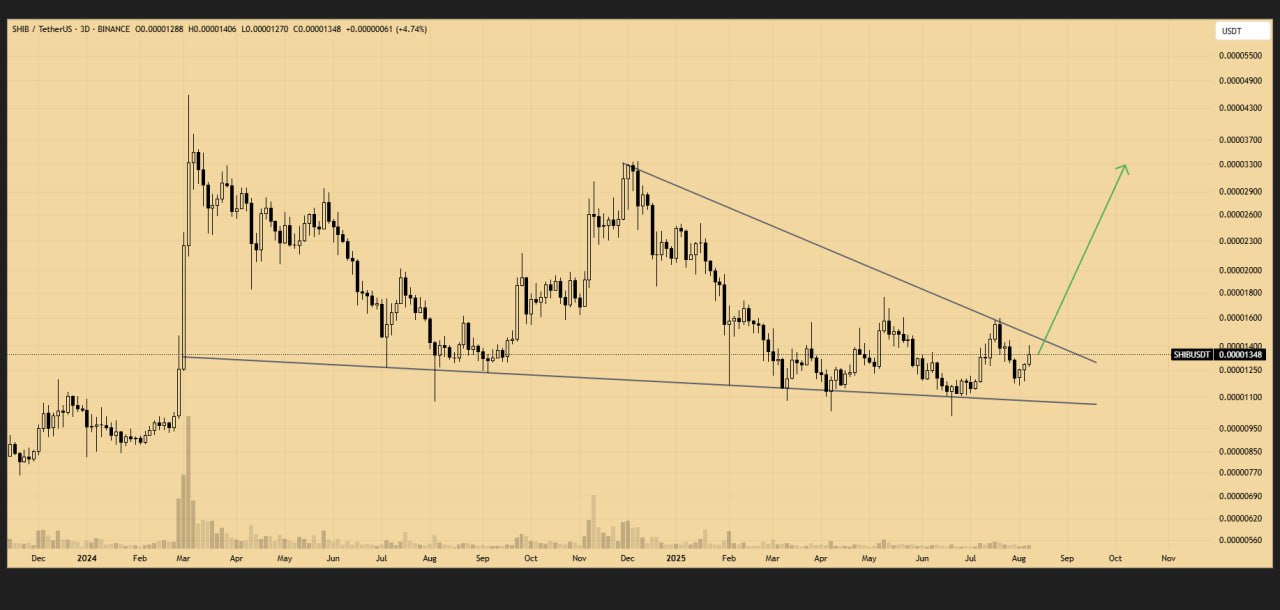
Shiba Inu could finally retest multi-month price highs as an analyst points to a looming falling wedge breakout on the three-day timeframe.
Despite its Ethereum nativity, Shiba Inu has not mirrored the rally of the second-largest cryptocurrency by market cap. Ether has increased 52% in the past month, while SHIB is down 1.57%.
Shiba Inu to Resume Upsurge Upon Breakout
Nonetheless, market watchers are still betting on a bullish development for Shiba Inu. Most recently, Crypto Mullah predicted that the prominent meme coin will “send it” upon breaking out of a falling wedge on the 3-day timeframe.
For perspective, Shiba Inu has been trending within a wedge since its December 8 high of $0.00003343. SHIB surged 49% in November 2024, joining the broader market Trump-inspired rally. The momentum endured in early December to the price high before a rejection ensured lower prices.
Notably, Shiba Inu has failed to sustainably aim for higher prices, with Crypto Mullah identifying a trend within the falling wedge as another momentum suppressor. According to him, SHIB would rally extensively if it finally broke free.
Meanwhile, Shiba Inu would require a bullish momentum greater than the one it had in July to break free. For context, SHIB rallied to the tip of the pattern’s upper resistance trendline on July 21, when it reached a high of $0.00001597. However, Shiba Inu failed to sustain the trend and fell back into the triangle.
Shiba Inu Falling Wedge Trend
Possible Target As Breakout Looms
With Shiba Inu’s recent resurgence, the analyst expressed optimism that it could finally break out from the multi-month falling wedge. When it does, he projects a rally to retest the price level where the pattern originated.
Specifically, he expects Shiba Inu to reclaim its December 2024 high of $0.00003343, which is 146.5% away from its current price of $0.00001356. Notably, a successful retest of the level will set Shiba Inu up for higher prices.
The price target aligns with an earlier call from analyst Javon Marks. The market commentator predicted a rally to $0.000032, as the MACD indicator signals bullish divergence.
Shiba Inu Next Near-Term Target
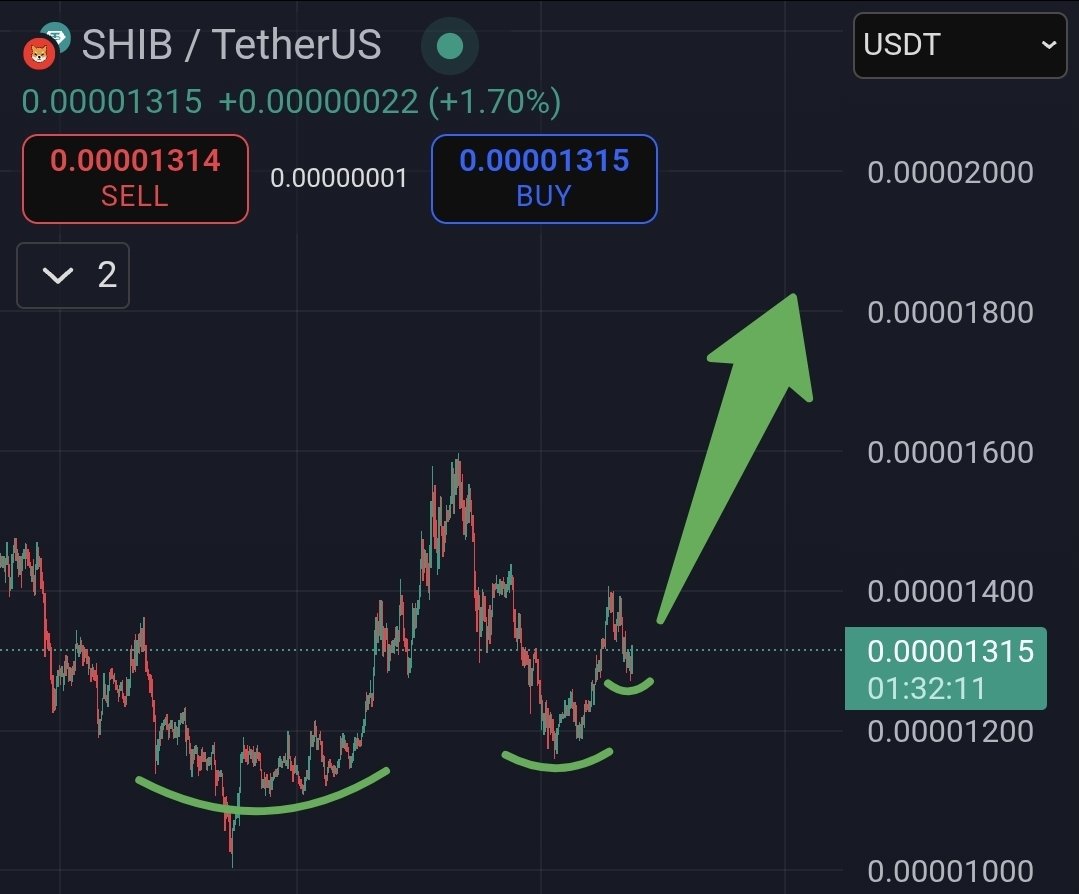
Meanwhile, SHIB KNIGHT believes Shiba Inu will reclaim bullish momentum in the coming days. His analysis points to a near-term surge to $0.000018, then to higher resistance zones.
Backing his assertion, the SHIB bull highlighted a promising structure on the Shiba Inu chart amid a higher low formation. He emphasized that the rebound from a recent low could be forming a higher low, which is a classic sign of building upward momentum.
Shiba Inu Higher Low Formation/SHIB KNIGHT
SHIB KNIGHT insisted that if this trend persists, Shiba Inu could rally 32% to $0.000018.
The initially strong outlook of XRP flipping Ethereum this cycle is gradually taking a back seat as the gap XRP needs to close continues to widen.
Some prominent market commentators who loudly called for the XRP flippening are now backtracking on that view. This comes as Ethereum (ETH) stages a streak of strong green candles without subsiding, while XRP remains largely idle.
Among those backtracking on that outlook is widely followed technical analyst Charting Guy. In a tweet on Tuesday, he highlighted how from November 2024 to January 2025, XRP exhibited massive momentum to flip ETH in market cap.
During this time, XRP surged almost 600%, while Ethereum remained almost idle, struggling to stay above $3,000. In perspective, ETH even dipped to $1,385 in April, one of its lowest points since 2020.
While XRP also dipped during this period, it held up much better. Considering XRP’s rapid market expansion of about seven times in weeks, many industry commentators expressed optimism that XRP would flip ETH to become the altcoin king.
“That’s No Longer the Case”
However, Charting Guy, in his latest commentary, says this outlook is “no longer the case.”
He disclosed that he re-invested in ETH in April near the bottom, and it has shown immense strength since. Today, ETH is trading just 10% away from its all-time high.
Notably, ETH touched $4,678 today. Considering its $1,380 price in April, that’s a massive 239% gain so far. At press time, ETH is only 5.11% below its all-time high of $4,891, trading at $4,633.
Its market cap is now $559 billion compared to XRP’s $191 billion. This means the gap between the two is now over $368 billion. Meanwhile, as of July 13, the gap between XRP and ETH was less than $200 billion.
While ETH has pumped by 52% in the last four weeks, Charting Guy sees Ethereum progressing further. However, for XRP, he noted that it probably has only a 2.5x max left from its current position.
Trading at $3.22, a 2.5x increase would give XRP a price of about $8 with a potential valuation of $477 billion, which would still be below Ethereum’s current market cap. Considering ETH may not stay idle while XRP surges 2.5x, the gap could widen even further.
Hold XRP and ETH
Considering this, Charting Guy warned market participants against listening to XRP “moon boys” calling for lofty prices for XRP while disregarding ETH. He urged investors to instead own both assets to be better positioned than to be a maxi.
He stressed that ETH’s outperformance and strength were overdue, as it has largely lagged behind Bitcoin this season.
Steep Climb for XRP to Overtake Ethereum
Prominent XRP advocate Bill Morgan agrees with Charting Guy’s view that XRP may not flip ETH this cycle. Morgan stated the widely anticipated flippening will not occur this cycle—maybe some other season.
Among popular outlooks for ETH this season are prices above $10,000. According to Fundstrat CIO Tom Lee, Ethereum could reach $16,000 this cycle with a market cap of $1.92 trillion. Meanwhile, Carl Moon suggests ETH may hit $25,000, leading to a market cap of $3 trillion.
On the other hand, popular “realistic” forecasts for XRP suggest prices between $10 and $20, which would give it a market cap just above $1.1 trillion.
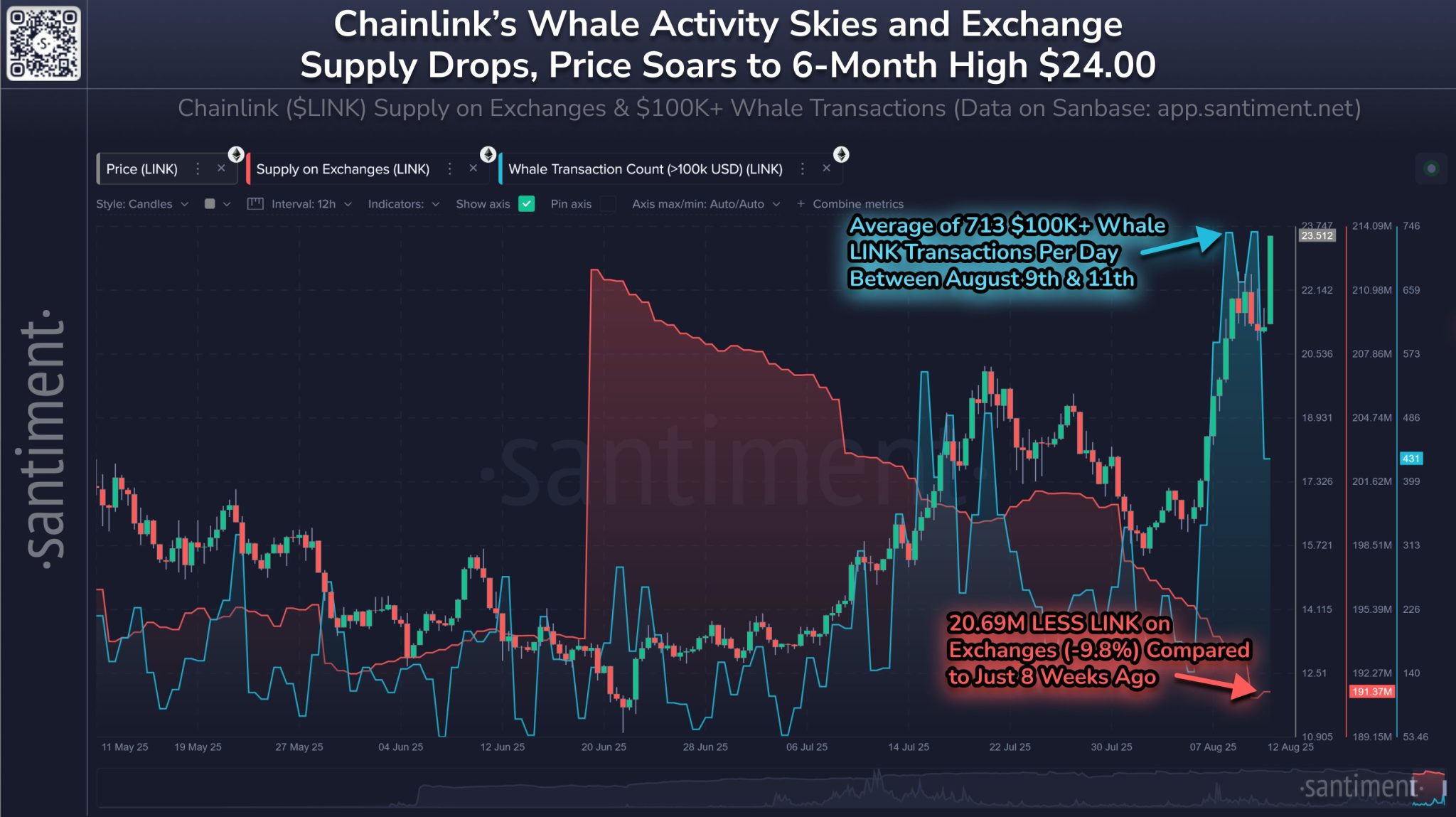
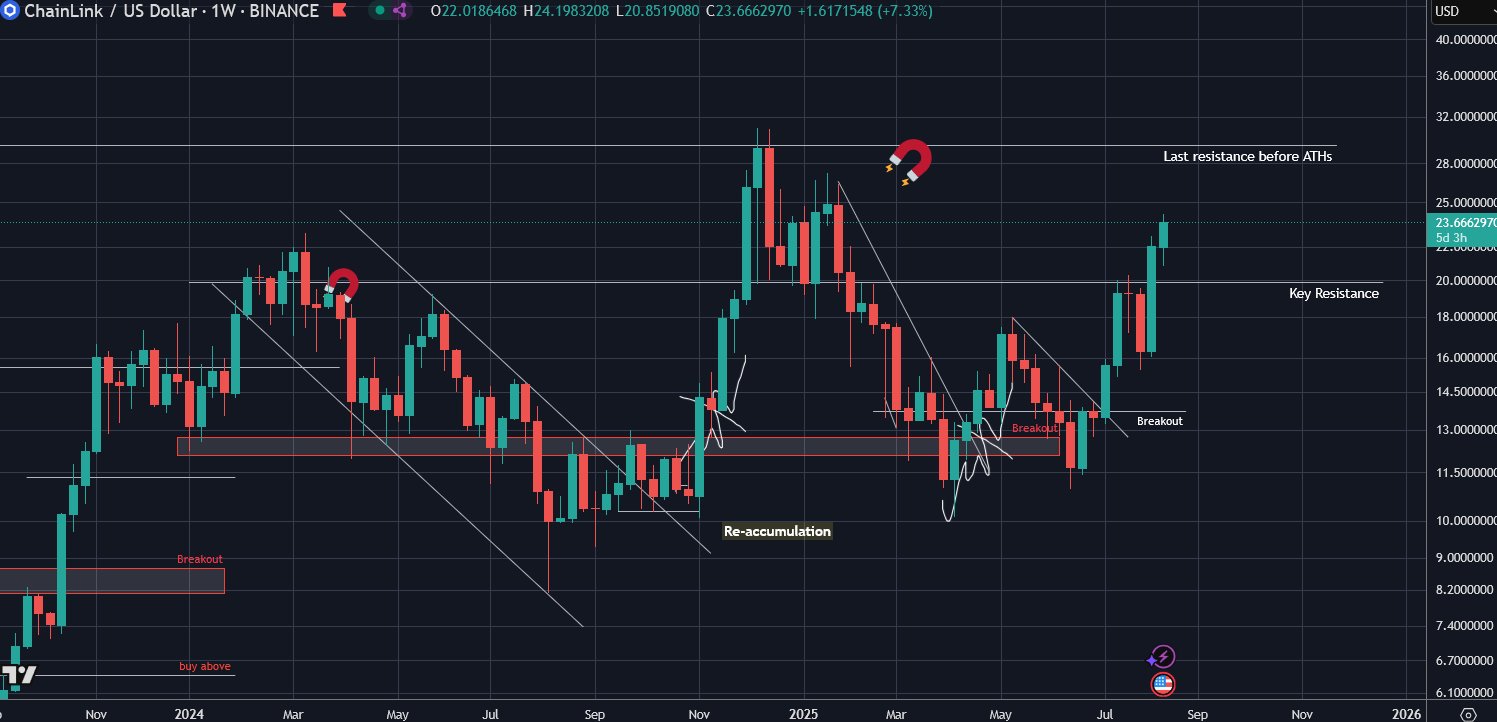
The Chainlink price climbed to its highest level since February as whale activity surges, data from Santiment revealed.
In a post on X, on-chain analytics platform Santiment noted that Chainlink reached $24 earlier this week, marking its highest price since February 2. This move came during a five-day rally this month that saw increased market activity from large holders.
Whale Transactions Surge During Rally
Specifically, transactions valued above $100,000 surged sharply during the rally. Between August 9 and 12, Chainlink recorded an average of 713 whale transactions per day, one of the highest activity levels for large-value transfers in the past three months. This increase in high-value transactions coincided with LINK’s price acceleration from below $20 to the $24 level.
6-month high for Chainlink
As of this press, Chainlink trades at $24.28, an impressive 13% surge in the past 24 hours. LINK has been on a bullish journey this past week, recording a 50.8% uptick.
Chainlink’s Exchange Balances Decline by Nearly 10%
Alongside the price rise, LINK’s exchange supply dropped significantly. Over the past eight weeks, since June 17, the amount of LINK held on centralized exchanges fell by 20.69 million tokens, representing a 9.8% decrease. Exchange balances moved from approximately 211 million LINK in mid-June to the current level of 191 million, signifying a reduced selling pressure and possibly a more bullish move.
Notably, from mid-May to early July, LINK traded in a relatively narrow range of $12.51 and $15.72, with occasional volatility and moderate whale transaction activity. In mid-July, prices began trending higher, breaking above $18.93 in late July. The upward momentum accelerated to above $20.53, coinciding with the spike in whale transactions and reduced exchange balances.
Experts Predict Chainlink to Reach $29
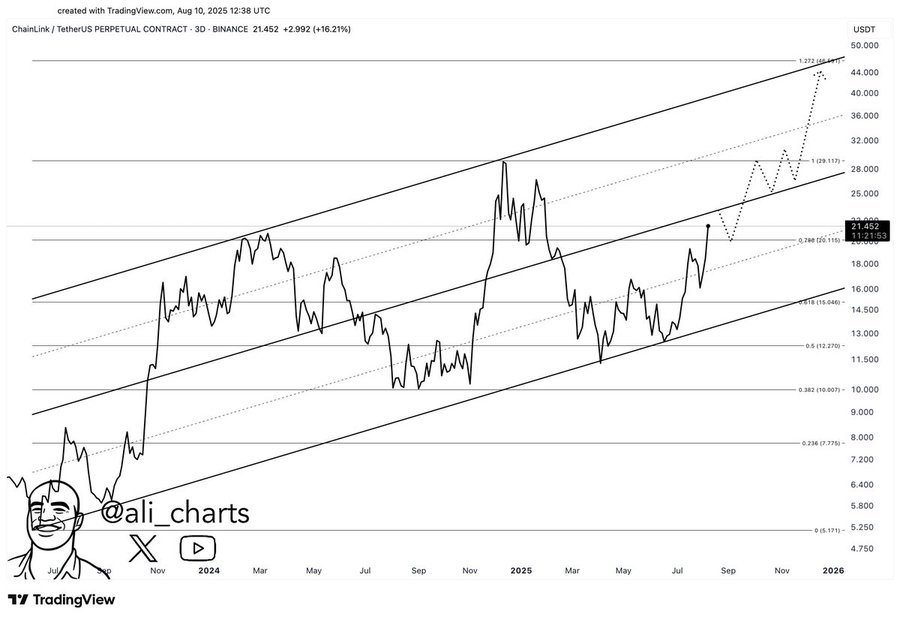
Meanwhile, crypto analyst Ali Martinez has identified $29 and $46 as the next major price targets for Chainlink, citing a bullish breakout above the $20.12 Fibonacci resistance level. His latest chart shows LINK’s first upside objective aligning with the 1.00 Fibonacci extension at $29.12.
Ali Martinez predicts the Link’s price
The second target is near the 1.272 extension at $46, which also coincides with the upper boundary of a long-term ascending price channel. Martinez’s outlook suggests that as long as LINK holds above $20.12, the path remains open for a continued rally towards new highs.
Interestingly, analyst trader Rocko projects a similar move. A chart shared by the analyst shows Chainlink breaking out of multiple downtrend structures and reclaiming key support at $19, with price now pressing into what he calls the “last resistance before new all-time highs.”
Chain Link to $30
Rocko projects a next target of $30 if it maintains key resistance above $19, coinciding with an earlier prediction. Notably, Chainlink’s all-time high stands at $52.88 from May 2021. This high was followed by a plunge to a low below $5, but LINK has since recovered from this floor to the current price.
A wallet has been holding onto an Ethereum short position for over a month now, but could be on the verge of liquidation as the Ether price rally persists.
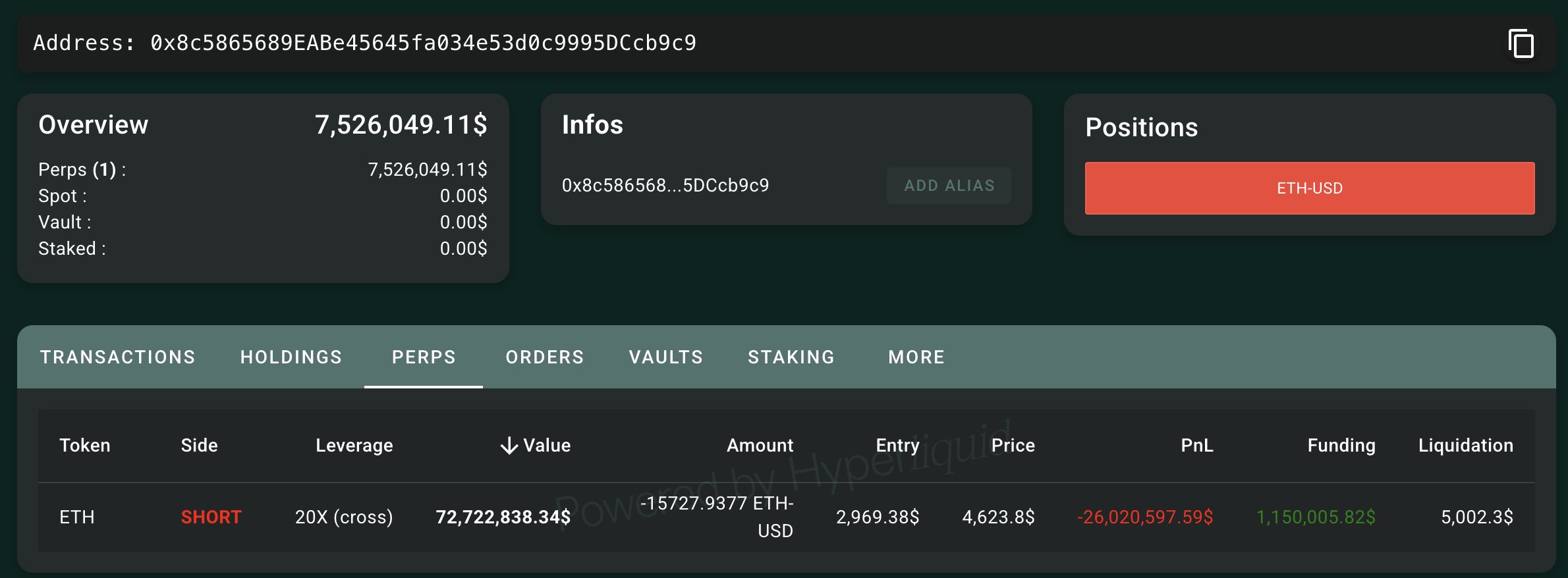
The whale address “0x8c58” opened a short position at $2,969 on Hyperliquid with a 20x leverage on July 1, with Ethereum correcting 3% on the day. Meanwhile, Ethereum quickly rebounded the next day and has been on a parabolic expansion since then.
Ethereum Whale Now At Risk of Liquidation
With Ethereum crossing a 4-year top of $4,600 today, the whale is now at risk of liquidation. The address sits at an unrealized loss of $26 million, with its liquidation price at $5,000.
20x Short Whale on Unrealized $26M Loss
Remarkably, the whale has been adding margin to his position as Ethereum’s price increased. He deposited 3.58 million USDC on July 18 and another 8.6 million USDC on August 9, all of which are at risk of going under the water if Ethereum’s bullish momentum persists.
For context, Ethereum has rallied a staggering 86.8% from its opening price of $2,486 on July 1 to its current market price of $4,644, spurred by growing institutional interest. Ether’s 8% growth yesterday, which has spilled into today, leaves it just 5% away from its current all-time high of $4,891.
Ethereum Foundation Wallet Sells 5,094 ETH
Meanwhile, a wallet tied to the Ethereum Foundation is dumping Ether despite its price rally. Lookonchain first reported the development on August 13, as the address “0xF39d” sold a total of 5,094 ($23.6 million) ETH over multiple transactions.
First, the wallet moved 1,696 ETH over two transactions on August 12 for 7.72 million DAI at $4,556. Then it sold another 1,100 ETH ($5.06 million) by 0:27 (UTC) today. A few minutes later, the address sold 2,300 ETH ($10.5 million) over five transactions, culminating in the 5,094 ETH.
In return, the wallet received a total of 18.71 million DAI stablecoin. However, it currently holds 11.58 million DAI, having moved over 7.1 million DAI to a DSProxy address.
Notably, the address originally received 20,756 ETH ($95.5 million) from the Ethereum Foundation wallet “EF 1” back in 2017. With the sale, which is its first major transaction in 128 days, the wallet now holds 100 ETH ($463,937).
Speaking in a recent podcast episode with Versan Aljarrah, a crypto tax attorney shared how XRP holders could unlock liquidity without triggering capital gains tax.
Versan Aljarrah, co-founder of the Black Swan Capitalist, requested this information after he called attention to the prospect of long-term strategies in the crypto market during the latest podcast episode.
Specifically, Aljarrah noted that serious investors don’t just flip crypto assets for quick gains. Instead, they often plan to use their holdings in ways that preserve ownership while unlocking value.
According to him, assets like XRP could act as collateral once regulations are fully in place. He then asked how, from a legal and tax perspective, borrowing against crypto would work compared to selling it, especially for investors who want to access liquidity without triggering capital gains tax.
How to Access Liquidity with XRP Without Triggering Capital Tax
In response, Andrew Gordon, a CPA and crypto tax attorney, highlighted the tax implications. Gordon said that the most effective way to avoid a crypto tax bill is to avoid creating a taxable event in the first place. Any sale, swap from one token to another, or conversion into U.S. dollars counts as a taxable event.
Borrowing against $XRP collateral might be the smartest tax move in crypto. Top attorney Andrew Gordon explains why loans aren’t taxable, meaning you can unlock liquidity without triggering capital gains.
— Versan | Black Swan Capitalist (@VersanAljarrah) August 13, 2025
However, he explained that borrowing against crypto operates differently. If an investor uses Bitcoin, XRP, or another token as collateral for a loan, they can receive cash or other assets without selling the original holding.
Because no sale occurs, the IRS does not treat it as a capital gains event. This lets investors access funds while still holding their assets in anticipation of future price growth.
Nonetheless, Gordon cautioned that loans must be repaid and that each investor needs to evaluate whether the move makes financial sense. However, he called this a highly effective, tax-efficient way to unlock liquidity for those confident in the long-term growth of their crypto holdings.
Responding, Aljarrah confirmed that the explanation cleared up questions he had personally. Speaking further, he called attention to the growing prominence of the Ripple stablecoin, RLUSD. To him, once RLUSD infrastructure expands, the ability to borrow against XRP could present better upside opportunities for investors.
Interestingly, market commentator Cypress Demanincor proposed this move as part of the ideal investment strategy to investors. Demanincor suggested that instead of selling their XRP tokens, investors could lend out their tokens and borrow against them.
Moreover, wealth manager Digital Wealth Partner demonstrated this move early this year. Specifically, the firm announced that it had secured a seven-figure loan for one of its clients using XRP as collateral.
The Crypto Tax Situation in the US
The latest discussion comes during a period of major changes in U.S. crypto tax policy. On January 1, 2025, the IRS began requiring brokers to report crypto sales using the new Form 1099-DA, although cost basis reporting won’t begin until 2026.
The agency also replaced the universal accounting method with wallet-by-wallet accounting, forcing investors to track gains separately for each wallet. Last month, Fidelity urged Congress to fix the rules surrounding Bitcoin and crypto tax.
Shiba Inu burn rate has spiked significantly as an anonymous user incinerates more than 85 million SHIB tokens in a single transaction.
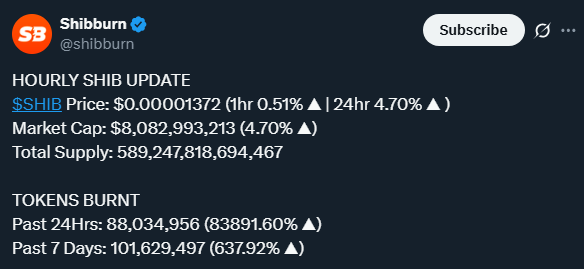
As usual, Shiba Inu’s burn tracker Shibburn indexed the transaction today, noting that the user transferred 85,795,990 SHIB tokens to the official dead wallet.
This indicates that 85.79 million Shiba Inu tokens have been permanently removed from circulation as part of efforts to boost the token’s price over time.
Data from Shibburn shows that the user burned the tokens today at 00:09 a.m. (UTC). With Shiba Inu currently trading at $0.00001368, the 85.79 million tokens are valued at $1,173. The user behind the transaction remained unknown in the hours leading up to press time.
Biggest Individual Burn Since July 29
While the 85 million SHIB burned is tiny compared to Shiba Inu’s massive supply of 589.25 trillion, it marks the largest single burn reported since July 29. This makes it the biggest in the past two weeks.
Since July 29, no individual burn transaction has exceeded 20 million SHIB tokens. The second-largest burn since that date saw roughly 18.64 million SHIB go up in flames on July 29.
A day earlier, on July 28, a Coinbase user burned 600.7 million SHIB immediately after withdrawing the tokens from the exchange.
Burn Rate Soars 83,391% in 24 Hours
Notably, the latest incineration has pushed Shiba Inu’s burn rate to 83,891% over the past 24 hours, with a total of 88.03 million SHIB burned within this timeframe. The tokens were permanently removed from circulation across six transactions, with the largest containing 85.79 million SHIB.
Meanwhile, the number of SHIB tokens destroyed over the past week by members of the Shiba Inu community is around 101.62 million. Consequently, Shiba Inu’s burn rate has spiked by 637.92% over the past seven days.
Shiba Inu burn
Shiba Inu Price Spikes Over 5%
Notably, the recent burn coincides with a spike in Shiba Inu’s price. Shiba Inu has recorded a slight growth of 5.3% over the past 24 hours, pushing its price to $0.00001368. The canine-themed token has also soared 13.06% in the past week.
While increased token burns often contribute to price appreciation, the latest spike is driven by a relief rally across the broader crypto market. Major assets, including Ethereum and Solana, have also posted substantial gains over the past day, totaling 8.27% and 12.90%, respectively.
XRP price has the potential to reach ambitious two-digit figures if rural and offline communities adopt XRP through QR wallets.
XRP Could Penetrate the QR Wallet Sector
One area that could drive a major XRP price increase is the growing QR code payment market. QR wallets have rapidly gained ground across developing countries, especially in rural and offline communities where access to traditional banking remains limited. Notably, XRP’s speed and efficiency make it a strong candidate for powering these payments.
In 2024, global QR-based payments reached $5.4 trillion. Juniper Research expects this figure to jump to $8 trillion by 2029. QR codes now handle nearly half of all mobile wallet transactions worldwide, helping to bring financial services to regions without stable banking infrastructure.
With this massive growth in mind, we asked ChatGPT to estimate XRP’s price if rural and offline communities started using it through QR wallets. The AI chatbot presented two bullish models to answer this question.
XRP Price if Rural and Offline Communities Adopted It for QR Wallet Payments
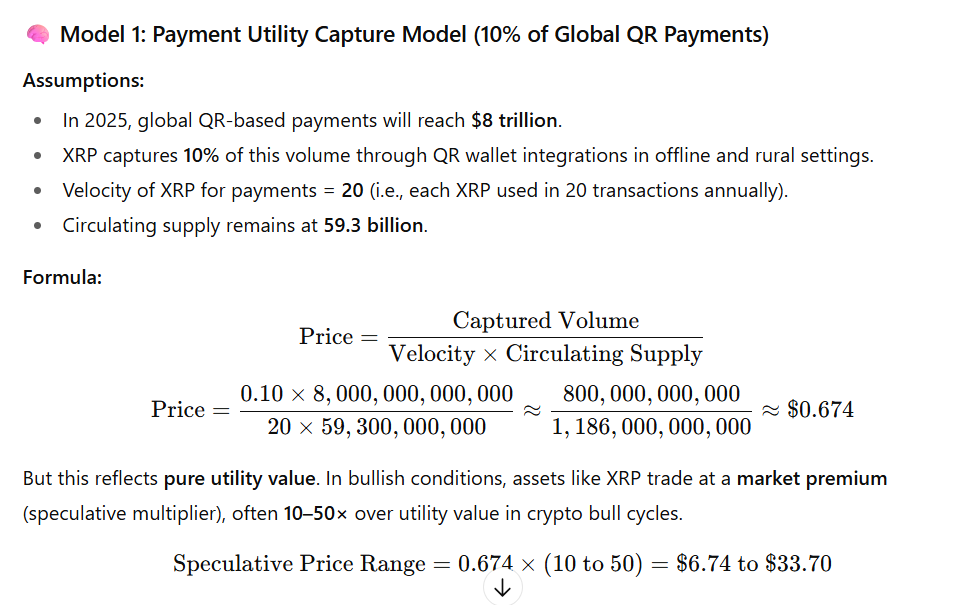
The first approach, the Payment Utility Capture Model, assumes that XRP handles 10% of global QR-based transactions in 2029. This would give it $800 billion in annual volume.
If each XRP token processes 20 transactions per year, a payment velocity of 20, and the supply remains at 59.3 billion tokens, XRP’s pure utility price would reach about $0.674.
However, this would not reflect XRP’s actual price, according to ChatGPT, as crypto prices often rise far beyond their utility value due to speculation. As a result, it applied a multiplier of 10 to 50, which reflects typical crypto market behavior, to project a price range of $6.74 to $33.70.
XRP Payment Utility Model | ChatGPT
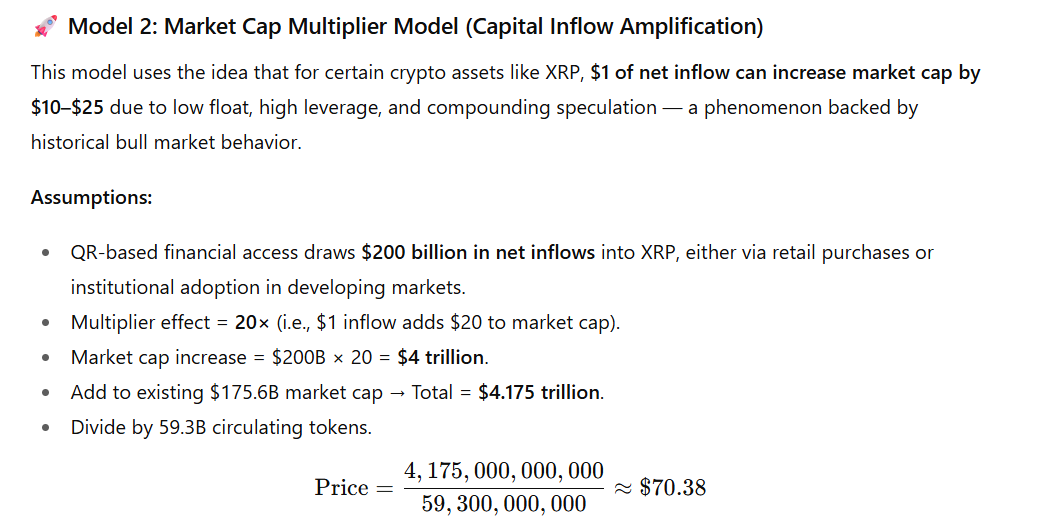
Meanwhile, the second model focused on capital inflows and how they could boost XRP’s market cap. ChatGPT suggested that QR adoption could attract $200 billion in new investment into XRP, driven by interest from retail users and institutions across developing markets.
The chatbot used a 20x multiplier, based on how crypto markets have responded to inflows in the past, to indicate that this capital could increase XRP’s market cap by $4 trillion.
Now, adding this to the current market cap would bring the total to $4.175 trillion. It then divided this valuation by the circulating supply of 59.3 billion tokens to arrive at a projected price of about $70.38 per XRP. According to ChatGPT, this scenario reflects an extremely bullish case where XRP becomes a major tool for digital payments in underserved areas.
XRP Market Cap Multiplier Model | ChatGPT
QR Wallet Payments Continue to Grow
Interestingly, real-world trends support the idea that QR wallets will continue expanding in these regions.In India, rural and semi-urban users made up 60% of the country’s UPI transaction volume by 2023. UPI payment volume jumped from 18 million in 2017 to over 8 billion in 2023, while total value soared from $16.7 billion to $1.7 trillion.
Meanwhile, in the Asia-Pacific region, digital wallets handled nearly two-thirds of all global mobile payments in 2023, totaling $9.8 trillion. In Africa, services like M-Pesa saw a 32% rise in active users last year, with QR codes playing a key role.
New technologies now allow users to complete QR payments offline, using static codes or Bluetooth. Notably, these tools make it easier for small merchants, farmers, and rural traders to go cashless, even without a steady internet connection.
A former Ripple developer has debunked the XRP ISO 20022 compliance claims. However, XRP could still benefit from RippleNet’s alignment.
The latest argument started with Jake Claver, CEO of Digital Ascension Group, praising XRP for what he sees as a forward-thinking move. He claimed that XRP recognized early on the importance of ISO 20022, a global standard that lets financial institutions exchange data in a common, streamlined format.
Ex Ripple Developer Debunks “XRP ISO 20022 Compliance” Claims
Claver argued that this focus is now paying off, claiming the network now processes hundreds of billions of dollars in daily transactions. He described ISO 20022 as one of the most important upgrades in finance, yet it is still misunderstood by much of the crypto industry.
The community pundit believes many blockchain projects build great technology but ignore the bigger challenge of connecting with the existing financial system. He noted that ISO 20022 can trigger this connection, and Ripple’s technology could become relevant in tokenizing traditional monetary systems.
However, Matt Hamilton, a former Ripple developer, debunked these claims. Hamilton stressed that XRP has never had anything to do with ISO 20022 and insisted there’s nothing in the XRP Ledger’s code or network that connects to the standard.
XRP did not prioritise ISO20022 whatsoever. There is literally nothing in the XRP Ledger codebase or network that has anything at all to do with ISO20022. It has been entirely a charade perpetuated by scammers like yourself.
He called the idea that XRP itself is ISO 20022 compliant a complete misunderstanding. According to him, this misunderstanding is fueled by misleading statements in the crypto space. In response, Claver admitted to erroneously conflating Ripple with XRP in his original statement.
Notably, the latest argument resurfaced a long-running discussion around the “XRP ISO 20022 compliance” claims. For context, much of the confusion comes from people blurring the lines between Ripple, the company, and XRP, the cryptocurrency.
XRP is Not ISO 20022 Compliant, But It Could Benefit from RippleNet’s Alignment
Specifically, Ripple’s global payments network, RippleNet, does in fact comply with ISO 20022. Ripple became the first blockchain-focused company to join the ISO 20022 Standards Body in May 2020.
Since then, RippleNet has been built to fully support the standard, letting it integrate with banks and payment providers worldwide through a single API.
On the other hand, XRP has no relationship with ISO 20022 compliance. XRP runs on the XRP Ledger, which uses JSON-based APIs instead of ISO 20022’s XML format. ISO 20022 is not a certification for tokens, as it’s a messaging standard.
As a result, cryptocurrencies themselves cannot technically be “ISO 20022 compliant.” Ripple’s Chief Technology Officer, David Schwartz, has confirmed that XRP has no direct link to the standard.
The common misunderstanding likely comes from XRP’s role in Ripple’s On-Demand Liquidity (ODL) service, which runs on RippleNet’s ISO-compliant framework to settle cross-border payments instantly.
However, even without direct compliance, XRP still benefits from RippleNet’s alignment with ISO 20022.With more banks and financial institutions worldwide moving to the standard, likethe U.S. Federal Reserve recently did for its Fedwire system, RippleNet becomes easier to adopt.
Notably, the biggest advantage for XRP is interoperability. RippleNet’s compliance means it can connect directly with global financial systems that follow the ISO 20022 standard, and XRP can then serve as the asset that bridges currencies in real time.
Traditionally, OTC trading happens in the dark where deals are completed quickly and riskily. It’s hard to find any safety net, and scams are everywhere. This pain point is exactly what Unich is striving to cope up with. They’re building an exchange that runs on smart contracts, so trades are not only fast but also safe and clear to everyone.
What’s wild is that in only six months, they managed to reach $1.2 billion in volume. What’s even wilder? That’s before their token generation event even kicks off.
What Makes Unich OTC Tick: The Core Products Explained
Unich OTC Exchange was born with the idea of bringing transparency and security to over-the-counter crypto trading in mind. The platform is built on smart contracts, aiming to eliminate the risks and scams common in traditional OTC deals, especially for pre-TGE tokens.
Before discovering this project’s potential and why it has achieved extremely amazing results, it’s important to understand the products at the heart of Unich: Pre-Market & Pre-Order. These core offerings directly address the risks and inefficiencies that have long hurt OTC trading.
1. Unich Pre-Market OTC: A Safer Way To Trade Pre-TGE Tokens
In conventional OTC deals for pre-TGE tokens, buyers often need to pay the full amount of the assets and wait for weeks (sometimes months) to receive the tokens. This model makes buyers prone to certain risks: what if the project doesn’t make it or the seller runs away with the money? The buyer then loses their whole investments without any hope or help.
Unich Pre-Market OTC tackles this painful problem by having both sellers and buyers deposit an amount of collateral into a smart contract to enforce strict trade terms.
The collateral functions as a guarantee that if one of the parties fail to complete their roles at the end of the trade, the latter will automatically receive their collateral as a compensation, together with their own collateral back.
This logical mechanism significantly reduces the counterparty risk and gets rid of the chance of OTC scams – a well-known issue in traditional OTC deals.
Plus, Unich also brings a one-of-a-kind feature to the table: Cashout Order. This feature allows buyers and sellers to exit their positions before the TGE of the token happens. In other words, traders can swap their positions with others on the platform and reclaim part of their original collateral.
Cashout Order’s flexibility lets users actively manage the risk, cut losses early, and rebalance their portfolio without waiting for the lengthy vesting period to finish.
2. Unich Pre-Order OTC: Leveraged Exposure With Lower Capital
Unich Pre-Order comes with a unique approach: traders can pre-sell or pre-buy listed tokens with just a collateral of 5% of the trade volume. They don’t have to pay the full amount in advance.
The trade will be settled later based on the token’s price at the Settlement Time, which is also predetermined.
This model offers effective natural leverage, so that users can enjoy the full profits of the token’s price movement but don’t have to deploy full capital. It also shields traders from short-term price volatility and liquidation risk since only the final settlement price determines the trade outcome.
Simply put, the mechanism makes it simpler for day traders to benefit from a token’s price without spending hours watching charts or handling margin calls.
Proof Of Traction: Numbers Never Lie
Unich has been moving impressively fast within just 6 months since mainnet. During this time, the project has made it to $1.2B in OTC trading volume. This is such an amazing number that you can barely find any other OTC exchange to hit it before their TGE.
The milestone speaks volumes about users’ interest in pre-TGE gems and trading them SAFELY. The huge volume, hence, generated over $20 million in revenue for the project during that 6 months.
Currently, Using is boasting a user base of 5 plus million users from over 100 different countries. People produce about 1,000,000 trades/day on the platform, which shows that they just keep coming over and over again and there are lots of activities occurring every day. Unich’s popularity is undeniable.
What’s more? Unich has shaken hands with more than 40 partners and calls them a unique name “Freedom Crypto Alliance.” Some reputable names like B2 Network, Pyth Network, and Redot Pay are part of it. These partnerships help Unich grow and build trust in the crypto community.
Unich IDO: One Of 2025’s Most Worth-Watching Token Sales
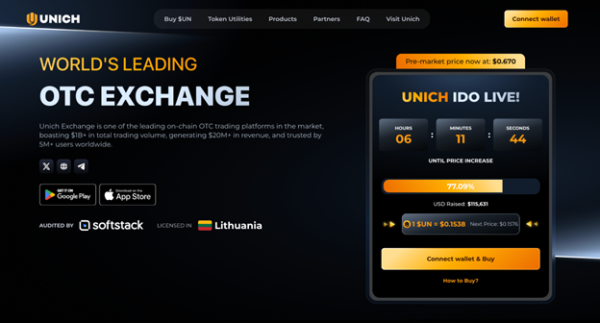
Recently, Unich has launched their public token sale – Unich IDO – to prepare for their forthcoming token generation event. The IDO lays down a target to raise an enormous fund through the sale of 100,000,000 $UN tokens.
$0.15 is the starting price for the token, and it will go up gradually when the supply goes down. This fair pricing motivates early birds to join and also rewards them for joining soon.
UNICH World Leading OTC Exchange
Besides that kind of rewards, Unich token sale also encourage supporters to bring friends with a favorable referral program. If you bring a friend and have them join the IDO, you will receive 11% rewards – 8% paid instantly in USDT and the latter 3% paid in $UN tokens. This reward also follows a vesting schedule.
This program actually plays a vital role in telling the world about the presence of Unich IDO and building loyalty and engagement within the community.
That’s not all. NFT holders get advantages, too. Users who have an EGGWARD NFT can buy the token at a 25% discounted price. These NFTs are available on famous marketplaces, such as Tensor, OKX NFT Marketplace, and Magic Eden.
You can also receive free EGGWARD NFTs by participating in Unich’s exclusive events and giveaways. What does that mean? Everyone can enjoy the benefits.
Why The $UN Token Is Worth Taking Notice Of
In fact, token pumping and dumping is not strange in the crypto space. A normal token can go up aggressively and then collapse the next day. But exchange tokens play by different rules. Their value tends to accumulate day by day when more trades or users come to the platform. $UN falls into this category.
It is the native token of Unich OTC exchange – a project that already shows off fantastic numbers. Every trade, every transaction fee, or every investment runs through it. So, as the project develops, the token’s value increases along with it.
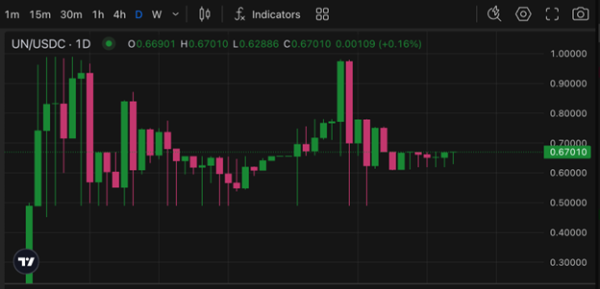
One more notable thing about $UN is that it’s gained fresh, super big interest from users even before listing. After launching on Unich Pre-Marker, the token’s price jumped from $0.16 to $0.80 in just 24 hours. That 5x leap is the solid proof of UN’s organic demand.
After that, it even hit a ATH of $0.99 before staying steady between $0.65 and $0.75
UNICH USDC
Just last week, trading volume reached about $14 million. This is a clear sign that Unich doens’t intend to push the price. Users are truly actively trading and engaged.
In terms of future growth plan, Unich plans to hold its token generation event (TGE) in the 3rd or 4th quarter of 2025. The team is in talks with several major centralized exchanges with a high hope to get $UN listed on at least one top-tier CEX soon after the token sale ends and official trading begins.
Adding to the excitement, $UN has recently been added to popular wallets like Binance Wallet, OKX Wallet, and Bybit Wallet. While no official exchange listings have been announced yet, these wallet listings have sparked rumors about upcoming exchange listings after the token sale. These rumors are growing interest from the crypto community.
As for tokenomics, $UN is designed with a community-first mindset:
80% (800 million tokens) allocated to community and ecosystem growth, with vesting schedules to ensure long-term stability.
15% reserved for core contributors, with a 12-month cliff and gradual vesting over 36 months.
5% set aside for investors and advisors, following a similar vesting timeline.
Finally, $UN comes packed with real utilities that encourage holding and participation:
Holders enjoy reduced trading and withdrawal fees across the platform.
A burn mechanism where 30% of quarterly profits buy back and burn $UN tokens until the supply is halved, supporting long-term value.
Governance rights allow holders to propose and vote on key protocol decisions, helping shape Unich’s future.
Another thing to keep in mind is that $UN’s fully diluted valuation (FDV) sits around $150 million right now. That’s pretty low compared to some bigger projects that have gone through several growth phases, like Jupiter, Solayer, or AAVE. This basically means $UN is still early in its journey, with plenty of room to grow and gain more attention.
Conclusion
In crypto, real wins come from solving old problems with fresh tech. Unich is doing just that, making OTC trading safer and smarter. How it rides the next wave will be telling, but for now, it’s a project worth keeping on your radar. With the Unich IDO currently running, it’ll be interesting to see how the market responds before and after TGE.