Home Blog Page 595

33,233% Returns on XRP, I’ll Wait 10+ Years for That, Top Investor Says

Prominent investor and commentator Armando Pantoja has expressed confidence in XRP eventually reaching triple digits, even if it takes more than a decade.

While XRP’s potential for such explosive growth remains controversial, Pantoja joins a growing group of analysts and researchers who believe the crypto asset is massively undervalued, especially following years of suppression due to regulatory headwinds.

XRP at $1,000? “Not Now, But Eventually”

In a recent tweet, Pantoja acknowledged that the idea of XRP reaching $1,000 is ambitious. However, he views it as a long-term possibility rather than an immediate outcome.

Although he recognizes the scale of such a projection, he believes it’s something that could happen in the future—not in the near term.

According to Pantoja, XRP is currently caught in a bear trap, a situation made worse by panic selling and the prolonged legal dispute with the U.S. SEC.

Pantoja drew a parallel between XRP’s potential trajectory and Bitcoin’s early journey, noting that it took BTC eight years to consistently remain above the $1,000 level. He suggested that XRP’s path to $1,000 would require a massive surge of 33,233% from its current level.

Nevertheless, Pantoja believes such a massive return would be worth the wait, even if it takes over a decade to materialize.

“A 33,233% return? I’ll wait 10+ years for that,” he said, suggesting XRP could reach the ambitious level by the next decade.

This timeline aligns with the view of CryptoGuard COO Matthew Brienen, who famously predicted that XRP would reach $1,000 by 2035.

Lawsuit Setback, But Not the End

Pantoja notably pointed to the SEC’s lawsuit against Ripple as a key reason XRP has lagged behind other assets during recent bull cycles. However, the case is now resolved, and XRP has been cleared of being classified as a security. As a result, many now see the token as well-positioned for a potential rebound.

Earlier in August, researcher Anderson argued that if Bitcoin can reach $1 million, XRP could logically reach $1,000. At current prices, XRP trades around $3, while Bitcoin sits near $115,500.

A $1,000 XRP would represent a 33,233% increase and place its market cap at approximately $59 trillion. For context, this figure exceeds the combined value of gold, Bitcoin, and the world’s top tech companies.

Dismissed by Some, Defended by Others

Despite these optimistic projections, skeptics like Coin Compass host Quinten Francois argue that XRP’s $1,000 target is delusional.

He noted that the token’s supply of over 59 billion would translate to a market cap larger than half the global stock market. EasyA founder Dom Kwok pushed back on this view, calling it shortsighted. 

Ultimately, for those like Pantoja, the focus isn’t on the current cycle, but on what XRP could represent in a tokenized financial future. Whether it takes 10 years or more, the belief is that the wait might just be worth it.

Verb Technology Secures $558M to Launch First Public Toncoin Treasury

0

Verb Technology is making a major leap into crypto by raising $558 million to build the first publicly listed Toncoin treasury. The firm will rebrand as TON Strategy and reshape its leadership and reserves.

The Nasdaq-listed firm disclosed the bold transformation in a press statement today. The company aims to pivot from its current business model to focus heavily on crypto asset reserves.

Major Capital Raise and Strategic Backers

As part of this shift, the company announced it secured $558 million through a private placement deal that exceeded expectations. The raise drew participation from more than 110 accredited and institutional investors.

The financing was structured through a PIPE (Private Investment in Public Equity) deal. This enabled select investors to purchase nearly 58.7 million shares at $9.51 each, raising over half a billion dollars. Notably, the transaction is scheduled to close around August 7, pending final approvals.

Kingsway Capital led the funding round, with support from high-profile firms such as Vy Capital, Blockchain.com, Ribbit Capital, and Graticule. Notably, Kingsway had previously partnered with the TON Foundation to raise up to $400 million for a similar Toncoin-focused treasury initiative.

Once finalized, most of the new capital will be used to purchase Toncoin, the native token of The Open Network (TON). The company aims to acquire roughly 5% of TON’s circulating supply, which would make it one of the largest holders globally.

Revenue Strategy: Staking Toncoin for Growth

TON Strategy plans to stake its Toncoin holdings to generate passive income, aiming to establish a treasury that is not only self-sustaining but also cash-flow positive. This model is designed to reduce reliance on external funding while deepening the company’s integration with the TON blockchain.

New Executive Team to Lead Crypto Transition

To support this shift, the company is bringing in new leadership with deep experience in crypto and finance.

Manuel Stotz, founder of Kingsway Capital and President of the TON Foundation, will take on the role of Executive Chairman. Veronika Kapustina, who previously advised the TON Foundation, will become the Chief Executive Officer.

Sarah Olsen, co-founder of Europa Partners, has been appointed Chief Financial Officer. Peter Smith, CEO & Co-Founder of Blockchain.com, will join as Special Advisor.

The new team is expected to drive the company’s crypto-first strategy forward.

Legacy Businesses to Remain

Despite the strategic overhaul, Verb’s existing operations, including its AI-powered livestream shopping platform, MARKET.live, and LyveCom, a recent acquisition, will continue. The company confirmed plans to expand these services in parallel with its crypto initiatives.

Crypto Investment Funds See $223M Weekly Outflows After Fed Shock

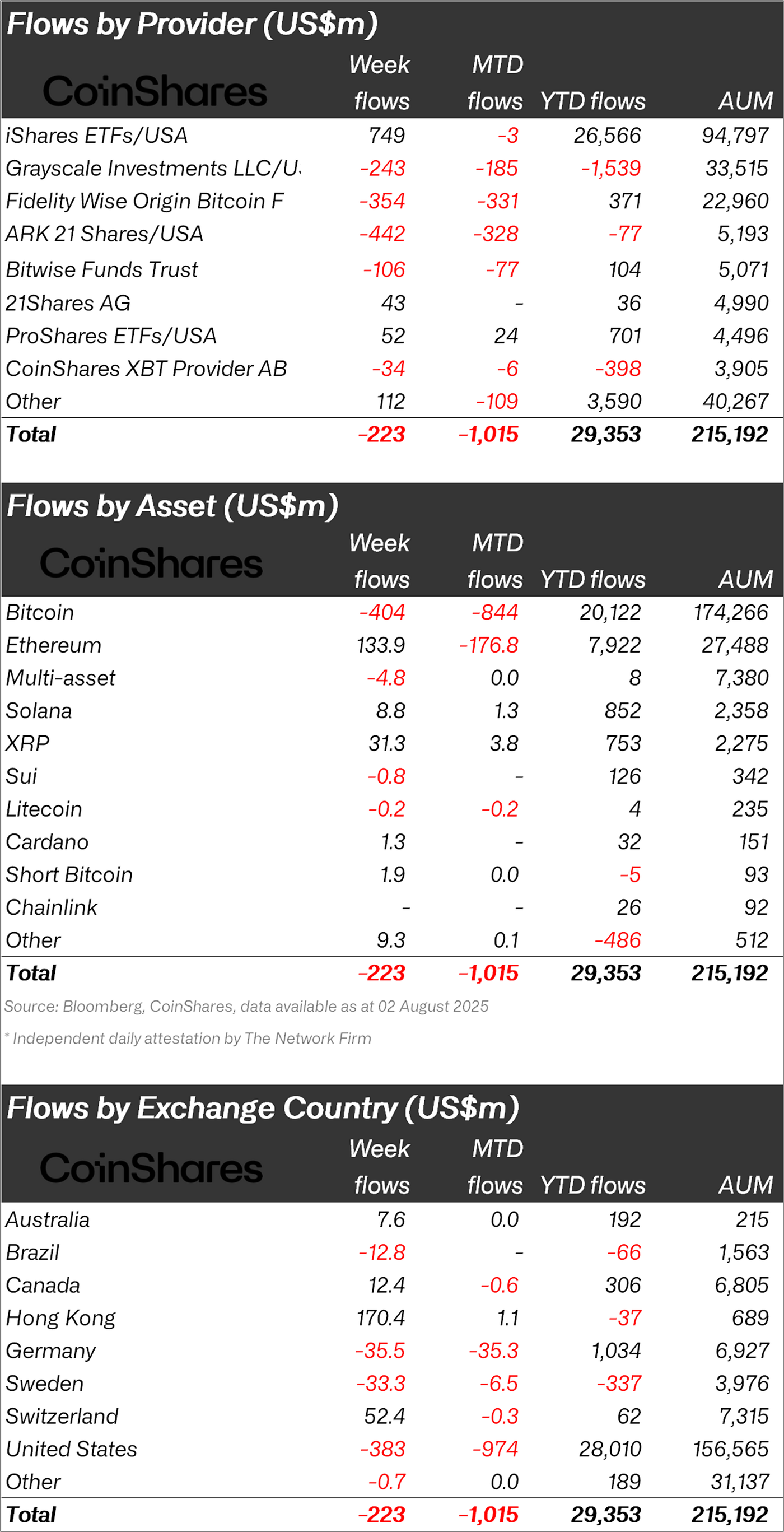
Crypto investment funds recorded $223 million in net outflows last week, marking the first weekly loss in 15 weeks, according to the latest data from CoinShares.

The reversal follows early-week inflows of $883 million and reflects market unease after hawkish signals from the U.S. Federal Reserve.

Macro Sentiment Turns Risk-Off

The outflows were likely triggered by the FOMC’s hawkish tone and stronger-than-expected U.S. economic data, which dampened risk appetite across markets. Despite weaker payroll numbers later in the week that hinted at potential policy easing, investor sentiment had already turned sour, leading to over $1 billion in outflows on Friday alone.

Still, recent gains remain impressive. Over the past 30 days, crypto investment funds have attracted $12.2 billion in inflows, representing nearly 50% of all inflows in 2025 so far.

Bitcoin Sees $404M Outflow, Largest of the Week

Bitcoin led the outflows with $404 million, highlighting its vulnerability to macroeconomic news. However, the top crypto asset still holds $20.1 billion in year-to-date (YTD) inflows, and its total assets under management (AUM) remain strong at $174.3 billion.

Ethereum Defies the Trend with $134M in Inflows

In contrast, Ethereum recorded $133.9 million in inflows, marking its 15th consecutive week of gains. The asset now has $7.9 billion in YTD inflows, reflecting investor confidence despite broader market volatility.

This resilience may be due to ETH’s impressive price performance in recent weeks, coinciding with the network’s ten-year anniversary and renewed optimism for a potential run to its all-time high.

Altcoins Post Mixed Results

Meanwhile, other major altcoins also saw moderate inflows, including XRP with $31.3 million, Solana with $8.8 million, and Cardano with $1.3 million. However, Sui, Litecoin, and a few smaller-cap assets experienced mild outflows.

U.S. Providers Lead Weekly Withdrawals

Notably, outflows were concentrated among major U.S.-based providers. ARK 21Shares reported $442 million, the largest of the group. The Fidelity Wise Origin Bitcoin Fund followed with $354 million in outflows, and Grayscale with $243 million.

Regionally, the United States saw $383 million in outflows, while Hong Kong ($170 million) and Switzerland ($52 million) reported inflows.

Overall, despite last week’s outflows, the broader trend remains positive. With YTD inflows totaling over $29 billion, the market may simply be experiencing a short-term cooldown after a period of rapid accumulation.

Michael Saylor Insists Bitcoin Is “An Offer You Can’t Refuse”

0

Michael Saylor, the longtime Bitcoin advocate and Strategy chairman says Bitcoin is an irresistible offer. 

In a post on X, Michael Saylor declared Bitcoin “an offer you can’t refuse,” reinforcing the asset’s growing strategic importance. 

Saylor’s remark comes as MicroStrategy continues to expand its Bitcoin holdings. As of this press, Strategy ranks as the highest public company holding the asset with 628,791 BTC. At the current price of $114,278, Strategy Bitcoin holdings stand at $71.87 billion.

Strategy began accumulating Bitcoin on August 11, 2020, and since then, the firm has made regular purchases, often funded through preferred stocks. The firm’s Bitcoin gain now stands at 55.9%. 

The company’s aggressive Bitcoin strategy has positioned it as a major player in the institutional adoption of digital assets. Saylor has consistently advocated for Bitcoin as a superior alternative to cash reserves and other assets.

Growing Confidence in Bitcoin Among Institutions

Meanwhile, the recent statement from Michael Saylor coincides with a broader wave of institutional interest in Bitcoin. Notably, Bitcoin whales have sold over 500,000 BTC in the past year, worth more than $50 billion.

In contrast, institutions, including ETFs and corporate treasuries, have absorbed nearly all of it. Now, they hold about 25% of Bitcoin’s 20 million circulating supply, reshaping the market’s ownership structure. For context, only the U.S. Bitcoin ETFs recorded a net inflow of $6.02 billion in July, making it the third best month after February and November 2024 inflow.

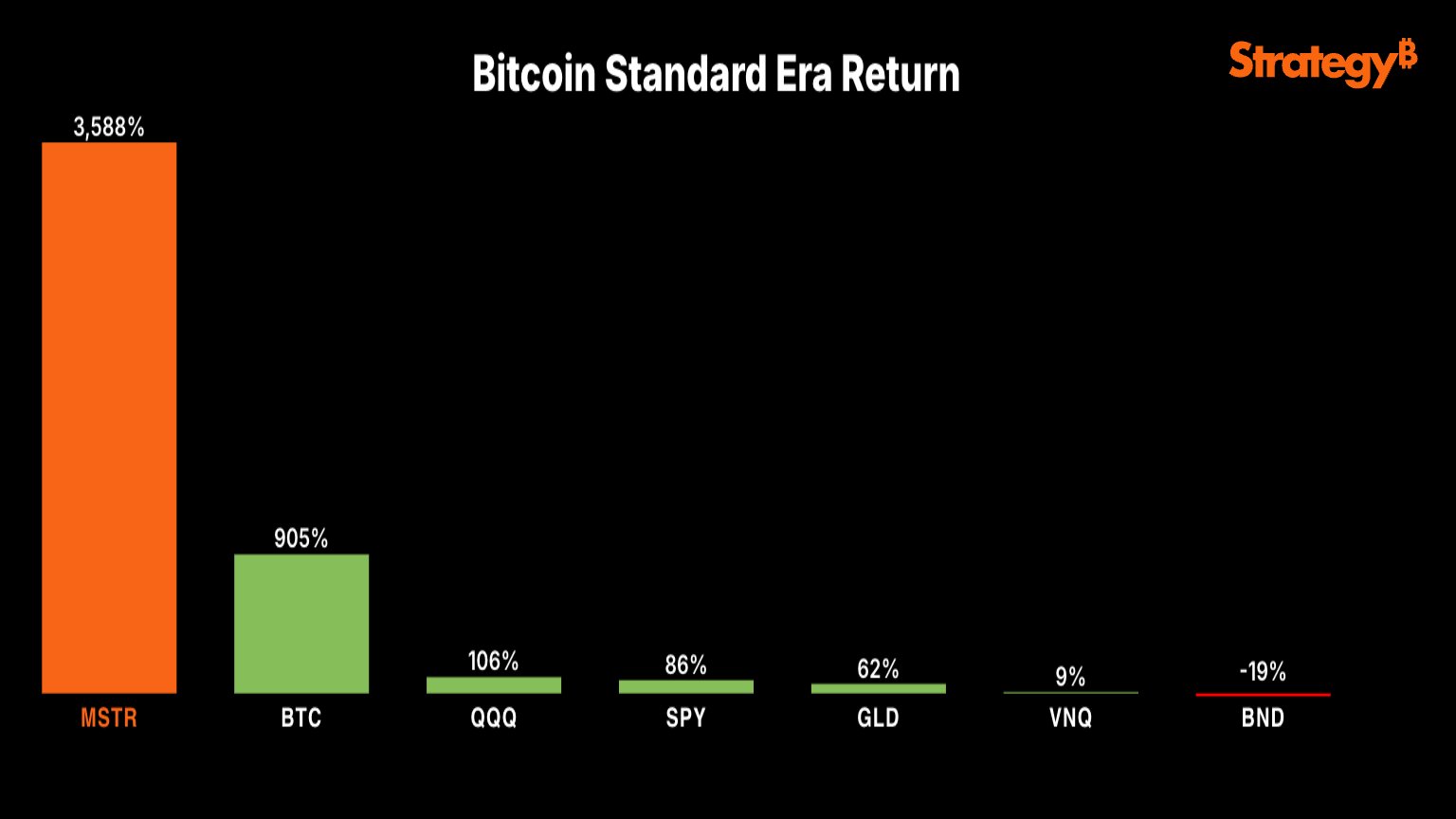
In return, Bitcoin has given monumental returns to investors. Data reveals Bitcoin outperformed major assets over the past five years, delivering a 905% return. In comparison, the Invesco QQQ Trust returned 106%, the S&P 500 ETF gained 86%, gold rose 62%, real estate edged up 9%, and bonds fell 19%. Image

Michael Saylor Predicts Bitcoin’s Price to Reach $21M

Believing in the long-term potential of Bitcoin, Saylor had earlier outlined a 21-year vision for Bitcoin, projecting a $21 million valuation per coin. He highlighted growing U.S. and global support, with new legislation, regulatory recognition, and over $150 billion in institutional inflows. 

Saylor noted rising corporate adoption, including firms like GameStop and Trump Media. He reported Bitcoin’s 56% annual return over five years. The Strategy Chairman compared dollar-cost averaging with leverage to traditional investments, urging businesses to adopt long-term Bitcoin strategies and view volatility as part of early network growth.

Crypto VC Funding Soars Past $5B in July 2025, Led by Strategy’s Bitcoin Push

0

Crypto VC funding saw a massive leap in July 2025, crossing $5.3 billion and setting a new monthly all-time high for the industry. 

Strategy’s aggressive Bitcoin acquisition plan contributed largely to this figure, per data from RootData. Interestingly, it represents an impressive rise from June’s $2.84 billion total and stands more than four times higher than the $1.02 billion reported in July 2024.

Notably, some crypto VC funding trackers report lower figures for the month, mainly because of a failure to include Strategy’s capital raise and a decision to wait for the final figures from delayed deals.

Strategy and MARA Lead the Charge

For context, Strategy raised a whopping $2.5 billion, representing nearly 50% of the total figure for the month. The company issued a fourth round of preferred stock, collecting around $2.47 billion after costs. With these funds, it purchased 21,021 BTC at an average price of roughly $117,000 per coin.

This latest buy pushed its total Bitcoin holdings to nearly 628,791 BTC, worth about $72.3 billion at market value. Just days later, Chairman Michael Saylor confirmed that the firm was preparing another $4.2 billion offering to continue its Bitcoin buying spree.

Meanwhile, other major firms also attracted strong investor interest. For one, MARA Holdings completed a $950 million convertible bond sale with zero interest, due in 2032. The company plans to use most of the proceeds to buy more Bitcoin, expand operations, and repurchase some of its outstanding debt. 

Upexi, Mill City, and Pump.fun Raise $1.45M in Crypto VC Funding

In the Solana ecosystem, Upexi secured a $500 million equity line through a flexible stock agreement with A.G.P. The funds will support the company’s growing Solana treasury strategy, which now holds 1.9 million SOL. 

Further, the SUI network also drew massive institutional support. Mill City Ventures III raised $450 million in a private deal to build a SUI asset reserve. Notably, the company acquired over 76 million tokens through over-the-counter agreements with the Sui Foundation. Investors in the round included Pantera Capital, Galaxy Digital, and others.

Meanwhile, Pump.fun achieved an impressive feat last month, raising $500 million through an initial coin offering that sold out in under 12 minutes. The project distributed 125 billion PUMP tokens, representing 12.5% of its total supply, across centralized exchanges and on-chain platforms.

Contributions from MEI Pharma, Polymarket, TWL Miner, and Gamesquare

Also, MEI Pharma became the first publicly traded U.S. company to hold Litecoin (LTC) as a treasury asset. The firm raised $100 million by issuing stock, then used the proceeds to buy LTC. It also brought Litecoin founder Charlie Lee onto its board and brought in digital asset firm GSR as a financial advisor.

Interestingly, prediction platform Polymarket also moved into the U.S. by acquiring a CFTC-approved exchange and clearinghouse for $112 million. Though the company hasn’t announced any token plans, the acquisition represents a big step toward regulatory integration.

TWL Miner, a cloud mining platform based in the UK, raised $95 million in Series B funding to bring artificial intelligence into its mining operations. Meanwhile, Gamesquare Holdings completed a $70 million stock sale to expand its Ethereum holdings through a partnership with Dialectic, a crypto-native investment firm.

Crypto VC Funding in July 2025 Colin Wu
Crypto VC Funding in July 2025 | Colin Wu

Overall, July saw 61 publicly disclosed deals from crypto VC funding, a slight drop from June’s 66 and well below the 114 recorded in July 2024. However, the dollar volume was much higher due to Strategy’s and MARA’s contributions. 

Centralized finance projects made up the biggest share of the crypto VC funding at just over 26%, followed by AI-focused ventures, wallets, and decentralized sectors like DeFi and GameFi. Notably, some of the funding totals may increase over time, as many deals aren’t made public in the same month they close.

Brian Armstrong Fires Back After UK Bans Coinbase Crypto Ad

0

Coinbase CEO Brian Armstrong has condemned the UK’s decision to ban the platform’s latest ad, calling it an attempt to silence criticism of a broken financial system.

Coinbase, a leading U.S.-based crypto exchange, has come under renewed scrutiny in the UK following the removal of its latest TV advertisement by local broadcasters. The ad, titled “Everything is Fine”, aired on July 31, 2025, and used satire to address economic frustrations across the country.

The UK-focused campaign spotlighted a series of mounting economic concerns. These included the soaring cost of living, growing dissatisfaction with the Labour-led government, and the weakening financial infrastructure.

It also drew attention to a rising trend of wealthy individuals moving abroad, underscoring broader disillusionment with the country’s economic direction. In this context, the ad framed crypto, particularly Bitcoin, as a practical alternative for those seeking greater financial independence and stability.

UK broadcasters, however, saw the messaging as too political and potentially misleading. The ad was promptly banned, sparking reactions from the crypto industry.

Regulators Cite Misleading Messaging

Broadcasting authorities argued that the campaign’s tone could mislead viewers by presenting crypto as a guaranteed solution. They also noted the ad painted a bleak picture of the UK government, despite not mentioning any political party directly.

This isn’t Coinbase’s first brush with UK regulators. In 2021, the Advertising Standards Authority (ASA) banned a Coinbase wallet promotion over claims of insufficient clarity. The new ban continues that trend, as watchdogs attempt to balance innovation with consumer protection.

CEO Armstrong Defends Message

Following the ad ban, Coinbase CEO Brian Armstrong took to the social platform X to defend the campaign. He said the ad captured concerns that many people already feel about today’s financial systems. Armstrong insisted the message wasn’t political or targeted at any party.

He also clarified that similar ads had been aired in the US, underscoring the campaign’s broader relevance. “We ran ads with similar themes in the US,” he noted, calling it a global critique of outdated financial systems.

Armstrong went on to challenge lingering UK perceptions that label crypto as gambling. He argued that such views ignore crypto’s potential to reform and modernize finance. Censorship, he added, only draws more attention to the need for change.

Mixed Reactions From the Public

Public opinion remains divided. Supporters within the crypto space called the ad bold and truthful. Detractors accused Coinbase of exploiting national struggles for commercial gain.

Meanwhile, the ad dropped at a crucial time, just as the UK Financial Conduct Authority (FCA) lifted its ban on retail investment in crypto exchange-traded notes (ETNs). 

The timing, while coincidental, may have worked in Coinbase’s favour, as it drew extra attention to crypto’s growing legitimacy.

CFTC Announces Crypto Sprint Initiative in New Collaboration with SEC

0

U.S. Commodity Futures Trading Commission (CFTC) announces the launch of “Crypto Sprint” to turn recommendations from last week’s White House digital asset report into concrete action. 

This was conveyed in a statement recently issued by Acting CFTC Chair Caroline Pham following the release of the White House digital asset report. Last week, the Presidential Working Group on Digital Assets outlined several recommendations to foster innovation in the crypto space. 

White House Recommendations to CFTC 

Some of these recommendations directly concern the CFTC, while others require the regulator to work with other sister agencies, including the Treasury and the SEC.  A segment of the report suggested that the CFTC be made the appropriate regulator for cryptocurrencies deemed commodities. 

In addition, the Working Group also urged the CFTC and SEC to collaborate and provide regulatory clarity for businesses and users in the digital asset market. 

CFTC Unveils Crypto Sprint, Plans to Work with SEC 

Shortly after the report was made public, Pham emphasized that the CFTC will not delay in fulfilling Donald Trump’s vision to position the U.S. as the global leader of the nascent industry. 

To fulfill this vision, Pham announced the “CFTC Crypto Sprint” to bring the suggestions from the digital asset report to fruition.

Under the Crypto Sprint initiative, Pham said the CFTC will work with the SEC chair, Paul Atkins, and pro-crypto commissioner Hester Peirce on its recently launched Project Crypto initiative. 

For context, the SEC flagged off the Project Crypto initiative last week as part of efforts to modernize the agency’s rulebook and transition the U.S. financial markets onto the blockchain. The CFTC has confirmed that it will work with the SEC to ensure the success of Project Crypto. 

According to Pham, providing regulatory clarity and fostering innovation in the digital asset market could help the Trump-led administration fulfill its promise of ushering in the “Golden Age of Crypto.” 

Meanwhile, she provided insights into the CFTC’s recent pro-crypto actions, including holding its first-ever Crypto Forum and withdrawing outdated staff advisories. 

During the Biden administration, the SEC and CFTC had engaged in a longstanding debate over which regulator should oversee the crypto market. However, this dynamic has shifted under the new administration, with the CFTC extending an olive branch to the SEC to support the success of Project Crypto.

Pundit Says Bitcoin Maxis Are Marketing Engine for XRP

XRP proponent Diep Sanh has suggested that Bitcoin maximalists are inadvertently fueling the growth of XRP.

In a tweet, Sanh described staunch Bitcoin advocates as a marketing engine for XRP, noting that the more they criticize it, the more people discover its value.

Sanh’s comment comes amid a wave of public attacks on XRP by several prominent Bitcoin advocates, including Rajat Soni, Robert Breedlove, Pierre Rochard, and Davinci Jeremie. Despite their negative messaging, XRP continues to maintain a strong base of supporters who view the criticism as free publicity.

From Mockery to Mainstream

Over the years, XRP has come under constant fire. For instance, in January, financial analyst Rajat Soni shared a satirical “how-to” guide for getting rich with XRP. He mocked the token’s structure and suggested it was designed to exploit naive investors.

He later claimed that XRP is a “stablecoin” and that even if Bitcoin soars to $5 million per coin, XRP’s real value in dollars may never exceed $1.

Meanwhile, Bitcoin historian Robert Breedlove went so far as to call XRP a “psychological operation,” suggesting it has a cult-like following.

On the other hand, Davinci Jeremie publicly warned that XRP can “freeze your money anytime,” advising against using it as a long-term investment.

However, this wave of negative sentiment hasn’t diminished interest in XRP. Instead, it appears to have amplified the discussion around it, pushing XRP into more conversations than ever before. According to Sanh and other XRP advocates, this continuous scrutiny acts as an unintentional spotlight.

Meanwhile, Ripple executives have not remained silent in the face of these attacks. During what appeared to be a coordinated effort by Bitcoin maximalists in January, Ripple CTO David Schwartz stated that the real reason for the attacks was Ripple’s advocacy for a diversified U.S. crypto reserve at the time.

The company had pushed for a reserve that includes XRP—not just Bitcoin. Ripple CEO Brad Garlinghouse echoed this sentiment, countering claims that he advised President Trump not to buy Bitcoin. Instead, he emphasized Ripple’s broader vision for a multi-asset digital economy.

$1,000 XRP and Meme Coin Labels

The attacks on XRP have also included ridicule over price predictions and the labeling of XRP as a meme coin. Prominent crypto commentator and trader Ran Neuner once listed XRP as the biggest meme coin by fully diluted valuation, placing it alongside Dogecoin.

Meanwhile, a separate debate recently emerged around the possibility of XRP reaching $1,000 from the Bitcoin community.

Critics point out that such a price would imply a $59 trillion market cap. XRP supporters, however, argue that dismissing high valuations as impossible reflects a lack of long-term vision, similar to the early skepticism surrounding Bitcoin.

XRP Community Turns FUD into Fuel

Despite being under constant attack, the XRP community continues to rally. Many now embrace a strategy of “let them talk.”

They recognize that even negative attention helps increase awareness and drive research into XRP’s use cases. Crypto commentator Mark Kangas recently noted that the constant attacks may be a blessing in disguise. “I think we owe them a hearty thank you,” he said.

Sanh’s tweet amplifies this viewpoint, turning criticism into a compliment.

Here is How Much XRP Must Rise to Overtake the Top 10 Assets in the World

0

With XRP now sitting as the 100th largest asset in the world, how much must it rise to overtake the assets within the top 10?

Notably, XRP currently trades at $2.87 and has drawn attention for its strong performance in 2025. Since January, XRP has gained 38%, putting it well ahead of major market benchmarks.

In contrast, the S&P 500 has climbed just 6%, while the NASDAQ 100 has added only 8.33%. Even gold, known as a go-to asset in uncertain times, has risen 28% this year, still below XRP’s performance.

XRP’s Drop to 100th Despite Impressive Run

Despite this strong run, XRP has seen some pressure lately. Specifically, its price has dropped 4.93% in August, pulling its market cap down to $170.7 billion. In July, XRP reached a new milestone with a $216 billion market cap and became the 69th most valuable asset in the world at the time.

Now, the recent drop has pushed it down to 100th on that list. Still, multiple market watchers and investors believe XRP remains undervalued, largely due to its expanding role in payment systems and global finance.

With XRP already among the world’s top 100 assets, some already wonder how much it must rise to break into the top 10. We recently made an assessment to highlight this. Notably, for the analysis, we kept the circulating supply at 59.3 billion tokens.

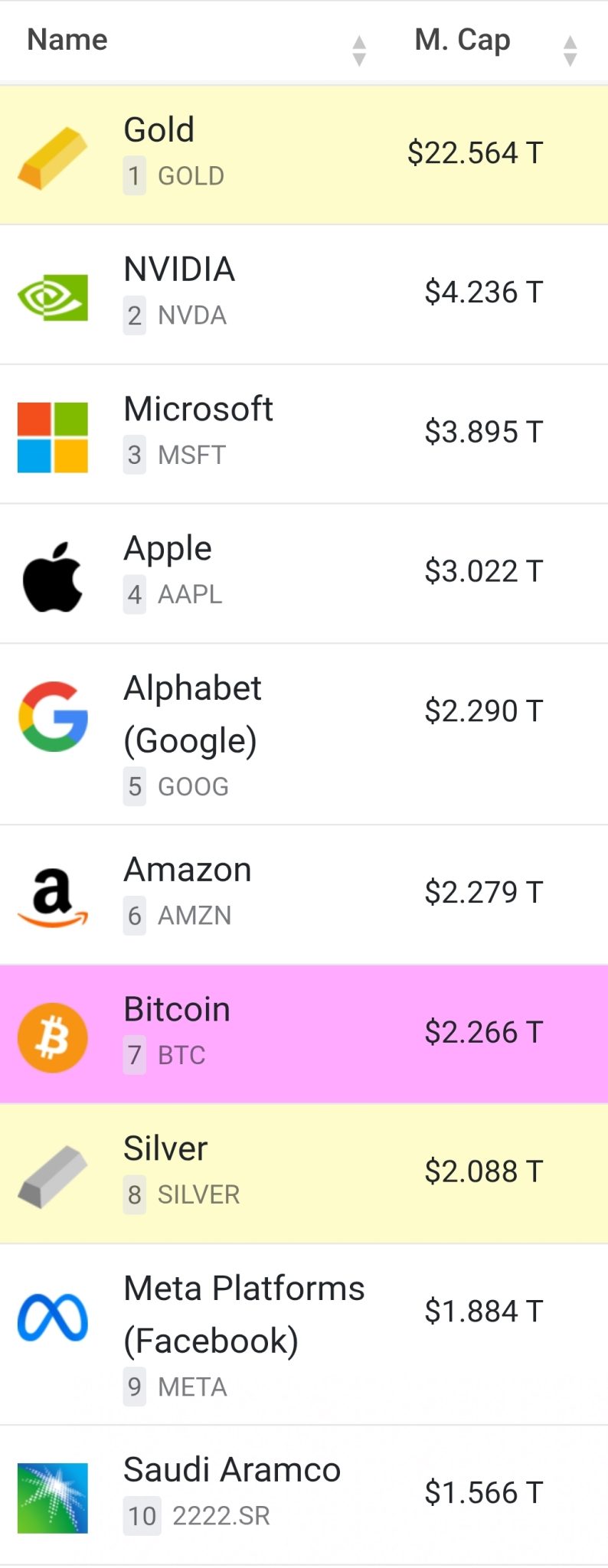
Top Assets by Market Cap

Prices at Which XRP Can Surpass Saudi Aramco, Meta, Silver, Bitcoin, Amazon, and Alphabet

Considering this metric, XRP must climb to $26.41 to match Saudi Aramco, which ranks 10th with a $1.566 trillion valuation. This would mark an 820% increase from its current price. Interestingly, market expert EGRAG has consistently predicted an XRP run to $27 in this cycle.

Moving one step higher, Meta Platforms (Facebook’s parent company) holds a $1.884 trillion market cap. Notably, for XRP to overtake it and become the ninth-largest asset, it needs to jump 1,007% from the current price to $31.77. Last August, analyst “XRP Hawker” projected XRP to hit $32. 

Next on the list is silver, valued at $2.088 trillion. XRP would have to reach $35.21, which translates to a 1,127% price increase. Meanwhile, to beat Bitcoin, currently worth $2.266 trillion and secure the seventh spot, XRP must rise 1,230% to $38.20. 

Notably, Amazon, which sits sixth, comes next with a $2.279 trillion valuation. To surpass Amazon, XRP would need to reach $38.44, a 1,240% jump. Meanwhile, for XRP to overtake Alphabet, currently valued at $2.290 trillion, its price would have to rise 1,245% to $38.63.

Interestingly, XRP could surpass Bitcoin, Amazon, and Alphabet in one fell swoop if its price soars beyond $38. In June, EGRAG also suggested that XRP could soar to $40, citing a prominent W pattern. At such a price, XRP would become the fifth-largest asset globally.

What XRP Needs to Overtake Apple, Microsoft, NVIDIA, and Gold

Meanwhile, if XRP aims to overtake Apple, currently worth $3.022 trillion, it would need to observe a larger rally to $50.95. However, beating Microsoft, now valued at $3.895 trillion, would require XRP to hit $65.67. This would represent a 2,188% increase from the current price.

Also, outpacing NVIDIA, which holds second place with a $4.236 trillion market cap, XRP needs to surge 2,387% to $71.39. Finally, to become the most valuable asset in the world and top gold, with its $22.564 trillion market cap, XRP would need to reach $380.38. This would mean a massive 13,156% price increase.

Data Shows the United States Holds 40% of the Global Bitcoin Supply

0

The United States controls the largest share of the Bitcoin circulating supply, India holds the second-largest share, while Europe follows closely behind. 

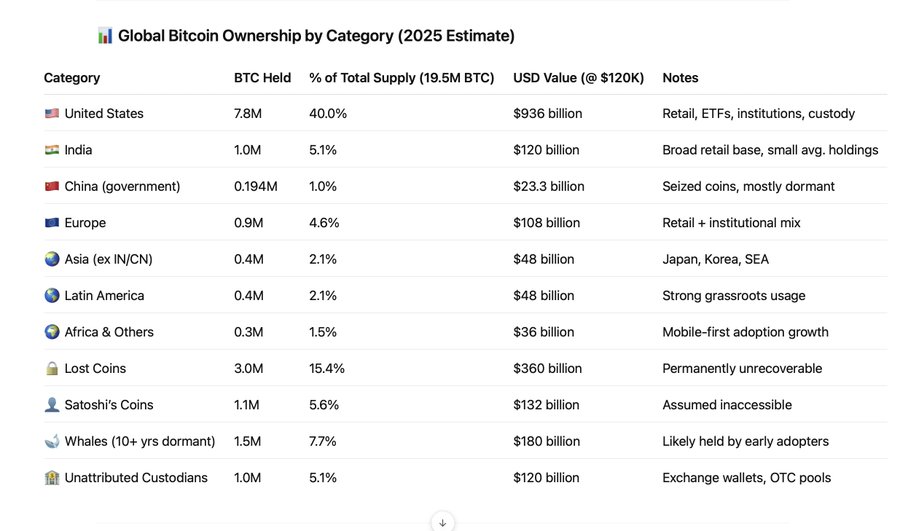
According to the 2025 estimate shared by Fred Krueger, the United States’ Bitcoin holdings are worth an estimated 7.8 million BTC out of the 19.5 million in circulation. This represents 40% of the circulating supply. A combination of retail investors, institutional funds, ETFs, and custodial services fuels the country’s dominance.

Bitcoin ownership by category

At $120,000 per BTC valuation, the U.S. holdings are valued at roughly $936 billion. While Bitcoin trades lower than this valuation, this figure reflects an increasing adoption through regulated products like Bitcoin ETFs. For context, U.S. Bitcoin ETFs saw net inflows of $6.02 billion in July, making it the third best month after February and November 2024.

Additionally, U.S.-based companies account for the top six of the public companies holding significant amounts of Bitcoin on their balance sheets. Strategy ranks first, holding 628,791 BTC. Marathon Digital Holdings (MARA) follows with 50,000 BTC, while XXI Capital holds 43,514 BTC. 

Bitcoin Standard Treasury Company owns 30,021 BTC, and Riot Platforms maintains 19,225 BTC. Notably, Trump Media & Technology Group Corp. also holds 18,430 BTC, highlighting growing corporate interest in digital assets across various sectors.

India Bitcoin Holdings Rank Second with Retail-Driven Growth

India holds 1 million BTC, accounting for 5.1% of the total supply. While the country’s regulatory environment remains uncertain, its user base continues to expand rapidly.

Most Indian holders are retail investors with small average balances. Still, the country’s volume places it ahead of Europe, China, and other global regions. India’s Bitcoin holdings are valued at $120 billion based on the same price assumption. 

Europe, China, Latin America, and Asia Trail Behind in Bitcoin Control

Notably, Europe holds an estimated 900,000 BTC, or 4.6% of the supply, worth $108 billion. The region shows a mix of retail and institutional ownership, though it remains behind India in total volume. Fred opines that the continent is not significantly involved in comparison to the U.S.

Meanwhile, the Chinese government holds around 194,000 BTC, or 1% of the total. These coins were seized and are mostly dormant. The value of these holdings is estimated at $23.3 billion.

Latin America and Asia (excluding India and China) each hold about 400,000 BTC (2.1%). Their holdings, valued at $48 billion each, are attributed mainly to strong grassroots usage. Meanwhile, Africa and other regions combine for 300,000 BTC, representing 1.5% of the total. 

Dormant and Lost Bitcoin Reduces Active Supply

A significant portion of Bitcoin is no longer in active circulation. An estimated 3 million BTC (15.4%) is believed to be permanently lost, which could be due to misplaced private keys or inactive wallets.

Meanwhile, Satoshi Nakamoto’s known wallets contain 1.1 million BTC (5.6%), which have never moved. These coins are assumed to be inaccessible. 

Another 1.5 million BTC (7.7%) have remained dormant for over 10 years, likely held by early adopters. Together, these three categories account for about 28.7% of the total supply, severely limiting available liquidity.

An additional 1 million BTC (5.1%) is held by unattributed custodians, including exchange wallets and over-the-counter (OTC) pools. Third parties control these coins and are not directly attributed to individual users.