Home Blog Page 594

Hoskinson Reacts to Claims That SNEK Meme Coin Has Contributed More to Cardano Than Midnight

0

Cardano founder Charles Hoskinson has reacted to claims that the SNEK meme coin has made more significant contributions to the Cardano ecosystem than Midnight. 

The ongoing feud between Hoskinson and some community members has shown no sign of ending anytime soon. During a recent exchange, an X user named Federico claimed that Midnight, Cardano’s upcoming privacy sidechain backed by Hoskinson, has had less impact on the ecosystem than the Snek (SNEK) meme coin. 

Federico made the assertion while reacting to a proposal from the SNEK team to withdraw 5 million ADA ($3.69 million) from the Cardano treasury to fund the token’s listing on a Tier-1 exchange. 

Cardano Treasury Won’t Fund Tokens’ Listing on Exchanges

Notably, Hoskinson declared his support for the initiative but recommended that the SNEK team structure the proposal as a three-year bond on its network. He pointed out that this would ensure that the team repays the 5 million ADA plus interest to the treasury. 

Aside from this, the Cardano founder emphasized that no ecosystem token, including SNEK and Midnight, will get their listing fees from the treasury. 

Hoskinson Reacts to Claims That SNEK Has Done More for Cardano Than Midnight 

Furious with this decision, Federico criticized Hoskinson, suggesting that while Midnight has not contributed anything to ADA, SNEK is responsible for the growth in the Cardano ecosystem. 

“Without SNEK, there would be nothing in Cardano right now,” the user remarked. 

In response, Hoskinson posted a GIF from The Big Lebowski, featuring ‘the Dude,’ played by Jeff Bridges, looking stunned. The meme captures Hoskinson’s surprise at the idea that a mere meme coin like SNEK has been more impactful to the Cardano ecosystem than Midnight. 

Hoskinson, who has been actively involved in the development of Midnight, has taken pride in the privacy blockchain. Recently, the Cardano founder claimed that more than 100 ventures across eight blockchains have already indicated interest in Midnight. 

Consequently, he argued that the strong institutional interest in Midnight shows his instrumental role in Cardano’s growth. 

SNEK Trend Puts Cardano in the Limelight 

Amid the recent feud, popular analytics platform TapTools alerted Cardano enthusiasts that SNEK was trending on X under Business and Finance. According to the accompanying screenshot, the meme coin had been mentioned in 6,005 posts on X, signaling heightened visibility. 

Reacting, Cardano stake pool operator (SPO) Phillerino stated SNEK’s recent trend as a win for the broader ecosystem. According to him, increased attention on SNEK automatically puts Cardano in the limelight. 

Pundit Predicts Timeline For Ethereum To Reach $5,600

0

A popular crypto market expert believes Ethereum could rally high in the coming months, citing adoption and technical patterns.

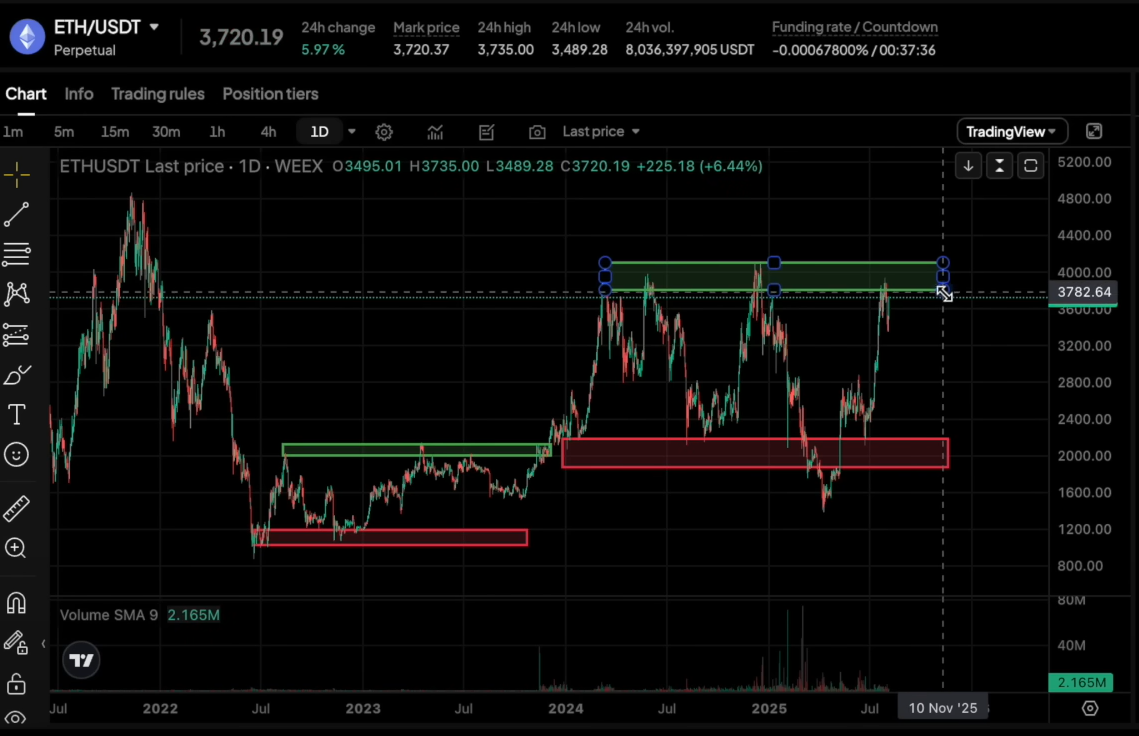
According to Altcoin Daily, Ethereum may rally to $5,600 by November, driven by strong institutional demand and historical post-halving performance. The crypto news outlet highlighted that Ethereum has not yet surpassed its all-time high but shows signs of building momentum.

In the video, the host cited Bitwise CIO Matt Hougan, noting that while August is historically one of the weakest months for crypto, it often sets the stage for substantial gains in the following months. They suggest any short-term dip could be seen as a buying opportunity ahead of a potential breakout in September through November.

Institutional Ethereum Adoption Surges

Altcoin Daily revealed that institutional buying of Ethereum continues to increase. The host cited Bitmine as the current largest ETH holder, 833,000 ETH worth over $3 billion, aiming to accumulate 5% of Ethereum’s total supply. 

Ethereum Chart
Ethereum Chart

Other major holders include Sharplink at $1.62 billion with 438,200 ETH and the Ethereum Foundation with $863 million. Notably, the U.S. government ranks 12th in ETH holdings.

The report notes that public companies are actively buying Ethereum at what they believe are favorable price levels. The buying activity is described as part of a race among institutions to secure ETH before prices move higher.

Historic Trends Show August Gains for ETH

Ethereum’s performance in the months following a Bitcoin halving has historically been positive. Altcoin Daily quoted analyst Alek, noting that, on average, Ethereum gained more than 64.2% in August during these periods.

Despite currently trading below $4,000, Ethereum has faced resistance around $3,800 multiple times. If it breaks above this level, Altcoin Daily believes the price could follow previous breakout patterns that took ETH over $2,000. Applying that same pattern forward, ETH could potentially reach $5,600 by November.

Meanwhile, Benjamin Cowen had earlier highlighted a reason Ethereum has not crossed $4,000. Cowen noted ETH has failed to break this level three times since 2024 due to skipping a key support retest.

However, he noted that this changed in April 2025 when Ethereum dropped to $1,385, touching its 400-week moving average. After that, ETH surged 178%, now eyeing a breakout. Notably, Ethereum trades at $3,617, a 1.9% rise in the past day, increasing its monthly gain to 43.5%. 

Chart Analysis Supports Ethereum Bullish Momentum

The video includes an analysis of Ethereum’s trading behavior, pointing to repeated resistance at around $3,800 and support near $2,200. Altcoin Daily suggests that Ethereum is forming a breakout pattern similar to earlier rallies.

The host cited analyst Ted, arguing that ETH is undervalued below $4,000, especially considering increased network activity and tightening supply. He made a comparison to assets like the S&P 500 and Bitcoin to show how assets tend to consolidate at resistance before breaking out.

Benjamin Cowen Cautions on Treasury Buying Narrative

While Altcoin Daily is optimistic, chart analyst Benjamin Cowen, speaking on Bankless, presented a more cautious perspective. He warned that the current ETH treasury trend could be pulling demand forward. 

According to Cowen, while the surge in institutional buying may push Ethereum to new highs, it could also exhaust demand later, potentially triggering a market reversal. 

Cowen also raised concerns about altcoin projects attempting to replicate Ethereum’s treasury accumulation strategy, which could lead to failures if not managed responsibly.

Finance Coach Says to DCA Into XRP for 10 Years to Transform Your Financial Future

0

Coach JV, a well-known finance expert, has suggested that everyday spenders could DCA into assets like XRP and Bitcoin instead of binge shopping on Amazon.

The crypto advocate disclosed this in a recent post on X, expressing his aversion to how people spend money. According to him, people often scroll endlessly on social media, load up their Amazon carts with impulse buys, and finance luxury cars worth $70,000 without hesitation. 

Yet, Coach JV noted that these same people rarely take time to understand or invest in assets like XRP or Bitcoin that could change their financial future for the better. The market expert suggested that instead of spending that money on things that lose value, people should build a budget and stick to a dollar-cost averaging strategy. 

For the uninitiated, dollar-cost averaging involves investing a particular amount into an asset consistently over a set period, regardless of the price. Notably, if these individuals simply set aside a fixed amount each month into deflationary crypto assets, Coach JV says they could create long-term financial security for their families. 

Returns of 10-Year DCA Into XRP and Bitcoin

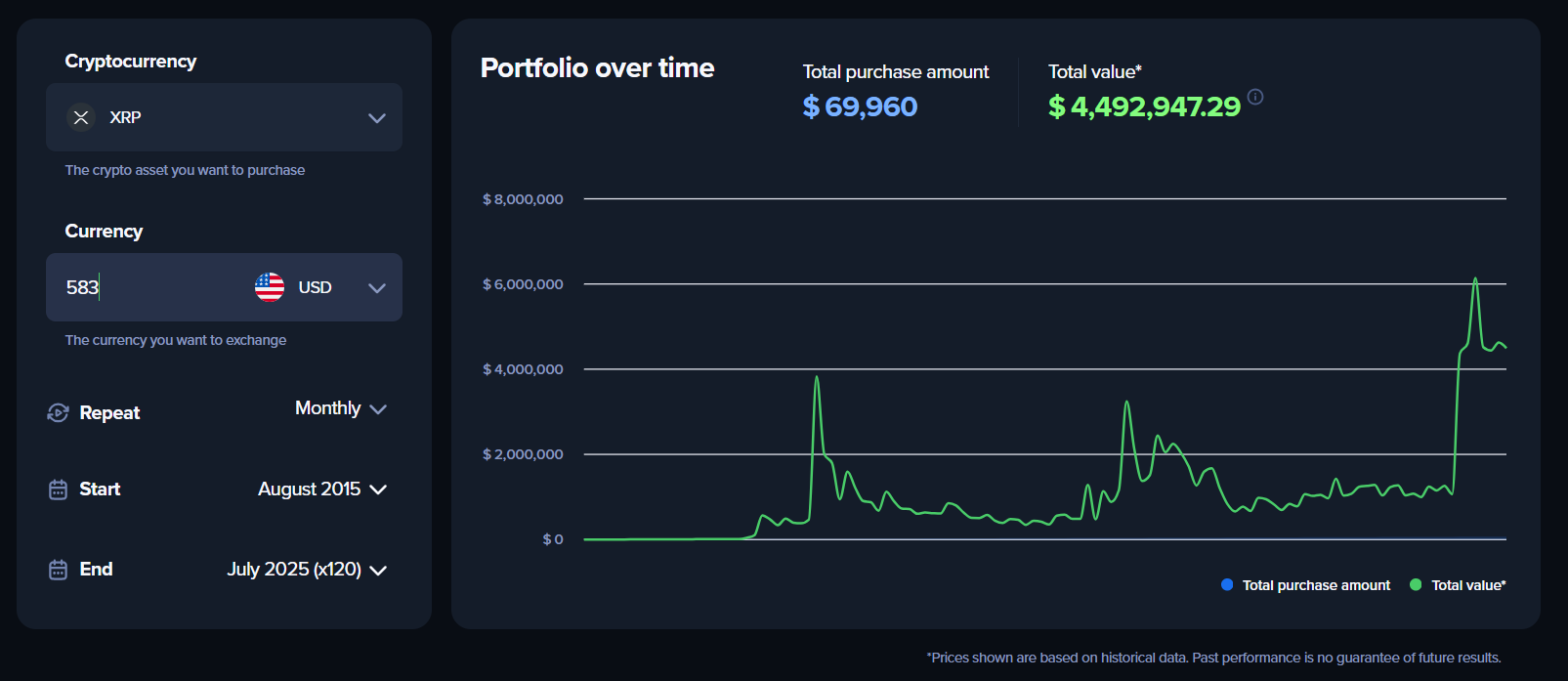
Meanwhile, to put his advice to the test, we made an assessment using the Uphold DCA calculator. In the first scenario, someone who invested $583 every month into XRP from August 2015 through July 2025 would have spent a total of $69,960. 

XRP DCA over 10 Years Uphold
XRP DCA over 10 Years | Uphold Calculator

Today, that investment would be worth about $4.49 million. For context, a recent 2025 study from Northwestern Mutual reveals that most Americans insist they need at least $1.26 million to retire. With the $4.49 million from the 10-year DCA into XRP, retirement could be a consideration today.

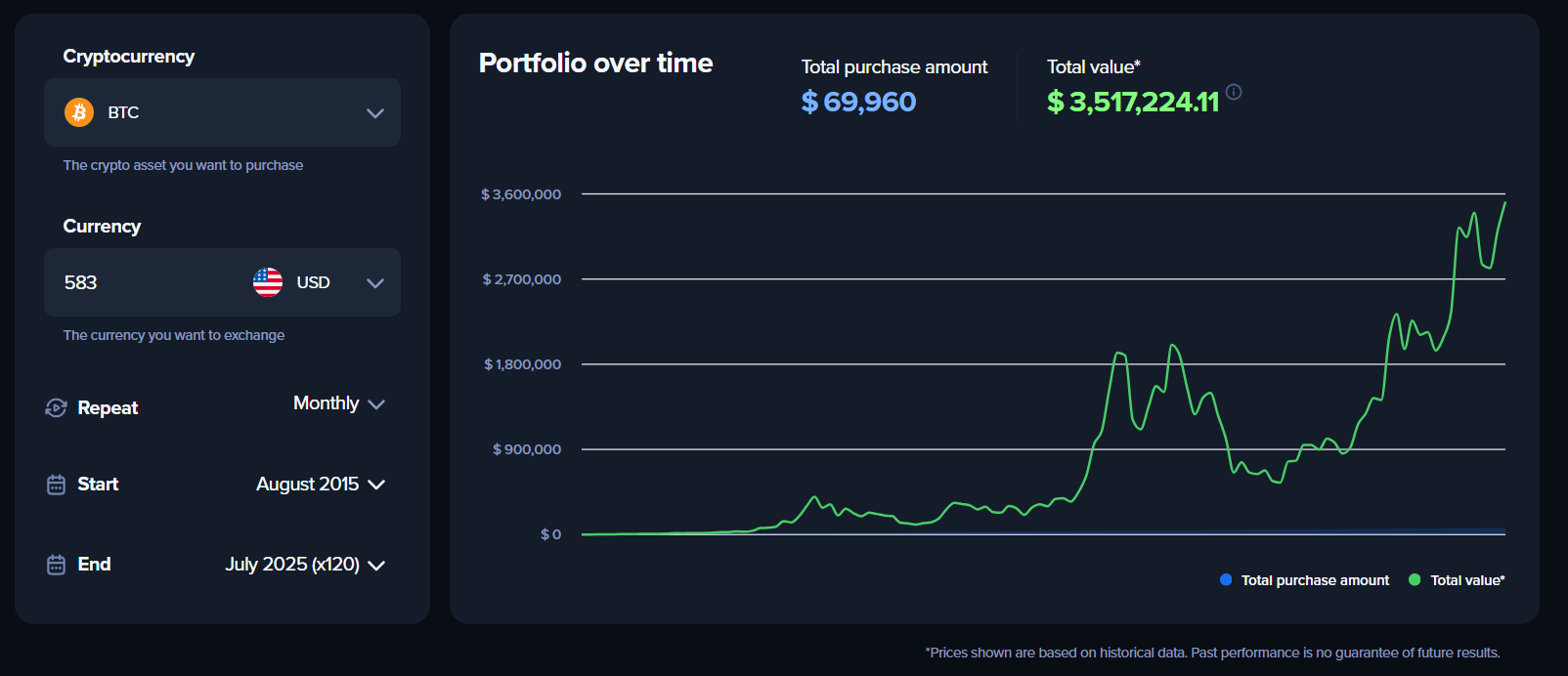
Meanwhile, we made a similar assessment with the same investment strategy for Bitcoin. Again, $583 every month for ten years would have resulted in a total spending of $69,960. However, with Bitcoin, the investment would be worth $3.5 million today. While lower than XRP, it is still enough for an investor to consider retirement.

Bitcoin DCA Over 10 Years Uphold
Bitcoin DCA Over 10 Years | Uphold Calculator

Currently, XRP trades around $3. Nonetheless, back in August 2015, it sold for just $0.008. The current price represents a massive 37,400% increase. Also, Bitcoin, now worth $114,000, was just $285 ten years ago, marking a more impressive 39,900% increase. 

Market Still Early?

Even though Bitcoin gained more in percentage terms, XRP’s unique price pattern yielded stronger gains for those using a dollar-cost averaging approach. While Bitcoin climbed steadily over the years, XRP moved in short, powerful bursts, including a 580% spike from November 2024 to January 2025.

While some investors might conclude that they have missed the mark, several analysts believe this is not the case. For instance, Edoardo Farina, a crypto educator, has insisted that the XRP market is still early. Meanwhile, Bitcoin advocates like Michael Saylor suggest the BTC price still has more room for growth, potentially hitting $13 million. 

Analyst Explains Why Cardano Is the Best Blockchain for US Government Use

0

Tim Warren, popularly referred to as Investing Broz, makes the case for why Cardano is the ideal blockchain candidate for potential adoption by the U.S. government. 

During a recent livestream, the market commentator argued that Cardano’s security protocols and decentralization make it uniquely suited among the top Layer-1 blockchains for government use.

Warren suggested that most L1 blockchains lack those guardrails and might leave users, including the U.S. government, exposed to privacy risks. Many industry stakeholders, including Warren, believe Cardano has proven to be a secure blockchain network.

Why Cardano Is the Top Blockchain Candidate for US Government Use

For the uninitiated, Cardano’s security lies in its Ouroboros proof-of-stake (PoS) consensus protocol, which validates transactions and secures the blockchain. Unlike the proof-of-work (PoW) algorithm, Cardano’s PoS mechanism is energy-efficient and widely regarded as more secure.

This security protocol strengthens confidence in Cardano’s resilience against attacks—an essential factor in attracting potential government adoption.

Additionally, Cardano supports true decentralization, ensuring that the broader community has a voice in shaping the project’s future rather than leaving decisions to a single entity.

To further address privacy concerns, Cardano has introduced Midnight, a data-protection-focused sidechain designed to enable secure and compliant smart contract execution.

If the U.S. government decides to adopt a blockchain for personal use, it may favor one that supports true decentralization. Given its robust security measures and genuine decentralization, Warren argues that Cardano outshines other Layer-1 blockchains as the prime candidate for U.S. government adoption.

Government Agencies Eye Blockchain Adoption

Warren’s bold claims come as several government agencies explore the use of blockchain for various purposes. Earlier this year, Elon Musk suggested that the U.S. Treasury may move its transactions to the blockchain to ensure transparency and track federal spending.

Although speculation suggested that the agency was considering Movement (MOVE) for potential adoption, neither Musk nor the Department of Government Efficiency (D.O.G.E.) confirmed the rumor.

Last week, the U.S. SEC also flagged off its Project Crypto initiative to migrate all financial markets to the blockchain. However, the securities regulator did not specify whether the government will establish a new blockchain from scratch or adopt existing ones like Cardano and Ethereum.

In the meantime, the U.S. government has shown significant interest in cryptos and blockchain in recent times. After enacting the GENIUS Stablecoin Act, it continues to advocate for more pro-crypto and blockchain initiatives aimed at making the U.S. the undisputed global leader in the industry.

Here’s Why XRP to $100 or $200 Is an Economically Impossible Dream

A new clash between XRP advocates and skeptics has emerged on X regarding ambitious price predictions for XRP compared to Bitcoin.

Projections placing XRP in the triple-digit range are facing backlash from those who argue the math simply does not add up. XRP technical analyst “24HRSCRYPTO” triggered the conversation by comparing potential returns from investing $1,000 in Bitcoin versus XRP. 

$1,000 in Bitcoin vs XRP

At Bitcoin’s current price of $114,500, the analyst argued that even if BTC climbs to $3 million, the return would still pale in comparison to what XRP could offer if it reaches $100 or even $200.

Specifically, the tweet estimated that a $1,000 BTC investment could return between $4,347 and $26,047 if BTC hits $500,000 to $3 million. 

On the other hand, it argued that a $1,000 XRP investment could return between $32,787 and $65,574 if XRP’s price rises to $100 or $200.

Essentially, 24HRSCRYPTO stressed that XRP has the biggest investment outlook going forward compared to Bitcoin, which he called “a government Ponzi hot potato.”

At the same time, he described XRP as a real liquidity solution for a $100 trillion future financial market.

“The Math Doesn’t Add Up”

However, not everyone is buying the dream. In a reply, X user IALTO dismissed the post as a “textbook example” of how investors get misled by unrealistic price expectations.

According to IALTO, a $100 XRP implies a $5.9 trillion market cap, and $200 would mean almost $12 trillion. He stressed that these valuations would surpass the combined market caps of Bitcoin, Apple, and Microsoft. “That’s not just unlikely. It’s economically implausible,” he argued.

His response aligns with the views of critics who have long cautioned against exaggerated price projections within the XRP community. However, XRP proponents maintain that XRP’s lower price and valuation today present a more promising future for retail investors than Bitcoin. They believe the coin could also soar to trillion-dollar valuations like BTC.

Even Cardano founder Charles Hoskinson recently expressed this perspective. He argued that Bitcoin’s growth potential is now very limited compared to lower-cap cryptos like ADA. According to him, Bitcoin could grow 10x but will take several years, possibly beyond 2030.

On the other hand, he claims lower-cap coins like ADA could grow hundreds of times more than Bitcoin within a similar timeframe.

As of now, XRP is trading at $3, with a market cap of $180 billion. Bitcoin is currently at $114,500 with a $2.27 trillion market cap. 

Notably, the gap between XRP’s current valuation and a hypothetical $100–$200 price point represents a 6,566% growth. While this is enormous, the XRP Army believes XRP’s utility will take it there.

“Utility Will Take XRP to $100–$200”

In response to IALTO’s skepticism about XRP reaching $200, 24HRSCRYPTO argued that comparing XRP’s potential to tech stocks or Bitcoin reflects a misunderstanding of how institutional liquidity works.

He claimed that XRP is not a speculative asset or a company. He stressed that XRP is a utility-based bridge currency designed to handle trillions in daily settlement flows across FX, tokenized treasuries, stablecoins, and real-world assets.

According to him, XRP reaching $100–$200 would not be driven by hype but by institutional demand requiring deep market liquidity. He dismissed traditional market cap comparisons as irrelevant in this context. Nonetheless, critics remain unconvinced by this argument.

Expert Recommends Holding At Least 0.01 Bitcoin for Each Loved One

0

A popular crypto YouTube channel has advised people to hold Bitcoin for each of their loved ones.

Altcoin Daily advises crypto investors to hold .01 Bitcoin for each family member they care about. The message, shared via X, aims to remind investors about Bitcoin’s value and the returns it could give in the long term.

Bitcoin’s Growing Appeal

The recommendation reflects a growing perception of Bitcoin as more than just a volatile crypto asset. With a fixed supply of 21 million coins, Bitcoin is increasingly seen as a strategic reserve asset among investors and nations. 

At the current trading price of approximately $114,400, holding .01 BTC amounts to an investment of about $1,144. However, Altcoin Daily’s message appeals to the idea that small, intentional holdings can make a significant difference in the future, especially if Bitcoin’s price continues to rise over time.

Expert Voices Echo Bitcoin Accumulation Strategy

Altcoin Daily is not the only voice encouraging Bitcoin accumulation. Author of The Bitcoin Thesis, Cole Walmsley, echoed a similar sentiment, saying 0.01 BTC could secure your long-term stake in a Bitcoin-driven future. He sees a “monetary singularity” where all global value is priced in Bitcoin.

Walmsley estimated that 0.01 BTC could eventually be worth $476,000 if Bitcoin captures $1 quadrillion in global value. He calls it the “greatest asymmetric opportunity,” arguing your downside is limited to your investment, while the upside could be infinite.

Meanwhile, Robert Kiyosaki, the author of Rich Dad Poor Dad, has always advocated for Bitcoin. In July, the investor bought one Bitcoin for over $100,000, saying he’d rather risk being wrong than miss out on its potential rise to $1 million. Kiyosaki believes the price will eventually hit seven figures. Just like Altcoin Daily, Kiyosaki had earlier encouraged his followers to buy even $500 worth of Bitcoin.

Meanwhile, Strategy Michael Saylor has also consistently maintained a strong pro-Bitcoin stance. Yesterday, Saylor called Bitcoin “an offer you can’t refuse” as Strategy’s holdings reached 628,791 BTC, now worth $71.87 billion. The company began accumulating Bitcoin in August 2020 and has since grown its position, making it the largest public company holder of the asset.

Adding to the long-term bullish sentiment, Cardano founder Charles Hoskinson, speaking at the Bitcoin conference, projected Bitcoin’s future value between $250,000 and $500,000, envisioning a $10 trillion ecosystem. 

How Much Will .01 BTC Reach?

Notably, other experts are also superbullish on Bitcoin’s long-term potential. Ark Invest updated its Bitcoin outlook, predicting a worst-case price of $300K–$500K by 2030, representing gains of approximately 162% to 337% from the current price of $114,400. In its Big Ideas 2025 report, the firm also forecasts a base case of $1.2 million (950% increase) and a bullish scenario of $2.4 million, implying a potential 1,998% surge.

At these projections, an investment of $1,144 today could grow to between $3,000 and $5,000 in the worst-case, around $12,000 in the base case, and up to $24,000 if the bullish scenario plays out.

0.01 Bitcoin Address Crosses 12 Million 

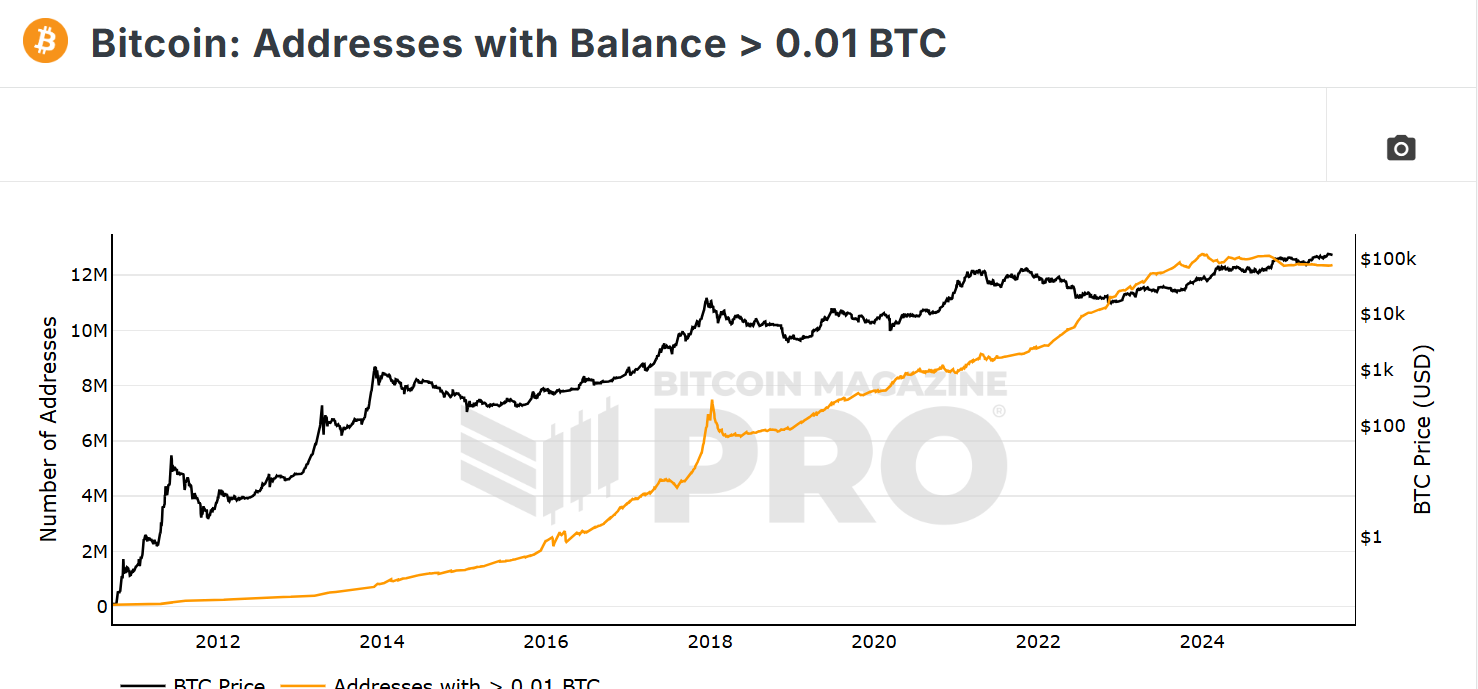
As of this press time, over 12.3 million Bitcoin addresses hold more than 0.01 BTC, reflecting a steady rise in grassroots adoption despite years of price volatility. According to a chart, wallet growth has remained consistent even during market downturns, indicating growing interest from smaller holders. 

Number of addresses holding 01 BTC
Number of addresses holding .01 BTC

Starting near zero in 2010, the number of addresses neared 7.5 million by 2018 and jumped to over 9 million by 2022. Meanwhile, Bitcoin’s price climbed from under $1 in 2010 to above $100,000 in 2025. The sustained increase in addresses highlights the influence of scarcity-based strategies like the one proposed by Altcoin Daily.

Analyst Uncovers Who Might Be Controlling XRP Price More Than We Think

0

According to market expert Dom, South Korean traders on Upbit might be determining XRP price movements more than we think.

Notably, XRP reached a new yearly high of $3.66 on July 18 after rallying 64% in just over two weeks. The surge reflected a broader market recovery, with Upbit traders contributing massively to it. However, the momentum quickly faded. 

Specifically, XRP price dropped along with the rest of the crypto market. By August 2, XRP had fallen to $2.73. Nonetheless, since then, it has bounced back above $3. While it still trades 18% below its July 18 peak, XRP has held on to the $3 level, with investors now watching closely for fresh buying interest that could trigger the next leg up.

Upbit Traders Might be Steering XRP Price More Than We Think

Amid this bearish trend, order book expert Dom called attention to a major factor behind XRP’s recent moves. According to him, this factor is the unusually strong influence of South Korean traders on Upbit. 

In an August 1 disclosure, he revealed that Upbit traders had sold a net 40 million XRP over 24 hours. This figure exceeded the combined volume of net XRP sales across all other exchanges. 

Dom suggested that Upbit’s selling spree played a major role in the market drop and argued that the Korean exchange might be controlling XRP price direction more than many realize.

Notably, the same group of Upbit traders also helped fuel XRP’s sharp rally weeks earlier. However, this time, their aggressive selling is contributing to the decline. Interestingly, as soon as they slowed down their selling, XRP found a bottom and began to recover, even while Binance traders continued to offload XRP. 

Dom noted a gradual accumulation of nearly 15 million XRP on Coinbase, which he believes could point to a potential Time-Weighted Average Price (TWAP) strategy. This accumulation coincided with XRP’s slow but steady climb from the lows.

XRP Price Action Against USOIL and USD

Meanwhile, Dom also tracked XRP’s performance on the USD and crude oil (USOIL) charts. On the USOIL chart, he noted on July 30 that XRP had broken out of a seven-month price range but saw little follow-through. 

The analyst predicted a possible retest of previous support levels, and by August 1, this projection materialized. Dom noted that this retest was actually important and explained that a full return into the old range would damage the bullish setup.

However, in an August 4 update, he expressed caution. According to him, XRP briefly dipped back into the range, but he described it as a weak fakeout, not a full rejection of the breakout. He said the next few days would be crucial. Specifically, if XRP falls again and settles back inside that long-standing range, short-term prospects could turn bearish.

XRP Against USOIL Dom

Meanwhile, on the USD chart, he shared a similar warning on August 2. However, two days later, he highlighted a bounce from the expected support zone. Still, he made it clear that XRP needs to push higher to regain a safe position. 

Dom believes the $3 level must turn into a solid support again. At press time, XRP changes hands at $3.05, struggling to maintain the $3 mark. The analyst suggested that a move above $3.12 would break the current downtrend and put XRP back into a bullish setup.

Shiba Inu No Longer in Top 20 — Here’s What Could Have Caused the Drop

0

As Shiba Inu continues to sit outside the top 20 ranking of crypto assets, this article highlights a few reasons impacting the token’s position. 

With a market capitalization of $7.26 billion, Shiba Inu ranks as the 22nd-biggest cryptocurrency globally and trades at $0.00001233.

Notably, Shiba Inu surged into the top 10 in 2021, rubbing shoulders with other major assets like Cardano and Solana. At one point, it even overthrew Dogecoin and ranked as the top meme coin.

While it lost its position in subsequent years, Shiba Inu again entered the top ten in March 2024 but soon lost it again. The coin lingered in the top 20 ever since until July 2025.

Now, the two-time top 10 crypto contender currently sits out of the top 20 rankings. Several factors contributed to Shiba Inu’s rapid decline.

Why Shiba Inu is Out of the Top 20 Crypto Ranking

Internal Discord

Shiba Inu’s top developer, Kaal Dhairya, recently acknowledged that the cryptocurrency is facing internal conflicts, which undermine the collective growth of the project.

The discord within the Shiba Inu ecosystem distracts the team from continuous development while also undermining the unity required to drive the project to greater heights.

Anonymous and Inactive Leadership

Meanwhile, investors are gradually losing faith in Shiba Inu due to lead developer Shytoshi Kusama’s decision to remain anonymous.

Investors were unbothered by the leader’s anonymity during Shiba Inu’s early days. However, as the project grew, many longed to see the face behind Shiba Inu. Despite attending two crypto events, including the IVS Summit held in Japan last year, Kusama still concealed his identity behind a mask.

Moreover, Kusama’s engagement on social media has decreased recently, compared to other industry stakeholders like Cardano’s founder Charles Hoskinson, Ethereum’s Vitalik Buterin, and Ripple’s CEO Brad Garlinghouse.

The absence of visible leadership has driven away several existing investors and discouraged newcomers from joining the SHIB bandwagon.

Institutional Apathy

Over five years after its launch, Shiba Inu remains a strictly retail-driven asset, with institutional clients remaining skeptical about the token. This is evident in the absence of a SHIB ETF filing. While no asset manager has filed for a Shiba Inu ETF, Dogecoin has seen multiple applications from firms like Bitwise and Grayscale.

These asset managers have ignored SHIB even though the SEC recently clarified that meme coins are not securities. This institutional apathy has limited large capital inflows into the Shiba Inu ecosystem and serves as a major factor keeping SHIB below the top 20 crypto ranking.

Enormous Supply

Shiba Inu’s enormous supply, currently around 589 trillion tokens, is also a major reason why SHIB sits below the top 20. Due to this massive supply, the token’s price and market cap are subject to greater volatility.

To potentially reclaim a spot in the top 20 — and possibly re-enter the top 10 — the Shiba Inu ecosystem may need to consider addressing internal challenges, enhancing transparency around leadership, implementing further token burn mechanisms, and exploring ways to attract institutional interest. These steps could help improve investor confidence and support long-term growth.

Encouragement From Shiba Inu Team

Even though Shiba Inu currently sits outside the top 20, the team has consistently encouraged investors to remain resilient during market downturns.

Earlier this year, after SHIB dropped to the $0.000012 region, Shiba Inu’s marketing lead, Lucie, stated that SHIB would succeed despite ongoing price challenges, suggesting that the token could eventually rise from the ashes.

Separately, she has also expressed her belief that SHIB could someday reach $0.01 and potentially aim for ambitious targets like $1. Whether these predictions will materialize remains to be seen.

CFTC Unveils Plan to Enable Spot Crypto Trading on Regulated Futures Exchanges

0

The U.S. Commodity Futures Trading Commission (CFTC) has unveiled a new initiative to allow spot crypto trading on registered futures exchanges.

In a press statement on Monday, the U.S. CFTC announced plans to enable the listing and trading of spot crypto asset contracts on designated contract markets (DCMs). These markets are regulated futures exchanges, and the move could pave the way for broader participation in U.S.-based crypto trading.

Acting Chair Caroline Pham stated that the initiative will operate within the agency’s existing authority. She invited all industry participants, stakeholders, and the public to submit feedback by August 18.

Part of the ‘Crypto Sprint’ Initiative

This program is the first major action under the CFTC’s new Crypto Sprint, launched last week. It follows recommendations from a White House digital asset report.

In that report, officials advised granting the CFTC oversight of spot crypto markets for assets considered commodities. The report also urged closer collaboration with the U.S. Securities and Exchange Commission (SEC) to ensure consistent rules for asset classification, trading, and registration.

Cooperation with the SEC’s ‘Project Crypto’

In parallel, the SEC is advancing its Project Crypto, a plan to modernize securities regulations for blockchain-based finance. SEC Chair Paul Atkins stated that the project will focus on rules for cryptocurrency distribution, custody, and trading to make the financial system more adaptable to on‑chain technologies.

Push for National-Level Crypto Rules

Pham emphasized that the CFTC is moving “full speed ahead” in coordination with the SEC to create a framework for spot crypto trading at the federal level. This joint approach aims to resolve long-standing questions over whether digital assets should be treated as securities or commodities.

With the August deadline approaching, market participants now have a window to help shape how cryptocurrencies are traded and regulated in the United States.

Teucrium CEO Says They Launched an XRP ETF Because He Sees Ripple “Hopefully” Replacing SWIFT

0

The Teucrium CEO has revealed that the firm launched an XRP ETF because he sees Ripple “hopefully” replacing SWIFT.

In a recent interview on the Thinking Crypto podcast, Teucrium CEO Sal Gilbertie explained why his firm launched a leveraged XRP exchange-traded fund (ETF), and why he believes XRP stands out in the crypto ecosystem.

Speaking with host Tony Edward, Gilbertie shared how Teucrium’s background in derivatives and his personal views on Ripple’s long-term strategy led to the creation of the Teucrium 2x Long Daily XRP ETF (XRP).

According to Gilbertie, while he didn’t originally invest in crypto himself, he always appreciated the concept. As someone who spent much of his career trading complex derivatives like swaps and futures, he immediately recognized the potential when Bitcoin futures became available.

Teucrium CEO Explains Why They Went for XRP

However, it was XRP that caught his attention. The Teucrium CEO said he never felt drawn to tokens like Ethereum or Solana. On the other hand, XRP made sense to him because of its practical use in finance. 

His own frustration with slow, outdated banking systems helped him connect with Ripple’s mission to modernize cross-border payments. He said, “I understand the financial system. I understand the banking system to some degree, and I understand, as we all do, when you try to send a wire, it’s a hassle.”

He highlighted how Ripple’s team has spent years building the foundation to upgrade how global money transfers work. He believes that effort puts them in a strong position to lead, suggesting they could “hopefully” replace SWIFT.

“The Ripple team, from their outset, have been out there laying the groundwork in the background to change the financial system… primarily through replacing, hopefully, the Swift system,” he remarked.

Gilbertie pointed to Ripple’s focus and professionalism, saying they stayed consistent in their goal to improve financial infrastructure. He believes XRP will likely come out on top in the race to modernize payment systems, citing its speed and growing market share. “We think they’re going to win the game in the transfer system,” he stated.

A Move That Paid Off

Meanwhile, Gilbertie noted that rather than competing with other giants in the spot XRP ETF space, Teucrium focused on its expertise in leveraged products. Gilbertie knew the firm couldn’t outmuscle the industry’s biggest names, so they carved out their own lane by launching a double-exposure XRP ETF. 

Since XRP futures weren’t available at the time, Teucrium structured the fund using swaps based on a Swiss ETF that held XRP. Notably, this workaround allowed them to launch first.

Interestingly, the move paid off. Late last month, Teucrium’s 2x XRP ETF became the first US XRP ETF to cross the $300 million AUM mark. 

Gilbertie credited the fund’s performance to strong demand from the XRP community, describing them as an “army”, and the appetite among traders for high-risk, high-reward products.

Earlier Frustration with Bitcoin Futures 

Meanwhile, during the Thinking Crypto podcast, Gilbertie also shared the setbacks Teucrium faced with Bitcoin ETF filings. Specifically, the firm filed early under the 1933 Act, which required a longer review process.

However, the then SEC Chair Gary Gensler later shifted the path for approval toward 1940 Act filings, which involved shorter timelines. As other firms rushed in under the new guidelines, Teucrium lost its early lead. 

Gilbertie said the sudden rule change cost them a major opportunity and left them watching from the sidelines as others entered the market first. Even so, the experience didn’t stop Teucrium. By choosing a different route and focusing on XRP, Gilbertie and his team found a new way to stand out.