Home Blog Page 603

Cardano Founder Says Glad to Be Working with Near Protocol as Intents Integration Plans Surface

0

Cardano users could have access to a new cross-chain tool as the Near Protocol team teases the addition of ADA to the Near Intents.

Vini Barbosa, a content manager and Near Intents proponent, disclosed that Cardano could be the next token available on Near Intents. For context, this cross-chain execution layer allows for seamless swaps without the need for centralized exchanges.

With the potential integration, Cardano users will now be able to swap ADA with over 100 tokens currently embedded on the Near Intents. Notably, this will further boost the market depth of ADA while providing Cardano holders with a new tool for seamless cross-chain interaction.

Cardano Founder Confirms Contact with the Near Team

Notably, the Near community spotted this possible integration on PikesPeak, a data and analytical protocol native to the Near Protocol. The Near team appeared to be testing out the new smart contract “cardano.omft.near” on PikesPeak, suggesting they are working on an ADA to Near swap using Intents.

Meanwhile, Cardano founder Charles Hoskinson confirmed the speculations in the Cardano and Near communities when he suggested that Cardano is in contact with the Near team on the possible integration.

“Glad to be working with Near,” Hoskinson wrote in a July 30 tweet.

Notably, there are several other major currencies swapable on the Near Intents, and Cardano would add to the list. Users can swap Bitcoin, Ethereum, Solana, XRP, Dogecoin, SUI, Near, and over 100 other assets on the platform.

For the uninitiated, Intents is an abstraction tool that simplifies the complexity of cross-chain transactions by delivering desired outcomes without the user worrying about the process. It saves users the hassle of constructing smart contracts, leveraging a network of “solvers” to complete a user’s intent in the best possible way.

Intents launched on beta in November 2024, but Near Protocol fully unveiled it for public use in the first quarter of this year.

Cardano Expanding Its Reach

Meanwhile, the Cardano ecosystem has been big on cross-chain partnerships lately, aimed at enhancing the interoperability of the blockchain. Besides the looming Near Intents integration, Cardano’s Tokeo Wallet recently teased an integration on the XRPL Ledger.

Cardano has also expanded its reach lately, with integrations into new wallets. Specifically, Brave in-browser wallet added support for Cardano to its 70 million users in May, while Blockchain.com integrated Cardano on July 17, making it available for its 37 million users.

At the center of this push is Hoskinson, who has expressed his desire to spearhead a unified crypto industry. Interestingly, he has recently advanced this course with his meetings with the Ripple executives and the Stellar co-founder.

Here’s What Will Boost XRP Value, According to Ripple’s CTO

0

The Ripple CTO David Schwartz recently affirmed that Ripple continues to prioritize XRP, insisting that more XRPL use will lead to greater utility and value for XRP.

In the most recent conversation, an XRP proponent asked Schwartz whether XRP still holds importance for Ripple, pointing out that Ripple now highlights its new stablecoin, RLUSD, more often but barely mentions XRP anymore.

XRP Use as a Bridge in Ripple Payments Dwarfs Every Other Asset 

Responding, Schwartz said XRP still plays a major role in Ripple Payments, especially as a bridge between currencies in cross-border transactions. 


Although he confirmed that he doesn’t have the exact numbers at the time, the Ripple CTO noted that he was certain Ripple uses XRP far more than any other digital asset for its payments service. To him, this proves XRP still sits at the heart of Ripple’s payment system.

Speaking further, he also discussed how RLUSD fits into Ripple’s plan. According to Schwartz, stablecoins like RLUSD make more sense for use cases that depend on price stability, like when companies use crypto assets as collateral or when they enter or exit crypto markets. 

Notably, price swings can cause problems in those areas, and RLUSD avoids that. However, for most other uses, Schwartz believes crypto assets like XRP do a better job. He said unless someone wants to avoid risk completely, they’d usually prefer holding major digital assets over cash.

Ripple CTO: More XRPL Use Will Lead to More Utility and Value for XRP

Moreover, Schwartz also stressed that more real-world adoption of the XRP Ledger (XRPL) will naturally lead to more demand for XRP. Specifically, he suggested that as more projects and institutions use XRPL in finance, this will translate to greater utility for XRP and consequently, higher value.

The Ripple CTO pointed out that XRP isn’t just another token added to the system, as it is part of how the ledger works. Because of that, he said it’s much harder to avoid using XRP on XRPL than it is to avoid using the native token on some other networks like Ethereum.

Schwartz’s comments come amid concerns that Ripple is starting to favor RLUSD over XRP. When Ripple launched RLUSD in December 2024, some in the community already felt uneasy. 

Growing Concerns Ripple Might be Sidelining XRP

These concerns got louder in May 2025 when Ripple announced that its partner, Hidden Road, a major clearinghouse that works with over 300 institutions, would use RLUSD as its main collateral asset. 

The move frustrated longtime XRP proponents like Elena Schoen, who said Ripple now seems to limit XRP to paying transaction fees while letting RLUSD handle the more important work in payments and onboarding.

However, a few community figures have pushed back. Community voice WrathofKahneman argued that Ripple hadn’t turned its back on XRP but had simply shifted toward building services for large institutions. Consultant Jake Claver also said that if Ripple moves more financial activity through XRPL, demand for XRP could actually grow.

Schwartz and Ripple CEO Brad Garlinghouse have also both tried to make the company’s approach clear. They have reiterated that RLUSD and XRP serve different roles. RLUSD helps with stable, on-chain fiat operations. XRP still fills the role of a bridge for moving money across borders quickly and efficiently. 

White House Official Confirms Bitcoin Reserve Is Coming, Says U.S. Is a BTC Fan and Won’t Issue a CBDC

0

Despite the White House’s crypto report not detailing the operational procedures for the Strategic Bitcoin Reserve (SBR), U.S. Director of Digital Assets Bo Hines confirmed that the initiative remains actively under development. 

Yesterday, the Donald Trump administration released a 166-page crypto report, detailing numerous policy recommendations to solidify America’s leadership in the crypto market. However, the report made no mention of how the government will establish the SBR, which has been a significant part of Trump’s crypto goals. 

Bitcoin Reserve is Still Under Development 

Amid this, speculation emerged that the government may have abandoned plans for a Bitcoin reserve.

In reaction, Bo Hines, the Director of the President’s Council of Advisers on Digital Assets of the White House, dismissed this speculation. He stated that the U.S. government remains a strong fan and supporter of Bitcoin and understands the importance of the initiative. He confirmed that the Bitcoin reserve is coming.

According to him, the Trump administration has already established the SBR and national digital asset stockpile through an executive order signed in January. He pointed out that the move was to recognize the uniqueness of Bitcoin, which has been in a class of its own. 

However, Hines emphasized the need to build out the necessary infrastructure to ensure the reserve is set up correctly. 

“This requires some labor to get it set up properly. You need to build the infrastructure and make sure you’re crossing your T’s and dotting your I’s to get it done the right way,” Hines remarked. 

Hines Refrains from Disclosing US Government Bitcoin Holdings 

When asked to reveal the number of Bitcoins the government owns and whether it will be made public, Hines declined to comment. 

“I can’t discuss that right now. There are several reasons why we are not disclosing that information at this time,” Hines remarked. 

Nonetheless, he revealed that the U.S. government intends to acquire “as much Bitcoin as possible” and will keep working towards that goal. The director of digital assets stated that the acquisition will be carried out in a budget-neutral way without requiring new appropriations. 

US Government Won’t Issue CBDC or Stablecoin 

Furthermore, Hines emphatically stated that the U.S. government will not issue a stablecoin or CBDC. He said the president’s executive order already prohibits the issuance of a CBDC. 

He noted that Fed Chair Jerome Powell has, on three occasions, confirmed that a CBDC would need Congressional approval. This requirement was also echoed in the GENIUS Act, destroying the prospects of CBDC. 

“Why would you ever want to use a government-backed stablecoin? There’s no purpose for it, and there’s no reason for it. We don’t want Big Brother spying on American consumers, and we feel extremely strongly about this,” he added. 

Here is What $10,000 Invested in Shiba Inu Today Could Be Worth by 2040

0

A $10,000 investment in Shiba Inu today could yield substantial returns if SHIB eventually clinches its projected 2040 price target.

While the current bull market has benefited Bitcoin, altcoins like Shiba Inu have yet to experience the massive gains they saw in 2021. 

Despite this, confidence has not waned as many investors believe the altcoin market, particularly Shiba Inu, is shaping up as fertile ground for outsized gains. This is driven by regulatory clarity and Shiba Inu’s AI initiatives. 

For context, the SEC recently declared meme coins like Shiba Inu as non-security, suggesting that the canine-themed token does not fall under its regulatory purview. The team behind Shiba Inu is also working behind the scenes to integrate artificial intelligence (AI) into the Shiba Inu ecosystem. 

Value of $10,000 SHIB Investment by 2040

Based on Shiba Inu’s regulatory clarity and AI commitment, seasoned investors are positioning themselves for a remarkable price surge by 2040. Bullish predictions from entities like Changelly and Telegaon suggest that Shiba Inu could delete up to three zeros, potentially transforming small investments into life-changing gains. 

With that in mind, we projected the 2040 value of a $10,000 SHIB investment made today. At the current price of $0.00001310, investors can scoop up 709,219,858 (709.21 million) SHIB tokens with a capital of $10,000. If SHIB reaches the ambitious 2040 targets set by Telegaon and Changelly, this 709.21 million SHIB portfolio will be worth substantially more than it is today.

Telegaon 

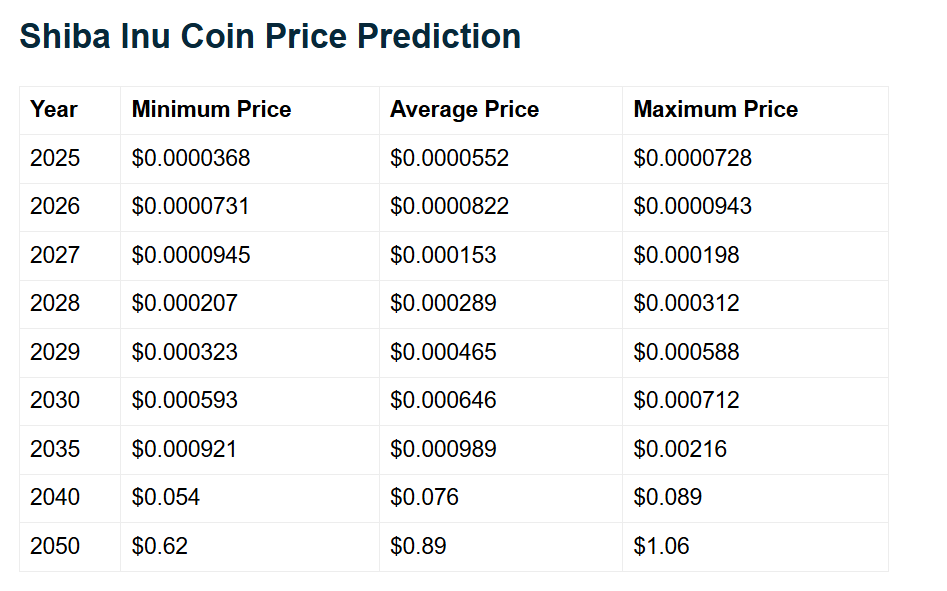
Popular prediction platform Telegaon expects Shiba Inu to clinch a conservative price target of $0.054 and an ambitious level of $0.089 by 2040. The $0.054 demands a rally of 382,878% from the current price of $0.00001410 while the $0.089 represents a 631,105% increase. 

Shiba Inu Price Predictions Telegaon

If SHIB clinches the $0.054 target, a portfolio of 709.21 million tokens will be valued at $38.29 million. In the same vein, hitting the $0.089 target will push the value of these 709.21 million tokens to $63.12 million. 

Changelly 

Changelly’s 2040 predictions for Shiba Inu are more conservative than those set by Telegaon. According to Changelly, Shiba Inu will reach a minimum target of $0.00608 by 2040 and a maximum price of $0.00766 in the same year. 

Notably, the $0.00608 forecast represents a 43,020% increase from the current price, while the $0.00766 forecast marks a 54,226% increase. At $0.00608, 709.21 million SHIB will be valued at $4.31 million. The valuation of this 709.21 million SHIB portfolio will spike to $5.43 million if Shiba Inu’s price reaches Changelly’s 2040 bull target. 

Can SHIB Reach Changelly and Telegaon 2040 Predictions 

The chances of SHIB hitting these price targets, particularly those set by Telegaon, are slim due to its hefty supply, which stands at around 589 trillion tokens. 

For instance, Telegaon’s 2040 maximum price prediction–$0.089–translates to a market cap of $52.42 trillion, based on the asset’s supply of 589 trillion tokens. This surpasses the valuations of gold and silver, and the overall crypto market cap. 

Moreover, the absence of an ETF tied to SHIB and the team’s preference for anonymity could impede any significant Shiba Inu rally to lofty targets, including those set by Changelly and Telegaon. 

XRP Sets Sights on $11 But Here’s Why $22 Isn’t Off the Table

0

XRP recently broke out of its months-long bull pennant structure, but a prominent market analyst suggests its target could be much higher.

Notably, this breakout occurred during the recent rally above $3 weeks back, with the move setting $11 in view. However, market analyst EGRAG Crypto suggests this price might not reflect XRP’s full potential. Based on past patterns, he argues the real target could possibly be around $22.

EGRAG’s Falling Wedge Target Falls Short by 111%

In his latest analysis, EGRAG compared XRP’s current setup to what happened in 2023. Back then, XRP formed a falling wedge on the weekly chart after dropping from a $1.96 high in April 2021. This pattern dragged on for several months until the token fell to $0.35 in early March 2023. At that point, XRP broke out. 

EGRAG expected it to rise to $1.43. However, instead of stopping there, XRP pushed much higher and reached above $3.30 by January 2025. This final price came in more than 111% higher than his original projection.

EGRAG said he shared this earlier example not to dwell on past performance but to show how crypto assets can go far beyond expectations. Data from his chart shows that the 2023 breakout built a foundation for XRP’s long-term rally, even though the price took time to gather strength. 

XRP 1W Chart EGRAG Crypto
XRP 1W Chart | EGRAG Crypto

Interestingly, the move set the stage for XRP’s jump to $3.40 in early 2025, a seven-year high. Notably, this rally formed the flagpole of what EGRAG now sees as a bull pennant pattern that started forming since the November 2024 uptrend. The run to $3.4 in January 2025 formed the flagpole of the bull pennant.

Pennant Breakout Eyes $11, But Actual Target Could be $22

After reaching the $3.4 peak, XRP pulled back and traded between $2 and $3 for more than six months. Chart data confirms that this price action shaped the pennant part of the formation. This month, XRP broke out of this pattern. Based on the size of the flagpole, EGRAG believes the breakout could drive XRP to $11.

Still, he asked an important question: what if, like in 2023, the new target also underestimates XRP’s true potential? If the same kind of price overshoot happens again, he believes XRP could run all the way to $22. 

Meanwhile, EGRAG also shared what he observed recently about crypto price predictions. According to him, linear measured moves often fall short in today’s fast-changing market. 

Instead, he sees more reliable results when applying logarithmic moves, especially for assets that show exponential growth. He pointed out that many patterns don’t just meet these projections, they sometimes surpass them.

Here’s What XRP Could Be Worth If It Handled Remittances Across Africa and Asia

0

What could XRP price skyrocket to if it powered remittances across both Africa and Asia?

Notably, while XRP recently bounced back to $3.17, many believe it’s still trading far below what it’s really worth. One of the biggest reasons behind this belief is its role in payments. With that in mind, we recently explored what XRP could be worth if it became the go-to solution for sending money across Africa and Asia.

Remittance Volume in Asia and Africa

Right now, the combined value of remittances going into both regions is estimated at around $491 billion each year. Africa accounts for about $95 billion of that, led by countries like Nigeria, Egypt, and Morocco. 

Meanwhile, Asia received the bulk of the flow, between $390 billion and $396 billion a year, making it the largest remittance market globally. Notably, if XRP powered all of this movement, its price could be significantly higher.

When we asked ChatGPT for valuation models, the chatbot presented three possible scenarios, each based on the idea that XRP takes over this huge market and becomes a major part of the financial system in these regions.

XRP Price if It Powered Remittances in Asia and Africa

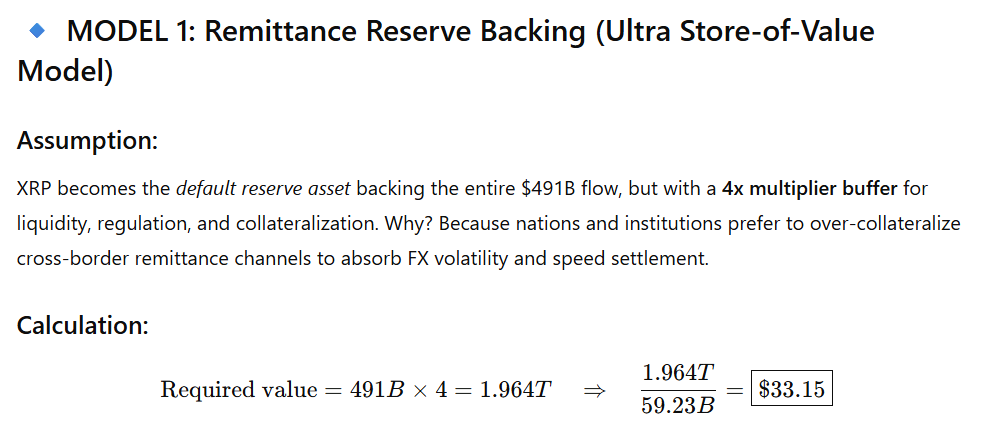
In the first model, ChatGPT assumed that XRP wouldn’t just move the money but also serve as the reserve asset behind it. To support the $491 billion in yearly remittances, it applied a 4x multiplier to account for liquidity needs, regulations, and volatility buffers. 

This put the target value at $1.964 trillion. When divided across XRP’s current circulating supply of 59.23 billion, this model pointed to a price of $33.15. 

XRP Price if Used for Remittances in Africa and Asia 3
XRP Price if Used for Remittances in Africa and Asia

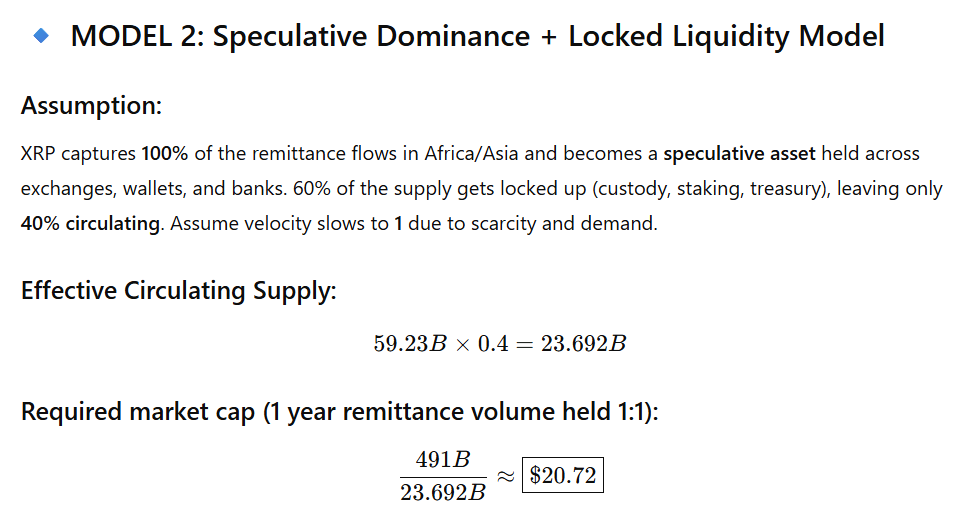
Meanwhile, the second model imagined that XRP moves the entire remittance volume and also becomes a highly sought-after asset, with 60% of its supply locked up in custody, staking, or treasury reserves. 

Such a scenario leaves about 23.69 billion XRP in active circulation. With demand still high and fewer tokens in the market, the price would need to jump to around $20.72 to match the remittance value.

XRP Price if Used for Remittances in Africa and Asia 2
XRP Price if Used for Remittances in Africa and Asia

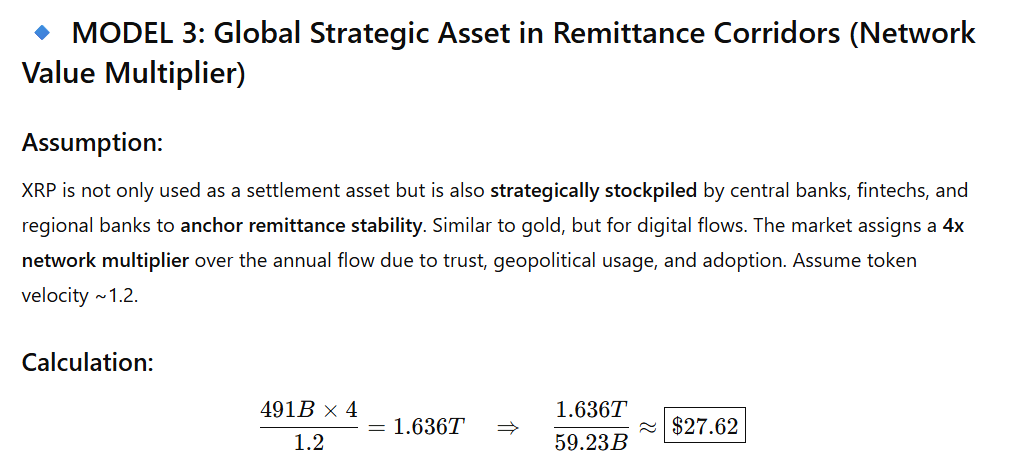
However, the third model leaned on XRP becoming a financial asset. ChatGPT suggested that banks, fintech firms, and governments could start holding XRP, much like they do gold, to help stabilize remittance systems. 

With the application of a 4x multiplier to the remittance flow and adjusting for token velocity, the model reached a projected value of $1.636 trillion. This would push XRP’s price to around $27.62.

XRP Price if Used for Remittances in Africa and Asia

Ripple Already Penetrating Asia and Africa

Notably, it bears mentioning that Ripple is already penetrating these regions. For instance, in Africa, the company has teamed up with Onafriq (formerly MFS Africa) to open blockchain-powered payment routes across 27 countries. 

It also partnered with Chipper Cash in early 2025 to offer faster, cheaper global payments into nine African nations. By mid-2023, Ripple’s On-Demand Liquidity was already in use in 13 African countries, including Egypt, Kenya, and South Africa.

Meanwhile, in Asia, Ripple has secured major partnerships and licenses. It runs its Asia-Pacific operations from Singapore, where it holds a full license. Also, it launched a dedicated fund to support blockchain innovation in Japan and South Korea and expanded its university program with a $5 million investment across six countries. 

In Japan, the company is working with HashKey DX to bring XRP Ledger-based finance solutions to the supply chain sector.

Here is Good News for XRP ETFs According to Legal Expert

The U.S. SEC has officially approved in-kind creation and redemption mechanisms for crypto exchange-traded products (ETPs), a move that could benefit potential XRP ETFs.

Notably, this change allows authorized participants to exchange crypto assets directly rather than relying solely on cash to create or redeem shares of crypto-based ETFs. The agency approved this for the existing Bitcoin and Ethereum ETFs.

SEC Chairman Paul Atkins Reacts

SEC Chairman Paul Atkins emphasized that these approvals are part of a broader effort to establish a regulatory framework tailored to the crypto markets.

He stated that the move helps build a more rational structure for the crypto sector, one that fosters a deeper, more dynamic market and ultimately benefits all American investors.

The in-kind model aligns crypto ETFs with structures already used for commodities like gold, reducing operational friction and cost inefficiencies for fund managers and investors.

Notably, the impacted crypto ETFs include Bitcoin and Ethereum ETFs listed on Nasdaq, CBOE, and NYSE.

Good News for XRP ETFs

In response to the announcement, pro-XRP attorney Bill Morgan called the development “massive” on social media. He noted that this change comes as several XRP ETF applications await SEC approval. According to Morgan, this represents yet another positive step for the broader crypto market.

For XRP, which has already secured legal clarity, the regulatory door is now more open than ever. The SEC’s recognition of in-kind creation could streamline operations for XRP-based funds.

While no XRP ETF has yet been approved, the structural framework outlined by the SEC is increasingly favorable.

In recent months, the SEC has delayed decisions on more than 10 XRP ETF applications currently under review.

U.S. SEC Commissioner Hester Peirce acknowledged that while the delays are frustrating, they reflect the SEC’s deliberate, rules-based review process. She noted that the process is not fast but ensures a thorough evaluation.

Essentially, the SEC continues to review various altcoin ETF filings and has not ruled out approvals. Despite missed deadlines, analysts expect a decision by October.

SEC Takes Further Steps Toward Market Maturity

In addition to approving in-kind creation, the SEC has also voted to permit mixed spot Bitcoin and Ethereum ETPs. It approved options and FLEX options on certain Bitcoin ETPs and raised position limits for BTC-based ETF options to as high as 250,000 contracts.

These moves further confirm the SEC’s evolving stance on crypto regulation under Chairman Paul Atkins. This contrasts with the more restrictive approach taken under former chairman Gary Gensler.

The Atkins-led Commission has adopted a merit-neutral stance toward crypto-based financial products. Jamie Selway, Director of the Division of Trading and Markets, noted that this policy shift will “result in a more efficient market.”

Institutions Could Scoop Up 1.9 Billion Retail XRP, Driving Price to $20: Expert

0

A well-known voice in the XRP community, known as XRP Liquidity, believes institutions could soon snap up nearly all XRP still held by retail investors. 

Notably, his comments come on the back of growing institutional interest in XRP amid the clearer regulatory atmosphere. XRP Liquidity pointed out that around 1.9 billion XRP currently sits in retail hands and warned that this supply might not last much longer if the current momentum continues. 

Ripple and Institutions Could Gulp the Leftover Retail XRP Supply

According to him, Ripple and institutional buyers could start acquiring this remaining supply, and they might push the price as high as $20 to convince everyday holders to sell. Notably, with XRP currently trading for $3.13, a rally to $20 would require a massive 538%.

Notably, investors holding 10,000 XRP, currently worth $31,300, would see their investments grow to a whopping $200,000 if XRP hits the $20 price mark. Interestingly, several analysts have also projected XRP to reach this $20 level. Most recently, EGRAG predicted a run to $20. 

Meanwhile, XRP Liquidity also suggested that the public narrative would likely frame the forthcoming institutional demand as coming from new retail investors, even if large institutions are the real force behind the buying pressure.

Teucrium XRP ETF Points to Growing Institutional Interest

This prediction adds to growing optimism around XRP’s future, especially after the recent success of a new exchange-traded fund tied to the asset. Teucrium Trading, a financial firm with a strong presence in the ETF market, recently launched the first-ever U.S.-listed leveraged XRP ETF. 

The fund, called the Teucrium 2x Long Daily XRP ETF and trading under the ticker XXRP, officially went live on April 8, 2025. Rather than holding XRP directly, the fund tracks its performance through swap agreements and international XRP-based products. It offers investors double the daily movement of XRP’s price.

Remarkably, despite XRP trading near a five-month low at launch, the fund pulled in around $5 million in volume on its first day, placing it among the top 5% of all ETF launches in terms of day-one activity. The strong debut showed that demand for XRP exposure remains high.

Most recently, Sal Gilberti, President and CEO of Teucrium Trading, joined CNBC’s Dominic Chu to talk about the fund’s rapid growth. He said the response had far exceeded expectations, calling it the company’s most successful fund so far. 

Gilberti explained that the product has attracted hundreds of millions of dollars since its launch, and he credited the XRP Army for fueling that momentum. This attracted a comment from Vincent Van Code, a software engineer and active member of the XRP community.

Specifically, Van Code described the ETF’s strong performance as a sign that XRP is moving closer to full-scale mainstream adoption, leading to the suggestion from XRP Liquidity that institutions could gulp the leftover retail supply.

US GDP Grows Beyond Expectations, Possible Impact on Bitcoin and Crypto Prices

How could Bitcoin react as the U.S. economy expands at an annualized rate of 3% in Q2 2025, beating forecasts of 2.4% and smartly reversing the -0.5% contraction in Q1.

The preliminary GDP data, released by the Commerce Department, points to a resilient U.S. economy supported by a significant drop in imports and steady consumer spending.

Notably, import activity fell by 30.3% during the quarter, following a 37.9% surge in Q1 as companies raced to front-run tariff changes. Meanwhile, consumer spending rebounded to 1.4%, up from a sluggish 0.5% in the previous quarter.

Core Inflation Slows, But Fed Holds Steady

Alongside GDP, the Federal Reserve’s preferred inflation metric, the core PCE index, came in at 2.5%. While slightly above expectations, it marked a significant decline from 3.5% in Q1.

The broader PCE index, which includes food and energy, also eased to 2.1%, hovering near the Fed’s 2% target.

Despite signs of easing inflation, industry analysts believe the Fed will maintain its benchmark interest rate at 4.25%–4.5% during its latest meeting.

In other words, while the data shows inflation is cooling, the Fed may still avoid immediate rate cuts. Notably, there has been no rate cut since December, despite increasing pressure from the government.

Trump Reacts: “Lower the Rate”

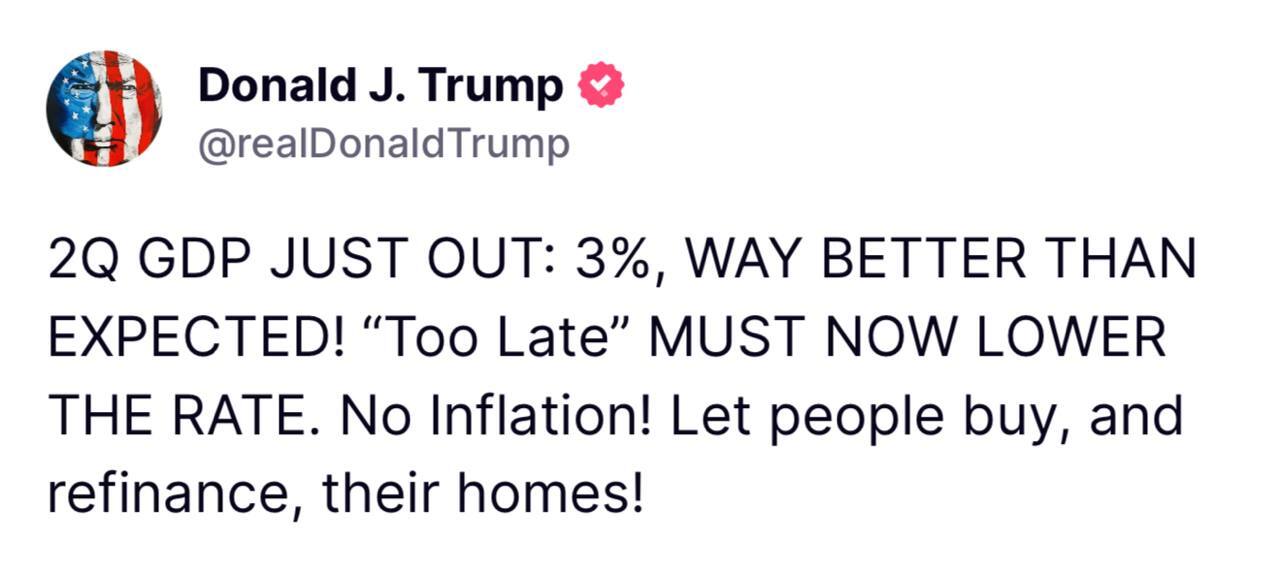
President Donald Trump took to his Truth Social account to respond to the GDP surprise, urging the Fed to cut rates. He highlighted the 3% growth in second-quarter GDP as “way better than expected” and emphasized that it was “too late” for inaction.

Specifically, Trump argued that with inflation under control, the Fed should lower rates to help people buy and refinance homes.

Image

Trump has been a vocal critic of the current high-interest rate environment, especially with mortgage rates suppressing housing demand. In Q2, residential investment dropped by 4.6%.

Bitcoin and Crypto Market Face Mixed Signals

For Bitcoin and the broader crypto market, the strong GDP print sends a mixed message. On one hand, economic strength reduces the risk of an immediate recession, which supports risk appetite.

On the other hand, the strength in GDP reduces the urgency for the Federal Reserve to ease monetary policy, keeping interest rates elevated. This condition tends to cap crypto upside.

Bitcoin trades around $118,600 following the GDP release, with little immediate price reaction. At press time, BTC is up 1%, with no strong attempt to break through the $120,000 range.

Ethereum, XRP, and other altcoins have shown similarly muted responses. Specifically, Ethereum is up 1.7%, trading at $3,826, while XRP is up by a similar percentage, trading at $3.13.

For now, the message from the economy points to resilience. However, for crypto bulls, the real price pump may only come once the Fed makes a move. Still, the crypto market has been rallying and breaking new highs this year, even amid the Fed’s tight monetary policy

Meanwhile, the crypto community remains optimistic about a rate cut to trigger the next bullish phase.

White House Crypto Report Preview Leaves Out Bitcoin Reserve: Here’s What It Covers Instead

0

A preview of the 180-day White House crypto report from the Presidential Working Group on Digital Assets has arrived, but it leaves out the Bitcoin reserve.

The White House has released a preview of its long-awaited crypto report after months of coordination across federal agencies. Notably, this marks the administration’s first major policy document on digital assets since President Trump established the Presidential Working Group on Digital Asset Markets back in January 2025.

SEC, CFTC, DeFi, and Stablecoins

Specifically, the White House crypto report presents a clear direction for crypto policy, pushing for faster innovation and stronger clarity in regulations. It urges financial regulators like the SEC and CFTC to close existing gaps and immediately allow digital asset trading at the federal level. 

The goal is to give crypto companies and investors clear rules on registration, trading, custody, and compliance without the red tape that has slowed the industry for years.

In addition, the report calls for fresh efforts to bring decentralized finance (DeFi) into the mainstream. It suggests that agencies create regulatory sandboxes and safe harbor programs so developers can launch new crypto products quickly, without facing early enforcement actions. This approach aims to support innovation while protecting consumers.

Moreover, it places a focus on stablecoins, especially those tied to the U.S. dollar. After President Trump signed the GENIUS Act earlier this month to establish a federal framework for stablecoins, the working group now wants agencies to move fast in putting it into action. The report describes stablecoins as tools that can help strengthen the dollar’s role in the global financial system.

CBDCs and Taxes 

Further, the administration doubled down on its opposition to central bank digital currencies. It called for legislation to ban the development of a U.S. CBDC, citing privacy concerns and warning against potential surveillance by the federal government.

Regarding taxes, the working group asked the Treasury Department and IRS to revisit current rules. It wants better guidance on how to handle crypto activities like mining, staking, and small everyday transactions. Notably, earlier this month, Fidelity made a similar suggestion to Congress.

Still on tax, the Presidential Working Group also recommended changes that could make it easier for businesses and individuals to use digital assets for payments, including updates to rules around the corporate alternative minimum tax and de minimis thresholds.

White House Crypto Report Preview Leaves Out Bitcoin Reserve

While the White House crypto report covers a wide range of issues, it leaves out one key topic: the Strategic Bitcoin Reserve and the broader plan to build a national stockpile of digital assets. 

Crypto commentators have called attention to this omission, especially since President Trump signed an executive order in March to create both programs. The White House even hosted a Crypto Summit that same month to bring in industry voices on how to manage these reserves. 

Despite that momentum, the new report offers no update on those plans. However, only the review has made it to the public. It remains to be seen if the full report will include this important aspect of the U.S. crypto journey.

The Trump Administration Pushing for Clearer Crypto Policies

Notably, the report follows a strict timeline set by Trump’s executive order from January, which gave federal agencies 180 days to review existing crypto rules, suggest changes, and submit a full report to the National Economic Policy Office. Since then, the administration has moved to update crypto policy.

Just days after the order, the SEC launched a dedicated Crypto Task Force to draft new rules. In March, Trump ordered the creation of the Bitcoin reserve and national crypto stockpile. 

The administration also disbanded the DOJ’s crypto enforcement team in April, signaling a softer enforcement approach. Then, in July, Trump signed the GENIUS Act into law, locking in a regulatory framework for stablecoins.

Meanwhile, the SEC under Trump scaled back and paused several high-profile lawsuits against crypto firms. The administration also rolled back Biden-era tax rules on crypto reporting, reducing compliance burdens for both users and businesses.