Home Blog Page 606

Coinbase Adds Samsung Pay for Seamless Crypto Purchases

0

Coinbase has rolled out Samsung Pay as a new payment option, making it simpler for clients in the U.S. and Canada to buy crypto straight from their phones. 

Coinbase Integrates Samsung Pay

This update lets users fund their accounts directly through the Coinbase app using Samsung Pay, without needing to switch apps or re-enter payment information. The feature has already started reaching some users across North America, with full availability expected in the coming weeks, according to a press release today.

With this partnership with Samsung, Coinbase combines its secure platform with the convenience of one of the world’s leading mobile wallets. Specifically, users with Samsung Pay can now move from browsing to buying crypto in just a few taps. 

The goal is to make the process feel as natural as sending a message or tapping to pay at checkout, especially as the crypto scene continues to attract new entrants.

Growing Global Crypto Adoption Demands Easier Onboarding

Notably, the latest trends in 2025 show just how fast crypto adoption is growing. Per recent reports, around 28% of American adults, roughly 65 million people, now own some form of digital asset, nearly double the number from 2021. 

Meanwhile, among those who haven’t yet entered the space, 14% plan to buy this year, while 67% of current owners want to grow their holdings. Interestingly, Bitcoin, Ethereum, and Dogecoin lead the list of coins drawing the most interest.

Globally, more than 824 million people now hold digital assets, with Bitcoin in the lead and owned by about 5% of the world’s population. Reports point to a strong price growth, more institutional involvement, and easier ways to invest as the drivers of this surge. 

Also, consumer sentiment keeps trending positive. About 60% of Americans familiar with crypto believe prices will rise, with many pointing to political developments as a key influence.

This growing momentum shows why Coinbase continues to improve its user experience. With Samsung Pay now in the mix, both first-time buyers and experienced investors can fund their accounts faster and more easily.  Last month, Coinbase sought SEC approval to offer stock trading on blockchain.

Coinbase Increasingly Integrating Mobile Wallets

This isn’t Coinbase’s first step into mobile wallet partnerships. The company added Google Pay support to its Coinbase Card in March 2020, giving Android users the ability to spend crypto via tap-to-pay. 

Later that year, Coinbase expanded Google Pay integration to include direct crypto purchases. Also, Apple Pay joined the lineup in June 2021 for the Coinbase Card, and in December 2024, Coinbase allowed direct crypto buys through Apple Pay using its Onramp feature.

Meanwhile, Coinbase is the latest to integrate Samsung Pay among crypto exchange and trading platforms. For instance, Alchemy Pay connected its virtual crypto cards with Samsung Pay in October 2024, opening the door for more than 500,000 users across 24 countries to make purchases using crypto, both online and in-store. 

In another instance, Gemini teamed up with Samsung’s Blockchain Wallet, giving Galaxy users the option to buy, sell, and trade crypto straight from the Gemini app by April 2025.

Stablecoin Regulations Would Boost the US Dollar: BlackRock

0

$12.5 trillion asset manager BlackRock has nodded to the growing narrative that stablecoins will boost the US dollar’s market dominance.

Analysts at the largest asset manager in the world shared in a weekly market commentary that stablecoins are a step in the right direction for the US dollar. This is because it would expose the titan fiat currency to new international use cases.

BlackRock strategists shared the view on the back of the new stablecoin regime in the United States. For context, a bipartisan effort in Congress ensured the passage of the GENIUS Stablecoin Act, the first federal crypto bill ever passed in the US, early this month.

GENIUS Act: A Dual Boost for the United States

The stablecoin market is slowly making its mainstream debut following the recent institutional interest in the sector. Notably, the stablecoin market cap has grown exponentially over the years, moving from under $50 billion in 2021 to $273 billion.

Meanwhile, the recently passed GENIUS Act provides a clear regulatory framework for the sector, including precise guidelines for issuers on reserve allocation. BlackRock strategists highlighted that the mandate for issuers to hold their reserves in the US Treasury bills, repurchase agreements, and money market funds will boost the demand for these investment vehicles.

For context, Tether and Circle, the two largest issuers, hold a combined $120 billion in Treasury bills. While this accounts for only about 2% of the Treasury’s $6 trillion market, the explosive growth by these issuers and increasing demand for stablecoins suggest this percentage will increase over time.

New International Use Case to Elevate US Dollar Dominance

For one, the US dollar dominates every other fiat currency, with perceived stability fueling its preference in international trade settlements. With cryptocurrencies, particularly Bitcoin, emerging as a strong competitor, US dollar-pegged stablecoins offer a lifeline for fiat currency.

BlackRock highlighted that tokenized forms of the US dollar would bolster the dollar’s dominance, especially as institutional transactions are coming on-chain. This enhances the US dollar’s use case in the digital scene, as it can still play a role in international payments.

Moreover, the United States’s first-mover advantage in endorsing the tokenized US dollar means that users can get easy access to the fiat currency over other volatile currencies. However, BlackRock noted that the ban on interest payments by issuers could hurt adoption in major economies.

Interestingly, BlackRock stated that stablecoins are a part of the future of finance, and the United States’ early dabbling reinforces its leadership in the nascent digital asset technology. Furthermore, Bitcoin would also play a crucial role in this future, but BlackRock suggested a distinct role as a driver of risk and returns.

UAE’s RAKBANK Rolls Out Crypto Trading for Retail Clients, Featuring XRP, Bitcoin and Others

0

RAKBANK introduces crypto trading involving Bitcoin, XRP and others for retail customers, becoming the first conventional bank in the United Arab Emirates to offer this service.

According to the announcement, the service allows users to buy, sell, and swap digital assets like Bitcoin, XRP, and Ethereum directly through the bank’s mobile application in AED. This launch marks a significant shift in how digital assets are integrated into mainstream financial services in the region.

RAKBANK Integrates Crypto Trading into Mobile App

RAKBANK’s new crypto service is embedded within its existing mobile banking platform. Users can transact directly from their current or savings accounts, with all trades conducted in UAE dirhams. This eliminates the need to convert to foreign currencies or use international exchanges.

The launch addresses a long-standing challenge for UAE crypto investors, who previously had to rely on global platforms like Binance and Coinbase. 

Group CEO of RAKBANK Raheel Ahmed stated that customers should have easy and fully regulated access to digital assets in their local currency. He noted that the launch reflects the bank’s ongoing commitment to offering a digitally advanced banking experience while maintaining a personal, customer-focused approach.

Partnership with Bitpanda Ensures Compliance and Security

Notably, Bitpanda Broker MENA DMCC, a Dubai-based subsidiary of Austria-founded Bitpanda, powers the crypto trading service. The platform operates under the supervision of the Virtual Assets Regulatory Authority (VARA), the regulatory body overseeing digital assets in Dubai.

Bitpanda is a European digital asset provider, regulated in Austria and Germany. RAKBANK’s partnership with the firm ensures its crypto offering complies with local and international regulatory standards.

Deputy CEO of Bitpanda, Lukas Enzersdorfer-Konrad, described the launch as a major step forward for digital finance in the region. He emphasized that the partnership with RAKBANK enables the delivery of crypto services in a secure, straightforward, and user-trusted manner.

Limited Rollout, with Wider Access Coming Soon

Currently, the crypto trading service is being offered to selected customers on an invitation-only basis. A broader rollout is expected in the coming months, as the bank gathers user feedback and ensures smooth system performance.

Meanwhile, RAKBANK’s entry into crypto services is aligned with the UAE’s broader strategy to position itself as a global digital asset hub. More than 600 crypto and blockchain firms operate in Dubai’s DMCC free zone, and regulators have quickly approved initiatives likeRipple’s RLUSD stablecoin.

Notably, this is not the first entry of RAKBANK into cryptocurrency. In 2022, Kraken partnered with RAKBANK to enable UAE-based users to fund their crypto accounts using local dirham transfers from any UAE bank. 

In April, however, Ruya, a UAE-based digital bank, became the first Islamic bank globally to offer direct access to Bitcoin and other crypto assets via its mobile app. 

Here are the Inflows XRP Needs to Hit $100 and $1,000

0

A well-known market pundit has shared what he believes are the inflows XRP would need to reach three-digit and four-digit prices.

Despite XRP’s recent journey above the $3 price milestone, several market participants insist that its current price is undervalued. As a result, multiple industry experts have projected lofty price targets for XRP, with the $100 and $1,000 figures featuring prominently.

Why Investors Remain Skeptical About an XRP Run to $100 and $1,000

However, critics and proponents alike have expressed doubt that XRP could hit these price levels, considering its current circulating supply and the possible market cap implications. Specifically, with a 59 billion circulating supply, a $100 price would push XRP’s market cap to $5.9 trillion. Meanwhile, a $1,000 value would take the valuation to $59 trillion.

At a $5.9 trillion market cap, XRP’s valuation would be larger than the current crypto market cap at $3.8 trillion. Also, the $59 trillion market valuation would make XRP the largest asset globally, overtaking gold. These implications have contributed to the doubt among investors.

How Much Does XRP Need to Hit $100 and $1,000?

However, XRP would not actually require capital inflow equal to these valuations to reach the projected price targets. Despite this fact, it remains unclear how much capital it would need to welcome to hit the price levels. As a result, media personality Zach Rector recently made an assessment using market cap multipliers.

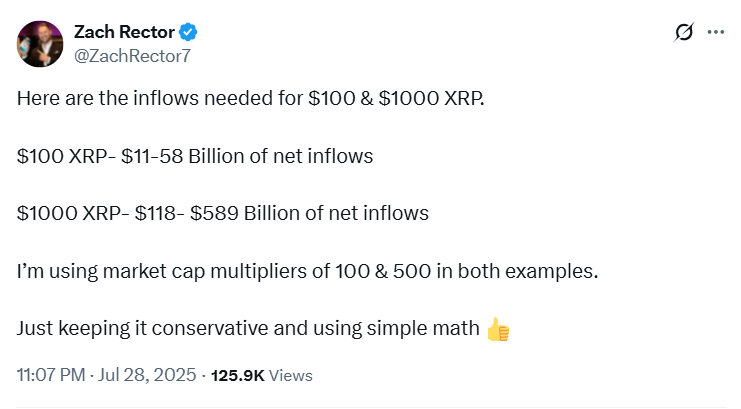
According to Rector, for XRP to reach a $100 price, it may need net capital inflows of about $11 billion to $58 billion. Recall that XRP would need to have a $5.9 trillion market cap for a $100 price.

Zach Rector on X
Zach Rector on X

For $11 billion net inflows to lead to this $5.9 trillion, XRP would need to see a 536x inflow-to-valuation multiplier. Meanwhile, for $58 billion net inflows to lead to $5.9 trillion market cap, XRP must boast an inflow-to-valuation multiplier of around 101x.

Further, with the $1,000 price target, Rector suggested that XRP might need net inflows of around $118 billion to $589 billion. For context, to reach the $1,000 price, XRP’s market cap needs to hit $59 trillion.

Now, considering a $118 billion in net inflows, XRP would need to accommodate a market cap multiplier of around 500x to reach a $59 trillion market cap. Meanwhile, XRP would require a multiplier of about 100x to reach a $59 trillion market cap with $589 billion in net inflows.

Interestingly, Rector has documented cases of XRP’s market cap multiplier reaching massive levels. For instance, in March, he showed that XRP recorded a 212x multiplier within a four-hour period. He also suggested that he has observed multipliers of up to 589x.

Predictions of XRP to $100 and $1,000

Notably, the $100 and $1,000 price predictions has dominated the community in recent times. Last month, XRP community commentator Edoardo Farina revealed that no event would make him sell his XRP below the $100 price mark. 

Earlier, in March, Farina insisted that XRP ought to be trading above the $100 price level under normal circumstances. In June, the Modern Investor also suggested that the XRP market is still early, as XRP is not yet trading for $100. 

However, while market participants are still struggling to come to terms with a future where XRP changes hands at $100, Versan Aljarrah, founder of the Black Swan Capitalist, said in March that XRP to $100 is not enough. According to him, XRP should be trading at six digits. In April, the CryptoGuard COO predicted XRP to reach $1,000. 

Top Analyst Reveals What Could Trigger XRP Next MEGA Pump of 600%

XRP may be preparing for another historic price breakout, according to analyst EGRAG, who believes the token is moments away from igniting a 600% rally.

XRP’s initial uptrend momentum has momentarily stalled over the past few days, as the coin continues to consolidate above $3. Today, the price has even dipped by over 5%, trading at $3.15 at press time.

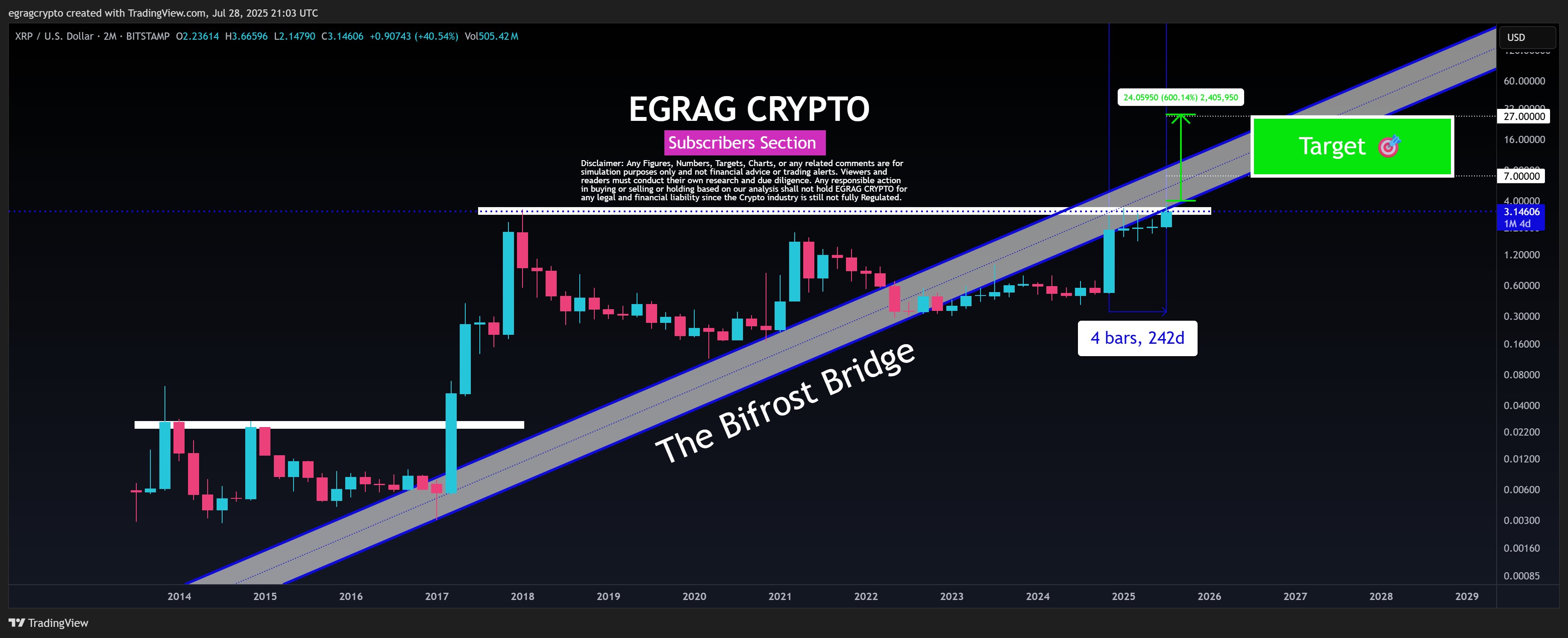
Meanwhile, savvy market watchers like EGRAG are spotting cues for the next historic price movement. According to him, the trigger would be a strong close above what he calls the “Bifrost Bridge,” a resistance zone that has capped XRP for over 240 days.

The Bifrost Bridge: XRP’s Final Barrier Before Liftoff

In a chart shared with followers, EGRAG highlighted a long-term trend channel dubbed the Bifrost Bridge. Notably, this marks a zone of historical resistance that XRP has tested for more than 242 days.

According to his analysis, XRP has been stalling beneath this level, but a decisive close above it could initiate a parabolic move toward $27. EGRAG notes that once this barrier is cleared, XRP could gain over 600% in what he calls a mega pump.

EGRAG's XRP chart with The Bifrost Bridge
EGRAG’s XRP chart with The Bifrost Bridge

Amid the long wait for the widely teased lofty prices, EGRAG urges the XRP community to “hold steady and strong,” promising that “Soon We Shall Fly So High.”

$4–$15 Still in Play: Other Analysts Agree

EGRAG’s explosive target is not without support. Earlier this week, analyst Zach Rector forecast that XRP could hit $4 to $5 “any day now,” calling for a breakout in the short term.

His chart highlighted a consolidation structure around $3.19, with a breakout window stretching from August 23 to September 7. Beyond the $5 zone, Rector places XRP’s mid-to-long-term upside between $7 and $15.

Fibonacci Targets Add Technical Backbone

Meanwhile, Tony Edward of the Thinking Crypto Podcast shared a separate weekly chart showing Fibonacci extension levels that point to $4.50, $6, $8, and $9 as potential price targets for the coin this season.

These Fibonacci targets present a technical structure that aligns with the $15 projections shared by other analysts and may act as steppingstones on the way to EGRAG’s $27 moonshot.

Historical Surge Patterns Back $20–$30 Possibility

In previous analyses, EGRAG has also referenced XRP’s historic rallies to justify his bold upside projections. He recently pointed to a 2,600% surge in 2017 to support a $33 price target for this cycle, and a 500% surge in 2021 to argue for $7.

Averaging these, EGRAG outlined a $20 target for the current cycle, which aligns with the ongoing 600% projection.

With $3.66 as the next resistance and the Bifrost Bridge holding the key to a massive pump, XRP’s next few weekly candles may prove historic. If bulls can break and close above this zone, a swift run toward $7–$15 and potentially $27 may follow, according to these analysts.

Dogecoin Signals Bullish Reversal After Double Bottom Breakout

0

Dogecoin has broken out of a double bottom formation, with analysts predicting potential upside targets at greater heights. 

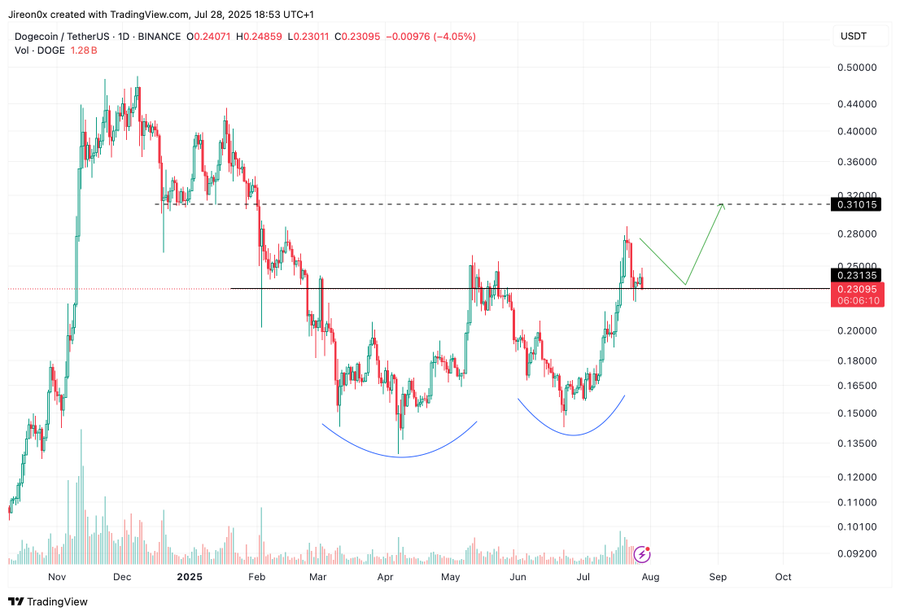
Crypto analyst Jireon highlighted the development, noting that DOGE had successfully broken above a long-standing resistance trendline. The chart shows the meme coin forming two clear price bottoms before surging above the neckline. 

Dogecoin Price analysis

Jireon described the setup as a textbook double bottom pattern, adding that the current price action suggests a bullish continuation may follow. 

The first bottom formed in April when DOGE dipped to about $0.130. After attempting a recovery and getting rejected at higher levels, the second bottom formed around July 5, once again touching the $0.15 region.

This second test of the same support zone, followed by a strong bounce, validated the formation of the double bottom, a pattern often considered a precursor to bullish trend shifts.

The neckline of the pattern was clearly established around $0.231, which had acted as a resistance level throughout the consolidation phase.

On July 25, Dogecoin convincingly broke above this neckline with a daily close well above $0.231, accompanied by a noticeable uptick in trading volume of $4 billion, a key requirement for confirming breakout strength.

As of now, the price has pulled back to retest the neckline, hovering just around the $0.231 zone. This retest is a critical moment; if DOGE holds this level and bounces, it would likely confirm the breakout and pave the way toward the next resistance at $0.310.

At this press time, DOGE is trading at $0.2303, a 4.9% decline in the past day. Despite the 13.8% decline in the past week, Dogecoin still boasts a 40.6% rise in the past month.

Momentum Builds Above the 200-Day Moving Average.

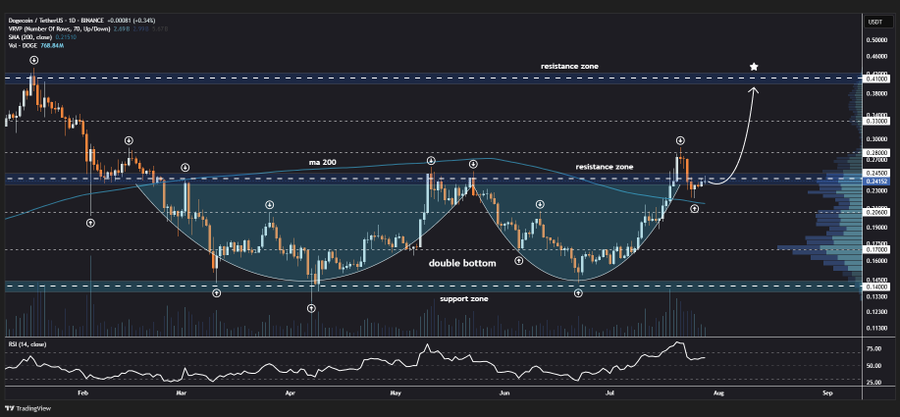
Fellow analyst Jonathan Carter added further validation to the breakout signal. In a separate analysis, Carter explained that Dogecoin was holding above its neckline and bounced off the 200-day moving average. This widely recognized technical indicator often defines long-term trend direction. 

Doge price analsysis

According to Carter, this bounce signals commitment to the upward move and suggests buyers are stepping in at key support levels.

Carter described the breakout level as stable, noting that it had held firm through the retest. The daily chart also shows a reaction from the market as DOGE approached the neckline, reinforcing the likelihood that the breakout is legitimate. These technical signals suggest that the price may continue to rise if volume and momentum persist.

Price Targets Emerge as Dogecoin Holds Support

With the neckline and moving average acting as dual support levels, analysts have identified potential price targets. Carter projected that if DOGE maintains its current structure, it could reach higher resistance zones at $0.28, $0.33, and possibly $0.41. These targets align with prior price levels where DOGE has previously faced selling pressure.

Jireon shared a similar view in his chart projection. While both analysts avoided making absolute predictions, their analyses suggest that Dogecoin’s current formation may lay the groundwork for a sustained uptrend.

Other Analysts Remain Bullish 

Meanwhile, prominent analyst Trader Tardigrade noted that Dogecoin may enter a new bullish phase after forming its first green Heikin Ashi candlestick on the monthly chart. 

Tardigrade noted this signal follows five months of decline, with similar past patterns leading to strong rallies. Historical trends show that green monthly candles in late 2022 and October 2024 preceded significant price surges. 

Other analysts, including MangoMan4, MasterAnanda, and CryptoELITE, have predicted targets ranging from $0.85 to as high as $5 if the uptrend continues. Also, Bitcoinsensus reported a bullish MACD crossover, historically linked to gains of up to 446%. The latest signal points to a possible 610% surge in Dogecoin’s price.


Cardano Founder Says ADA Is a Significantly Better Investment Than Bitcoin

0

Cardano founder Charles Hoskinson has claimed that ADA has bettered Bitcoin as an investment vehicle since its early days and will continue this trend.

Cardano (ADA) has increased by 91% in the past year, while Bitcoin (BTC) has surged 71% during the same period. According to Hoskinson, this outperformance has endured for several years.

In a recent interview with Jason Yanowitz, the co-founder of Blockworks, the Cardano founder stated that ADA is a “significantly better investment” than Bitcoin. He based these claims on the significant growth of the Cardano ecosystem since its early days, in comparison to Bitcoin.

ADA a Better Investment than Bitcoin: Cardano Founder

For the uninitiated, Cardano conducted its initial coin offering (ICO) in four stages, starting from September 2015 to January 2017. Hoskinson noted that Cardano held 108,000 BTC from the crowd sales after conversion from the yen currency and was one of the largest Bitcoin holders at the time.

Meanwhile, he highlighted that those Bitcoins would be worth around $12 billion in today’s market, precisely $12.8 billion, if he simply held them. However, he and his team committed the funds to creating the Cardano ecosystem, which is now one of the largest in the crypto space.

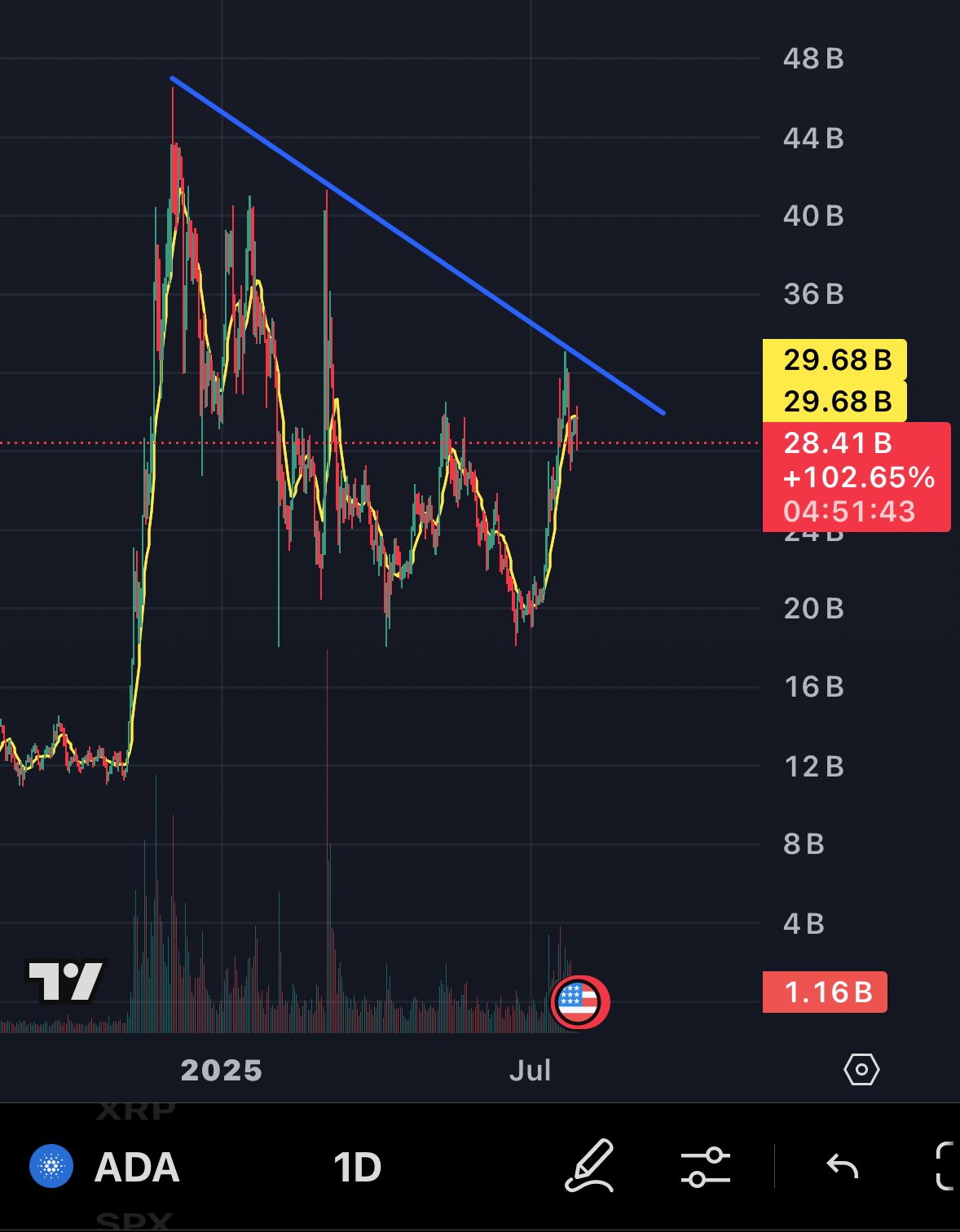
Hoskinson emphasized that Cardano’s market cap currently stands at $30 billion, about 150% higher than the $12 billion that the realized Bitcoin stash is worth now. He noted that this suggests that Cardano has outperformed Bitcoin by a factor of approximately 2.8. As a result, ADA is a significantly better investment than BTC.

Furthermore, ADA’s price trajectory in comparison to Bitcoin further paints the picture. For context, Cardano has surged 3,900% from its launch price of $0.02 in September 2017, while Bitcoin has posted a 2,410% rally from its opening price of $4,337 in the same timeframe.

Cardano to Continue Outperforming Bitcoin

When asked if this trend would continue, Hoskinson nodded in agreement. He noted that the best-case scenario for Bitcoin is a 10x rally to $1 million. According to him, the difference in what is potentially possible for Cardano compared to Bitcoin is probably a 10x to 100x growth, suggesting that ADA has between 100x and 1,000x growth prospects.

Meanwhile, he cited Cardano’s potential to become a Bitcoin DeFi layer and ecosystem developments, such as Midnight, as catalysts for this bullish ADA outlook. Notably, a 100x and 1,000x growth for Cardano would make it a $2.8 trillion and $28 trillion asset, respectively.

Remarkably, Hoskinson also provided an update on the NIGHT airdrop, noting it would happen in the second half of this year. He also predicted that the NIGHT token could grow to become a $10 billion project after its launch.

Billionaire Ray Dalio Advises Holding Up to 15% in Bitcoin

0

Billionaire investor Ray Dalio has significantly raised his recommended exposure to Bitcoin and gold, warning that America’s ballooning debt could trigger a financial spiral and undermine the U.S. dollar.

Bridgewater Associates founder Ray Dalio has sounded a fresh alarm on the U.S. economy. He suggests investors increase their holdings in Bitcoin or gold to as much as 15% of their portfolios, a sharp rise from his previous guidance of 1–2% in 2022.

In a recent interview on the Master Investor podcast, Dalio expressed growing concern over the U.S. government’s fiscal trajectory. He cited a projected $12 trillion in new Treasury issuance over the next 12 months. 

The funding is aimed at managing the ballooning $36.7 trillion national debt, a scenario Dalio believes could spiral into what he calls a “debt doom loop.”

Treasury Borrowing Soars Above Forecasts

Adding weight to Dalio’s warning, a new U.S. Treasury report released Monday revealed an increased borrowing forecast, signaling deeper financial concerns. The government now expects to borrow $1 trillion in the third quarter, $453 billion more than previously projected. It also plans to add another $590 billion in the fourth quarter.

Dalio interprets these rising figures as signs of underlying structural problems. He believes these issues could, over time, erode global confidence in the U.S. dollar.

Gold and Bitcoin as Safe Havens

While Dalio has historically preferred gold, he now regards both gold and Bitcoin as strategic hedges against currency depreciation. He describes both assets as “effective diversifiers” and emphasizes their value in an environment where traditional fiat money may lose purchasing power.

However, he stopped short of endorsing Bitcoin as a future reserve currency, raising concerns about surveillance issues and the potential for code-level flaws that could compromise the network. Specifically, Dalio noted that Bitcoin transactions are public, and governments globally want privacy.

Flexible Allocation

Despite these caveats, Dalio acknowledged that he holds a small amount of Bitcoin. His 15% allocation suggestion is not fixed but meant to be a flexible guideline.

He said investors should decide for themselves how to distribute that allocation between gold and Bitcoin. The decision should depend on their individual preferences and risk tolerance.

Dalio’s shift in perspective comes amid the growing mainstream acceptance of digital assets. Public and private firms now hold over 1.4 million BTC tokens. As of press time, Bitcoin is trading at $118,891, down 0.05% in the past 24 hours.

Cardano May Reach $1.66 as Analyst Confirms Breakout

0

A prominent crypto commentator predicts Cardano could test new highs, suggesting the coin may come back from the dead.

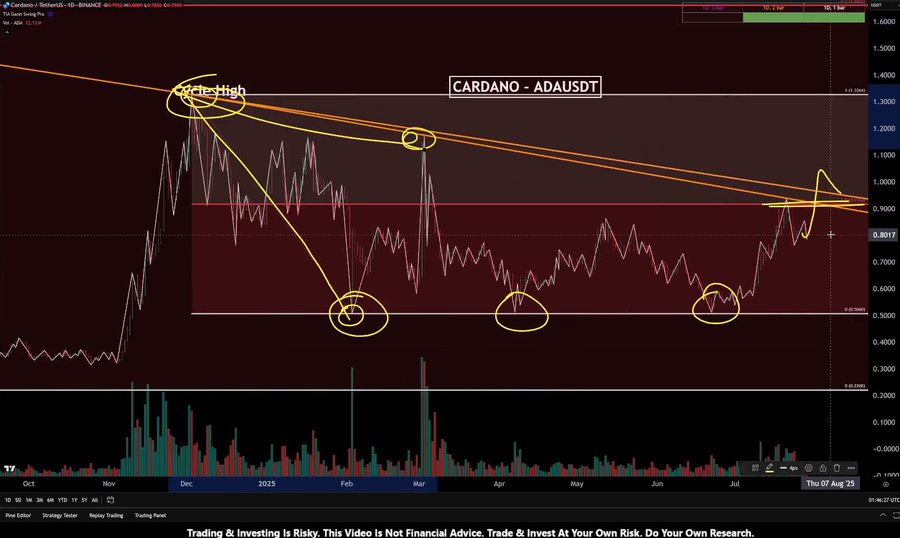
In a post on X, crypto analyst Michael Pizzino highlighted a technical shift in ADA’s price action. The chart spans from October 2024 to August 2025 and shows a confirmed breakout from a descending resistance trendline. 

Michael believes Cardano has potential if and when it gets back above $0.95. He considers this area the halfway point from last year’s December to the February 2025 correction.

Cardano Technical Analysis

This resistance had defined ADA’s downtrend for months. Notably, ADA eventually formed a textbook inverse head-and-shoulders pattern, a bullish reversal signal. The breakout occurred above the triple bottom neckline at $0.506, a level now acting as solid support.

Price Holds Near $0.80, Analyst Bullish on $1.66

As of this press time, Cardano is trading at $0.8023, down 5% over the past 24 hours and 7.7% in the past week. Despite the pullback, ADA remains up 42.7% in the past month, signaling sustained bullish momentum.

ADA reached a high of $0.92966 on July 21 before retracing to its current range. The area between $0.8045 and $0.8246 now serves as immediate resistance. 

A break above this range could lead to a move toward the psychological $1.00 mark, the value it last reached on May 5. Michael believes Cardano reaching $0.99 could retest the $1.66 level with potential for more upside movement.

With the neckline at $0.506 confirmed as support, a drop below $0.506 could reintroduce downside risk, though current momentum remains above that threshold.

Is Cardano Undervalued at the Current Price? 

Meanwhile, crypto influencer Josh believes ADA is undervalued at its current price of $0.80. He suggests that a 5x to 10x return is more than reasonable, highlighting ADA’s breakout potential as it approaches a key descending trendline resistance. 

Cardano Price analysis

Supporting this outlook, Token Talk noted that ADA has shown immense strength by confirming a bullish reversal pattern, specifically a classic Double Bottom formation.

These technical signals suggest that ADA may be on the verge of a major upward move, positioning it as a compelling opportunity in the current market cycle.

Adding to the bullish sentiment, Crypto King called the ADA 1-day chart “a bliss to watch.” He highlighted a key resistance level and hinted at a massive breakout on the horizon. According to him, once this level gives way, ADA could surge to at least $1.4–$1.6, with a new all-time high potentially programmed into the near future.

Notably, analysts are super bullish on Cardano’s long-term price action. Mintern and Tyler Burke project ADA could hit $11–$12 by 2026, citing long-term accumulation and signs of a potential parabolic breakout in the next market cycle.

Top Portfolio Manager Says Every Company Will Be a Bitcoin Treasury Company in 20 to 30 Years

0

Miller Value Partners CIO and Chairman Bill Miller IV has a bold prediction for the adoption of Bitcoin as a primary treasury reserve asset.

Miller stated that in two to three decades, every company will become a Bitcoin treasury company. Notably, he made this bold prediction on CNBC’s Closing Bell on July 28, tapping the Bitcoin strategy to outlast that of other cryptocurrencies.

Why Every Firm Will Buy Bitcoin

Notably, the Miller Value Partners CIO shared that Bitcoin will be on the balance sheet of every company in 20 to 30 years, as it will continue to hold more value than fiat currency. He stressed that this almost guaranteed outperformance would attract more traditional financial institutions to buy Bitcoin.

His narrative centers around Bitcoin’s self-publicity with its enduring price uptick. According to him, when bonds and equities with exposure to Bitcoin-related products outperform those that don’t, then it will be a snowball downhill for Bitcoin adoption.

Currently, 282 entities hold Bitcoin, of which 160 are publicly traded firms. Notably, these numbers have increased significantly in the last few months as more companies have added BTC to their treasuries, following Strategy’s success in doing so.

Firms like Metaplanet, Twenty One Capital, GameStop, and ProCap adopted the Bitcoin treasury playbook, allocating millions of dollars to accumulate the pioneering cryptocurrency. While this strategy has spread to other cryptocurrencies, such as Ethereum, BNB, and XRP, Miller noted that Bitcoin’s long-term bullish trajectory will continue to attract institutions to it.

Meanwhile, Miller’s response followed a question by the host, Michael Santoli, on why Strategy’s MSTR stock has receded lately. He noted that the reception of the Michael Saylor-chaired firm’s aggressive fundraisers to buy more Bitcoin has not changed.

The CIO noted that investors have consistently oversubscribed for every rollout from Strategy, a glaring indication of the demand for Bitcoin in the traditional financial market. Notably, the upsizing of Strategy’s new STRC product from $500 million to $2.52 billion last week supports this narrative.

Bitcoin Is The Only Game-Changing Technology

Furthermore, Miller took a dig at Ethereum and Solana, suggesting that the recently approved crypto bills allegedly “grandfathered” them as being decentralized. For perspective, the US House passed the CLARITY Act, the Anti-CBDC Surveillance bill, and the GENIUS Act on Crypto Week, marking a landmark victory for the digital asset industry.

Miller noted that the CLARITY Act allowed the classification of Ethereum and Solana as decentralized blockchains. Nonetheless, he stressed that Bitcoin remains the only cutting-edge technology and will continue to stand out, despite the bill giving these blockchains undue advantages.

He termed Ethereum and Solana’s proof-of-stake consensus as centralized, stating that the mechanism confers power to those who hold large stakes in the network. However, the energy-intensive nature of Bitcoin’s proof-of-work consensus is a game-changing innovation.

Moreover, Miller stated that most other blockchain technologies do not address any real-world problems. This Bitcoin does, with its supply accountability and 24/7 visibility. Furthermore, with its massive liquidity, institutional adoption, and first-mover advantage, Bitcoin will ultimately prevail.