Home Blog Page 607

SEC Sets New Deadline for Truth Social Bitcoin ETF Approval

0

The SEC has extended its review of the Truth Social Bitcoin ETF, tied to Donald Trump’s media group, to September.

The move comes amid broader delays in crypto ETF approvals and a cautious regulatory approach to digital asset markets.

In a statement on Monday, the U.S. SEC delayed its decision on a proposed Bitcoin exchange-traded fund (ETF) backed by Trump Media & Technology Group, the parent company of Truth Social. The review, initially set to conclude by August 4, will now continue until September 18.

The proposed exchange-traded fund aims to list on NYSE Arca under the agency’s commodity-based trust share framework. The SEC cited the need for more time to assess the proposal and any regulatory or ethical concerns.

If approved, the ETF would be the first of its kind linked to the business interests of a sitting U.S. President, Donald Trump.

More Crypto ETFs Face Delays

The Truth Social ETF isn’t the only fund currently caught in regulatory limbo. The SEC has also delayed its decision on Grayscale’s Solana Trust, pushing the review deadline to October 10. Similarly, Canary Capital’s proposed Litecoin ETF remains under extended review.

These delays signal that the SEC is maintaining a cautious stance amid increased demand for crypto-linked financial products. Under U.S. law, the agency has up to 270 days to evaluate ETF applications.

SEC Commissioner Urges Patience

In response to industry frustration over these delays, SEC Commissioner Hester Peirce, often nicknamed “Crypto Mom” for her pro-digital asset stance, encouraged stakeholders to manage expectations. In an interview, she cited ongoing regulatory complexities as reasons for the slow approval process.

Her remarks underscore that while interest in digital assets continues to grow, the regulatory environment remains complex and slow-moving.

Growing Concerns Over Trump’s ETF

Meanwhile, the Truth Social Bitcoin ETF has drawn heightened attention not just because of its crypto focus, but due to its direct ties to Donald Trump’s business empire.

In May, Democratic Senators Elizabeth Warren and Jeff Merkley expressed serious concerns about a new cryptocurrency initiative tied to President Trump. They warned that the arrangement represented “a staggering conflict of interest” and might facilitate foreign influence through a Trump-associated stablecoin.

Although the SEC hasn’t formally objected to the ETF, its political implications are significant. Some critics fear the fund could enable Trump to personally benefit from regulatory outcomes or market movements tied to crypto assets associated with his brand.

Trump’s Pro-Crypto Policy Push

In parallel with the rising scrutiny, President Trump has increasingly positioned himself as a pro-crypto leader during his current term. 

On July 18, he enacted the GENIUS Act, the nation’s first significant federal law focused on regulating stablecoins. This legislation introduces more defined compliance guidelines for tokens backed by digital dollars. It also reflects a broader change in how Washington is handling the crypto sector during his administration.

Just weeks earlier, on June 25, William J. Pulte, the Trump-appointed head of the Federal Housing Finance Agency (FHFA), directed Fannie Mae and Freddie Mac to consider new policies that would permit unconverted crypto holdings to be treated as eligible assets in mortgage qualification assessments.

If implemented, this move would allow certain crypto assets to be treated similarly to cash in the homebuying process. Buyers would no longer need to convert them to U.S. dollars first.

BitMine Predicts $60,000 Ethereum Price, Cites Multiple Research Firms

0

BitMine Immersion Technologies predicts the Ethereum price will reach a lofty five-digit height, citing credible research from multiple firms.

In an X presentation titled “The Alchemy of 5%,” the company revealed its view on the second-largest cryptocurrency. BitMine’s chairman, Tom Lee of Fundstrat, described ETH as the “biggest macro trade over the next decade.” 

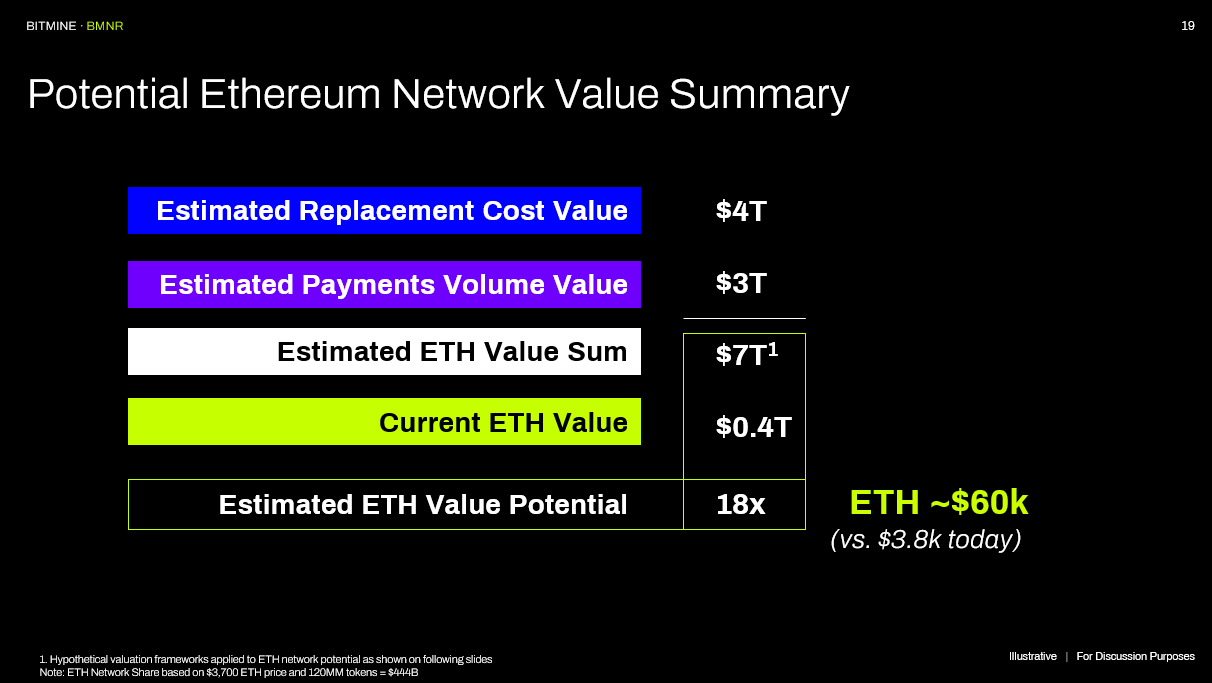
Several research firms consulted by Bitmine have estimated Ethereum’s potential value by comparing its capabilities to those of Wall Street’s traditional financial infrastructure. Using a “replacement value” model, they assessed Ethereum’s worth in terms of settlement systems and payment volumes, projecting a combined network value of $7 trillion.

With Ethereum currently valued at just $0.4 trillion and trading around $3,800, the analysis implies an 18x upside potential, placing ETH’s hypothetical value at approximately $60,000.

Ethereum trades at $3,872, a 1.6% decline in the past day, reducing its monthly gain to 57.6%. Meanwhile, Tom Lee had earlier predicted the Ethereum price to reach $4000 this July and $15,000 by the end of the year.

Meanwhile, BitMine’s vision centers on acquiring and staking up to 5% of Ethereum’s circulating supply. The firm holds 600,000 ETH, representing roughly 0.5% of Ethereum’s circulating supply.

BitMine believes in Ethereum’s role in powering stablecoins, a sector projected by the U.S. Treasury officials to surpass $2 trillion in value, enabling real-world asset tokenization, and supporting institutional finance, which will drive long-term price appreciation. 

According to BitMine, Ethereum’s dominance is already evident, as over 60% of all stablecoins operate on its blockchain. 

ETH Strategy Builds on Treasury Model

BitMine launched its Ethereum treasury strategy with a $250 million private investment in public equity (PIPE) deal, which closed on July 8. Just 18 days later, the firm’s ETH and treasury holdings had grown to $2.7 billion, exceeding the initial capital raise by more than 700%. The net asset value (NAV) per share rose from $4 to $23 during the same period, a sixfold increase.

The company’s approach mirrors the early strategy of Strategy, which famously pivoted into Bitcoin in 2020. BitMine noted that it reached $2.7 billion in holdings in 18 days, compared to 180 days for Strategy to achieve the same benchmark with Bitcoin.

Ethereum Seen as Financial Infrastructure

BitMine argues that Ethereum treasury firms are more than just asset holders; they are becoming infrastructure providers. As Ethereum runs on a proof-of-stake model, BitMine’s staked ETH contributes to network security and generates yield.

The company claims that this dual role makes ETH an attractive long-term asset. With Wall Street firms increasingly using Ethereum to tokenize assets and issue stablecoins, BitMine sees ETH as a foundational layer of future finance.

The company also launched a monthly update series titled The Chairman’s Message, led by Tom Lee, to share ongoing progress and strategy.

Corporate Treasuries Enter Ethereum Market

However, BitMine is not alone. Other corporations are also building Ethereum reserves. SharpLink Gaming holds 438,000 ETH, Bit Digital owns over 100,000, and Blockchain Technology Consensus Solutions recently raised $62.4 million to expand its holdings to over 29,000 ETH.

However, BitMine currently holds the largest known ETH treasury among public companies. Its stated goal is to become the “MicroStrategy of Ethereum.”

Despite the bullish outlook and rapid ETH accumulation, BitMine’s stock performance has been volatile. After soaring more than 3,000% earlier this month, BMNR shares have since dropped over 25%, closing around $35 after reaching a yearly high of $135.

SharpLink Chairman Says Ethereum is The Future, Declares ETH Outshines BTC in Treasury Strategy

0

Ethereum is gaining institutional traction, and co-founder Joe Lubin believes that the future of the decentralized programmable blockchain is now.

Lubin made this statement on the Bloomberg Close show on July 28, amid the pent-up demand for Ethereum. The Ethereum co-founder, who is also the chairman of treasury firm SharpLink, noted that despite a slower adoption rate compared to Bitcoin in its early days, the time for Ethereum has finally arrived.

For context, host Romain Bostick asked why Ethereum did not gain instant traction like Bitcoin did in its early days. In response, Lubin noted that institutions did not recognize Ethereum’s value proposition as quickly as they did Bitcoin, whose status as digital gold emerged early on.

Nonetheless, although it took longer than Bitcoin, the Ethereum co-founder insisted that institutions are now gravitating towards Ethereum.

Ethereum’s Future Is Now

Lubin agreed with FundStrat’s CIO Tom Lee, who said earlier that Ethereum is the next Bitcoin. For context, Lee shared this line of sentiment in June, citing a Wall Street convergence to utilize the Ethereum network, with its stablecoin proficiency the primary lure.

Notably, Lubin, who is also CEO of Consensys, shared a new narrative for this growing adoption. He told Bloomberg that enterprises and financial institutions have now recognized they can leverage Ethereum’s decentralized programmability to enhance transactions and agreements.

The Ethereum network was the first to introduce smart contract programmability, a capability that paved the way for decentralized finance. This trustware has enabled users to perform various activities on Ethereum beyond simple settlements, while also automating transactions for a stress-free execution.

These capabilities are now beginning to catch the eye of institutions, Lubin emphasized. He projected that Ethereum’s offering of guaranteed execution, verifiability, and automatically enforceable agreements is fueling the emerging traction, and this is still in its early stages.

Yield-Bearing Makes Ethereum Treasury Better Than Bitcoin’s

Furthermore, Lubin lauded the efforts of Strategy’s Michael Saylor in driving Bitcoin adoption and the wave of corporate adoption seen a few months back. However, he noted that Ethereum’s corporate treasury strategies offer better profitability compared to Bitcoin’s.

For context, he shared that the Ethereum treasury firms can do “a lot more” with their Ether stash than their Bitcoin counterparts. He stressed that Ethereum is a productive and yielding asset that can be multiplied through staking and other DeFi ventures.

This way, they can grow their stash directly and much faster. Lubin noted that SharpLink Gaming has been accumulating Ethereum massively and is fully harnessing this yield-bearing mechanism.

Notably, these advantages boil down to a lack of native DeFi capabilities on the Bitcoin network. Hence, Bitcoin treasury firms rely primarily on the price performance of Bitcoin to generate yield for investors.

Nonetheless, Lubin’s SharpLink faces stiff competition from other Ethereum treasury firms, such as Bitmine Immersion and BitDigital. Currently, Bitmine leads the standings with approximately 566,800 ETH ($2.16 billion), followed by SharpLink with roughly 360,800 ETH ($1.37 billion).

Moreover, Ethereum reserve strategies now hold a combined 2.33 million ETH ($8.87 billion), accounting for 1.93% of the asset’s supply.

WallStreetBets Founder Says Shiba Inu Burned Enough Tokens to Prove Scarcity Still Sells

0

Founder of WallStreetBets, Jamie Rogozinski, recently commented on the spike in Shiba Inu burn, noting it propelled SHIB to a seven-week high. 

According to Rogozinski, Shiba Inu’s latest burn was so massive it would thrill anyone who enjoys setting things on fire. He claimed that the latest burn resulted in a 3% price surge, ultimately taking SHIB to its highest level in seven weeks.

In his view, nothing can be compared to deflationary tokenomics, which transforms FOMO (Fear of Missing Out) into “burn baby burn” mania, capturing the community’s reaction to massive token incineration.

He also suggested that this deflationary tokenomics reinforces the narrative that scarcity still sells. This indicates that news of a massive burn or supply reduction tends to drive demand for the related token, propelling the price to higher levels.

For context, this trend was observed in 2021 after Ethereum co-founder Vitalik Buterin burned a significant amount of Shiba Inu tokens.

In May 2021, Buterin sent more than 410 trillion SHIB to the dead wallet, permanently removing the tokens from circulation. The burn attracted investors’ attention to SHIB and helped propel it to an all-time high of $0.00008845 in October 2021.

Shiba Inu Burn Rate Soars 16,855% in 24 Hours

Rogozinski’s commentary coincided with a surge in Shiba Inu’s burn rate. As of yesterday morning, Shiba Inu’s burn rate was down 67.66% from the previous week, with only 35.98 million tokens removed from circulation. However, it spiked to 478.9% a few hours later, thanks to the incineration of over 636.68 million tokens.

This comes after an unknown Coinbase user sent 600.7 million Shiba Inu tokens to the official burn wallet yesterday. The user withdrew the Shiba Inu tokens from Coinbase to an unlabeled blockchain wallet and burned them almost immediately.

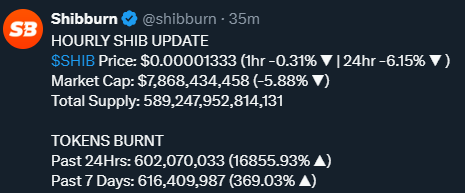
Data from Shibburn shows that a total of 602,070,033 (602.07 million) SHIB tokens have been removed from circulation over the past 24 hours, representing a 16,855% increase in daily burn rate. Notably, 616.4 million SHIB were burned over the past week, marking a 369.03% increase.

Shiba Inu burn rate increases

Price Lags

Despite the surge in Shiba Inu’s burn rate, the token’s price has slumped 6.15% in the past day to $0.00001333. Moreover, SHIB also plummeted 10.22% over the past week.

Shiba Inu’s recent dip coincided with a broader market downturn, which has negatively impacted the prices of major cryptocurrencies like Ethereum and XRP. For context, while Ethereum’s price has plunged 3.14% over the past day, XRP is down 4.65%.

Shiba Inu Supply Remains Largely Unchanged

Previously, the WallStreetBets founder commented on Shiba Inu’s ongoing burn campaign. He pointed out that despite the large-scale incineration of SHIB tokens, the total supply has remained largely unchanged.

As of April, when Rogozinski made his remarks, Shiba Inu’s supply stood at 589.25 trillion tokens, with approximately 410.75 trillion permanently removed through burning. Currently, the supply is 589.24 trillion, representing a minor decrease of just 0.001%.

Galaxy Digital Moves $447M in Bitcoin to Major Exchanges, Stirring Sell-Off Fears

0

Galaxy Digital, the financial services firm known for its deep involvement in Bitcoin and crypto, has once again rattled the markets. 

Specifically, the firm transferred nearly half a billion dollars in Bitcoin to major exchanges, reviving fears of a potential sell-off. Data from analytics firm Arkham Intelligence confirmed that Galaxy moved 3,782 BTC worth approximately $447 million to several wallets over the past 12 hours. 

Notably, the majority of this sum was directed to centralized exchanges such as Binance, Crypto.com, Gemini, and Bitstamp. This has prompted speculation about an impending large-scale sell-off.

Though Galaxy has not officially disclosed the purpose behind the transfers, the timing has raised eyebrows.

Galaxy’s Largest Bitcoin Transactions in History

Specifically, the activity comes shortly after the firm facilitated one of the largest Bitcoin transactions in history.

The sale involved over 80,000 BTC worth $9 billion, and was carried out on behalf of a wallet from the Satoshi era that had been dormant for 14 years. Notably, the transaction occurred on July 25.

BTC Price Stabilizes After Brief Drop

Following the news of the transfer, Bitcoin briefly dipped to $117,427. Meanwhile, it began to recover shortly after. At the time of writing, it was trading at $118,816. The drop sparked temporary market panic, but the rebound indicates buying interest at lower levels.

Bitcoin is currently in a consolidation phase, fluctuating within a narrow $116,000–$120,000 range. This follows a sharp rally earlier this month that pushed the cryptocurrency to new highs.

$116K Becomes Key Support Level

As reported earlier by The Crypto Basic, market analyst Kevinn Nguyen emphasized the importance of the $116,000 support zone, noting that a strong hold at this level, paired with increasing trading volume, could set the stage for another bullish breakout.

According to Nguyen, if momentum builds, Bitcoin could test $124,000 in the near term, with some optimistic investors even eyeing a seasonal surge toward $250,000.

Wall Street Weighs In: Citi Forecasts BTC at Up to $199K

Meanwhile, Citigroup has updated its Bitcoin outlook for 2025, reflecting the growing interest from institutional investors.

The financial giant’s latest projections suggest a base case target of $135,000. In a bull case scenario, Bitcoin could reach as high as $199,000.

However, in a bear case, the price may fall back to $64,000, depending on global macroeconomic pressures.

EasyA Founders Predict XRP Could Reach $1,000 in Interview at the New York Stock Exchange

0

During a recent interview at the New York Stock Exchange, EasyA co-founders Dom and Phil Kwok shared why they believe XRP could reach $1,000 by 2030. 

Notably, the brothers pointed to the growth of decentralized finance (DeFi) on the XRP Ledger (XRPL), Ripple’s growing global footprint, and increasing interest from major financial institutions as the catalysts that could trigger this price.

XRP DeFi Could Trigger the XRP to $1,000 Price

Specifically, Dom Kwok explained that EasyA has built a close partnership with Ripple, working together to connect over one million developers to the XRPL. 

He said Ripple has set up a foundation for institutional adoption by procuring key licenses around the world and launching tools like the RLUSD stablecoin. He believes this will allow Ripple to lead as traditional finance (TradFi) enters the crypto scene.

“We work very closely together with Ripple. We work very closely to actually bring our massive community of over 1 million developers onto the XRP Ledger,” Dom remarked.


Speaking further, he highlighted Ripple’s acquisition of Hidden Road, a prime broker, as a major example of how XRP will support real-world use cases like trade settlement and cross-border payments.

Meanwhile, Phil Kwok spotlighted how XRP could benefit massively from its growing DeFi scene, eventually leading to the $1,000 price mark. Phil noted that, unlike Ethereum, which already experienced a breakout DeFi phase that pushed its market cap into the hundreds of billions, XRP and Stellar haven’t had that moment yet. 

Dom Kwok said, “I know a lot of people have been asking for my price targets on XRP. And I think it’s the first time I’ll say it, but I think XRP is heading to $1,000 by 2030. So for me, it’s, you know, a super important project and actually probably one of the most important projects out there at the moment.”

According to him, this is a major opportunity. Phil pointed out that despite not having a well-developed DeFi ecosystem yet, XRP’s market cap has ranged between $150 to $200 billion. Accordingly, he believes XRP and XLM could benefit rapidly if they experience DeFi breakthroughs.

Phil said EasyA is actively preparing the XRPL ecosystem for this DeFi wave through ongoing development and education.

XRP DeFi Ecosystem Waking Up

Interestingly, several recent developments show the XRP DeFi ecosystem is gradually waking up. Last month, Circle launched its USDC stablecoin on the XRPL, which expanded liquidity and created more possibilities for DeFi tools like DEXs, swaps, and lending platforms. 

Also, in January 2025, the XRPL upgrade known as XLS-73d allowed users to create AMM pools for Ripple’s RLUSD, opening the door for more users to provide liquidity and earn yields. This came shortly after the XRPL gained AMM functionality.

Meanwhile, Ripple’s developer team, RippleX, is also building a native lending platform that will support under-collateralized, fixed-term loans using XRPL assets. Further, the Cardano founder has also teased that Cardano’s forthcoming privacy chain, Midnight, could serve as the XRPL’s DeFi layer.

Moreover, cross-chain integrations are expanding XRP’s reach. Flare Network introduced “XRPFi,” which brings features like staking, lending, and borrowing to XRP holders. 

THORChain is also integrating XRP into its mainnet, allowing users to swap XRP directly with other top crypto assets without needing centralized exchanges. In addition, Flare CEO Hugo Philion recently confirmed that Flare is working on a new stablecoin backed directly by XRP.

Interestingly, the Kwok brothers aren’t the only ones who expect XRP to hit $1,000. In April, CryptoGuard’s COO Matthew Brienen said XRP could reach that milestone by 2035. A month later, analyst BarriC made a similar prediction, citing XRP’s expanding role in global finance. 

Here’s XRP Price if It Completely Follows 2017 Fractal

0

Market data indicates XRP price could soar to unimaginable heights if XRP completely followed its 2017 fractal.

The XRP price action since the fourth quarter of 2024 has been largely impressive, as the altcoin recovers most of its lost values from years back. Currently trading for $3.13, XRP has gained a massive 538% since November 2024, re-igniting bullish sentiments within the community.

Multiple Analysts Believe XRP is Following 2017 Fractal

However, one of the most interesting narratives among XRP proponents is the suggestion that the XRP price action has been following its 2017 fractal. For context, during the 2017/2018 uptrend, XRP delivered its most impressive performance in history.

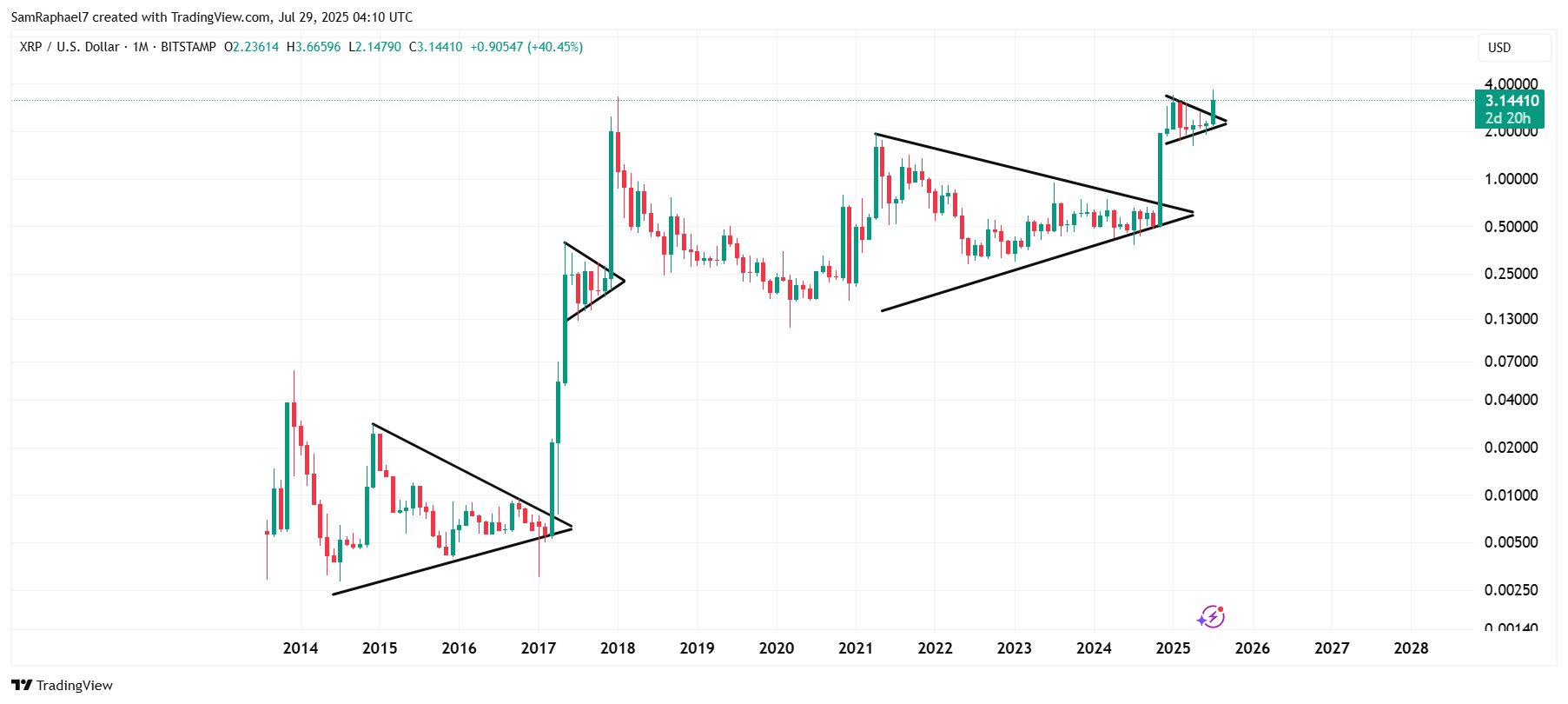
To put things into perspective, back in 2017, XRP underperformed at the start of the year, trading within a symmetrical triangle. However, it broke out in March 2017, soaring to a new peak of $0.3988 by May before facing resistance and consolidating for six months.

Interestingly, it broke out of this consolidation range in December 2017, eventually soaring to the $3.31 all-time high by January 2018. Notably, from its starting price of $0.0055 in March 2017 to the ATH of $3.31 in January 2018, XRP increased by about 60,000%. 

XRP Price Following 2017 Fractal

Most recently, after underperforming within a symmetrical triangle, XRP staged a breakout in November 2024, soaring to a new peak of $3.4 in January 2025. After this peak, it faced a roadblock and consolidated for six months until the recent breakout this month.

As a result, some market watchers believe XRP might be following the same 2017 trend in the current cycle. Some market commentators who have made this claim include EGRAG Crypto, Lud, Bassii, Charting Guy, Crypto Vilian, Javon Marks, Random Crypto Pal, CryptoWZRD, and several others. 

What if XRP Price Followed the Fractal to the Letter?

However, while all these analysts agree that XRP is following its 2017 fractal, they have presented varying price targets for when XRP completes this fractal. This is largely due to conservative ideas among the market watchers, as their analyses suggest XRP might not exactly repeat the same magnitude of uptrend.

But what if there were no conservative measures, and XRP really does repeat the full upsurge from 2017? Notably, as earlier highlighted, XRP soared 60,000% from $0.005 to $3.31 in 2017. If it repeated a similar 60,000% run from the $0.5 price in November 2024, this would push the XRP price to $300 per token.

Nonetheless, most market commentators have failed to project such a price due to the market cap implications. With nearly 60 billion tokens in circulation, an XRP price of $300 would translate to a market cap of $18 trillion for XRP. This represents over four times the size of the entire crypto market and puts XRP close to the market cap of gold, the largest asset by valuation.

However, if such a rally ever happened, it would be memorable for every XRP holder. To put things into perspective, if XRP price hit $300, an investor who held $5,000 in XRP at $0.5 (around 10,000 tokens) would see their bag surge to $3 million. 

Pundit Says Your $1,000 in XRP Can Easily Turn Into $10,000–$50,000

A market commentator argues that XRP offers a far higher return on investment than Bitcoin at current prices.

The analyst draws an analogy to how a $1,000 investment in XRP compares to the same amount in BTC. Notably, this comparison was made by market analyst “Common Sense Crypto” in a tweet, which he described as a “quick fact” investors should consider.

Specifically, he claimed that a $1,000 investment in XRP today could yield between $10,000 and $50,000 during the current cycle. In contrast, he argued the same amount invested in Bitcoin would likely grow to just $1,300–$1,500.

Common Sense Crypto emphasized that return on investment is more important than the current price of a cryptocurrency. He suggested that while Bitcoin, now trading at $120,000, may be hitting significant price milestones, the focus should be on ROI. He urged investors to “choose wisely.”

Notably, his post reflects a broader sentiment within the XRP community. XRP advocates often argue that XRP’s upside potential from its current price of around $3 outweighs that of Bitcoin due to its smaller market cap and room for exponential growth. For context, XRP’s market cap is $188 billion, while Bitcoin’s stands at $2.37 trillion.

XRP Continues to Outperform Bitcoin on ROI Metrics

This isn’t the first time XRP has been positioned as a better investment than Bitcoin. In June, Edoardo Farina of Alpha Lions Academy made similar remarks, stating that Bitcoin at six-figure prices no longer offers a compelling risk-reward ratio.

Farina highlighted XRP’s explosive growth between November 2024 and January 2025, during which the token rose from $0.50 to $3.40, a 7-fold return. In comparison, Bitcoin climbed from $68,000 to $112,000, representing just a 64% gain.

If $50,000 had been invested in XRP during that period, it would have ballooned to $340,000. The same investment in Bitcoin would have grown to just $82,352.

Can XRP $1,000 Rise to $50,000 in This Cycle?

A $1,000 investment in XRP at today’s price of $3.18 would buy approximately 314 tokens. To turn that into $10,000, XRP would need to hit $31.85.

To reach the $50,000 target, XRP would need to soar above $159. Notably, this aligns with some of the most bullish projections from influencers like Dustin Layton, who recently claimed that 1,000 XRP could yield a $50,000 return in 2025.

However, it’s worth noting that such a price would place XRP’s market cap near $9.5 trillion.

Critics Say History Is Still Against XRP

Meanwhile, skeptics continue to caution investors against overly optimistic expectations. XRP has yet to reclaim its 2018 all-time high of $3.84, even as Bitcoin has nearly doubled its previous peak.

Commenting on Common Sense Crypto’s price outlook, X user Justin Windheim dismissed it as “crap,” stating that it’s unrealistic to expect XRP to reach $159 and turn $1,000 into $50,000. According to him, a 50X price projection is not plausible for this year.

What Timeline Is Realistic?

Independent forecasts from platforms like Changelly and Telegaon suggest XRP might not reach the $50 mark until 2035. As for a $150 price target, some projections extend as far out as 2040.

These long-term estimates contrast with the ultra-bullish short-term views held by some XRP analysts within the crypto community.

Nasdaq-Listed CEA Industries to Launch BNB Treasury Strategy with Up to $1.25B in Funding

0

CEA Industries has announced a major strategic overhaul, including a $500 million private placement, positioning it to become the largest publicly traded BNB treasury company.

The funding round, structured as a PIPE (private investment in public equity), comprises $400 million in cash and $100 million in crypto contributions. It includes provisions that could scale total funding to $1.25 billion through warrant exercises. This makes it one of the substantial crypto-focused private placements ever completed by a U.S.-listed firm.

The offering drew strong interest from both institutional and crypto-native investors, securing commitments from more than 140 participants. Notable backers include YZi Labs, Pantera Capital, and Blockchain.com, underscoring rising institutional conviction in blockchain-aligned corporate strategies.

10X Capital, which co-led the deal alongside YZi Labs, will serve as the asset manager for the BNB treasury strategy.

In addition to its role in structuring the private placement, 10X Capital brings deep expertise in capital markets and digital assets, further reinforcing the institutional foundation of the initiative.

Focus on BNB as Core Asset

The raised capital will be used to build a long-term treasury of BNB. BNB currently holds a market capitalization of over $116 billion, making it the fifth-largest crypto globally.

CEA Industries aims to accumulate and grow its BNB position over the next 12 to 24 months. It plans to achieve this using sophisticated capital market strategies and blockchain-native techniques.

Beyond treasury accumulation, the firm is actively evaluating ways to generate yield within the Binance ecosystem through mechanisms such as staking and crypto lending. The company has emphasized its commitment to a cautious, risk-managed approach as it explores these options.

New Executive Team to Lead Transformation

To lead this transformation, the U.S.-listed firm has introduced a seasoned executive team. David Namdar, co-founder of Galaxy Digital, takes the helm as CEO. Russell Read, former CIO of CalPERS, joins as Chief Investment Officer, alongside senior executive Saad Naja. Their combined background in both institutional finance and digital assets is expected to drive disciplined execution.

Continued Nasdaq Listing and Forward Strategy

Despite the strategic pivot, CEA Industries will maintain its listing on the Nasdaq Capital Market under the ticker “VAPE.”

The new treasury strategy is set to go live immediately following the expected deal closing on or about July 31, 2025. The company also pledged to maintain full transparency around its holdings, acquisitions, and governance structure, emphasizing regular reporting and active engagement with the Binance and BNB communities.

Tron Files with SEC to Enable $1 Billion Capital Raise

Tron Inc. has filed a Form S-3 shelf registration with the U.S. SEC, enabling it to raise up to $1 billion through future offerings of a broad range of securities.

These may include common and preferred stock, debt instruments, warrants, rights, or any combination of these instruments.

Notably, this move does not indicate an immediate capital raise. Instead, it grants Tron Inc. the flexibility to issue securities over time based on market conditions and strategic priorities. Each offering will be outlined in separate prospectus supplements.

The filing comes amid major branding and structural changes. Formerly known as SRM Entertainment, the company rebranded to Tron Inc. this month. 

In parallel, it updated its Nasdaq ticker to “TRON,” a move that aligns more closely with its blockchain strategy. The company now holds the largest known reserve of TRX tokens among publicly traded entities.

TRX Treasury Reserve

Notably, Tron Inc. upholds a Treasury Reserve Policy that names TRX tokens as its primary reserve asset, alongside excess cash and short-term investments. The company currently holds 365 million TRX tokens, with no sales to date.

Tron Inc. sees TRX as a long-term strategic asset that aligns with the global trend toward blockchain adoption. It plans to accumulate more tokens using proceeds from capital raises, such as equity, debt, or convertible instruments, as well as surplus liquidity.

Additionally, the company may use its TRX holdings for staking, collateralized financing, or other yield-generating strategies.

$100M PIPE Deal Funded in TRX

On June 16, 2025, the company completed a $100 million private investment in public equity (PIPE) with an institutional investor. The deal included 100,000 shares of Series B Convertible Preferred Stock and warrants for 220 million shares of common stock, fully funded in TRX based on its June 15 closing price.

The tokens are in a secure Treasury Wallet overseen by the board and monitored on-chain by Hong Kong-based BiT Global Trust.

Bridging Blockchain and Real-World Revenue

While expanding its crypto strategy, Tron Inc. continues to generate revenue through its physical product business. Via a wholly owned subsidiary, the company manufactures merchandise, including toys and collectibles, for major global theme parks such as Disney, Universal, SeaWorld, and Six Flags.

This dual model gives Tron Inc. exposure to both the fast-growing blockchain economy and steady revenue from globally recognized entertainment brands.

Shelf Registration Enhances Financial Flexibility

Notably, the shelf registration filed today allows Tron Inc. to conduct multiple securities offerings under a single registration statement. Each offering will be accompanied by a separate prospectus supplement that outlines the terms, including pricing, volume, and the intended use of proceeds.

As of July 24, 2025, Tron Inc. shares closed at $8.74. The company now meets all eligibility requirements to use Form S-3 without prior limitations.