Home Blog Page 609

China’s Kuaishou Rocked by $20 Million Bitcoin Fraud in One of the Country’s Most Complex Digital Scams

0

Chinese short-video giant Kuaishou is grappling with a $20 million internal fraud and money laundering scheme. The scandal involves eight employees who exploited bonus systems and laundered funds through Bitcoin.

Kuaishou, a major rival to TikTok, has been rocked by a high-profile internal fraud and money laundering case. According to a report by People’s Daily, a state-run newspaper in China, eight employees carried out a year-long scheme in which they siphoned off nearly 140 million yuan (approximately $20 million) from the company and laundered it through Bitcoin.

Insider Exploits Bonus System to Steal Millions

A Kuaishou insider named Feng led the scheme. He orchestrated the fraud using his unchecked control over internal financial operations.

According to People’s Daily, Feng had authority over the selection of third-party vendors, the calculation of performance bonuses, and the approval of payments, areas that lacked sufficient oversight.

Feng exploited these vulnerabilities to engineer loopholes in the reward subsidy system. He also shared sensitive internal data with two outside collaborators, Tang and Yang.

Together, they fabricated documentation to qualify for large bonus payouts fraudulently. These fake bonuses were directed to shell companies secretly set up by the group, effectively draining millions from Kuaishou’s accounts.

Shell Companies and Crypto Used to Obscure the Trail

To conceal the stolen funds, the conspirators established multiple shell companies —entities that existed only on paper, with no actual business operations. The stolen money passed through these entities to various accounts to obscure its origin.

Notably, the final step involved converting the funds into Bitcoin via over-the-counter (OTC) crypto desks and coin mixers. These tools are commonly used to anonymize blockchain transactions.

Prosecutors revealed the group used eight global platforms to distribute the funds across several crypto wallets, creating what they described as a “closed-loop” laundering system.

Authorities Trace Funds Through Blockchain Forensics

Despite the sophisticated laundering operation, Chinese authorities successfully tracked the stolen assets. The case was investigated by the People’s Procuratorate of Haidian District, which specializes in technology-related crimes.

Prosecutor Li Tao led the investigation, using transaction records, cash flow data, and internal company documents to reconstruct the fraud. Through blockchain analysis and international cooperation, investigators recovered 92 BTC worth approximately $11.7 million.

Court Hands Down Heavy Sentences

Following the investigation, the court imposed strict sentences for all parties involved. Feng received the longest term, 14 years and six months in prison. Other members of the group received sentences ranging from 3 to 14 years, along with substantial fines. Notably, the court convicted all of them of occupational embezzlement.

The case has been officially recognized as one of the most sophisticated corruption cases in China’s tech industry. It was highlighted in a newly released White Paper on Anti-Commercial Corruption (2020–2024) and covered in detail by People’s Daily.

Legal analysts say this case highlights serious gaps in internal oversight within fast-growing tech companies, especially where employees hold too much discretionary power over financial systems.
Top Analyst Predicts Cardano May Revisit All-Time High Quickly

0

Crypto Analyst touts Cardano to go vertical and revisit its 2021 all-time high. Will Cardano reach $3 and beyond in this bull run?

In a post shared by Angry Crypto Show on X, prominent analyst and trader Ivan on Tech believes Cardano (ADA) could break out sharply and return to its all-time high. He stated that Cardano could suddenly trade vertically, potentially revisiting its peak of $3.09, reached in September 2021.

At press time, ADA trades at $0.84693, a 2.0% increase in the last 24 hours. It has gained 51.5% over the past month and narrowed its weekly loss to 3.2%. Despite this recovery, ADA remains 72.59% below its all-time high.

Earlier Predictions on Cardano Revisiting Its All-time High Never Click!

Several crypto analysts had previously hinted at Cardano reaching the previous all-time high. Last year, Dan Gambardello said Cardano could break its all-time high within 30 to 60 days, citing past cycle patterns and recent tech upgrades. However, this did not materialize. 

Earlier this year, analyst Michaël van de Poppe also noted bullish momentum for ADA, saying market sentiment could shift as conditions improve. Earlier this month, Michaël went super bullish on Cardano’s price action, noting the token will reach $10.

Meanwhile, crypto influencer Becker also added that Ethereum’s strength may lift other altcoins. He listed ADA, along with XRP, DOGE, SUI, AVAX, and SOL, as coins likely to benefit. 

Cardano’s Current Price Prediction

Data from TradingView reveals Cardano is showing strong bullish momentum, with the majority of its moving averages across short to long-term periods flashing buy signals. 

While most oscillators, including the RSI and Stochastic, remain neutral, the Momentum indicator points to a possible short-term upward push, even as the MACD suggests mild selling pressure. 

ADA is currently trading above its pivot point of $0.60, with resistance levels extending up to $1.04, indicating room for further gains.

Meanwhile, Crypto analyst Hardy highlighted Cardano’s eight-year streak of zero downtime or hacks, calling it a network built to last. With ADA securing a weekly close above the key $0.74 level, he signaled a bullish outlook and identified $1.13 as the next target. 

Analysts Bullish on Cardano’s Long-term Potential 

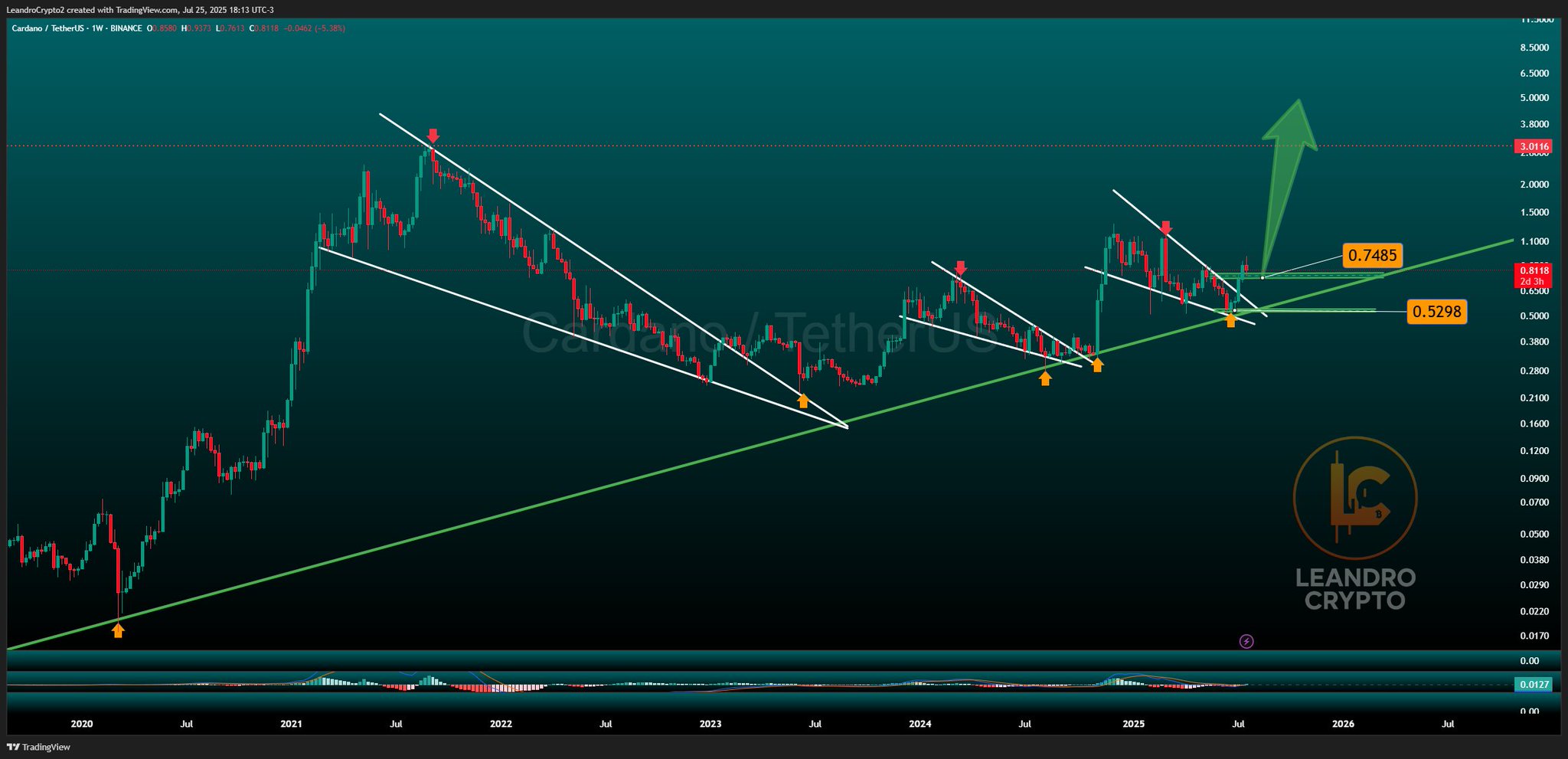
Further, a weekly chart shared by Mintern noted that Cardano appears to be following a recurring bullish pattern. The chart highlights three descending wedge formations, each followed by a breakout and a strong price rally.

Cardano 1W Chart
Cardano 1W Chart

ADA recently broke out of a similar wedge pattern after bouncing off long-term trendline support near $0.7485 and $0.5298. The setup suggests Cardano could be preparing for another upward move, potentially retesting its all-time high of $3.09 if the trend continues. Mintern suggests Cardano could reach $11 during this cycle.

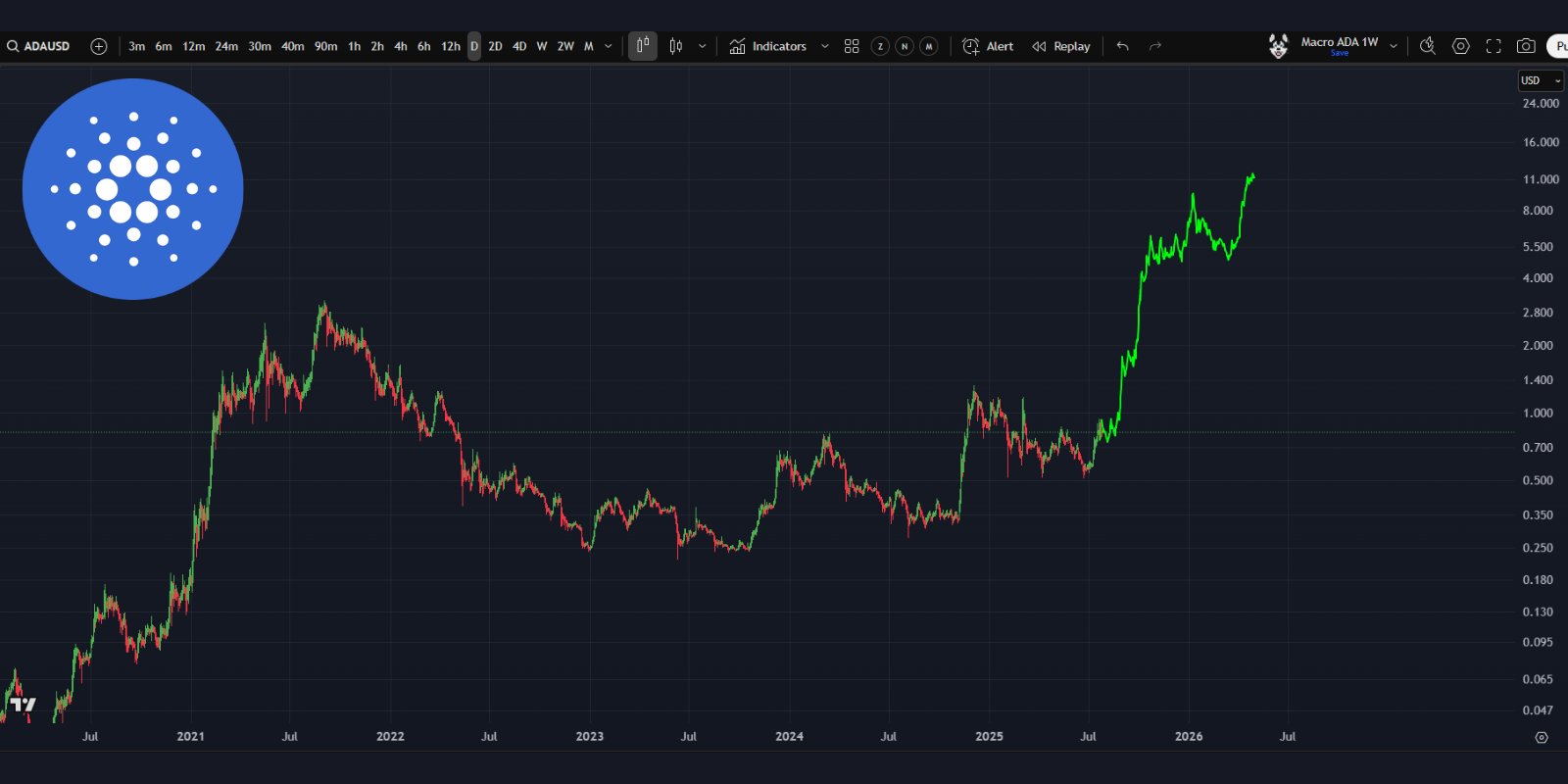
Meanwhile, another analyst, Tyler Burke, predicts ADA will reach $11 to $12 by 2026. In a chart shared on X, a parabolic rise following years of accumulation and sideways movement suggests that ADA could be gearing up for a major breakout in the next market cycle that could see a 10x uptick in the token’s price.

Cardano 1D Chart
Cardano 1D Chart

Expert Who Asked Investors to Buy XRP At $0.10 Says This XRP DeFi Bridge Will Rally 20x

0

A long-standing crypto enthusiast who advocated for an XRP buy at 10 cents five years ago has tipped Flare to be the next to rally substantially.

Specifically, King Karan took to X to remind users that he called for an XRP exposure back in 2020. In the viral staged call clip on July 27, he taunted those he advised to buy XRP five years ago but ignored his bullish projection.

He noted that XRP traded at $0.10 at the time he made this call, a price now etched in history. Notably, XRP trended around $0.11 for most of 2020, before its brief rally in 2021. While it failed to mirror a broader market bullish trend during that cycle, it has never returned to 10 cents again.

Meanwhile, at the current price of $3.27, XRP has rallied nearly 30x, or a staggering 2,872%, from its 2020 lows. Now, King Karan, the marketing head at Monerex, has revealed a new opportunity for those who missed out on XRP.

Flare En-Route to $1: Expert

Interestingly, he predicted that Flare would be the next to rally comprehensively, suggesting that it is one that those who missed XRP should consider. Specifically, the market enthusiast noted that the FLR token would experience a surge of at least 20 times its current price of around $0.020.

He based his bullish price prediction on Flare’s adoption prospects. According to the crypto investor, Flare would become the biggest data provider on the blockchain.

For the uninitiated, the Flare network, an EVM-compatible layer 1 chain, utilizes the Flare Time Series Oracle (FTSO) to provide decentralized access to data feeds. The blockchain supplies price and market data of multiple assets, enabling accurate cross-chain interoperability.

Furthermore, King Karam highlighted that a supply shock is on the horizon for Flare, as large amounts of the token will be locked up. However, he did not provide further context for this assertion.

Nonetheless, he noted that these developments would ensure that Flare would reach $1 someday. From its current price of $0.025, this represents a 3,900% surge to the unprecedented price mark.

Is Flare’s Relationship With XRP a Driver?

Notably, Flare is a decentralized finance (DeFi) bridge to the XRP Ledger. The Flare team has debuted several schemes to unlock smart contract features for XRP holders and enhance cross-chain interoperability for the Ledger.

One of which is the Firelight, a liquid staking protocol that allows XRP holders to put their stash to work. The protocol debuts a wrapped XRP, “FXRP,” which users can stake to mint new tokens called stXRP. This push would unlock billions of dollars’ worth of liquidity for the Flare ecosystem while also attracting institutional interest.

XRP Just Recorded Its Largest Bear Trap in History

0

XRP is now showing signs of recovery following the latest pullback. As a result, some analysts suggest the recent drop was a bear trap.

For context, after soaring to a local top above $3.66 two weeks back, as it rode on the broader market’s explosive rally, XRP faced intense selling pressure. Consequently, it dropped to retest the $3 psychological mark following a massive 10.34% intraday collapse on July 23.

Investors Caught in a Bear Trap

Now, with the market showing signs of a recovery, market watcher Armando Pantoja believes the recent pullback was a bear trap. For context, a bear trap happens when an asset’s price appears to be dropping further, tricking investors into selling, but then it quickly reverses and moves upward.

Notably, following the 10.34% slump on July 23, XRP saw a subsequent 1.19% drop the next day amid sustained panic selling. For instance, market expert Dom confirmed that Upbit saw about 75 million XRP in sell volume over 24 hours, contributing largely to the price crash. According to Dom, these trades were the major factor behind XRP’s collapse.

However, after XRP reached a low of $2.9, the price recovered sharply, with XRP now trading for $3.27 at press time. Now that the market appears to be heading toward previous highs, Pantoja believes the July 23 crash was merely a bear trap. He suggested it was the largest bear trap in XRP’s history.

Interestingly, during this collapse, several market pundits advised investors against selling off their XRP. For instance, well-known author Steve Shultz insisted that investors do not sell off their tokens during the crash, citing a previous experience in which he lost a potential profit of $2 million in Bitcoin.

XRP Still in a Bullish Trend

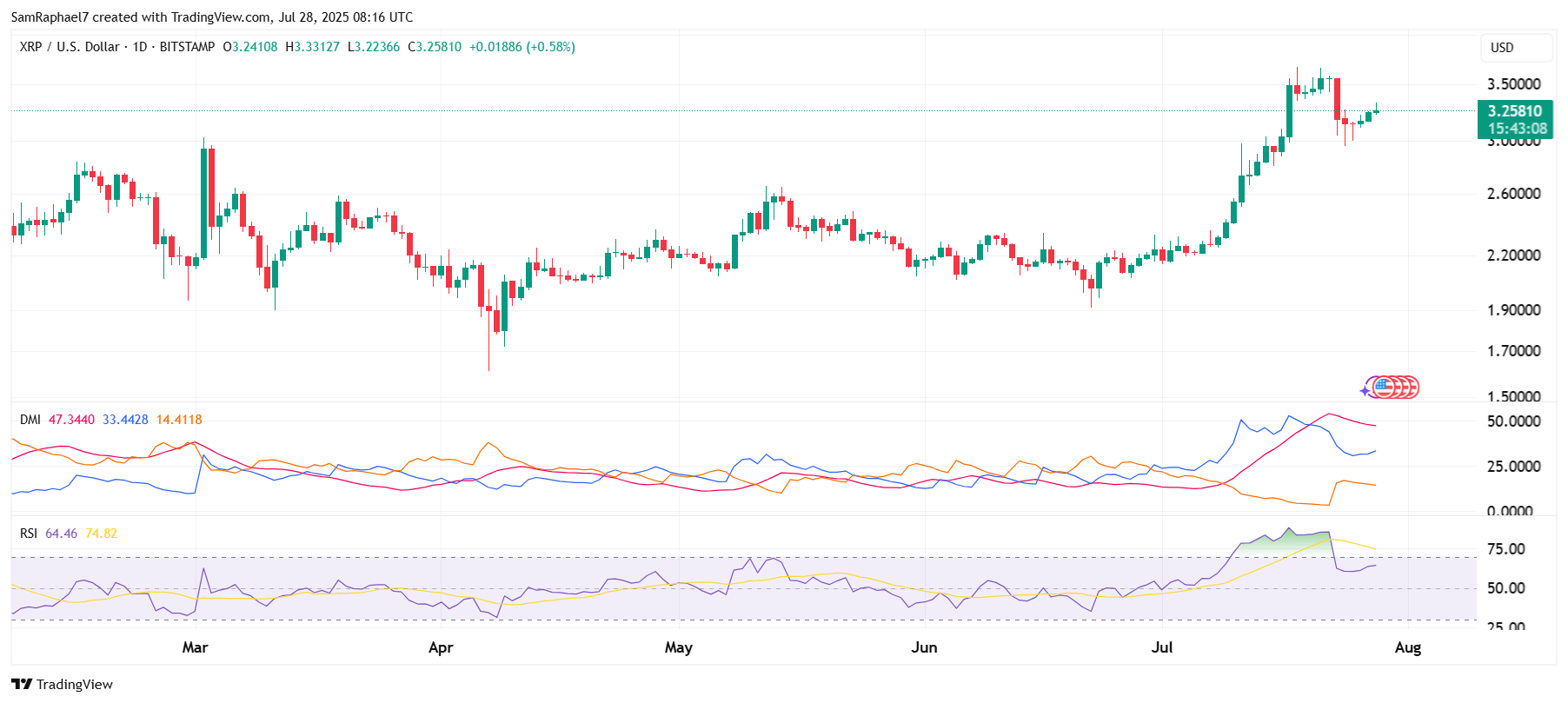
Since these comments, XRP has regained over 10% of its value, nearly reclaiming the previous top. Data from XRP’s daily chart shows that the Directional Movement Index (DMI) is flashing positive signs. Specifically, while the ADX has dropped in recent times, it remains above 47, with the +DI (33) overshadowing the -DI (14.4).

XRP 1D Chart
XRP 1D Chart

Moreover, the Relative Strength Index (RSI) remains at the 64 mark, indicating sustained bullishness despite not yet being in an overbought zone. Notably, these figures indicate that XRP is still in an uptrend, although the momentum has cooled. 

In addition, Dom noted during the latest price upsurge that the spot-perp premium, which indicates whether the market is overheated, rose to dangerously high levels. However, the drop that followed helped reset the premium, creating a healthier environment for the next leg up. 

Stablecoin Backed by XRP in Development, Expert Says It Could Be the Hardest Money Ever Known

The idea of a stablecoin backed by XRP is gaining traction in the crypto community.

The proposal comes from Phil Kwok, co-founder of Web3 app builder EasyA. In a series of tweets, he floated the idea of creating a stablecoin collateralized with XRP.

For context, a stablecoin backed by XRP means the issuer holds XRP to support the value of the stablecoin. Kwok suggested that a properly designed stablecoin backed by XRP could become the “hardest money ever known.”

He also followed up with an even more ambitious vision: a stablecoin backed by XRP with yield paid in XRP.

Does RLUSD Already Serve This Purpose?

Expectedly, the concept sparked interest across the ecosystem as it points to a potential new use case for XRP beyond remittances and cross-border payments. Meanwhile, some commenters asked whether Ripple’s RLUSD already fulfills this function.

Kwok clarified that RLUSD serves a different use case than the one he proposed. Notably, RLUSD is backed not by XRP but by cash and U.S. Treasuries. The Ripple stablecoin runs on both the XRP Ledger and Ethereum, meaning RLUSD can be minted natively on either network.

Meanwhile, Kwok is proposing a stablecoin with XRP as part of its collateralization.

Any Crypto-Backed Stablecoin?

In the crypto space, the idea of a crypto-backed stablecoin is not new. The popular DAI stablecoin by MakerDAO uses Ethereum and other crypto assets as collateral to issue a USD-pegged stablecoin. 

Specifically, DAI is an example of a crypto-backed stablecoin, but it is pegged to USD, not backed by USD itself. Notably, DAI recently rebranded to Usds (USDS).

XRP-Backed Stablecoin Already in the Works, Flare Networks Confirms

Hugo Philion, co-founder of Flare Networks, responded to Kwok’s tweets with confirmation and support for the idea. He noted that the Flare team is already developing an XRP-backed stablecoin.

A follow-up from the official Flare X account further reinforced this, outlining how their ecosystem is preparing for such innovations through its FAssets Incentive Program.

The Four Pillars

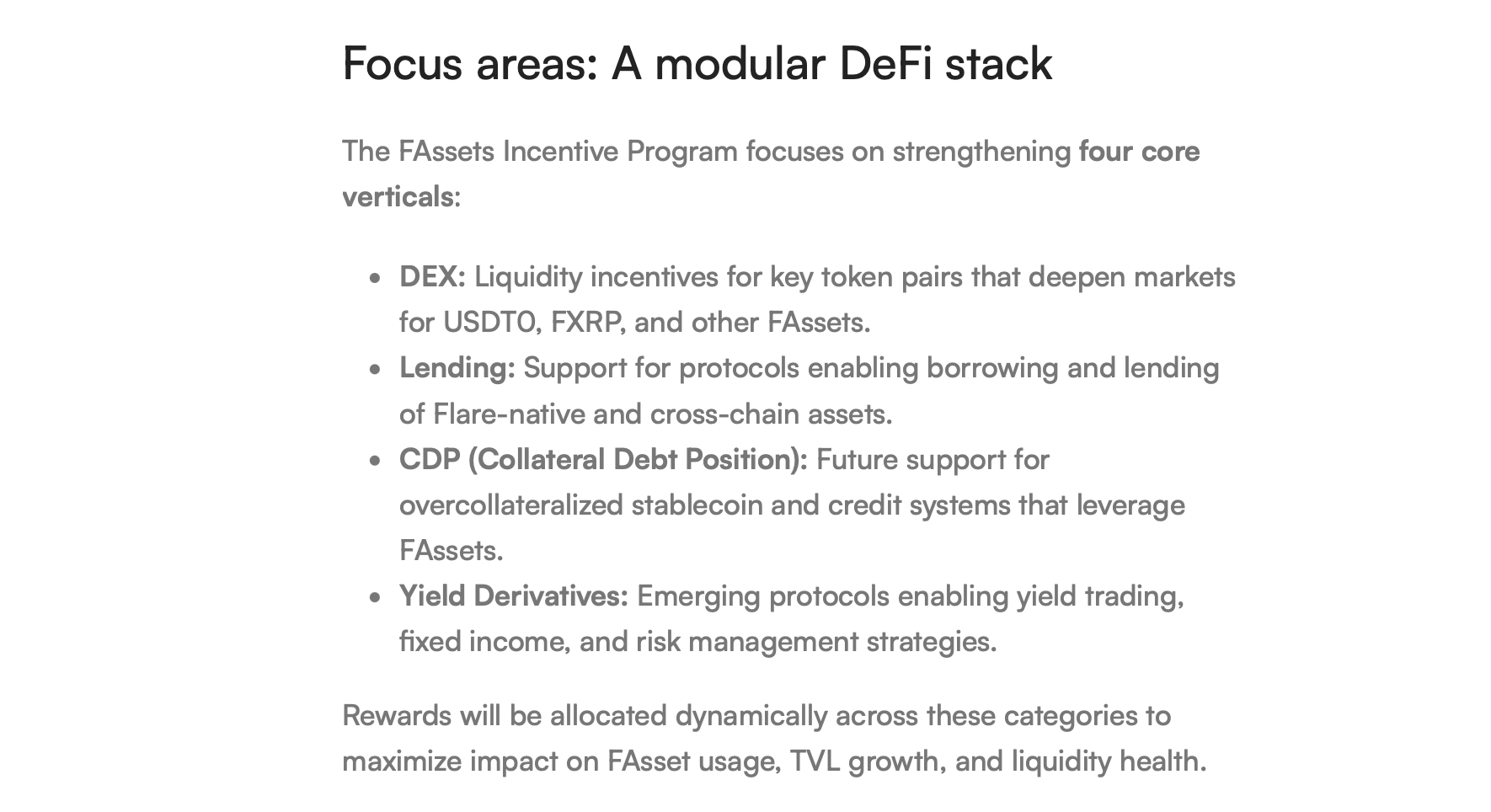
According to Flare, the XRP-backed stablecoin initiative aligns with its broader DeFi roadmap, built on a modular DeFi stack and four key verticals:

  • DEX Liquidity: Incentives for trading pairs like USDTO and FXRP to ensure deep and healthy markets.
  • Lending Protocols: Support for borrowing and lending of both Flare-native and cross-chain assets.
  • Collateralized Debt Positions (CDPs): Upcoming support for overcollateralized stablecoins and credit systems leveraging FAssets such as FXRP.
  • Yield Derivatives: Protocols designed to enable fixed-income products and yield trading, likely facilitating XRP yield payouts in future implementations.
Source: Flare https://x.com/FlareNetworks/status/1949317421589782768
Source: Flare

Overall, the idea of a stablecoin backed by XRP with native yield opens a new frontier for the XRP ecosystem. The asset is traditionally associated with institutional payments and liquidity corridors. However, this development could further expand its role into decentralized finance.

Large Whale Dumps $3.19M in Solana for Vine Coin as VINE Price Soars 112%

0

A large whale has dumped millions’ worth of Solana in what appears to be an attempt to divest into the Vine Coin (VINE) amid a recent price surge.

Specifically, the crypto whale spent 17,082 SOL, worth about $3.19 million today, July 28, to purchase 22.4 million VINE tokens, according to Blockchain analytics firm Lookonchain. The transaction, executed through Solana-based decentralized exchanges, happened within hours of a Binance withdrawal. 

Notably, the VINE tokens are now valued at approximately $3.36 million, reflecting a modest gain of about $17,000 since the acquisition.

The whale’s move comes as VINE posts sharp gains across the board. As of this press time, VINE trades at $0.1482, up 112% over the past 24 hours. It has climbed 238% in the past week and 437% over the last month.

Whale Moves Entire SOL Position Into VINE

Lookonchain flagged the transaction, pointing to the wallet address 8RwxXR, which now holds only 3.42 SOL, valued at around $661. This indicates that nearly all of the 17,082 Solana tokens were committed to the VINE purchase.

The whale conducted the trade through popular Solana DeFi protocols, including Jupiter and Raydium. On-chain logs show interaction with the VINE/WSOL market on Meteora, a decentralized exchange aggregator. The entire swap took place in under six hours.

Trading History Suggests High-Risk Strategy

This is not the whale’s first high-stakes move. Lookonchain previously reported that the same wallet lost about $125,000 trading PUMP tokens. Despite that setback, the investor has returned with a significantly larger position in another relatively unknown asset.

Solscan reveals the wallet also holds several low-liquidity tokens with no visible market value, including SOLUV and Wake Up to Money (WAKEUP). 

VINE Surged Following Elon Musk’s Tweet 

Notably, VINE memecoin, inspired by the defunct short-video app, came into the limelight after Elon Musk announced plans to revive Vine in AI form. The post, which drew over 44 million views, led to a surge of the memecoin by over 100% following the announcement. 

While Elon Musk’s tweet reignited speculation about the platform’s return, his post stirred skepticism about AI-generated content replacing Vine’s original creative spark. 

Although former Vine founder Rus Yusopov had earlier hinted at AI-driven short videos, there’s no confirmed link between him and Musk’s plan. 

Notably, Rus launched the VINE memecoin earlier this year, and it briefly hit a $480 million market cap before crashing. The recent surge has now pushed the coin’s value to over $149 million. However, Vine co-founder Dom Hofmann denied any connection to the meme coin, and there is no apparent link between Musk’s proposed project and the token.

Tether CEO Confirms Incoming US-Compliant Stablecoin

0

Tether, the leading stablecoin provider by market value, is planning a comeback in the U.S. with a new, fully compliant domestic stablecoin.

The move follows the recent enactment of the GENIUS Act. The landmark regulatory framework is designed to govern the stablecoin ecosystem within the United States.

In an interview with Bloomberg, Tether CEO Paolo Ardoino revealed that the company is close to announcing a new U.S.-focused stablecoin, designed from the ground up to meet the American regulatory standards. The token is expected to launch by the end of 2025. It will cater primarily to institutions such as banks, fintech firms, and payment processors.

GENIUS Act: A Game-Changer for Crypto Regulation

President Donald Trump signed the GENIUS Act into U.S. law on July 17, 2025. The law, titled Global Enforcement and National Innovation for Ubiquitous Stablecoins, has introduced a dual-track regulatory system for stablecoins. It offers a legal framework for domestic and international issuers, requiring rigorous reserve backing, third-party audits, and redemption guarantees.

For Tether, long criticized in the U.S. for its opaque practices, the act provides a long-awaited chance to operate on U.S. soil within a clearly defined legal environment. As part of its compliance efforts, the company will register USDT under the foreign issuer pathway. At the same time, it will launch its new U.S.-compliant token in parallel.

New Domestic Stablecoin to Target Institutional Market

The new stablecoin will be backed one-to-one with U.S. dollars or Treasuries, stored with licensed custodians, and monitored by federal regulators. Tether is currently laying the groundwork, onboarding local custodians, establishing banking ties, and aligning with federal standards.

Unlike its global counterpart, USDT, the new stablecoin will be exclusively for institutional users. These include banks, payment processors, and fintech companies. Ardoino emphasized that this new direction reflects a fundamental transformation in Tether’s approach to transparency and regulation.

“This isn’t just about entering the U.S. market, it’s about rebuilding our presence with institutional credibility,” Ardoino stated.

Tether to Face Stiff Competition

Tether’s re-entry comes amid an increasingly competitive U.S. stablecoin space. Circle, the issuer of USDC, already holds a dominant position thanks to years of proactive licensing and compliance efforts. It maintains money transmitter licenses in 46 states and is registered with FinCEN. The firm also holds an e-money license in France under MiCA regulations.

Meanwhile, banking giants including JPMorgan, Citigroup, Bank of America, and Wells Fargo are developing their own stablecoins under the GENIUS Act, adding to the competitive pressure.

Ardoino acknowledged the competitive challenge but remained confident in Tether’s technical edge and global experience.

 “Our technology stack and market knowledge give us a unique advantage. We may be new to the U.S. market, but we’re not new to this industry,” he said.

Tether plans to leverage its recent financial success, $13 billion in net profits last year, to support its U.S. expansion and compliance efforts. The company is preparing for a phased rollout, with full operations within the next three years.

Cardano Founder Says If You Hold XRP, You Will Receive the Largest Airdrop Ever

0

Cardano founder Charles Hoskinson recently reiterated that XRP holders, among holders of other major ecosystem native tokens, will receive the Midnight airdrop.

The largest airdrop ever in terms of reach (number of wallets) is now available for claims, and Hoskinson reaffirms that XRP enthusiasts are not left out. He shared at the Consensus 2025 event that XRP holders will participate in the Midnight airdrop.

XRP Holders Can Claim Midnight Token

Hoskinson noted that a total of 37 million wallets were deemed eligible for the Glacier airdrop. Notably, after his comments, the June 11 snapshot occurred, which captured users with at least $100 worth of XRP at the time. Notably, holders of Cardano, Bitcoin, Ethereum, Solana, BNB, AVAX, and BAT are also eligible for the airdrop.

Meanwhile, the claim page for the Midnight airdrop is now live, allowing eligible participants to claim the token. The portal opened on July 15 and has a 60-day window, ending in mid-September, during which users can redeem their drop rewards.

After the 60-day claim window expires, users with unclaimed tokens will now unlock them through computational mining in the Scavenger Mine phase. The lost-and-found phase follows immediately, and after four years, the team will transfer the unredeemed tokens to the Midnight treasury.

Here’s How Many NIGHT Tokens XRP Holders Will Receive

Notably, the earlier released whitepaper for the airdrop had revealed how many NIGHT tokens XRP holders will get. The Midnight tokenomics shows that they will receive 5% of the 24 billion NIGHT tokens that will be distributed.

Specifically, this amounts to 1.2 billion NIGHT tokens, which the Midnight team will distribute according to the amount of XRP held at the time of the snapshot. This suggests that the larger your XRP holding is, the weightier your allocation.

Meanwhile, Cardano holders will receive the largest allocation, with 50% of the 24 billion NIGHT tokens reserved for them. Bitcoin holders will receive 30%, while holders of Ether, SOL, BNB, AVAX, and BAT will each share 5%.

Notably, Hoskinson shared that this diverse and multi-ecosystem-inclusive NIGHT distribution will unite the industry, a charge he has single-handedly led in recent times. Recall that the Cardano founder has advocated for a shift from the zero-sum competitiveness seen in the crypto ecosystem to cross-chain collaboration for the greater good of the ecosystem.

For the uninitiated, the NIGHT token is one of the native tokens of the Midnight network, operating under a dual tokenomics model. The Cardano sidechain will run with NIGHT and DUST as native tokens, with the former conferring governance rights to holders and the latter used as gas for Midnight transactions.

XRP Heading to a Price Where Most People Will Only be Able to Afford Dust: Expert

0

A notable XRP market commentator has suggested that XRP will rise to a price level where most investors would only be able to afford “dust of the token.”

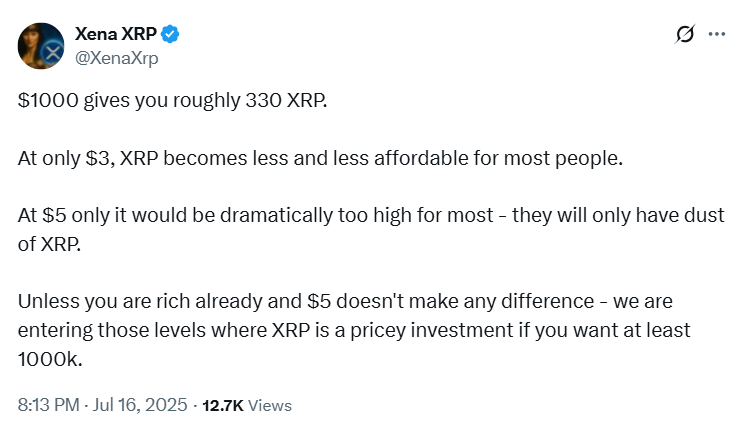
This commentary came from Xena, a community pundit that has continued to express her confidence in XRP’s price prospect. Notably, XRP recently spiked above the $3 mark after attempting to breach the level for several months. On the back of this feat, Xena called attention to how much XRP $1,000 could get.

$1,000 Can Only Get 315 XRP Now

The pundit pointed out that with XRP trading for $3, an investor who commits $1,000 would only amass 330 XRP. Specifically, XRP trades for $3.17 as of press time. At this price, a market participant would only procure 315 XRP with $1,000, indicating that the figure has reduced since Xena’s comments.

Xena on X
Xena on X

Notably, Xena suggests this trend could continue. According to her, at the $3 price level, XRP is becoming less affordable to the everyday investor. Community commentators like Edoardo Farina also identified this pattern when XRP traded for $2. Last month, Farina insisted that XRP was already pricing out retail investors.

Meanwhile, in a recent report, The Crypto Basic found that procuring just 2,400 XRP to enter the top 10 of the XRP Rich List is now out of reach for the average salary earner in the U.S. and the U.K. unless they save for multiple months. 

However, this was not the case just a year ago. Moreover, a $1,000 investment would have procured much more tokens, as Xena implied. For context, in July 2024, XRP traded for around $0.48. At this price, an investor could amass around 2,083 XRP with $1,000. Today, this figure has reduced to 315 XRP.

Most People Would Only be Able to Afford “Dust”

Xena believes the figure will continue dropping, essentially predicting XRP price to see consistent gains. According to her, at a $5 price, which represents a mere 57% rise from the current price, most investors would already find it “dramatically too high” to buy XRP. 

She suggested that as a result of this, these investors would only settle for “dust of the token,” referring to fractional ownership. Notably, this is the trend that occurred with Bitcoin. A decade ago, in July 2014, $1,000 could buy 4 BTC as Bitcoin traded around $250. Now, the $1,000 would only be able to afford 0.008 BTC, essentially a fraction or “dust.”

Xena sees this happening with XRP. She noted that unless one is wealthy and can afford to commit higher amounts toward investments, XRP is heading toward a level where investors will see it as a pricey asset especially if they’re aiming to amass up to 1,000 tokens.

Here’s How Much XRP Has Risen Since Jim Cramer Called It a “Giant Con”

The price of XRP has surged nearly tenfold since CNBC host Jim Cramer dismissed it as a “giant con.”

In a recent tweet, XRP commentator “NFAdotcrypto” resurfaced a 2022 discussion in which Cramer labeled the asset a “giant con.” At the time of his remark, XRP was trading at approximately $0.38.

Notably, the crypto community has long joked that Cramer’s investment calls often mark market bottoms. XRP appears to be yet another prime example.

Shortly after his comment, XRP began a multi-year rally. The movement was fueled by favorable court rulings, increased institutional adoption, and the expansion of Ripple’s payment infrastructure.

How Much Has XRP Increased Since Cramer’s Statement?

XRP has climbed nearly 10X from $0.38 at the time of Cramer’s statement to a current price above $3. Specifically, XRP is now trading at $3.20, with a recent peak of $3.66 last week. 

This represents a staggering 742% gain since Cramer’s controversial comment. When factoring in the recent high, the gains exceed 863%. These figures highlight a monumental price recovery and growth that few, especially Jim Cramer, anticipated. 

Other tokens Cramer has publicly criticized have followed similar trajectories, turning negative sentiment into bullish momentum. Meanwhile, Cramer isn’t the only XRP critic whose bearish call has backfired.

Forbes Once Called XRP a “Zombie”

In March 2024, Forbes dismissed XRP as a “zombie” and a “good-for-nothing” token. At that time, XRP traded at $0.60 with a $36 billion market cap.

Forbes also criticized Ripple for its perceived lack of progress in replacing SWIFT and questioned XRP’s real-world utility, despite its high trading volume. It grouped Ripple with 19 other billion-dollar crypto projects labeled as “functional zombies.”

However, XRP has since rebounded, reaching over $3.6 and adding more than $180 billion to its market cap. Several other tokens criticized in the same report have also posted major gains, leading to criticism of Forbes’ failed predictions.

Raoul Pal Called XRP an “Old Narrative,” Then Admitted He Was Wrong 

Separately, in August 2024, Raoul Pal, founder of Real Vision, warned XRP investors to prioritize profits over emotional attachment. He criticized what he described as a “cult-like” mentality within the community.

Pal urged holders to move on from “old coins” like XRP and instead focus on newer narratives in the bull market. He argued that ideological attachment could cost investors substantial gains.

However, shortly after his remarks, XRP surged over 550%, jumping from $0.50 to more than $3.50.

Remarkably, Pal publicly admitted he was wrong. In a post on X, he praised XRP holders for their resilience and acknowledged their long-term conviction in the project. He clarified that his earlier comments were intended to help investors avoid missed opportunities.

XRP supporters welcomed the admission. Panos Mekras of Anodos Finance even encouraged Pal to explore the innovations of the XRP Ledger.