Home Blog Page 621

Millionaire Pundit Shares New Cardano ATH Price If Ethereum Rallies to $5,000

0

Top YouTuber Alex Becker reiterated his bullish stance on Cardano, stating his price target if Ethereum reaches a new all-time high.

Ethereum to $4,000 or $5,000 could happen as early as this month, according to FundStrat’s CIO Thomas Lee. If this materializes, some suggest that most altcoins will surge in tandem.

Specifically, millionaire YouTuber Alex Becker shares a bullish outlook for Cardano, the ninth-largest cryptocurrency by market capitalization. According to him, ADA would rally to a new all-time high if Ethereum surges to $5,000.

Cardano Is Easily Going to $5

Notably, Becker asserted in his July 21 podcast that Cardano could easily rally to $5 in a bullish market condition. For context, this would mark a 474% or nearly 6x surge from the current price of $0.87.

Why is Becker, a long-standing Cardano community critic, repeatedly bullish? This is because he feels the ecosystem is maturing. In the podcast, he highlighted that Cardano has amazing technology backing it and a visionary leader in Charles Hoskinson.

“I think Charles Hoskinson is probably one of the better leader figureheads in crypto,” Becker added.

Remarkably, this is not the first time that Becker has shared bullish predictions for Cardano despite admitting it makes “his skin crawl.” He predicted in March, when Cardano was trading around $0.735, that it would rally four to five times from there.

Again, he claimed in May that Cardano will outperform “Ethereum killer” Solana. He noted that this does not mean that SOL will not rally this cycle, but he believes Cardano will offer better portfolio upside for holders.

Top Analyst Shares Complementing Bullish Cardano Prediction

Meanwhile, Ali Martinez has a similar bullish stance on Cardano’s trajectory. He noted in a tweet that Cardano is definitely reclaiming $1. To him, it is not a matter of if, but when Cardano would do so.

An accompanying chart shows that Cardano recently broke above a crucial resistance level in the daily chart. ADA’s 20% weekly gains pushed it past the $0.84 supply wall, and Martinez highlighted that the next target is the resistance line above the $1.05 price level.
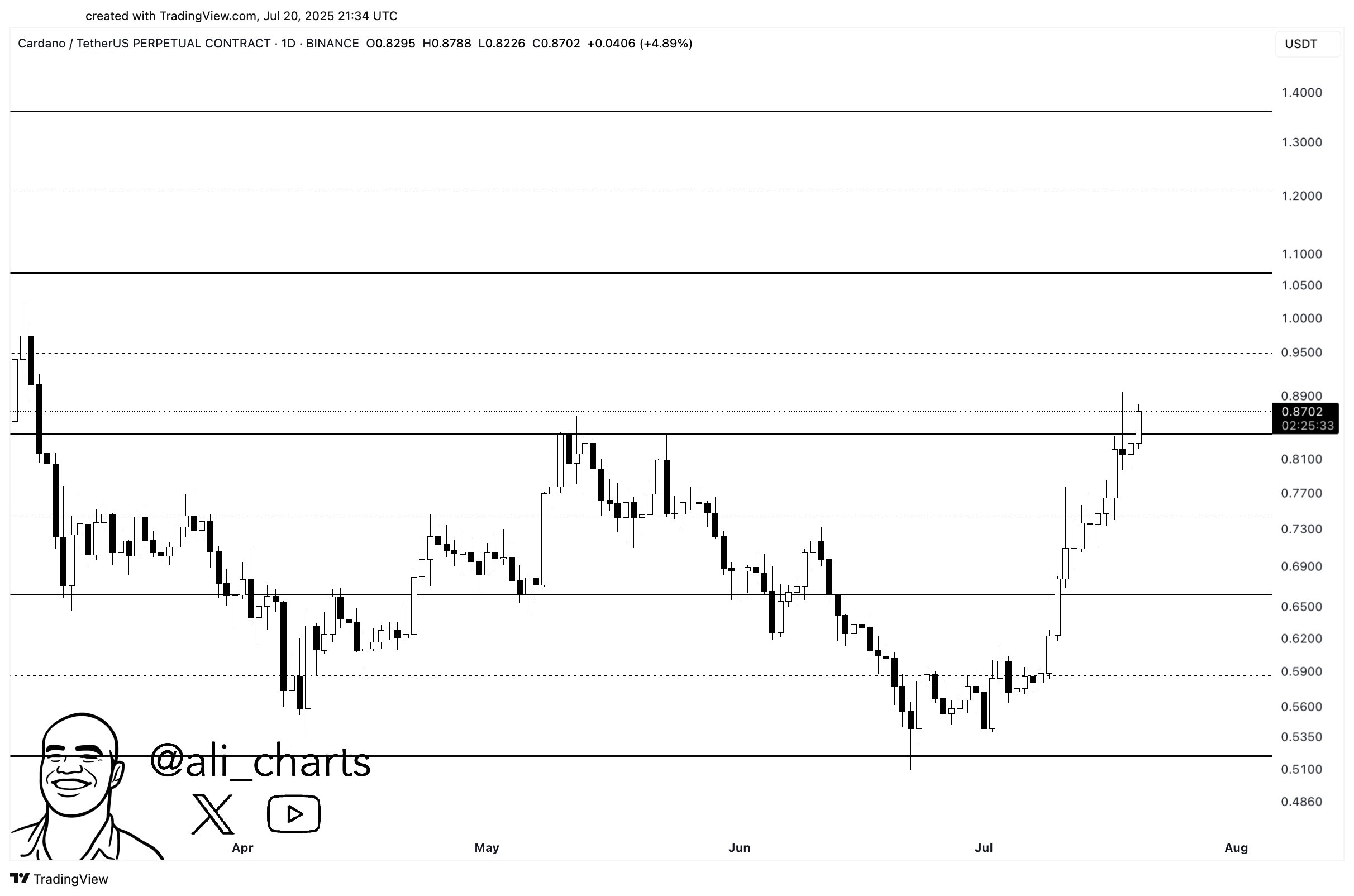
Cardano’s Next Price Target/Ali Martinez

Notably, Cardano last reached $1 in early March, during a period of price fluctuation following Donald Trump’s executive order establishing a national strategic crypto reserve.

Western Union CEO Confirms Plans to Integrate Stablecoin into Its Digital Wallet

0

Western Union CEO Devin McGranahan suggests that stablecoins are not a threat, but rather a catalyst that accelerates cross-border settlements.

McGranahan shared this view during a recent Bloomberg interview, where he provided insights into the company’s recent operations. 

Stablecoin Is an Opportunity, Not a Threat 

According to him, the financial services corporation does not consider stablecoins a threat to its business, but rather an opportunity. 

Given this, he disclosed that the company is exploring how to integrate stablecoin products into its digital wallet for customers worldwide. This initiative will allow Western Union’s customers to hold, send, and receive stablecoins, as well as fiat currencies. 

Instead of building its entire stablecoin product in-house, McGranahan said Western Union will partner with other infrastructure companies for the initiative.

Although he did not mention potential partners, he hinted that Bloomberg has already interviewed some of the companies it intends to partner with on the stablecoin initiative. 

Growing Interest in Stablecoins Among Banks and Financial Institutions 

Notably, McGranahan made the disclosure just days after President Donald Trump signed the stablecoin legislation, the GENIUS Act, into law. The law provides a clear framework for U.S. dollar-pegged stablecoins.

Meanwhile, Western Union is not the only financial institution exploring stablecoins as a tool for digital payments. As previously reported, top U.S. banks, including Bank of America, Citibank, JPMorgan Chase, and Wells Fargo, are pursuing a joint stablecoin venture. Under the venture, the banks intend to issue their stablecoin soon. 

It is no surprise that banks are exploring stablecoins for digital payments. Stablecoins are typically known for maintaining a stable price and facilitating low-cost, fast payments. Promoters emphasized that these features are crucial for enhancing the traditional payment system, which many consider outdated. 

Besides banks, other major financial institutions have also shown interest in stablecoins, with some rolling out their own. Last year, Ripple launched RLUSD, a stablecoin that has skyrocketed to a market capitalization of $532 million in barely seven months after its debut. 

The stablecoin market has gained traction over the years, boasting a valuation of $267.21 billion. Tether (USDT) remains the leader of this market, with its valuation currently standing at $161.71 billion. 

JPMorgan to Accept Bitcoin, Ethereum as Collateral for Loans

0

Wall Street giant JPMorgan Chase is exploring the possibility of offering loans backed by clients’ crypto holdings, signaling a new era of mainstream banking acceptance of digital assets.

In a strategic pivot, the bank is considering plans to extend credit backed by crypto assets such as Bitcoin and Ethereum, according to a Financial Times report. The initiative, which could launch as early as 2026, underscores how traditional lenders are increasingly integrating crypto into their core services.

If finalized, the policy would mark a sharp departure from CEO Jamie Dimon’s previously hostile stance on crypto. In 2017, Dimon famously dismissed Bitcoin as a “fraud” and warned it was only useful for criminals. He even said he would fire any trader caught buying it.

However, Dimon’s tone has softened in recent years. Speaking in May, he likened the right to own crypto to the right to smoke, even though he does not engage in such acts himself.

Big Banks Begin Embracing Crypto

JPMorgan has cautiously entered the crypto space by planning to lend against crypto exchange-traded funds (ETFs). Accepting direct crypto collateral, actual coins held by clients, would take the bank deeper into a space long seen as too volatile or opaque for traditional finance.

Other top banks, including Goldman Sachs, still avoid crypto as collateral. However, with a more favorable regulatory climate emerging, especially under the Trump administration, the tide is shifting. Morgan Stanley, for instance, is reportedly exploring crypto trading via its ETrade platform.

Adding momentum to the shift, last week the U.S. House of Representatives passed landmark legislation to regulate stablecoins. Big banks have welcomed the bill as it offers long-awaited regulatory clarity and could unlock broader adoption.

Challenges Ahead for Crypto Lending

Despite growing interest, crypto-backed lending faces major hurdles. Regulators have warned that digital assets are prone to misuse for illicit transactions, heightening scrutiny around anti-money laundering (AML) compliance. JPMorgan would also need to develop mechanisms to seize or manage crypto in the event of borrower default.

The bank doesn’t currently hold cryptocurrencies on its balance sheet, meaning it would likely partner with a third-party custodian to hold the crypto collateral. Exchanges like Coinbase already offer such custodial services.

Though historically cautious about mainstream cryptocurrencies, JPMorgan has been proactive in blockchain innovation. In 2019, the bank launched one of the first digital coins developed by a major U.S. financial institution.

Here’s This CEO Timeline For XRP Reaching $1,500 to $2,000

0

Jake Claver, the CEO of Digital Ascension Group, recently shared an audacious XRP price prediction during an episode of The Good Morning Crypto show. 

Speaking with host Abdullah “Abs” Nassif, Claver said he sees XRP climbing as high as $2,000 by Jan. 1, 2026, if certain global and market conditions come together. He also pointed to a lower target of $1,500 and admitted that many people might find these figures far-fetched.

Reverse Carry Trade, Tether, and Epstein 

Notably, Claver based his projection on several potential developments that he believes could influence the financial system. Specifically, one of these developments is the unwinding of the reverse carry trade, which he expects to trigger a shift in liquidity. 

He pointed to Tether as a possible weak link in the crypto ecosystem. According to him, there are speculations suggesting regulators like the SEC, CFTC, and DOJ could hold a joint hearing on Tether following the approval of the GENIUS Act. He believes this could set things in motion if it happens.

Further, Claver claimed that newly released documents linked to the Jeffrey Epstein case might also impact the crypto space, possibly involving Tether. 

While he didn’t mention any specific project, he implied that any negative exposure could hurt investor confidence and create a contagion across markets. In such an event, Claver believes XRP could become the asset that people turn to for safety and liquidity.

The Shane Ellis Theory

Meanwhile, he also referenced a theory from Shane Ellis, which proposes that liquidity issues on exchanges like Bitfinex could cause a sudden spike in XRP’s price, citing the controversial price point of $589 as part of that argument. 

On top of that, Claver highlighted XRP’s potential to help with settlement processes in traditional finance. He pointed out that while the stock market settles trades with a delay, typically one business day, crypto trades settle much faster, usually within 20 to 40 minutes.

Notably, he argued that, in a crisis, institutions would need a real-time settlement solution to manage risk and rebalance their positions quickly, especially during weekends or holidays when traditional markets close. He believes XRP could play that role.

Claver also pointed to Project ION, a settlement platform developed in 2022 through a partnership between the DTCC and R3. He said the system is already in place but needs a neutral, liquid bridge asset to connect different financial systems. According to him, XRP fits that need and could step in when the time comes.

He also mentioned the possibility of rising oil prices triggered by conflict in the Middle East, which could speed up the breakdown of the carry trade and drive more investors toward XRP.

How Ambitious is an XRP to $2,000 Target?

However, despite his reasons for the predictions, they remain rather ambitious. Currently, XRP trades around $3.48. For it to reach $1,500, it would need to rise by roughly 43,000%. Meanwhile, to hit $2,000, it would have to climb 57,371%. 

In addition, these prices would push XRP’s market cap to levels never seen before. At $1,500 per token, XRP would be worth $90 trillion, four times the size of gold’s market cap. At $2,000, its value would soar to $120 trillion, which exceeds the entire global M2 money supply of around $94 trillion.

While these figures may seem unrealistic, they may attract attention due to their potential yield. If Claver’s prediction plays out, even a small XRP holding could turn into a fortune. A person with 1,000 XRP, worth just $3,480 today, could see that grow to $1.5 million at $1,500 per token or $2 million at $2,000 per token.

Here’s What XRP Could Be Worth If Amazon Used It for Daily Payments

0

Amid discussions around XRP’s utility in payments, we assessed what XRP price could rise to if Amazon used it for everyday payments.

Despite XRP’s bullish trend, several market commentators still argue that it’s trading below what it’s truly worth. 

XRP Price Currently Undervalued 

Their reason for this sentiment is that XRP’s real-world potential, especially as a payment solution, remains mostly untapped. Interestingly, one major name that often comes up in this conversation is Amazon. 

Specifically, over the years, several community commentators have speculated about a possible integration between the two. Nonetheless, so far, Amazon hasn’t confirmed or even hinted at any plans to use XRP for payments.

Discussions Around XRP and Amazon

This speculation emerged in 2020 when RippleNet, Ripple’s payment network, appeared as a partner on Amazon Web Services (AWS). This triggered excitement among XRP proponents, but nothing came from it in terms of XRP actually powering payments on Amazon. 

Meanwhile, in mid-2024, crypto exchange Bitget re-examined the idea and pointed out XRP’s strengths. They noted that XRP could be a perfect fit for Amazon’s ecosystem. Still, the online retail giant has remained silent on the matter.

As the discussions persist, we recently explored what XRP’s price might look like if Amazon did adopt it for everyday transactions. Notably, we turned to ChatGPT for a forecast. 

In response, the AI chatbot used Amazon’s most recent business data to build three different models. Each of the models showed how XRP’s price could change based on how deeply Amazon integrates the token into its system.

Amazon’s Impressive 2024 Figures

For perspective, Amazon had over 309 million users worldwide in 2024, with more than 200 million based in the U.S. By 2025, estimates suggest that number will grow to around 321 million globally, including over 208 million American users. 

In terms of revenue, Amazon pulled in $638 billion last year and is on track to hit $700 billion in 2025, based on growth trends between 9.5% and 11% annually. Daily revenue stands around $1.3 to $1.4 billion. Customers place nearly 12 million orders each day. 

The platform supports a massive product catalog, well over 350 million items globally, possibly exceeding 600 million when you count third-party sellers. As of early 2025, about 9.7 million sellers operate on Amazon, including nearly 2 million in the U.S.

Using these figures, ChatGPT built three models to estimate XRP’s price if Amazon fully embraced it.

Possible XRP Price if Amazon Adopted It for Payments

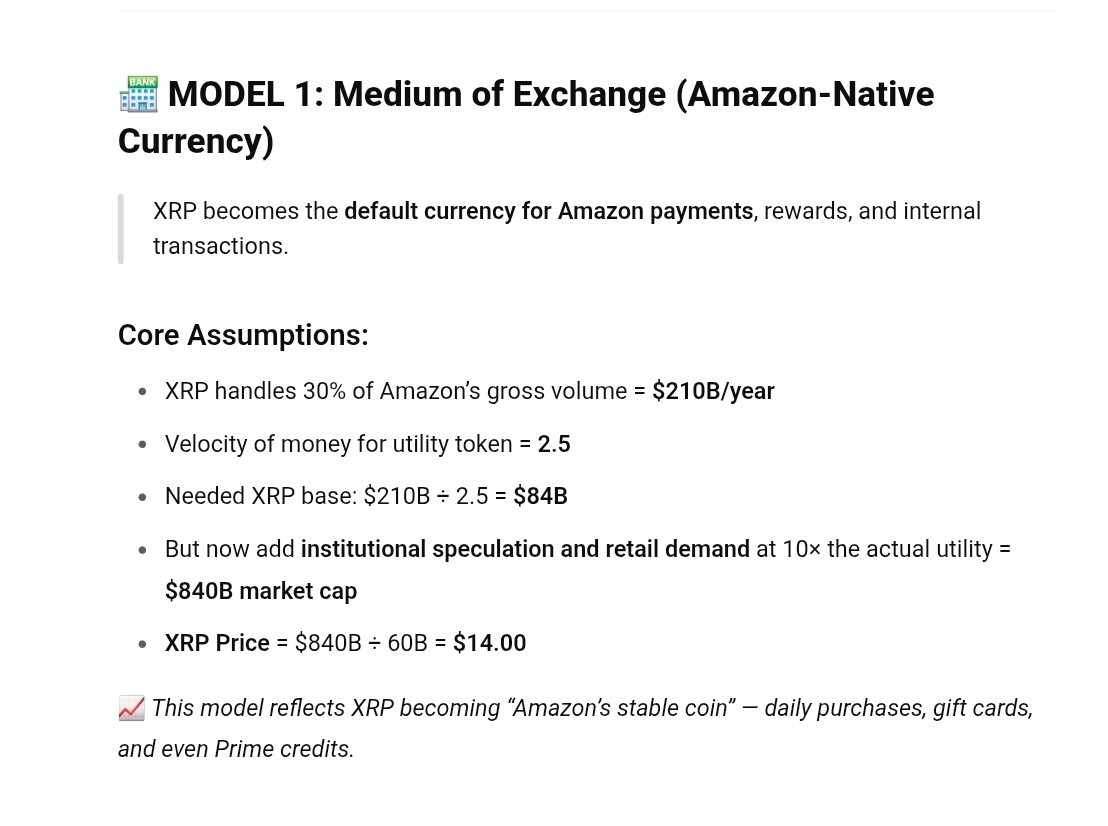
In the first model, XRP serves as Amazon’s default currency. This includes areas like product payments and gift cards to Prime subscriptions. Notably, if XRP powers 30% of Amazon’s total annual volume, about $210 billion, and moves at a velocity of 2.5, the base amount of XRP needed would total $84 billion. 

However, considering additional demand from investors and traders, which ChatGPT estimates at ten times the utility value, the total market cap would hit $840 billion. Now, dividing that by the 60 billion tokens in circulation, XRP’s price could climb to $14.

XRP Amazon Medium of Exchange Model ChatGPT
XRP Amazon Medium of Exchange Model | ChatGPT

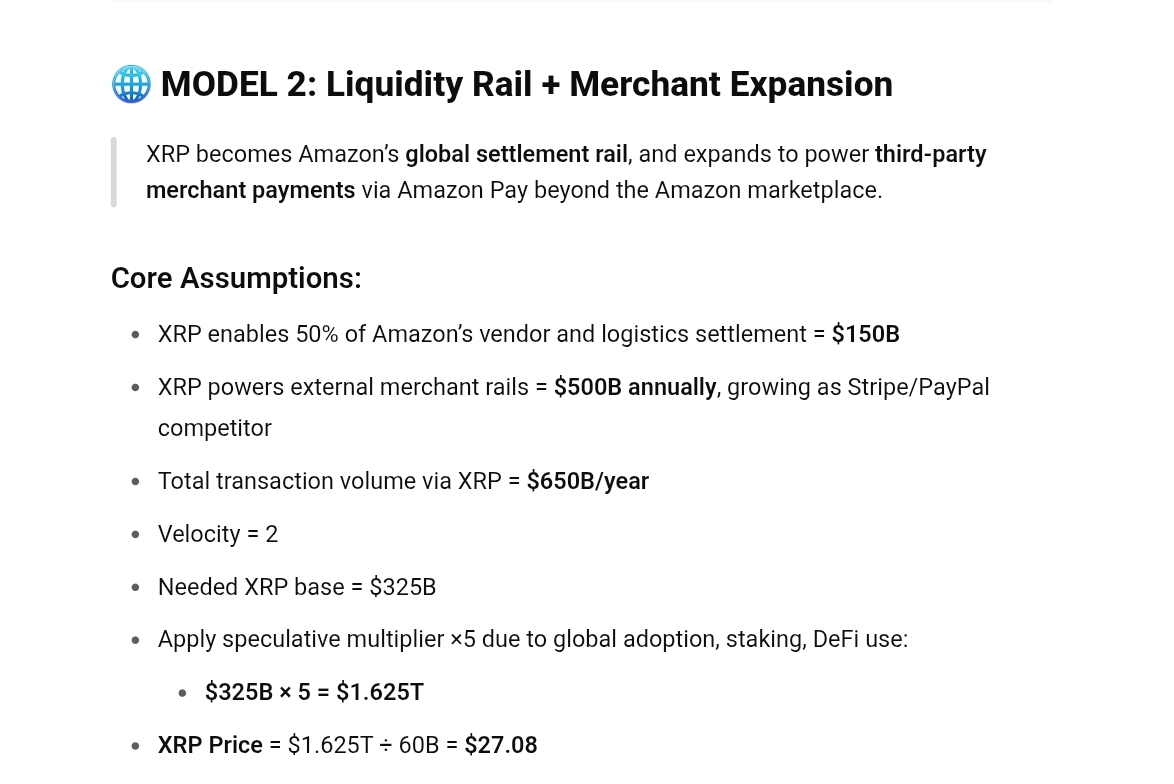
Meanwhile, the second model sees XRP as a global payment rail for Amazon. This includes vendor settlements, logistics, and third-party merchants using Amazon Pay. 

Specifically, if XRP processes $150 billion from Amazon’s systems and $500 billion from external merchant payments, its total volume would reach $650 billion per year. With a velocity of 2, the base requirement would drop to $325 billion. 

XRP Liquidity Rail Model ChatGPT
XRP Liquidity Rail Model | ChatGPT

However, applying a speculative multiplier of five, based on increased adoption and real-world financial use, the market cap would grow to $1.625 trillion. With 60 billion tokens in circulation, XRP could trade at around $27.

The third model considers XRP acting as an infrastructure token that supports CBDC bridges, AWS micropayments, smart device transactions, and even staking for Prime memberships. 

In this setup, XRP handles $1 trillion in global economic activity, with just 30% requiring backing, around $300 billion. Multiplying this by eight to show speculative growth pushes the figure to $2.4 trillion. 

XRP Reserve Asset Model ChatGPT
XRP Reserve Asset Model | ChatGPT

Afterward, ChatGPT then added the previous two models’ value, around $660 billion, to arrive at a combined market cap of $3.06 trillion. Interestingly, this valuation would push XRP’s price to roughly $51. However, it is important to note that these evaluations remain highly speculative. 

BitGo Files for IPO Amid Bitcoin Market Boom

BitGo Holdings, one of the longest-standing crypto custody firms, has confidentially filed for an initial public offering (IPO) with the U.S. SEC.

With this move, BitGo joins a growing list of digital asset firms that have pursued public listings in recent times.

The draft registration statement, submitted on Form S-1, does not yet disclose the number of shares to be offered or a proposed price range. In accordance with Rule 135 of the Securities Act, BitGo noted that the announcement does not constitute an offer to sell securities.

The IPO will commence once the SEC completes its review, depending on market and other conditions. Confidential filings like this one allow companies to prepare for a listing without publicly revealing financial details until closer to the launch date.

Rising Tide of Crypto IPOs

BitGo’s IPO attempt follows a wave of recent listings by high-profile crypto firms. Circle, the issuer of the USDC stablecoin, went public in June on the New York Stock Exchange. Its share price skyrocketed from $31 to over $298, a staggering 861% increase in just a few weeks. The firm is now valued at over $55 billion.

Shortly after, Grayscale Investments and trading platform Bullish also filed confidentially with the SEC. The trend indicates that crypto companies are now seeing a more convenient environment to go public under the more crypto-friendly President Donald Trump’s administration.

These moves also coincide with the historic surge in crypto asset prices. Last week, Bitcoin peaked above $123,000 and is currently ranging around the $120,000 level.

BitGo’s Comeback Moment

Founded in 2013, BitGo is best known for safeguarding crypto assets for institutional clients, including exchanges, funds, corporations, and ETF issuers. The company claims to hold over $100 billion in assets under custody and supports more than 1,200 tokens on its platform.

This IPO marks a significant moment for BitGo, which had previously planned to be acquired by Mike Novogratz’s Galaxy Digital for $1.2 billion in 2022. That deal ultimately fell apart, leading to litigation. The development forced BitGo to remain private while rivals like Coinbase went public.

With BitGo’s confidential IPO underway, the industry is also on the lookout for similar moves from others like Ripple, Gemini, and Kraken.

Ethereum Massive Price Pump Drives Record $4.39B Weekly Inflows into Digital Assets

0

The strong Ethereum rally has helped digital asset investment products hit an all-time weekly inflow high of $4.39 billion. 

The global crypto investment landscape experienced a historic week as capital poured into digital asset funds at unprecedented levels, primarily driven by Ethereum’s recent price breakout.

According to the latest data from CoinShares, digital asset investment products saw net inflows of $4.39 billion last week. This breaks the previous weekly record of $4.27 billion set following the 2024 U.S. elections.

This milestone marks the 14th straight week of net inflows, pushing the year-to-date figure to a robust $27 billion. The total assets under management (AuM) for these products have now climbed to a record $220 billion.

Trading activity also intensified, with exchange-traded product (ETP) turnover reaching a new peak of $39.2 billion. Both Bitcoin and Ethereum experienced heightened volume, underscoring growing investor interest amid a broader market rally.

U.S. Dominates Inflows; Ethereum Leads the Charge

Regional data shows that the United States remains the powerhouse, accounting for $4.36 billion of the weekly inflows. Other countries also contributed positively, including Switzerland ($47.3 million), Australia ($17.3 million), and Hong Kong ($14.1 million). In contrast, Brazil and Germany posted mild outflows of $28.1 million and $15.5 million, respectively.

Ethereum stood out as the top performer of the week, drawing a record-breaking $2.12 billion in inflows. This figure is almost twice its previous high of $1.2 billion.

Over the last 13 weeks, Ethereum-linked investment products have accounted for 23% of the asset’s total assets under management. So far in 2025, inflows have hit $6.2 billion, already exceeding the full-year total for 2024.

Fueling this investor enthusiasm is Ethereum’s latest price action. The second-largest cryptocurrency surged by 24.5% in the past week, briefly topping $3,800 for the first time in over seven months.

Bitcoin, Solana, and Others See Steady Demand

Bitcoin also attracted substantial interest, bringing in $2.2 billion in inflows, though this was a slight decrease from the $2.7 billion recorded the week before. Notably, ETPs accounted for 55% of Bitcoin’s total exchange volume, suggesting institutional interest remains strong.

Other altcoins such as Solana, XRP, and Sui saw inflows of $39 million, $36 million, and $9.3 million, respectively, highlighting a broad-based increase in investor participation.

The overall crypto market has continued its upward trend, with global market capitalization rising 0.84% in the past 24 hours to touch $3.93 trillion.

As Ethereum gains momentum and institutional interest continues to rise, the digital asset investment market is experiencing a historic bull phase. With growing global participation and record capital flows, crypto prices could break more records for the remainder of 2025.

Trump Media Reveals Bitcoin Now Makes Up Two-Thirds of Its Liquid Assets After $2B Purchase

0

Trump Media and Technology Group (TMTG) announced that Bitcoin and related assets now make up about two-thirds of its $3 billion in liquid holdings. 

Trump Media Acquires $2B Worth of Bitcoin

The company, which operates Truth Social, Truth+, and the financial brand Truth.Fi, revealed this in a recent press release, in which it confirmed it has acquired around $2 billion worth of Bitcoin and Bitcoin-related securities as part of its long-term crypto strategy.

In addition to the $2 billion stake, Trump Media also set aside $300 million for an options-based plan to acquire even more Bitcoin-related assets. 

The firm aims to turn those options into actual Bitcoin when the market conditions are right. Moreover, it also plans to use its crypto holdings to support its revenue goals and explore acquisitions of other digital assets.

CEO Devin Nunes said the company is following its crypto strategy closely. He explained that Bitcoin gives Trump Media more control over its finances, helps guard against potential issues with traditional banks, and will eventually connect with a utility token the company plans to launch across its platforms.

Initial Plans to Set up a Bitcoin Treasury

This move builds on a plan Trump Media first laid out in May 2025. Specifically, on May 27, the company announced it would raise $2.5 billion to build a Bitcoin treasury. 

The plan included selling $1.5 billion in company stock and issuing $1 billion in convertible bonds. At the time, Nunes called Bitcoin a major financial tool for freedom and said it would help power features like subscription payments and future token use.

Trump Media brought in Anchorage Digital and Crypto.com to handle the security and storage of its Bitcoin, showing its commitment to managing the assets through trusted partners.

In June and July 2025, the company pushed deeper into the crypto space by filing for several crypto-focused exchange-traded funds (ETFs) with the SEC. One of the proposed funds would include 75% Bitcoin and 25% Ether, with plans to list on the NYSE Arca and custody managed by Crypto.com. 

Another fund, the Truth Social Crypto Blue Chip ETF, would hold a mix of top digital assets: 70% Bitcoin, 15% Ether, 8% Solana, 5% Cronos, and 2% XRP. Trump Media expects these ETFs to launch later in 2025, depending on regulatory approval.

Growing List of Bitcoin Treasury Firms

Notably, the company has confirmed it would keep buying Bitcoin using both equity and debt, following the approach that MicroStrategy first popularized.

Trump Media joins a growing number of public companies that have moved into Bitcoin this year. For instance, the Smarter Web bought 196 BTC in June, while GameStop entered the market in May with a $500 million Bitcoin purchase. Moreover, the Blockchain Group also picked up 75 BTC in June.

Interestingly, data from Bitcoin Treasuries shows that 155 publicly traded companies now hold Bitcoin, with their combined holdings reaching 868,709 BTC. Trump Media’s $2 billion investment places it among the top corporate Bitcoin holders.

The US Government Has Given “Stamp of Approval” on Bitcoin and Crypto: SEC Chair

0

Recent developments in the White House have demonstrated that the US government recognizes and has embraced Bitcoin and cryptocurrencies.

US Securities and Exchange Commission (SEC) Chair Paul Atkins believes that the digital asset industry has come to stay in the United States. During an appearance on CNBC’s Squawk Box, he noted that all indicators point to the legitimacy of the sector as an integral part of the US economic market.

US Government Now Approves of Bitcoin

Atkins lauded the recent efforts of the current US President, Donald Trump, and Congress to create regulatory clarity for the stablecoin industry through the GENIUS Act. For context, Trump signed the bill on Saturday, following its passage in the US Senate and then in the US House this month.

The pro-crypto SEC chair claimed that this signifies that the US government has given its stamp of approval on Bitcoin and cryptocurrencies, a move never seen before in the industry’s history. Notably, it also marks a complete turnaround in the sector’s fate compared to the previous administration, where it faced a barrage of legal actions and unclear regulation.

Meanwhile, Atkin emphasized that the recently approved legislation would transform the existing settlement system, which Trump mentioned was outdated. The use of stablecoins would usher in an instantaneous and cost-effective rail for the payment and delivery of securities, the commissioner’s leader highlighted.

Interestingly, the bipartisan Congress’s support and Trump’s admiration of the GENIUS Act follow sentiments that it would sustain the US dollar’s relevance and make America the undisputed leader in the digital asset scene. Top White House officials teased that the stablecoin legislation would bring in trillions of dollars to the US economy.

Trump’s Holistic Embrace of Cryptocurrencies

The US president transitioned from a skeptic to a Bitcoin believer in the run-up to his second term, promising to be a Bitcoin-friendly president. This move earned him financial support and the votes of crypto enthusiasts.

During his first few months in office, he signed an executive order to establish a strategic crypto reserve and tasked the White House crypto working committee to pursue budget-neutral means of acquiring more Bitcoin. Again, Trump’s cabinet choice and consistent cheer at every milestone achieved demonstrated his friendly gesture towards the sector.

Most recently, Trump urged the US House to pass the GENIUS bill hastily and stepped in to put hardliners in line when the bill suffered a setback last week. He did not waste any time giving his approval when the bill passed, all of which points to his recognition of the digital asset industry.

Meanwhile, this adoption has seen cryptos outperform most major stocks since Trump entered office. Bitcoin rallied to a new all-time high of $123,181, XRP reached a seven-year high, and Ethereum rebounded to higher prices.

How to Time-Lock Your XRP Using Built-In Escrow Function

A lesser-known feature of the XRP Ledger (XRPL) is gaining attention in the community, specifically the option to escrow your own XRP for future use. 

Jake Claver, the MD of Digital Ascension Group, recently reminded XRP holders that they can lock their tokens with a built-in time delay using the XRP Ledger’s native escrow capability.

Escrow for Future Growth or Discipline

The XRPL offers a unique feature that allows users to lock their XRP. This functionality serves multiple purposes, from securing assets for long-term holding to enforcing personal financial discipline, and even automating scheduled transfers.

Specifically, an XRPL escrow is a contract where funds are held until certain conditions are fulfilled. Unlike traditional escrow, the ledger automates this process by locking XRP or tokens until the specified conditions pass, without the involvement of a third party.

A practical example is Ripple’s XRP escrow program, launched in December 2017. Ripple locked 55 billion XRP into secured accounts to provide transparency and predictability regarding XRP’s supply.

Nearly eight years later, Ripple’s escrow balance is down to around 36 billion tokens. The released 19 billion tokens were distributed at a rate of 1 billion XRP monthly since the initial lockup in 2017.

Just as this program provides transparency on Ripple’s holdings, Claver explained that a similar escrow service is available to all XRP enthusiasts. It’s a tool on the ledger that eliminates the need for third-party custodians.

Using XRP Toolkit to Set Up an Escrow

Claver noted that through platforms like the XRP Toolkit, holders can register their wallets, manage their XRP, and set up self-imposed escrows. The process involves selecting the amount of XRP to lock and the exact release time. This feature can also automatically transfer XRP to another wallet at a future date, just like Ripple’s program.

For long-term investors, this offers a way to “protect XRP from yourself,” Claver said, by delaying access to funds until a strategic financial goal is reached. 

Escrow Process

According to XRPL documentation, the sender creates an escrow using the EscrowCreate transaction, locking funds with specified release conditions and recipient information.

The recipient completes the escrow with EscrowFinish when conditions are met, releasing the funds and deleting the escrow.

If an escrow expires (passes its expiration time without completion), the sender can cancel it using EscrowCancel, returning the funds.

Limitations

Escrowing small amounts may be impractical due to higher costs, especially when using crypto-conditions, which incur greater fees. Meanwhile, the sender must hold the reserve while the escrow is active.

Notably, only the PREIMAGE-SHA-256 crypto-condition is supported. In other words, the funds can be unlocked only by proving knowledge of a secret that hashes to a specific SHA-256 value.

Lastly, the timing is based on ledger close times, which can cause slight delays in seconds.