Home Blog Page 64

How Polymarket Trader Turned a $10.8M Loss Into $8M+ Profit in Two Weeks

A Polymarket trader known as DEEDDIT has pulled off one of the platform’s biggest turnarounds. 

The trader recovered from a $10.8 million loss and turned it into more than $8 million in all-time profit within two weeks, according to on-chain analytics platform Lookonchain.

The comeback was completed on July 14 after DEEDDIT placed an $11.3 million wager on Spain to advance against France in the 2026 FIFA World Cup semifinal. Spain’s 2-0 victory generated roughly $9.9 million in profit in a single day, marking the end of the recovery.

Lookonchain called the performance “legendary,” saying the trader erased an eight-figure loss through a series of high-stakes sports prediction market bets.

$9.9M Win Completes the Comeback

A screenshot of DEEDDIT’s Polymarket profile shows a one-day profit of $9.89 million. The Spain vs. France prediction was the trader’s biggest winning position.

The profile shows that DEEDDIT bought Spain to advance at 44.5 cents. The position later paid out nearly $10.98 million.

Other successful bets included markets involving France, Switzerland, Argentina, the United States, Norway, England, and Mexico across several World Cup fixtures.

The account shows a largest single win of $6.1 million. It also shows that the trader has made 17 predictions since joining Polymarket in June 2026.

Polymarket trader DEEDDIT account

Crypto Markets See More High-Stakes Trades

The Polymarket comeback comes as Lookonchain continues to track large trades across digital asset markets.

In a separate post, the analytics firm reported that a whale holding $75.4 million opened a 5x leveraged long position on 20,000 CXMT tokens. The position was worth about $164,000 at an entry price of $6.

The trade was already showing a $44,000 unrealized gain. The trader also placed additional limit orders between $5.80 and $7.20 to increase exposure.

Lookonchain also highlighted another trader who turned 1.6 ETH, worth around $3,000, into 1,527 ETH by trading the memecoin CASHCAT. The trader bought 16.3 million CASHCAT tokens and later sold the entire position for about $2.855 million, generating a 952-fold return.

Bitcoin Rally Faces Fresh Inflation Test

The wave of headline-making trades comes as the crypto market rebounds after softer-than-expected U.S. inflation data.

Bitcoin rose about 3.4% over the past 24 hours to trade near $64,800. The broader cryptocurrency market gained roughly 2.9%.

The rally followed the June U.S. Consumer Price Index (CPI) report, which strengthened expectations that the Federal Reserve may take a less aggressive approach to monetary policy. The data also boosted demand for risk assets.

Traders are now watching the upcoming release of U.S. Producer Price Index (PPI) data. Crypto analyst Ted Pillows said Bitcoin has historically shown sharp volatility around PPI releases.

Image

Several reports this year have triggered double-digit moves in either direction. Traders remain divided on whether the next move will extend the current rally or trigger a reversal.
XRP Now Boasts a 70% Share of the Global Represented Commodity Market of $3.5B

0

The XRP Ledger is now home to more than 70% of the entire represented tokenized commodity market, emerging as the dominant player in the sector.

Tokenization remains one of the biggest narratives in the crypto scene in recent years, and the XRP Ledger (XRPL), originally built to support the nascent market, seems to be taking up a reasonable share of the sector.

Market data indicates that over 70% of the global represented commodity market on-chain resides within the XRP ecosystem, with Polygon and Arbitrum accounting for the remaining 30%.

Global Tokenized Commodity Growth

This is according to data provided by RWA.xyz, a leading analytics platform for the tokenization market. 

Notably, the worth of the global tokenized commodity market stands at $8.08 billion as of press time. This represents a year-to-date increase of $3.84 billion from the $4.24 billion figure recorded at the start of the year.

The Tokenized Commodity Market

Interestingly, while only halfway through, this year’s $3.84 billion increase so far has already surpassed the $3.2 billion figure witnessed by the market in 2025. The milestone confirms the increased attention the tokenized commodity market has enjoyed in recent times.

Of the current $8.08 billion market value, distributed commodities, which refer to assets that market participants can move outside the issuing platform, account for $4.53 billion. Meanwhile, represented commodities, which include assets that investors cannot transfer off the issuing platform, total $3.55 billion.

XRP Dominates Represented Commodity Market

Further data shows that while Ethereum hosts most of the distributed market value, XRP dominates in the represented commodity market.

Specifically, the XRP Ledger accounts for $2.5 billion of the total $3.55 billion worth of represented commodity sector. This gives the ecosystem a large dominance rate of 70.4%. For context, these commodities make up about 57% of the total tokenized real-world assets on the XRP Ledger, which sits at $4.4 billion.

XRP Leads Represented Commodity Market

Most of the commodity value residing on the XRPL comes from the JMWH product provided by Justoken. Notably, this product boasts a value of $2.229 billion at press time, representing more than 89% of the total commodities within the XRP ecosystem.

Besides the XRP Ledger, only two mainstream networks host represented tokenized commodities on-chain, specifically Arbitrum and Polygon. While XRP accounts for $2.5 billion of the global market, Polygon has a $661.2 million share, while Arbitrum is home to just $482,700 worth of represented commodities.

How XRP Fares in the Overall Commodity Market

XRP may lead the represented commodity sector, but its share reduces drastically when considering the overall commodity market, including represented and distributed assets.

In this case, Ethereum holds the largest share, with $4.2 billion across all commodities. This represents nearly 52% of the total $8.08 billion in total tokenized commodity value. Meanwhile, XRP’s $2.5 billion figure gives it a 31% market share, second only to Ethereum.

Total Commodity Market Value

Cardano Foundation Joins Ripple, Visa, and Google in x402 Initiative to Drive AI-Powered Payments

0

The Cardano Foundation has joined the newly launched x402 Foundation as an Associate Member, strengthening Cardano’s position in the next generation of internet-native digital payments.

The announcement places the Cardano ecosystem alongside some of the world’s largest technology, payment, and blockchain organizations as they collaborate to develop an open standard for machine-to-machine and AI-powered transactions across the internet.

Cardano Foundation Becomes Part of the x402 Ecosystem

According to the Linux Foundation, the Cardano Foundation is now an Associate Member of the x402 Foundation. It joins an expanding group of industry leaders that includes Ripple, the Solana Foundation, Coinbase, American Express, Google, AWS, Stripe, Shopify, and Visa.

The announcement has generated excitement within the Cardano community. Supporters believe the Foundation’s participation could position Cardano to benefit from the rapid growth of AI-driven payments and autonomous financial applications. 

Many community members have also argued that the move lays the groundwork for ADA to support agentic payments at scale as the emerging payment standard evolves.

Linux Foundation Launches Open Governance for x402

Notably, the Linux Foundation officially launched the x402 Foundation to provide neutral, community-driven governance for the x402 protocol.

Originally contributed by Coinbase, x402 transforms the decades-old HTTP 402 “Payment Required” status code into a native payment layer for the internet. Instead of treating payments as separate processes, the protocol enables AI agents, APIs, and applications to exchange value over HTTP just as seamlessly as they exchange data.

Linux Foundation CEO Jim Zemlin said AI agents and automated systems are becoming important participants in the global economy. However, they still lack a secure, standardized way to conduct transactions online. 

He explained that the x402 Foundation aims to establish an open, vendor-neutral payment standard that remains interoperable while supporting the next generation of internet commerce.

What Cardano Foundation Membership Means

Although the announcement does not introduce a direct technical integration between Cardano and the x402 protocol, the Foundation’s membership gives it a voice in the governance process that will shape the protocol’s future.

As an Associate Member, the Cardano Foundation can contribute to discussions on protocol development while helping advance open standards for internet-native payments. This role also gives Cardano greater visibility among technology companies, financial institutions, cloud providers, and developers building AI-powered applications. 

The Cardano Foundation’s involvement also aligns with broader efforts to enable frictionless blockchain payments for AI systems. 

Meanwhile, Cardano-native projects are already exploring these capabilities. For example, Masumi Network is exploring x402 to power automated payments, escrow services, refunds, and reputation systems for AI-driven applications. 

Bitcoin Correction Signals Mid-Cycle Reset, Not Bull Market End: CryptoQuant

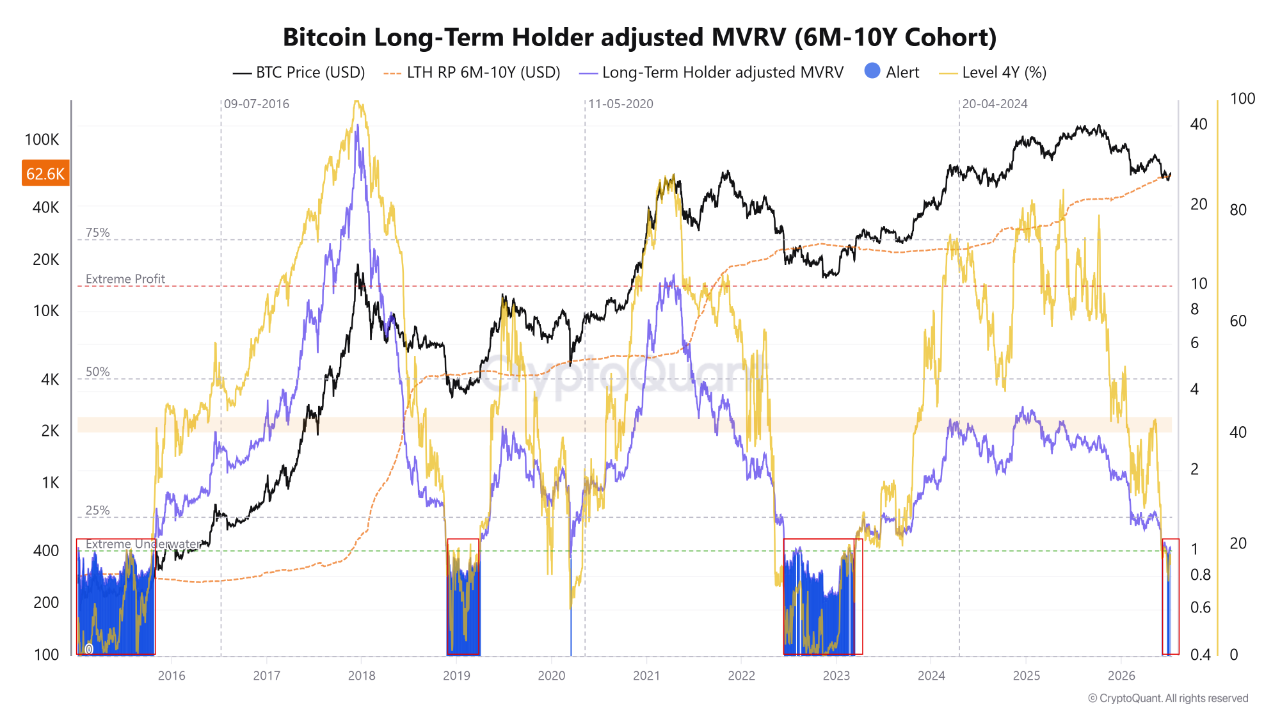
The ongoing Bitcoin correction is resetting market valuations rather than marking the end of the current bull cycle, according to CryptoQuant contributor CryptoZeno.

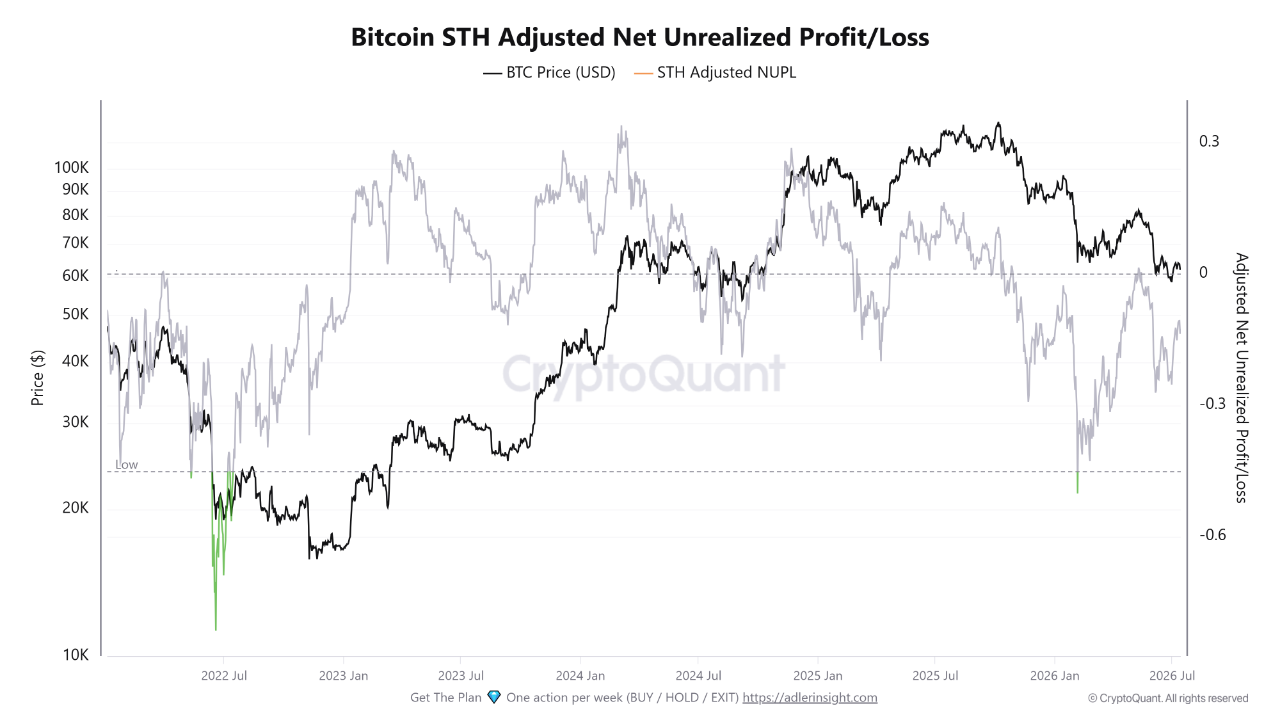
In two separate analyses, he examined Bitcoin’s long-term holder (LTH) MVRV and Adjusted Net Unrealized Profit/Loss (NUPL) metrics. Both indicators suggest that experienced investors remain committed despite recent price weakness.

Long-Term Holder MVRV Points to Valuation Reset

Notably, Bitcoin is trading at $64,500, up 4% over the past day, but it remains down 49% from its all-time high.

CryptoZeno said that Bitcoin holders who have held their coins for six months to 10 years are showing signs that the market is undergoing a reset rather than rushing to sell.

Unlike the major market tops in 2017 and 2021, the adjusted MVRV indicator remains far below the levels that typically signal heavy profit-taking by long-term investors. Instead, on-chain data suggests that these holders are remaining patient.

quicktake-image

The report also found that the average price these long-term holders paid for their Bitcoin continues to rise, even though Bitcoin’s market price has declined. This suggests that the recent downturn is mainly driven by weaker prices rather than long-term investors selling their holdings.

According to CryptoZeno, this type of correction helps eliminate short-term speculation while keeping long-term holders invested, creating a healthier market environment with a more limited Bitcoin supply.

NUPL Shows Market-Wide Profit Reset

In a separate analysis, CryptoZeno examined Bitcoin’s Adjusted NUPL, which tracks unrealized profits and losses across the network.

He found that the indicator has moved closer to neutral following the recent price correction, meaning investors’ unrealized profits have declined significantly. Historically, this type of movement has signaled a market reset rather than the beginning of a prolonged bear market.

Long-Term Holders Remain Resilient

However, investor behavior differs between long-term and short-term Bitcoin holders.

Long-term holders are still sitting on substantial unrealized profits, even though those gains have declined from previous highs. This suggests they remain confident and are not showing signs of panic selling.

Short-term holders, on the other hand, are close to breaking even after recently experiencing paper losses. Their lower profit margins make them more likely to sell in response to market sentiment until prices begin to recover.

Overall, CryptoZeno said that both the MVRV and NUPL indicators suggest the market is experiencing a healthy profit reset rather than a full capitulation.

If long-term holders continue to hold their coins and new buyers step in to absorb the limited supply, the current correction could represent a mid-cycle reset rather than the end of the bull market.

XRP Faces Make-or-Break Point as Ichimoku Cloud Caps Recovery at Key Resistance

0

XRP now has one major resistance level to overcome before it can begin to change the bearish trend, as the Ichimoku Cloud presents strong overhead resistance.

Currently, XRP trades at $1.1093, where a series of lower highs on the weekly chart continues to show that sellers remain in control. At the current price, XRP is already down more than 70% from the $3.6 all-time high.

While a weekly close above $1.1444 would break the lower highs pattern for the first time in 12 months, the Ichimoku Cloud continues to stand in the way of a stronger recovery.

XRP Ichimoku Cloud Showing Bearish Trend

Notably, the weekly Ichimoku Cloud indicates that the market remains bearish, with XRP trading below every major part of the indicator. Specifically, the Tenkan-sen stands at $1.2050, the Kijun-sen at $1.5182, Senkou Span A at $1.3616, and Senkou Span B at $2.3293.

Since XRP remains below all four levels, the overall trend still favors sellers. The cloud stretches from $1.3616 to $2.3293, creating almost $1 of resistance above the current price. As the cloud is wide, buyers will likely face massive selling pressure as they try to move higher.

The Chikou Span also confirms this position. At $1.1093, it sits below both the cloud and the price from the same period 12 months ago, adding another sign that the broader trend remains weak.

The first Ichimoku level buyers need to reclaim is the Tenkan-sen at $1.2050. However, XRP must first break above $1.1444, which means buyers still have an important hurdle to clear before reaching that target.

XRP 1W Chart
XRP 1W Chart

XRP Seeing Lower Highs

Meanwhile, XRP has remained in a downtrend since reaching its cycle high of $3.66 in July 2025. During this time, every rally has ended below the previous one, and this has allowed sellers to keep control of the market.

After peaking at $3.66, XRP failed to move beyond the $3.30 to $3.40 area before falling again. Later rallies stopped around $2.50, then $2.00, and eventually near $1.60 as 2026 began. Each lower high strengthened the bearish structure.

The downtrend now meets horizontal resistance at $1.1444, creating a strong technical barrier. This level combines the descending trendline with an established resistance zone, which makes it one of the most important price points on the chart.

If XRP closes above $1.1444 on the weekly timeframe, it would break this year-long pattern of lower highs for the first time. This could shift attention toward the next resistance at the Tenkan-sen near $1.2050.

Key XRP Price Levels to Watch

The $1.1444 level remains the key resistance because it sits only 3.2% above the current price of $1.1093. However, breaking it will not be easy because buyers must also push through the descending trendline that has limited every rally over the past 12 months.

If XRP manages a clear weekly close above $1.1444, the next targets would be $1.2050 and then Senkou Span A at $1.3616. Reaching those levels would help the case for a broader recovery.

On the downside, the psychological support at $1 remains just as important. The current weekly candle has already touched a low of $1.0531, leaving that support less than 1% below the week’s lowest price. If XRP closes below $1 on the weekly chart, it would lose its last visible support level and could face stronger selling pressure.

Further above, $2.4 remains an important long-term resistance level. This area acted as support during the 2025 consolidation period, but it now sits about 116% above XRP’s current price.

ADA Holders Criticize Transfer of TOKEN2049 Responsibility From EMURGO to Cardano Foundation

0

The ADA community has reacted strongly after Intersect confirmed that responsibility for delivering Cardano’s presence at TOKEN2049 Singapore will shift from EMURGO to the Cardano Foundation.

The decision has sparked a governance debate across the Cardano ecosystem, with several community members arguing that the transfer bypasses the treasury governance process approved by Delegated Representatives (DReps). 

Intersect Explains Why the Cardano Foundation Will Lead TOKEN2049

In a recent announcement, Intersect revealed that EMURGO has been focusing its resources on managing the aftermath of the SecondFi incident. Consequently, the company informed Intersect that it could no longer allocate the personnel required to organize and execute Cardano’s participation at TOKEN2049.

Following discussions among EMURGO, the Cardano Foundation, and Intersect, the three parties agreed to transfer delivery responsibility for the event to the Cardano Foundation.

As the administrator of the treasury process, Intersect emphasized that its priority is to ensure approved governance actions are successfully delivered. Therefore, it described the change in the executing entity as the most practical solution, citing the limited time before the October conference and the need to avoid uncertainty surrounding Cardano’s participation.

The controversy traces back to an earlier governance decision. Cardano’s DReps previously approved EMURGO’s standalone treasury proposal requesting 3.3 million ADA to fund an official Cardano presence at TOKEN2049 Singapore. 

Now, Intersect confirmed that the Cardano Foundation would receive the approved funds and execute the project instead.

Community Questions Governance Process

Meanwhile, Intersect’s announcement immediately drew criticism from several community members, who argued that the approved proposal specifically authorized EMURGO, not the Cardano Foundation, to execute the project.

Popular DRep Chris O described the decision as a breach of Cardano’s governance framework. According to him, DReps approved a proposal that explicitly assigned execution to EMURGO. Therefore, if EMURGO could no longer fulfill its obligations, the treasury funds should have been returned rather than reassigned to another entity.

Chris also argued that the Cardano Foundation should submit its own treasury proposal if it intends to organize the event. He also criticized what he viewed as Intersect and the Foundation unilaterally changing the terms of an approved governance action without seeking another DRep vote.

Additionally, community member Dramz called for the funds to be returned entirely, expressing frustration with EMURGO’s role in the situation. 

Similarly, another community member questioned why Intersect decided on behalf of the broader Cardano ecosystem. He urged the organization to return the funds to the treasury and allow a fresh governance proposal rather than modify the existing one. 

Despite the criticism, not everyone opposed the decision. Some Cardano supporters argued that maintaining an official presence at TOKEN2049 outweighs the need to restart the treasury process.

They contend that requiring a new proposal could delay preparations and potentially jeopardize Cardano’s participation in one of the cryptocurrency industry’s largest conferences. From their perspective, transferring execution to the Cardano Foundation ensures the original objective of the approved proposal is achieved despite EMURGO’s operational constraints. 

Binance XRP Reserves Fall to 2.6B, Lowest Level in Five Months: Will Price Rebound?

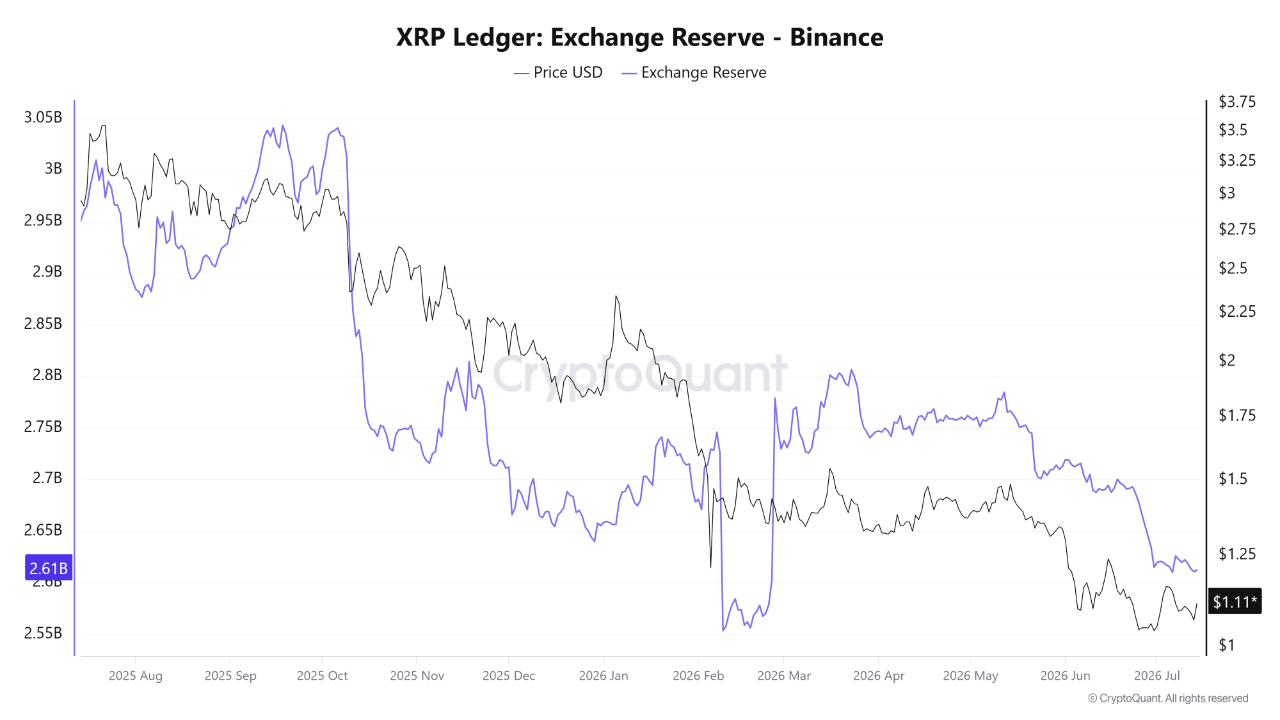
Binance’s XRP reserves have dropped to their lowest level since February, according to CryptoQuant data shared by Arab Chain.

The decline suggests a continued reduction in the amount of XRP held on the world’s largest cryptocurrency exchange.

Notably, Binance’s XRP reserves fell to about 2.61 billion XRP at the start of July. They have since stabilized around that level, as no major inflows have been recorded to replenish the exchange’s reserves.

XRP Price Drops Despite Lower Exchange Supply

Amid the decline in reserves, XRP’s price fell to around $1.06 over the same period. This suggests that lower exchange balances alone were not enough to trigger a price recovery.

Essentially, broader market conditions continue to drive XRP’s performance. Liquidity, trading activity, and investor sentiment remain the primary factors influencing the price, even as exchange-held supply declines.

Lower Binance Reserves May Reduce Selling Pressure

Binance’s reserves remaining at 2.61 billion XRP mark the lowest level in five months. Lower exchange balances indicate that investors are moving tokens off trading platforms, reducing the amount of XRP readily available for sale.

While the decline in reserves has not yet pushed prices higher, it could help reduce selling pressure over the medium term if demand improves. A tighter exchange supply, combined with stronger buying activity, could create more favorable conditions for XRP.

Notably, Binance held more than 3 billion XRP in reserves a year ago. At the time, XRP was trading above $3.25, near its cycle peak. However, the price later declined by about 72%, reaching $1.04 earlier this month.

During the same period, Binance’s XRP reserves largely mirrored the price movement, declining steadily over the past 12 months as XRP fell. This runs counter to the popular view that declining exchange reserves necessarily indicate accumulation and are inherently a bullish signal.

Meanwhile, given how far the bear market has progressed, the situation could be stabilizing, potentially opening the door for a bullish recovery. At press time, XRP was trading at $1.11, up 4.62% over the past 24 hours. Its weekly performance has also returned to positive territory.

Selling Pressure Still Weighs on XRP

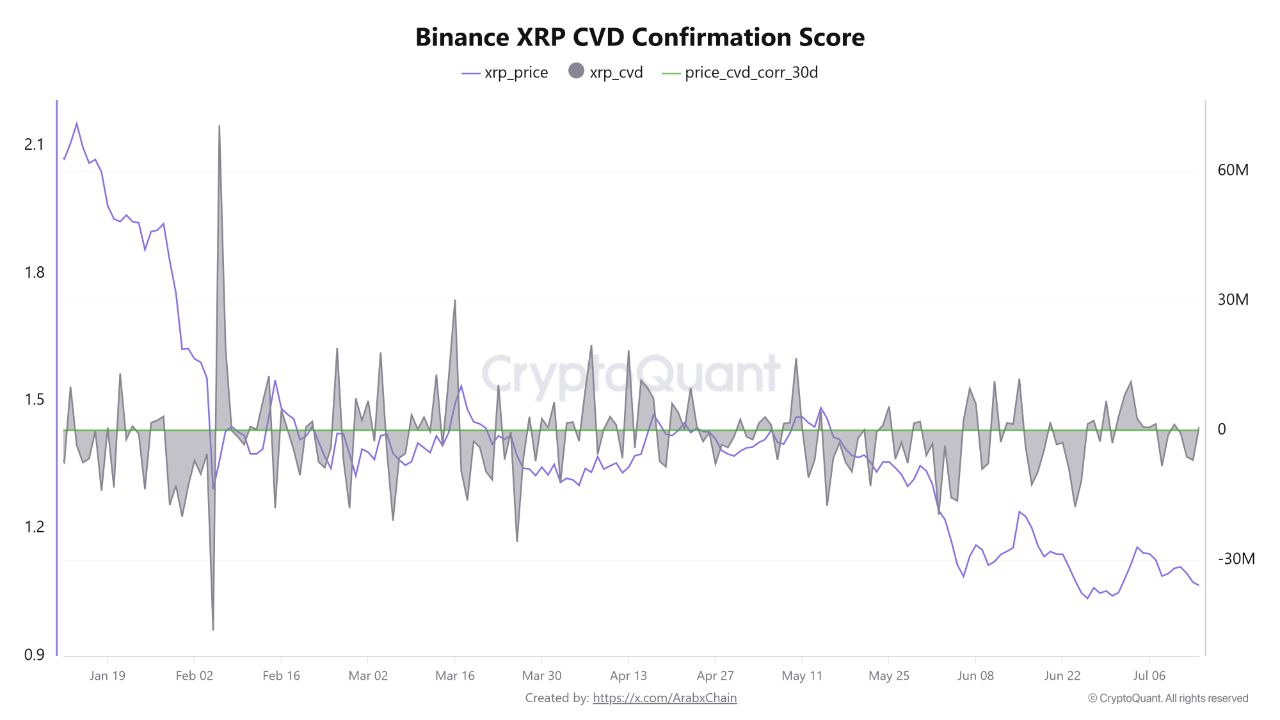
In a separate CryptoQuant analysis, Arab Chain highlighted Binance’s Cumulative Volume Delta (CVD) Confirmation Score as evidence of continued selling pressure. The CVD stood at approximately -6.93 million, indicating that sell orders continued to outpace buy orders on the exchange.

Meanwhile, the 30-day Price-CVD Confirmation Score stabilized at around 0.84, suggesting that the relationship between price action and order flow remains intact. However, buying activity is still too weak to support a sustained reversal.

Arab Chain said that while declining exchange reserves can tighten available supply, XRP’s price will continue to depend on stronger demand, improved liquidity, and sustained buying pressure. A positive CVD, along with a stronger Confirmation Score, could signal renewed buying interest and support a broader recovery.

Hoskinson Says RealFi Will Become a Major TVL and Transaction Driver for Cardano

0

Cardano founder Charles Hoskinson has expressed strong confidence in the network’s RealFi initiative, arguing that it could significantly expand Cardano’s DeFi ecosystem.

His remarks come shortly after the launch of RealFi’s Phase 1 testnet, which has already attracted strong early participation and fueled community growth.

Hoskinson Explains How RealFi Can Increase Cardano’s TVL

In a statement today, Hoskinson highlighted RealFi’s ability to increase Cardano’s total value locked (TVL), one of the most important metrics for measuring capital deposited across DeFi protocols.

According to him, users who participate in RealFi must deposit assets into the protocol’s smart contracts. Those funds remain locked while generating yield, which the protocol later distributes back to participants.

As more users deposit assets and interact with the platform, Cardano’s TVL naturally grows. In addition, every deposit, withdrawal, and yield distribution generates new on-chain transactions, increasing overall network activity.

“The cool thing about RealFi is that it is gonna be a big TVL and TX generator for Cardano,” Hoskinson said. 

A Catalyst for Cardano’s DeFi Expansion

Furthermore, Hoskinson described RealFi as a key pillar of Cardano’s long-term DeFi strategy. He expects it to become one of the network’s most important financial applications since the protocol revolves around yield-generating deposits.

He also argued that initiatives like RealFi will strengthen Cardano’s DeFi ecosystem by attracting more liquidity and expanding the network’s financial infrastructure.

Since users deposit assets into yield-generating smart contracts, the protocol creates additional opportunities to issue and utilize stablecoins within the network. As a result, RealFi could improve liquidity while supporting the broader growth of Cardano’s on-chain financial ecosystem.

Phase 1 Testnet Gains Strong Early Traction

Hoskinson’s optimism follows encouraging progress during RealFi’s Phase 1 testnet.

Earlier, he described the launch as a “wonderful start” after the RealFi team released participation figures from its Pioneer Season. According to the update, more than 1,000 users have joined the testnet, while nearly 500 verified wallets are actively participating in Phase 1. In addition, the project has attracted over 2,000 followers on X and more than 420 new members on its Discord server in just over a week.

The RealFi team emphasized that these numbers represent more than simple user growth. Instead, they reflect rising interest in developing a transparent stablecoin backed by real-world assets.

RealFi Aims to Connect DeFi With the Real Economy

Cardano’s RealFi is designed to connect DeFi with real-world financial services by using blockchain liquidity to support initiatives such as microfinance and small business lending. The project aims to improve financial access for underserved communities while showcasing practical blockchain applications beyond trading.

During its initial testing phase, users can swap test assets for USDr, stake USDr for sUSDr, and later redeem their tokens. Cardano founder Charles Hoskinson said RealFi is progressing toward mainnet launch, which could boost Cardano’s DeFi growth and expand its real-world adoption. 

In the meantime, Cardano’s TVL stands at $71.56 million, which is significantly lower than Ethereum’s $41.09 billion and Solana’s $4.91 billion. 

The XRP Ledger is the Place to Use Tokenized RWAs, Not Just Hold: Evernorth

0

Evernorth CEO Asheesh Birla says the XRP Ledger is evolving into a platform where tokenized real-world assets can be actively used, not simply stored.

The value of tokenized real-world assets (RWAs) on the XRP Ledger has climbed 388% from $900 million at the start of the year to $4.4 billion, according to data from RWA.xyz. But for Evernorth CEO Asheesh Birla, there should be more beyond just the general concept of tokenization.

Birla claims that the next phase of tokenization is not about placing traditional assets on a blockchain. Instead, the real opportunity lies in making those assets productive while they remain in their tokenized form.

Tokenized Assets Need Utility, Not Just Presence: Evernorth

Birla compares the future of tokenized finance to how traditional financial markets have operated for decades. Notably, capital naturally gravitates toward platforms where it can be deployed with the least friction. Those with the deepest liquidity and the most competitive pricing also attract market users.

Rather than remaining idle in digital wallets, the Evernorth CEO expects tokenized assets to become increasingly dynamic. Since they are more liquid, they should provide better yields based on an owner’s risk appetite. Rebalance portfolios as market conditions change, and interaction with lending and collateral services should also be easier and automated.

From Birla’s perspective, tokenization is only the foundation. The real deal is if a network allows an asset to actively participate in broader financial activities.

XRP Ledger Offers Beyond Tokenization

According to Birla, several pieces of that infrastructure are already available on the XRP Ledger.

The network has already developed a built-in decentralized exchange and supports near-instant transaction settlement. Notably, several financial institutions have acknowledged the XRP Ledger as a good fit for cross-border payments, with HSBC calling it a “game changer.”

Additional features, including on-chain lending and collateral vaults, are also under development, creating an environment where tokenized assets can be used rather than simply stored.

He emphasized that this is not a zero-sum game, as multiple networks will support tokenized assets as the sector expands.

However, those like the XRP Ledger, offering deep liquidity, efficient settlement, reliable governance, and broad asset availability, will attract more adoption over time. The over 380% growth in RWAs on the Ledger this year is already reflecting that.

Ripple’s RLUSD Is an Early Proof of Expanding On-Chain Liquidity

Birla also pointed to the RLUSD stablecoin as an early example of this trend taking shape on the XRP Ledger.

Citing Evernorth’s June data, he highlighted that RLUSD has grown to approximately $1.6 billion in circulation, while more than 50% of its liquidity now resides on the XRP Ledger, up from just 17% in April. At the time of writing, however, the stablecoin’s circulating supply has dropped to $1.48 billion, with 59% of it on the XRP Ledger.

Birla explained that stablecoins play a central role in digital finance because they provide the liquidity needed for payments, lending, settlement, and other financial services. The increasing concentration of RLUSD liquidity on the XRP Ledger suggests users are choosing its infrastructure, as it allows capital to move quickly and efficiently.

Notably, these comments come days after Birla encouraged crypto treasury companies to move beyond building portfolios. As the industry moves to its next phase, he urged them to explore means of generating returns from their stash, recommending tokenization on the XRP Ledger.

XRP Boasts 3.13% Market Share: Could It Reach $50 in a $100T Crypto Market?

The XRP community is discussing the token’s long-term value based on its current share of the cryptocurrency market.

XRP currently accounts for 3.13% of the total crypto market, which stands at $2.15 trillion today. Meanwhile, XRP commands only $66.74 billion of that market, with its price at $1.06.

This valuation makes XRP the sixth-largest cryptocurrency, behind USDC, BNB, USDT, Ethereum, and Bitcoin.

Of all crypto assets, only Bitcoin has a trillion-dollar valuation. As for valuations above $100 billion, only Ethereum and Tether are in that range.

During the peak of the crypto bull market last year, however, the picture looked very different. Bitcoin’s market capitalization exceeded $2 trillion, Ethereum’s rose above $500 billion, and XRP’s surpassed $210 billion. Today, all three have lost more than 50% of their value.

Regardless of the current market conditions, there is strong optimism that another bull market will emerge and crypto asset valuations will expand severalfold once again.

$100 Trillion Outlook

Some market commentators and industry leaders have forecast a future in which the total cryptocurrency market reaches $100 trillion. In such a scenario, Bitcoin would likely command more than half of the market, implying a market capitalization of $50 trillion or more.

At that valuation, Bitcoin would trade above $2.5 million per coin, representing roughly a 40x increase from today’s price of $62,500.

Meanwhile, the altcoin market would account for nearly $50 trillion in market capitalization. Given XRP’s prominent position today, many believe it could continue to maintain a meaningful share of the market in the years to come.

Hypothetical XRP Price Levels

Using a theoretical $100 trillion total crypto market capitalization, XRP’s price at different market dominance levels would be:

  • 1% dominance: $16.01 per XRP
  • 2% dominance: $32.03
  • 3.13% dominance: $50.10
  • 5% dominance: $80.08
  • 10% dominance: $160.15

These estimates assume XRP maintains the same share of the overall cryptocurrency market as the industry’s total value grows. However, actual market conditions could differ significantly.

History of XRP’s Market Share

During the last bull market, XRP’s market share climbed to 5.58% in January 2025 and 5.52% in July of the same year. In the 2021 bull run, it also exceeded 6%.

In 2017, XRP’s market share reached as high as 31%, while during the 2014 bull run, it stood at approximately 20%.

XRP Market Share| TradingView

Essentially, major bull markets have seen XRP’s market share increase significantly, which naturally supports a more optimistic outlook for its potential valuation in a $100 trillion crypto market.

However, nothing is guaranteed. Several established cryptocurrencies have already been overtaken by newer projects such as Hyperliquid (HYPE), DeXe, and VVV, pushing some older coins further down the rankings.