Home Blog Page 63

Cardano Founder Says Midnight Japan Announcement Is Still on Track Despite SBI–Solana Deal

0

Cardano founder Charles Hoskinson has reassured the community that a major announcement involving Midnight is still on the way.

His comments came after rumors emerged that the highly anticipated Japanese partnership he teased in June had collapsed following a partnership between Japanese financial giant SBI Group and the Solana Foundation. 

SBI-Solana Partnership Sparks Speculation 

As previously reported, SBI Group partnered with the Solana Foundation as part of efforts to position Japan as a leading hub for institutional on-chain finance in Asia. Consequently, some Cardano community members questioned whether SBI was the same company Hoskinson had referenced several weeks earlier.

One community member suggested that the newly announced SBI–Solana partnership could have been the deal Hoskinson had previously hinted at, arguing that the agreement may have fallen through before SBI ultimately chose Solana.

The speculation quickly gained traction because Hoskinson had earlier revealed that Midnight was close to securing a significant partnership in Japan.

Hoskinson Separates SBI Partnership From Midnight Deal

However, Hoskinson swiftly dismissed the rumors and made it clear that the SBI–Solana partnership is unrelated to Midnight.

According to the Cardano founder, the SBI collaboration had “nothing to do” with the agreement he has been discussing. He also stressed that the anticipated announcement is “still pending,” indicating that the rollout remains ongoing rather than being canceled.

Notably, his clarification reassures the Cardano community that the previously teased Japanese initiative has neither been replaced nor abandoned. 

Initial Midnight Teaser

Hoskinson’s latest remarks refer back to comments he made in June, when he revealed that Midnight secured a significant partnership with a major Japanese company.

At the time, he admitted he was surprised that Cardano had managed to attract such a prominent partner. Although he declined to identify the company, he disclosed that the initiative revolves around NIGHT liquidity in Japan.

Following his latest clarification, the Cardano community continues to await the long-promised announcement.

Why the Midnight Partnership Matters

Midnight remains one of the most significant technological developments within the Cardano ecosystem. Designed as a complementary privacy-focused blockchain, it enables organizations to process sensitive financial, enterprise, and regulatory data while preserving the security and transparency of Cardano’s public ledger.

Since its launch, Midnight has already attracted several high-profile partners, including Google and Telegram-related AlphaTON Capital. Consequently, a successful partnership with a major Japanese company could further strengthen Midnight’s institutional credibility and expand its presence in one of Asia’s most important financial markets.

Bitcoin OG Wakes Up to $283M Profit but Misses an Extra $363M

A long-dormant Bitcoin whale has resurfaced after eight years, moving 5,908 BTC worth about $382.67 million to a new wallet.

Blockchain tracker Lookonchain called attention to the movement on X. Notably, the wallet had been inactive since receiving the coins in 2018, when the holdings were worth roughly $99.64 million. At the time, Bitcoin traded at around $16,865, with the bear market still in its early stages.

Eight-Year Hold Still Earns $283M

Interestingly, the investor is moving the coins during another bear market. Despite doing so, the investor is still sitting on an estimated $283 million profit.

At Bitcoin’s current price of around $64,700, the 5,908 BTC is worth approximately $382.67 million. The stash has nearly quadrupled in value since it was acquired.

Meanwhile, the transfer has drawn attention because Bitcoin is trading about 49% below its 2025 all-time high.

Source: Arkham
Source: Arkham

How Much Profit Was Missed?

If the investor had sold at Bitcoin’s 2025 peak of $126,200, the 5,908 BTC would have been worth about $745.6 million.

At that price, the investor’s portfolio would have been worth approximately $745.6 million. Accordingly, the total profit would have reached around $645.95 million, representing a 648% return on investment after nearly a decade of holding.

Compared with its current value, the wallet is worth about $362.9 million less than it would have been at the peak. In other words, the investor missed out on that amount in unrealized gains by not selling earlier.

Source: Arkham
Source: Arkham

Early Bitcoin Holders Remain Well Ahead

The transfer highlights how profitable early Bitcoin investors remain despite the market downturn. Even after Bitcoin’s 50% decline from its record high, those who accumulated the asset before its major bull runs are still sitting on significant gains.

Meanwhile, with the bear market approaching one year, market watchers are looking for signs that the downturn is ending. In a post on X, market commentator Seth said selling Bitcoin now is “a crime”. He argued that “only poor people” sell after a 54% correction and $100 billion in liquidations.

The comment suggests that Bitcoin’s downside risk is now lower than its upside potential, given how much the asset has already declined.

Healthy Buying Signals

CryptoQuant analyst TopNotchYJ recently said Bitcoin’s on-chain data suggests the market is entering a healthy accumulation phase, with investors steadily buying despite risks from elevated leverage.

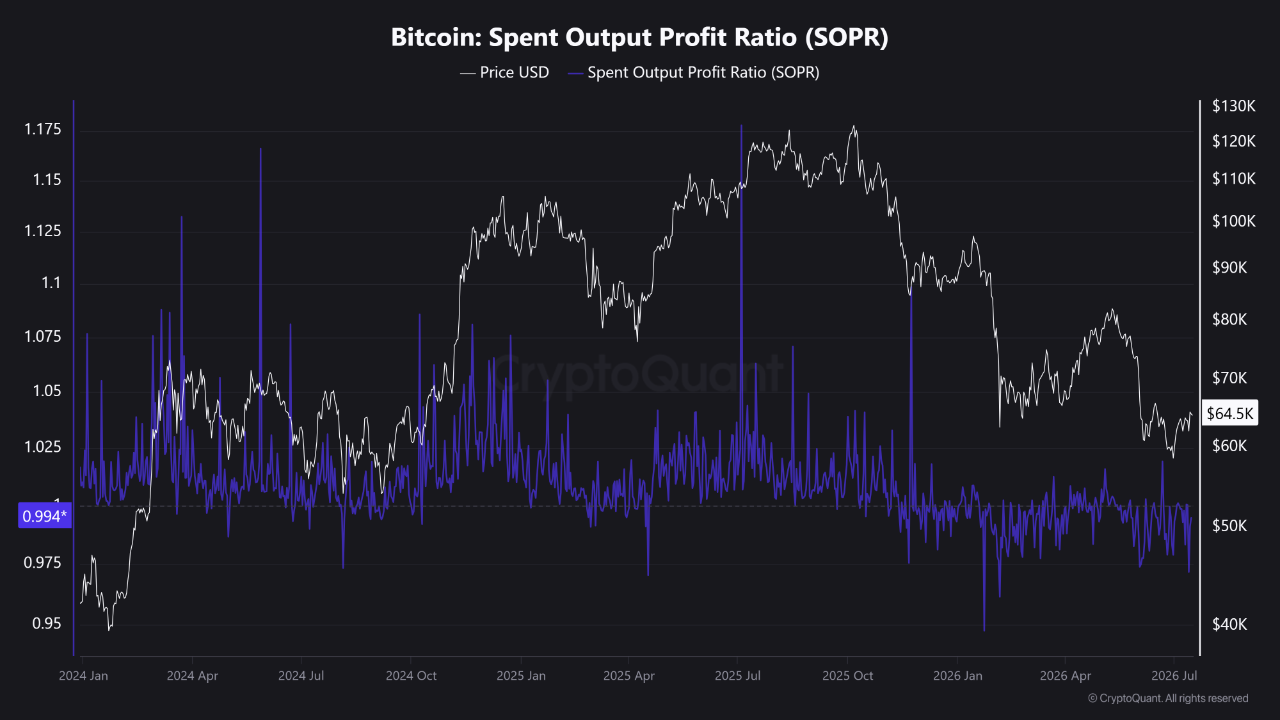
He said Bitcoin has transitioned from the speculative bull market of 2025 into a “structural consolidation phase,” with institutions increasingly driving demand. Key indicators, including a stable SOPR near 1.0 and declining exchange reserves, suggest balanced trading activity and growing long-term accumulation.

Bitcoin is also seeing more BTC move into ETFs and institutional custody, reducing the amount of supply held on exchanges.

XRP Has Now Entered the Same Buy Warning Zone as Bitcoin

0

XRP has entered the same macro buy warning zone as Bitcoin, a development that marks the beginning of major multi-year accumulation windows. 

This rare signal has often appeared near the start of multi-year accumulation periods, and this has led many market participants to believe the current phase could present an attractive entry point if the market follows its historical cycle.

XRP Rebounds After a Deep Correction

Currently, XRP trades at around $1.12 after recovering slightly from the cycle low recorded in late June. The token briefly fell to $1.01, bringing it within touching distance of the important $1 psychological support level for the first time in about 19 months.

The decline completed a massive correction that erased more than half of XRP’s value from its cycle peak of $3.6, reached during the summer of 2025. Now, XRP has entered a buy warning zone similar to the one it slipped into in 2024 before the meteoric surge.

This structure began with the major pivot low of $0.3823 formed in July 2024. From there, XRP completed a five-wave rally amid stronger trading volume and a breakout above a Fibonacci extension level, pushing toward the $3.6 all-time high in July 2025.

However, from here, XRP has continued to correct. The latest pullback still looks like a normal correction, not the start of a new bearish trend, and seems similar to the same demand zone from July 2024.

XRP Slips Into Buy Warning Zone

Notably, Bitcoin has also slipped into such buy warning zone. However, the current low has not yet produced the signals that have marked every major XRP bottom in the past. 

A confirmed bottom would require a one-two-three-four-five impulse within about four weeks, rising trading volume throughout the move, and a close above the key Fibonacci level. Until these signals appear, the chances that XRP has already reached its cycle bottom remain lower.

Important Price Levels Remain in Focus

The first major resistance level sits near the 0.382 Fibonacci retracement at about $1.18. Above that, the 20-period exponential moving average stands near $1.22, a level that has stopped every recent recovery attempt.

On-chain cost basis data also points to these areas as major resistance. About 22.8 million XRP sits between $1.18 and $1.19, while another 27.4 million XRP is concentrated between $1.21 and $1.22. That supply could make it more difficult for buyers to push prices higher. 

Support remains just as important. XRP continues to hold above the $1 level, but a clear move below that price could open the door to a decline toward $0.80. 

If the token falls below the 0.5 Fibonacci level near $1.02, attention could shift to the 0.618 Fibonacci level around $0.87. This area aligns with a stronger support zone where the next major market bottom could develop.

What Comes Next for XRP?

Although XRP has entered the same macro buy warning zone as Bitcoin, the market still needs stronger confirmation before calling a major bottom. Traders should watch for rising trading volume, a breakout above the key Fibonacci level, and a complete five-wave impulse forming within about four weeks from the cycle low.

Every major XRP bottom has shown this combination of signals. Notably, analysts such as Casi and EGRAG Crypto still believe XRP could make one more lower low before the correction ends.

Bitcoin Shows Signs of Healthy Accumulation Despite Correction Warning

Bitcoin on-chain data suggests that the market is entering a healthy accumulation phase, with investors steadily buying the asset.

However, a CryptoQuant author warns that high levels of leverage in the market could still trigger a sharp price correction.

Notably, Bitcoin is up 1.8% over the past week, trading at $64,200, though it remains 49% below its all-time high.

In a post, CryptoQuant’s TopNotchYJ said that Bitcoin’s speculative momentum from the 2025 bull market has shifted into a “structural consolidation phase”. According to him, institutional investors are gradually accumulating Bitcoin, rather than short-term traders driving price movements.

SOPR and Exchange Reserves Signal Steady Accumulation

TopNotchYJ said Bitcoin’s aggregate Spent Output Profit Ratio (SOPR) has remained close to 1.0. This indicates that buying and profit-taking are relatively balanced, rather than showing signs of panic selling.

The market observer also pointed to Bitcoin’s declining exchange reserves. Specifically, more BTC is moving into ETFs and institutional custody instead of remaining on exchanges for trading. This decline in available supply points to growing long-term demand.

TopNotchYJ added that Bitcoin’s Estimated Leverage Ratio (ELR) and overall open interest have dropped significantly from earlier highs, reducing the risk of major liquidation events.

Chart by TopNotchYJ
Chart by TopNotchYJ

While funding rates remain slightly positive, indicating continued demand for long positions, the lack of major exchange inflows suggests that large investors are no longer selling aggressively.

Essentially, these indicators show that Bitcoin is in a healthy accumulation phase, with long-term demand becoming a larger market driver than speculative trading.

High Leverage Could Trigger Correction

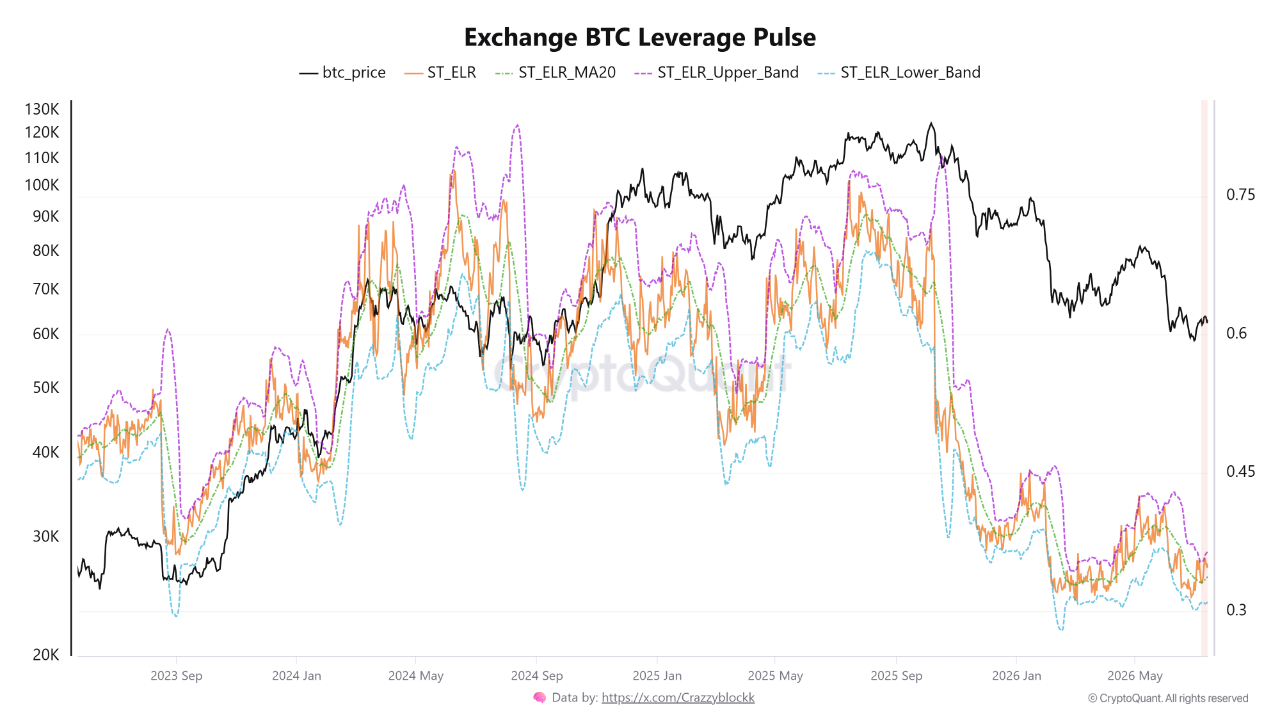
Separately, fellow CryptoQuant author Crazzyblockk shared a more cautious outlook, warning that Bitcoin’s leverage levels remain unusually high. He noted that BTC Exchange Leverage Pulse, which compares exchange open interest with stablecoin reserves, shows that the use of borrowed funds is increasing much faster than available spot liquidity. This could leave the market vulnerable to a sharp deleveraging event.

Crazzyblockk noted that leverage has risen to one of its highest levels on record, ranking within the top 5% of historical readings, and remains well above its long-term average. This suggests that the current rally is being driven more by borrowed capital than by fresh spot buying.

The analyst warned that if stablecoin reserves remain too low to absorb selling pressure, the market could experience a sharp wave of liquidations to restore balance.

Chart by Crazzyblockk

Two Different Views on Bitcoin

Essentially, the two CryptoQuant analysts interpret the market differently. TopNotchYJ believes Bitcoin is in a healthy accumulation phase, supported by lower leverage, declining exchange balances, and stable on-chain data.

Crazzyblockk disagrees, arguing that leverage remains too high compared with available exchange liquidity. In his view, this increases the risk of a sharp price correction if market conditions deteriorate.

U.S. Government Moves 54,897,092,652 Shiba Inu Seized From FTX

0

The U.S. government has transferred nearly $250,000 worth of Shiba Inu tokens seized from the collapsed cryptocurrency exchange FTX. 

The transactions, first flagged by blockchain analytics platform Arkham Intelligence, have sparked speculation that the assets are being repositioned as part of the ongoing FTX bankruptcy recovery process.

U.S. Government Transfers Nearly 55 Billion SHIB

According to Arkham Intelligence, the U.S. government executed the Shiba Inu transfers in two separate transactions.

The first and largest transfer moved 54.89 billion SHIB, valued at approximately $235,500, to an unlabeled wallet address. Authorities then sent an additional 2.32 million SHIB to the same destination wallet. Overall, the government moved a total of 54,897,092,652 (54.89 billion) SHIB tokens. 

US Government Transfers Shiba Inu

On-chain data shows that the original U.S. government wallet no longer holds any SHIB after the transfers. Meanwhile, the receiving wallet now contains 54.89 billion SHIB, with SHIB representing the wallet’s only asset. 

The SHIB transfers were not the only transactions recorded by Arkham Intelligence. Blockchain data also shows that the U.S. government transferred $19.62 million in USDT to Coinbase, alongside roughly $9.3 million worth of ETH sent to the same exchange. 

ImageSeized Assets Expected to Support FTX Creditor Repayments

The transferred SHIB originated from assets the U.S. government seized from FTX and Alameda Research after the exchange collapsed in November 2022.

Arkham Intelligence indicated that the tokens will presumably help fund repayments to creditors affected by the FTX bankruptcy. However, creditors are unlikely to receive SHIB or other cryptocurrencies directly.

Instead, the FTX bankruptcy estate has consistently liquidated recovered digital assets and distributed the proceeds in cash. As a result, creditors receive U.S. dollar payments based on cryptocurrency prices at the time FTX filed for bankruptcy in November 2022, rather than at current market values.

FTX Repayment Program Nears $9.5 Billion

The latest government wallet activity comes as FTX continues to make substantial repayments to creditors. On March 31, 2026, the bankruptcy estate completed its fourth distribution round, paying $2.2 billion to eligible creditors. That payment increased the total amount distributed to around $9.5 billion.

According to the estate, most U.S. customers and general unsecured creditors have now recovered 100% of their approved claims, while convenience class claimants have received payouts of up to 120%.

The March distribution followed three earlier repayment rounds completed in February, May, and September 2025. Meanwhile, FTX also began processing payments to preferred equity shareholders in late May 2026, marking another milestone in the bankruptcy proceedings. 

XRP Withdrawal Activity Hits 5-Month Extreme on Coinbase as Exchange Flows Turn Negative

XRP users are increasingly moving tokens away from major cryptocurrency exchanges.

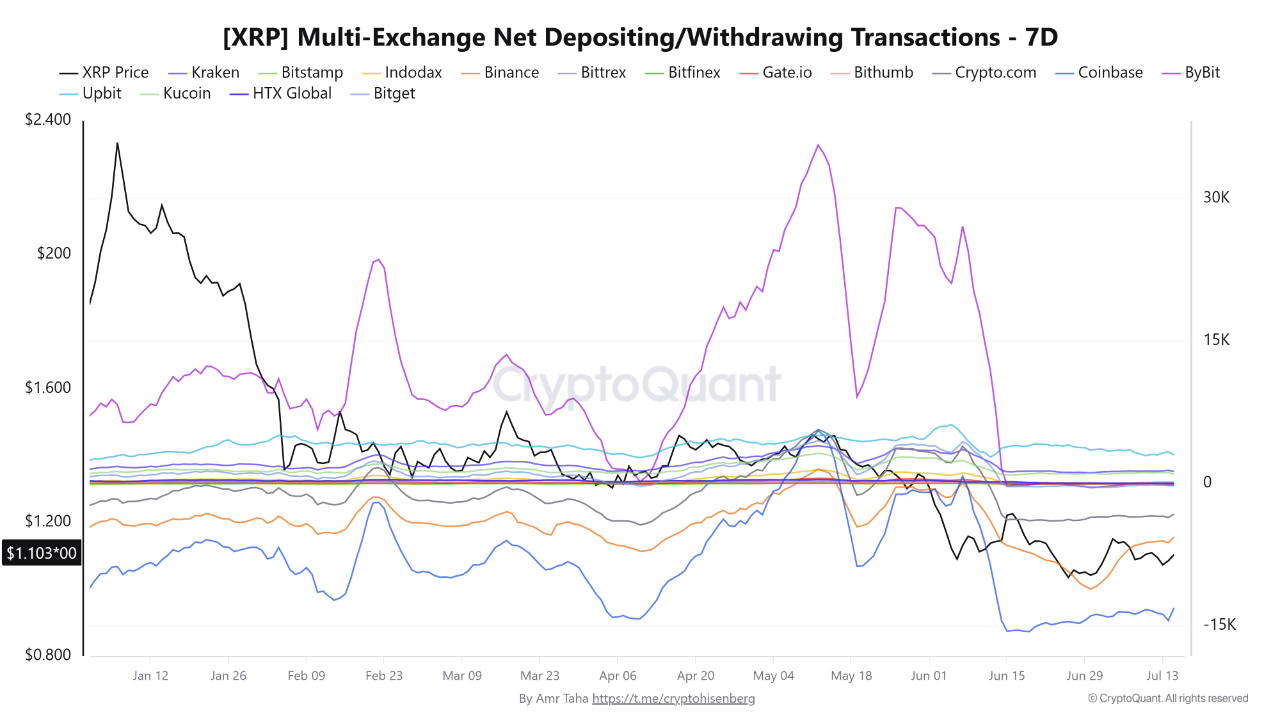
On-chain data shows that withdrawals are now exceeding deposits across Coinbase, Binance, and Bybit.

According to CryptoQuant analyst Amr Taha, Coinbase recorded its strongest withdrawal-heavy seven-day period in about five months. Binance also returned to levels last seen in February.

The shift points to a change in exchange-user behavior, although XRP’s price has remained mostly stable.

Coinbase Sees Strongest Withdrawal Trend Since February

Taha said Coinbase’s seven-day net deposit/withdrawal transaction count fell to around -13,000 on July 15. This marked the exchange’s most negative reading since mid-February.

The latest figure was lower than the approximately -12,300 recorded on Feb. 14. That represents a decline of about 700 transactions, or 5.7%, showing a wider gap between withdrawals and deposits than seen in recent months.

The report added that Coinbase’s current negative reading is about 2.3 times larger than Binance’s. This makes Coinbase the exchange with the strongest withdrawal bias among the three platforms.

Binance Returns to February Levels as Bybit Undergoes Major Shift

Binance also saw a significant drop in net transaction activity. Its seven-day reading declined to roughly -5,600 transactions, a level close to what was recorded on Feb. 11.

Bybit experienced the biggest change in trend. Its seven-day metric fell from around +27,000 transactions on June 7 to approximately -220 by July 15. That represents a swing of about 27,220 transactions in 38 days.

However, Taha noted that Bybit’s latest reading remains near neutral. This suggests that the exchange’s earlier deposit-heavy activity has faded rather than shifted into unusually strong withdrawal demand.

Exchange Flows Change While XRP Price Remains Stable

With Coinbase, Binance, and Bybit all showing negative seven-day readings at the same time, Taha said the data points to a move toward withdrawal-heavy XRP activity across exchanges.

Despite the change in exchange flows, XRP continued trading near $1.10. This suggests that the rise in withdrawals has not yet led to immediate price gains.

The pundit also clarified that the metric tracks the number of deposit and withdrawal transactions, not the amount of XRP transferred or its dollar value.

As a result, the data shows changes in exchange-user behavior but does not reveal the size of the holdings moved or where the withdrawn XRP was ultimately sent.

Cardano Surpasses TRON in ETF Demand as Over $44M Flows Into ADA Investment Products

0

Cardano exchange-traded funds (ETFs) have attracted stronger investor inflows than TRON, underscoring growing institutional confidence in the Cardano ecosystem.

According to data compiled by Blockworks, Cardano-linked ETFs recorded $37.2 million in net inflows during 2025. The momentum has continued into the current year, with the products already attracting over $6.9 million in additional net inflows.

In contrast, investment products tied to TRON experienced substantial capital outflows over the same period. Blockworks data shows that TRON ETFs lost $33.38 million in 2025, while investors withdrew another $17.47 million from TRX-linked funds this year.

The contrasting performance suggests that institutional and professional investors continue allocating capital to Cardano despite broader market volatility. 

Cardano and TRON ETFs

Cardano ETFs Outperform TRON in AUM and Monthly Flows

Cardano’s ETPs currently manage $48.3 million in assets under management (AUM) across eight active investment products. Some of the top offerings include 21Shares Cardano ETP (AADA), WisdomTree Physical Cardano, and Bitwise Physical Cardano ETP (RDAN)

These regulated investment products trade outside the United States, allowing investors in multiple international markets to gain exposure to ADA without directly buying or holding the cryptocurrency.

Moreover, recent investment activity also favors Cardano. Over the past 30 days, the eight Cardano ETPs attracted $1.17 million in fresh capital. Meanwhile, TRON’s exchange-traded investment products brought in just $534,000 during the same period.

The gap also extends to overall assets under management. While Cardano’s eight ETPs oversee $48.3 million in AUM, TRON currently has only two active ETPs with a combined $29 million in AUM.

International Demand Grows Ahead of Potential U.S. ETF

The latest inflows have drawn attention across the Cardano community because they originate entirely from markets outside the United States.

Although U.S. investors still lack access to a spot Cardano ETF, Grayscale has already filed an application for one. Market observers expect the U.S. SEC to decide on the proposal later this year.

Current expectations point to a potential decision by October 2026, provided the regulatory timeline remains on schedule. The process gained momentum after CME Group launched Cardano futures in February 2026, triggering the SEC’s six-month regulated market observation period. Once that requirement concludes on August 9, 2026, ADA will satisfy a key eligibility criterion for consideration for spot ETFs.

If the SEC reviews Grayscale’s application under its streamlined 75-day approval framework, the agency could issue a final decision as early as October 23, 2026.

Ripple Engineering Head Reveals What’s Coming Next for XRP Ledger

0

Ayo Akinyele, Head of Engineering at RippleX, recently explained what Ripple is now focusing on as it continues expanding the XRP Ledger (XRPL). 

He shared this during the latest episode of RippleX’s Onchain Economy, where he discussed how blockchain is changing financial infrastructure and what comes next for the XRPL ecosystem.

Akinyele said traditional finance is gradually being rebuilt with blockchain technology. He believes the on-chain economy creates new opportunities by changing how value is defined and transferred. 

Notably, he confirmed that, as Head of Engineering at RippleX, his team focuses on building the features that allow financial institutions to develop their solutions directly on-chain.

Ripple Builds Features for Institutional Adoption

Akinyele said RippleX is currently focused on developing features that support several important financial services on the XRP Ledger. 

These include tokenization, stablecoin payments, token trading on the ledger, and the creation of on-chain financial markets. He said these capabilities help build the internet of value by giving different types of assets more practical use.

He also noted that RippleX has learned from working with financial institutions that many of them prefer infrastructure that closely reflects how they already operate. 

Essentially, RippleX aims to rebuild processes on blockchain rails instead of replacing their existing systems. 

He added that the decentralized design of the XRP Ledger provides the shared infrastructure that traditional finance has been missing and also improves reliability, security, accuracy, and operational efficiency.

New Features Move XRPL Beyond Payments

Looking back at developments earlier this year, Akinyele said RippleX introduced features that made permissioned trading possible on the XRP Ledger. 

He called attention to additions such as permissioned domains and permissioned decentralized exchanges (DEXs), and explained that they allow financial institutions to verify the participants involved in their trading activities.

According to him, these features are an important step because they expand the XRP Ledger beyond settlement and payment use cases. 

They also make it possible for regulated institutions to participate in more advanced on-chain financial activities while confirming the identities of those involved in their trading flows.

RippleX Now Moving Toward On-Chain Credit and RLUSD

After introducing those features, RippleX has turned its attention to on-chain credit, according to Akinyele. He said the team is now working on enabling lending and borrowing against digital assets that represent real-world value. 

In addition, RippleX plans to connect these capabilities with RLUSD, Ripple’s stablecoin. He explained that combining on-chain credit with RLUSD brings together the key services financial institutions have been looking for. 

These include token issuance, token trading, collateral management, credit, and yield generation. He believes that bringing all of these functions together on the XRP Ledger will create a type of on-chain economy that TradFi has not seen before.

How XRP Fits Into This Plan

Akinyele also mentioned how XRP fits into these plans. He said XRP’s utility comes from Ripple’s effort to build a trusted financial operating system that supports use cases for financial institutions in their day-to-day operations.

He called attention to comments Ripple CEO Brad Garlinghouse has repeatedly made about XRP being the company’s north star. According to Akinyele, Ripple continues to build around trust, XRP’s utility, and XRP’s role in providing liquidity. 

He said these features will help financial institutions build real financial markets on-chain and operate at a speed that has not been possible before.

Cardano First Hydra-Powered DEX Pauses Operations Amid Sustainability Challenges

0

The Cardano ecosystem has suffered another setback after a decentralized exchange powered by Hydra announced that it is suspending operations indefinitely due to operational constraints.

DeltaDeFi, the first Hydra Layer 2-powered DEX on Cardano, confirmed the decision in an operational update. The announcement has reignited concerns across the Cardano community, with many viewing it as the latest addition to a growing list of ecosystem projects that have either shut down or reduced operations in recent months.

DeltaDeFi Suspends Development and Maintenance

In an update shared with its community, the DeltaDeFi team revealed that it had exhausted its operational runway. This left it with no choice but to pause the project effectively immediately.

As a result, the team will suspend both platform development and active maintenance until further notice. During the downtime, the developers plan to evaluate strategies that could enable the project to resume operations in the future.

Meanwhile, DeltaDeFi announced plans to return its remaining funds to users once sufficient minimum UTXO becomes available to process withdrawals. The team also advised users who do not automatically receive their funds to contact the developers through the project’s X account or Discord server for assistance.

How DeltaDeFi Advanced Cardano’s Hydra Ecosystem

DeltaDeFi stands out from many decentralized exchanges by building on Hydra, Cardano’s Layer-2 scaling solution designed to increase transaction throughput while reducing settlement times.

Unlike most Cardano DEXs that rely primarily on automated market makers (AMMs), DeltaDeFi adopted an order-book-based trading model. This approach delivered a trading experience closer to traditional financial markets while preserving the benefits of decentralized infrastructure.

The platform promoted features such as sub-second transaction settlement, high-speed order execution, and improved trading efficiency through Hydra’s scaling capabilities. With the project’s suspension, Cardano loses one of its most prominent real-world demonstrations of Hydra’s decentralized finance (DeFi) potential.

It bears mentioning that Hydra recently introduced v2.2.0, focused on real-world use cases, enhanced benchmarking, and optimized snapshot latency. 

Another Challenge for Cardano Builders

DeltaDeFi’s decision adds to a growing list of Cardano projects that have recently scaled back operations or exited the ecosystem altogether. Projects including JPG Store, TapTools, and contributors such as Chicken have previously cited challenges ranging from rising operational expenses and limited funding to long-term developer sustainability.

Although each project has faced its own circumstances, several common themes have emerged. These include shrinking funding opportunities, increasing operating costs, prolonged market weakness, and ongoing ecosystem governance challenges.

DeltaDeFi’s operational pause reinforces concerns that even technically innovative projects on Cardano continue to face significant sustainability hurdles despite ongoing protocol upgrades and ecosystem development. 

XRP Finally Crosses the 8M Activated Accounts Milestone After 13 Years

0

The XRP Ledger (XRPL) has officially crossed the 8 million activated accounts milestone for the first time in history.

The latest milestone confirms that the XRP ecosystem’s user base continues to grow despite the difficult market conditions that have dampened investor sentiment since Q4 2025. 

At the time of writing, the number of activated wallets had reached 8,000,688, with 688 new accounts added after the network crossed the 8 million mark earlier in the day. 

Total Activated XRP Wallets
Total Activated XRP Wallets | XRPScan

Data from XRPScan also shows that these 8,000,688 activated wallets currently hold 67.526 billion XRP, which represents the circulating supply of the token.

For context, The Crypto Basic previously reported that XRP wallets had already exceeded 8 million in the past, but those figures counted every wallet ever created, including ones that had later been deleted. 

The latest achievement only counts activated wallets, making this the first time the XRP Ledger has officially reached 8 million active accounts.

New XRP Wallet Growth Slows as Market Weakness Continues

The milestone comes even though the pace of new wallet creation on the XRP Ledger has slowed in recent months. 

Since March 2026, the network has averaged about 2,300 new accounts each day. However, it is important to note that there were a few stronger days, including 8,817 new wallets on March 19, 4,131 on May 29, and 6,221 on June 30.

The recent daily average of 2,300 is lower than the roughly 3,000 new wallets the network added each day between January and March 2026. 

This slowdown comes as a result of XRP’s recent price performance. Since reaching its all-time high of $3.60 in July 2025, the cryptocurrency has fallen by more than 70% and now trades at around $1.10.

The broader market downturn has also weighed on investor confidence. As prices continued to struggle, fewer new participants joined the XRP Ledger, leading to a slower rate of wallet creation than the network recorded during stronger market conditions.

During Q4 2025, when XRP had only recently started its decline, the XRP Ledger still averaged around 4,000 new wallets every day. The network performed even better in Q3 2025, when it added roughly 4,800 new accounts each day.

Number of New XRP Wallets

Compared with that period, the current daily average of 2,300 new wallets represents a 52% drop from the Q3 2025 level. Despite the decline, the network has continued to add new users, allowing the total number of activated wallets to gradually move beyond the 8 million milestone.

Wallet Growth Remains Positive Despite Slower Momentum

Meanwhile, data from a community-driven Rich List resource provides more context on the network’s progress this year. 

According to the figures, the XRP Ledger started the year with 7,466,236 wallets. Since then, it has added roughly 534,000 wallets, pushing the total above the 8 million mark.

Although this represents healthy growth, it falls short of last year’s performance. By the same point last year, the number of wallets had increased from 5,826,977 to 6,689,454, an increase of 862,477 wallets. 

The difference is largely due to changing market conditions. At this point last year, XRP was climbing toward a new all-time high. This year, however, the asset has dropped 70% below its $3.60 peak, and this has impacted the pace of new wallet creation.

So far in July, the XRP Ledger has added only 29,000 new wallets. At the same point in June, it had added 32,000 wallets, while the comparable period in May recorded 34,000. This shows that wallet creation has slowed not only compared with last year but also from one month to the next throughout this year.

However, participation across the XRP Ledger remains consistent. While the community celebrates the network’s first 8 million activated accounts, most continue to watch for a recovery in wallet creation. A stronger XRP price could encourage more users to join the network and help restore the faster growth seen during previous market rallies.