Home Blog Page 641

Cardano Founder Proposes Ecosystem Treasury for ADA, Midnight, and The Top 50 Native Tokens

0

Cardano founder Charles Hoskinson has made another proposal for a Cardano-focused ecosystem treasury reserve, steering community reaction.

He has been persistently seeking ways to put the ecosystem’s dormant ADA treasury to work, with a suggestion in a July 8 X post becoming the latest proposition. Recall that he had earlier proposed using a portion of the stash to buy Bitcoin or a native stablecoin, teasing that it would boost Cardano DeFi and TVL.

New Proposal for Treasury Utility

In the Tuesday tweet, Hoskinson sought the thoughts of the Cardano community on an ecosystem digital asset treasury containing ADA, Midnight, and the top 50 Cardano native tokens.

Notably, this proposal bears a resemblance to his initial suggestions, but this time, he has looked inward. Recall that his call to buy and hold Bitcoin as a treasury asset sparked widespread criticism, with skeptics alleging that a top 10 project has found solace in another major rival. 

The proposal would see Cardano set up a treasury that includes the Midnight token and other high-ranking native tokens. Data from CoinGecko shows that some of the top Cardano ecosystems include SNEK meme coin, World Mobile Token (WMTYX), Liquid Finance (LQ), Minswap (MIN), and Indigo Protocol (INDY).

Top 50 Too Broad?

Interestingly, the proposal started a community discussion as proponents shared their thoughts. Notably, a few users emphasized that the top 50 Cardano native tokens would encompass a lot of random tokens without intrinsic use cases.

A user stated that he is not a fan of using Cardano’s treasury to buy meme coins, while a few other reactions suggested that the proposal would be more productive if it focused on the top 20 or 25 Cardano-native tokens.
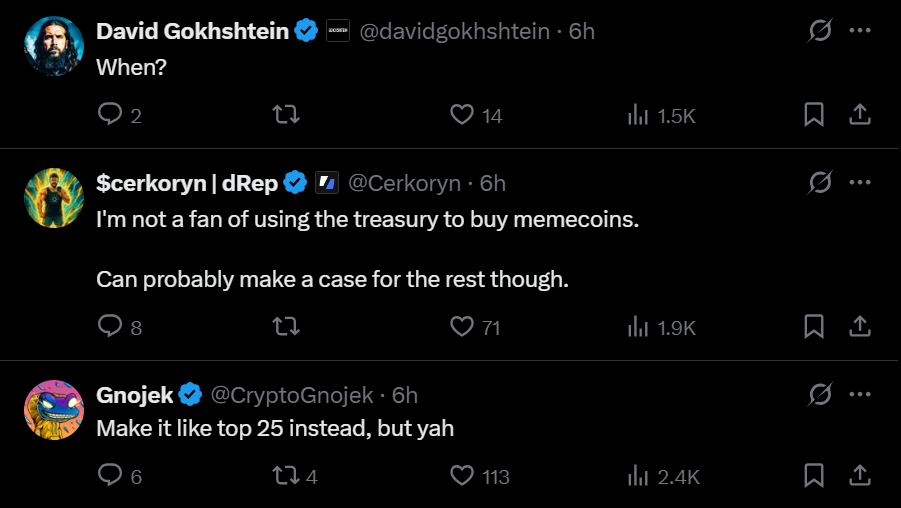
Comments On Hoskinsons Proposal
Comments On Hoskinson’s Proposal

However, while a handful of the reactions supported the proposal or something similar, a few others disagreed. For instance, a user favored Hoskinson’s initial idea of a stablecoin investment, insisting that Cardano should fix its stablecoin liquidity issues.

Remarkably, Hoskinson’s proposals all aim at moving Cardano’s treasury from an unmanaged single-asset on-chain reserve to a multiple-coin off-chain treasury. He believes this would generate yield for the ecosystem and, in turn, boost reserves.

XRP Sees Massive $1.9B Volume on Upbit Over an Hour: What’s Happening?

The XRP market recently witnessed an extraordinary uptick in volume on South Korean exchange Upbit, triggering speculation among pundits.

Besides the unexpected spike in volume, XRP also saw impressive inflows on the Upbit exchange within a short period, compounding investor curiosity. Notably, XRP community figure and game designer Chad Steingraber first called attention to the series of anomalies in multiple posts.

XRP Sees Massive $1.94B Volume on Upbit 

Citing Coinglass data, Steingraber revealed yesterday that as of 2:51 PM (UTC), XRP volume on Korea’s largest exchange Upbit had skyrocketed to $1.94 billion over the span of just an hour. This represented a massive spike in volume, with the next highest volume amounting to just $90 million on Binance.

In a separate disclosure, market pundit Zach Rector also highlighted that XRP had witnessed up to $720 million netflow on Upbit over a 1-hour period as of 3 PM yesterday (UTC). Rector beckoned to Steingraber and XForceGlobal, a Korean certified Elliott Wave analyst, to discuss the anomaly.

Responding to this initial disclosure, XForceGlobal confirmed that XRP has continued to dominate in trading volume across Korean exchanges, aligning with the $720 million netflow witnessed on Upbit. He pointed out that 20% of XRP’s circulating supply is in the Korean spot market, indicating that nearly every Korean crypto investor owns XRP.

Net Inflows on Upbit Spike to $1.58B

Meanwhile, in response, Steingraber further noted several other upticks in volume and flows. Specifically, he revealed that the $720 million netflow spotlighted by Rector had increased further since then. At the time, Steingraber revealed that netflows on Upbit had increased to $1.58 billion in the hour leading to 3:29 PM yesterday (UTC). 

However, over time, the netflows cooled, but remained incredibly high, especially on the 1-hour timeframe. Notably, two hours later, as of 5:23 PM yesterday (UTC), Steingraber again disclosed that net inflows over an hour amounted to $156.84 million on Upbit, still on the high side. Data confirmed that other exchanges, including Binance, saw outflows during this period.

Possible Implications on XRP Price

Speaking on the possible implications of this netflow trend, Rector called attention to the inflow-to-valuation multiplier effect that often drives crypto markets. For context, due to this multiplier effect, every $1 in netflow into the market often leads to a much higher increase in the token’s market cap. 

However, this multiplier effect often varies. According to Rector, he identified a 235x multiplier for each dollar that entered the XRP market earlier in the day. This entails that for every $1 in netflow, the XRP market cap recorded an increase of $265. As a result, an $18 million inflow at the time led to a market cap growth of $4.27 billion. 

Nonetheless, it is important to note that these netflows into exchanges do not always translate to capital flows into the XRP market. Instead, they often represent flows into exchanges. As a result, they would not always translate directly to market cap growth.

For instance, with the $1.58 billion netflow into Upbit yesterday, a modest 25x multiplier would have led to an increase in XRP’s market cap by $39.5 billion. This would have resulted in a market cap of $173 billion, leading to a price of $2.8. Instead, XRP’s market cap only grew by $4 billion during that period, leading to a market cap of $138 billion or a price of $2.35. 

XRP has since corrected from this $2.35 high, now changing hands at $2.26 amid a mild 0.23% rise in the past 24 hours. Nonetheless, at the current point, XRP is in a comfortable position, as noted by Rector, having flipped the $2.25 mark from resistance to support.

Here’s How Much $5,000 and $15,000 in XRP Could be Worth in 15 Years

Considering the most prevalent expert projections, how much could your XRP investment today be worth over the next 15 years?

As Strategy Chairman Michael Saylor mentioned earlier this year, volatility is a “gift” in the crypto scene. Notably, this is because crypto assets have the potential to yield massive returns on modest investments over an extended period, largely due to their volatility.

XRP’s Volatility Could Yield Massive Returns

XRP, the third-largest cryptocurrency excluding stablecoins, also features a similar volatility. For instance, during the 2017/2018 bull run, XRP rallied from $0.0055 in March 2017 to $3.8 in January 2018. Notably, this marked a 68,990% increase in just 10 months.

To put things into perspective, if an investor had committed $10,000 to XRP when it traded for $0.0055 in March 2017, they would have procured 1.81 million XRP tokens. Meanwhile, at the $3.8 peak price, these tokens would have been worth $6.9 million. This is a classic demonstration of XRP’s ability to yield massive gains through volatility.

However, some market commentators argue that the XRP market is now too mature for such rapid explosive surges. Despite this, XRP still has some impressive upside momentum left in it. In a recent case, XRP soared from $0.5 in November 2024 to $3.4 in January 2025. This represented a 580% rise in less than three months.

How Much $5,000 and $15,000 in XRP Could Be Worth in 15 Years

Now, while market participants firmly believe that XRP still has more room for growth, the extent of this expansion is uncertain. As a result, multiple analysts have continued to make projections. Amid this trend, we recently assessed how much $5,000 and $15,000 in XRP today could be worth in 2040 if any of these projections materialize.

For context, XRP currently trades for $2.26 per token. At this price, a $5,000 investment would purchase 2,212 XRP tokens. Meanwhile, if an investor commits $15,000, they would amass 6,637 tokens.

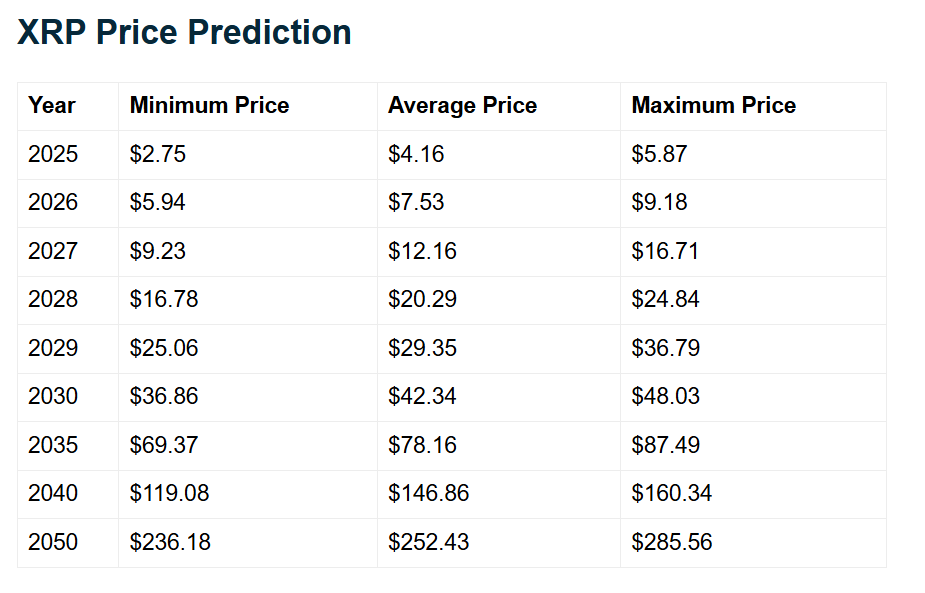
Meanwhile, Telegaon analysts believe XRP would have a minimum price of $119.08 in 2040, but they expect the price to soar to as high as $160.34 within that year. At the peak price of $160, a $5,000 investment will have grown to $354,672, while a $15,000 holding will be worth a whopping $1.064 million.

XRP Price Predictions Telegaon

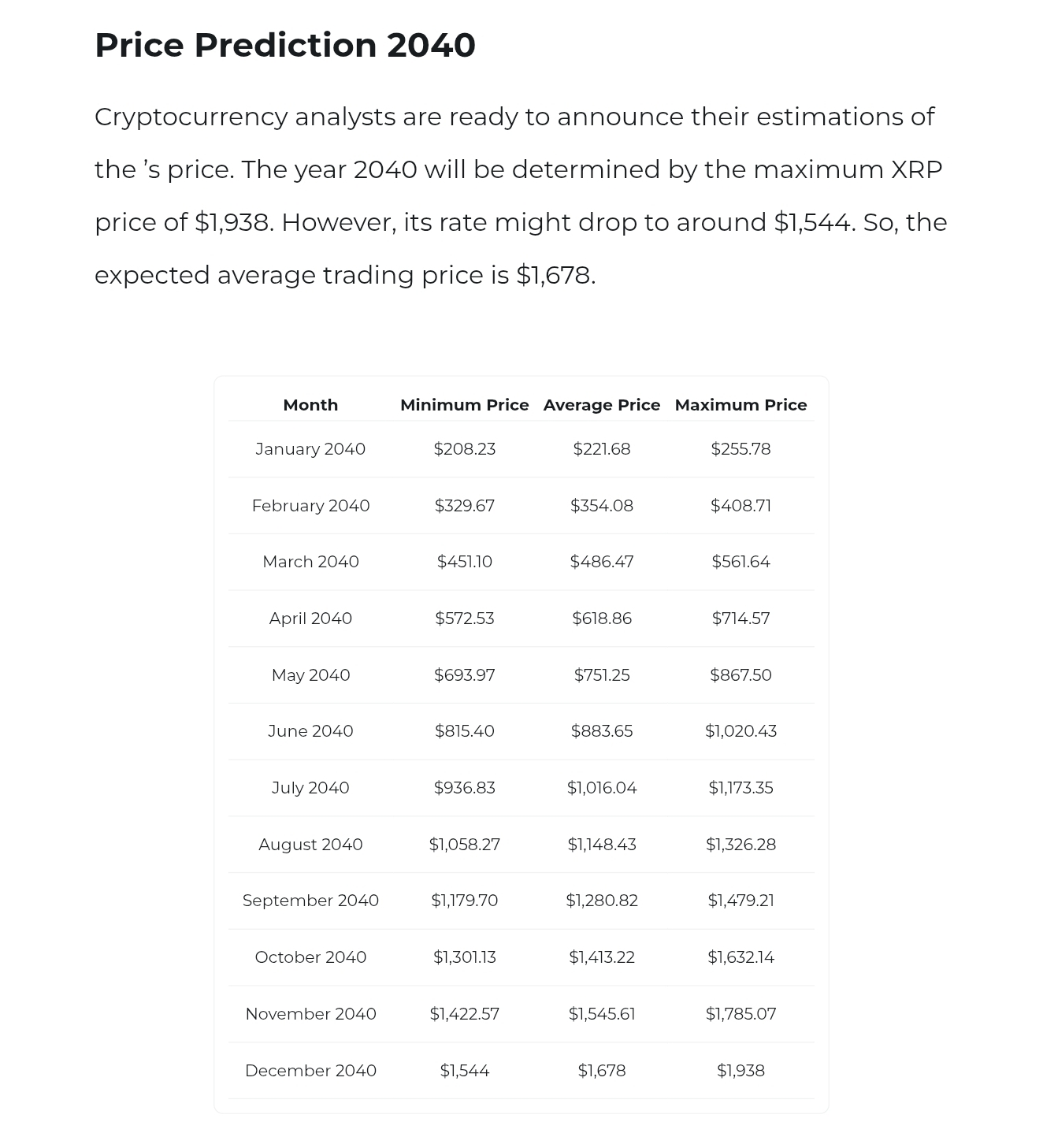
However, analysts at crypto exchange Changelly suggest XRP could start 2040 with a minimum price of $208, then reach a peak of $1,938 in December. At $1,938, the $5,000 bag will rise to $4.286 million. Meanwhile, the $15,000 investment will hit a value of $12.86 million. These returns are enough for retirement.

XRP Price Predictions for 2040 Changelly
XRP Price Predictions | Changelly

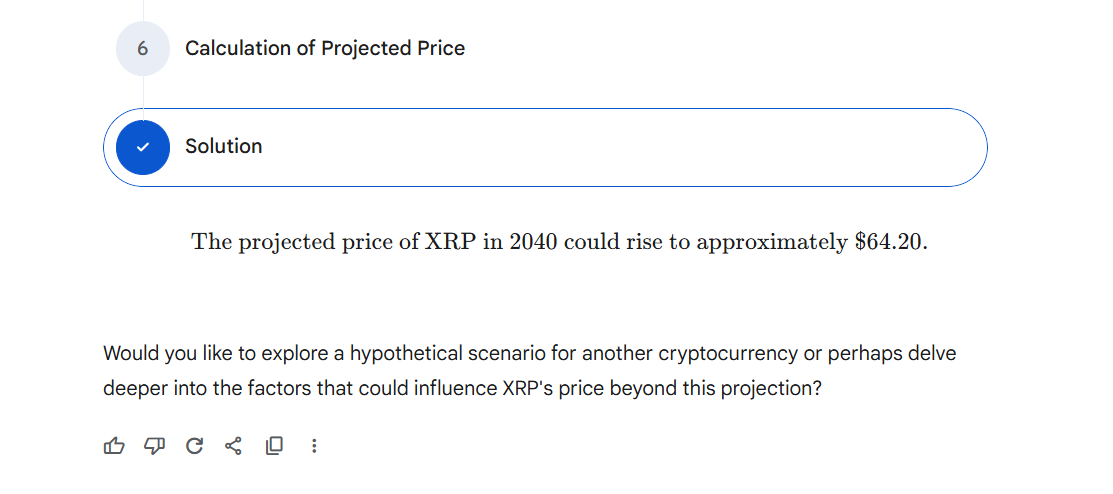
Nonetheless, Google Gemini is not as optimistic. When we asked the AI chatbot, it predicted that XRP could reach $64.2 in 2040. Notably, in such a scenario, the $5,000 holding will be worth $142,000. However, the $15,000 bag could grow to $426,000.

XRP Price Predictions Google Gemini
XRP Price Predictions | Google Gemini

XRP Rich List Update: Here’s How Much XRP You Need Now to Be a Top 10% Holder

Crypto educator Edoardo Farina has revealed important insights into XRP wallet distribution based on the latest figures from the XRP Rich List.

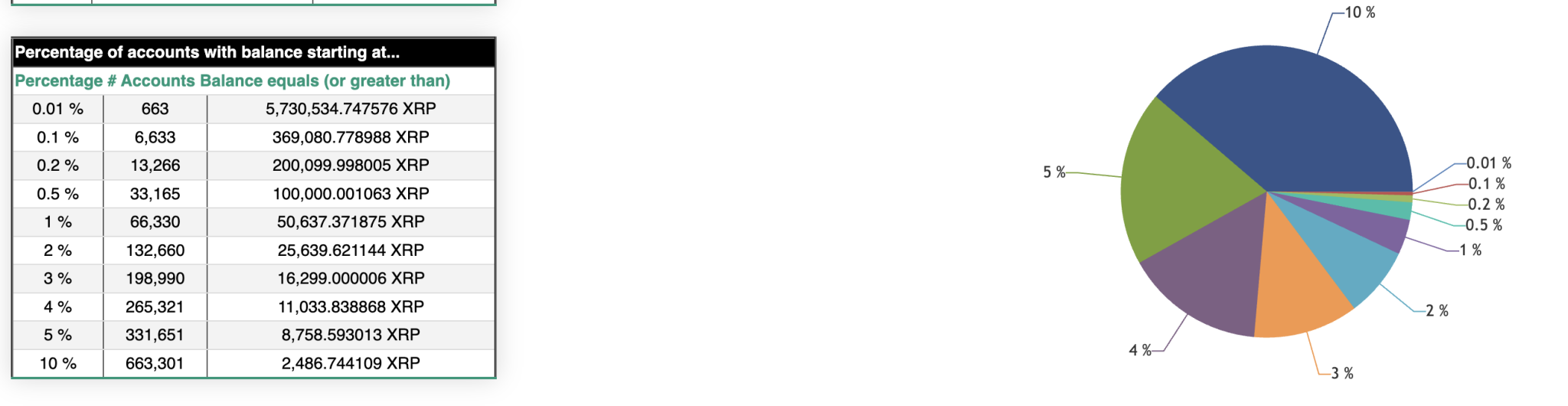
The update highlights how much more competitive the landscape has become for holders on the XRP rich list. As of today, an XRP wallet must hold at least 2,486 XRP to rank among the top 10% of all XRP wallets globally.

Meanwhile, to reach the top 5%, holders need 8,758 XRP. For the top 4%, the requirement is 11,000 XRP, while the top 3% requires 16,299 XRP. The top 2% hold at least 25,639 XRP, and to enter the top 1%, a wallet must hold a minimum of 50,637 XRP.

Notably, only 663 wallets globally hold more than 5 million XRP, placing them in the top 0.01% of all wallets. These ultra-high holdings are typically associated with founders, institutions, and exchange addresses rather than everyday retail investors.

XRP Rich List Data
XRP Rich List Data

While XRP is one of the most recognized cryptocurrencies, Farina suggested that actual global adoption remains extremely low.

Global XRP Adoption Remains Limited

Notably, the XRP Ledger has over 6.6 million active wallets. Farina argues that many of these are inactive or small “dust” wallets. Additionally, frequent users often operate multiple wallet addresses.

Taking that into account, the estimated number of individual XRP holders globally may be fewer than one million, Farina claims. Compared to a world population of eight billion, this means only about 0.01% of people currently hold any amount of XRP.

This low adoption rate supports the view that the average retail investor is still early in the broader XRP ecosystem.

Self-Custody and Long-Term Strategy

Beyond just ownership, Farina emphasized the importance of how XRP holders should store and manage their assets. Many wallets do adopt self-custody with large volumes on exchanges rather than in cold storage.

Farina also suggested that the number of holders with full control over their private keys is even smaller than the total number of XRP wallets implies.

As XRP experiences price volatility, Farina argues that most investors are likely to sell at key psychological price levels, such as $10 or $100. Only those with firm conviction, patience, and secure cold storage are likely to hold through to higher valuations, such as $1,000.

Climbing the XRP Rich List Is Becoming More Expensive

Ultimately, the XRP Rich List data also illustrates how quickly the market is expanding. Just one year ago, it required between $1,000 and $1,500 to be in the top 10% of XRP holders. 

Today, that number has increased dramatically as price appreciation and rising adoption have intensified competition.

With XRP becoming more valuable, the amount of capital required to enter the top ranks continues to rise. This trend suggests a narrowing window of opportunity for retail investors aiming to accumulate enough XRP to break into higher tiers of the Rich List.

As a result, Farina has boldly claimed that 99% of investors will eventually be priced out.

Pundit Explains Why XRP Price Still Lags Despite Spike in XRPL Transactions to 1.6M

While the XRP price is up today, it has not made any decisive upward push despite the XRP Ledger witnessing what some regarded as a spike in transactions.

For context, the XRP Ledger recently hit 1.6 million transactions in 24 hours, a figure many see as a sign of rising network activity. Yet, despite this perceived milestone, XRP’s price continues to trade around $2.2.

Several community pundits have noted this contrast between rising transaction volume and stagnant price action, with market commentator Ripple Van Wickle recently discussing what might be going on behind the scenes.

Wickle explained that the sharp rise in daily transactions shows real use of the XRP network, not just speculative trading. In his view, this is an indication of growing adoption.

XRP Also Needs a Spike in Trade Volume

He believes more people are turning to XRP for actual settlement purposes, which often means there are broader developments brewing quietly in the background. However, he also clarified that increased network activity alone doesn’t guarantee price growth.

While the XRPL currently shows strong usage, Wickle pointed out that trading activity on exchanges hasn’t kept up. Spot volume, which tracks how much XRP people are buying and selling, hasn’t moved much. For context, data from CoinMarketCap shows XRP has averaged $1.9 billion in 24-hour volume over the past three days.

XRP Trade Volume CoinMarketCap

According to Wickle, this divergence shows that while interest in the network is growing, serious money hasn’t flowed in yet. Without that trading volume, he believes XRP’s price will likely stay stuck.

Wickle also noted that at the time, XRP price traded under two important levels: $2.22 and $2.23. These levels now act as resistance, and unless XRP breaks above them, he thinks any attempt at a rally could lose steam quickly. Interestingly, XRP has broken above these levels, now trading at $2.27.

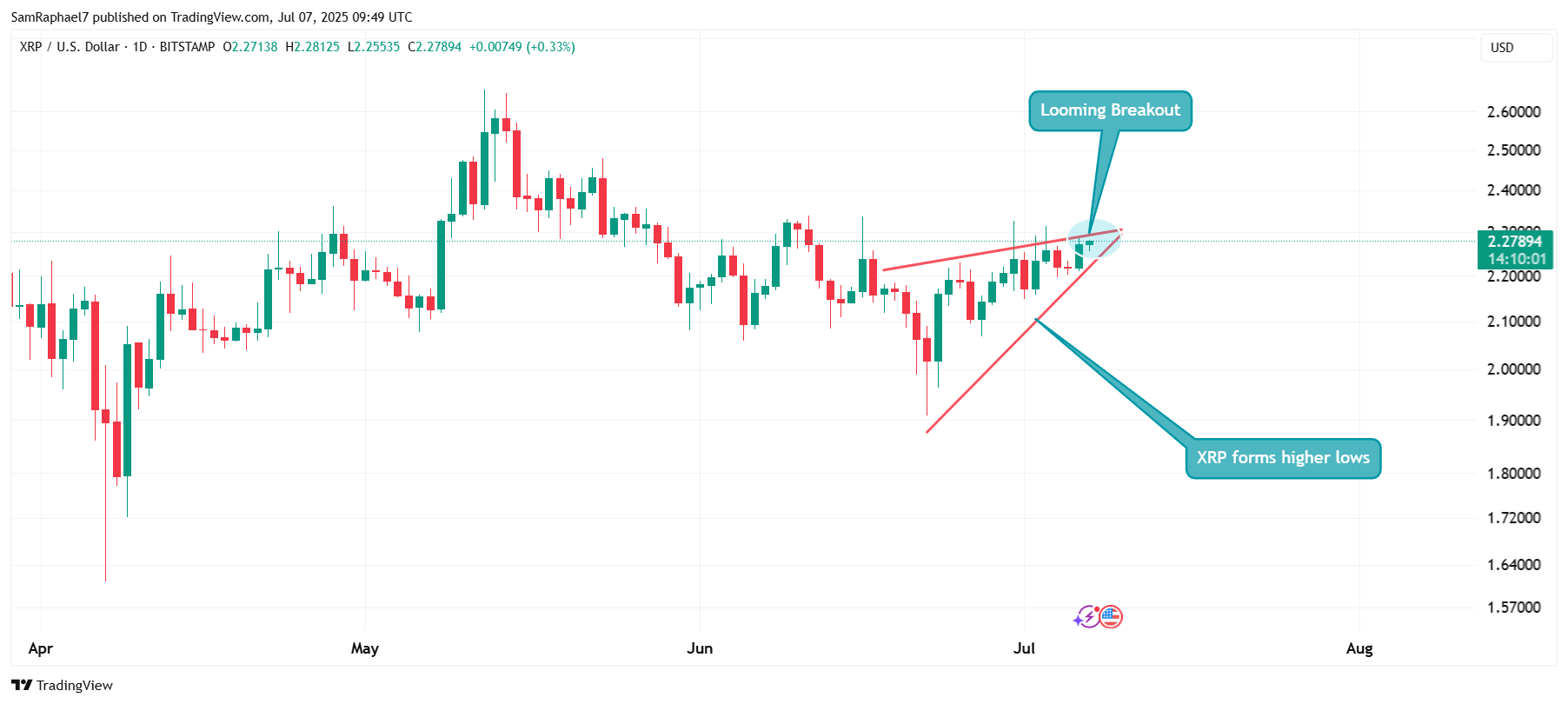
Meanwhile, looking at price patterns, Wickle observed that XRP has been forming higher lows since June, shaping a pattern that usually leads to a breakout. However, for that to happen, he stressed that buyers need to step in with more conviction.

XRP Price Chart
XRP Price Chart

Are Institutions Re-entering the Market?

Also, he talked about the source of the rising transactions. He asked whether new institutions are behind the volume or if it’s just more activity from existing users settling transactions. 

Specifically, if institutions are re-entering the market, Wickle sees this as a powerful signal for future price gains. On the other hand, if the spike comes from routine settlements, the market impact could remain limited.

Further, Wickle highlighted a pattern around past XRP price rallies. According to him, during major price surges, both transaction volume and trading volume increased together. Right now, that alignment doesn’t exist. 

He believes smart traders are watching this gap closely and waiting for stronger confirmation before making big moves. He then marked $2.40 and $2.55 as the next important price levels. If XRP clears both with strong trading support, he said it could spark the next breakout.

Here’s Why Ripple’s RLUSD Strategy Holds Enormous Potential for XRP

0

XRP community influential figure Eri Chan has highlighted the potential impact of Ripple’s RLUSD stablecoin strategy on XRP.

In a June 6 post, she emphasized that cross-border payment giant Ripple is a long-game player, and XRP holders should be patient enough if they want to reap their investment reward. Furthermore, the community leader identified a few steps that Ripple has taken with the RLUSD token and its enormous potential for XRP.

RLUSD on XRPL to Rival Ethereum’s with Smart Contracts

For one, native programmability is gradually coming to the XRP Ledger. Specifically, Ripple has progressed significantly in its quest to introduce smart contracts to the Ledger’s mainnet.

One of the closest to the quest is the launch of the XRPL Ethereum Virtual Machine (EVM) Sidechain. Ripple announced on June 30 that the sidechain has launched on the mainnet after years of development, enabling Ethereum-compatible smart contract programmability on the XRP Ledger.

Meanwhile, Chan emphasized that the actualization of this quest will be a game-changer for Ripple USD’s presence on the XRPL Ledger. Currently, over 68% of XRPL’s circulating supply is on the Ethereum network, accounting for over $391 million of the $485 million supply.

If smart contract features become native to the XRP Ledger, Chan noted that RLUSD will become a more competitive stablecoin, offering faster and cheaper settlements than on the Ethereum network. Notably, this would increase RLUSD minting and utility on the XRPL, thereby boosting XRP fee revenues and potentially impacting its price.

National Banking Charter: A Dual Oversight for RLUSD

Remarkably, Ripple applied for a national banking charter with the US Office of the Comptroller of the Currency (OCC) on June 2, paving the way for a potential dual regulatory oversight for the RLUSD stablecoin. For context, Ripple obtained a state-issued license from the New York Department of Financial Services (NYDFS) in December, and the OCC approval will birth a double regime for RLUSD.

Essentially, the XRP community influencer highlighted that federal oversight for RLUSD will enhance institutional confidence, enhance its use in national payment, and secure a Federal Reserve master account. She noted that these calculated RLUSD stablecoin steps from Ripple will unlock enormous potential for XRP.

Nonetheless, she urged enthusiasts to remain patient. According to her, these significant utility-focused steps will require more time to unfold.

TRUMP Meme Coin Expanding to TRON Blockchain

0

TRUMP, the meme coin inspired by U.S. President Donald Trump, plans to launch on the Tron blockchain.

This announcement came via a statement from the project’s official account on X, fueling hopes for wider adoption. Notably, this would mark its first expansion beyond the Solana network, where it launched earlier this year.

The planned cross-chain move aims to tap into TRON’s active user base and faster transaction speeds, which could drive broader adoption of the meme coin.

TRUMP Rollercoaster Debut: Price Surge and Sharp Correction

For context, TRUMP debuted on Solana on January 17, 2025, issuing 200 million tokens out of a planned total supply of 1 billion. Initial trading was extremely volatile, with prices skyrocketing from below $10 to $75 within hours. This pushed its fully diluted valuation close to $75 billion at the peak of the frenzy

However, the coin’s price soon tumbled. At press time, TRUMP is trading at $8.59, reflecting a massive decline of 88.57% from its peak. Current data shows TRUMP’s circulating market capitalization at approximately $1.718 billion, with a fully diluted valuation nearing $8.59 billion.

Details Missing as Market Awaits Tron Deployment

While excitement around TRUMP’s cross-chain expansion builds, the team has yet to release technical details or an official timeline for the Tron deployment. This lack of clarity has left investors speculating on when and how the move will impact trading dynamics, especially given the token’s history of extreme volatility.

Justin Sun’s Oversized Stake Raises Ethical Questions

Meanwhile, adding to the conversation is Tron founder Justin Sun’s deep involvement in TRUMP. In a tweet on May 20, 2025, Sun publicly confirmed he is TRUMP’s largest holder. He reportedly owns over $18.6 million worth of tokens after investing $75 million in Trump’s World Liberty Financial platform.

Interestingly, Sun’s position made him the top winner in TRUMP’s “private dinner” sweepstakes, which offered the top 220 holders exclusive invitations to dine at Trump’s Virginia golf club. Critics argue the sweepstakes creates a pay-to-play dynamic, blurring ethical lines.

Centralized Tokenomics Heighten Regulatory Risks

Further fueling concerns, two Trump-affiliated companies, CIC Digital LLC and Fight Fight Fight LLC, control a combined 80% of TRUMP’s total token supply, locked in a three-year vesting schedule.

Analysts warn that this extreme concentration of ownership could enable price manipulation, undermining crypto’s foundational principles of decentralization and fairness.

This centralized structure, coupled with TRUMP’s political branding, has drawn the attention of ethics watchdogs and lawmakers.

Senators Richard Blumenthal, Elizabeth Warren, and Jeff Merkley have called for new legislation to limit how politicians and affiliated entities can use cryptocurrency endorsements or projects for personal or political gain.

As TRUMP moves forward with plans to launch Tron, it stands at a crossroads. The expansion could bring new liquidity and investor interest.

Bitcoin and Ethereum Lead as Crypto Funds Mark 12th Week of Inflows

0

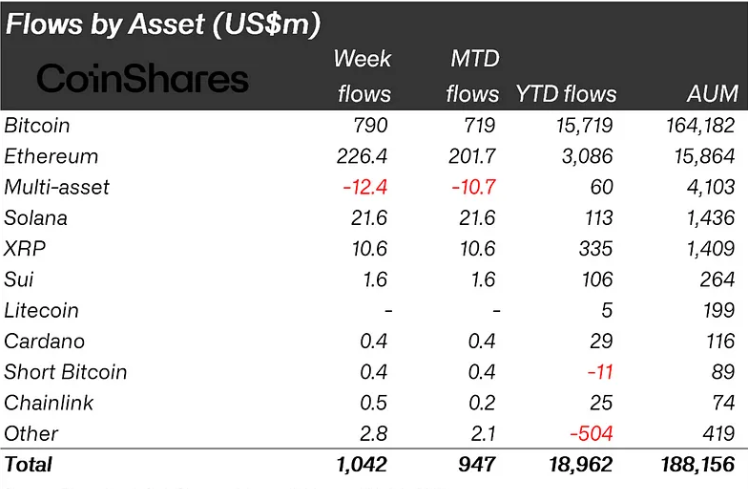
Led by Bitcoin and Ethereum, digital asset investment products marked the twelfth straight week of positive sentiment, according to CoinShares. 

The investment products recorded inflows totaling $1.04 billion last week only. This figure brings the month-to-date total to $947 million. 

Investors continued to show strong interest in single-asset crypto products, particularly Bitcoin and Ethereum, with both assets accounting for the majority of the weekly inflows. Specifically, Bitcoin led with $790 million, while Ethereum followed with $226.4 million. 

Bitcoin and Ethereum Attract Majority of Capital

CoinShares data indicates that Bitcoin investment products’ flows pushed year-to-date inflows to $15.7 billion. Ethereum also saw a notable surge in investor interest, registering $226.4 million in weekly inflows, raising its year-to-date figure to $3.1 billion. Importantly, Ethereum’s average weekly inflows over the past eleven weeks have reached 1.6% of total assets under management, double Bitcoin’s 0.8% over the same period.

Bitcoin and Ethereum Lead Inflows | CoinShares

Meanwhile, investor appetite extended beyond the two largest digital assets. Solana recorded $21.6 million in inflows, XRP brought in $10.6 million, and Sui posted $1.6 million. Despite smaller volumes, these inflows indicate continued interest in alternative assets within the sector.

However, multi-asset products experienced net outflows of $12.4 million during the week, and $10.7 million month-to-date, suggesting a shift away from diversified funds toward targeted asset exposure.

Fund Providers Reflect Shifting Preferences

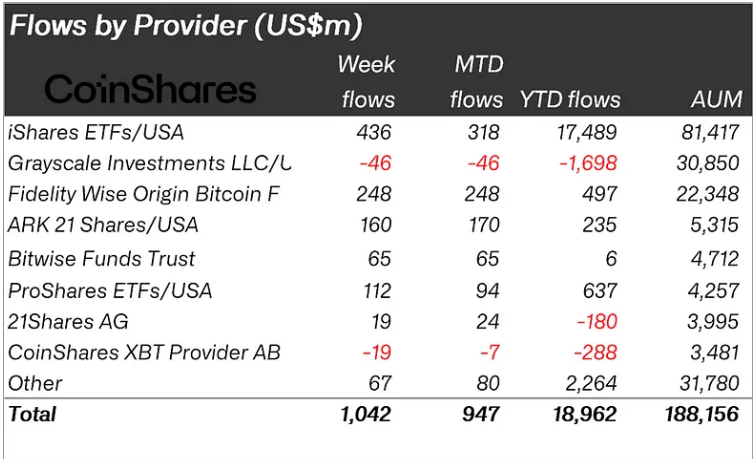
Here, Blackrock’s iShares ETFs expectedly topped the list, drawing $436 million in new capital and boosting year-to-date inflows to $17.5 billion. The funds now manage $81.4 billion in total assets. Fidelity’s Wise Origin Bitcoin Fund followed, securing $248 million during the week and nearly $500 million in year-to-date flows.

Screenshot 2025 07 07T170824677
Flows by Provider | CoinShares

ARK 21Shares and ProShares ETFs also saw sizable inflows of $160 million and $112 million respectively. Bitwise Funds Trust received $65 million in weekly inflows, showing growing interest in smaller fund options.

In contrast, some issuers faced net redemptions. Grayscale Investments reported $46 million in weekly outflows and $1.698 billion year-to-date, though it maintains $30.8 billion in AUM. CoinShares XBT Provider registered outflows $7 million month-to-date, pushing its year-to-date total outflows to $288 million.

U.S. Leads by Region as Canada and Brazil Lag

Regionally, the United States led inflows, contributing over $1 billion of the total weekly figure. Germany followed with $38.5 million, while Switzerland added $33.7 million. These markets continued to account for the majority of new investments in digital asset products.

Meanwhile, Canada and Brazil showed contrasting sentiment. Canada posted $29.3 million in outflows, and Brazil followed with $9.7 million in redemptions.

SEC Nears Streamlined Approval for XRP, Solana, and Meme Coin ETFs: Insiders Confirm

The U.S. SEC recently issued its most comprehensive guidance to date on crypto exchange-traded products (ETPs).

Industry commentators are hailing the document as the first formal step toward the approval of a wave of crypto ETFs. These include those tied to major altcoins, such as Solana and XRP, as well as a meme coin associated with President Donald Trump.

From Roadblock to Roadmap

Under the new Republican leadership, the SEC has demonstrated a greater willingness to engage constructively with the crypto sector. The agency has not only launched a task force to develop a regulatory framework for crypto funds but has also dropped several enforcement actions it had previously been aggressively pursuing.

Matt Hougan, CIO of Bitwise Asset Management, views the new SEC guidance as a key milestone. “The most fascinating thing about this guidance is that it exists,” he said.

Notably, Bitwise currently has over six crypto ETF applications awaiting approval. Hougan stressed that the release of the guidance alone shows the SEC now sees crypto exchange-traded products as part of mainstream finance. Essentially, the agency appears ready to create a more straightforward regulatory path for these products.

Notably, the guidance instructs issuers to present disclosures in plain English and to explicitly address key risks such as custody, volatility, and competition in the crypto markets.

SEC Prepares Universal ETF Listing Rule to Replace 19b-4 Process

Perhaps more impactful than the guidance itself is what’s coming next. According to sources familiar with the SEC’s ongoing discussions, the agency is developing a universal listing framework to eliminate the need for exchanges to file Form 19b-4 for each crypto ETF.

The current 19b-4 process can delay ETF approvals by up to 240 days. However, a standardized rule, which is undergoing refinement in collaboration with exchanges like Nasdaq and Cboe, could cut this to just 75 days.

“The SEC is seeking a general rule that can apply to all listings,” remarked a top executive at a major ETF issuer. “Exchanges may begin filing under this general rule within weeks.”

What’s Next

For now, final approval for spot ETFs tied to Solana, XRP, Polkadot, Dogecoin, and Trump’s meme coin is still pending. Issuers expect that no decisions will emerge until the SEC releases its second major guidance document. They expect this to emerge in the last quarter of 2025.

REX-Osprey Launches First US ETF With Solana Exposure

As the regulatory groundwork takes shape, some asset managers are moving ahead with creative workarounds. On July 1, REX Financial and Osprey Funds launched the REX-Osprey Sol + Staking ETF. Notably, this is the first U.S.-listed ETF offering exposure to Solana, albeit indirectly.

The fund uses an offshore investment structure that holds both Solana and a non-U.S. Solana fund. It also incorporates staking, allowing investors to earn yield in return for participating in Solana’s blockchain validation process.

Remarkably, the ETF attracted $12 million in assets on its first day, highlighting investor appetite for Solana-related products. REX CEO Greg King confirmed the firm is positioning itself for a direct Solana spot ETP as soon as the SEC finalizes the rules.

Here’s How High XRP Will Go in 2025, According to 4 Top AI Tools

With XRP still stuck below major resistance and investor sentiment split, one researcher turned to artificial intelligence for a fresh perspective on XRP price prospects in 2025. 

Instead of relying on traditional analysts, leading AI tools, including ChatGPT, Gemini, Perplexity, and Grok, were asked to predict how high XRP could climb by the end of 2025. While their responses leaned bullish, they came with conditions. Crypto Researcher Ripple Van Winkle called attention to the responses in a post on X.

ChatGPT XRP Price Prediction

Specifically, ChatGPT presented three distinct scenarios depending on how events unfold for Ripple. In a conservative estimate, it predicts XRP will climb back to $3.80, matching its previous all-time high from 2018. 

A more moderate forecast predicts the token will be between $5 and $6, assuming Ripple secures key partnerships and continues to experience adoption. However, in the most aggressive scenario, XRP could rise as high as $10 to $15 if everything breaks in its favor.

Gemini, Perplexity, and Grok Weigh In

Interestingly, both Gemini and Perplexity provided similar outlooks, projecting XRP in the $5 to $10 range. Nonetheless, they emphasized that such growth is only possible if Ripple’s legal troubles are resolved and if an XRP spot ETF enters the market. It bears mentioning that Ripple and the SEC have already decided to drop the case, pending court approval.

Meanwhile, Grok, the AI developed by Elon Musk’s xAI, was more cautious. It projected a lower range between $1.80 and $5.81, with its most likely scenario falling between $3 and $4.50.

Key Drivers Behind the Predictions

The AIs identified three main forces that could push XRP higher this year. First is the outcome of Ripple’s legal battle with the U.S. Securities and Exchange Commission. Both parties have agreed to dismiss their appeal. What’s pending is the official settlement announcement. Market watchers believe this development could unlock institutional interest. 

Second is adoption, in terms of new partnerships and broader use of XRP in cross-border payment systems. Ripple has continued to pursue new alliances and acquisitions, which many believe will benefit XRP. 

Finally, the AI tools noted that the approval of spot XRP ETFs in the United States could serve as a major catalyst for the XRP price. This is because it would attract both retail and institutional capital. ETF inflows played a significant role in propelling Bitcoin’s price in 2024.

Bitcoin Influence on the Broader Market

Another common theme across the AI predictions is the importance of Bitcoin’s trajectory. The chatbots noted that a strong post-halving bull run, combined with clearer pro-crypto U.S. policies, could lift the entire market, including XRP. In other words, XRP’s success will not exist in isolation but as part of a larger shift in market sentiment.

While the outlooks were generally optimistic, all four AIs included a disclaimer that the projections were not financial advice. Specifically, they encouraged investors to do their research and remain cautious, even in the face of promising forecasts. At press time, XRP is trading at $2.27, up 0.8% today.