Home Blog Page 648

Here’s the Ideal Dogecoin Buying Opportunity for a 200% Rally: Top Analyst

0

A TradingView analysis has identified a clear pattern of price uptrend in the Dogecoin chart, presenting a 200% upside opportunity.

Analyst “SwallowAcademy” shared the bullish Dogecoin setting in a July 2 commentary, as the prominent meme coin shows strong upside momentum. DOGE seems ready to put its 14% correction in the previous month behind it, joining a broader market rebound.

Dogecoin In a Sweet Spot

The commentary highlighted a technical indicator suggesting that Dogecoin is in a favorable position for those seeking to accumulate it at a bargain. The analyst stressed that DOGE is in a “sweet spot” and predicts that a proper upward trajectory is on the horizon.

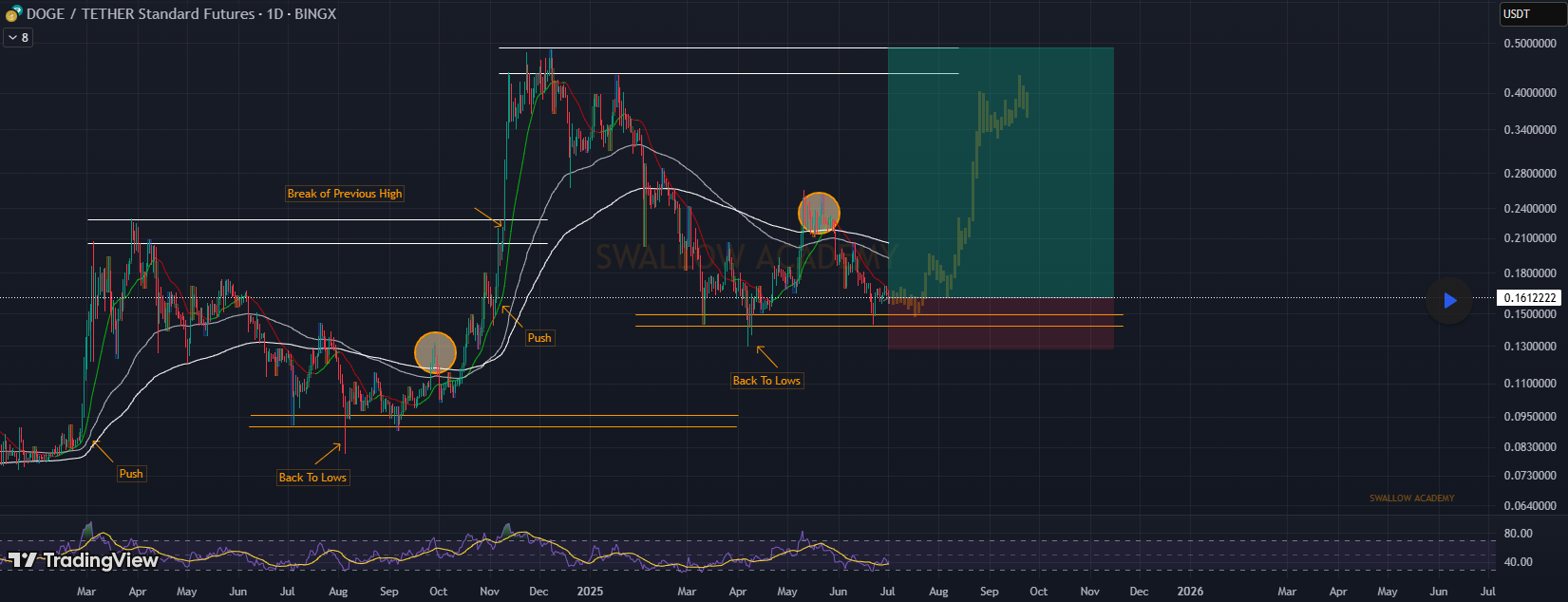
Meanwhile, the market watcher shared a clear trend that Dogecoin has followed since 2024, which supports this anticipated price explosion. Notably, the accompanying chart shows a series of price upward pushes, a retest of its lows, followed by a break of the previous high.
DOGE Analysis SwallowAcademy
Dogecoin Analysis | SwallowAcademy

For more perspective, the chart shows that Dogecoin experienced a massive price rally from February 28, 2024, to March 28 of the same year, rising from $0.085 to $0.229. Following the uptick was a period of consolidation, where DOGE retested its lows, reaching a bottom of $0.080 on August 5, 2024.

However, Dogecoin resumed another round of price upsurge after a period of consolidation, resuming a push to break its previous high in early November. The momentum persisted until it rallied to a multi-year high of $0.4846 on December 8, 2024.

A 200% Upsurge Opportunity Opening

Dogecoin maintained its bullish pattern with a healthy retracement back to its November lows, where the previous fireworks resumed. The meme coin corrected 73% from its December highs to the low of $0.1298 on April 7, which the analyst believes is its bottom.

Having found support around its current price, the TradingView commentary predicted a quick run to retest its previous high and possibly break the resistance to much higher prices. From a price of $0.1612 at the time of his analysis, he predicted a 200% upsurge to December’s high of $0.4846.

Meanwhile, DOGE has rallied slightly higher from there, trading at $0.1742 at the time of writing. This culminates in a 178% uptrend from its current market price.

Nonetheless, SwallowAcademy highlighted that Dogecoin must hold a crucial support at $0.14 to keep the price push alive. He stressed that as long as DOGE trends above the price mark, we can expect a positive move.

Interestingly, if the pattern fully mirrors, the $0.4846 target could be the start, as the past scenario saw Dogecoin break its previous high. Other parallel analyses have predicted a surge to break its current all-time high and reach $0.80, while some suggest a $1 target is on course for DOGE.

XRP Is Not Ripple Stock, Linqto Owns 4.7M Ripple Shares, Not XRP: Ripple CEO

Ripple CEO Brad Garlinghouse has noted the distinction between XRP and Ripple shares amid the controversy surrounding Ripple’s pre-IPO shares and the Linqto platform.

This clarification comes in response to investor concerns fueled by regulatory investigations into Linqto and its sale of so-called “representative units” of Ripple stock. Garlinghouse reiterated that Ripple has no business relationship with Linqto and did not directly issue any shares to the platform.

In his latest post, Garlinghouse clarified that XRP and Ripple equity are fundamentally different. He stated that his comments were strictly in reference to Ripple equity, not XRP tokens.

Ripple Confirms Linqto Holds 4.7M Shares

According to Garlinghouse, Linqto owns 4.7 million Ripple shares. However, the platform acquired those shares from other shareholders via the secondary market. He highlighted this figure to reassure investors that Ripple is aware of how many of its shares Linqto currently holds.

Garlinghouse made it clear that Ripple is not involved in how Linqto structured its offerings or manages the investors who purchased those shares.

He also admitted he has “no idea” how Linqto handled participants to whom it sold Ripple share units. In effect, it cannot vouch for the company’s business practices. 

Essentially, Garlinghouse distanced Ripple from any potential legal or financial consequences tied to Linqto’s operations, which are currently under investigation by U.S. authorities.

Good News for Linqto Unitholders?

Despite the controversy, Garlinghouse noted that the value of Ripple shares has increased significantly over time. In parallel, investors who gained exposure through Linqto’s units may still see strong returns, provided Linqto fulfills its side of the transactions.

For context, just last month, Ripple launched a $700 million tender offer to repurchase shares at $175 each, a 135% premium over recent private market prices. The offer, open from June 10 to July 9 via Nasdaq Private Market, applies to holders of eligible vested stock or options. It follows a January buyback at $125 per share.

Calls for Refunds

Amid ongoing controversy surrounding Linqto, some have called for the platform to refund users. However, pro-XRP attorney John Deaton disagreed with refunding investments at their original cost. He argued that doing so would unfairly enrich the platform. 

Deaton, who invested $30,000 in Circle (now worth $157,000), said such a move would allow Linqto to pocket investor profits. He called this unjust, especially in light of Ripple’s ongoing $175 per share buyback, noting that his average cost was just $33.

Notably, Linqto froze user accounts and suspended operations in February, prompting backlash from more than 14,000 users.

As scrutiny intensifies, Ripple is safeguarding its reputation by clearly distinguishing its operations from those of third-party platforms offering access to its pre-IPO equity.

Here’s How High XRP Can Reach if Ripple Gets a Banking License

With Ripple now officially seeking a banking license, what impact could an approval have on XRP price?

Ripple Applies for Banking License

Notably, Ripple keeps pushing deeper into mainstream finance. Yesterday, CEO Brad Garlinghouse announced that Ripple applied for a national bank charter to the Office of the Comptroller of the Currency. 

With Ripple already holding a New York Department of Financial Services BitLicense, the company would gain both state and federal supervision if regulators approve the charter. Garlinghouse stressed that Ripple built its reputation on compliance and now wants to raise the trust bar for stablecoins.

He also revealed that through its subsidiary Standard Custody, Ripple further applied with the Federal Reserve for a master account. Importantly, direct Fed access would let Ripple store reserves for its RLUSD stablecoin at the central bank itself. 

Possible Impact on XRP and RLUSD

The news triggered a commentary from the popular community analyst “XRP Investing.” He argued that a national bank charter would place Ripple shoulder‑to‑shoulder with banking giants such as JPMorgan, giving RLUSD and XRP greater legitimacy.

He added that a master account would mean bullet‑proof backing for RLUSD, due to direct custody with the Fed. According to him, the combination of OCC regulation, NYDFS oversight, and Fed connectivity would create a stablecoin built for institutions and allow banks to adopt XRP for fast, low‑cost cross‑border payments.

However, the impact of this bullish development on XRP price remains uncertain. So, to gauge how far XRP’s price might climb, we asked ChatGPT for an assessment. Interestingly, the chatbot presented four valuation models to assess how far XRP could go. 

ChatGPT Presents the Institutional Utility and RLUSD + Fed Access Models

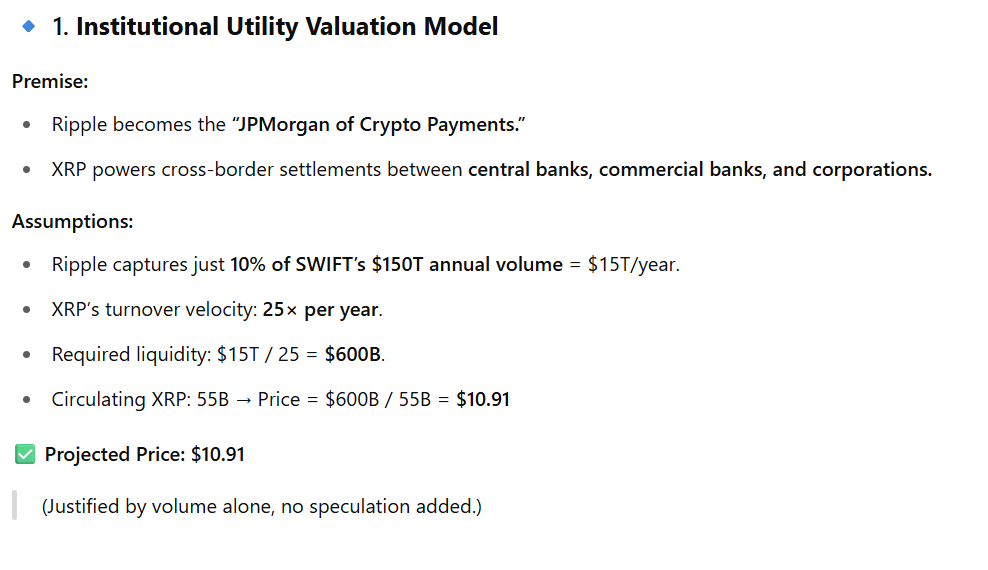
ChatGPT first highlighted an Institutional Utility Model. In this case, Ripple captures only one‑tenth of SWIFT’s yearly $150 trillion messaging volume by routing payments through XRP. 

Due to the fact that crypto settlement turns over funds multiple times a year, the model uses a velocity factor of 25. Notably, under these assumptions, the network would need roughly $600 billion worth of XRP in circulation to serve that flow. 

XRP Valuation Model on Institutional Utility ChatGPT
XRP Valuation Model on Institutional Utility | ChatGPT

Meanwhile, ChatGPT assumed that XRP has a circulating supply of 55 billion tokens. With this supply assumption, each XRP token will roughly be worth $10.91. However, this estimate ignores speculative demand, so it stands as a utility‑only baseline.

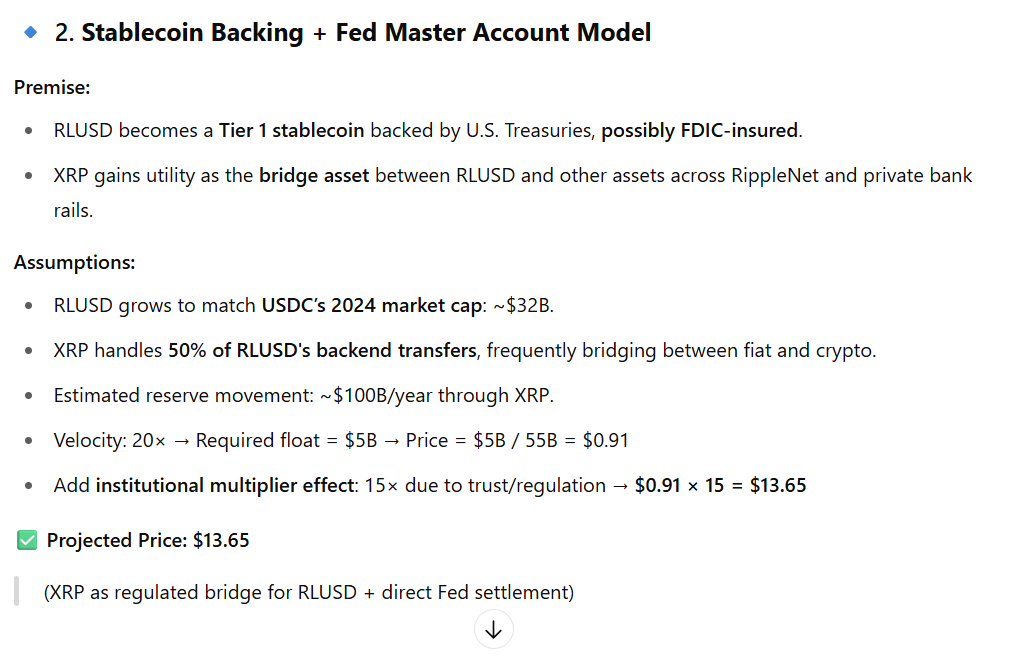
Next, ChatGPT presented the RLUSD + Fed Access Model, which focuses on stablecoin flows. It assumed RLUSD matches USDC’s 2024 market cap of $32 billion and that XRP bridges half of RLUSD’s on‑chain transfers, about $100 billion a year.

XRP Valuation Model on RLUSD Backing ChatGPT
XRP Valuation Model on RLUSD Backing | ChatGPT

With a turnover rate of 20, XRP must supply $5 billion of liquidity. The model then layers a fifteen‑times trust premium because regulators would supervise every link in the chain. Conclusively, the multiplier sends XRP to about $13.65.

Tokenization and NVT Models

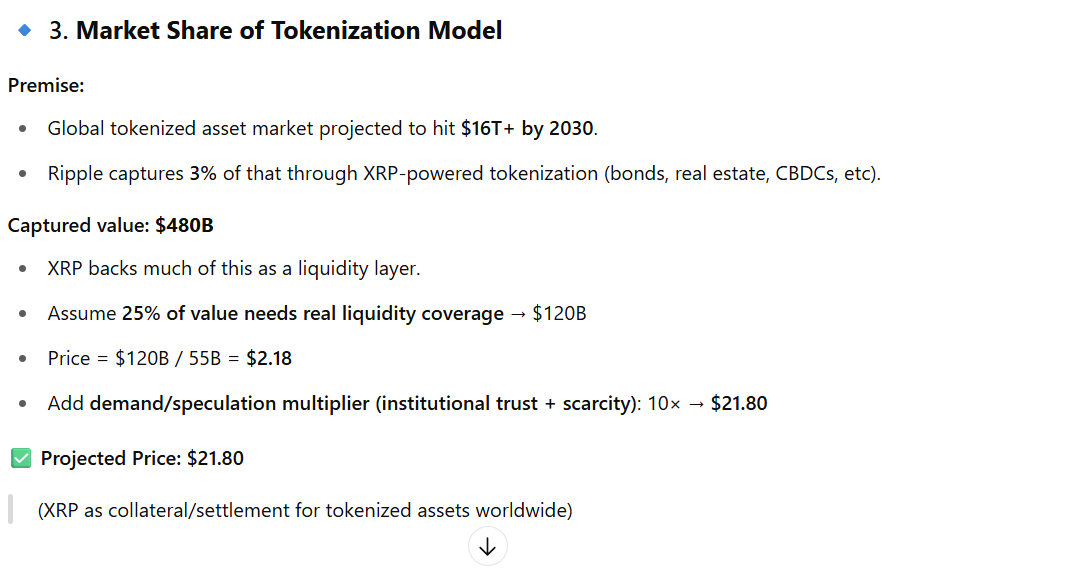
Meanwhile, the third model, the Tokenization Market‑Share Model, values XRP’s role in moving tokenized real‑world assets. For context, analysts expect tokenization of bonds, real estate, and other instruments to exceed $16 trillion by 2030. 

XRP Valuation Model on Tokenization ChatGPT
XRP Valuation Model on Tokenization | ChatGPT

If Ripple captures 3% of this market and XRP sits on‑chain for one‑quarter of it, the token will need to cover $120 billion. Dividing this by circulating supply yields $2.18, but ChatGPT applied a ten‑times institutional and speculation factor as financial firms often prize fully compliant rails. Notably, the adjustment pushes XRP to about $21.80.

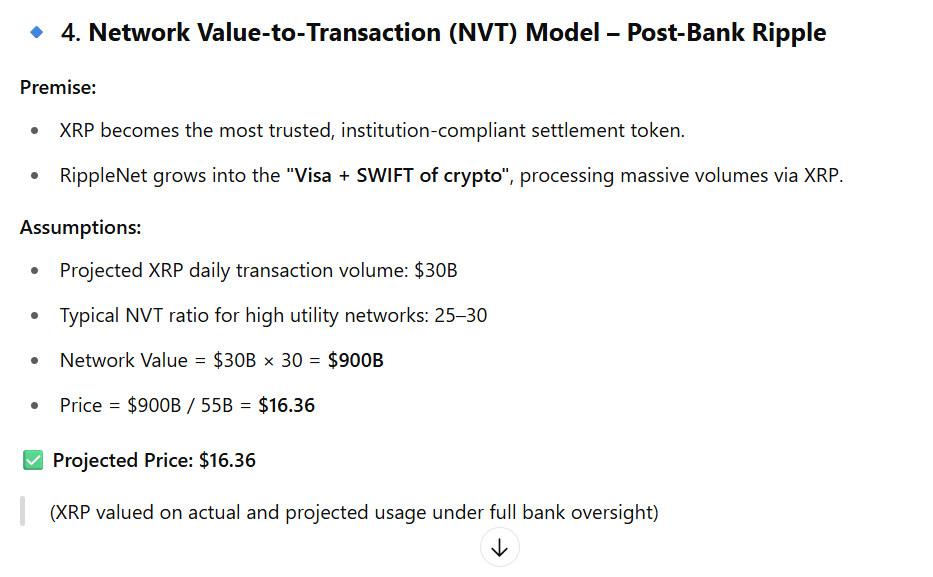
Finally, ChatGPT highlighted a Network‑Value‑to‑Transaction (NVT) Model that links market cap directly to expected onchain activity. The chatbot projects daily XRP settlement volumes of $30 billion once banks join Ripple Payments at scale. 

NVT XRP Valuation Model ChatGPT
NVT XRP Valuation Model | ChatGPT

For context, high‑utility blockchains usually trade at an NVT ratio between 25 and 30. Now, multiplying the midpoint by daily volume produces a total network value near $900 billion. Spread across the current float, each coin approaches $16.36.

500M People Will Declare Their Independence When Bitcoin Hits $200,000: Max Keiser

0

Max Keiser, the Bitcoin advisor to El Salvador, has made a bold Bitcoin prediction, one that he believes could disrupt the legacy financial system.

Bitcoin is closing in on $110,000 and a new all-time high, and bullish sentiment is returning to the cryptocurrency market. This comes after a brief drop to $105,000 on July 1, a move that many saw as another consolidatory move to grab liquidity.

Meanwhile, the FOMO around Bitcoin intensifies as institutions scramble for a share of the scarce asset, of which nearly 95% of its total supply has been mined and owned. With that in mind, Max Keiser, a Bitcoin maximalist and advisor to El Salvador President Nayib Bukele, has boldly predicted how BTC will disrupt the flawed financial system.

Bitcoin’s Gain: The US Dollar’s Doom?

In a July 2 tweet, Keiser highlighted that Bitcoin at $100,000 is already causing chaos. For context, Bitcoin reached a six-figure valuation for the first time last December, spurred by bullish momentum following US President Donald Trump’s win.

Since then, Bitcoin has reached new all-time highs multiple times, drawing the attention of nation-states and major corporations. Notably, a recent H1 analysis revealed a significant increase in the number of Bitcoin-holding public companies and a substantial inflow from US Bitcoin spot ETFs, indicating a clear desire for a share of the pioneering cryptocurrency.

Keiser stressed that this strong traction is happening at just a $100,000 Bitcoin price. When Bitcoin’s price unlocks new milestones, he assured that more harm will come to fiat currencies.

For instance, he noted that at $200,000, central banks and countries will start panicking as over 500 million people declare their independence. This suggests that several individuals would opt out of the centralized financial system for Bitcoin’s economy, widely known for its decentralization and “sound money” properties.

Furthermore, things become even more complicated for the traditional financial system when Bitcoin reaches $300,000. Keiser asserted the utter depletion of the US dollar, stating that the disintegration will see Bitcoin priced in gold instead of fiat.

Interestingly, he is not the first to forecast such depletion in fiat currency, particularly the US dollar. Top venture capitalist Tim Draper noted earlier that Bitcoin would be worth an infinite amount against the dollar.

Timeline for Bitcoin to $200,000 and $300,000

These price targets are popular expectations for Bitcoin, as several analysts anticipate the target in the near term. For instance, Standard Chartered reiterated yesterday that Bitcoin would reach $200,000 before the end of this year, highlighting macroeconomic tailwinds as major drivers.

The prediction aligns with outlooks from Bitwise, Robert Kiyosaki, and Bernstein, among others.

Furthermore, analyst Michael van de Poppe predicted that Bitcoin’s price could rally to a minimum of $300,000 this cycle and potentially reach as high as $600,000. Binance’s co-founder, Changpeng Zhao, also projected a price above $300,000 this cycle, asserting a rally to $500,000 or $1 million.

At the time of writing, BTC trades at $109,366, up 2.5% in the past 24 hours.

Ripple Seeks US Banking License and Fed Master Account for RLUSD

0

San Francisco-based payments company Ripple is seeking to obtain a U.S. banking license from the Office of the Comptroller of the Currency (OCC). 

Ripple CEO Brad Garlinghouse confirmed the application for a national bank charter on X shortly after the Wall Street Journal reported the development. 

Dual Oversight for RLUSD 

If approved, the national bank charter will enable Ripple to bring its dollar-pegged stablecoin (RLUSD) under full federal banking supervision. 

The company obtained a state banking license for its stablecoin from the New York Department of Financial Services (NYDFS) last year. According to Garlinghouse, once the OCC approves Ripple’s national bank charter application, the company would hold both federal and state licenses. 

He emphasized that the dual oversight will provide a new benchmark for trust in the $250 billion stablecoin market. This oversight could signal to institutions that RLUSD has similar regulatory guardrails to those of fiat currencies. 

More Crypto Companies Pursue Federal Banking Licenses 

Until recently, obtaining a U.S. national bank charter was nearly impossible for crypto companies due to regulatory restrictions. Currently, Anchorage Digital is the only crypto firm with one. 

However, the industry expects the OCC to approve more crypto-related applications soon, particularly under the agency’s incoming chair, Jonathan Gould. Like most officials in the Trump administration, Gould is also a fan of cryptocurrency. Thus, he is expected to support industry participants in obtaining a national bank charter. 

That optimism has prompted several crypto firms, such as Fidelity Digital Assets and Circle, to also apply for national banking licenses with the OCC. 

Ripple Applies for Fed Master Account 

Furthermore, Garlinghouse confirmed that Ripple applied for a Federal Reserve master account through its subsidiary Standard Custody earlier this week. 

Approving the application will allow Ripple to hold the reserve deposits of RLUSD directly at the Fed. The Ripple CEO emphasized that the access will provide RLUSD with an additional layer of security and trust. 

Prominent crypto journalist Eleanor Terrett suggested that obtaining a Fed master account is more significant than owning a bank charter. A banking lawyer informed Terrett that while a Fed master account is considered Diamond, a national bank charter is equivalent to Platinum. 

RLUSD Prioritizing Regulatory Compliance 

In the meantime, Garlinghouse stressed that Ripple will continue to build trusted and secure infrastructure for its products, including RLUSD. According to him, RLUSD stands out in the $250 billion stablecoin market due to its prioritization of regulatory compliance. 

RLUSD, which launched in December 2024, currently ranks as the ninth-largest stablecoin, boasting a market capitalization of $469 million. Its trading volume surged 10.80% in the past day to $57.01 million.  

Analyst Identifies Bitcoin Breakout of the Decade: Here’s The Potential Implication on BTC Price

0

Prominent market analyst MichaelXBT predicts Bitcoin could breach long-term resistance, leading to what he calls the “breakout of the decade.”

Bitcoin’s price has experienced notable fluctuations recently, rising to a local peak of around $108,000 on June 30 before dropping back to around $105,000 by July 2.

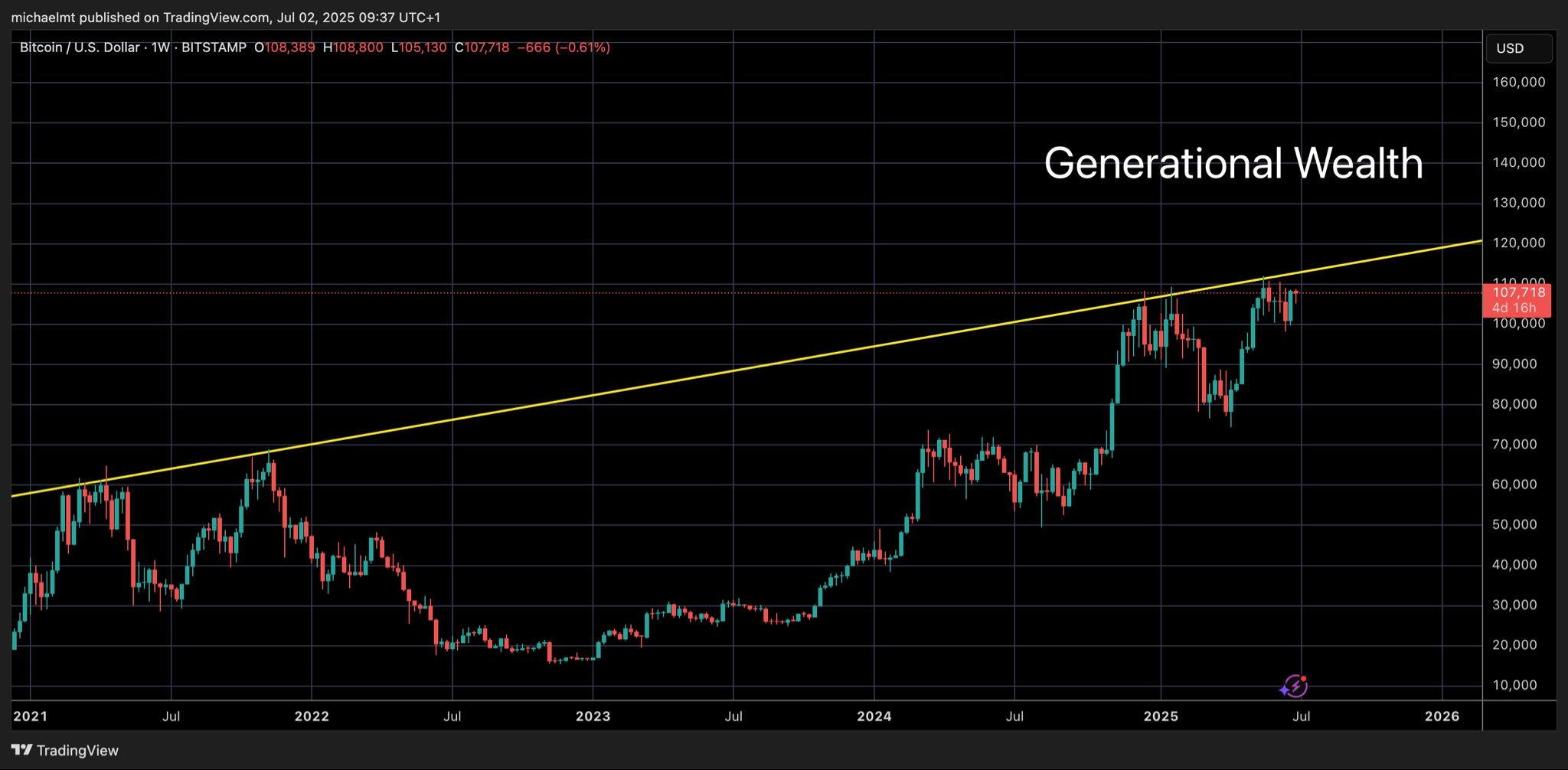
However, as of today, Bitcoin’s price has rebounded to $107,888. This recovery follows a prediction of a long-term breakout from long-time trader Crypto Michael, who analyzed Bitcoin’s price movement over the past few years, in a weekly timeframe. His insights focus on an important resistance trend line that has impacted Bitcoin’s price performance since 2021.

The Resistance Line and Its Historical Significance

The trend line extends from a low point in 2021 and has been tested multiple times over the years. Each time Bitcoin has approached this line, it has struggled to break through. Notably, Michael described this trend line as one of the largest resistance lines in Bitcoin’s history.

Image

The first test of this resistance took place on April 12, 2021, when Bitcoin’s price reached $64,962. Following this attempt, Bitcoin’s price dropped significantly, falling below $29,000 by June 21, 2021.

Bitcoin faced another rejection after testing the resistance again on November 8, 2021, when the price reached $69,035, before it dropped to around $15,000. These early failures at the trend line highlighted its strength as a barrier.

Recent Tests and Breakout Possibilities

Despite the previous setbacks, Bitcoin has continued to test the same resistance level. The next attempt occurred on December 16, 2024, when Bitcoin’s price broke above the resistance to touch $108,200. 

However, the bullish momentum was short-lived, and another attempt on December 20 saw Bitcoin reach $109,300. Despite these fluctuations, Bitcoin continued to test the resistance, and on May 19, 2025, Bitcoin briefly hit its all-time high of $111,800, although it was rejected there by the same trendline.

Michael believes that once Bitcoin breaks through its key resistance trend-line, those sidelined in the market could miss out on what could be the “breakout of the decade.”

Interestingly, the analyst agreed with a commenter who noted that many traders have lost hope, which only makes him more bullish on Bitcoin’s future. According to the commenter, this typical market behavior suggests that while the everyday trader may be fearful, the market is setting up for a substantial upward run.

Where is Bitcoin Headed 

At the same time, The Crypto Basic recently called attention to an analyst who provided a timeline for Bitcoin to reach specific levels. Leo Heart’s analysis uses a rainbow logarithmic regression model to project Bitcoin’s price following each halving event, indicating significant post-halving increases. 

Based on this model, Bitcoin’s price by 2029 is projected to range between $122,372 and $509,090. Heart predicts Bitcoin will remain below $120,000 until the end of 2028, with a price range of $137,000 to $165,000 by the end of 2025.

BlackRock Bitcoin ETF Now Holds 696,874 BTC with All-Time High Value of $75B+

The value of the BlackRock Bitcoin ETF, iShares Bitcoin Trust, is reaching historic levels as the price of BTC remains high.

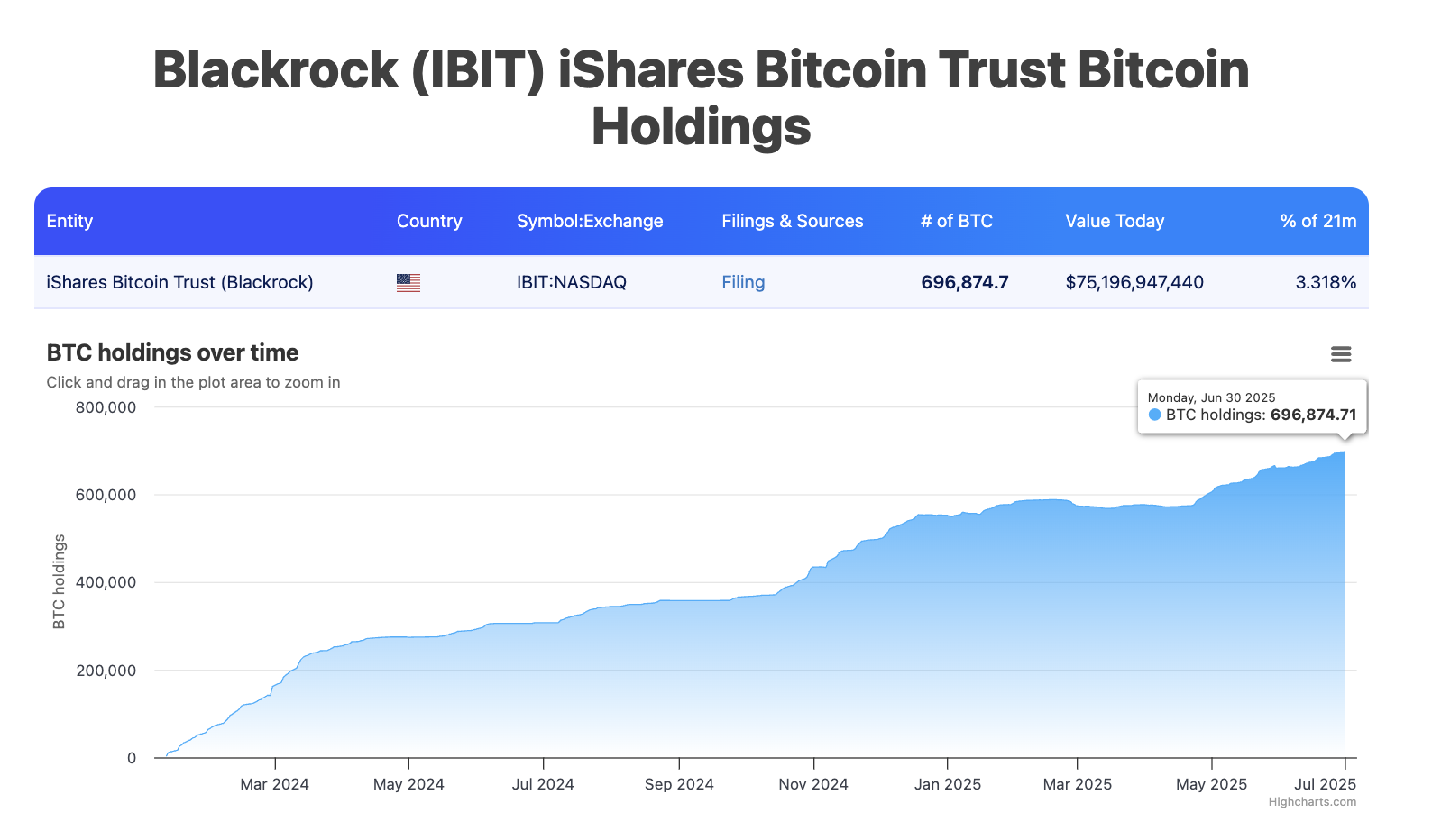
Latest data shows that BlackRock now holds 696,874 BTC. With Bitcoin trading above $107,800, the leading asset manager’s portfolio is worth over $75.1 billion. This marks an all-time high valuation for BlackRock’s Bitcoin ETF. This substantial Bitcoin war chest makes BlackRock the largest holder of Bitcoin among ETFs.

Notably, its holdings account for 3.318% of the total 21 million BTC supply—the largest share, even when considering the holdings of public firms like MicroStrategy.

BlackRock Bitcoin Holdings Compared to Rivals

In the ETF space, BlackRock’s closest competitor is Fidelity, which holds 201,346 BTC worth $21.71 billion. This means BlackRock holds more than three times the Bitcoin of its nearest rival.

Interestingly, the company surpassed the 201,000 BTC mark as early as March 2024, just three months after the ETF’s official launch. Its accumulation spree has only continued since, more than doubling that bag in just over a year.

BlackRock Bitcoin portfolio chart

This is reflected in the consistent streak of positive inflows to the BlackRock iShares Bitcoin Trust. Notably, the ETF recorded no new acquisitions on Tuesday, resulting in a net outflow of $342 million from the U.S. ETF market that day. 

However, for every trading day since June 6, the firm has made several multi-million-dollar Bitcoin purchases, amounting to 15 consecutive trading days of acquisitions.

Meanwhile, other asset managers such as Invesco, Franklin, Valkyrie, and WisdomTree often recorded zero inflows. For example, WisdomTree’s BTCW last saw an inflow five months ago in February. A similar lack of new Bitcoin acquisitions is also evident in Valkyrie’s BRRR Bitcoin ETF.

On the other hand, competitors like Grayscale have mostly posted negative flows. Since launch, Grayscale’s GBTC has recorded a staggering $23.36 billion in outflows. Despite this, the firm still maintains a Bitcoin portfolio of 185,098 BTC worth $19.96 billion.

Total Bitcoin Holdings by US and Global ETFs

Overall, U.S. Bitcoin ETFs currently hold 1.247 million BTC worth over $135 billion. Including global ETFs, the total rises to 1.426 million BTC, valued at $153.86 billion.

Institutional and Government Bitcoin Holdings

Beyond ETFs, public companies collectively hold 856,029 BTC worth over $92.3 billion. Meanwhile, private firms possess 421,641 BTC worth around $45.46 billion.

This massive accumulation, which gained momentum primarily in 2024, demonstrates the growing institutional appeal of Bitcoin. Many now consider it a viable financial instrument and store of value.

Even various governments are Bitcoin holders. Countries such as the United States, China, El Salvador, the United Kingdom, and five others hold a combined 529,705 BTC worth $57.12 billion.

Many additional entities are setting plans to join this trend. This continued exposure has cemented Bitcoin’s role in the financial world and has fueled optimism that its price may one day reach $1 million per coin.

Top Analyst Predicts Minimum XRP Price for July and Ultimate Target by December 2025 Amid Breakout

0

With XRP finally breaking out, a top market analyst has predicted its target for July and how high it can go before the end of the year.

XRP reclaimed $2.20 yesterday and rose as high as $2.32 for the first time since mid-June, as momentum shifted in its favor. A broader altcoin market recovery, coupled with bullish developments from the Ripple vs. SEC case, is a possible catalyst for this surge.

XRP Breaking Out

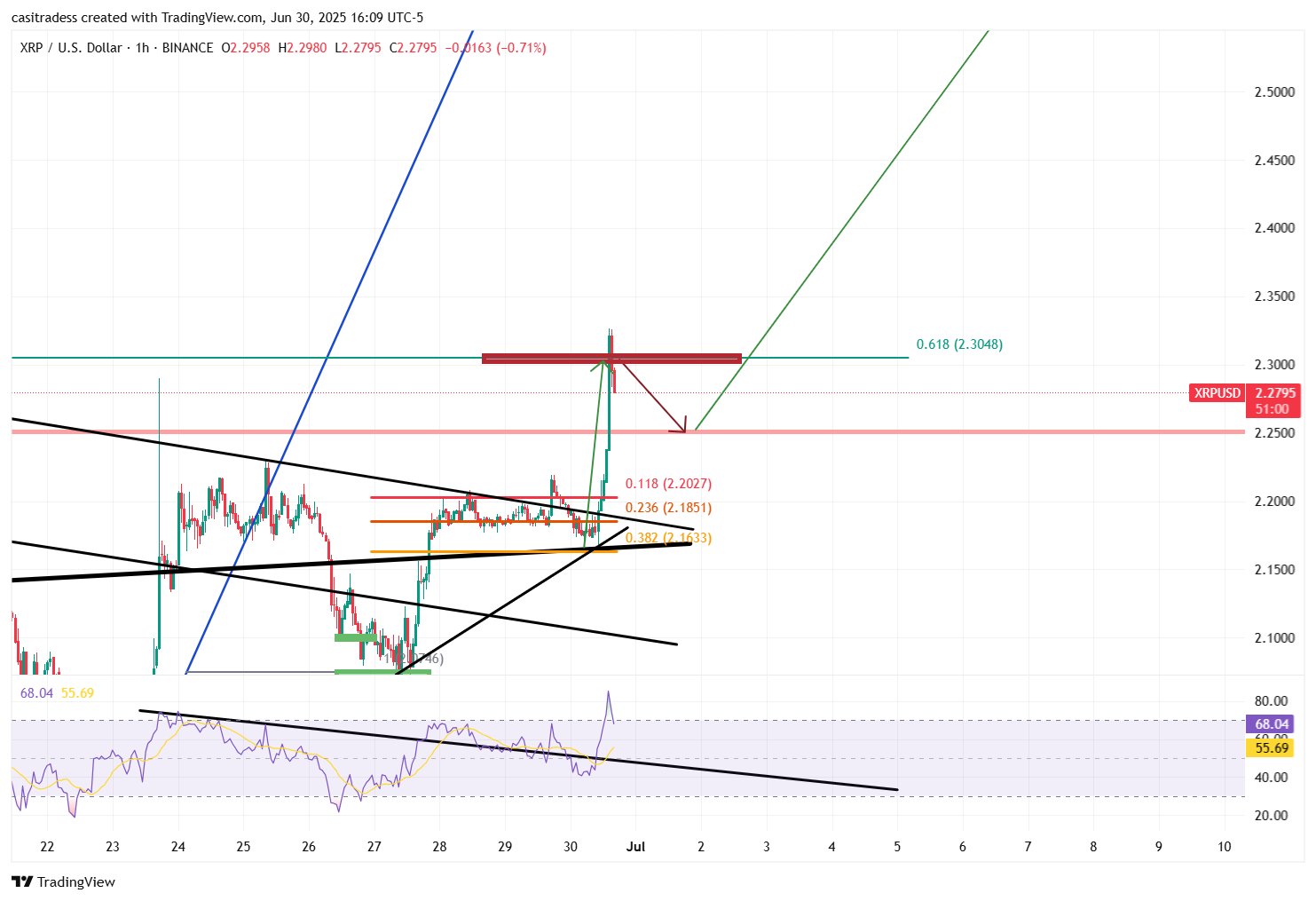
Meanwhile, analyst CasiTrades highlighted in a June 30 analysis that XRP is breaking out. XRP’s rally to $2.32 saw it defy a descending triangle on the hourly timeframe, rallying to the 0.618 Fibonacci extension before its slight retracement.

Now, she predicted that what XRP needs to do next is retest the macro level at the 0.382 Fibonacci extension before a bullish continuation. The analysis emphasized that the retest to $2.25 is crucial to turn the former resistance level into a strong support.

XRP Analysis/CasiTrades

Notably, XRP has retested the price mark, retracing to trade at $2.22, slightly below the 0.382 Fib. extension. If XRP regains momentum, CasiTrades predicts that XRP will advance to prices like $2.69 and $3.04, with a bullish relative strength index (RSI) further catalyzing the uptrend.

Analyst Shares XRP Target for July

Following the analysis, a user inquired about CasiTrades’ price projection for July. In response, the experienced analyst predicted that XRP would rally to a minimum target of $6.50 and could potentially extend to $8, noting that this was the first extension target.

Notably, both targets are new all-time highs for XRP, which peaked at $3.84 in January 2018. From the current price of $2.22, XRP would need to surge 192% and 260% to reach $6.5 and $8, respectively.

Interestingly, several other analysts have projected a similar price outlook for XRP. “The Analyst” predicted a rally to $6.5 as one of his targets for XRP, citing a similar breakout. His commentary suggests that XRP can reach as high as $9.50.

Meanwhile, George Tung also insisted that XRP can realistically reach $8. However, he suggested the timeline for this price to would be by the end of the year, rather than Casi’s July prediction.

Nonetheless, an analysis from WatersAbove predicts a higher price target for XRP this July. He asserted that XRP would hit $15, tapping an “XRP Summer.”

XRP to $20+ by the End of 2025

CasiTrades’ conversation with the user continued, with another comment asking if XRP can trade above $20 by December 2025. The market watcher concluded it was possible, but XRP would have to break above $13.

Her comments highlighted that XRP would enter a fifth wave of bullish uptick if it shows strength to surpass $13. If XRP does, it can go as high as $26, a staggering 1,071% rally from the current price.

Remarkably, this falls slightly below EGRAG Crypto’s $27 price target for XRP this year.

First U.S. Spot Solana ETF Featuring Staking Goes Live with $8M Volume in 20 Mins

The first-ever U.S. Spot Solana ETF with staking features has officially launched, and its debut has since attracted attention from market observers.

Bloomberg’s senior ETF analyst, James Seyffart, revealed this in a post on X. According to him, the REX-Osprey SOL + Staking ETF, trading under the ticker SSK, began its debut with $8 million in trading volume within the first 20 minutes. Seyffart described this as a healthy start for a completely new ETF.

How Does the REX-Osprey SOL + Staking ETF Operate?

Notably, this new ETF gives investors a direct way to gain exposure to Solana (SOL) while also earning staking rewards. About 80% of the fund’s assets go into spot SOL, and the managers actively stake over half of that to generate on-chain yield. 

Investors benefit directly from these staking returns, which currently offer an annual yield of roughly 7% to 7.3%. Meanwhile, the rest of the portfolio includes other Solana exchange-traded products, mostly from markets outside the U.S., along with a small slice in liquid staking assets like JitoSOL.

Interestingly, REX and Osprey structured the ETF as a C-corporation under the Investment Company Act of 1940. This move helped them clear regulatory hurdles that have slowed or blocked similar crypto funds in the past. 

While this structure gives the fund a clear path to operate and distribute staking rewards, it also introduces less favorable tax treatment compared to more traditional ETF models. This is something institutional investors will need to weigh. Importantly, the ETF carries a management fee of 0.75%.

Regulatory Progress Toward Launch

Also, the road to launch was not smooth. REX and Osprey first filed their registration earlier this year, pitching a model that combines spot crypto holdings with staking income. 

However, on May 30, the SEC asked them to delay the launch, citing questions around how to classify the fund. The team then restructured the product into a C-corp to address those concerns. By June 27, the SEC told the issuers it had no further comments, which industry insiders saw as a quiet green light. The fund officially went live today.

Path for Launch of Traditional Spot Solana ETF Products

Interestingly, the launch came just one day after the SEC approved the Grayscale Digital Large Cap Fund (GDLC), which holds Solana alongside Bitcoin, Ethereum, XRP, and Cardano. 

Seyffart had previously said that GDLC would likely go first, followed by other Spot Solana ETF products. With both GDLC and the SSK ETF now trading, investors feel more confident that a traditional Spot Solana ETF may land next.

Notably, this optimism has continued to grow. The SEC is currently reviewing multiple Solana ETF applications from top firms like VanEck, Franklin Templeton, Galaxy Digital, Fidelity, and Grayscale. 

While the SEC hasn’t approved them yet, it continues to review updated filings and has pushed final decision deadlines into late July. Several applicants have tweaked their proposals to include in-kind redemptions and staking features.

Brad Garlinghouse Confirms Ripple Has No Business Relationship with Linqto Amid Federal Investigation

0

Ripple’s CEO, Brad Garlinghouse, has clarified the confusion surrounding the company’s relationship with investment platform Linqto. 

Garlinghouse issued the clarification while responding to reports of the U.S. Department of Justice (DOJ) probe into Linqto and the company’s potential bankruptcy filing. 

No Business Relationship with Linqto  

Following the reports, Garlinghouse addressed Linqto investors, particularly those who had purchased pre-IPO shares of Ripple. According to Garlinghouse, Linqto owns a total of 4.7 million Ripple shares, which were acquired directly from existing shareholders on the secondary market. 

This indicates that Ripple did not issue its pre-IPO shares directly to Linqto. Moreover, Garlinghouse asserted that Ripple does not have any business relationship with Linqto other than the company being a pre-IPO shareholder. 

He also confirmed that Linqto has never participated in any of Ripple’s fundraising campaigns. 

Linqto’s Offering of Ripple Pre-IPO Shares 

Notably, Linqto has been offering non-accredited investors an opportunity to invest in pre-IPO shares of top companies, including Ripple, in anticipation of a potential IPO. 

On several occasions, Linqto’s pre-IPO Ripple shares have sold out within hours, due to the surge in interest in Ripple. A case in point was in October 2023, when Linqto reopened another pre-IPO stock buying opportunity for Ripple shares after previously selling out. 

However, investors have been skeptical about Linqto’s business model, with some users expressing concerns on X. As a result, Ripple halted the approval of Linqto’s additional purchase of its shares via the secondary market in late 2024. 

Notably, Garlinghouse’s comments are part of an effort to distance Ripple from the regulatory and legal concerns tied to Linqto’s business model. 

Linqto Faces Regulatory Scrutiny 

For context, concerns about Linqto’s business model began in November 2024. At the time, The Crypto Basic reported that Gene Zawroty, Linqto’s former Chief Revenue Officer (CRO), sued the company and two other executives for fraud, market manipulation, and insider trading. 

Currently, federal investigators are also examining the company’s operations, with reports suggesting that Linqto may face potential bankruptcy. In a previous statement, former U.S. Senate Candidate John Deaton confirmed that the SEC and another three-letter federal agency are also probing Linqto’s business model.

According to him, the pre-IPO shares that Linqto offers do not belong to Ripple. He suggested that they are owned by a Special Purpose Vehicle (SPV), which holds pre-IPO shares in Ripple.