Home Blog Page 660

Here’s Double-Digit XRP Price Based on Math If the Symmetrical Triangle Breaks Out

0

Market technician EGRAG Crypto has identified when he believes XRP could finally break out from its months-long symmetrical triangle.

Notably, this extensive symmetrical triangle has contributed significantly to the ongoing consolidation phase that XRP has experienced over the past few months. For context, after reaching a 7-year high of $3.4 and subsequently pulling back, XRP has continuously ranged around the $2 price.

However, EGRAG expects the current phase to end in July or September. According to him, “The Breakout Is Coming.” Notably, he confirmed that he arrived at this conclusion “Based on Math” of the pattern.

XRP Forms Months-Long Symmetrical Triangle 

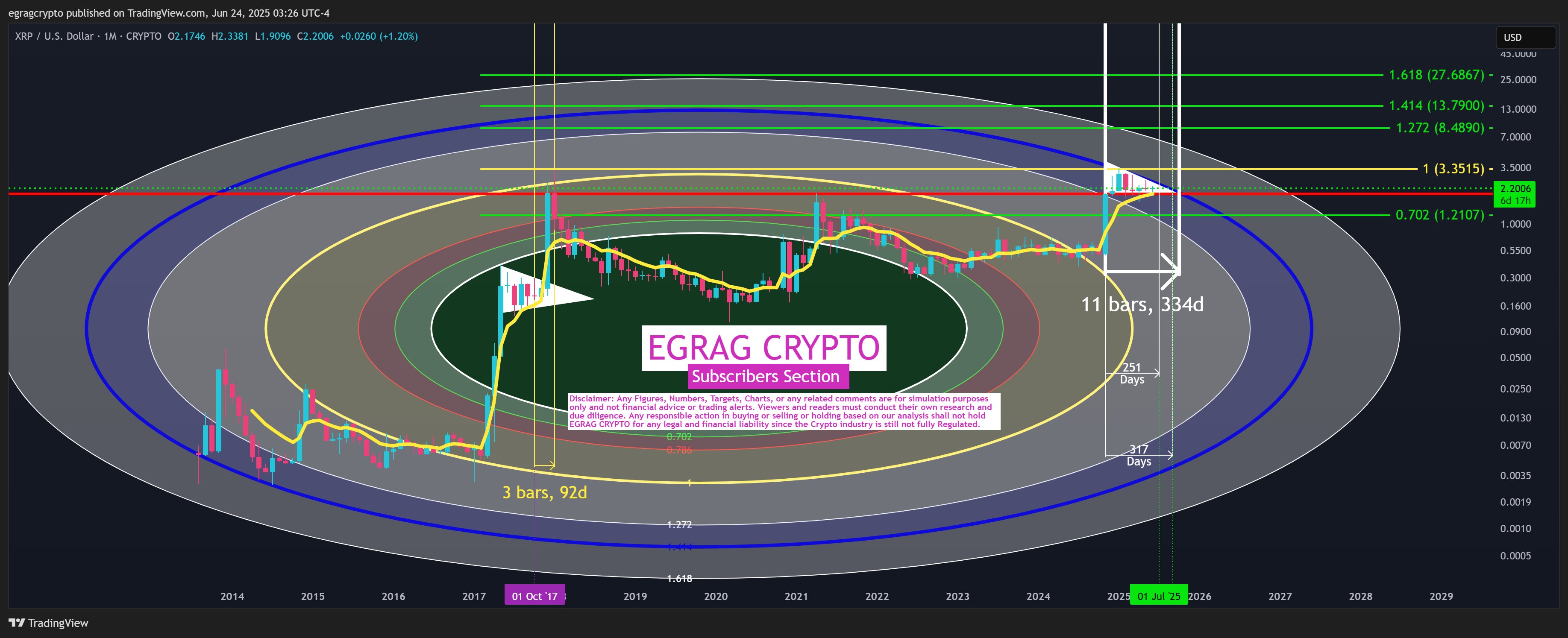
For context, within the consolidation phase, the symmetrical triangle has shaped XRP’s price movements, with the upper descending trendline presenting bearish resistance, while the lower ascending trendline provides support. Data from EGRAG’s chart shows that the triangle’s formation began after the meteoric surge in November 2024. 

Importantly, XRP has, over the months, attempted to break above the symmetrical triangle but to no avail. Specifically, the first attempt occurred in the second week of January 2025, when XRP reached the $3.4 peak. However, the resistance at this mark proved resilient, leading to a pullback.

The second breakout attempt came up in early March as XRP reclaimed $3. Nonetheless, the resistance again resulted in a massive pullback. Meanwhile, XRP recovered to a lower high of $2.65 last month, again, looking to breach the upper trendline. However, this proved futile as well.

XRP Symmetrical Triangle EGRAG Crypto
XRP Symmetrical Triangle | EGRAG Crypto

Amid these attempts, market participants have grown increasingly anxious, especially during times of extreme bearish pressure like what the crypto market witnessed over the weekend.

XRP Breakout Timeline 

In an effort to ascertain when a successful breakout will occur, EGRAG leveraged historical data. According to him, breakouts from such triangle formations often happen 75% to 95% of the duration of the entire structure. The analyst presented this theory with a total duration of 334 days, essentially 11 weeks.

Since Q4 2024, XRP has already spent over 200 days in this symmetrical triangle. As a result, EGRAG suggests that a breakout could occur in early July, representing 251 days or 75% of the total 334-day duration. If this doesn’t materialize, he expects the breakout to happen between early July and mid-September, marking 317 days or 95% of the total 334-day duration.

After the expected breakout, EGRAG believes XRP will likely be on track for new price heights. Data from the chart shows that his first target is the $3.35 high, representing Fibonacci 1. From here, EGRAG sees XRP reaching several Fibonacci extensions, with the second target resting at $8.49, around the Fib. 1.272 extension. This would mark a new all-time high.

Meanwhile, the market analyst expects further upside, suggesting XRP could rally to a new peak of $13.79 at Fibonacci 1.414. After this, EGRAG believes XRP has the potential to claim a price of $27.68, aligning with Fib. 1.618. Notably, from the current price of $2.17, XRP must rally from 291% to 1,175% to reach the $8 to $27 price region.

Expert Says Within 6 Months XRP Will Prove It Was Cheap Under $2

DustyBC, a widely followed analyst, has boldly asserted that the next six months could be a defining period for XRP.

In a tweet, he emphasized that by December 2025, the world will recognize that XRP was incredibly cheap at under $2. DustyBC went on to challenge the crypto community to bookmark the tweet and revisit it by year’s end, when he believes his ambitious outlook may have materialized.

This perspective suggests XRP could be trading at a significantly higher price or may have established a new trading range well above $2 by then.

The Last Time XRP Was “Cheap”

Notably, XRP used to trade in the $0.40 to $0.60 range just a few years ago. With the price now having held above $2 for the past seven months, many investors who didn’t buy in that earlier range are looking back with regret, realizing they missed the chance to buy it cheap.

Specifically, just last year, one could purchase 100,000 XRP for about $50,000. Today, that same amount costs over $200,000, four times more.

Despite widespread predictions that XRP would crash after its historic run, the coin has consistently held above $2. Repeated market-wide dips have failed to push XRP below $1.60 over the last seven months. Each drop below $2 has been followed by a swift rebound above that threshold.

Given this resilience, a growing number of voices in the crypto community believe the next move is upward, as bears fail to establish new lows. In parallel, DustyBC believes that those who don’t recognize XRP as being “cheap” at $2 may regret their decision as early as six months from now.

Commenters on the post agreed that a turnaround could occur by year’s end. Beyond XRP’s strong fundamentals, historical patterns in timing are also fueling optimism.

Will History Repeat for XRP?

Notably, XRP’s last major breakout began in the final weeks of 2024 and carried into early 2025. The projected six-month timeline for XRP to establish a new trading range aligns with this, suggesting history could repeat.

Where Will XRP Be by Year’s End?

Despite his optimism, DustyBC did not specify what XRP’s new trading range might be. However, last year he shared a chart predicting the emergence of a “God candle,” a surge that could send XRP soaring by 4,000% to nearly $30.

At the time of that prediction, XRP was trading at $0.51. It has since touched $3.40 before retracing. Many investors remain optimistic, with some expecting XRP to reach $30 or more by the end of this market cycle.

XForceGlobal, a Korean Elliott Wave analyst, has forecasted that XRP could hit $10 to $20, despite ongoing skepticism. He stated he would “be laughing at everyone” who doubts the coin’s potential. He has set an early 2026 timeline for the potential realization of his forecast.

Meanwhile, even more ambitious projections have come from analyst Javon Marks. He believes XRP could skyrocket 3,900% this cycle, potentially reaching $99. He bases this prediction on similarities between XRP’s current price action and its 2017 rally, when it broke resistance and surged past its previous all-time high.

While these forecasts are certainly optimistic, more conservative analysts have projected a $9 price for XRP by year’s end.

Future of Crypto Payments: Regulatory Landscape In The EU And UK With Insights From Cryptomus

0

Future of Crypto Payments: Regulatory Landscape in the EU and UK with Insights from Cryptomus

Worldwide, crypto regulations are undergoing swift changes. With rapid expansion and inconsistent laws behind it, the crypto market is now seeing efforts to introduce clear and uniform regulations. Cryptomus, as a leading player in the crypto space, actively monitors these changes to ensure full compliance with emerging regulations.

The EU and UK are building rules to balance progress with consumer protection and market stability. Their new laws, including the EU’s MiCA framework and the UK’s Property (Digital Assets) Bill, aim to bring digital assets closer to traditional finance. Cryptomus is already aligning its operations with these new rules to remain at the forefront of compliance and innovation.

In this article, we’ll look at significant regulatory updates and the ways crypto companies, including Cryptomus, are responding to promote a more secure and reliable market.

Key Regulatory Updates in the EU and UK

The latest policy changes in the EU and UK target stronger investor protections alongside clearer and more secure crypto market practices. Cryptomus is closely monitoring these developments to ensure continued compliance. These efforts put them at the forefront of creating global crypto rules.

What is MiCA in the European Union?

MiCA is the EU’s first set of rules for cryptocurrencies. Its key objectives include setting firm rules, defending investor interests, and encouraging innovation.

Crypto rules in Europe were varied before MiCA, which made it tricky to do business across countries and meant investors didn’t always have reliable protections. Key requirements under MiCA include:

  • To offer custody, trading, or advisory services, crypto businesses must register and get permission.
  • More robust verification measures to enhance oversight and limit illicit behavior.
  • Stablecoins should be completely backed, stress-tested, and transparent in their operations.
  • Issuers are required to outline risks and avoid conflicts, with regulator approval.
  • Tokens are clearly classified as utility, asset-backed, or e-money for easier regulation.

While MiCA is a major step forward, it does not yet require on-chain KYC, which is something future updates may address.

The Crypto Regulatory Framework In The UK

The UK is progressing in regulating cryptocurrencies by embedding digital assets into its existing financial system. The focus is on consumer protection, addressing illegal use, and defining clear rules for the industry.

A major step is the Property (Digital Assets) Bill, which would:

  • Officially recognize digital assets as property in England and Wales
  • Strengthen fraud protection
  • Clarify legal processes for disputes

Scotland and Northern Ireland are exploring similar measures.

The Financial Conduct Authority will lead enforcement, covering token issuance, payments, asset security, and governance. Chancellor Rachel Reeves also introduced the Cryptoassets Order 2025, applying traditional finance standards—like transparency and consumer protection—to crypto trading, custody, and staking.

The UK is also increasing AML enforcement, with the FCA managing identity verification, financial reviews, and penalties for non-compliance.

What This Means and the Future Outlook

With combined efforts from the EU and UK, cryptocurrency regulation is entering a phase of tighter and more structured control. The move to require identity verification and anti-money laundering rules among leading market companies shows regulators’ aim to stop crime without slowing down technological progress. Cryptomus, as an active player in the industry, is already taking steps to ensure compliance with these evolving regulations.

Cryptocurrencies have moved beyond the label of speculative or fringe assets. Financial regulators now recognize them as part of the larger financial structure. This shift is prompting enhanced scrutiny, covering crypto and related technologies including NFTs, DeFi, and autonomous organizations. Cryptomus is also preparing for this increased scrutiny by adopting robust compliance measures across its platform.

Looking ahead, several future regulatory directions seem likely:

  • Expansion of regulatory scope: beyond cryptocurrencies, new laws are expected to cover digital assets including NFTs, DeFi protocols, and DAOs. The challenge will be to regulate these innovative products without stifling innovation. Cryptomus is positioning itself as a leader in adapting to these expanding regulations.
  • Integration with traditional finance: major banks collaborate on shared stablecoins to improve cross-border payments, showing more interest in trusted and regulated digital finance. Cryptomus is part of this movement, ensuring seamless integration of traditional finance with blockchain technology.
  • Crypto property gets legal recognition: the UK’s Digital Assets Bill says digital assets are property, which might lead other countries to do the same. Cryptomus welcomes these legal developments, as they will provide clearer regulations and security for users.
  • Improved investor safety: fresh regulations aim to block scams, questionable transactions, and unfair practices. Cryptomus remains committed to improving investor safety with its secure platform.
  • New DeFi rules: growing KYC and AML compliance demands may lead platforms to adopt semi-centralized models. Cryptomus is staying ahead of these trends by evolving its services to meet both regulatory and user needs.
  • Unified policies: authorities work together to limit arbitrage and support steady development in cryptocurrency.

How Cryptomus Complies with Regulations?

The crypto industry’s top players are quickly adjusting to the new regulatory environment. Cryptomus, which has been operating since 2022, continues to put strong security and compliance first.

The main compliance milestones include:

  • Cryptomus maintains strong communication with regulators to adapt quickly to policy updates and legal requirements. For instance, the move from USDT to USDC for European residents was managed efficiently to meet the new MiCA stablecoin standards.
  • Uses strict identity and anti-money laundering checks to keep operations clear and prevent fraud, laundering, and other shady activities. This aligns with worldwide standards to safeguard everyone. 
  • Cryptomus takes security seriously, implementing routine vulnerability checks, secure servers, and up-to-date software. To safeguard user assets, it also relies on multi-factor login, PIN verification, whitelisting, and tight session controls.
  • Supports international efforts against financial crime by enforcing strict AML and CTF policies, building trust with users and partners.

Thanks to these actions, Cryptomus sets an example of balancing safety and regulation with user-friendly crypto payment experience.

Conclusion and Recommendations

In 2025, the EU’s MiCA rules, alongside the UK’s updated crypto laws, made licensing, AML/KYC checks, and transparency standards compulsory for all crypto payment providers.

With cooperation across countries, rules are being updated to reflect the rise of DeFi, NFTs, and stablecoins, making it simpler to use cryptocurrencies alongside regular banks. So, investors should pick platforms that are transparent and follow regulations to stay secure and stable.

Cryptomus stands out in this regard by not only adhering to current regulations but also anticipating future compliance requirements.  As regulatory frameworks grow tougher, platforms that respond promptly will accelerate market development, helping create a balanced and reliable crypto space.


Turkey Rolls Out New Crypto Rules to Fight Money Laundering

Turkey’s Ministry of Treasury and Finance has announced a new wave of crypto regulations to prevent illicit funds laundering through crypto asset transactions. 

The measures target platforms and users, tightening oversight in one of the world’s most active cryptocurrency markets.

Mandatory Transfer Descriptions & Source Verification

Under the new rules, all crypto asset transfers must now include a transaction note of at least 20 characters, detailing the purpose of the transfer. Crypto Asset Service Providers (CASPs) must also collect detailed information about the source of funds and the intent behind crypto transactions.

The regulations seek to bolster transparency in the crypto asset ecosystem and align Turkey more closely with international anti-money laundering (AML) standards.

Delayed Withdrawals for Non-Compliant Transfers

Notably, a key feature of the reforms is the introduction of mandatory withdrawal delays for transactions that do not fully meet the FATF’s “travel rule” requirements.

Specifically, a minimum 72-hour delay will apply for first-time withdrawals. Meanwhile, users must wait at least 48 hours for all other non-compliant withdrawals.

Officials say the delay is meant to prevent criminal proceeds, especially from illegal betting and online fraud, from being quickly transferred out of the system.

Stablecoin Transfers Face Tight Limits

Authorities will also impose daily and monthly limits on stablecoin transactions to further control fund flows. The daily limit is $3,000 while the monthly limit is $50,000. However, platforms that fully comply with the travel rule can double these limits.

In a statement, Treasury and Finance Minister Mehmet Şimşek confirmed that legitimate crypto activities will remain protected under the new framework.

Users engaged in market making, liquidity provision, or inter-market arbitrage who can document their funds’ legal origin will be exempt from some new restrictions, provided they operate through licensed platforms under official supervision.

Minister Şimşek also issued a warning to CASPs. He noted that those who fail to comply with the updated rules could face severe penalties, including administrative fines, license denial, or cancellation.

Turkey Tightens Grip as Crypto Adoption Booms

The move comes as Turkey continues to see surging crypto adoption amid economic instability, high inflation, and a tech-savvy population. Despite the stricter rules, authorities maintain that the new framework is not intended to suppress crypto, but to ensure it grows within a secure and regulated environment.

Cardano Founder Says Midnight is Going to Be the DeFi Layer of XRP

0

Charles Hoskinson, the founder of Cardano, recently shared his vision for the Midnight collaboration with the XRP ecosystem.

Hoskinson discussed this during a live AMA session, revealing that he wants Midnight, Cardano’s privacy-focused sidechain, to become the DeFi layer for the XRP ecosystem. 

Midnight to Act as the DeFi Layer of XRP

According to the Cardano founder, this move would allow XRP holders and Ripple itself to access better DeFi yields without needing to move their tokens off the XRP Ledger.

Hoskinson believes XRP can stay true to its identity while still gaining access to advanced DeFi services. His goal centers on giving XRP users a chance to earn higher returns through features like staking, lending, and liquidity pools. These are options that XRP’s native chain doesn’t support because it lacks smart contract capabilities.

Midnight, the Cardano sidechain designed to protect user privacy through zero-knowledge cryptography, is at the center of this plan. Notably, Midnight lets users run confidential smart contracts and interact with DeFi applications without revealing sensitive data.

As the Cardano ecosystem connects Midnight to the XRP Ledger, it will present DeFi opportunities for XRP holders while keeping their assets safe on the native chain.

A Full XRP DeFi Package

Hoskinson’s plan is part of a broader push to build bridges between blockchain communities rather than create competition. Specifically, he wants Cardano and XRP to work side by side, with Midnight acting as a secure layer that expands XRP’s use cases. 

The integration doesn’t stop with Midnight, as confirmed by Hoskinson, who teased a “full DeFi package.” As part of this package, Cardano’s Lace Wallet will soon support XRP, allowing users to manage XRP and other digital assets in one place. 

In addition, discussions are underway to bring RLUSD, Ripple’s USD-backed stablecoin, into the Cardano ecosystem. If this is successful, RLUSD will serve as a stable liquidity option for DeFi platforms running on Midnight.

Meanwhile, Hoskinson has also spoken with Ripple’s top executives, including CTO David Schwartz and CEO Brad Garlinghouse, about building a smooth connection between Midnight and the XRP Ledger. These talks aim to combine Cardano’s smart contract tools with XRP’s strength in cross-border payments and deep liquidity.

The Midnight Airdrop 

Interestingly, to encourage early adoption, Cardano has launched two airdrop campaigns: the Glacier Drop and the Midnight airdrop. XRP holders who had at least $100 worth of XRP on June 11, 2025, can claim part of the 1.2 billion NIGHT tokens, which power Midnight’s governance. 

Notably, Midnight has already gone live on testnet, with developers deploying the first privacy-focused apps late last year. Cardano expects the mainnet launch later in 2025. The sidechain supports multiple blockchains, including Ethereum, Solana, Avalanche, and XRPL.

Republican Senators Introduce Biggest Crypto Bill of the Year

0

Senators from the Republican Party have introduced a new bill to establish clear regulatory guidelines for the U.S. cryptocurrency industry. 

The new crypto regulatory framework was published on the Senate Banking Committee website today. CNBC first reported on the development earlier after it obtained a draft framework of the new bill, dubbing it the “biggest crypto bill of the year.”  

The bill’s sponsors are the Chairman of the Senate Banking Committee, Senator Tim Scott, and pro-crypto Senator Cynthia Lummis. Two other Republican Senators, Bill Hagerty—the sponsor of the GENIUS Act—and Tom Tillis, also backed the upcoming crypto legislation. 

Features of the New Bill 

Notably, the legislation would provide clear rules of the road for crypto businesses, investors, and regulators. In particular, it will end years of ambiguity in the sector by specifying requirements that determine whether a token qualifies as a security or commodity. 

For context, assets classed as securities will fall under the SEC’s regulatory purview, while the CFTC will regulate those categorized as commodities. 

Additionally, under the proposed legislation, crypto trading platforms would be required to register with the CFTC rather than the SEC. The Gary Gensler-led SEC previously sued multiple exchanges, including Binance and Coinbase, for failing to register with the commission. 

Although the SEC has withdrawn these lawsuits, the bill would ensure that the CFTC oversees crypto exchanges. Furthermore, it would reduce the SEC’s authority over cryptocurrencies, making the CFTC the industry’s main regulator. 

A Leverage 

Interestingly, the legislation features what CNBC called a ‘common sense package’ to prevent sanctions evasion and anti-money laundering (AML). According to Senator Scott, the included common-sense package will help strengthen negotiations for the bill’s potential passage. 

The development comes a week after the Senate passed the GENIUS legislation for stablecoins. As reported earlier, 68 Senators, including 18 Democratic lawmakers, voted in support of the stablecoin bill, which has now moved to the House for further deliberations and votes. 

President Trump has also urged the House to pass the stablecoin legislation so he can sign it into law immediately. Given the bipartisan support for the GENIUS Act, Senator Scott hopes that his upcoming crypto legislation will receive similar support. 

Notably, the Senate Banking Committee has scheduled a formal hearing on the bill today at 3 p.m. (ET). 

Anticipating XRP to Hit $7 Is No Longer Gambling: Top Analyst

According to prominent crypto commentator Crypto Bitlord, the journey for XRP to higher price targets is a matter of pure belief.

XRP has surged by over 10% today, reaching $2.21 after recovering from a dip to $1.90 over the weekend. XRP’s ongoing rally follows Bitcoin’s recapture of the $105K level, helping altcoins breathe after the weekend bloodbath.

Amid the promising market, optimism is rising about XRP’s potential run to a new all-time high. In a post on X, Crypto Bitlord remarked that giant whales loaded up their XRP bags during the latest dip. According to him, buying XRP under $2 is a gift, especially for those who believe the coin is going higher.

In his view, when you know XRP is going to $7, it’s no longer gambling to load up now. To him, “it’s pure belief.”

“We Will Never See XRP Under $2”

In a follow-up update, Crypto Bitlord confidently claimed that the next stop for XRP is $7 amid the ongoing recovery. He even asserted that XRP will never be seen under $2 again. “Not in this lifetime,” he said, underscoring his conviction.

Sharing his bullish perspective, trader Tyler Durden remarked that many investors have yet to realize what’s about to happen with XRP.

Crypto Bitlord stressed that it’s remarkable everyone has had the chance to purchase XRP, yet some remain on the sidelines. He likened being involved in crypto without holding XRP to lacking a fundamental part of one’s DNA.

As of today, XRP needs to increase by 218% to reach $7. This would mark a new all-time high for the coin that has been trading below its peak for seven and a half years. This price point would elevate its market cap to over $412 billion, while its fully diluted market cap would approach $700 billion.

Notably, many market commentators have expressed the view that XRP could reach and surpass $7 this year.

Popular Projections for $7+

For instance, last month, Bitcoin analyst George Tung predicted that XRP would climb to $8 this year. Tung considers $8 a conservative target for XRP’s price by year-end, citing strong institutional interest evident in the growing number of spot XRP ETF applications.

Likewise, crypto analyst Bearable Bull projected XRP reaching $8, describing this move as the start of a new chapter and marking the end of what he calls a “Generational Wealth Journey.”

Interestingly, commentators like Xena believe prices below $10 are too modest to be realistic outlooks for XRP.

Longer Timelines

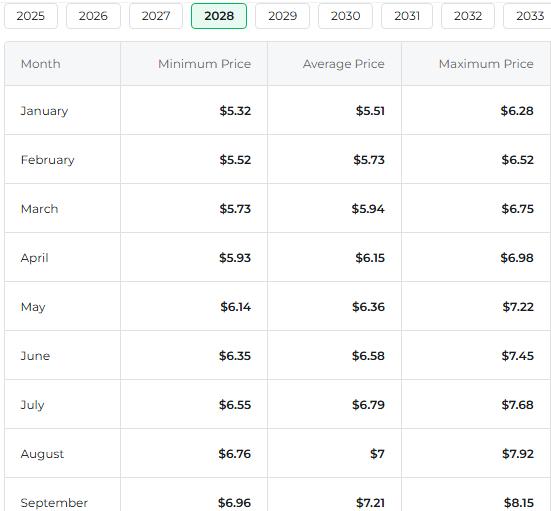
Despite this popular optimism about XRP’s potential, a detailed report by the Changelly crypto exchange suggested it could take until 2028 for XRP to reach $7 and above. Asset manager Bitwise shares this perspective.

In its industry report to professional investors, Bitwise suggested XRP may approach $7 by 2026 only in an ultra-bullish market. The price target becomes a baseline by 2028, according to the report.

Here’s How Much You Could Make If XRP Hits $8 and You Hold 15,000 XRP

0

Patient investors holding 15,000 XRP could realize substantial returns if the token surges to a new all-time high of $8.

While the broader crypto market has largely underperformed in recent months, investors remain optimistic about a potential bull run that could propel many tokens such as XRP to new all-time highs (ATH) by the end of the year.

Specifically, XRP is expected to reach an ATH of $8 by year-end, surpassing its previous record of $3.84 set on January 4, 2018. For XRP to hit this $8 milestone, its price would need to rise by 270.34% from its current level of $2.16.

Assuming XRP’s circulating supply remains stable at 58.93 billion tokens, a price of $8 would bring its market cap to approximately $471.44 billion, up from its current valuation of $127.28 billion.

XRP to $8 Forecast by 2025

Notably, George Tung, the founder of CryptosRUs, is one of the leading experts who predict XRP will climb to $8 this year. According to Tung, XRP’s price could climb to a ‘conservative’ target of $8 by year-end. In his view, this strong institutional interest is reflected in the multiple applications for spot XRP ETFs.

In addition, community pundit Xena shared a similar sentiment about XRP’s potential surge to the $8 mark this year. However, Xena believes the $8 price target is too conservative compared to the community’s expectations for more ambitious projections.

Last month, pseudonymous crypto influencer Bearable Bull suggested that XRP was on track to reach the $8 mark. He noted that XRP’s move to the $8 territory signals the beginning of a new chapter while declaring an end to a “Generational Wealth Journey.”

Potential Implications for Investors Holding 15,000 XRP

These bullish predictions continue to fuel optimism among XRP investors. With XRP currently trading at $2.16, a potential rise to $8 would result in significant gains for early investors, especially those holding 15,000 XRP.

At present, a wallet containing 15,000 XRP is worth $32,400. Data from the Rich List indicates that approximately 167,459 addresses hold between 10,000 and 25,000 XRP, placing holders of 15,000 XRP squarely within this category.

If XRP reaches $8, a holding of 15,000 XRP would be valued at $120,000, representing a return on investment (ROI) of $87,600. While this projection focuses on 15,000 XRP, investors with smaller or larger holdings would also benefit if the price reaches this target.

For instance, a 5,000 XRP holding valued at $10,800 would be worth $40,000 at an $8 price.

XRP Rebounds

Meanwhile, XRP is gradually rebounding from the recent downturn that affected the broader crypto market over the weekend. Its price briefly dipped below $2 amid escalating geopolitical tensions in the Middle East.

However, the asset rebounded above $2 late yesterday after President Donald Trump announced a ceasefire between Iran and Israel. Although market watchers are optimistic about XRP’s potential surge to the $8 mark this year, it remains to be seen whether this forecast will materialize.

Meanwhile, leading crypto trading platform Changelly speculates that XRP will not trade at $8 until September 2028, approximately three years from today.

XRP to $8 price target I Changelly

Michael Saylor Predicts Timeline For Bitcoin to Hit $21 Million

0

Michael Saylor, executive chairman of Strategy and longtime Bitcoin advocate, addressed the BTC Prague 2025 audience last week with a detailed update on Bitcoin’s long-term trajectory.

His keynote followed a series of global and domestic policy shifts that, according to Saylor, have significantly impacted the cryptocurrency landscape since his last forecast in July 2024. While the market has seen notable price movement, Saylor focused on adoption trends, institutional involvement, and macroeconomic shifts.

He outlined a 21-year outlook, emphasizing a target valuation of $21 million per Bitcoin—anchored in global monetary transformation rather than short-term speculation.

Notably, at this point, owning just 4.8 Bitcoin could make one a centaillionaire, according to Michael Saylor’s long-term projection.

Geopolitical and Regulatory Tailwinds

Since July 2024, political momentum in the United States has moved sharply in favor of Bitcoin. The White House, along with key congressional figures, adopted pro-Bitcoin positions. In response, new federal cabinet-level roles were created to support digital asset integration. 

Regulatory bodies including the SEC, OCC, and the Federal Reserve acknowledged Bitcoin’s role in the financial ecosystem. Concurrently, Congress reviewed several legislative initiatives such as the Bitcoin Act and the Clarity Act. 

These developments positioned Bitcoin within mainstream policy discussions. At the same time, institutional adoption intensified, with over $150 billion in capital entering the Bitcoin market and approximately 1.4 million BTC held by institutions.

Notably, Saylor addressed Bitcoin’s adoption beyond U.S. borders. Several governments, including those in the United Kingdom, China, and El Salvador, began discussions or initiatives supporting Bitcoin. In parallel, the broader crypto industry shifted focus toward Bitcoin as the foundational digital asset. 

Public companies joined the “Bitcoin 100,” a group of firms holding BTC on their balance sheets. Names included Trump Media, GameStop, SmarterWeb, and Metaplanet. Meanwhile, ETF approvals further accelerated access to Bitcoin across both retail and institutional channels. These coordinated developments across sectors contributed to Saylor’s thesis of Bitcoin as a transformative financial network.

Financial Metrics and Strategic Guidance

In support of his forecast, Saylor highlighted performance metrics and financial models. He reported Bitcoin’s 56% annual rate of return over five years, significantly outpacing the current 13% cost of capital.

He compared dollar-cost averaging (DCA) in Bitcoin to traditional investments, showing DCA returns of $40 million on a $2 million input, versus $6 million through S&P 500 exposure.

Using leverage and equity issuance in combination with DCA strategies could yield up to $760 million. He advised businesses to create scalable Bitcoin strategies, secure long-term low-interest funding, and avoid short-term debt risks. He emphasized that volatility should be seen as part of the network’s early phase rather than a deterrent.

Here’s How High $500 in Shiba Inu Could Grow if SHIB Market Cap Hits $500 Billion

0

Investing as little as $500 in Shiba Inu today could yield significant returns for early investors if SHIB’s market cap reaches $500 billion. 

Shiba Inu, alongside the broader crypto market, staged a major recovery late yesterday after President Donald Trump announced a complete ceasefire between Israel and Iran. 

The war between the countries had led to the devastating collapse of crypto prices, with SHIB plunging to a six-month low of $0.00001010 on June 22. However, today, SHIB has rebounded from this low following Trump’s ceasefire announcement. 

SHIB, which dropped to an intraday low of $0.00001067, is currently trading around $0.00001185, representing an 11.05% spike. This incredible rebound has reignited investors’ hopes in Shiba Inu, with many projecting further price appreciation toward unprecedented levels. 

For instance, popular Shiba Inu community commentator “Shib Spain” suggested that the coin’s on-chain metrics are flashing bullish signals that could send its price above the $0.0001 mark. 

Given this bullish forecast and SHIB’s recent rebound, this article estimates the potential returns on a $500 investment if Shiba Inu’s market capitalization reaches $500 billion. 

The Potential of a $500 Investment in SHIB

With SHIB currently trading at $0.00001185, a $500 stake in the asset will fetch 42.19 million Shiba Inu tokens. Interestingly, this same investment could have secured about 49.5 million tokens over the weekend, when the price dropped to $0.00001010. 

Yet, purchasing SHIB at the current price is still a discount compared to when the asset traded at around $0.00003 in December. 

Investment Value if Shiba Inu Reaches a $500B Market Cap

If SHIB’s market cap were to reach the projected $500 billion, it would represent a 7,042% increase from its current valuation of $7 billion. Assuming the token’s circulating supply remains constant at 589.25 trillion, a $500 billion market cap would place SHIB’s price at an all-time high of $0.000848.

At this target price, a $500 investment in 42.19 million SHIB bought at $0.00001185 would be worth approximately $35,780. That translates to over $35,000 in returns from an initial $500 investment.

SHIB to $0.0008 Predictions 

While this analysis appears enticing, the major question revolves around whether SHIB will ever reach a $500 billion market cap milestone or a unit price of $0.000848 in its lifetime. For context, Shiba Inu has never achieved a market cap of $100 billion, let alone approached the $500 billion threshold. 

Despite this, many crypto market watchers consider $0.0008 a realistic target for SHIB. For instance, according to a Finder’s survey, 26 industry experts suggest that SHIB could climb to $0.0008543 by 2035, approximately 10 years from now. 

In our previous analysis, the AI model Grok forecasted that the $0.0008 price milestone would come to fruition by late 2027, potentially driven by the widespread adoption of SHIB. 

However, ChatGPT expects SHIB to hit the $0.0008 target between 2027 and 2029. ChatGPT indicated that Shiba Inu will reach the price mark through increased adoption of top projects, such as SHIB: The Metaverse and Shibarium. 

Additionally, prediction platform Telegaon estimates that SHIB could hit the $0.0008 target between 2031 and 2034. Meanwhile, Changelly experts project a potential surge to this level by the end of 2034.

This analysis only explores the potential returns from a small $500 investment in Shiba Inu if the token reaches a $500 billion market cap. It is intended for educational purposes only and should not be considered financial advice.