Home Blog Page 671

Deutsche Bank Says the GENIUS Act May Bolster the Dollar’s Global Dominance

0

Deutsche Bank believes that the Genius stablecoin Act could give the dollar a major edge in the global digital economy. 

In comments shared Tuesday by market watcher Walter Bloomberg, the bank’s strategist Marion Laboure said the legislation could help dollar-backed stablecoins attract more foreign liquidity, especially in countries with weak financial systems. 

According to her, this new development could speed up the use of digital dollars worldwide. Notably, this could materialize without needing central bank digital currencies or traditional banking channels.

Senate Passes the GENIUS Act

For context, the bill behind this momentum, the Guiding and Establishing National Innovation for U.S. Stablecoins (GENIUS) Act, passed the Senate on June 17 in a 68-30 vote. Notably, it creates the first full-scale federal framework for stablecoins in the United States. 

Specifically, the bill requires issuers to back every stablecoin with safe, fully reserved assets and to submit to monthly audits. It also sets strict anti-money laundering rules and opens the door for banks, fintech companies, and even large retailers to issue their own stablecoins. 

Importantly, oversight now sits with the U.S. Treasury Secretary. The bill also bars sitting members of Congress and top federal officials from issuing stablecoins while in office, although some critics say it doesn’t go far enough on conflict-of-interest concerns linked to President Trump.

Previous Report from Deutsche Bank

Notably, Laboure’s latest remarks build on earlier analysis she released in May with fellow Deutsche Bank analyst Camilla Siazon. 

In that report, the pair stressed that stablecoins were becoming a key part of the digital dollar system, helping reshape foreign exchange, improve liquidity, and modernize payments and capital flows. They pointed out that clearer rules in the U.S. would likely push stablecoins into the financial mainstream. 

They also said this could raise demand for U.S. Treasuries and help the dollar keep its place as the world’s most trusted currency. Conclusively, the report argued that solid regulation in 2025 could legitimize stablecoins and bolster wider adoption.

Deutsche Bank Exploring Stablecoin Project

Meanwhile, the latest comments come as Deutsche Bank is also exploring a stablecoin project of its own. Earlier this month, Sabih Behzad, head of digital assets for Deutsche Bank, said the bank is reviewing several options. 

These include launching its own stablecoin, joining an industry-wide effort, or building a tokenized deposit system to improve how payments and settlements work. Although the bank hasn’t chosen a final direction or announced a timeline, it continues to expand its digital currency efforts. 

For instance, it has already partnered with the Partior platform for cross-border payments, taken part in Project Agorá to explore tokenized wholesale settlements, and invested in digital asset custody solutions.

Top Financial Institutions Entering the Stablecoin Space

Other major banks are also entering the space. Specifically, Societe Generale just launched a dollar-backed stablecoin called USD CoinVertible through its digital arm SG-FORGE. The token, set to start public trading in July, runs on Ethereum and Solana. 

In the U.S., JPMorgan is getting ready to release a digital deposit token, JPMD, for institutional clients. At the same time, a group of big American banks, including JPMorgan, Citigroup, Bank of America, and Wells Fargo, are working on a shared stablecoin platform. 

Following the Senate vote on the GENIUS Act, Treasury Secretary Scott Bessent spotlighted reports projecting that the stablecoin market could hit $3.7 trillion by 2030. Also, U.S. Crypto Czar David Sacks believes the GENIUS Act could lead to trillions in demand for U.S. Treasuries.
Ripple-Backed Spot XRP ETF Goes Live in Canada

Canadian digital asset manager 3iQ Corp. has debuted its spot-based XRP ETF on the Toronto Stock Exchange (TSX). 

Dubbed the 3iQ XRP ETF (XRPQ), the product will provide North American users with exposure to the fourth-largest crypto by market capitalization. 

To commemorate the ETF launch, the 3iQ team disclosed plans to ring the TSX’s closing bell today. Investors will trade the ETF shares at a 0% management fee for the first six months of trading. This move is part of efforts to grant investors cost-effective access to the product. 

Ripple Invests in 3iQ Fund 

Notably, San Francisco-based crypto payments firm Ripple expressed its confidence in the ETF by investing in the fund. However, 3iQ did not disclose the amount of investment the company made in XRPQ. 

Per the announcement, the ETF will invest in long-term XRP positions acquired through regulated platforms, such as over-the-counter (OTC) desks. The XRP coins backing the ETF will be held in segregated cold storage to minimize the risk of potential hacks. 

Furthermore, Canadian investors can acquire shares of XRPQ through their registered accounts. Notably, the XRP product will also be made available to institutional clients outside of Canada. However, investments from institutional clients will be subject to local rules. 

3iQ CEO Reacts 

Commenting on the development, 3iQ’s CEO and President, Pascal St-Jean, suggested that the launch of XRPQ aligns with its mission of offering access to regulated and affordable digital assets. 

He acknowledged XRP’s remarkable growth potential over the past decade. Notably, XRP price has surged roughly 10,850% since 2015, climbing from $0.02 to $2.19. 

As a result, St-Jean emphasized that XRPQ will create an avenue for Canadians and eligible international investors to benefit from XRP’s growth potential. 

XRP ETFs Gain Traction 

Meanwhile, the development comes less than a day after Purpose Investments announced the launch of its XRP ETF product (XRPP). Like XRPQ, Purpose’s XRP ETF also launched on the Toronto Stock Exchange today. 

While two-spot XRP ETFs have rolled out in Canada, investors are still awaiting the debut of a similar product in the United States. Since last year, several asset managers have filed with the SEC to launch spot XRP ETFs in the U.S. 

There are more than 10 XRP ETF applications currently awaiting the SEC’s approval. In the meantime, speculation suggests that the U.S. regulator will approve the launch of these products by October 2025. It remains to be seen whether this prediction will come to fruition. 

Here’s What 5,000 XRP Costs Today and What It Could Be Worth in 2035

XRP remains one of the few crypto assets that many industry experts believe has a promising future.

While XRP is currently holding around $2, these experts continue to forecast a future where XRP could far surpass the double-digit price range, potentially reaching triple digits and even four digits. They believe that such a future would reward today’s investors who remain patient despite XRP’s current underperformance.

This conviction largely draws inspiration from two sources: XRP’s historical performance and the asset’s strong fundamentals. In light of this, this article explores the potential financial position of those holding 5,000 XRP today over a ten-year outlook—specifically, how this investment could perform by 2035.

The Cost of 5,000 XRP Today

As of today, XRP is trading at $2.16, boasting a one-year growth of 351%. At this current price, a portfolio of 5,000 XRP would cost approximately $11,000.

Notably, the latest on-chain data shows that only 541,166 wallets out of a global total of 6.566 million XRP holders hold between 1,000 and 5,000 XRP. In contrast, 5.3 million wallets hold 500 XRP or less.

These figures highlight how rare and valuable holding 5,000 XRP has become, as many investors fall short of even this relatively modest threshold. According to industry pundits like Edoard Farina of Alpha Lions Academy, the reason only a small percentage of XRP investors hold 5,000 or more is due to the increasing cost of acquiring XRP.

To put things in perspective, back in November 2024, the price of XRP was as low as $0.49. At that time, 5,000 XRP could be acquired for just $2,450. Compared to today’s $11,000, that’s a staggering 340% increase in just seven months.

In essence, XRP’s rising price is pricing out many retail investors who missed the opportunity to buy when it was under $1. Many believe this trend will continue as the XRP ecosystem continues to mature. Proponents argue that XRP at $2 is still a bargain for those with vision and patience.

For example, media personality John Squire recently tweeted that crypto investors will regret not buying XRP at $2 within five years. Many share this sentiment, pointing to XRP’s dramatic rise from below $0.50 in Q4 2024 to its current price as evidence.

What 5,000 XRP Could Be Worth in 2035

Whether XRP continues to rise over the next few years, as supporters suggest, or declines as critics predict, remains uncertain. However, based on some of the more optimistic forecasts in the industry, we can explore what a 5,000 XRP holding could potentially be worth by 2035.

Among the leading entities offering long-term XRP price predictions are crypto exchange Changelly and forecasting site Telegaon.

According to Changelly, XRP could reach a minimum price of $54.48 by January 2034 and a maximum of $89.64 by December 2034. Interestingly, analysts at Telegaon offer nearly identical projections for XRP by 2035.

If these predictions prove accurate, a $11,000 investment in 5,000 XRP today could grow to at least $272,400. In the most optimistic scenario, this same holding could reach $448,200, nearing half a million dollars. That represents an extraordinary return on investment of approximately 4,050%.

Such projections are enticing and could potentially transform the financial stories of many XRP holders. However, it is important to remember that these outcomes are not guaranteed.

On the Flip Side

Meanwhile, bearish forecasts for XRP are far less common, but one notable exception comes from Bitwise. The asset manager projects XRP could fall to $0.13 by 2030. In that scenario, a 5,000 XRP holding would be worth just $650, a steep drop from today’s $11,000 value. 

It’s worth noting, however, that Bitwise’s bullish outlook for XRP by 2030 places the coin at $30.

Top U.S. Exchange Says Holders With $50,000 Worth of XRP Are on The List for This Airdrop: Details

Leading crypto exchange Uphold recently announced a promotional offer for XRP holders, in collaboration with Zebec Network.

The campaign will reward eligible XRP holders with free ZBCN tokens, Zebec’s native asset, upon meeting certain criteria. The initiative seeks to celebrate and incentivize high-volume XRP users on the Uphold platform while offering them exposure to the broader Zebec ecosystem.

Rewarding Those Holding $50K+ in XRP

Specifically, the promotion targets large Uphold XRP holders with at least $50,000 worth of XRP in their wallet as of June 11, 2025. This equates to approximately 25,000 XRP tokens, as the coin traded above $2.

Uphold confirmed that only U.S. residents, excluding those in New York and Florida, are eligible. Participants are at least 18 years old and in good standing with Uphold, having completed full identity verification procedures.

ZBCN Token Rewards Incoming

The Zebec Network team allocated a total prize pool of $100,000 worth of ZBCN tokens for the promotion. It will distribute the reward proportionally among all eligible users, meaning the more participants who qualify, the smaller each reward may be.

However, the $50,000 minimum holding requirement ensures a relatively limited pool of participants, potentially maximizing each individual’s token allocation. For context, only 131,535 XRP wallets currently hold 25,000 tokens, according to XRP rich list data, and the number is likely even lower on the Uphold exchange.

Eligible users will receive their ZBCN tokens directly into their Uphold accounts, specifically in a ZBCN sub-account. Uphold has stated that distribution will occur within 30 days of the promotional date. In other words, the latest delivery window is around July 11, 2025.

Stay Safe and Wait for Official Instructions

Uphold and Zebec Network have strongly urged users to remain vigilant and rely only on official communication channels. Instructions for claiming ZBCN tokens will be through Uphold’s in-app messages and official email notifications.

They advise users not to click on third-party links or trust direct messages regarding the promotion, as scammers may attempt to exploit the buzz surrounding the airdrop.

Uphold also reserves the right to amend or cancel the promotion at its sole discretion. Only one reward will be issued per eligible user, and prizes are non-transferable.

Overall, this joint initiative by Uphold and Zebec Network rewards XRP loyalty and introduces holders to the Zebec ecosystem via its native ZBCN token.

Notably, this is not the first time Uphold has organized a promotional campaign for XRP holders. Just last month, Uphold hosted an exclusive giveaway to celebrate the XRP Vegas 2025 event. According to the announcement, one lucky winner received $50,000 in XRP.

TRON (TRX) Risks Drop Below $0.26 as Bearish Sentiment Grows

Tron (TRX) failed to hold above key support, and falling derivatives data and rising long liquidations point to a potential dip to $0.24.

As fear grips the broader crypto market, TRON struggles to avoid a deeper correction below the $0.26 support level. With open interest in decline, can TRX withstand the incoming supply pressure?

Tron Price Analysis

On the daily chart, TRX shows a failed attempt to break above the $0.2971 resistance level. Following this, the price pulled back toward the 23.60% Fibonacci level at $0.2634, where bulls are now struggling to absorb the selling pressure.

Tron Price Chart
Tron Price Chart

The presence of multiple long-wick candles indicates increasing selling pressure, warning of a steeper correction. At present, TRX is trading at $0.2739, showing a modest intraday recovery of 0.41%.

However, with the formation of another wick candle near the 24-hour high of $0.2759, the price action suggests a potential retest of the 23.60% Fibonacci level.

Adding to the downside risk, the MACD and signal lines are trending downward and approaching the zero line. Meanwhile, the daily RSI is flattening near the midpoint, signaling fading bullish momentum. Together, these indicators suggest a bearish trend may be forming in TRX.

If a downtrend develops, TRX could break below the local support trendline that has held since late May. A decisive close beneath the 23.60% Fibonacci level could lead to a test of the psychological $0.2500 mark, followed by the support floor at $0.2400.

On the upside, immediate resistance lies at $0.2806, followed by the recent high of $0.2971.

TRX Derivatives Show Weakening Market Confidence

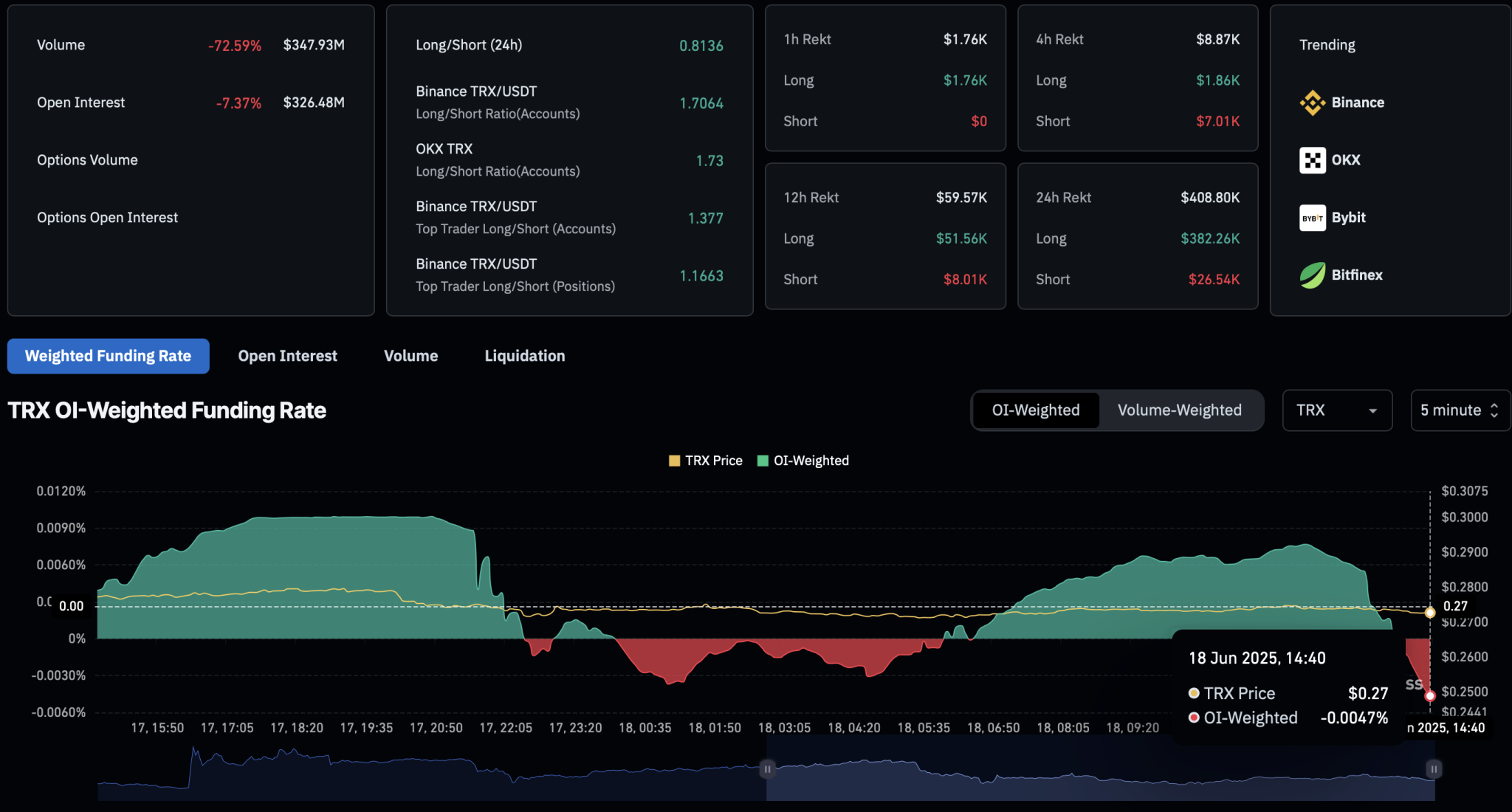
According to CoinGlass data, bearish sentiment in TRON’s derivatives market is rising sharply. Open interest in TRX has dropped by 7.37%, falling to $326.48 million.

This decline is largely driven by increased long liquidations, which reached $382K in the past 24 hours, significantly higher than the $26K in short liquidations.

Tron Derivatives
Tron Derivatives

This liquidation imbalance has pushed the 24-hour long-to-short ratio down to 0.8136, reflecting a higher concentration of bearish positions. In addition, the TRX OI-weighted funding rate has flipped negative to -0.0047%, indicating mounting bearish pressure.

As a result, traders in the TRON derivatives market are increasingly anticipating a steeper correction, especially as weakness persists across the broader crypto sector.

GENIUS Act Passage Solidifies XRP Status: Here’s How

0

A notable crypto commentator suggests that the GENIUS Act could attract more institutional clients to RLUSD while cementing XRP status as a regulated utility token. 

This suggestion came from the community voice “SMQKE” on X following the U.S. Senate’s passing of the GENIUS Act. As previously reported, while 68 Senators voted in favor of the bill, 30 others were against it. Yet, the bill received bipartisan support and establishes clear rules for stablecoins in the United States. 

Notably, the regulation requires stablecoin issuers to comply with rules that ensure investor protection and prevent money laundering. Specifically, the GENIUS Act mandates transparent reserve holdings and requires issuers to conduct regular audits. 

GENIUS Act to Drive RLUSD Institutional Adoption 

Interestingly, SMQKE suggested that Ripple USD (RLUSD) satisfies the requirements of the GENIUS Act, particularly the reserve and audit standards. As a result, he argued that the stablecoin could become more appealing to institutions as the GENIUS Act passed Senate review. 

It is worth noting that USD deposits, short-term government bonds, and other cash equivalents collateralize RLUSD. These collaterals ensure that RLUSD maintains the 1:1 peg to the dollar. 

Notably, a third-party accounting firm also conducts a monthly attestation of the stablecoin’s reserve to ensure transparency.

Impact on XRP 

Meanwhile, SMQKE suggested that the institutional adoption of RLUSD would enhance XRP’s utility and demand. He made this argument because RLUSD operates on multiple networks, including the XRP Ledger (XRPL).

For context, every XRPL-based RLUSD transaction incurs a small XRP fee, which is automatically burned, potentially shrinking the token’s supply over time. 

According to SMQKE, as RLUSD institutional adoption soars, demand for XRP will follow suit due to its use in covering fees. While XRP is not a stablecoin, its operation within a stablecoin framework by the GENIUS Act could strengthen its case as a utility token. 

XRP and RLUSD to Better Compete Against CBDCs 

Furthermore, the community figure asserted that the GENIUS Act would better position RLUSD and XRP to compete against central bank digital currencies (CBDCs) for institutional adoption. 

This reasoning suggests that the GENIUS Act would provide the regulatory framework to drive institutional adoption of XRP and RLUSD. 

In the meantime, the GENIUS Act still faces another hurdle before it becomes law. The stablecoin bill has only passed in the Senate. Its passage in the House is also a requirement before the U.S. President can sign it into law. 

Cardano Bears Tighten Grip as ADA Eyes $0.50 Breakdown

The price of Cardano has dropped 3% as it tests key support. With rising liquidations and weakening derivatives sentiment, will ADA plunge to $0.50?

Cardano faces the risk of breaking down from a crucial support trendline after falling over 3% on Tuesday. Could this drop push ADA to the psychological $0.50 level? Let’s explore.

Cardano Price Analysis Warns of Wedge Breakdown

On the daily chart, Cardano shows a bearish reversal from a long-standing resistance trendline, leading to a pullback of over 15% in the past week. At the time of writing, ADA trades at $0.61 with a modest intraday recovery of over 0.5%.

Cardano Price Chart
Cardano Price Chart

Amid the ongoing downtrend, Cardano is now testing a critical local support trendline, as bulls struggle to absorb increasing selling pressure. The current price action reveals a wedge pattern formed by converging trendlines.

While the trend suggests a possible bearish continuation, technical indicators are giving mixed signals. The MACD and signal lines remain in a downtrend, whereas the daily RSI shows a minor bullish divergence.

If selling pressure persists, a decisive close below the support trendline could extend Cardano’s decline toward the psychological $0.50 mark. However, a rebound could see ADA retest immediate resistance near the overhead trendline at $0.68.

Cardano Derivatives Traders Hold Bearish Bias

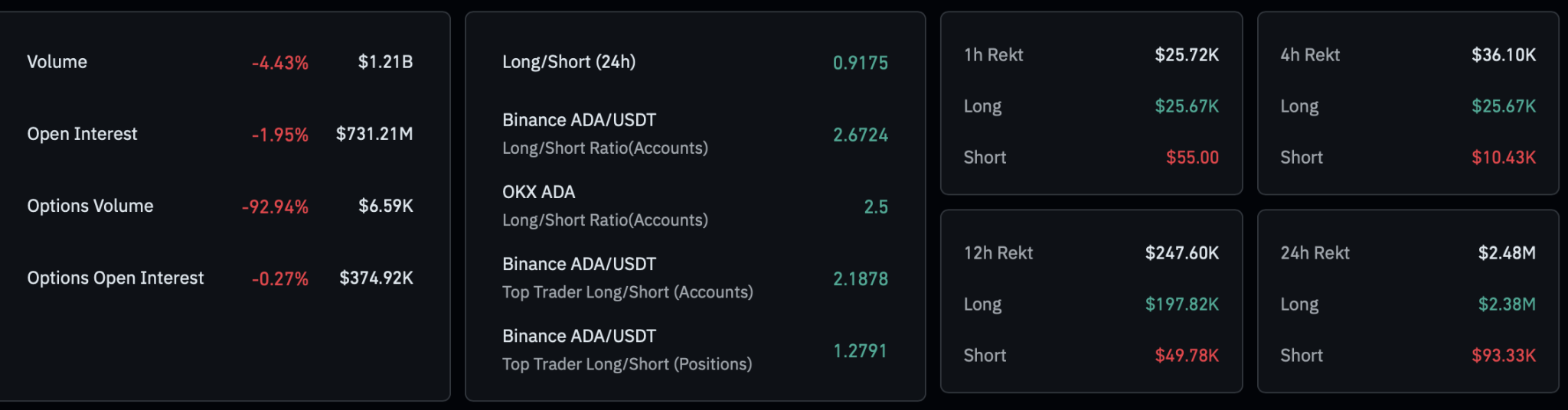
Meanwhile, optimism in Cardano’s derivatives market continues to fade as downside risks increase. According to Coinglass data, Cardano’s open interest has declined by 1.95%, falling to $731.21 million.

Adding to the bearish sentiment, long liquidations over the past 24 hours reached $2.38 million, substantially higher than the $93,330 in short liquidations.

Cardano Derivatives
Cardano Derivatives

This imbalance has pushed the 24-hour long-to-short ratio down to 0.9175, indicating a larger proportion of active selling positions. With bearish dominance evident in the Cardano derivatives market, traders appear to be bracing for a deeper correction.

Bitcoin Rebounds from $103K as ETF Flows and OI Delta Flash Bullish Signals

Bitcoin rebounds from $103K following geopolitical volatility. ETF inflows and a flip in the 180-day OI delta suggest a potential local bottom.

Amid rising tensions in the Middle East, a spike in crypto market volatility briefly pushed Bitcoin below $104K. However, a bullish rebound from a crucial support trendline has lifted BTC back above the $105K mark.

Could this short-term recovery and derivatives market signals indicate a local bottom, driving Bitcoin to a new swing high?

Bitcoin Price Analysis

On the 4-hour price chart, Bitcoin shows a bullish failure to sustain momentum after briefly crossing above the $108,000 mark. A pullback on Tuesday saw BTC test levels below $103,000.

Bitcoin price chart
Bitcoin price chart

However, a long lower wick on the price candle reflects strong buying pressure, pulling Bitcoin back up from the local support trendline. As of now, BTC trades above the $105,000 level, hinting at a possible trend reversal.

Technical indicators, however, offer mixed signals. The MACD and signal lines are trending downward below the zero line. On the other hand, the RSI shows a temporary surge in bullish momentum, approaching the mid-level.

Immediate resistance for Bitcoin stands at $107,015, followed by a recent peak at $108,681.

Bitcoin ETFs Accumulate Amid Turbulent Market Conditions

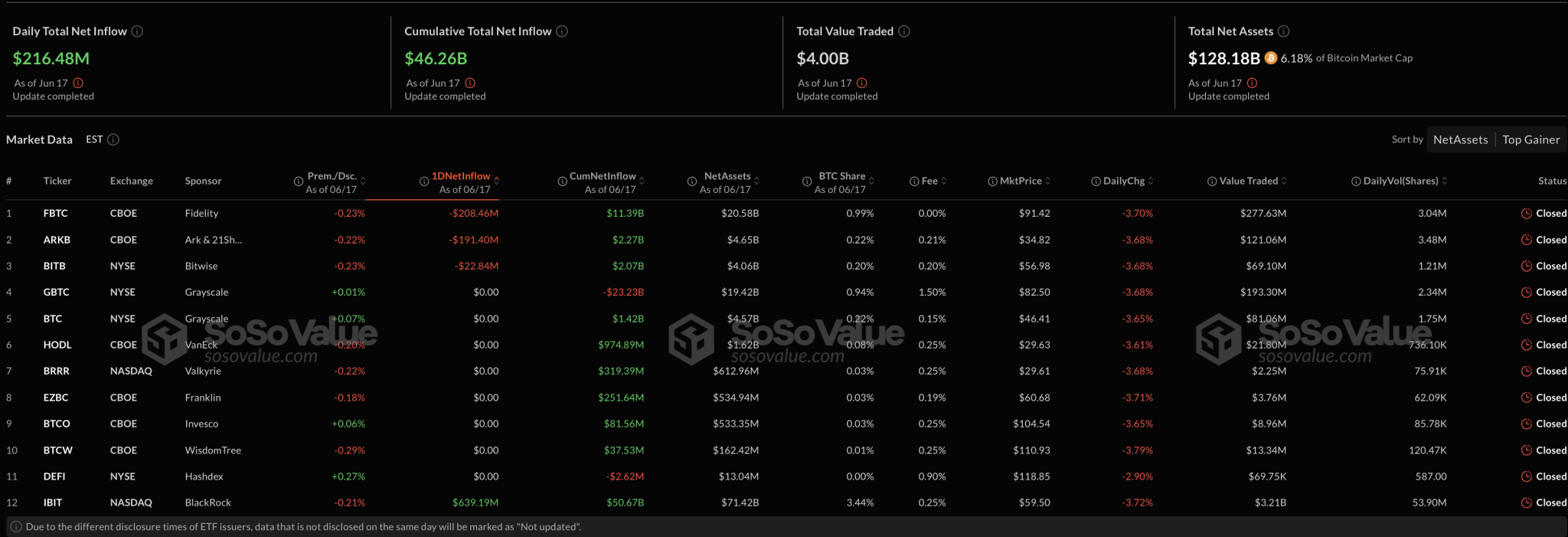
Despite the decline in Bitcoin’s price, institutional support continues to strengthen. According to SoSoValue data, U.S. Bitcoin spot ETFs have recorded six consecutive days of positive inflows.

On June 17, the daily net inflow reached $216.48 million, led by BlackRock’s $639.19 million. This inflow offset outflows from three major ETFs: Fidelity with $208.46 million, ARK and 21Shares with $191.40 million, and Bitwise with $22.84 million.

As of June 17, total net assets held in U.S. Bitcoin spot ETFs amount to $128.18 billion, accounting for 6.18% of Bitcoin’s total market capitalization.

BTC ETFs
BTC ETFs

180-Day OI Delta Turns Red, Signaling a Local Bottom

Amid rising institutional activity, a recent tweet from Alphractal, a crypto data analytics platform, highlights that the 180-day Open Interest (OI) Delta has turned negative. This indicates that more leveraged positions have been closed than opened over the past six months.

The largest contributors to this decline are Bitget with -$7.42 billion and CME with -$3.93 billion. In contrast, Gate.io stands out with a $3.2 billion increase, showing behavior counter to most other platforms.
Historically, a negative OI Delta has often coincided with local bottoms.

In 2021, the metric flipped red as Bitcoin traded between $31K and $41K, just before the run to its $69K all-time high. Similarly, in 2023 and 2024, negative OI deltas aligned with local bottom formations.

However, there are exceptions. In 2022, a sharp decline in OI marked the deepest point of the bear market.

Essentially, if the OI Delta turns positive again, it could signal a bullish reversal. But if the reduction persists, it may point to continued downside pressure.

Analyst Says Dogecoin LMACD Shows Signs of Rolling Over and Playing Dead

0

The Dogecoin monthly LMACD shows signs of potentially rolling over, indicating a further weakening of momentum.

Notably, Dogecoin price is trading at $0.1701, a 1.11% decline from the intra-day high of $0.1724. As of mid-2025, the cryptocurrency remains far from its all-time high of $0.74, indicating ongoing bearish pressure.

LMACD Indicates Bearish Momentum

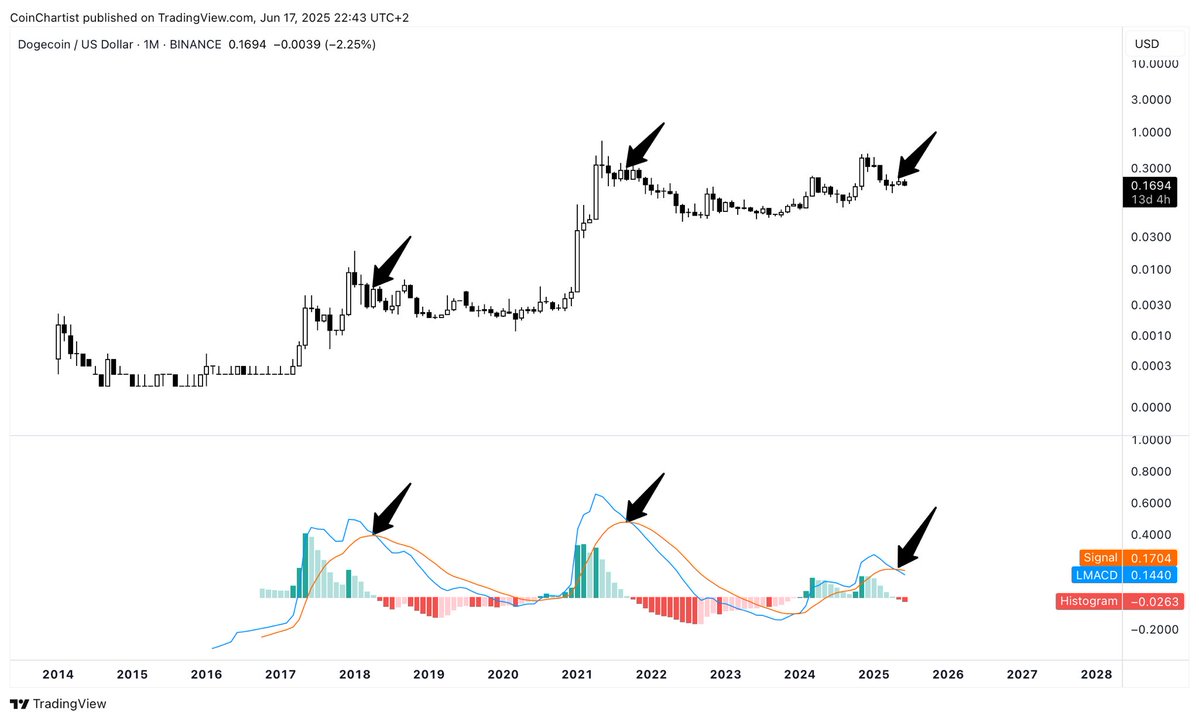
However, according to crypto analyst Tony “The Bull” Severino, CMT, Dogecoin’s 1-month LMACD (Logarithmic MACD) shows DOGE is likely in for a continuation of the downtrend, as it happened in previous cycles. The LMACD line remains below the Signal line, and the histogram is still negative, signaling weak momentum. 

Looking back to 2017-2018, Dogecoin displayed a bullish trend, with the LMACD line above the Signal line and a positive histogram, indicating strong momentum. However, as the price peaked at $0.017 on January 7, 2018, the trend shifted.

Specifically, the LMACD turned negative, with the histogram showing declining momentum. This shift marked the start of a downtrend, and Dogecoin’s price eventually fell to as low as $0.002 by April 2018.

Image

The 2020-2021 period, however, saw a major reversal. During this time, the LMACD strongly favored the bulls, with the indicator signaling an upward price movement.

This period of strong momentum saw Dogecoin rise to its peak of $0.68 on May 8, 2021. The LMACD histogram remained green, showing robust positive momentum. This phase reflected a strong rally, but by 2022, the LMACD began signaling a reversal.

LMACD Reversal in 2022 

After reaching its 2021 high, the LMACD’s position began to shift. The histogram turned red, and the LMACD line crossed below the Signal line, signaling the end of Dogecoin’s bullish phase.

This reversal marked the beginning of a downtrend that lasted through 2022. By mid-June 2022, Dogecoin’s price had fallen to around $0.05. The LMACD’s negative positioning, coupled with the red histogram, suggested that Dogecoin had entered a period of weak market momentum.

The current LMACD readings further suggest continued bearish conditions. The LMACD stands at 0.1440, with the Signal line at 0.1704. Additionally, the histogram remains negative at -0.0263, indicating weak momentum. These negative signals show that Dogecoin’s market trend is still under pressure.

According to the analyst, this 1-month LMACD for Dogecoin shows signs of potentially rolling over and playing dead, indicating a further weakening of momentum.

Analyst Predicts Massive DOGE Price Recovery

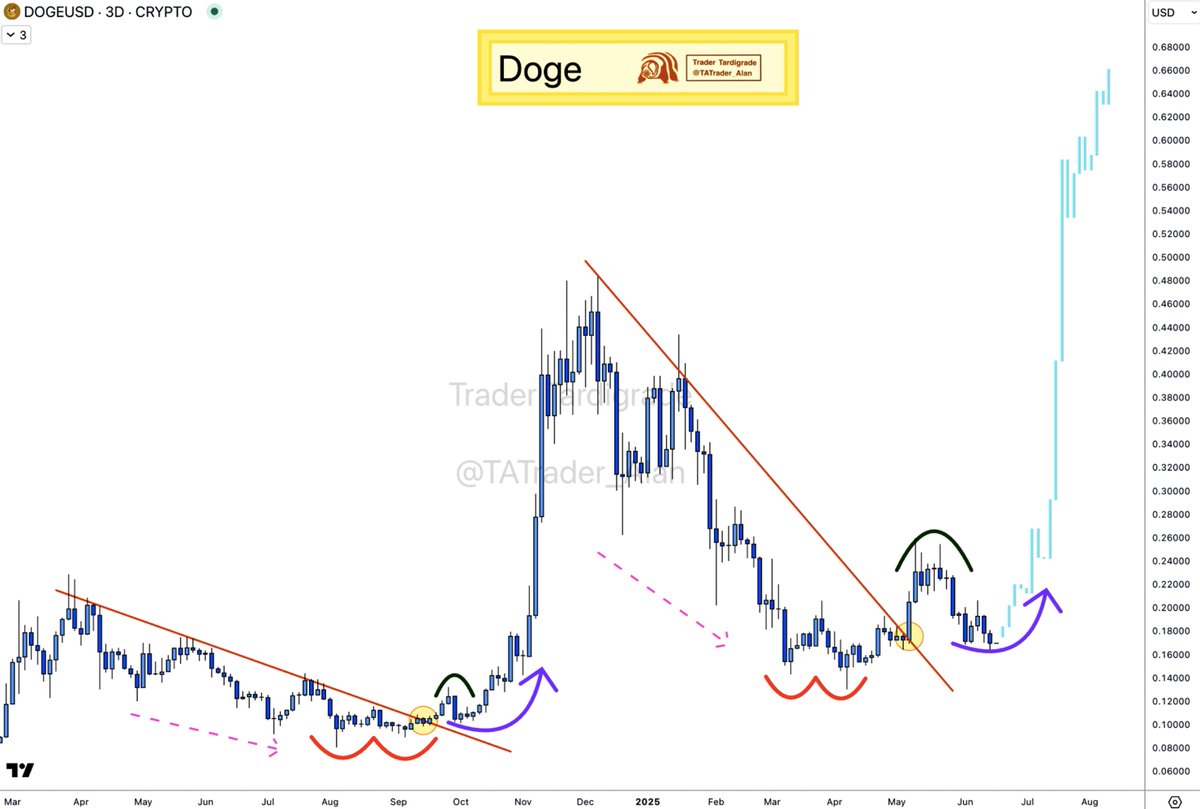
While the LMACD shows bearish momentum, there are other analysts who believe that Dogecoin may still have some bullish potential. For one, Trader Tardigrade has suggested that Dogecoin follows certain price rhythms, implying that its price may follow similar patterns after breakout phases.

According to Tardigrade, the cryptocurrency could see a rally similar to previous price actions after significant consolidation periods.

Image

Tardigrade’s analysis points out that Dogecoin may begin to show signs of accumulation within the $0.18 – $0.20 range, with potential for upward movement if it holds these support levels. This could lead to a bullish breakout, possibly pushing Dogecoin towards the $0.6533 level, a more than 260% increase from current levels. 

On-Chain Data Shows Changing Market Sentiment

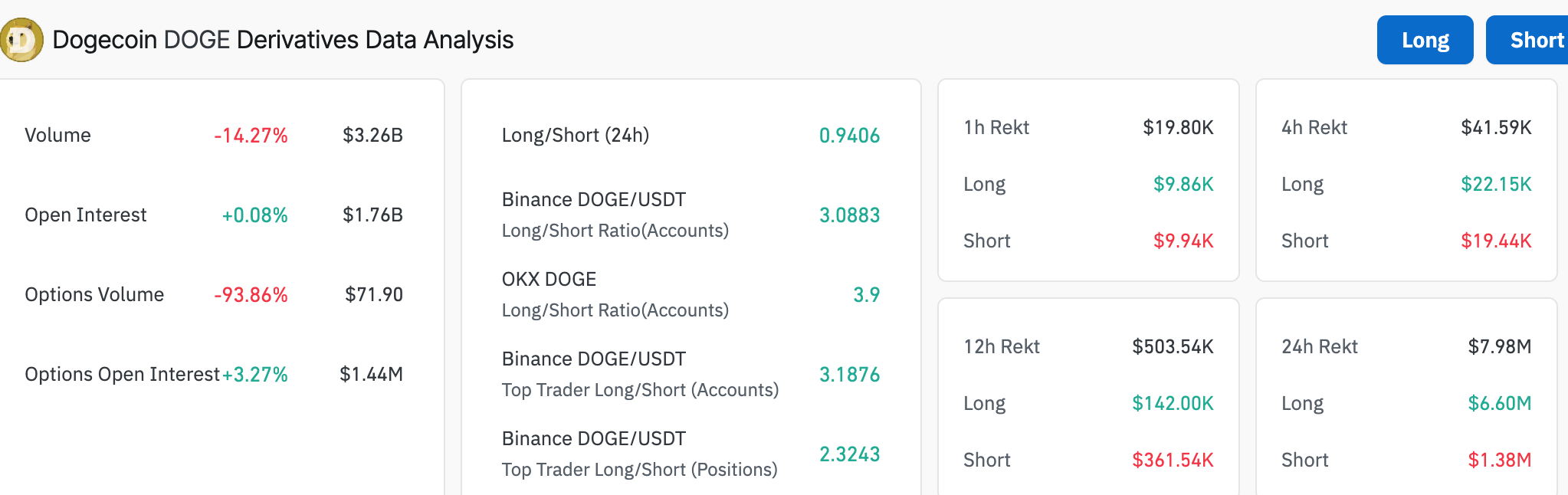
Elsewhere, according to data from CoinGlass, the derivatives market is also showing signs of shifting sentiment towards Dogecoin. The open interest for Dogecoin has seen a slight uptick of 0.08%, reflecting a growing interest in the cryptocurrency despite its weak technical signals. 

Additionally, the trading volume for Dogecoin has been substantial, an indication that the market may be preparing for another move.

Dogecoin Derivatives Data

Spain’s Second-Largest Bank Recommends Up to 7% Bitcoin Allocation for Wealthy Clients

0

Prominent Spanish bank BBVA has been paving the way for mainstream cryptocurrency adoption, advising its wealthy customers to invest in Bitcoin.

With the rapidly diminishing skepticism that was previously held against cryptocurrency, banks have been cautious in their dealings with the sector. Nonetheless, Spain’s second-largest bank, BBVA, remains a pacesetter with its embrace of the digital asset industry.

A recent Reuters report shows that the banking giant has been promoting exposure to Bitcoin as early as September last year. According to the Tuesday report, Philippe Meyer, the head of digital and blockchain solutions at BBVA Switzerland, made this disclosure at a DigiAssets conference in London.

BBVA Advising Wealthy Clients to Buy Bitcoin

Meyer expressed the firm’s support for financial technological innovations and its embrace of the nascent cryptocurrency sector in the speech. He noted that BBVA Switzerland has been advising its wealthy private clients to hold Bitcoin and Ethereum, the two largest cryptocurrencies by market cap.

Meanwhile, the percentage of portfolio exposure varies depending on the client’s risk appetite. For a balanced portfolio, BBVA recommends that clients allocate 3% of their portfolio to buying cryptocurrencies.

However, BBVA recommends up to 7% exposure to adventurous customers. Interestingly, it plans to expand its scope of exposure beyond Bitcoin and Ethereum to include other cryptocurrencies later this year.

Interestingly, this percentage allocation closely aligns with those of other prominent industry leaders. For context, Thomas Petterffy, the 46th wealthiest man in the world, recommended a 2-3% exposure to Bitcoin, while BlackRock CEO Larry Fink suggests a 2-5% portfolio allocation to Bitcoin.

BBVA’s Crypto Venture

Remarkably, BBVA SA’s venture into the cryptocurrency space grows bolder by the day. The leading bank secured approval from Spain’s regulators in March to provide crypto custody and trading services to its clients, marking the first such approval in the country.

Recall that the bank already offered a similar service to customers in Turkey and Switzerland before the expansion to Spain. It also provides other crypto-related services to its customers.

Changing Tides Towards Cryptocurrency

Following the backlash from the FTX crash and the Terra Luna depeg, the banking sector steered clear of digital assets and discouraged meddling in the industry. However, the tides are rapidly shifting, ushering in a new wave of acceptance by traditional financial institutions.

The United States played a huge role in this emerging disposition. Donald Trump declared himself the “Bitcoin President,” created a conducive environment for innovation, and even approved the establishment of a stockpile of major cryptocurrencies.

This has sparked FOMO among nations and corporate firms, with the banking sector also slowly coming around. The Office of the Comptroller of the Currency (OCC) and the Federal Deposit Insurance Corporation (FDIC) have recently cleared banks to offer crypto custody services to digital asset firms, rescinding an earlier clause that discouraged relationships with both worlds.

Banking giants Standard Chartered Bank and Deutsche Bank have also been exploring the expansion of their crypto offerings to the United States.