Home Blog Page 672

Researcher Uncovers XRP Potential Role in Fedwire’s Over $1 Quadrillion Yearly Settlement

XRP community researcher SMQKE recently drew attention to XRP’s potential role in the U.S. financial system through Fedwire, the Federal Reserve’s real-time gross settlement service.

Reports suggest Fedwire and its associated wholesale services process an astounding $1 quadrillion annually. This system essentially moves the equivalent of the U.S. GDP every few days. The figure also dwarfs systems like ACH and highlights Fedwire’s global significance.

Ripple’s Connection Through Volante and Finastra

Meanwhile, Volante Technologies and Finastra also play important roles in this system. These are key tech providers for Fedwire and are established Ripple partners.

In 2019, Ripple partnered with Finastra to embed its blockchain-based solutions into Finastra’s payment ecosystem. This move enabled Finastra’s clients to access RippleNet’s 200+ financial institutions. In parallel, Ripple users gained entry into Finastra’s extensive banking network.

On the other hand, Volante has secured integration with Ripple’s technology since 2015. It offers Fedwire as a service via the cloud and has confirmed that its platform users can utilize XRP for transactions.

ISO 20022 Certification Tightens the Link

Notably, Finastra and Volante further deepened their position in the U.S. banking system in May 2024, when they received ISO 20022 certification from the Federal Reserve for their Fedwire-compatible solutions.

Finastra’s certified products include Payments To Go, Global PAYplus, PAYplus USA, and PAYplus Connect. Similarly, Volante earned certification for its wire payment processing solutions.

These developments pave the way for 24/7 modernized payments and support compliance through cloud-based intermediary platforms or full system replacements. All these hold while they maintain compatibility with Ripple’s infrastructure. Remarkably, Ripple itself is ISO 20022 compliant.

XRP Set for Institutional-Grade Utility

This establishes a line of connection between Ripple, XRP, and the core of U.S. interbank infrastructure. It also supports a larger thesis that XRP may be quietly embedding itself into the foundation of future finance.

Given its speed, low fees, and high scalability, XRP may become interoperable with systems that process some of the largest transaction volumes on Earth.

As the payments landscape transitions toward real-time settlement with systems like FedNow and RTP, Ripple and XRP strategically align to bridge the gap between traditional finance and blockchain-based infrastructure.

If XRP plays a fractional role in the Fedwire’s over $1 quadrillion annual ecosystem, it could be a massive untapped utility that proponents believe could further shape XRP’s price.

Interestingly, Ripple’s CEO, Brad Garlinghouse, recently backed this speculation by suggesting XRP could handle 14% of SWIFT’s multi-trillion-dollar volume by 2030.
Analyst Predicts XRP Price for July 24, Says We’re About to Get ‘XRP Summer’

Analyst WatersAbove has released a new ambitious forecast for XRP, predicting a surge into the double-digit range as early as next month.

While XRP continues to struggle around $2, dangerously close to breaching below the $2 level, market watchers like WatersAbove are convinced that an explosive movement is imminent to reverse years of underperformance.

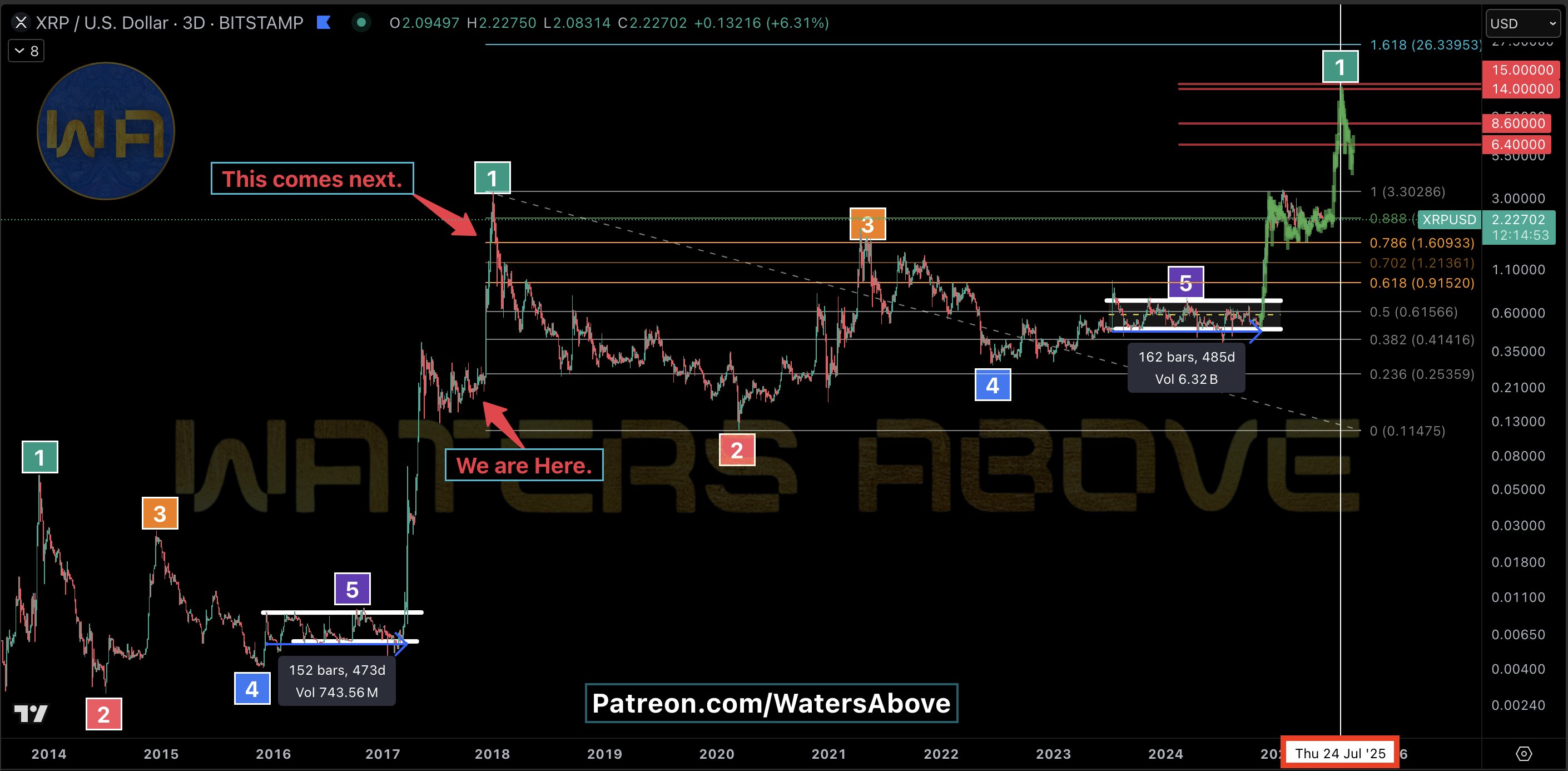
In a recent tweet, WatersAbove boldly asserted that XRP could reach $15 by July 24, 2025. Referring to the next stage of XRP’s market cycle as “XRP Summer,” the analyst suggests the asset is now entering a breakout phase similar to the one that led to its historic 2017 rally.

A Familiar Pattern, a New Timeline

Using a multi-year fractal overlay, WatersAbove shows that XRP recently completed a 485-day consolidation pattern. Interestingly, the same structure preceded XRP’s rise from under $0.006 to over $3 in 2017/2018.

Notably, the initial breakout from the 485-day range already saw XRP soar by about 600% before the ongoing cooldown phase began. According to the chart, the current breakout is just beginning. It projects a continuation that could send XRP into a new trading range.

For context, a similar pattern played out in 2017 when XRP broke out in Q2, canceling two zeros within three months before a cooldown reversed some of the gains. A resumption occurred in Q4 of that year, culminating in XRP reaching a peak above $3.

WatersAbove believes a similar scenario will unfold in 2025, with the projected top reaching above $15 by mid-year.

Image
XRP chart by WatersAbove on X

This marks a revision from his earlier June projection, which called for a move to $10 by late July or early August 2024. The updated forecast now sets a shorter horizon for the rally to unfold. Notably, his chart suggests XRP could even reach a peak of $26.33 before the next round of retracement occurs.

Market Still Cooling Off, But Bullish Expectations Remain

Despite the bullish outlook, XRP is trading at $2.16 at the time of writing. It is down 3.21% today and 6% over the past week. Price action has remained subdued, but sentiment within the community remains extremely bullish.

In a separate update, well-known analyst Michael XBT also expressed strong belief that the XRP consolidation phase is ending. He recalled how he accurately predicted XRP would break out of a seven-year bull pennant pattern in July 2024, reinforcing his new sentiment that a second leg up is on the horizon.

However, he refrained from offering a price target or timeline for when this might occur.

Community Reacts with Hope, Doubt, and Banter

On the other hand, WatersAbove’s decision to issue a bold $15 forecast with a compressed timeline, just five weeks away, faced resistance among other market watchers.

Some are optimistic, while others are openly skeptical. X user Mr. Kaspa challenged the prediction with a $10,000 bet that XRP won’t even hit $4 by the proposed date. Another user, King Valex, posted his own chart and argued the projection was off-base, claiming the pattern does not support a $15 target.

Others took a lighter tone. Régis Maël joked that he’d owe WatersAbove a coffee, tea, wine, or beer if the prediction proves accurate. Meanwhile, Ja King questioned the sudden confidence, wondering if the analyst was trolling for engagement.

Mixed reactions from crypto community

DAG Director Explains Why XRP Will Remain Relevant Despite the Rise of Stablecoins

0

Jake Claver, Digital Ascension Group Managing Director, believes XRP will still maintain its relevance despite growing stablecoin adoption.

As more institutions enter the stablecoin market and Ripple’s own RLUSD gains traction, some XRP holders worry that XRP could lose its relevance in payments. However, Claver believes XRP still has an important role to play, and that its relevance could actually grow as stablecoins become more common.

The Stablecoin Race Heats Up

Notably, the race to dominate the stablecoin market has heated up. For instance, Ripple introduced RLUSD in December 2024, targeting business use and cross-border utility. 

Since then, the token has gained momentum, reaching over $400 million in market cap at press time. Ripple has integrated RLUSD into its payment network and made it available on both Ethereum and the XRP Ledger, with plans to expand to other blockchains.

Other major institutions are also getting involved. Specifically, the Trump-inspired WLFI project has already launched the USD1 stablecoin, and tech giants like Amazon and Walmart are looking to follow suit. Interestingly, JPMorgan, Wells Fargo, Citibank, and Bank of America are also exploring a joint stablecoin project. PayPal has also launched its own stablecoin, PYUSD.

Why XRP Will Maintain Its Relevance 

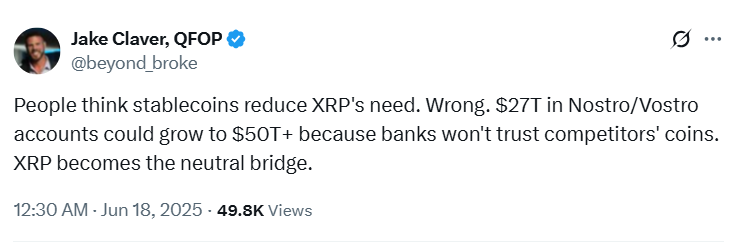
Amid the growing competition, Claver recently pushed back against the idea that these stablecoins may make XRP irrelevant. Notably, many people assume stablecoins will replace the need for XRP in global transfers, but that view overlooks a major issue: trust. 

Specifically, banks and institutions likely won’t feel comfortable using stablecoins controlled by their competitors. They won’t want to rely on an asset issued and governed by a rival institution or corporation.

Jake Claver on X
Jake Claver on X

Because of that hesitation, Claver believes the current system of holding funds in Nostro and Vostro accounts, a setup already tying up $27 trillion, could become even more bloated. Without a neutral asset to bridge different currencies, banks may need to lock up even more money to manage risk, pushing that number past $50 trillion.

Importantly, XRP solves this problem because it doesn’t belong to any one bank or company. It offers a neutral, decentralized bridge that everyone can use without handing over control. 

While stablecoins like RLUSD may be convenient for certain payment flows, they can’t replace the unique position XRP holds. As Claver sees it, the more crowded and competitive the stablecoin market becomes, the more valuable a neutral option like XRP becomes.

Stablecoin Market Grows 

Notably, the stablecoin market itself has experienced rapid growth in 2025. At press time, the total market value has crossed $256 billion, up from $204 billion at the start of the year. Stablecoins now make up almost 9% of the entire crypto market. 

Their usage also continues to rise. In 2024, stablecoin transfers totaled over $27.6 trillion, surpassing the combined volumes of Visa and Mastercard. Individuals and businesses now use them for payments, remittances, and income strategies, not just trading.

The regulatory framework is also improving. The GENIUS Act, which just passed Senate voting, would require large stablecoins to hold U.S. dollar reserves or highly liquid assets and submit to annual audits. Analysts at Standard Chartered believe the stablecoin market could hit $2 trillion by 2028 as regulations clear up and adoption spreads.

Here Are Key Milestones and Next Steps in Ripple-SEC Settlement

0

Prominent legal expert Bill Morgan outlines the procedural milestones in the settlement process between the U.S. SEC and Ripple. 

The lawsuit between the SEC and Ripple is gradually nearing its conclusion as the parties work toward getting their settlement agreement approved. Although the settlement process started smoothly in April, it faced a significant hurdle last month after Judge Analisa Torres denied the motion.

Meanwhile, in an X post today, attorney Morgan outlined the settlement’s progress, highlighting which steps are complete, pending, or have failed. 

Ongoing Ripple v. SEC Settlement Progress 

In April, the parties jointly requested that their appeals in the Second Circuit be frozen for 60 days, potentially allowing them to resolve the case. The Second Circuit granted the request on April 16 and ordered the SEC to file a status report by June 16. 

Execution of Settlement Agreement 

According to Attorney Morgan, Ripple signed the settlement framework on April 23, 2025. However, the SEC authorized the agreement on May 8, 2025, following an internal meeting at the agency. 

For context, the settlement agreement involves reducing the fine to $50 million from the initial $125 million and dismissing the permanent injunction on the company’s future institutional sales. 

First Motion for Indicative Ruling

Afterward, the parties jointly requested an indicative ruling from Judge Analisa Torres on May 8 to dismiss the injunction and slash the fine to $50 million. 

Judge Rejects Motion 

A week later, specifically on May 15, Judge Torres denied the motion for an indicative ruling due to a procedural flaw. Moreover, the parties failed to show exceptional circumstances, as mandated by Rule 60. 

Second Motion for Indicative Ruling Refiled 

Meanwhile, Ripple and the SEC refiled the indicative ruling motion on June 12, 2025. They addressed the procedural flaw and highlighted the exceptional circumstances warranting the indicative ruling. 

SEC Updates Appellate Court on Case’s Progress 

Following the expiration of the temporary pause on June 16, the SEC updated the Second Circuit about the case’s progress. It emphasized that its second motion for an indicative ruling is pending in the district court. 

In parallel, it requested that the Second Circuit extend the temporary pause by an additional 60 days, with the deadline for a status report set for August 15, 2025. 

Pending Settlement Processes 

In the meantime, the second motion for an indicative ruling is still pending in the district court. However, some experts, including Attorney Fred Rispoli, founder of Hodl Law, believe the motion will be granted. 

Limited Remand to District Court 

If Judge Torres grants the indicative ruling, attorney Morgan suggested that the parties will file a motion in the Second Circuit, asking for a limited remand to seek relief by reducing the penalty amount to $50 million and dismissing the injunction from the district court. 

Should the Second Circuit grant the request, the case will be sent back to Judge Torres so she can authorize these requests.

Dismissal of Appeal and Cross-Appeal 

Following a potential approval from Judge Torres, Morgan suggested that the SEC and Ripple would request that the Second Circuit dismiss their appeal and cross-appeal.

These pending proceedings assume that Judge Torres grants the second motion for an indicative ruling. However, if she rejected the motion, it would affect the next procedures.

Top Analyst Says XRP HTF Chart Looks Really Good, Suggests Area to Place a Bid on XRP

0

A top market analyst has remained bullish on XRP trajectory this cycle, identifying a good buying opportunity at a major support area.

Analyst Callum R.G. provided this update in an X post on Tuesday amid a broader market downside. For context, XRP corrected by 3% yesterday after previously raising high bullish hopes with two consecutive days of price appreciation, during which it gained nearly 5%.

XRP Higher Timeframes Look Good: Analyst

Despite the predominant bearishness, Callum remains positive about XRP. He noted that XRP remains one of the few altcoins to retain its gains from Q4 2024, an indication of its resilience in the face of market uncertainties.

For perspective, XRP pumped hard between November and December 2024, rising from $0.50 to $2.90 before closing the year at $2.08. While the momentum persisted until the asset reached $3.39 in January, it has relinquished most of the gains.

Nonetheless, XRP is up 3.45% year-to-date and is one of the few high assets that remain above its opening price this year. Furthermore, Callum stated that XRP’s higher-timeframe chart looks really good, despite recent drawdowns.

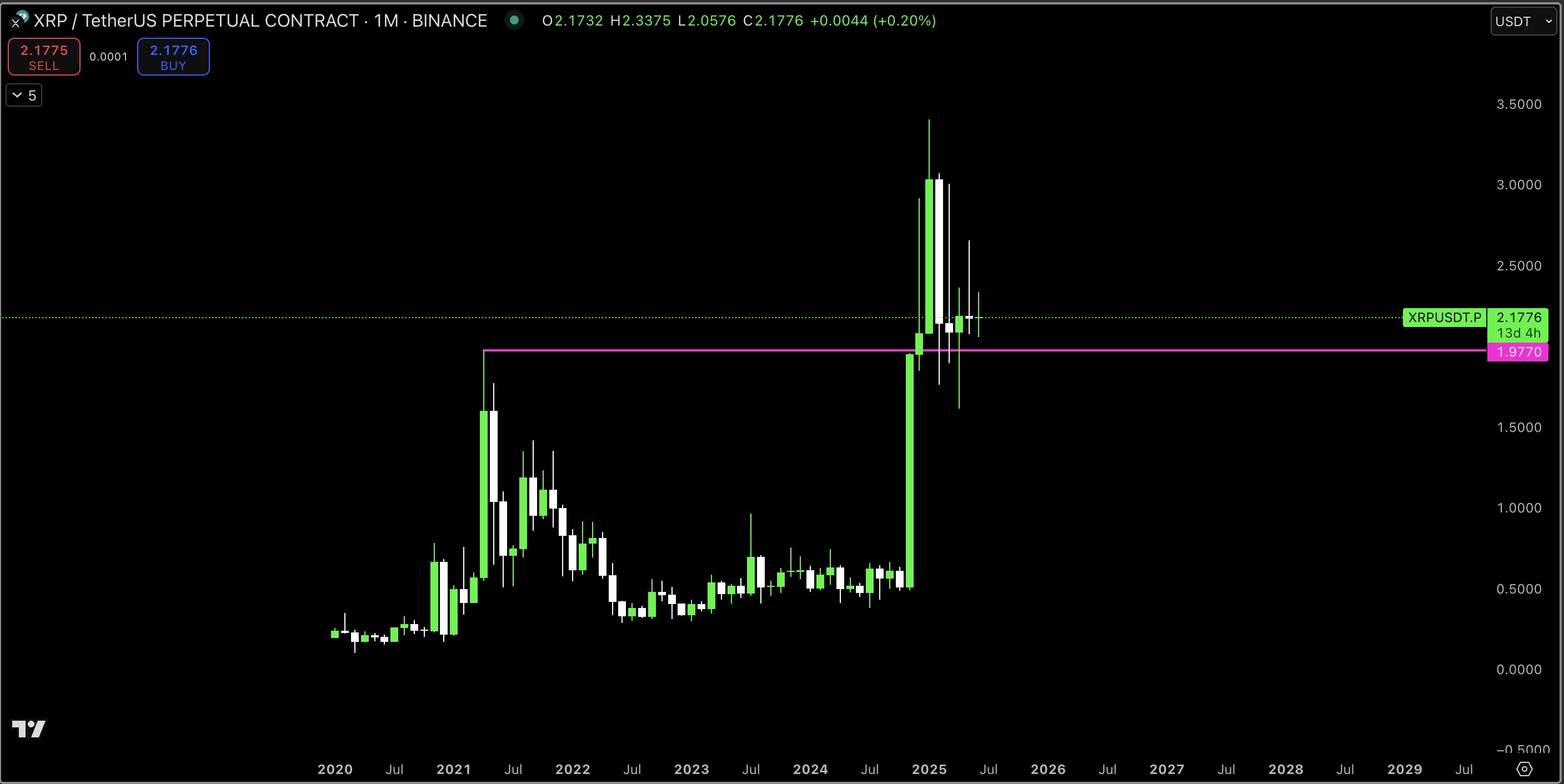
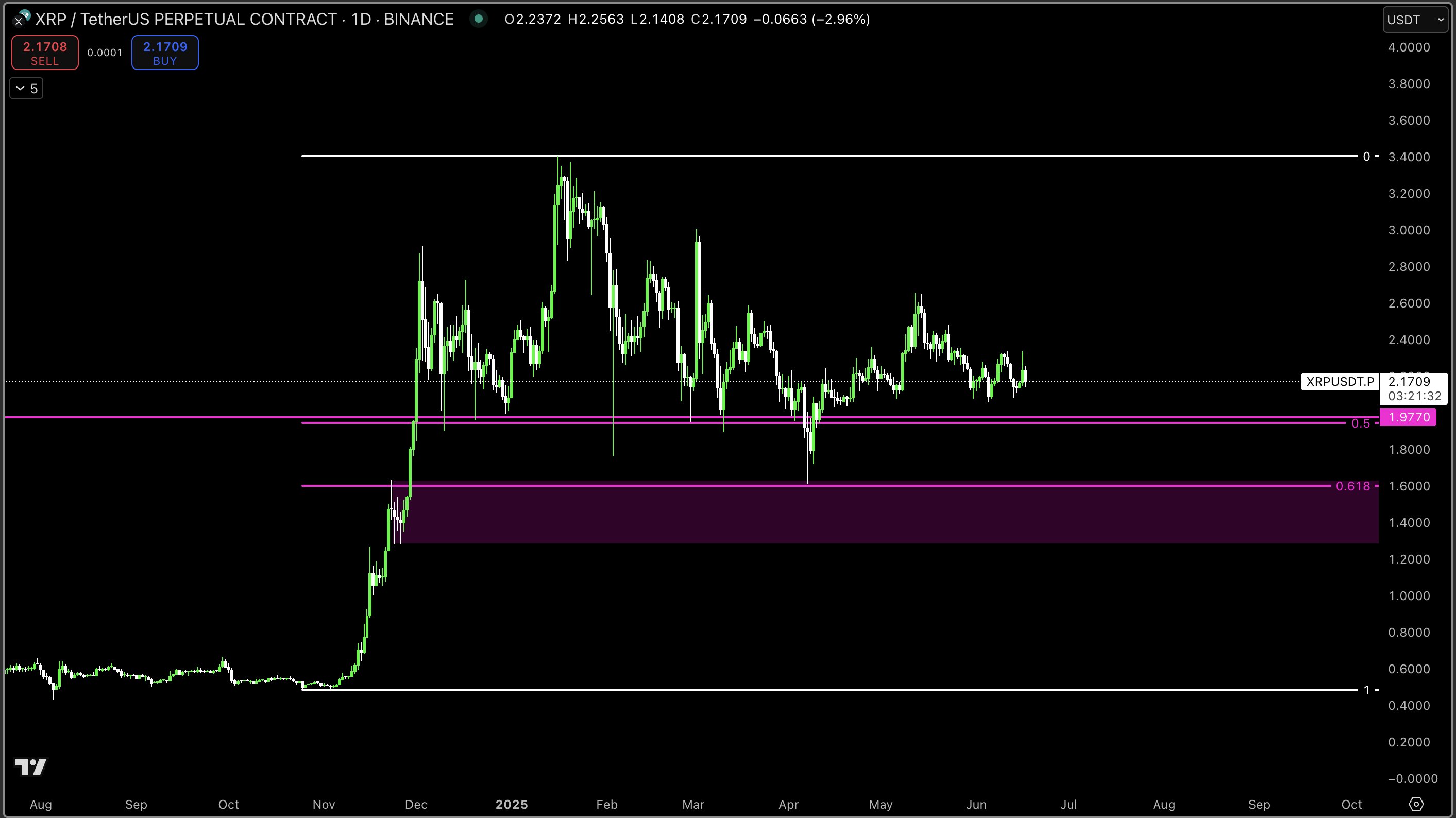
An accompanying XRP/USDT 1M chart shows that the coin has held above its 2021 price high of $1.97. The market watcher highlighted that this aligns with the 0.50 Fibonacci extension, with a trend above the level seemingly bullish for XRP.

XRP’s Trend Above the 2021 High/Callum

Analyst Says Good Place to Buy

Meanwhile, with the market showing weakness, XRP could see lower prices. Callum noted that the 0.50 Fibonacci level at $1.97 could be a good place to reload XRP, should it continue its downtrend.

Interestingly, XRP has retested the level several times this year, severely rebounding on each attempt. It even closed below the price mark towards the end of March and dipped further to $1.61 in early April, but bulls ran prices back above the support.

Callum advocated stacking more of the XRP at that level for a medium-term hold. However, he highlighted the 0.618 Fibonacci extension at $1.60 as the next support below the $1.97 region but stressed that it would take “a market-wide giga nuke” for XRP to retest the area.

XRP Major Supports/Callum

At the current price of $2.15, XRP would need to further correct by 8.3% and 25.5% to reach the 0.50 and 0.618 Fibonacci extensions, respectively.

XRP Still Keen on New Highs This Cycle

Meanwhile, Callum insinuated that the recent price retracement could be a re-accumulation phase for XRP before the next leg up. When this ends, he suggested that XRP could rally to new highs this cycle, specifically mentioning Bitcoin dominance’s peak and the consequent altcoin season as major catalysts.

While the analyst did not mention his target for this cycle, other analyses suggest XRP still has more highs to conquer. Crypto Beast predicted a minimum price of $8, citing bullish technical and fundamental developments, while EGRAG debunked claims that XRP has already peaked at $3.39, projecting a rally to $24.

Trump Crypto Czar Calls GENIUS Act Passage a Landmark Moment for Stablecoin Regulation

0

David Sacks has praised the Senate’s passage of the GENIUS Act, stating that it enhances consumer protection and strengthens the U.S. dollar’s dominance.

On Monday, June 17, the U.S. Senate passed the bipartisan Guiding and Establishing National Innovation for U.S. Stablecoins (GENIUS) Act, marking a crucial step in regulating payment stablecoins. 

This landmark legislation provides a comprehensive framework for using and issuing stablecoins. The GENIUS Act now heads to the House of Representatives for further consideration, where it could move closer to becoming law.

Support from Key Figures in the U.S. Government

Speaking on X, David Sacks, the White House AI and Crypto Czar, expressed his enthusiasm for the passage of the stablecoin bill. He highlighted its potential to enhance the global dominance of the U.S. dollar and protect consumers.

Sacks commended the U.S. Senate’s bipartisan efforts and called the bill a step forward in creating regulatory clarity for the stablecoin sector.

He also thanked President Trump for his crypto-related initiatives and praised Senator Bill Hagerty for authoring the bill. The legislation received bipartisan support from key figures, including Senators Tim Scott, Cynthia Lummis, and Kirsten Gillibrand.

Stablecoin Market to $3.7T

In his commentary, U.S. Treasury Secretary Scott Bessent cited reports projecting the stablecoin market could reach $3.7 trillion by 2030.

He stated that this growth is increasingly likely following the passage of the GENIUS Act. Bessent emphasized that a thriving stablecoin ecosystem would drive demand for U.S. Treasuries, which back most stablecoins.

This demand could help lower government borrowing costs and contribute to reducing the national debt. Additionally, Bessent pointed out that expanding stablecoins could bring millions of new users worldwide into the dollar-based digital asset economy.


Key Benefits of the GENIUS Act for Stablecoins

Following the bill’s passage, Senator Bill Hagerty took to X to highlight that the GENIUS Act establishes the first pro-growth regulatory framework for payment stablecoins. He emphasized that the bill would cement U.S. dollar dominance, protect consumers, and increase demand for U.S. Treasuries.

Hagerty noted that the act combines the dollar’s stability with the efficiency of blockchain technology, potentially accelerating the adoption of crypto in traditional finance and improving payment processing.

According to him, projections suggest that by 2030, stablecoin issuers could become the largest holders of U.S. Treasuries. This could strengthen the nation’s fiscal resilience and reinforce the U.S. dollar’s role as the global reserve currency.

US Senate Passes GENIUS Stablecoin Bill in Landmark Move for Crypto Regulation

0

The US Senate has passed the GENIUS Stablecoin Bill, its first crypto regulatory framework bill, marking a landmark victory for the digital asset sector.

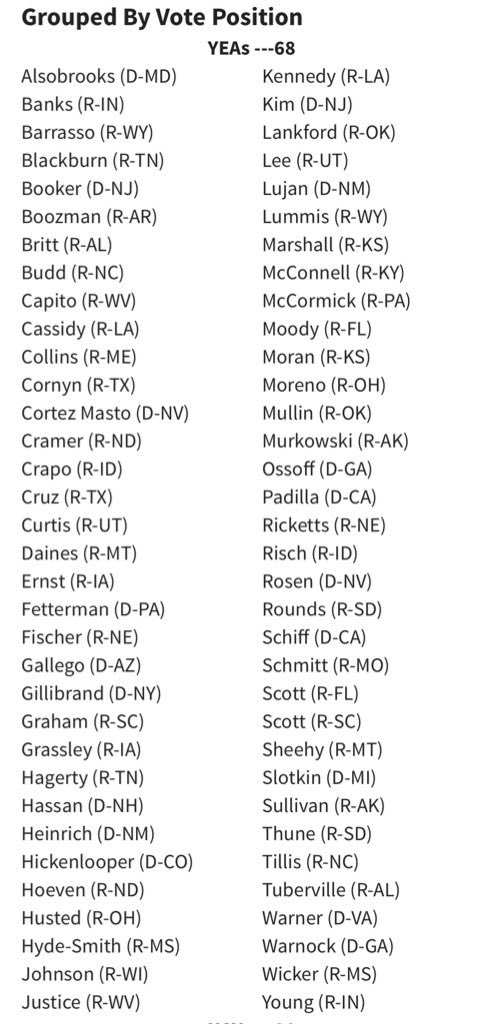
The much-discussed stablecoin bill gained bipartisan support on Tuesday, June 17, moving it one step closer to becoming law in the United States. About 68 senators supported the bill, representing a significant majority compared to the 30 who voted against it.

Senators Who Supported the GENIUS Stablecoin Bill

Following the passage of the amended version of the GENIUS Stablecoin Bill, it will now move to the House for deliberation.

GENIUS Act Nears Becoming a Law

For the uninitiated, the GENIUS (Guiding and Establishing National Innovation for US Stablecoins) Act aims to establish guardrails for stablecoins in the United States. Sponsored by Senator Bill Hagerty, the legislation would regulate the fiat-pegged cryptocurrencies, protecting investors and promoting mainstream adoption.

Meanwhile, the bill passed after facing an initial hurdle last month. The Democrats raised concerns over Donald Trump’s growing involvement in the industry and rescinded the legislation at the time.

However, after several amendments, a cloture vote in May swayed the passing process back on track, with the bipartisan support continuing to the end yesterday. Notably, the approved legislation still did not prohibit the president from issuing stablecoins, but it did prevent members of Congress and their families from doing so.

The GENIUS Act hands stablecoin control over to the Office of the Secretary of the Treasury, currently held by Scott Bressent. This diverges from a similar bill in the House, termed the STABLE Act, which shares authority between the Federal Reserve and the OCC.

Progressive Crypto Regulatory Clarity, Finally

Meanwhile, the groundbreaking passage drew reactions from crypto industry leaders, who celebrated the milestone. Ripple CEO Brad Garlinghouse appreciated the efforts of pro-crypto senators who spearheaded the push for regulation of the nascent digital asset sector.

In a tweet, he noted that this was the first significant financial bill since the 2010-enacted Dodd-Frank Act and the first relating to cryptocurrency to receive passage in the Senate. The CEO emphasized that this was a historic moment for digital assets, which Congress has long overlooked despite years of efforts to gain clarity.

Interestingly, many have teased the bill not just to foster innovation but to drive mainstream adoption of stablecoins. Crypto czar David Sacks stated that trillions will flow into the US economy with the passage, and Bessent projected that dollar-pegged stablecoins would hit a market cap of $2 trillion by 2028.

Furthermore, institutions are already exploring the new payment rail pending a functional regulatory framework. Amazon and Walmart are looking to enter into the sector, Shopify has adopted a USDC-powered payment system in collaboration with Coinbase, and Bank of America is also eyeing a similar move.

Cardano Must Hold This Level to Trigger Run to $1.43

Analytical account Rose Premium Signals highlights a potential triple-bottom formation for Cardano, suggesting a possible bullish reversal if key support holds.

Cardano (ADA) has experienced a significant price decline over the past week, dropping from over $0.70 on June 12 to just above $0.60 by June 18. As of today, ADA stands at $0.6203, reflecting a 13.77% drop over the past seven days. 

Amid the consistent downtrend, prominent technical patterns have emerged in Cardano’s price action, with an analyst pointing to a potential triple-bottom formation.

Analysts Observe Triple Bottom Formation

Rose Premium Signals, a prominent analytical account on X, highlighted this pattern in a recent analysis.

Image

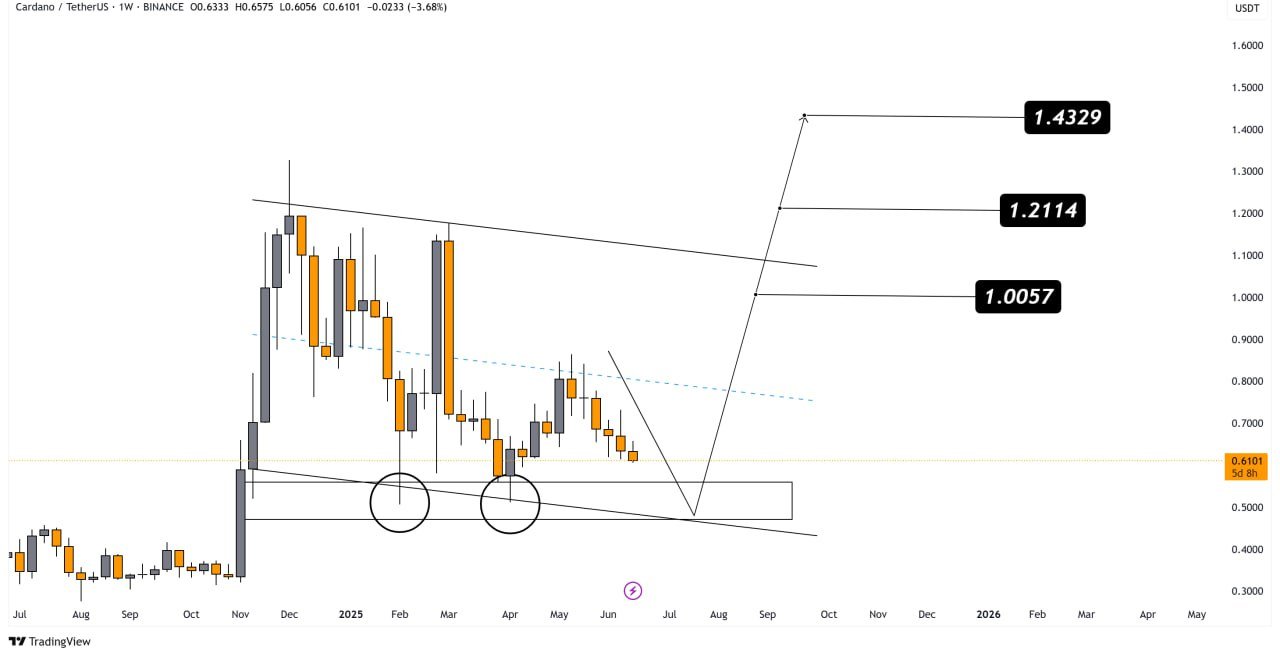
The triple bottom is typically a bullish signal, formed when the price tests the same support level three times. ADA first reached a bottom at $0.51 on February 3, then revisited a similar level on April 7. Now, the price is approaching this key support zone again.

Falling Wedge Suggests Possible Bullish Breakout

Meanwhile, in addition to the triple bottom, a falling wedge pattern is also visible on the ADA chart, which may indicate a potential bullish breakout. A falling wedge occurs when price movements compress within two trendlines, with the expectation of a breakout once the upper trendline is breached.

ADA’s price has previously failed to break past the upper trendline on December 2, when the price hit $1.3, and again on March 3, when bullish momentum faltered at $1.17. However, the current price action within the falling wedge suggests that ADA could see an upward move once the price breaks the upper resistance. 

Price Targets and Key Levels to Watch

Now, should ADA manage to hold the support and form a bullish weekly candle, there are several price targets to watch. The first target is around $1.0057, which represents an initial resistance level. 

The second target sits at $1.2114, and the final target is $1.4329. This would require an approximate 131.4% price increase from the current $0.62 level.

Elsewhere, MasterAnanda, in his TradingView analysis, emphasized the importance of ADA reclaiming the $0.68 to $0.70 range. Currently, the 34-week exponential moving average (EMA34) sits at $0.70, and the 200-week moving average (MA200) is at $0.67. Reclaiming this range could be vital for ADA to reverse its prevailing bearish trend.

If You Hold $1,000 in Shiba Inu, Can SHIB Make You Rich by 2035?

0

Shiba Inu investors looking to be rich could meet their target over the next decade, depending on their idea of “meaningful gains.”

Amid the broader market lull, Shiba Inu (SHIB) has continued to trade between the $0.000011 and $0.000012 price levels since the massive collapse from $0.000013 occurred last week in the wake of Israel’s strike on Iran’s nuclear sites. This event has triggered ongoing conflicts in the Middle East.

Mixed Reaction from Shiba Inu Investors

SHIB’s bearish consolidation has mirrored the broader crypto market’s trend, as even Bitcoin (BTC) observes range-bound movements. Notably, while most Shiba Inu investors maintain their resolve, some have given in to bearish pressure, continuously offloading their bags.

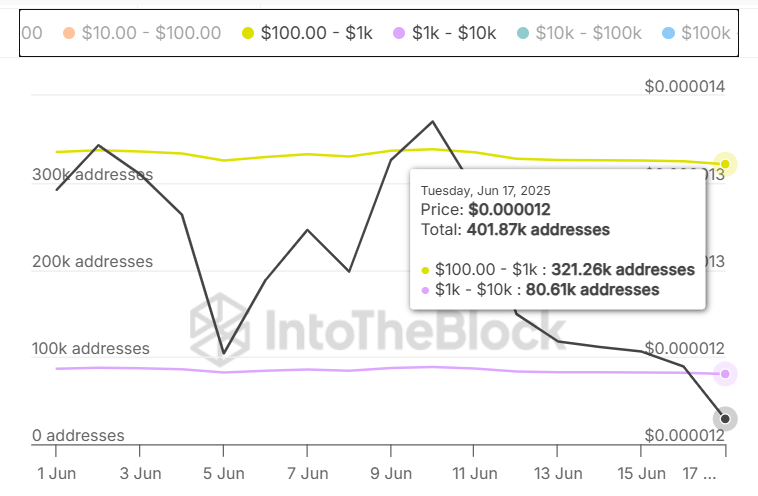
Specifically, the number of investors holding an average of $1,000 worth of Shiba Inu has reduced since the beginning of June. Data from IntoTheBlock shows that investors holding between $100 and $1,000 in SHIB and those holding $1,000 to $10,000 numbered 421,850 at the start of June.

Today, this figure has dropped to 401,870, indicating that the Shiba Inu ecosystem lost 19,980 investors in this class within two weeks. However, despite the departure of so many investors, others have remained steadfast, anticipating what they believe could be an elaborate recovery effort.

Shiba Inu Investors IntoTheBlock
Shiba Inu Investors | IntoTheBlock

Notably, Shiba Inu has proven over the years that it has the potential to reward patient investors, and analysts believe this time might not be different. However, considering the prevalent SHIB price projections available, could investors holding $1,000 in Shiba Inu today see any meaningful gains over the next decade?

If You Hold $1,000 in SHIB, Can Shiba Inu Make You Rich by 2035?

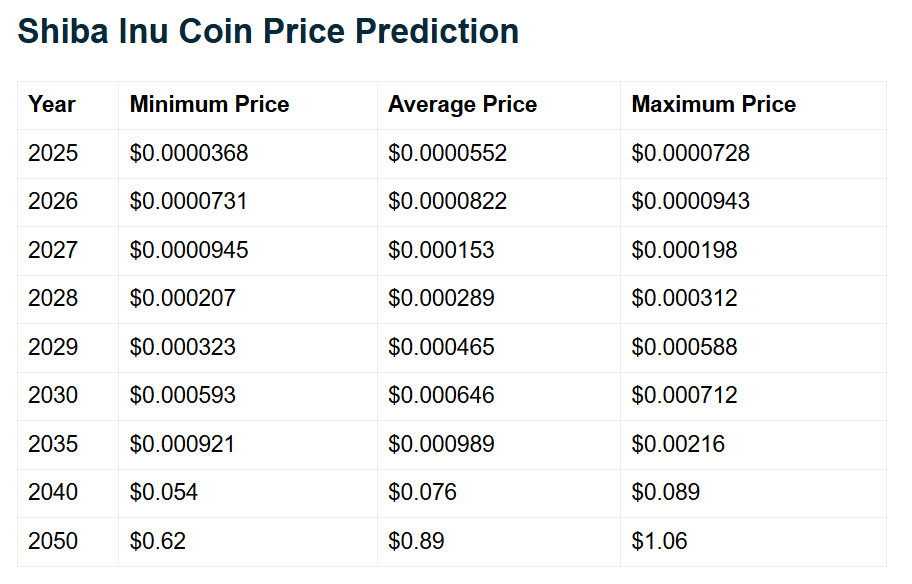
The Crypto Basic recently evaluated this, pooling predictions from popular sources that see SHIB soaring to new heights by 2035. For instance, analysts from Telegaon believe Shiba Inu could claim a maximum price of $0.00216 in 2035. 

Shiba Inu Price Prediction Telegaon
Shiba Inu Price Prediction | Telegaon

To put things into perspective, at Shiba Inu’s current price of $0.00001167, an investor holding $1,000 worth of SHIB owns about 85.689 million tokens. Now, if Shiba Inu’s price appreciates by 18,408% to reach the $0.00216 price forecasted by Telegaon analysts, these 85.689 million SHIB will be worth over $185,000.

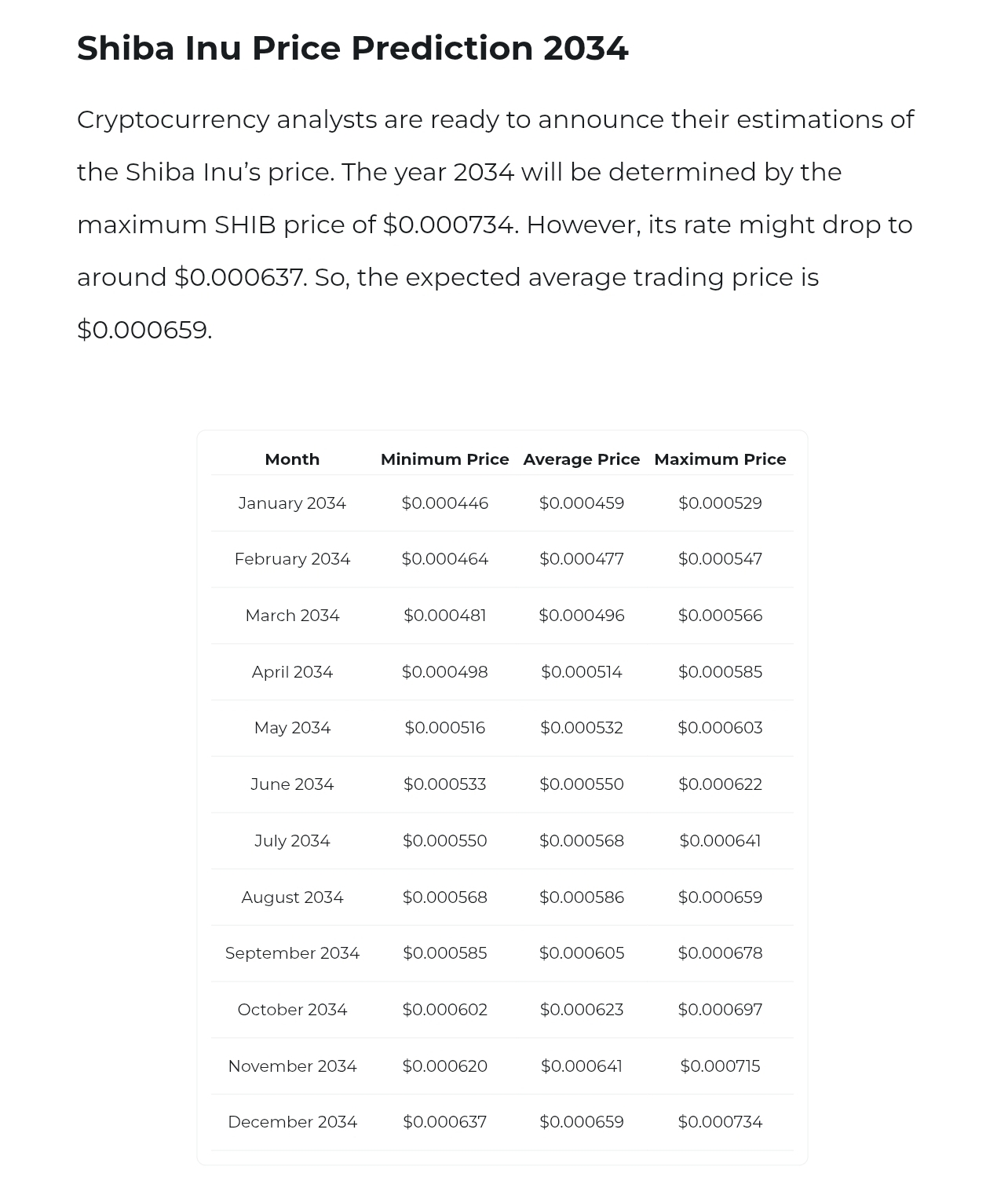
However, while crypto exchange Changelly presents no Shiba Inu price predictions for 2035, analysts at the platform have projections for 2034, a year before. These analysts see SHIB hitting $0.000734 by December 2034, a 6,189% increase from current prices. At this price, a $1,000 investment would grow to $62,896.

Shiba Inu Price Prediction Changelly 4
Shiba Inu Price Prediction | Changelly

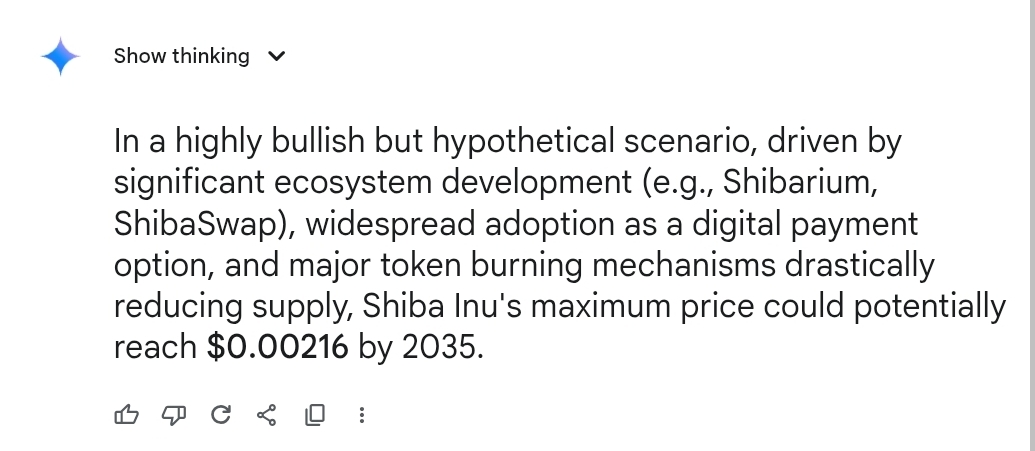
Meanwhile, AI chatbot Google Gemini expects SHIB to reach a $0.00216 price by 2035 in a bullish scenario, aligning with Telegaon’s forecasts. As previously mentioned, at this Shiba Inu price, today’s $1,000 investment would soar to $185,000, yielding a profit of $184,000.

Shiba Inu Price Prediction Google Gemini
Shiba Inu Price Prediction | Google Gemini

Now, whether these returns translate to meaningful gains or not depends on individual investor appetite. Some investors might be content with a 185x or 63x within ten years, while others might seek more. Interestingly, if an investor commits more today, say $10,000, then a 185x would have yielded more, specifically $1.85 million.

Ripple Submits New Letter in Ongoing Case Against SEC

0

Ripple Labs has submitted a supplemental letter in support of the motion for an indicative ruling in the SEC lawsuit. 

In a letter addressed to U.S. District Judge Analisa Torres, Ripple further explained why she should grant the parties’ request for an indicative ruling.

The recent filing comes less than a week after the SEC and Ripple refiled the motion to obtain an indicative ruling from Judge Torres. 

For context, the parties request an indicative ruling from the judge to modify her final judgment by dismissing the permanent injunction imposed on Ripple’s future XRP sales and reducing the penalty to $50 million. 

While the judge initially denied the request, the SEC and Ripple jointly refiled the indicative ruling motion to satisfy the ‘exceptional circumstances’ criteria. Ripple has now filed a supplemental letter supporting the recently filed motion. 

Ripple’s Supplemental Letter 

In the supplemental letter, Ripple clarified the scope of the requested relief. The filing stressed that the parties are not asking Judge Torres to revise her summary judgment order. Ripple acknowledged that the order remains binding on the company and serves as a guide to other courts.

Additionally, the motion contended that the potential dismissal of the permanent injunction does not absolve Ripple from complying with federal securities laws. 

“[…] Like every other market participant, [Ripple] is obligated to follow the law, regardless of whether an injunction is imposed or not,” the motion read. 

Meanwhile, according to the motion, granting the indicative ruling based on the settlement agreement would help end the multi-year legal dispute, potentially saving costs for the parties and the appellate court.

Furthermore, Ripple highlighted the SEC’s evolving crypto policy. It emphasized that the regulator has dismissed multiple crypto enforcement actions, established a Crypto Task Force unit, and signaled intentions to create regulatory standards for the industry.

Based on the SEC’s pro-crypto initiative, Ripple’s lawyers urge the court to grant the indicative ruling. They believe the relief would free the Second Circuit and District Court from further docket pressure. 

Lawyers React 

However, the filing has triggered reactions from several legal experts. Former SEC lawyer Marc Fagel suggested that Ripple’s supplemental letter adds no substance to the joint motion. 

According to him, Ripple submitted the filing to address skeptics of its joint motion without presenting any new arguments. 

Attorney Fred Rispoli, founder of Hodl Law, suggested that while the motion is not a powerhouse brief, he still thinks it is a crucial attempt. He pointed out that the letter addressed some glaring gaps in the previous motions, such as ending the appellate risk and reaffirming Ripple’s compliance with the summary judgment order. 

Notably, while the motion is not a strong attempt, Rispoli said it could be enough to obtain the indicative ruling.