Home Blog Page 680

Cardano Risks Breakdown: Falling Wedge Signals $0.50 Crash

Cardano is trading near $0.63 amid a falling wedge setup. A breakdown could push ADA to $0.50, while a reversal may target $0.77.

Amid the broader market downturn, Cardano faces the risk of a potential breakdown from a falling wedge pattern. With declining optimism in the derivatives market, ADA may be heading toward the psychological $0.50 level.

Cardano Price Analysis

On the daily chart, Cardano shows a failed bullish attempt to break above a local resistance line, resulting in three consecutive bearish candles. Currently, ADA is trading at $0.6392, with an intraday drop of 3.40%, testing a local support trendline.

Cardano Price Chart
Cardano Price Chart

Notably, two converging trendlines on the daily chart form a falling wedge pattern. The current intraday candle shows a minor lower wick, suggesting a potential reversal.

However, the recent pullback has intensified bearish pressure, reflected in momentum indicators. The MACD and signal lines have shifted into a bearish alignment, accompanied by a fresh red histogram on the daily chart.

Similarly, the RSI has dropped to 38, approaching the oversold zone, suggesting weakening bullish momentum. Together, these indicators warn of a potential breakdown if bearish momentum continues.

A close below the support trendline would significantly increase the likelihood of Cardano retesting the $0.50 psychological level.

Conversely, a bullish breakout from the falling wedge, initiated by a rebound from the support trendline, could push ADA toward the 50% Fibonacci retracement level at $0.7746.

ADA Derivatives

Cardano’s open interest has declined by 6.16% over the past 24 hours, indicating a sharp drop in trader optimism. As of now, open interest stands at $792.61 million, while the OI-weighted funding rate has flipped into negative territory at -0.0132%.

Cardano Derivatives
Cardano Derivatives

This shift suggests a notable surge in bearish activity over the last 8 hours, primarily driven by increased long liquidations. According to available data, long liquidations total $6.97 million, compared to just $131K in short liquidations, signaling a significant wipeout of bullish positions.

As a result, the long-to-short ratio has dropped to 0.9033 in the past 24 hours, reflecting a bearish outlook among derivatives traders.

Dogecoin Dips Below $0.2: Will the $0.17 Support Zone Hold?

Dogecoin dips below $0.20 amid a broader meme coin market correction, testing the critical $0.17 support zone. Are the bears about to take control?

With the crypto market pulling back, the meme coin sector has seen a 5% decline in market capitalization over the past 24 hours, falling to $60.47 billion.

As the broader market corrects, Dogecoin is down nearly 10% in the same timeframe, breaking below the psychological $0.20 level. Will this pullback in the largest meme coin lead to a breakdown of the $0.17 demand zone?

Dogecoin Price Analysis

On the daily chart, Dogecoin’s price action reveals a bullish failure to maintain the uptrend seen earlier this week. After facing strong rejection at the 100-day EMA of $0.2043, the meme coin has taken a bearish turn, with a third consecutive red candle forming.

Dogecoin price chart

Dogecoin is now trading below the 23.60% Fibonacci retracement level at $0.17718. Its current market price is $0.1740, reflecting a 3.95% drop on the day.

As the pullback intensifies, pressure is building on the local support trendline and the $0.17 demand zone. While optimistic traders are looking for a potential double-bottom reversal at $0.17, the broader market sentiment increases the risk of a breakdown.

The MACD and signal lines have failed to form a bullish crossover and continue to trend downward, with a rising number of bearish histogram bars. Additionally, the continued decline in the 50-, 100-, and 200-day EMAs reinforces the bearish outlook.

According to Fibonacci levels, a deeper pullback to $0.1298 is possible. However, price action analysis suggests minor support at $0.1529. On the flip side, a potential reversal could target the 50-day EMA at $0.1976.

Bearish Imbalance in Dogecoin Derivatives

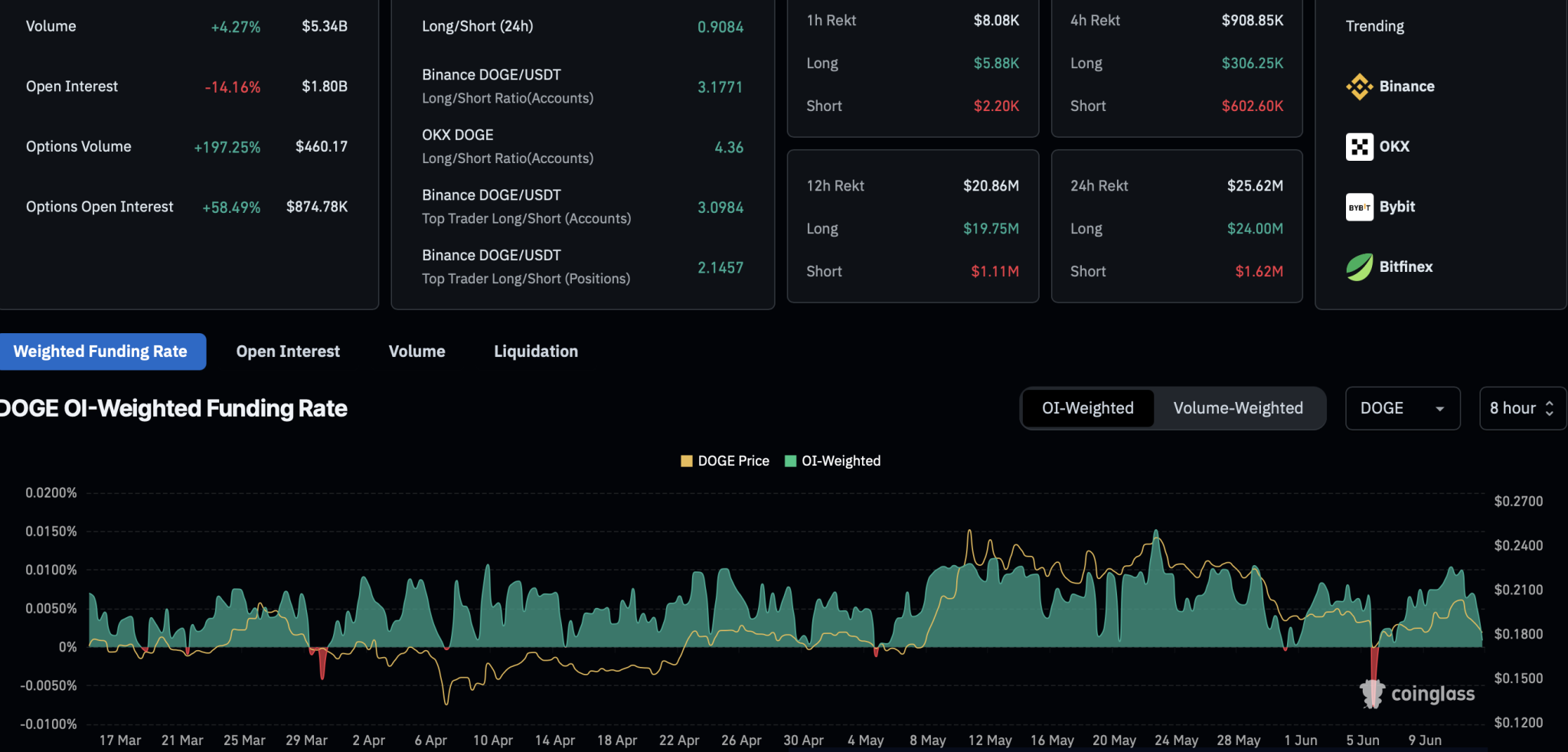
As the broader market sell-off gains momentum, optimism in Dogecoin derivatives is fading. According to Coinglass data, open interest has dropped by 14.17%, falling to $1.80 billion.

Bullish sentiment among derivatives traders is also weakening, as reflected in the OI-weighted funding rate, which has declined to 0.0009%. 

Dogecoin Derivatives

Notably, the past 24 hours have seen a significant wipeout of bullish positions, with $24 million in long liquidations, compared to just $1.6 million in short liquidations.

This has created a bearish imbalance in Dogecoin’s open interest, with the long/short ratio dropping to 0.9084.

Bitcoin Risks $100K Retest as Liquidations Top $1B Amid Middle East Tensions

Bitcoin slips below $104K as liquidations exceed $1 billion amid the Israel-Iran conflict. Is BTC set to retest $100K? 

The risk-on sentiment in the crypto market is weakening due to the recent Israeli attack on Iran. Amid escalating tensions, crypto market liquidations have surpassed $1 billion.

At press time, Bitcoin is trading below $104,000, with an intraday pullback of over 1%. Is BTC’s decline likely to reach the $100,000 level?

Bitcoin Price Analysis

On the 4-hour chart, Bitcoin recently reversed from the $110,266 resistance level, resulting in a correction of over 5% in the past three days. With the latest 4-hour candle closing below the 200-period EMA at $104,557, Bitcoin is testing a local support trendline.

Bitcoin Price Chart
Bitcoin Price Chart

Recent candles show lower price rejections, indicating that Bitcoin is struggling to hold above the critical trendline. BTC risks retesting the $101,763 support level, raising the probability of a drop toward the psychological $100,000 mark.

As bearish pressure builds, the MACD and signal lines have moved into negative territory, accompanied by a surge in bearish histogram bars on the daily chart. Thus, momentum indicators reveal a bearish bias, increasing the likelihood of a trendline breakdown.

However, a potential Morning Star pattern forming near critical support could trigger a bullish reversal, possibly pushing the price up to test the 100 EMA at $106,402.

Bitcoin Derivatives

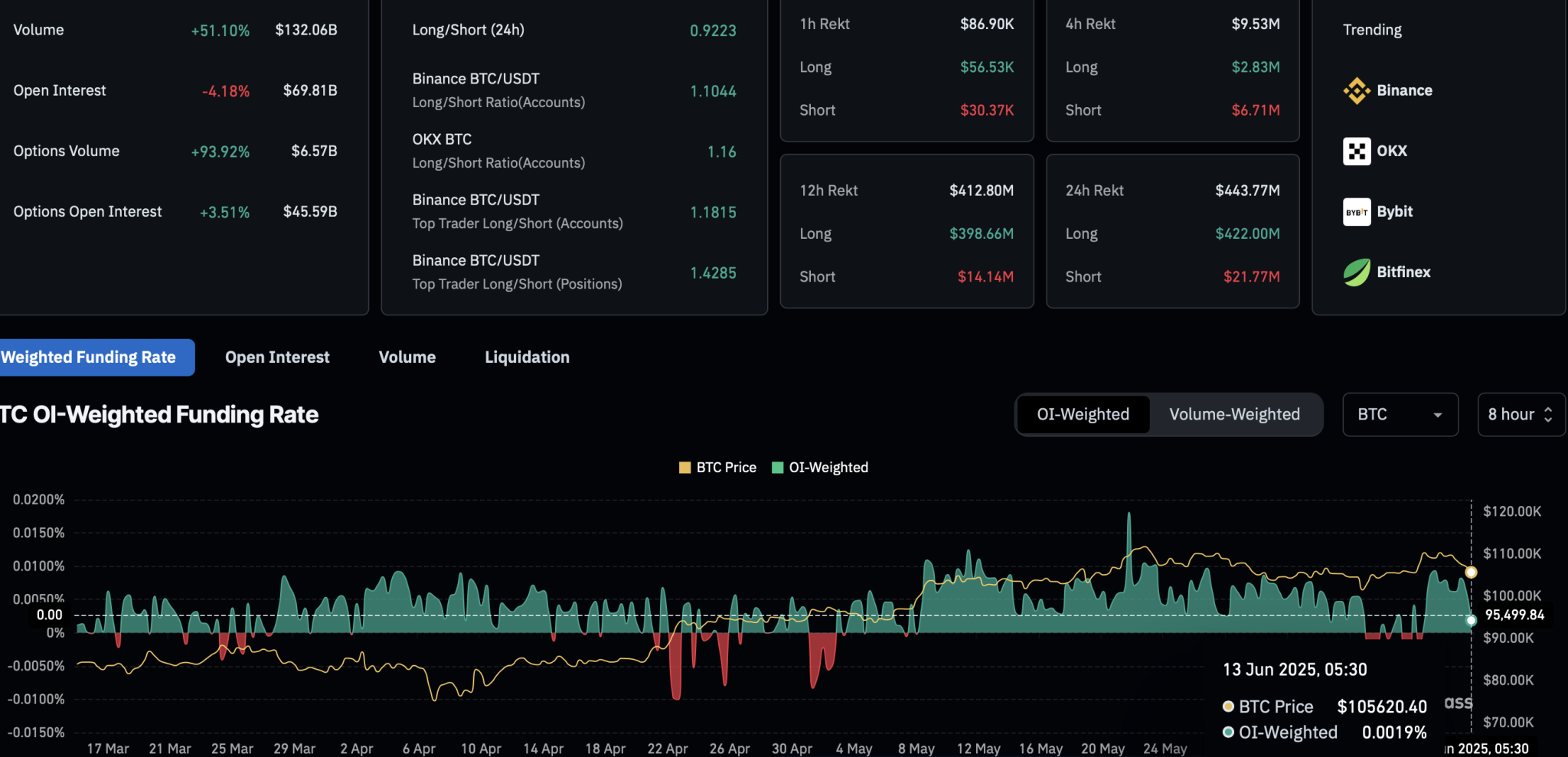
In the derivatives market, trader interest in Bitcoin has declined significantly. Open interest has dropped by 4.18% to $69.81 billion. With this decline, bullish sentiment has weakened, as the OI-weighted funding rate has fallen to 0.0019% from a peak of 0.0082% on June 12.

This sudden shift coincides with $422 million in long liquidations over the past 24 hours, compared to just $21 million in short liquidations. Meanwhile, in the broader market, liquidations have surpassed $1.15 billion.

As a result, the long-to-short ratio has fallen to 0.9223, indicating a bearish tilt in open positions.

Bitcoin Derivatives
Bitcoin Derivatives

Bitcoin ETFs

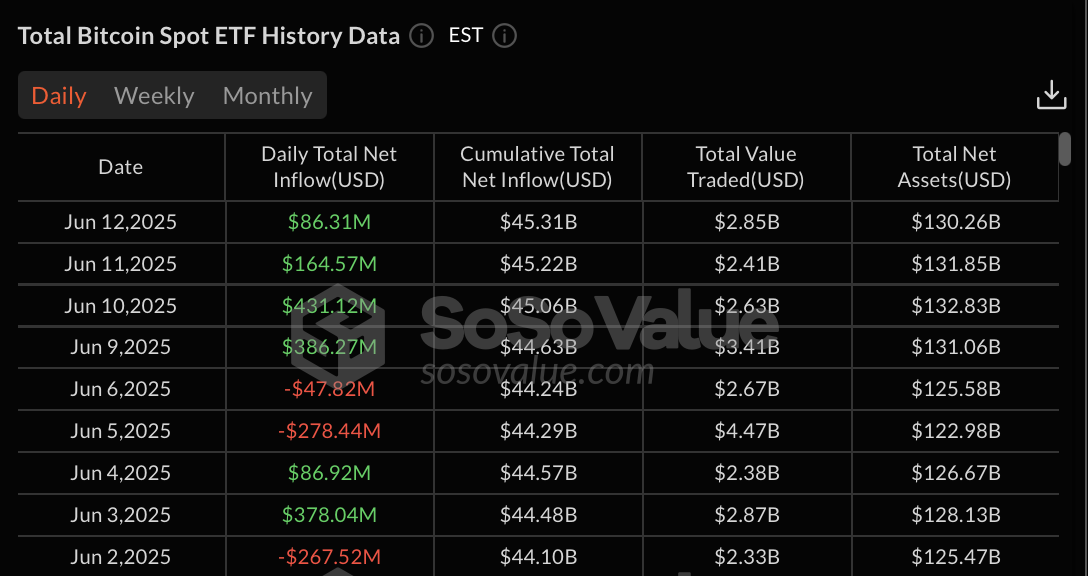
Despite heightened short-term volatility stemming from Middle East tensions, U.S. Bitcoin spot ETFs continue to display strong investor confidence. On June 12, daily net inflows totaled $86.31 million, marking the fourth consecutive day of positive inflows.

So far this week, total net inflows have reached $1.07 billion, supporting the case for a continued long-term uptrend.

Bitcoin ETFs
Bitcoin ETFs

Shiba Inu Ends Meme Era with Launch of Ambitious Project

0

The Shiba Inu ecosystem team announces a major project that could revolutionize SHIB and potentially mark the end of its meme era. 

The team took to X to announce the beta launch of Shib Alpha Layer, the ecosystem’s rollup abstraction developed in collaboration with ElderLabs. Despite no VC funding, the Shiba Inu ecosystem team and ElderLabs’ engineers successfully built the project in record time.

Shiba Inu Ignores Critics, Ships Ambitious Project  

While unveiling the new initiative, Shiba Inu’s lead developer, Kaal Dhairya, reflected on past criticism directed at the cryptocurrency. He noted that Shiba Inu was initially dismissed as a meme coin, overwhelmed by “Wen Shibarium?” jibes and drowned in fear, uncertainty, and doubt (FUD).

Instead of focusing on the criticism, Dhairya emphasized that the team kept building, delivering key projects like Shib Alpha Layer, which he introduced yesterday.

The Shib Alpha Layer helps unify every RollApp, integrating them into a single, ultra-fast layer. It acts as a unified top layer that hides the complexity of multiple RollApps operating beneath it.

“[With Shib Alpha Layer], users feel like they are transacting on one chain while dozens of rollups operate beneath the surface,” Dhairya remarked. 

Benefits of Shib Alpha Layer 

Some of its benefits include ‘single-chain UX,’ which prevents users from having to hop between bridges or fragmented wallets. It also provides users with near-instant finality with blazing-fast transactions. 

The Shib Alpha Layer enables users to pay transaction costs using any token of their choice, including SHIB and BONE. It features ZAMA’s Fully Homomorphic Encryption (FHE), offering encrypted smart contract logic. 

Moreover, it is equipped with a plug-and-play ShibOS service, allowing users to choose any module while ignoring others. Meanwhile, Dhairya disclosed other upcoming features to be added to the project, including instant bridging and multi-chain interoperability. 

Interestingly, the top developer highlighted Shibarium as the settlement layer of the project. This automatically upgrades every RollApp to an L3 network, equipping them with built-in security. 

Furthermore, subsequent upgrades would feature full FHE support, with RollApp deployment open to everyone. 

Following the project’s beta launch, Dhairya emphasized that Shiba Inu’s meme era has ended, signaling the beginning of the Shib Alpha Layer era. 

Shiba Inu Lead Developer Highlights New Project 

Meanwhile, Shiba Inu’s lead developer, Shytoshi Kusama, also brought the newly introduced project to the community’s attention, urging enthusiasts to read the text from Dhairya. 

Recall that Kusama has been inactive on X over the past few weeks due to his ongoing work on the whitepaper exploring the interaction between Shiba Inu and AI. 

However, he emerged from hibernation yesterday to highlight Shiba Inu’s Web3 gaming initiative on Astra Nova’s TokenPlay.ai platform and the newly introduced Shib Alpha Layer. 

Dogecoin to Produce Its Highest Price Since 2021 After Testing This Level: Top Analyst

0

A top market analyst has suggested that Dogecoin will rally to a four-year high when the current downside ends, highlighting a major support level to watch.

Master Ananda shared this view in a TradingView analysis today amid a broader market recession. Bitcoin dropped to an intraday low of $102,758, sparking a broader market downtrend that did not spare Dogecoin.

DOGE, the largest meme coin by market cap, joined the wave and is already down 4.8% today. Unless the current momentum reverses, the token is on the cusp of its third consecutive losing day, having retraced 13.6% during this period.

Analyst Identifies Crucial Support

For context, Master Ananda noted that he expected Dogecoin’s current price crash as its chart structure formed a lower high on June 5, a sign of a bearish reversal. While Dogecoin rebounded from the lows of the earlier-mentioned date, it has given back its gains, aligning with the bearish indicator.

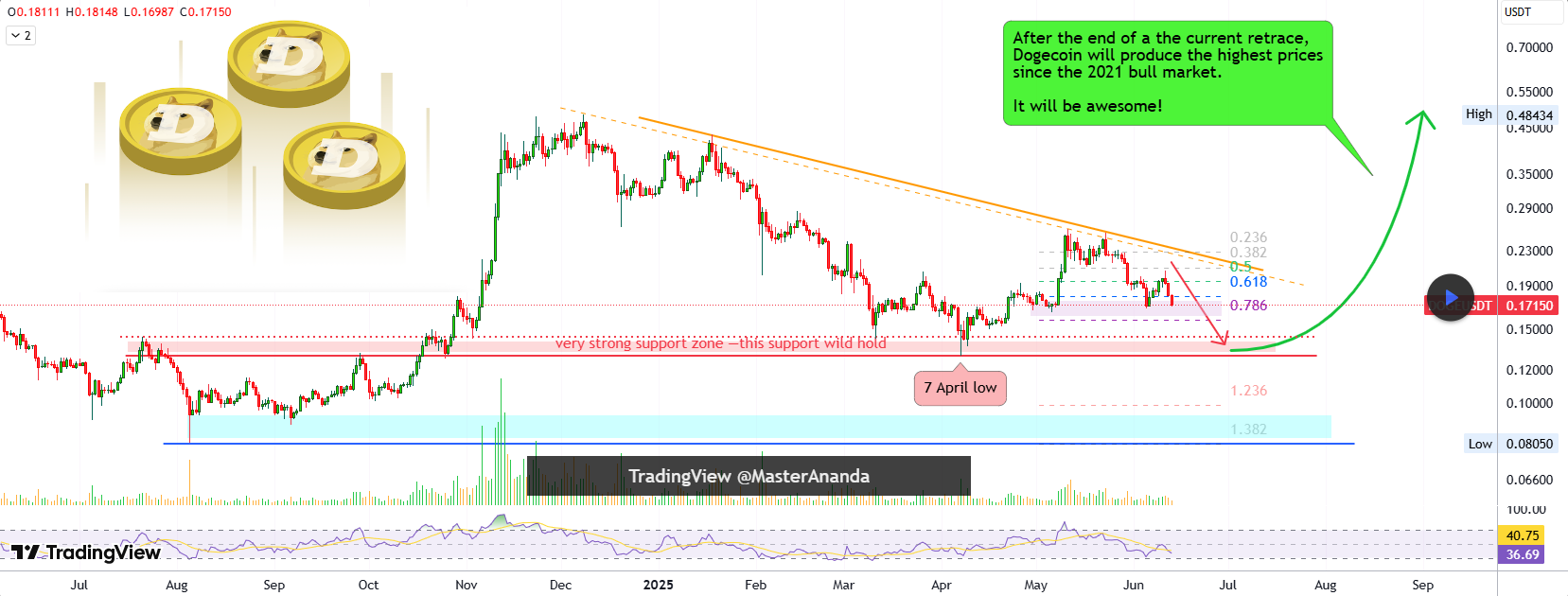
Meanwhile, the analyst identified macro support levels at the 0.618 and 0.786 Fibonacci retracement levels, at $0.178 and $0.158, respectively, that could serve as a short-term hedge against escalating price weakness. However, he noted that they are weak supports and may not suffice for the bearish momentum.

Dogecoin Analysis per MasterAnanda

Notably, DOGE has broken down from the 0.618 Fib. Support level at its current price but remains 8.6% away from the 0.786 Fibonacci level. Master Ananda noted that if the levels fail to hold, Dogecoin seems poised to retest the lows last seen in April.

Specifically, Dogecoin bounced from a major support level around $0.13 in April, a level that served as support in July 2024 and as resistance in September 2024. Notably, the meme coin retested the support in October and November of the same year but bounced extensively at each retest.

The analyst expects the $0.13 support to tame Dogecoin’s bearish momentum again if prices dump to the level. He noted that the RSI would have to go into extreme weakness for prices to fall below, which is very unlikely.

What’s Next After Support Retest?

Interestingly, Master Ananda advised going all in at the April 7 lows if prices ever retraced to that point, insisting it would be a great buy. As Dogecoin bounced from the support in October before rallying over 200%, he predicted a similar outcome.

Per the accompanying chart, the analyst expects Dogecoin to rebound from the lows and target a four-year price high. He predicted an over 250% upsurge in support to levels above December’s high of $0.484.

Dogecoin trades at $0.173 at the time of writing, 20% away from this support and 180% from the projected high. It bears mentioning that other analysts see DOGE surpassing the $0.484 mark this cycle, with targets like $1 and $2.9 in the books.

Critics Challenge Bitcoin Safe Haven Claims as BTC Slumps Amid Israel’s Airstrikes on Iran

0

Bitcoin has declined following Israel’s airstrikes on Iran, while gold has seen an increase, reigniting debate over Bitcoin’s safe haven status.

Specifically, Bitcoin experienced renewed volatility on Friday following a significant geopolitical escalation, as Israel launched airstrikes on Iran. The conflict, which led to sharp moves across global markets, triggered a pullback in major cryptocurrencies, including Bitcoin.

Bitcoin briefly dropped below $103,000 before recovering slightly to trade at $103,964, marking a 3.66% decline in 24 hours. The largest crypto had maintained levels above $107,000 since June 9 but failed to sustain gains amid growing geopolitical tensions.

Alongside Bitcoin, Ethereum also registered sharp losses, dropping as much as 7.6% at one point during the session.

Bitcoin Critics React After Gold Outperformed

Meanwhile, traditional safe haven assets like gold and oil saw gains. Gold climbed to $3,421, an increase of $38.60 or 1.14%, while oil prices jumped by 5%, signaling investors’ shift toward perceived safer assets.

This divergence fueled renewed criticism of Bitcoin’s ability to serve as a hedge during macroeconomic uncertainty. Former Chief Market Strategist Gil Morales argued that the price reaction exposed Bitcoin’s nature as a speculative asset rather than an alternative store of value. He likened its behavior to that of a tech stock, stating that in a risk-off environment, Bitcoin declines like any other risk asset.

How Could Anyone Consider Bitcoin?

The contrasting movements of Bitcoin and gold reignited already running debates around the narrative of Bitcoin as “digital gold.” Peter Schiff, Chief Economist and a long-time Bitcoin critic, pointed to market reactions as evidence that investors still turn to physical gold in times of crisis. 

Schiff noted that while the S&P 500 futures dropped by 1.5%, and oil surged, gold’s price rose as expected. In contrast, Bitcoin saw a sell-off. As a result, Schiff questioned:

“How could anyone consider Bitcoin as a digital version of gold?”

Some market participants countered this argument by highlighting logistical challenges in trading physical gold. They claimed that selling gold through platforms like JM Bullion can result in significant transaction costs, up to 10% when factoring in shipping and insurance.

Others criticized gold’s limited utility in the digital era, arguing that Bitcoin, despite recent declines, remains more adaptable and efficient. Schiff, however, disputed the cost claim, stating that selling gold should not incur such high expenses.

Further Bitcoin Backlash Despite Historical Bitcoin Outperformance

As the market digested the broader implications of the Israel-Iran conflict, additional criticism surfaced regarding Bitcoin’s market behavior during crises.

Jacob King, CEO of WhaleWire, argued that Bitcoin historically performs poorly during geopolitical or economic shocks. 

He attributed this to speculative demand and emphasized that Bitcoin thrives only in stable markets.

Bitcoin Maxis Still Exist

Despite the criticisms, comparisons between Bitcoin and gold have remained a central theme. A user cited historical price growth as a reason to consider Bitcoin superior, noting Bitcoin’s rise from $0.30 in 2011 to over $112,000 in 2025. In contrast, gold rose from $1,150 to a range between $2,838 and $3,375 over the same period.

Moments before this turmoil, Mike Novogratz, CEO of Galaxy Digital, predicted that Bitcoin could eventually reach $1 million, driven by rising institutional demand. Speaking on CNBC, he said Bitcoin is gaining status as a macro asset, now viewed alongside gold, silver, and major indexes like the S&P 500.

He pointed to reduced global confidence in the U.S. dollar and BlackRock’s involvement as key factors accelerating this shift.

Here Are Two Possible Outcomes After USDC Launch on XRPL

The XRP Ledger (XRPL) has taken a major leap in utility and global reach with the native launch of USDC, the world’s largest regulated stablecoin.

As the news gains traction, Santiago Velez, President of Block Digital, views the development as a win for the broader ecosystem, regardless of the motives behind the move.

USDC Now Live on XRPL

For context, on June 13, Circle officially launched native USDC on the XRP Ledger mainnet. This integration makes the stablecoin directly accessible without the need for bridges. 

Notably, Circle Mint and Circle APIs fully support the integration, enabling fast, low-cost settlement for developers, fintech firms, and institutions using XRPL’s Layer-1 blockchain.

With this update, USDC on XRPL can power enterprise B2B and cross-border payments, DeFi liquidity provisioning and token swaps, and financial applications for faster on/off-ramps and settlements.

The XRPL now joins 21 other blockchains with native USDC support, expanding the stablecoin’s reach into new payment and finance use cases.

Velez: Two Scenarios, One Positive Outlook

Notably, in a tweet, Santiago Velez responded to the announcement by outlining two possible interpretations of Circle’s move. He stressed that both are positive for the XRP Ledger’s evolution.

According to Velez, the integration clearly demonstrates XRPL’s open nature. He emphasized that it shows the XRPL is genuinely open and permissionless, as Circle didn’t need Ripple’s approval to launch USDC. 

In his view, this demonstrates the network’s decentralization in practice. Other commentators added that the development further challenges the claims of Bitcoin maximalists, who assert that XRPL is centralized and requires external permission.

Secondly, Velez proposed that the launch may signal a strategic alliance. From this perspective, Ripple and Circle could be coordinating at a deeper level to align for a larger equity play and form a dominant force in stablecoin-based payments infrastructure. Notably, there are ongoing talks of Ripple acquiring Circle.

Meanwhile, Velez emphasized that these two scenarios aren’t mutually exclusive. Together, they indicate that XRPL is attaining a maturing role in digital finance.

Community Reaction

The integration of USDC on XRPL has already sparked discussion around future adoption and the strategic timing of the launch. 

One community member argued that Circle likely recognizes the launch of RLUSD as a threat to USDC and, therefore, felt compelled to offer USDC on XRPL as an alternative. They suggested launching on a new Layer-1 is easier than forcing liquidity, institutional players, and RWA issuers to migrate to another blockchain.

Others who agreed with this view remarked that, regardless of the dynamics, Ripple still stands to benefit.

Ultimately, Velez argued that the development challenges long-standing critiques of XRPL and opens the door to new partnerships, applications, and momentum for XRP.

U.S. Issuing Crypto Bond for Assets Like XRP Is “More Than Possible”: CFTC Chair

0

Chris Giancarlo, the Trump-appointed CFTC Chair, believes the idea of issuing government bonds for crypto assets like Bitcoin and XRP is more than a possibility.

Speaking with Bradley Kimes, host of the Digital Perspective platform, Giancarlo, who had previously served as CFTC Chair, shared this view during a discussion at the XRP Las Vegas conference.

Kimes asked Giancarlo about the growing number of ideas being floated in Washington about how the government could acquire and manage digital assets. He pointed out that some have even suggested the U.S. might one day issue bonds backed by crypto. 

Government Issuing Crypto Bonds “More Than a Possibility”

In response, Giancarlo said such a move is “more than a possibility.” According to his disclosure, this is something he expects to see at multiple levels, as federal, state, and even local governments could eventually explore the path.

Giancarlo, often called “Crypto Dad” due to his early support of blockchain technology, explained that the current administration sees real long-term value in holding digital assets. 

He said President Trump has taken issue with how previous administrations handled crypto seizures, especially their tendency to sell off confiscated coins. Giancarlo revealed that the current White House prefers to hold these assets, believing they could help strengthen the country’s financial position. 

In his words, had the government held onto Bitcoin seized years ago, it could have made a serious dent in the national debt.

He also emphasized that this change does not necessarily require Congress to act. Notably, federal agencies already have the authority to hold onto seized crypto, and the White House has started using that power.

The Government Could Also Use Crypto Reserves Strategically 

Meanwhile, beyond holding assets, Giancarlo said the administration is looking at ways to use crypto reserves more strategically. He compared it to how the U.S. uses its Strategic Petroleum Reserve. For context, that oil reserve isn’t just for emergencies but also acts as a tool for economic policy. 

Notably, if global oil producers like OPEC try to manipulate prices, the U.S. can release oil from the reserve to push prices back down. Giancarlo said the same logic could apply to a digital asset reserve, especially now, with countries in the BRICS alliance developing their own currencies to challenge the U.S. dollar.

In that context, he said it makes sense for the U.S. to stockpile digital assets just as it does with oil or precious metals. Interestingly, he pointed to examples like China, which regularly stockpiles metals and food, and said the U.S., as the world’s largest economy, should do the same with digital commodities.

Interest in Buying More Bitcoin

Giancarlo’s comments come as Bo Hines, Trump’s Director for Digital Assets, continues to explore several ways to buy more BTC. Recall that President Trump signed an executive order in March 2025 to create the Strategic Bitcoin Reserve. 

That reserve holds over 200,000 Bitcoin, worth roughly $22 billion at press time, taken from criminal and civil forfeiture cases. The reserve treats Bitcoin like digital gold, locking it away as a long-term store of value.

Alongside it, the administration also launched the Digital Asset Stockpile. This separate pool includes assets like Ethereum, XRP, Solana, and Cardano. Unlike the Bitcoin reserve, this stockpile allows controlled sales and gives the Treasury more flexibility in managing digital holdings. 

Kimes concluded the conversation by noting the similarities between oil and crypto reserves, suggesting the government could eventually influence crypto prices just like it does with oil. Giancarlo agreed, saying countries have used reserves to shape markets for centuries, and the U.S. should do the same with digital assets.

Shiba Inu Lead Shares Big News You Might’ve Missed

0

Shiba Inu lead Shytoshi Kusama has reacted to the recent partnership between the ecosystem and prominent AI gaming platform TokenPlayAI. 

In a June 12 tweet, he drew the attention of the Shiba Inu community to the “big news,” suggesting it is the start of something special. Further, he noted that this was part of a larger-scale artificial intelligence (AI) adoption strategy in the Shiba Inu ecosystem.

Recall that he had teased the idea in his bio, sparking speculations within the Shiba Inu community. For context, he recently updated his bio to an AI-related write-up, stating that he was writing a final white paper exploring AI and Shiba Inu’s role in the new age.

Shiba Inu Secures Partnership with Astra Nova’s TokenPlayAI

Meanwhile, the visionary lead’s reaction comes on the back of the recent collaboration between the ecosystem and TokenPlayAI, an AI-powered gaming platform built by the Astra Nova team. For the uninitiated, Astra Nova is a decentralized gaming platform powered by NVIDIA and driven by artificial general intelligence (AGI).

The Shiba Inu ecosystem’s official X account confirmed the development, which will debut Shib.fun, a gaming platform. TokenPlayAI would launch its seamless, AI-powered protocol on Shiba Inu, allowing games and creators to generate new adventures without the need for coding.

The collaboration will bring the future of Web3 gaming to the ecosystem, positioning Shiba Inu in the next era of on-chain gameplay, as teased by both parties. Players on the TokenPlayAI platform also earn token rewards as incentives for participation.

Moreover, the platform, powered by Alibaba Cloud, is still in its development stage and urges interested parties to join the waitlist. At the time of writing, the website shows that 22,021 entities have signed up, indicating strong interest.

Shiba Inu Partner TokenPlay

More AI Partnerships to Come?

Notably, Kusama earlier highlighted a lack of conversation around AI in his feed, insisting the community does not know what is imminent. Yesterday’s tweet further confirms that he is indeed up to something.

According to him, the TokenPlayAI partnership was one of the many AI strategies coming to the Shiba Inu ecosystem. His tweet suggested more partnerships, noting that he would share further details of new and existing partners in an upcoming AI-centric white paper.

Meanwhile, the Shiba Inu ecosystem has heavily backed Kusama’s vision. Community figure Luis Delgado stated in a recent post that the lead has “several aces up his sleeve” to take Shiba Inu to the next level and consequently push prices to $0.01.

Wall Street, Businesses, and Institutions Now Watching XRP: Flare Team

0

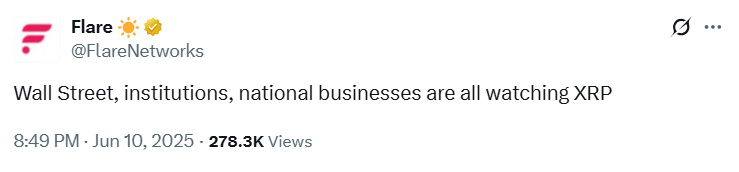
The Flare Network team has suggested that Wall Street firms, major companies, and institutions are now keeping a close eye on XRP. 

The team highlighted this amid growing interest in the XRP and XRPL ecosystems, as more businesses explore how to use the XRP Ledger (XRPL) in real-world financial systems. 

XRP Now Capturing Mainstream Attention

Notably, this claim is backed by expanding use across different sectors. Several recent developments over the past two months confirm this. 

Flare Network on X
Flare Network on X

These moves come as the crypto industry sees clearer rules in the United States and, notably, as the long-standing legal battle between Ripple and the U.S. SEC nears its end. Interestingly, both sides have agreed to a settlement, and the court is expected to approve it soon. 

May 2025 Developments Around the XRPL and XRP

Specifically, one of these bullish developments occurred last month, when the World Economic Forum released a report on how financial markets are starting to use blockchain for asset tokenization. The report highlighted that the XRP Ledger now supports $1 billion in private equity tokenization. 

Days later, the Dubai Land Department chose the XRP Ledger to power its first Real Estate Tokenization Project. The initiative officially began on June 23, representing a major step in applying blockchain to real estate, especially in the Middle East. 

Also, late last month, Ault Capital Group, a subsidiary of a firm listed on the New York Stock Exchange, announced plans to roll out an XRP-based lending platform aimed at U.S. public companies. 

Meanwhile, within that period, three different firms confirmed they would be adding XRP to their corporate reserves. Specifically, Ault Capital, VivoPower (a Nasdaq-listed company), and Webus International all revealed plans to hold XRP as a reserve asset. 

Announcements from XRPL Apex

Remarkably, the positive momentum continued into June. Particularly, on June 11, the first day of XRPL Apex 2025, Ondo Finance launched tokenized U.S. Treasuries on the XRP Ledger. 

Notably, these assets, backed by BlackRock’s USD Institutional Digital Liquidity Fund and short-term U.S. government bonds, give investors a way to access traditional financial products through blockchain. 

Ripple’s stablecoin, RLUSD, supports minting and redeeming, while the XRPL’s built-in compliance features like KYC and on-chain credentials ensure the system meets regulatory standards.

Further, VivoPower committed $100 million in XRP to generate returns through Flare’s DeFi platforms like FAssets and Firelight. The company plans to grow its XRP treasury using those returns, showing a real shift in how businesses use XRP in their financial strategies.

Essentially, these moves show that XRP is gaining serious ground, confirming the remark from the Flare Network team. With big names now investing, building, and launching products on XRPL, the asset is entering a new phase driven by real adoption, not hype.