Home Blog Page 679

Former Ripple Director Predicts How Much Valuation Ripple Could Have If it Files for IPO

0

A former Ripple director suggests that Ripple’s potential initial public offering (IPO) could be a landmark event, given its estimated valuation. 

In an X post yesterday, Sean McBride speculated that Ripple’s recent tender offer indicates that the company is valued at $30 billion. 

Largest IPO in History 

McBride derived the estimate after Ripple disclosed plans to repurchase $700 million worth of its own shares at a fixed price of $175 each. Sources revealed that Ripple announced the buyback initiative in an emailed statement to existing stockholders. 

Notably, McBride derived the $30 billion estimate by multiplying Ripple’s offer of $175 per share by the total number of outstanding shares. According to McBride, if Ripple chooses to go public through an IPO at the estimated $30 billion valuation, it would be the largest in history. 

Data from Renaissance Capital indicates that Saudi Aramco holds the title of the largest global IPO, having raised around $25.6 billion in 2019. Tech giant Alibaba ranks in the second position, raising roughly $21.76 billion in its September 2014 IPO. 

With Ripple’s estimated valuation at $30 billion, McBride suggested that the company could surpass every IPO in history. He described the $30 billion valuation as “unreal,” underscoring how extraordinary such a feat would be if Ripple were to file for an IPO at that level. 

Ripple IPO Potential Timeline 

Speculation about Ripple’s potential IPO has intensified recently, with several experts predicting when the company might go public. 

Last year, McBride predicted that Ripple might file for an IPO outside the United States by 2025. At the time, McBride made the prediction during the peak of the SEC v. Ripple lawsuit. 

In addition, famous financial expert Linda P. Jones speculated that Ripple’s IPO could happen sometime this year. However, in McBride’s recent update, he stressed that Ripple would not be filing for an IPO anytime soon. 

While major crypto-focused companies like Circle and Coinbase have gone public, Ripple does not prioritize an IPO due to its substantial cash reserves. 

Instead, it is focusing on growing its business as reflected in its recent acquisition of Hidden Road for $1.25 billion. Ripple also attempted to acquire the leading stablecoin issuer Circle before the company went public, having raised $1.14 billion. 

WhiteBIT Unveils Hedge Mode To Equip Futures Traders With Enhanced Risk Management Tools

0

WhiteBIT, one of Europe’s most prominent cryptocurrency exchanges by traffic, has officially introduced Hedge Mode for futures trading, an advanced feature aimed at improving trader control and strategy amid market volatility.

With Hedge Mode, traders gain the ability to simultaneously hold both long and short positions on the same futures contract. This dual-position capability allows for more sophisticated risk management techniques compared to the platform’s default One-Way Mode, which restricts users to a single directional position per market.

The feature is now available across all regions where WhiteBIT supports futures trading, representing a significant step in the platform’s transformation into a more professional and flexible trading environment.

“Volatility is both a challenge and an opportunity in crypto markets. With Hedge Mode, we’re giving our users more control, more flexibility, and better protection, especially in fast-moving conditions. It’s a significant step forward in our mission to make crypto trading safer and smarter.”

Addressing Market Uncertainty, The launch coincides with heightened turbulence across crypto markets. April 2025 saw liquidations of over $1.3 billion in crypto derivatives, impacting nearly 310,000 traders, according to CoinGlass. Such conditions spotlight the urgent need for more advanced trading tools to help investors navigate price swings and mitigate losses.

Key Benefits of Hedge Mode

WhiteBIT’s Hedge Mode offers several practical advantages for futures traders:

  • Risk Protection: Hedge existing positions against sudden market reversals
  • Flexible Strategy Management: Manage diverse strategies or timeframes within a single market
  • Advanced Trading Tactics: Execute complex approaches like arbitrage, grid setups, or delta-neutral trades

Traders can switch between Hedge and One-Way Modes seamlessly, aligning their setup with real-time market conditions and personal strategies.

Building on a Series of Product Innovations

This update is part of a broader wave of enhancements introduced by WhiteBIT, including:

  • Buy Crypto – Fast fiat-to-crypto conversions
  • 1×10 Trading Bot – Automated execution of trading strategies
  • Isolated Margin on Sub-Accounts – Greater control over risk and margin across different trading portfolios

Together, these features reflect WhiteBIT’s dedication to delivering institutional-grade tools tailored to the needs of both beginner and seasoned traders.

Why Doesn’t Ripple Adopt an XRP Reserve Strategy If XRP Is Going to $8,000 and Replacing SWIFT: Gary Cardone

Bitcoin critics are raising questions about the growing trend of crypto treasury strategies involving assets like XRP and Ethereum, in addition to BTC.

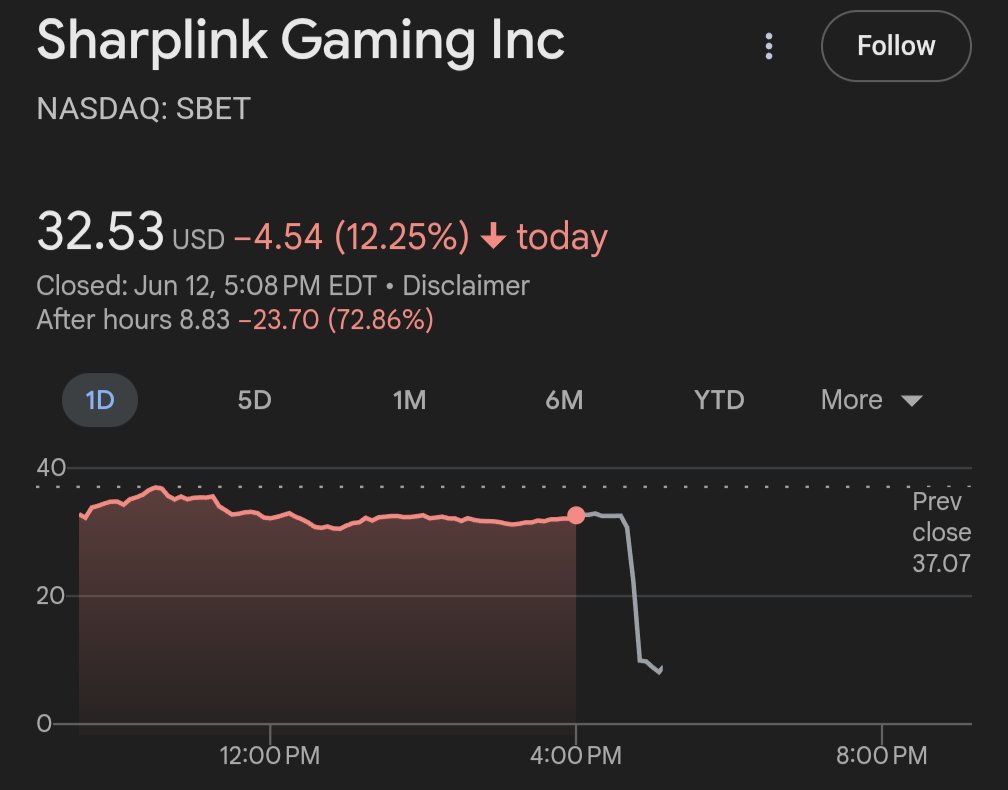
The debate gained momentum after SharpLink Gaming, one of the first companies to adopt an Ethereum-based corporate reserve model, suffered a shocking 73% drop in after-hours trading. The collapse has reignited discussions about which digital assets are truly suitable for institutional treasuries.

In a tweet, Bitcoin proponent Steven Lubka pointed to SharpLink’s plunge as evidence that BTC remains the only reliable reserve asset. His statement suggests that altcoins like Ethereum are unsuitable for long-term corporate balance sheets, and financial expert Gary Cardone agrees with this opinion.

Image

Cardone weighed in on the conversation by turning the spotlight on Ripple. He questioned why Ripple has not transitioned into a company with an XRP reserve strategy, especially if the token is expected to appreciate dramatically and replace SWIFT as the global payments backbone.

Specifically, Cardone argues that if XRP truly has the potential to reach heights like $8,000, as suggested by some, then Ripple should already be leveraging the token as its core reserve asset. 

For him, the fact that Ripple has not done so raises doubts about how much confidence the company itself places in XRP’s long-term value.

XRP Army Reacts

Unsurprisingly, Cardone’s comments did not go unanswered by XRP enthusiasts. Jason Jude called the criticism both contradictory and uninformed. He pointed out the irony of demanding that Ripple move to an XRP reserve model while critics often complain that Ripple already owns too much XRP.

This commentary highlighted the inconsistency among critics who question Ripple’s 40% XRP holdings yet expect the company to rely even more heavily on it as a reserve strategy.

Others accused Cardone of letting his Bitcoin-only bias cloud his judgment. Several community members argued that dismissing XRP could become one of his biggest investment regrets.

Corporate Momentum Builds Behind XRP

Despite the criticism, XRP continues to gain traction as a treasury asset among Nasdaq-listed firms. Several companies actively integrate XRP into their financial strategies, aligning with the push to diversify beyond Bitcoin.

For instance, Trident Digital Tech Holdings is raising $500 million to build one of the first major XRP treasuries. Also, Webus International in China is seeking $300 million in credit and plans to integrate Ripple’s payment solutions.

VivoPower International has earmarked $100 million from its latest private round, while Wellgistics Health has secured a $50 million credit line for XRP accumulation.

This growing institutional interest suggests that some companies are betting on XRP as a payment utility and a long-term store of value.

Treasury Strategy Works for Altcoins

Meanwhile, the broader crypto community is also challenging Lubka’s claim that BTC is the only viable treasury asset in the wake of SharpLink Gaming’s fallout.

Specifically, Solana enthusiasts cited data showing that DeFi Development Corp has experienced a massive 3,657% year-to-date gain after adopting a SOL-based strategy months ago.

Even SharpLink Gaming’s monthly chart shows an impressive 882% gain, undermining the narrative that Bitcoin proponents are pushing.

Cardano Founder Says the Biggest Threat to Bitcoin’s Dominance Is Cardano

0

Cardano founder Charles Hoskinson has reaffirmed his longstanding position that Cardano represents the most significant challenge to Bitcoin’s dominance. 

According to Hoskinson, Cardano’s trajectory over the past seven years reflects a consistent adherence to the foundational principles of decentralization and sound monetary policy. 

He stated that Cardano’s community has stayed true to promises made at the outset, emphasizing that its technological advancements have addressed long-standing limitations in the Bitcoin network.

Technological Advancements and Governance Models

Hoskinson pointed to several developments in Cardano that, in his view, surpassed Bitcoin’s innovation pace. Notably, he referenced the Extended UTXO model, which expands on Bitcoin’s own UTXO structure, allowing for smart contract support while maintaining a similar security architecture. 

He also highlighted Cardano’s Plutus programming language, which enables advanced decentralized applications, and the platform’s integration of on-chain governance, which he described as a superior decision-making framework compared to Bitcoin’s informal consensus process.

Building on these technical milestones, Hoskinson argued that Cardano successfully translated early Bitcoin ecosystem ideas—such as colored coins and Lightning Network innovations—into functioning features. 

He asserted that many of these innovations were originally discussed within the Bitcoin community but never prioritized in Bitcoin’s official development roadmap. As a result, Cardano has positioned itself, in Hoskinson’s view, as the ecosystem that “finished the work” envisioned by early Bitcoin developers.

Decentralization, Security, and Network Stability

Meanwhile, the Cardano network has operated for seven years without downtime, hacks, or major failures. Hoskinson emphasized that its proof-of-stake consensus achieves comparable security to Bitcoin’s proof-of-work system, while also delivering greater energy efficiency and scalability.

He cited nine years of peer-reviewed research, simulations, and formal methods development that culminated in the current stable state of the Cardano blockchain.

This focus on long-term development aligns with the Cardano founder’s belief that blockchain success should be measured not solely by market price or user adoption, but by technical integrity and resilience. He stressed that the network’s resilience and evolution reinforce Cardano’s claim to being “sound money,” a term often used by Bitcoin supporters to describe their asset.

Institutional Momentum and Bitcoin’s Future Role

However, Hoskinson also acknowledged Bitcoin’s growing institutional support. In a prior interview with Bitcoin Magazine, he discussed how Bitcoin’s integration with decentralized finance (DeFi) has progressed due to upgrades like Taproot, which introduced new capabilities for programmability.

He noted that this evolution enables Bitcoin to participate in DeFi more effectively, with Cardano’s architecture providing a compatible platform through its own UTXO-based design.

Hoskinson further addressed the impact of institutional involvement on Bitcoin’s market trajectory. He mentioned that entities such as BlackRock, which now holds over 600,000 Bitcoin tokens, and support from parts of the U.S. government, contribute to significant market momentum. 

He projected that Bitcoin could reach a price range between $250,000 and $500,000 within two years, with the potential to hit $1 million by decade’s end, fueled by adoption from Fortune 500 companies.

Amazon and Walmart Exploring Launch of Their Own Stablecoins: Report

0

Two major retail giants, Walmart and Amazon, are reportedly exploring the launch of their dollar-pegged stablecoins. 

The Wall Street Journal (WSJ) reported the development today, citing sources with direct knowledge of the matter. According to WSJ, the retail behemoths are considering launching brand-specific stablecoins pegged to the U.S. dollar. 

Potential Benefits 

Stablecoins could enhance companies’ operations by offering instant and cheaper transactions. This would contrast with what is obtainable in the traditional financial system, where settlements sometimes take days, and users pay significant fees. 

Moreover, these dollar-pegged tokens could help companies save millions of dollars in transaction fees. However, the initiative could negatively impact the retail behemoths’ banking partners. 

By issuing brand-specific stablecoins, Amazon and Walmart could shift massive cash flows away from their banking partners. For context, Amazon’s global e-commerce sales reached an astounding $447 billion in 2024, while Walmart’s global sales surpassed $100 billion the previous year. 

Since stablecoins offer cheaper transactions, saving a small fee on each transaction could help the e-commerce giants save millions of dollars. 

In the meantime, Amazon and Walmart have not confirmed whether they are planning to launch dollar-pegged stablecoins. 

GENIUS Act’s Passage Will Determine Stablecoins’ Launch 

Nonetheless, the potential launch of the brand-specific stablecoins for Amazon and Walmart is contingent on the passage of the highly anticipated GENIUS Act. 

The legislation represents the United States’ effort to regulate the stablecoin market by establishing straightforward anti-money laundering (AML) and collateralization rules. Congress has been deliberating on its potential passage since Bill Hagerty introduced it earlier this year. 

The bill has undergone several voting exercises, including one earlier this week when congressional members voted to invoke cloture on its recent amendment. 

According to Eleanor Terrett, the Senate has scheduled a final passage vote for the GENIUS Act on June 17, 2025.

If the bill passes, it could allow Amazon and Walmart to introduce their stablecoins under a regulatory framework.

While Walmart and Amazon plan to introduce brand-specific stablecoins, rival Shopify is considering integrating with an existing one. Yesterday, Shopify rolled out early access for Circle’s USDC payments. 

Under the initiative, merchants can accept USDC payments from customers on the Base network. Notably, Shopify partnered with Stripe and San Francisco-based exchange Coinbase for the initiative. 

SharpLink Gaming Acquires $463M in Ethereum, Becomes Largest Public ETH Holder

Nasdaq-listed SharpLink Gaming has made a groundbreaking move involving Ethereum as part of its treasury strategy, becoming the largest public holder of ETH.

In a press statement today, the firm disclosed that it acquired 176,270.69 ETH for approximately $462.95 million, at an average acquisition price of $2,626 per ETH.

With this aggressive purchase, SharpLink Gaming has secured its position as the world’s largest publicly traded ETH holder. This acquisition places SharpLink second only to the Ethereum Foundation in total ETH holdings.

The massive transaction, executed during a period of bearish ETH performance, represents a significant institutional vote of confidence in Ethereum’s long-term value and utility.

ETH Becomes Primary Treasury Reserve Asset

Notably, SharpLink has officially adopted ETH as its primary treasury reserve asset. This decision makes the firm the first Nasdaq-listed company to do so.

SharpLink’s CEO, Rob Phythian, explained that the decision reflects its strong belief in Ethereum as a cornerstone of the future digital economy and decentralized technologies. He also emphasized that choosing ETH as the company’s main treasury reserve asset is a firm confidence in its potential as programmable, income-generating digital capital.

SharpLink also revealed that over 95% of its ETH holdings are in active staking or liquid staking solutions. This helps to secure the Ethereum network while generating native yield.

This dual-benefit strategy positions SharpLink to participate in the network’s growth while earning passive income through ETH rewards.

Capital Raised via $1B ATM Program Fuels Crypto Play

Notably, from May 30 to June 12, 2025, SharpLink raised approximately $79 million in gross proceeds through its $1 billion at-the-market (ATM) equity program. The majority of these funds went into acquiring additional ETH.

Since June 2, 2025, these cumulative ETH purchases have driven ETH-per-share growth of 11.8%, enhancing shareholder value through digital asset exposure.

Ethereum Co-Founder Joseph Lubin Backs the Move

Joseph Lubin, Co-Founder of Ethereum and Chairman of SharpLink, praised the company’s strategy, calling it “a pivotal milestone for the institutional adoption of Ethereum.”

Lubin highlighted the timing of the move, noting that it comes amid growing momentum in the U.S. Congress to pass digital asset and stablecoin legislation. He suggested the passage could serve as a broader catalyst for Ethereum’s mainstream adoption.

Ultimately, SharpLink’s ETH-centric treasury strategy aligns with a broader trend among public companies seeking exposure to digital assets. The move echoes MicroStrategy’s historic embrace of Bitcoin.

SharpLink’s Stock Crashes 73%

Meanwhile, just hours after the announcement, shares of SharpLink Gaming tumbled more than 70%. Analysts suggest the dramatic decline was due to investor confusion, with many misinterpreting a routine SEC filing as insider selling. The resulting panic overshadowed the company’s bold $463 million Ethereum treasury strategy.

Here Are Perfect Times to Buy and Sell Bitcoin Based on Halving Cycles

0

A prominent Bitcoin trader has suggested the perfect time for market participants to buy and sell BTC for optional gains, referencing the Bitcoin halving cycles.

The Bitcoin halving, which helps reduce the premier crypto asset’s daily issuance rate, has historically served as an important factor for investors looking to evaluate Bitcoin’s price action, especially with respect to its cyclical movements.

Bitcoin Investment Strategy Around the Bitcoin Halving

While some of these assessments have been rather undependable, trader Mags, who calls himself “the scalping pro” has recently called attention to a structure that could assist investors who are willing to play the long game when it comes to Bitcoin.

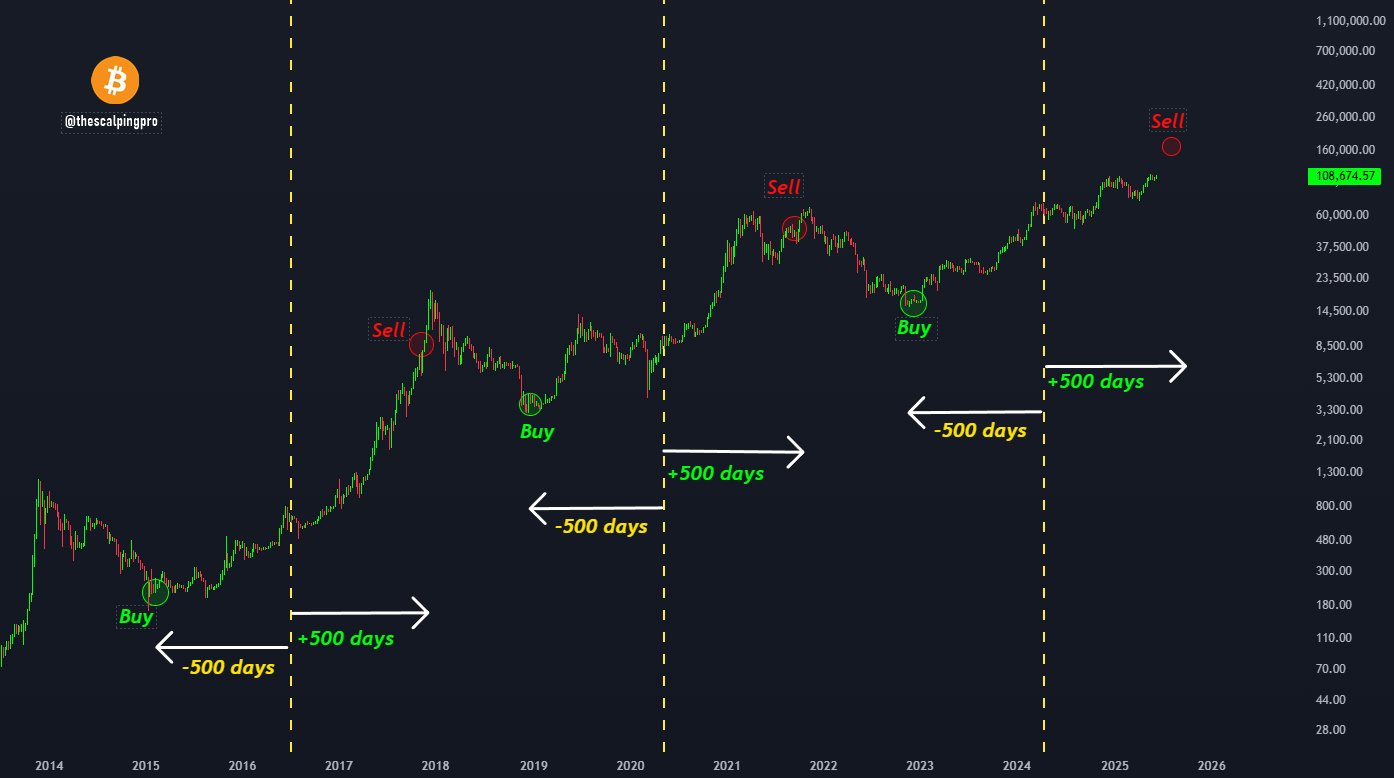
In a disclosure yesterday, Mags identified a simple Bitcoin investing strategy that may help with maximizing gains. Specifically, he centered the strategy around the Bitcoin halving cycles, identifying precisely when to buy BTC before the halving and when to sell off one’s bag after the halving.

According to Mags, investors who want to time the market perfectly should buy Bitcoin 500 days before the next halving is expected to occur. After this, they should hold onto their Bitcoin bag and do nothing. Meanwhile, once it is 500 days after the halving, Mags advises that they sell off their tokens. They can then repeat this process ahead of the next halving.

Bitcoin’s Cyclical Movements Around the Halving

Data from his chart shows the analytical bearing of this investment advice. Interestingly, Bitcoin tends to be near its bottom price of the cycle about 500 days before the next halving. In addition, the crypto asset draws closer to its cycle top 500 days after the halving.

The chart suggests that this pattern has continued to play out since the second halving in history, which occurred on July 9, 2016. Specifically, Bitcoin had dropped to around $230 in late February 2015, about 500 days before this halving. Meanwhile, by late November 2017, also 500 days after the halving, BTC had surged to $11,800, close to that cycle’s top.

Bitcoin Cyclical Movements Around the Bitcoin Halving Mags
Bitcoin Cyclical Movements Around the Bitcoin Halving | Mags

Further, BTC collapsed to a low of around $3,700 by December 2018, 500 days before the third halving. After the third halving occurred on May 11, 2020, Bitcoin’s price surged to $50,000 about 500 days later, specifically in September 2021. This was also close to the cycle’s top.

Now, the trend appears to also be playing out in the ongoing cycle. Notably, Bitcoin slumped to a cycle low of $16,000 in early December 2022, about 500 days before the latest halving which occurred on April 20, 2024. Interestingly, 500 days after the halving is in September 2025, and Mags expect BTC to reach new highs then.

The September 2025 Timeline

Interestingly, the September 2025 timeline aligns with predictions from other analysts for when Bitcoin could reach its cycle top. Last month, market veteran Peter Brandt suggested Bitcoin could reach its top for this cycle in August to September 2025, projecting a top price of $150,000.

Also, analyst EGRAG predicted last October that Bitcoin’s cycle top could come up in mid to late 2025. While Mags’ Bitcoin halving template does not perfectly identify Bitcoin’s cycle bottom and top, it has proven to be accurate in pointing out prices close to these regions. 

Meanwhile, the trader failed to provide a definitive target for his cycle top. Despite this, his chart points to a price around the $160,000 mark. BTC currently trades for $104,745, down 1% this week. To claim $160,000, the asset must rise 52% from the current level.

US Politician Pushing for New Bank Charter That Could Let Ripple Get a Banking License

0

US politician and former congressional candidate Greg Kidd says he is working on a bank charter that could allow firms like Ripple to get banking licenses.

Kidd, a co-founder of Haka Yaka Ventures and owner of Vast Bank, said this at the just-concluded XRP Las Vegas conference. In a one-on-one interview with journalist Eleanor Terrett, Kidd discussed his involvement in politics and revealed efforts to introduce this new type of bank charter.

A New Bank Charter that Could Allow Ripple to Procure a Banking License

Kidd explained that although he no longer runs for office, he still works closely on financial legislation. He’s now focused on creating a special charter designed strictly for banks that deal only with deposits and payments. It eliminates the need for physical branches or lending.

This idea aims to make it easier for digital-first businesses to enter the space. He said this new approach would give companies like Ripple a path to owning a banking license, even though he clarified he wasn’t speaking for Ripple or suggesting they plan to apply. 

Notably, his larger goal is to break up the dominance that traditional banks hold and make banking more accessible to new firms, whether they’re digital wallets, remittance companies, or even major retailers. 

Greg Kidd: Cost of Moving Money Should be Minimal

Speaking further, Kidd pointed out that the cost of processing payments on the XRP Ledger is nearly zero, so the price of sending money should reflect that. He sees payments as something that should work like a public utility: low-cost and available to everyone.

Interestingly, Kidd criticized the current system, where only a few people, including himself and Jackie Reses from Lead Bank, have managed to secure banking licenses under the Biden administration. 

The American entrepreneur called for a return to a time when competition, innovation, and inclusion drove the banking sector before the financial crisis of 2008 disrupted it.

Ripple and the Banking Scene

Meanwhile, Ripple has already made moves within the banking sector. In June 2024, the company became a Platinum Member of the American Bankers Association (ABA).

Ripple Platinum Member of the American Bankers Association

This top membership gives Ripple greater visibility and stronger access to banking leaders and policymakers, putting the blockchain payment firm in a better position to influence the direction of financial services.

Moreover, Ripple CEO Brad Garlinghouse, speaking at the same Las Vegas event, confirmed that the firm plans to rewire the banking system. According to him, Ripple wants to help banks move money faster and more cheaply by cutting out intermediaries and removing the need for pre-funded accounts. 

Garlinghouse stressed that Ripple doesn’t aim to replace banks. Instead, the firm wants to work with them to speed up and simplify cross-border payments.

Putting the Banking Industry On-chain

Meanwhile, during his interview, Kidd also discussed Vast Bank, his latest venture. He explained that the reason he decided to buy a U.S. bank was to put real U.S. dollars directly on the blockchain. 

He believes this will replace outdated banking ledgers with secure, real-time records on networks like the XRP Ledger. These on-chain dollars, backed by FDIC insurance and regulatory protections, could become available to people around the world.

Kidd also revealed that he invested in the Bank of London and is closing a deal in Europe. His goal is to bring dollars, pounds, and euros onto blockchain networks so that banking can run non-stop, 24/7, with digital money that never leaves the chain.

Ripple May Someday Buy Up Some Legacy Companies and Put Them Out of Their Misery: Greg Kidd

Crypto pioneer and former Ripple exec Greg Kidd outlines a vision for blockchain-powered banking, suggesting Ripple could transform traditional finance by absorbing outdated institutions.

Kidd shared these insights at the third annual XRP Las Vegas conference during a fireside chat with journalist Eleanor Terrett. He reflected on his early days with Ripple and described a future beyond crypto as a speculative asset. For him, the endgame is full integration of blockchain into the core of the global financial system.

Kidd recalled that when he joined Ripple in 2012, there were only 188 accounts on the ledger. 

“It was like being there with the disciples,” he said. “But even then, the vision was clear: money should move at the speed of the internet.”

Vast Bank, Tokenized Dollars, and a New Financial Backbone

Today, Kidd leads an initiative to bring the banking system on-chain by acquiring Vast Bank, a nationally chartered institution regulated by the OCC and the Federal Reserve. He aims to issue FDIC-insured U.S. dollar deposit tokens directly on blockchain networks, including the XRP Ledger.

Unlike stablecoins, which must be backed 1:1 and are limited in scope, Kidd’s approach leverages fractional reserve banking.

We’re eight times more capital efficient than stablecoins,” he said. “And we can pay interest, offer consumer protections, and keep money moving around the clock.”

This on-chain model serves crypto-native developers and users while undercutting the legacy system’s inefficiencies.

Kidd sees a world where people everywhere can hold and use digital U.S. dollars that never technically leave the banking system, even when sent across borders. He argues that if funds remain on the ledger and in dollar form, traditional remittances become obsolete. 

Open Banking and Fair Access

The conversation also touched on the evolution of U.S. financial regulation since the 2024 election. Kidd credited the new administration with removing “reputational risk” from federal exam guidelines. This obstacle had previously kept many legal industries, including crypto, cannabis, and adult content, out of the banking system.

“We call them the consensual vices,” he said. “If you’re legal and licensed, you should be banked. Period.”

Meanwhile, Kidd’s political activism hasn’t slowed. He now advocates for a new banking charter focused solely on deposits and payments. This would allow fintech firms like Ripple to obtain banking licenses without building brick-and-mortar branches or issuing loans.

Kidd eyes a future where banking is as accessible and seamless as breathing air.

“Payments should be free. Banking should be universal. And blockchain makes that possible,” he said. “What Ripple and others are doing now is building that future.”

Ripple to Put Legacy Companies Out of Their Misery

As Ripple expands its investments and navigates global markets post-lawsuit, Kidd predicts the company will play a central role in overhauling traditional finance.

When asked where he sees Ripple in ten years, Kidd said the company will become a fully integrated blockchain firm. He even suggested Ripple may someday buy up some legacy companies and “put them out of their misery.”

By that, he means acquiring financial institutions still operating on outdated infrastructure and migrating them onto more efficient blockchain rails.

His comments highlight Ripple’s long-term ambition not just to challenge but to absorb and transform legacy financial infrastructure.

Wealth Expert Warns DCA Into XRP May Soon Be Impossible: Here’s Why

0

Matthew Snider, CIO of Digital Wealth Partners, has issued a new warning after Trident Digital announced plans to create a $500 million XRP treasury. 

Yesterday, The Crypto Basic reported that Trident intends to raise $500 million through the issuance of stocks and other financial instruments to establish an XRP reserve. 

Trident’s XRP treasury initiative will commence in the second half of this year, pending regulatory approval. In the meantime, Trident, whose shares trade on Nasdaq, is discussing with other firms and investors the development of an appropriate strategy for its XRP reserve. 

This includes identifying the best terms for acquiring XRP and setting up the reserve’s infrastructure. Following the announcement, Trident joined many public companies in adopting XRP as a reserve asset. 

Publicly listed companies such as Webus International, Wellgistics Health, and VivoPower have also announced plans to create corporate treasuries for XRP. 

XRP Supply Squeeze Incoming? 

Amid growing interest in XRP among corporate entities, Snider warned that retail investors may soon find no XRP left to accumulate through dollar-cost averaging (DCA). 

For context, DCA is a strategy that enables investors to purchase small amounts of an asset at regular intervals, typically to lower their average cost over time by buying when prices dip below their initial entry point.

With several corporations signaling their intent to buy and hold millions of dollars’ worth of XRP in reserves, the amount of XRP available for open market trading could steadily decline.

As a result, according to Snider, investors may soon find there is not much XRP left to accumulate via DCA. While this could potentially drive XRP’s price higher, retail investors might be squeezed out of the opportunity to adopt the coin.

Essentially, Snider’s message warns retail investors to seize the moment and grow their XRP portfolios before more big players lock up too much of the coin’s supply.

How Much XRP Is Ideal to Hold?

Most investors believe XRP has what it takes to transform the financial futures of patient holders. Notably, some experts, such as Linda P. Jones suggested that XRP could reward patient investors with generational wealth. 

Amid this growing optimism, many community members have been asking about the minimum amount of XRP one should hold to significantly improve their financial status. According to Edo Farina, founder of Alpha Lions Academy, investors should aim to hold at least 1,000 XRP.

Meanwhile, other commentators like King Vale believe that 50,000 XRP should be the minimum to effectively position oneself for financial success. Given that this investment, worth over $100,000, is out of reach for many, some push back against such requirements. Critics like Xena reject arbitrary numbers, calling them ego-driven and lacking a rational foundation.