Home Blog Page 697

Researcher Says This Bitcoin Cycle Feels Like 2017, When BTC Surged Over 5,000%

Joe Burnett, Director of Market Research at Unchained, says today’s Bitcoin market dynamics are strikingly similar to those during the explosive 2017 bull run.

In a recent market analysis, Burnett highlighted strong parallels between the current Bitcoin cycle and the dramatic 2017 bull market. According to him, while the 2020–2021 season brought significant growth, the momentum of those years didn’t quite match the parabolic energy seen in 2017.

For context, from January 2016 to December 2017, the price of Bitcoin soared by 5,640%, rising from $350 to $20,089. Meanwhile, the 2020/2021 cycle delivered an 8X surge with BTC rising from $6,900 to $68,000.

Burnett suggested that key headwinds such as China’s mining ban and FTX’s “paper Bitcoin” activity may have dampened the 2021 season. Meanwhile, the 2024–2025 season is shaping up differently.

Altcoin Mania Then, Bitcoin Treasury Mania Now

Burnett recalls how, in 2017, altcoin speculation indirectly drove demand for Bitcoin. At the time, most users had to buy Bitcoin first in order to access altcoins on other exchanges, especially since Coinbase only listed a handful of assets. This created what Burnett calls a “black hole” effect, where speculative capital was drawn into Bitcoin as a gateway asset.

Today, a similar dynamic is playing out, but this time through Bitcoin treasury companies. Firms like Strategy and MetaPlanet are raising capital by issuing equity and using those proceeds to acquire Bitcoin. This effectively converts speculative equity demand into Bitcoin buying pressure.

Notably, as previously reported, 12 companies joined the Bitcoin treasury trend in May.

ETF Inflows and Institutional Demand Add Fuel

Another critical factor supporting the bullish outlook is the continued influx of institutional capital via spot Bitcoin ETFs. These inflows represent a robust and sustained source of demand that, when combined with speculative flows into Bitcoin-focused companies, could set the stage for another vertical move in Bitcoin’s price.

Notably, firms like BlackRock have acquired over 600,000 BTC over the past year amid their ETF listings.

Setting the Stage for a Parabolic Move

Burnett concludes that if these trends hold and macroeconomic conditions remain relatively favorable, the Bitcoin market could be nearing the beginning of another parabolic phase.

The confluence of strong fundamentals, institutional adoption, and speculative interest could recreate the kind of rapid price acceleration not seen since Bitcoin’s historic run to $20,000 in late 2017. 

Bitcoin is trading at $105,000 at press time, and some industry commentators believe prices as high as $500,000 could be a target this season.

When Altcoin Season?

Meanwhile, concerns have emerged that the rotation of capital into ETFs and Bitcoin-related investments is delaying the prospects of an altcoin season. Some analysts suggest that altcoins now need a new narrative to thrive alongside Bitcoin, as the typical rotation trend may be over.

Circle IPO Found to Be Oversubscribed by 25x: Here’s What This Means and How It Could Affect Ripple’s Bid

Recent reports confirm that the Circle IPO is massively oversubscribed, a development that impacts any potential negotiations with Ripple.

Circle, the USDC stablecoin issuer, has seen overwhelming investor demand for its upcoming IPO, with financial blog Zero Hedge reporting today that the offering is over 25 times oversubscribed. 

For the uninitiated, this oversubscription means investor demand for Circle’s shares exceeds the number of shares available in the IPO by a large margin.

The development is massive for the crypto payments company and could have implications for Ripple, which has reportedly been pursuing a multibillion-dollar acquisition of Circle in recent months.

Circle’s IPO Momentum

On May 27, 2025, Circle began its IPO with plans to raise as much as $624 million by selling 24 million Class A shares, priced between $24 and $26 each. This gives the company a fully diluted valuation ranging from $5.65 billion to $6.71 billion.

By June 2, rising investor interest led Circle to increase its offering to 32 million shares, boosting its projected valuation to around $7.2 billion, likely due to early indications of the oversubscription. The company plans to go public on the New York Stock Exchange under the symbol “CRCL,” with the IPO set to launch on June 5, 2025.

Now, the oversubscription, 25 times the available shares, indicates investor enthusiasm. For instance, ARK Invest, led by Cathie Wood, plans to invest $150 million in Circle shares, and BlackRock is also expressing interest.

Essentially, this demand suggests that Circle may be massively undervalued at its IPO pricing and could witness strong performance in the public markets.

Regulatory Tailwinds

The IPO comes at an important moment for the crypto industry. Recently, the U.S. Senate voted to advance the GENIUS Act to regulate stablecoins. In addition, President Donald Trump has expressed support for signing stablecoin regulation into law by August, before Congress enters recess. 

This favorable regulatory outlook has provided additional tailwinds for Circle, which currently manages $62 billion in USDC circulation, accounting for 27% of the stablecoin market. Moreover, Circle’s financials for 2024 show $1.68 billion in revenue, although net income declined to $155.7 million, down from $267.5 million the previous year.

Ripple’s Bid Under Pressure

Meanwhile, Ripple has been trying to acquire Circle in what has been reported as a bidding war with Coinbase. Notably, Ripple’s initial offer of $5 billion was rejected, with subsequent reports indicating that Ripple raised its bid to between $9 billion and $11 billion. 

Though Ripple’s CEO recently denied offering $10 billion, he did not fully dismiss the possibility that acquisition talks had occurred. However, Circle has now publicly dismissed rumors of acquisition talks with either Ripple or Coinbase.

With the IPO now confirmed to be massively oversubscribed and the company increasing its valuation target, Circle has gained important leverage. 

The market response gives Circle a strong reason to continue independently rather than accept any takeover bid. For Ripple, this means any chance of acquiring Circle would now require a much higher premium if it’s still possible at all.

Analyst Says $5 Dogecoin ‘Loading’ Based on 3 Historical Patterns

0

Analysts are forecasting a potential breakout for Dogecoin based on the emergence of symmetrical triangle patterns.

The price of Dogecoin (DOGE) has risen modestly by 0.68% over the past 24 hours to $0.1957. Despite recent short-term fluctuations, some analysts believe a significant upward move could be imminent.

One analyst on X points to the formation of symmetrical triangle patterns in Dogecoin’s price chart, suggesting a breakout may be underway.

According to CryptoElite’s chart, Dogecoin has formed three symmetrical triangle patterns throughout its history, each preceding a breakout and continuing the previous trend.

The first triangle appeared in early 2016, with Dogecoin trading around $0.0001. Following a period of consolidation, the price broke out in late 2017, confirming a bullish trend and surging from $0.008 to $0.017 by January 7, 2018.

The second triangle formed after the price dropped below $0.002 in December 2020. After a lengthy consolidation, a breakout occurred in April 2021, propelling the price to $0.40. A pullback followed, bringing the price down to $0.24, before bulls regained control and drove it to $0.73 by May 2021.

Dogecoin Current Triangle and $5 Price Forecast

The third Dogecoin triangle began forming around mid-2022, with the price bottoming out at $0.05. A breakout occurred in early 2024, with the price reaching approximately $0.22 by March 2024.

Another consolidation phase followed, but Dogecoin broke out again in December 2024, climbing above $0.48. Since then, it has fallen to $0.13 but is currently showing signs of recovery.

Analysts now believe the ranging phase is complete, and another major breakout could be near. Analyst CryptoElite projects that Dogecoin could surge by as much as 2,450%, potentially reaching $5.

Rising User Activity Could Fuel Demand

Supporting this bullish outlook, data from IntoTheBlock shows a sharp increase in user activity over the past seven days.

  • New addresses rose by 102.40%
  • Active addresses increased by 111.32%
  • Zero-balance addresses surged by 155.44%

These metrics indicate growing interest in Dogecoin, often a leading indicator of upward price movement. The rise in new and active addresses suggests increasing demand, which may help drive prices higher. These trends imply that more users are engaging with Dogecoin.

Screenshot 2025 06 04T131858723
Dogecoin Daily Active Addresses

Shared Optimism for Dogecoin

Further strengthening the optimistic narrative, crypto analyst Tardigrade recently highlighted a possible bull run for Dogecoin. His forecast is based on a breakout from a base-three pattern within a step-like parabolic curve. According to Tardigrade, Dogecoin could achieve a 2x return, potentially surpassing the $0.50 mark.

Cardano Eyes Bullish Comeback Amid New Institutional Talks

Cardano (ADA) has broken a local trendline and is eyeing a recovery above $0.72. Growing institutional interest and rising open interest in derivatives suggest a potential breakout to $0.837.

As altcoins gradually regain momentum, Cardano appears poised for a bullish comeback this week. On Wednesday, ADA gained nearly 1%, triggering a trendline breakout on the lower time frames. Will this breakout help Cardano re-establish a bullish trend?

Cardano Price Analysis

On the 4-hour chart, Cardano shows signs of a bullish move after previously failing to sustain above the $0.837 resistance level. Following multiple peaks formed last month, ADA dropped nearly 10% last week.

Cardano price Chart
Cardano Price Chart

The decline stabilized just above the $0.648 support level, with possible reinforcement from the psychological $0.65 mark. With a short-term recovery of nearly 2% this week, Cardano has broken above a local resistance trendline formed by lower highs during the recent pullback.

Currently, ADA is testing the 50-period EMA at $0.70, aiming for a continued recovery. However, the 100- and 200-period EMAs near $0.72 serve as the next significant resistance zone. Thus, despite the trendline breakout, ADA still faces several key resistance levels.

Despite these overhead barriers, the RSI reflects growing bullish momentum as it moves above the midpoint. If Cardano manages to break through the $0.72 level, a rally toward the $0.837 resistance becomes more likely.

Conversely, the key support level remains at $0.648, followed by a secondary support level around $0.60.

CEO-Level Meeting Between Cardano Foundation and Franklin Templeton

Adding to the bullish sentiment, Frederick Gregaard, CEO of the Cardano Foundation, recently met with Jenny Johnson, CEO of global investment firm Franklin Templeton, which manages $1.6 trillion in assets.

The Cardano community reacted positively to the news, viewing it as a strong signal of institutional engagement.

Furthermore, Gregaard and the Cardano Foundation’s CLO will travel to Washington, D.C., in the coming week to collaborate with U.S. policymakers on developing blockchain-related risk frameworks.

This initiative may help position Cardano as a preferred platform for institutional blockchain projects.

Sentiment Heightened as Cardano Prepares for Bullish Reversal

According to Coinglass, interest in Cardano among derivatives traders has surged, evidenced by a 2.5% increase in open interest, now totaling $845.67 million. Additionally, the funding rate flipped back to positive territory, rising to 0.0084% after a brief dip.

However, the long-to-short ratio over the past 24 hours remains slightly bearish at 0.1969, indicating a minor uptick in short positions. This aligns with substantial long liquidations totaling $805,000, while short liquidations were relatively modest at $154,000.

Cardano Derivatives
Cardano Derivatives

Tron Eyes 18% Rally as Network Revenue Surges to $343M

Tron (TRX) shows strong bullish signals after breaking out of a six-month consolidation range. With $343 million in reported revenue and growing trader optimism, can TRX reach $0.3226?

Currently trading at $0.2712, TRX has risen over 3% from the weekly low of $0.2626, as the trend gradually gains momentum. The price action hints at a potential post-retest reversal from the previous consolidation zone.

TRX Price Analysis

On the daily chart, TRX is trending upward, forming a local ascending support line. Last month, the price broke above the 23.60% Fibonacci level at $0.2634, signaling a breakout from the extended consolidation range.

Tron Price Chart
Tron Price Chart

This consolidation phase lasted nearly six months. Despite the breakout, TRX has hovered just above the upper boundary of the range, struggling to decisively break the $0.2806 resistance level.

However, a recent bounce off the local support trendline suggests a possible post-retest continuation of the bullish trend. The MACD and signal lines are approaching a potential bullish crossover, while the RSI is rebounding from the midline.

Together, these indicators point to an increased likelihood of a trend reversal. The next major resistance for TRX lies at the 50% Fibonacci level of $0.3226, representing an upside potential of over 18%.

Tron DAO Reports Strong May Growth

Adding fuel to the bullish outlook, Tron DAO recently reported robust network growth in May. The organization recorded $343 million in revenue, with global accounts reaching 310 million. The network also hosted 78 billion on-chain stablecoins and anticipates continued growth in June.

Optimism Rises in Tron Derivatives Market

In the last 12 hours, optimism has grown among TRX traders in the derivatives market. According to Coinglass, the long-to-short ratio measured by volume reached 53.54%, pushing the overall ratio to 1.1524.

This reflects a notable increase in bullish sentiment. With this wave of optimism, the derivatives market appears to be anticipating a further bounce in TRX price.

Coinglass
Coinglass

Will Ethereum Hit $3,000 This Week Amid BlackRock Inflows?

Ethereum has attracted over $109 million in ETF inflows as institutions shift from Bitcoin. Can ETH break through the $3,000 mark this week?

As the crypto market gradually gains momentum, hinting at a potential bullish recovery, institutional investors are increasingly loading up on Ethereum. With BlackRock now favoring Ethereum over Bitcoin, could ETH cross the $3,000 threshold this week?

BlackRock Shifts Capital from Bitcoin to Ethereum

On June 3, the total daily net inflow into U.S. Ethereum spot ETFs reached $109.43 million, marking the 12th consecutive day of positive inflows. BlackRock led the day’s activity with $77.06 million in inflows.

Meanwhile, on May 30 and June 2, BlackRock Bitcoin ETF registered massive outflows totaling $561 million. However, at the close of the most recent trading day (Tuesday), BlackRock’s Bitcoin ETF reported a positive inflow of $58 million.

While notable, this figure still falls short compared to the inflows into its Ethereum ETF. Some analysts interpret this as a sign that BlackRock is restructuring its holdings, shifting funds from Bitcoin to Ethereum, in preparation for a potential altcoin season.

On-Chain Data Points to an Extended ETH Rally

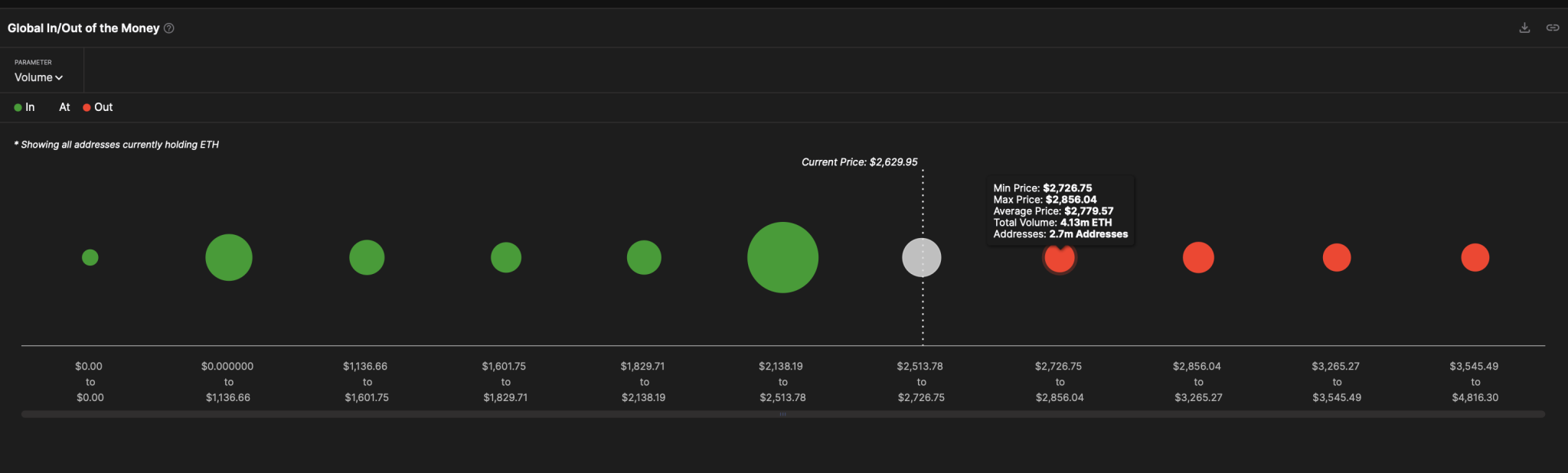
According to IntoTheBlock’s Global In/Out of the Money (GIOM) indicator, Ethereum’s immediate resistance zone lies between $2,726 and $2,856. It contains about 4.13 million ETH held by 2.7 million investors.

Meanwhile, the current out-of-the-money zone holds a significantly larger supply, 12.32 million ETH held by 10.77 million investors, with an average acquisition price of $2,613.

Ethereum’s uptrend will likely continue because the at-the-money zone represents a much larger supply than the immediate resistance zone.

Alphractal CEO Predicts Ethereum Breakout Rally

In a recent tweet, Joao Wedson, CEO of Alphractal, highlighted activity from Ethereum market makers. He shared a three-month aggregated liquidation heatmap, noting significant accumulation at lower levels, suggesting the potential for a major breakout move, depending on the duration of the accumulation phase.

Wedson projects a price target of $2,830 following a breakout above $2,660. He also identified a potential stop-loss level at $2,556.

Ethereum Price Analysis

On the daily chart, Ethereum showed over 1% growth on Wednesday, pushing weekly gains above 3%. However, ETH remains within a consolidation range between the 38.2% Fibonacci level at $2,395 and the 50% level at $2,699.

Ethereum Price Chart

A recent bullish crossover between the 50-day and 100-day EMAs supports a short-term recovery. Additionally, the daily RSI indicates a bullish spike.

According to Fibonacci levels, a breakout above the 50% level could pave the way for a test of the $3,000 mark, aligning with the 61.8% Fibonacci level. Ethereum could target the 78.6% level at $3,436 if recovery extends further.

Bitcoin Utility to Transcend ETFs and Treasuries Toward Mortgages and Bonds: Crypto Founder

0

Andrew Parish, the co-founder of trading platform Arch Public, has predicted the next sector where Bitcoin utility would thrive in the next two years.

The US Bitcoin spot exchange-traded funds launched in 2024, providing alternative exposure for institutional investors who, previously, could not gain direct access to the pioneering cryptocurrency. Notably, demand for the traditional investment vehicles has ensured that the BlackRock product has become one of the most successful ETF launches in history.

Now, Bitcoin treasuries are the latest trend. Michael Saylor’s Strategy was one of the first to adopt the premier asset as a primary reserve asset, and so more firms have started borrowing to buy Bitcoin.

Currently, the strategy has become commonplace, as companies leverage offering Bitcoin exposures to generate capital they wouldn’t have generated to buy the most pristine asset in existence.

Bitcoin’s Utility is Infinite and These Figures Suggest a Growing Appetite for Bitcoin

Meanwhile, a recent episode of The Wolf of Wall Street podcast, featuring host Scott Mlker and Arch Public co-founders Andrew Parish and Tilman Holloway, has shed light on the numerous opportunities that retail and institutional investors can explore with Bitcoin.

Milker highlighted the growing number of crypto treasury firms as companies begin to hold beyond Bitcoin. For perspective, Strategy has continued to expand its Bitcoin holdings, now a whopping 580,250 BTC worth over $60.6 billion. Meanwhile, the number of entities holding BTC has increased to 223 as companies like Twenty One Capital enters the race.

Entities Holding Bitcoin Bitcoin Treasuries
Entities Holding Bitcoin | Bitcoin Treasuries

While these figures suggest a growing appetite for Bitcoin, Holloway insisted that this represents just 20% of the ways institutional players want to gain exposure to the asset. The Arch Public CEO emphasized that there are millions of ways that firms leverage Bitcoin’s utility, with its liquid nature and debt-worthiness a primary lure.

Bitcoin Bond and Mortgage Utility Emerging

Notably, Parish noted that Bitcoin’s next utility would be in the bond and mortgage market. Specifically, he predicted a “mushroom cloud of market” for Bitcoin in association with bonds and self-repaying loans.

For the uninitiated, the Bitcoin bond market operates similarly to the traditional debt market, but with Bitcoin serving as collateral. This allows investors to lend their BTC to issuers and, in return, accrue interest while also enjoying further upsides if the cryptocurrency appreciates before maturity.

On the other hand, a Bitcoin-backed mortgage gives users ownership of a property, with BTC serving as collateral. An interesting feature of these types of loans is that the interest rates are adjusted in relation to Bitcoin’s price, with an uptick in the asset’s price helping to offset payments.

Parish sees this sector as the next big thing, insisting that prominent institutions will shift their focus towards innovation within the next two years. Interestingly, John E. Deaton, a well-known crypto lawyer, agrees with this narrative.

In a tweet, he suggested that BitBonds and Bitcoin-backed mortgages are emerging as a strong niche in the crypto industry. Furthermore, he mentioned that the duo, coupled with the flourishing real-world asset (RWA) tokenization sector, means the next few years would be exciting.

Remarkably, new Bitcoin-based products are being introduced at an increasing rate, as the asset’s growing popularity has spurred the launch of vehicles offering exposure. The options for the BlackRock Bitcoin spot ETFs recently debuted after the US SEC approval.

Senator Lummis Says US Military Supports Bitcoin Reserve Initiative, Predicts Dramatic 10-Year Rally for BTC

0

Senator Cynthia Lummis (R-WY), the chair of the Senate’s Subcommittee on Digital Assets, suggests that the U.S military endorses the creation of a Strategic Bitcoin Reserve (SBR). 

In an interview with Bloomberg, the Senator disclosed this view in response to critics, such as Jamie Dimon. For context, Dimon recently criticized the Bitcoin stockpile initiative, emphasizing that it is a waste of resources. 

In response, Senator Lummis pointed out that the U.S. military disagrees with Dimon’s opinion about the Strategic Bitcoin Reserve initiative. She suggested that the U.S. military believes it is imperative to have a Bitcoin reserve. 

According to her, the military considers Bitcoin a significant tool in the economic war with China. The commentary signals Bitcoin’s potential use as a hedge against economic sanctions or aggression. 

Guns, Bullets, and Bitcoin Needed for National Security 

The pro-Bitcoin Senator noted that, even though the U.S. must prepare for a potential gun and bullet war, it still needs to establish a Bitcoin reserve.  

This suggests that countries will require military readiness and financial resilience, potentially through Bitcoin, to safeguard their interests during economic and armed conflicts. 

“All we need to do is look to the leadership of the current U.S. military to find support for a strategic Bitcoin reserve,” Senator Lummis remarked. 

US Strategic Bitcoin Reserve

As a vocal supporter of a Strategic Bitcoin Reserve, Senator Lummis has proposed a bill to have the U.S. purchase and hold 1 million BTC. While the bill has not seen much progress since its introduction, President Donald Trump ordered the creation of a Bitcoin-only reserve and a digital asset stockpile for altcoins. 

Trump declared that the U.S. would fund the reserves using assets forfeited in civil and criminal actions. However, the country will raise funds through budget-neutral means to grow its Bitcoin holdings. 

Lummis Forecasts 10-Year Bitcoin Rally 

Meanwhile, Senator Lummis issued a bullish forecast for Bitcoin during the interview. The Senator claims she has a model that points toward a dramatic spike in Bitcoin’s price over the next 10 years. 

“This asset has growth potential for the next ten years, which is tremendous,” the Senator added. 

Her reasoning stems from the fact that nearly all Bitcoins, representing 99% of the supply, will be mined within this period. Notably, she expects Bitcoin’s price appreciation to slow down after the next 10 years. 

Everyone Will Be Involved in the Crypto Economy Like Trump

Meanwhile, Lummis commended President Trump for engaging in the digital economy. Trump’s engagement takes the form of regulatory support and the adoption of cryptocurrencies as reserve assets. 

The U.S. President has encouraged Congress to pass sensible and straightforward regulations for the industry, positioning the U.S. as the global crypto capital. Additionally, his family operates various crypto businesses, including a DeFi platform, a stablecoin, and meme coins. 

According to Senator Lummis, everyone will eventually get involved in the digital economy in one way or another. 

Ripple Is Building a Financial System with XRP Ledger, Ripple CTO Confirms

Ripple CTO David Schwartz has affirmed that Ripple developed a financial system around the XRP Ledger (XRPL), XRP, and its recently introduced RLUSD stablecoin.

This revelation came during the recent XRP Las Vegas event. It emerged from an exchange between Schwartz and crypto reporter Vincent Scott, who presented a framework describing Ripple’s ecosystem as a self-contained financial architecture. Schwartz agreed that this framework aligned with Ripple’s direction.

A System Built on Three Pillars

Notably, Scott’s framework centers on three core components: RLUSD functioning as the unit of account, XRP as the medium of exchange or “gas,” and XRPL as the decentralized payment infrastructure.

Schwartz confirmed that these elements could indeed could collectively translate to a financial system. “Yes, you can consider those things a financial system,” he said.

Essentially, Ripple’s infrastructure facilitates cross-border payments and now could deliver broader financial services traditionally offered by banks and fintech institutions.

In follow-up commentary, Schwartz outlined Ripple’s goal of enabling services such as payments, investments, and loans through this evolving infrastructure. Including RLUSD suggests that Ripple is working toward a stable, scalable foundation for everyday transactions and settlement.

Despite the significance of this moment, the news initially flew under the radar. Scott expressed frustration that the acknowledgment hadn’t gained wider attention, as he had initially provided no solid evidence beyond his own account, which led to skepticism about his report.

He made a public appeal for Ripple’s CTO to confirm the interaction, which he eventually did with clarification and support.

XRP Holds a Unique Role, but XRPL Is Broader Than Ever

Amid the discussions, community member Ricky Tan raised a key point. He asked whether the focus is shifting from XRP alone to the broader range of assets on the XRP Ledger.

In response, Ripple’s CTO clarified that XRP holds a special position on XRPL, but the ecosystem itself is expanding rapidly.

Schwartz emphasized that XRPL supports more than just XRP. It includes stablecoins and tokenized real-world assets and will eventually support various types of loans.

Meanwhile, he stressed that XRP holds a unique position within the XRPL ecosystem as the only asset that every account can receive, the only one without a counterparty, and the first asset that pathfinding algorithms consider for liquidity.

Autobridging mechanisms also favor XRP, making trades involving it more likely to be completed. Additionally, it is the sole asset for paying transaction fees.

According to Schwartz, the key question is how much value the XRPL can generate, and how much of that value could translate into XRP’s market value. He noted that this is a difficult thing to quantify. For example, it’s unclear how much of XRP’s current value is directly tied to utility and activity on the XRPL.

Bitcoin Wallets Holding 10–10,000 BTC Aggressively Takeover 79,244 BTC

0

Bitcoin wallets holding between 10 and 10,000 BTC have aggressively accumulated coins over the past week.

This aggressive accumulation continues even as Bitcoin’s price has shown significant fluctuations recently, ranging between $103,000 and $110,000. As of June 4, 2025, Bitcoin trades at $105,366, marking a 3.24% decline over the past week.

Intense Accumulation by Large BTC Holders

According to data from Santiment, wallets holding between 10 and 10,000 BTC have been accumulating Bitcoin at an extraordinary pace. In just one week, these wallets added a total of 79,244 BTC, which equates to an average of 11,321 BTC per day. 

Image

The sharp upward trend in these holdings highlights the growing dominance of these Bitcoin “whales” in the market. As of June 2, their total holdings have surpassed 13.57 million BTC.

This aggressive accumulation is noteworthy because it suggests that large holders are positioning themselves to control a larger share of Bitcoin’s available supply. With significant amounts of Bitcoin withdrawn from exchanges, this could lead to a tightening of supply, potentially putting upward pressure on the price.

Nobody is Selling Bitcoin: Eric Trump

At the 2025 Bitcoin conference, Donald Trump’s son Eric Trump highlighted the rising demand for Bitcoin with a limited supply.

Specifically, he cited growing interest from entities like sovereign wealth funds committing billions of dollars daily. He noted that fewer than 100 companies held Bitcoin a year ago, but that number has surged recently.

Meanwhile, Bitcoin’s supply is dwindling, particularly on over-the-counter platforms and exchanges, where inventory levels are rapidly decreasing. With demand outpacing supply, Eric projected that Bitcoin’s price could soar to between $150,000 and $170,000 by the end of 2026.

Companies Diversifying to Bitcoin Treasury

Additionally, recent reports highlight a growing trend of companies diversifying their cash reserves by purchasing Bitcoin. According to data, 12 companies disclosed acquiring Bitcoin for the first time in May 2025.

Notable buyers included GameStop, which acquired 4,710 BTC, and Zap Solutions, which purchased 1,500 BTC. Other companies such as DDC Enterprise, Roxom Global, and ATAI also made smaller acquisitions.

On this note, Binance founder Changpeng Zhao stated that not taking risks to buy Bitcoin is a risk in itself.

BTC Netflow Data Reflects Strong Whale Activity

Further supporting the accumulation trend, Bitcoin netflow data reveals a sharp increase in the activity of large Bitcoin holders. Over the past seven days, the netflow of large wallets surged by 92.32%.

This suggests that these holders continue moving Bitcoin into their wallets, reinforcing the ongoing accumulation pattern.

Screenshot 2025 06 04T105640899
Bitcoin Large Holders Netflow

However, the 30-day and 90-day netflow figures present a contrasting picture. The 30-day change shows a sharp reversal in netflow, amounting to a decline of 16,945.59% compared to the previous period, likely reflecting a major outflow earlier in the month.

Meanwhile, the 90-day change reflects a 621.02% drop, suggesting that recent accumulation contrasts sharply with lower activity in the prior months.