Home Blog Page 696

Unknown Wallet Moves 2,869,483,918,550 Shiba Inu Worth $36M to Coinbase: Here’s What Really Happened

0

An unmarked whale wallet has recently transferred trillions of Shiba Inu tokens to Coinbase, sparking curiosity among market participants.

Whale tracking platform Whale Alert highlighted this transaction in a tweet on June 4, which saw a whale move Shiba Inu tokens worth millions of dollars to the Coinbase Institution wallet. The shift coincided with a continued decline in Shiba Inu’s price, with the token down 2.34% in the past 24 hours.

Whale Shifts 2.85 trillion SHIB

Notably, the transaction happened on Wednesday at exactly 21:24 (UTC). Specifically, the unknown sending address, “0x2e2c,” transferred 2,869,483,918,550 SHIB, worth approximately $36.6 million at the time, to Coinbase Prime, the institutional investor arm of the leading US exchange.

While the community pondered the transaction, The Crypto Basic carried out detailed research and uncovered that there is more to the transaction. For perspective, the 2.89 trillion SHIB ($36.6 million) shift followed a string of other transactions, and the sending wallet was not necessarily unknown, as Whale Alert reported.

What Really Happened

First, analysis from Arkham identified the sending wallet as Wintermute, a prominent market maker. Furthermore, the transaction did not involve Coinbase Prime alone; it originated from the leading custody provider, BitGo.

For context, a BitGo multisignature wallet, “0x808,” transferred 2.9 trillion SHIB ($37 million) to Wintermute the same day but at an earlier time, specifically at 20:53 (UTC). Interestingly, the movements involved other assets besides SHIB; the BitGo wallet also sent 16,650 ETH ($43.5 million), which also ended up on Coinbase.
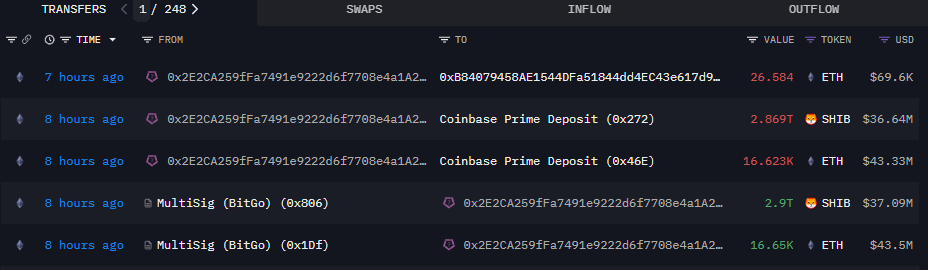
Shiba Inu Shift Involving Wintermute

This flow of funds indicates that Wintermute simply pulled funds from the custody platform BitGo and shifted them to Coinbase Prime. There are several reasons market makers make these kinds of moves, including trading purposes.

When a market maker needs to execute trades or provide liquidity on an exchange, they transfer funds from a secure custody account to the exchange. This shows that Wintermute simply moved the Shiba Inu and Ethereum to Coinbase Institutional, where active trading and market-making occur.

Meanwhile, movements of the Shiba Inu token of this magnitude are not new, and do not typically have significant impacts on price. For instance, The Crypto Basic reported a transaction where a wallet labelled “GnosisSafeProxy” shifted 3.36 trillion SHIB to an unidentified wallet.

A report revealed that Crypto.com transferred a staggering 32.47 trillion SHIB, stunning the crypto community. However, The Crypto Basic later uncovered it was just an internal shuffle to its deposit address.

Shiba Inu trades at $0.00001281 at the time of writing.
Ripple Releases $2.2B in XRP From Escrow for June

0

San Francisco-based fintech giant Ripple has unlocked over $2.2 billion worth of XRP from its escrow accounts.

As part of its regular monthly routine, Ripple released 1 billion XRP tokens from escrow for June 2025. At the time of release, the tokens were valued at approximately $2.21 billion.

Transaction Details 

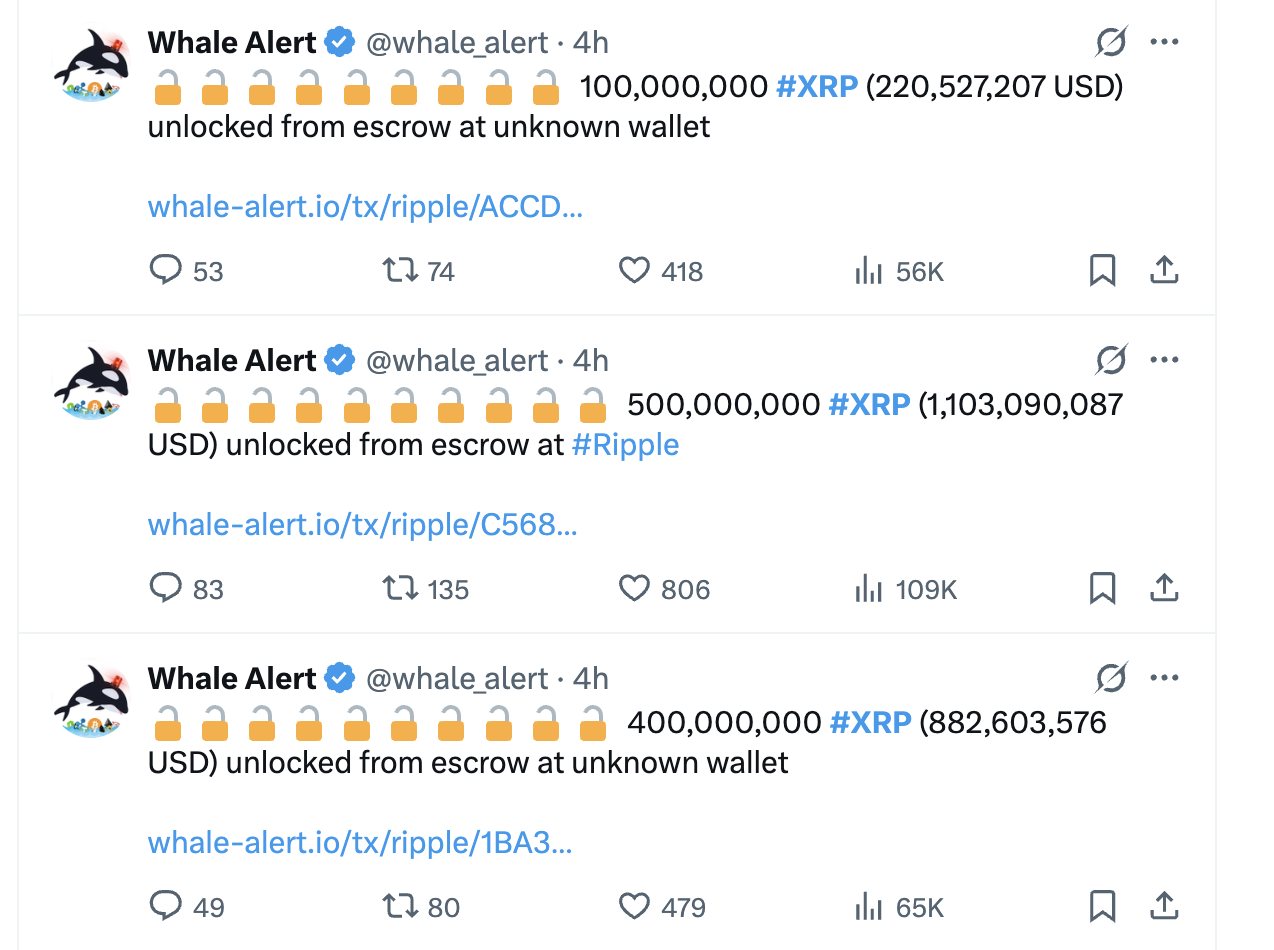
Crypto tracking service Whale Alert flagged Ripple’s latest escrow activity. According to a series of posts on X, Ripple released the 1 billion XRP through three separate transactions.

In the first transaction today at 1:42 (UTC), Ripple released 400 million XRP worth around $882.47 million from escrow into its ‘Ripple 26’ wallet. 

Three minutes later, Ripple unlocked another 500 million XRP ($1.1 billion) from escrow and deposited it into one of its wallets, labeled ‘Ripple 27.’ 

Furthermore, the crypto payments company initiated another XRP release about three minutes after the second transaction. This time, the company unlocked 100 million XRP ($220.42 million) from its escrow account and transferred it into the ‘Ripple 26’ wallet. 

Following the transactions, Ripple 26 and Ripple 27 wallets each hold a balance of 500 million XRP. 

Ripple unlocks XRP from escrow
Ripple unlocks XRP from escrow for June

Ripple Locks 670M XRP in Escrow in June

It is worth noting that the latest escrow transactions come a few days after Ripple locked around 670 million XRP in escrow for this month. 

As previously reported, Ripple locked the tokens, worth approximately $1.46 billion, in two transactions, each containing 470 million XRP and 200 million XRP, respectively. 

Essentially, while Ripple released 1 billion XRP from escrow in June, it locked 670 million coins this month. This indicates that approximately 330 million XRP will be added to the coin’s circulating supply, currently at around 58.76 billion. 

A Routine Exercise 

Notably, Ripple’s escrow releases are a well-established practice. Since 2017, after locking up 55 billion XRP in escrow, the company has been releasing 1 billion XRP on the first day of each month.

Meanwhile, Ripple subsequently updated the practice by returning a sizable amount of the released funds to escrow. This steady release boosts transparency and predictability regarding the coin’s supply. It also alleviates concerns that the company might flood the market with its huge holdings. 

Coinbase Shuffles 54M XRP 

In other news, Whale Alert also reported the large movement of XRP to the Coinbase cryptocurrency exchange. According to Whale Alert, two unknown wallets moved nearly 54 million XRP to Coinbase, triggering concerns about potential selling pressure. 

Notably, Whale Alert reported that the first whale moved roughly 26.95 million XRP to Coinbase yesterday at 04:43 p.m. (UTC). Afterward, the other whale transferred 27.04 million XRP to the same exchange around the same time. 

Although Whale Alert claimed the senders’ identities were unknown, on-chain data shows that Coinbase initiated the transactions, moving the coins from its cold wallets to operational addresses. 

Expert Explains Why It is Important to Hold 5,589 XRP

A prominent XRP community pundit has suggested that investors hold a substantial amount of XRP tokens before the market explodes.

Earlier in May, J4b1, a well-known XRP community voice, projected that the XRP market could explode, and advised investors to hold at least 5,589 tokens before this occurs. He pointed to May 19 as an important date that could mark the start of a major change for XRP. 

His sentiment focused on the launch of XRP futures by the CME Group, a move he said would set the stage for much bigger developments, including the approval of spot XRP ETFs.

Expectedly, on May 19, CME officially launched XRP futures, giving the asset broader exposure to institutional investors. That launch followed similar moves by Bitnomial and Coinbase, but CME’s involvement added serious weight to XRP’s growing credibility. 

According to J4b1, other big cryptocurrencies like Bitcoin, Ethereum, and Solana saw their spot ETFs approved only after their futures markets gained traction. Now that XRP is on a similar path, many investors believe ETF approval could follow soon.

Right now, the SEC has started reviewing an XRP ETF proposal filed by WisdomTree. Several other ETF applications remain on the table, but the agency has pushed back its decisions. 

Despite this, the community remains hopeful. Investors see these delays as part of a familiar pattern. For context, Bitcoin and Ethereum faced the same kind of setbacks before regulators gave them the green light. Many now believe XRP is heading down the same road.

How Much Could 5,589 XRP be Worth?

Notably, J4b1 suggested that holding exactly 5,589 XRP before the market picks up could pay off in a big way. At the current price of $2.20 per token, that amount would cost around $12,295. 

Interestingly, The Crypto Basic previously found that If XRP gains enough attention after ETF approvals and attracts 30% of the money that poured into Bitcoin ETFs, its price could jump to $22. In that case, the 5,589 XRP would be worth $122,958, a gain of more than $110,000.

However, some experts believe the potential is even greater. In April, crypto analyst Cryptominder predicted XRP could climb to $50. If that happens, the 5,589 XRP would grow to a value of $279,450. 

Meanwhile, another analyst, BarriC, believes XRP price could claim higher levels. As a result, he forecasted a price as high as $100. At that level, the same amount of XRP would be worth $558,900, over half a million dollars in profit from the original investment.

Now, XRP futures are trading on the CME, ETF applications are under review, and more institutions are entering the crypto space. As a result, many believe the market looks primed for change. J4b1 expects these events to push XRP into a new growth phase.

RLUSD is the Trojan Horse That Could Break XRP: Pundit

An XRP community member who goes by “Stellar Expert” recently claimed that the Ripple stablecoin, RLUSD, could threaten XRP’s future rather than support it. 

In a thread on X, he suggested that RLUSD might shift Ripple’s focus away from XRP and possibly render the asset unnecessary. However, Ripple leaders have in the past pushed back against this idea, confirming the two assets play different but equally important roles.

Despite the reassurance, Stellar Expert recently argued that RLUSD’s multi-chain design could weaken the XRP Ledger’s position. He pointed out that RLUSD resides on both Ethereum and the XRP Ledger.

Concerns RLUSD Might Thrive Beyond the XRP Ledger

As a result, he questioned whether the stablecoin might end up thriving more on other blockchains like Ethereum or Solana, especially if institutional clients choose these options for their better infrastructure.

He compared this possibility to how USDT started on Bitcoin’s Omni layer but later found a stronger foothold on TRON, which offered lower fees and faster speeds. However, this argument might not hold with XRPL, which is already fast and cost-effective.

According to him, if RLUSD gains traction outside the XRP Ledger, XRP could lose most of its reason to exist. He claimed that RLUSD could handle the same tasks XRP exists for, such as cross-border payments, currency exchange, and settlement. 

Since RLUSD is programmable, stable, and works across chains, he said it could become the core token used by banks and other institutions in Ripple’s network. In his view, this development could leave XRP with little real purpose.

Speaking further, he also warned XRP supporters not to assume that everything Ripple builds will benefit XRP. While Ripple continues to roll out tools and services, he believes the company is now pouring its real efforts into RLUSD. 

According to him, if that stablecoin succeeds without XRP, then XRP may slowly fade into the background, much like how Omni lost relevance when Tether moved on.

Ripple Executives Have Cleared the Air

Nonetheless, Ripple executives had already addressed these concerns. Last October, Ripple President Monica Long clarified that RLUSD and XRP are not in competition. She explained that the company uses both assets for its payment service and that they work side by side depending on what clients require.

Ripple CTO David Schwartz also made similar statements last year. He emphasized that XRP still plays a unique role on the XRP Ledger. Besides serving as a bridge asset in payments, it also supports the network by powering transactions amid other native functionalities.

Schwartz explained that some payment clients prefer XRP for its liquidity and speed, while others may choose a stablecoin depending on the use case or regulatory demands. Either way, Ripple uses both assets actively based on client needs.

In addition, Stellar Expert’s idea that Ethereum offers better performance might not reflect the actual reality. Notably, the XRP Ledger already delivers faster and cheaper transactions than Ethereum. 

While Ethereum remains the hub of decentralized finance, it comes with high gas fees and slower processing times. TRON attracted USDT because of faster and cheaper transactions, something the XRP Ledger already has as an edge over Ethereum.

Right now, RLUSD mainly operates on the XRP Ledger. Because the network uses XRP for transaction fees, any increase in RLUSD activity actually boosts XRP’s utility. More transactions mean more XRP gets burned as part of the fee system, which could help strengthen the asset over time, not weaken it.

Here’s Why Shiba Inu to $0.01 Seems Impossible, Also SHIB to $0.001 Appears Unrealistic

Despite predictions that Shiba Inu could claim a 1-cent price sometime in the future, this dream might be unattainable amid current market conditions.

Since retracing from its October 2021 peak of around $0.00008845, Shiba Inu (SHIB) has continued to be at the mercy of the bears. The asset has failed to recover this price mark amid the ongoing bull run, still trading 85% below the 2021 all-time high.

Calls for Shiba Inu to $0.001 and $0.01

Nonetheless, this discouraging trend has not impacted confidence. Calls of a Shiba Inu running to $0.001 have dominated the scene. Particularly, last September, Krao, a market analyst, suggested SHIB could hit $0.001 within a few months. 

Interestingly, that same month, another analyst, LuckSide, mentioned that all signs point to Shiba Inu reaching $0.001, citing whale activity and bullish on-chain indicators. At the time, SHIB traded for $0.0000138.

While the $0.001 prediction remains elusive, community voices have pushed for even higher price targets, including the 1 cent ($0.01) dream. For one, Shiba Inu marketing lead Lucie insisted in March that SHIB would go to $0.01. However, she admitted it could take some time. 

Shiba Inu Needs Unattainable Rallies to Hit $0.001 and $0.01

Meanwhile, at Shiba Inu’s current price of $0.000012, both the $0.001 and $0.01 targets are not within immediate reach. For context, before the meme coin can claim $0.001, it must increase by 8,233%. Also, to reach $0.01, SHIB would have to surge 83,233% from the current price.

These rallies are nearly unattainable due to the current market context. To put things into perspective, Shiba Inu has not been able to record up to a 1,000% increase since its historic rally ended in October 2021. Even its uptick from this cycle’s floor of $0.0000058 in June 2023 to the peak of $0.000045 in March 2024 only represented a 686% gain.

While this could be due to the bear market that took shape after 2021, it also reflects current market realities. Essentially, even in a bull run, Shiba Inu might not be able to pull off more than a 3,000% increase. 

Nonetheless, this isn’t unique to SHIB but applies to the entire crypto market due to the maturity of most assets in the top 20, especially those that existed in 2021.

For context, despite Bitcoin reaching a new all-time high of $112,000 last month, this only represented a 623% increase from its cycle low of $15,479 in November 2022. Most industry leaders expect BTC’s top to be $250,000 this year, but this would mark a 1,515% increase from the cycle low.

While Shiba Inu is capable of recording something greater due to higher volatility, it might only do double that, potentially leading to a peak price of $0.0001798. While this is below the $0.001 and $0.001 targets, it would still mark some reasonable gains for investors.

SHIB’s Circulating Supply Dilemma 

The second reason why SHIB might not be able to reach $0.001 and $0.01 is its current circulating supply. With over 589 trillion tokens in circulation, a price of $0.001 would yield a $589 billion market cap, higher than even Ethereum’s current valuation. While this is not entirely impossible, it’s highly ambitious.

Meanwhile, a price of $0.01 would place Shiba Inu‘s valuation at $5.89 trillion. This figure is greater than Bitcoin’s current market cap of $2 trillion and the broader crypto market cap of $3.3 trillion. Notably, attaining this feat is rather impossible with the current market conditions.

Essentially, a Shiba Inu run to $0.01 would only become attainable if the broader crypto market expands considerably from the current position. However, this might take over a decade, aligning with Lucie’s comments. Meanwhile, a run to $0.001 may materialize in the next bull run if SHIB gains enough ground in the current cycle.

Expert Says This Development Could Be Huge for XRP

Some influential voices in the XRP community speculate that XRP could benefit from the wild rumor that Ripple is potentially acquiring Circle, the issuer of USDC.

Recently, Circle filed to go public on the New York Stock Exchange via an IPO, offering 24 million Class A shares under the ticker CRCL. News of this development casts doubt on the speculation of a bidding war between Ripple and Coinbase for Circle’s acquisition.

However, Mickle, a prominent figure in the XRP community, argues otherwise. According to him, Circle will not make it to the public market given the offers from entities like Ripple. Notably, initial reports suggest that Ripple offered up to $5 billion to acquire the USDC issuer.

As reported, Circle rejected the bid. Shortly afterward, a detailed announcement about the firm’s IPO became public. Meanwhile, a subsequent report suggested Ripple returned with a revised offer exceeding $10 billion.

Ripple’s Reported Offer “Too Good to Ignore”

According to Mickle, this is a “juicy” deal that Circle’s shareholders may find hard to resist. He claimed the firm seeks to raise $6 billion from the IPO, making Ripple’s $10 billion offer appear to be the more logical route.

He emphasized that Circle might be compelled to pursue an acquisition instead of the IPO path, entertaining bids from both Ripple and Coinbase. However, he believes Ripple would have the upper hand. In his commentary, he suggests the development could be “huge” for XRP.

Still, many disagree with this perspective, calling it baseless speculation with no grounding in reality.

For instance, the founder of the MoneyGCC Project Management Service argued that Circle can turn down any offer. He urged Mickle to consider the personalities on Circle’s board, the company’s long-term strategic interests, and its legal obligations to Coinbase, which could hinder a Ripple acquisition.

Meanwhile, Circle has already dismissed the rumors about its acquisition. It denied any offer to sell itself to Ripple or Coinbase, stating that its focus remains on the IPO.

But How Would Ripple Raise $10B to Acquire Circle?

Commentators in the broader crypto community have raised red flags about the rumored acquisition, particularly regarding Ripple’s liquidity to fund the purchase.

Dave Weisberger questioned how Ripple could liquidate enough XRP tokens to pursue a $10 billion acquisition. He noted that selling billions in XRP could significantly impact market liquidity and the token’s price.

On the other hand, pro-XRP attorney Fred Rispoli suggested Ripple could avoid large XRP sales by using a mix of debt, cash, and equity. Still, Weisberger remains skeptical, arguing that Ripple would ultimately need cash, not just XRP or stock, to close the deal, if at all.

Meanwhile, Ripple CEO Brad Garlinghouse reportedly denied claims that Ripple offered $10 billion to acquire Circle. However, according to the report, he did not deny that acquisition discussions may have taken place.

XRP’s Potential Price Action If the Deal Succeeds

Nonetheless, acquiring Circle would give Ripple control over USDC and its stablecoin, RLUSD. This could expand Ripple Payments and potentially increase XRP’s utility in cross-border settlements.

According to an analysis by The Crypto Basic last month, ChatGPT and Grok predicted the potential impact on XRP’s price if the deal goes through.

In a base-case scenario, XRP could rise to $3.50–$4.50 due to increased demand and ecosystem growth. In a bullish scenario, XRP might surge to $6–$10 (ChatGPT) or $6–$8 (Grok), assuming a smooth integration.

Moscow Exchange Launches Bitcoin Futures Tied to BlackRock ETF

0

The Moscow Exchange has launched trading of Bitcoin futures, marking a significant step in the growing acceptance of cryptocurrency in Russia.

These new products are tied to the performance of the BlackRock Bitcoin ETF (IBIT), which has recently experienced substantial growth.

While this development signals Russia’s continued embrace of crypto, the futures contracts are available only to qualified investors. This reflects the country’s cautious approach to regulating digital assets.

Moscow Exchange Rolls Out Bitcoin Futures

The Moscow Exchange’s futures contracts will be linked to the value of the IBIT. They will be traded in US dollars per lot, with settlements processed in Russian rubles. The futures will be offered quarterly, with the first expiring in September 2025. 

Notably, MOEX step aligns with recent developments in the Russian financial system. The government has made strides to allow more crypto-linked products within a controlled environment. 

The Bank of Russia approved the issuance of derivative instruments and securities tied to the value of crypto for qualified investors in May 2025. However, the central bank remains cautious, advising against direct crypto investments for most financial organizations and their clients.

IBIT’s Positive Ascent 

Russia’s growing interest in crypto comes amid broader shifts in global financial markets. The success of the BlackRock Bitcoin ETF underscores the increasing institutional adoption of crypto-based financial products. 

This move comes just days after IBIT’s impressive rise to become one of the world’s top 25 exchange-traded funds by assets under management (AUM). According to Bloomberg ETF analyst Eric Balchunas, IBIT has accumulated $72.4 billion in AUM.

Despite the success of IBIT, the Bank of Russia maintains caution by limiting such offerings to qualified investors.

Sberbank Expands Bitcoin-Investment Products

Meanwhile, Russia’s largest bank, Sberbank, is planning to launch a new investment product tied to Bitcoin’s price movements. These structured bonds are currently available to a select group of qualified investors via the over-the-counter market. 

Unlike typical crypto investments, the structured bonds provide exposure to Bitcoin without requiring a crypto wallet or dealing with unregulated foreign platforms. Instead, the entire transaction process is conducted in rubles within Russia’s financial and regulatory framework.

John Bollinger Suggests Bitcoin Rally May Be Exhausting

John Bollinger highlights a “Three Pushes to a High” pattern on Bitcoin, signaling the end of its rally phase, with potential exhaustion ahead.

Bitcoin’s price has recently been hovering around $105K, showing a -0.99% drop in the last 24 hours and a 3.39% decline in the past week. Despite this, the price has still managed to stay within a range of $103K to $108K over recent days.

This stability, however, might be short-lived, as several technical indicators suggest that Bitcoin’s current upward momentum is weakening. John Bollinger, the inventor of the Bollinger Bands indicator, has pointed out signs of potential exhaustion, raising questions about the sustainability of Bitcoin’s rally.

Bollinger Bands Suggest Potential Exhaustion

As Bitcoin continues to climb, it has frequently touched or surpassed the Upper Bollinger Band. This repeated action indicates heightened volatility and suggests that the asset might be nearing the limits of its bullish push.

The formation of a “Three Pushes to a High” pattern adds further weight to these concerns. In this pattern, Bitcoin made three successive attempts to break higher, but with each push, the price has achieved smaller gains.

The first push reached $93,777 in late April, the second hit $104,063 in early May, and the third touched an all-time high of $111,800 later in May. The diminishing returns from each successive attempt signal weakening buying pressure and a potential end to the rally.

Momentum is Gradually Declining

Meanwhile, the Relative Strength Index (RSI) also presents additional insight into Bitcoin’s overbought condition. As of June 4, the RSI reached an unusually high level, suggesting that Bitcoin’s price may soon face a correction or a period of consolidation. 

The overbought condition is particularly evident as the RSI surpasses the 0.7 mark, a typical signal of an overstretched market. 

Bitcoin’s momentum also appears to be slowing down. The momentum indicator, represented by a black line on the chart, rises in tandem with Bitcoin’s price but starts to decline after reaching the recent all-time high. John Bollinger mentioned that the “Three Pushes to a High” pattern on Bitcoin’s chart marked the end of the current rally phase. 

Meanwhile, one commenter expressed the view that the current signals indicate a local exhaustion, suggesting that a pullback or consolidation phase is more likely than a full trend reversal. In response, Bollinger agreed, stating that he shares the same perspective. When asked whether Bitcoin was about to hit the lower Bollinger Band, Bollinger replied that he was uncertain and would be looking for the next good setup.

Declining Inflows from Large Holders

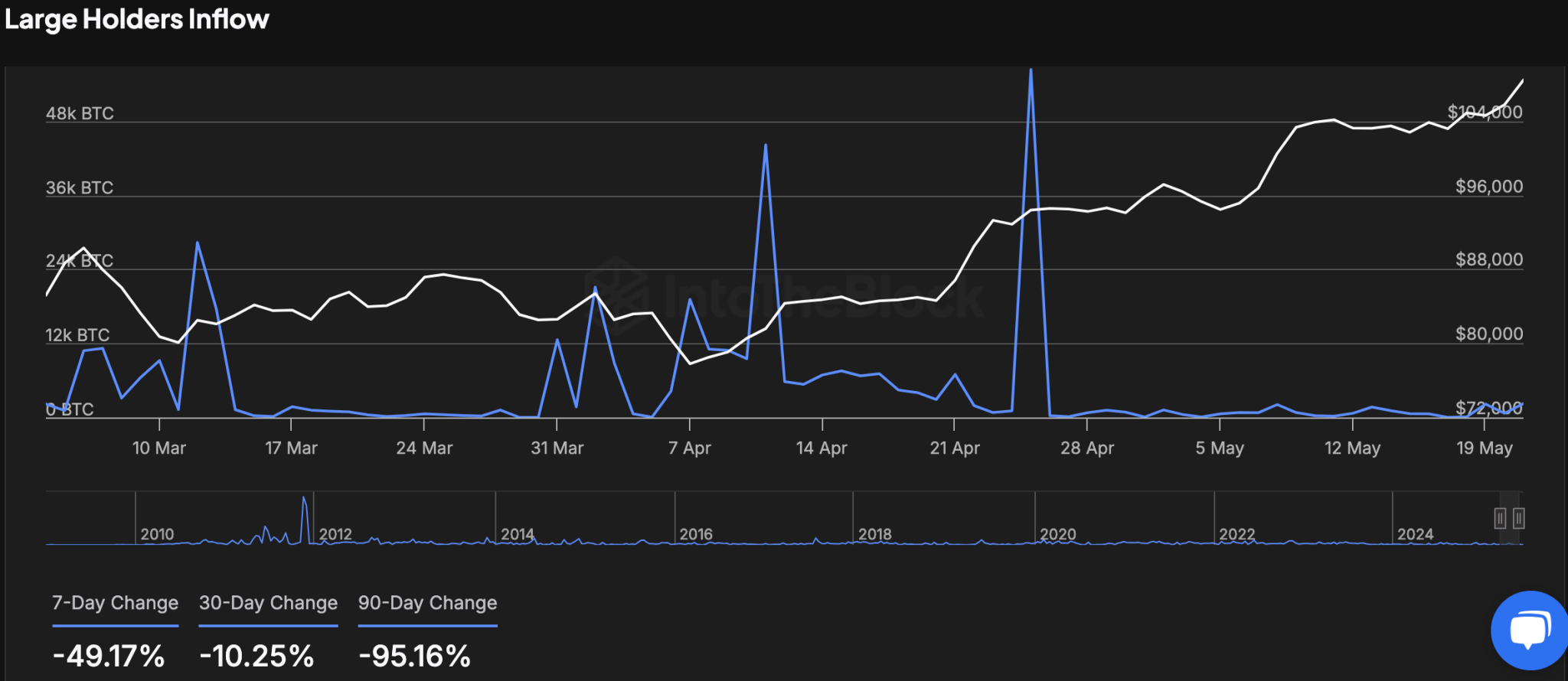
The market has seen a sharp decline in the activity of large Bitcoin holders, further supporting the notion of a slowing rally.

Screenshot 2025 06 04T175951512
Bitcoin Large Holders Inflow

In the last week, the large holders’ inflow dropped by 49.17%. Over the past month, the metric has fallen by 10.25%, and in the last 90 days, it has plunged by a significant 95.16%. This sharp decline in large-holder activity suggests that institutional and high-net-worth investors are pulling back.

Crypto Beast Calls for Altcoin Diversification

Amid the uncertainty surrounding Bitcoin’s price action, seasoned crypto analyst Crypto Beast has advised investors to shift their focus toward altcoins. He pointed out that Bitcoin’s rally, which saw a 121% increase last year and a near 13% rise this year, may be nearing its peak. 

While Bitcoin’s market cap dominance has been trending upwards, Crypto Beast suggests that the real opportunities now lie within the altcoin market. He also noted that Bitcoin dominance is close to its resistance level, suggesting an imminent decline that would likely benefit altcoins.

Messari Highlights Growing Interest in XRP as a Treasury Reserve Asset

0

Messari, a leading provider of crypto market intelligence products, has highlighted three publicly traded companies exploring establishing strategic XRP reserves.

In an X post today, Messari noted that three companies—VivoPower, Wellgistics, and Webus International—are planning to purchase and hold XRP as a treasury reserve asset.

Webus to Set Up $300M XRP Reserve.

Specifically, Webus International filed with the U.S. SEC to raise $300 million through non-equity funding to create a strategic XRP reserve. 

The Nasdaq-listed company would fund the XRP treasury plan using its available cash reserves, institutional-backed credit facilities, and shareholders’ guarantees.  

According to the filing, Webus will develop the strategic XRP reserve in collaboration with Samara Alpha Management. Once established, the company will leverage the reserve to support its global payment solutions. 

VivoPower Reserve Plan 

In addition, Messari noted that Nasdaq-listed VivoPower is earmarking around $121 million to create a strategic XRP reserve. Although the Messari tweet suggests that VivoPower plans to invest around $121 million in XRP, the company’s official announcement referred to this amount as the funds raised in a recent private placement.

Notably, Prince Abdulaziz bin Turki Abdulaziz Al Saud of Saudi Arabia led the private placement. Per the announcement, a significant portion of the $121 million will be used to purchase and hold XRP as a treasury reserve asset. 

This move aligns with VivoPower’s goal to transform itself into the world’s first XRP-focused enterprise. 

Wellgistics Health Secures $50M for XRP Reserve

Further, Messari highlighted Wellgistics Health as the third company exploring the XRP treasury strategy. Recall that the publicly traded health company secured $50 million last month to adopt XRP as a treasury reserve asset. 

Additionally, Wellgistics announced plans to leverage XRP for real-time payments, aiming to eliminate the barriers of traditional payment systems. 

Growing Interest in XRP as a Reserve Asset 

At the moment, there is a growing trend among institutions to adopt XRP as a reserve asset. In addition to VivoPower, Wellgistics, and Webus, other companies are also considering adding XRP to their balance sheets. 

In December, Worksport revealed plans to acquire XRP and Bitcoin as treasury reserve assets using 10% of its operational cash.

Last month, Ault Capital Group (ACG) announced that it will invest $10 million in XRP this year, supporting its expansion into the financial services sector. 

Interestingly, the United States also named XRP among the assets that could be included in its digital asset stockpile. 

Nasdaq-Listed Webus Officially Files with SEC for $300M XRP Reserve

0

Institutions are starting to recognize the upsides of an XRP treasury, with Webus, a Nasdaq-listed firm, joining the growing list of firms looking to hold the asset.

Webus International, an automotive and hospitality company, has filed an update form with the US Securities and Exchange Commission (SEC). It declared in the Form 6-K filing on Tuesday its intention to create an XRP corporate treasury.

A $300M Initial XRP Treasury Strategy

For the uninitiated, foreign firms listed in the American market use the Form 6-K filing to communicate updates to US investors. Webus submitted the form to the US SEC on June 2, disclosing its intention to hold XRP, the fourth-largest cryptocurrency by market capitalization.

To fund the corporate XRP treasury, the Nasdaq-listed company would leverage debt vehicles, a new norm among treasury companies following the success of Michael Saylor’s Strategy (formerly MicroStrategy). Webus had announced on May 29 that it would raise $300 million through non-equity and credit financings to buy and hold XRP.

Meanwhile, Webus’ proposed XRP treasury reserve is in partnership with Samara Alpha Management LLC, a top-tier asset management firm based in New York. The hedge fund seeding platform would manage Webus’ $300 million XRP treasury deal.

Webus to Integrate Ripple Payment

Remarkably, the Chinese automotive company is not only creating an XRP corporate reserve, but it is also integrating Ripple’s payment system for effortless, blockchain-based transactions. Webus would leverage Ripple’s institutional-grade cross-border payment network for frictionless settlement, eroding the slow and costly traditional system.

The XRP Ledger ranks among the fastest blockchains in the crypto space, settling transactions within 3-5 seconds and at a meager fee. Ripple uses the Ledger for its seamless cross-border business, and Webus would now integrate it to increase swift transactions and booking transparency for its hospitality venture.

Institutional Adoption of XRP Treasuries Escalates

As crypto treasuries are becoming increasingly commonplace, XRP is among the digital assets that companies are hoarding in their reserve. As with Bitcoin and Ethereum, firms are also creating reserves for the XRPL native token.

Just last month, VivoPower, another Nasdaq-listed firm, announced the launch of an XRP treasury strategy, claiming it was the first among publicly traded companies to do so. The company also raised $121 million through a private placement led by a Saudi Arabian prince.

Meanwhile, Wellgistics Health also announced in May that it would raise $50 million to buy and adopt XRP as a treasury asset, while also incorporating the asset in its new blockchain-based payment system.